Your ShelfYour Projects

Review and Herald, Vol. 84, No. 12.

Christian Trust
Earlier text: Nearness to God

California

SAN FRANCISCO.—In many respects the past year has been without a parallel. The great earthquake in April last and the devastating fires left over one half of the city in utter ruin, and the number of lives lost will never be known. Property to the value of hundreds of millions of dollars was swept out of existence. Public and private records were almost completely destroyed, and the city was for several weeks on the verge of what might have been the greatest monetary panic this country has ever seen. This was averted only by the declaring of holidays by the governor of the State until confidence and calmness once more took possession of the minds of men. Under these conditions, San Francisco, the once beautiful city by the Golden Gate, after weeks of confusion, for a few weeks clothed herself in sackcloth and turned from the evil of her way. The tremendous spectacle of common misfortune and suffering revealed, for a short time only, the universality of the brotherhood of mankind.
Then came trust manipulation of prices of necessities, labor disturbances resulting in various strikes, in one of which the badly crippled street-car service was again at a complete standstill for eleven days. Attracted by the high wages offered, hundreds of men from all parts of the country flocked to the city, if not for work, to at least by fair means or foul share in the labors of others. Whisky saloons, which for a time had been prohibited, were invariably the first to reopen, and appeared in wooden shacks all through the burned sections, placarded, “Open for Business.” Next, and in order, came an unprecedented reign of violence, drunkenness, robbery, and bloodshed. Rumors of extortion, misappropriation of relief moneys and the public funds by dishonest managers and corrupt city officials and politicians persistently multiplied, until the grand jury took action and returned various indictments against the mayor of the city and many others.
Official indifference, if not actual sanction, of the disregard of private rights, and even of life itself, by the semi-public corporations, has become the order of the day. Saloons, with drunkenness and its attendant vices, with the sanction of the authorities, has invaded many of the hitherto respectable portions of the city which were not destroyed in the April disaster.
Taking advantage of the necessities of the people, many landlords have abnormally increased their rents; trusts created a shortage of coal; and almost all other necessities have been made the pretext for large advances in prices. On the one hand are boundless, ungoverned selfishness and avarice in the endeavor to accumulate money; on the other hand, increasing perplexity and discontent, and a growing feeling of being oppressed beyond the limit of endurance.
In spite, however, of the wickedness and selfishness of men, which can only be adequately expressed by comparing it with what we are told of the cities of Sodom and Gomorrah, and of the adverse circumstances which have surrounded the church in San Francisco, with several saloons and incident evils within but a few doors of the church building, the past year has been in many respects the best in the history of the church here.
The total amount of cash handled in all the various funds of the church, including tithes, exceeded $12,000. After the disaster in April, donations to the amount of $490.16 were received from various churches and individuals to repair the damage sustained by the church building. The total expense of these repairs was $741.25. At the close of the year there was a small credit balance in each fund, the aggregate amount on hand being $505.51. The entire amount, including tithes and offerings, from the members of this church for the year 1906 exceeds $8,000.
The presentation of these reports at the annual meeting of the church on Jan. 2, 1907, was the occasion of much rejoicing, as it shows, in spite of the reduction in numbers because of the removal from the city of many of the members, that the cause of God is prospering, even beyond the most sanguine expectations of those who have been in contact with it. E. E. PARLIN.

An Encouraging Letter

Two members of the Nashville church have been having wonderful success in selling our papers in the cities of the South. Under date of January 1, at Atlanta, Ga., they write:—
“From the time we left Nashville the last of November, up to December 31, or eighteen days’ work, we have sold three thousand papers, lacking forty, and have been in ten cities, so that traveling and locating have taken time also. Last Saturday evening, after the Sabbath, we sold the special Watchman in Montgomery, Ala., ninety-seven in all. We sold at ten cents a copy, to devote the proceeds to the $150,000 fund.
“We expect to be in Atlanta till January 15, as we have fifteen hundred copies ordered for this place. We sold fourteen hundred here last year in seven days. ‘The Lord hath done great things for us; whereof we are glad.’”
With $15.60 in tithe, these sisters enclose five dollars each for the $150,000 fund. There are those who think that by engaging in some worldly business they will be able to give more to the cause of God, but the more prosperity in the world a man has, the less he seems to be able to give.
Is not this the highest kind of business capacity, the bringing of the truth before a large number, the salvation of their souls, and through the proceeds gifts to the cause of God? Are there not many whose hearts prompt them now to go and do likewise, at least to do as far as God gives ability and opportunity? He will do great things, beyond all that we can ask or think, for those who step out upon his promises.
J. S. WASHBURN.

W. JAY TANNER

Hayti

We feel that we have great reason to be thankful for the many blessings we have been permitted to enjoy the past year in Hayti. It has been my privilege to baptize twenty-eight souls during this time. This gives us a net gain of twenty-four for the year. All but two of these were from the Catholic Church. Besides these, there are ten who await baptism. It was our plan to baptize them in December; but stormy weather set in, and made the roads impassable, thus preventing us from traveling.
A week ago I baptized a sister from Santo Domingo. She began keeping the Sabbath over six years ago. During all this time she never had the privilege of seeing an Adventist. As soon as I reached Hayti fifteen months ago, she wrote, asking me to come and baptize her. This I planned to do, but was prevented on account of the recent revolution in that republic. These revolutionary troubles finally made it necessary for her to flee for safety, and as a result, she came to Cape Haytien, where, to her great joy, after six years of waiting, she had the happy privilege of following her Lord in baptism. She will soon return to Santo Domingo, to be a beacon-light for the truth among the people of that as yet unentered country.
The last person to accept the message in Hayti the past year, so far as we know, is a young Wesleyan native pastor, who has been in charge of a church of that denomination not far from here. In the early part of the year this pastor had a report in a religious journal published in Port au Prince, in which he made the remark that “Adventism at the Cape” was “beginning to die out.” Since he wrote that report, several things have combined to lead him to investigate our work and message, with the result that he has determined to keep the Sabbath, be baptized, and have a part in the closing message for these times.

W. JAY TANNER

The Danish-Norwegian Missionary Institute at Minneapolis

At the meeting of the General Conference Committee in Washington last April it was recommended that a Danish-Norwegian missionary institute should be held in some central place as soon as practicable. Later the brethren decided that this meeting should convene in the Scandinavian church at Minneapolis, Minn., Jan. 3-13, 1907.
Chicago has nearly three hundred thousand Scandinavians, Brooklyn about one hundred and fifty thousand. Minneapolis, however, is more centrally located for us, besides having the largest Scandinavian population of any city in America. Thirty-five per cent of its two hundred thousand inhabitants are of that nationality. The Norwegians especially have made Minneapolis the center of their religious and educational interests. The Norwegian United Lutheran Church, the largest body of Lutherans in America, has its school and publishing house in Minneapolis, as has also the large Free Lutheran Church. Our Scandinavian Adventist church in Minneapolis was organized in 1884, and has now a membership of forty-eight. During the institute a series of lectures was given in the church, and the attendance was good.
Aside from quite a number of our brethren from different places, the following workers were in attendance at the institute. Ordained ministers: L. Johnson, H. R. Johnson, J. C. Neilsen, H. Steen, N. C. Bergersen, H. Hansen, N. P. Neilsen, H. C. J. Wollekar, L. H. Christian, M. L. Andreasen, M. S. Reppe, P. A. Hansen, A. G. Christiansen. Licentiates and other workers: Prof. P. E. Berthelsen, of Union College, C. A. Thorp, the editor of our paper, C. Edwardsen, J. H. Schmidt, K. Rasmussen, H. P. Anderson, Carl P. Hansen, H. P. Hansen, P. O. Johnson, Emil Johansen, Ina Grundset, Hansigne Strunge. Of our Swedish brethren Elders J. F. Andersen, John Hoffman, and A. J. Stone were present.
This missionary institute was the first of the kind that has been held in the Danish-Norwegian language.
As it was not a conference session it did not concern itself with conference business. It was wholly an educational and spiritual mission council. The brethren met to study the spiritual need of our Danish-Norwegian churches, the needs of the field, the best methods of work, and most of all, to study the Bible and seek the Lord. In all these studies the Lord was certainly in our midst. The brethren called the institute a “Philadelphia meeting,” because of the harmony and love that ruled in every session from beginning to end.
A careful program for the meeting had been prepared and printed. From this I take some of the topics discussed: Our Youth, The Spiritual Needs of Our Churches, Prayer-meetings, The Sabbath-school, The College View School, Need of Teachers, Church Order, The Importance of Organization, A More Efficient Ministry, The Study of Our Own Language, The Health and Temperance Work, Plainness of Dress, Should Adventists Raise Hogs? Missionary Finance, Tithing, The Spirit of Prophecy, The Sanctity of the Home, Have Divorced Persons a Right to Remarry? and other questions of more local import than some of these.
Aside from the above general statement in regard to the meeting, only a few special points may be mentioned in detail.

The Work Before Us

How large a Danish-Norwegian mission field we have in America may be seen from the table below. Only those States with a large Scandinavian population are given. The total is for the entire country.
Census of 1900
STATES NORWEGIANS DANES SWEDES
California 15,180 27,120 43,646
Colorado 3,447 6,150 32,295
Connecticut 2,118 6,747 48,492
Illinois 89,928 46,938 297,441
Iowa 76,902 51,306 89,625
Kansas 4,431 8,442 45,442
Massachusetts 10,005 7,310 124,476
Michigan 22,746 18,470 80,868
Minnesota 314,675 48,897 346,428
Montana 10,662 3,123 . . . .
Nebraska 8,632 37,593 74,079
New Jersey 6,888 11,697 22,011
New York 35,803 26,248 128,124
North Dakota 90,612 11,859 25,257
Oregon 8,367 4,989 13,665
South Dakota 59,364 15,114 26,041
Texas 4,068 3,267 13,464
Utah 6,384 27,326 21,075
Washington 29,673 10,878 38,211
Wisconsin 184,725 48,513 78,588
Total 1,200,000 450,000 1,800,000
The Scandinavian population of America is increasing very rapidly. There were more than twice as many Scandinavians here in 1900 as there were in 1880. The Scandinavians cling loyally to their own language and nation. Ninety-two per cent of the Swedes, eighty-seven per cent of the Norwegians, and eighty-six per cent of the Danes in America have both parents of the same nationality.
The Danish-Norwegians in America are, like the great majority of people in this money-mad age, intensely materialistic. They come to America, like the majority of emigrants, to make money; and they make it. The Norwegians in America have more money than all the Norwegians in Norway. They are in fact two dollars richer per capita than any other nationality in this country.
Of the four hundred and fifty thousand Danes in America, six per cent belong to some church. Of the one million two hundred thousand Norwegians, thirty-three per cent are members of a church, and nearly all are members of the Lutheran Church with its lifeless forms and ceremonies. Secret societies, lodges, unions, etc., flourish, but of religious revival there is but very little. I do not mean by this statement that the Danes and Norwegians are the most irreligious people. It has, indeed, been said that the Norwegians are the most religious of any Protestant nation. The REVIEW readers know that people everywhere in this time have drifted far away from the truth.

The Work Done — The Workers

Statistics are intensely interesting and very useful. We Danish-Norwegians are, however, so closely connected with our American conferences that it is no easy matter to secure accurate and full statistics of our work. Of this I am certain, the figures given in the table below are not too large.
STATES Church-Members Mission Workers Ordained Ministers Baptized in 1906
Iowa 251 1 1 17
Minnesota 273 3 1 17
Nebraska 163 3 1 18
South Dakota 183 3 2 7
North Dakota 91 . . . . . .
Illinois 167 4 1 17
Maine 16 . . . . . .
New York 66 4 1 31
Washington 70 2 1 14
Oregon 105 1 1 6
California 35 . . . . . .
Wisconsin 190 6 2 17
Michigan 21 . . . . . .
Utah 50 3 2 20
Canada 41 2 2 12
Other 12 5 2 50
Total 1,734 37 17 226
In this table we have counted only those who really are Danish-Norwegian in spirit, those who read our language, take our paper, attend our meetings. If we had reckoned all the Adventists of Danish-Norwegian descent, the figures would have been at least a third larger.
Many of our foreign missionaries are Scandinavians. Not a few Danish-Norwegian brethren labor wholly in the American language. Twenty-one of our best laborers have gone from America to labor in Denmark and Norway. In 1875 there were, according to Elder Matteson’s statement, two hundred Danish-Norwegian Sabbath-keepers in America, which indicates that our number has doubled every ten years.

Finances

It is not possible at this time to give a detailed statement of the money given by the Danish-Norwegians to the cause. There is but one State in which our workers receive more in wages than our Danish-Norwegian brethren pay in tithe. In most of the States our brethren bring at least twice as much tithe as our workers are paid. This is by no means written in a complaining spirit. Far from it. We are indeed glad that this is true, especially so now when so much tithe goes to the South and to the foreign work. I know of no State where the American brethren do not treat our workers liberally and right.
We have no institutions of our own to finance, consequently we have no debt. We have raised some money for educational and missionary purposes, and have gotten what was needed. It was voted at the institute to raise a fund out of which we could assist needy students — this to be done after counsel with the State conferences.

The Circulation of Our Literature

Of Danish-Norwegian books the following have been sold in America: “Great Controversy,” 20,000 copies; “Thoughts on Daniel and the Revelation,” 10,000; “Patriarchs and Prophets,” 5,000; “Prophecies of Jesus,” 5,000; “Object Lessons,” 5,000; thousands of “Bible Readings,” “Life of Christ,” “Steps to Christ,” “Christ our Saviour,” “Sunshine at Home,” and a number of smaller books, pamphlets, and tracts. During the last six months of 1906 we increased the subscription list of our Danish paper by six hundred and thirty-three new yearly subscribers over and above the loss of old subscribers. It was planned at the meeting to continue this work the coming year. Our paper has three thousand subscribers. Last year it was self-supporting.
In 1875 we had in our language twenty-three tracts and pamphlets, and no large books. At the present time we have fifteen large books, eighteen pamphlets, and sixty-five tracts. Our greatest need now is not to get more literature, but to distribute what we have on hand. However, we also need more books and tracts. We need more of the “Testimonies” in our language. We can never expect to get all the “Testimonies” in the Danish. But we need more selections from them. It must be our constant aim to get as good a collection of books and tracts as possible. Last fall Elder Conradi’s book on the “Revelation” was printed in the Danish-Norwegian. This is a very valuable addition to our literature, as it is adapted to the Danish manner of thinking. It ought to have a large sale as a subscription book among our people in America.

Schools and Teachers

In 1888 Elder J. G. Matteson held two short Bible schools, one at Minneapolis, the other in Chicago. In 1890 the Danish department of Union College was opened. More laborers have been educated there for our work than in all the other schools we have had. At the present time there are thirty-one students in that department, which is more than there have been for some years. It was planned to make a strong effort to induce a greater number of students to attend the school.

A More Efficient Ministry

We spent much time at the institute in considering the studies and the work of a minister, as for instance: Prayer, How and What to Study, Preparations of Sermons, City Advertising, The Order of a Series of Lectures, Visiting the Sick and those Interested, Work for Our Churches, Distributing Literature. Daily progress in these matters is needed if we are to raise the standard of the ministry.
One year ago a Danish-Norwegian reading circle was started for our work- workers. In this we read four good, well-written Danish-Norwegian books on missions, history, science, or theology each year. These books are ordered in Norway and Denmark so as to get the best language possible.
Another definite plan to assist the younger ministers in obtaining the necessary preparation is set forth in the following resolution adopted at this institute:—
“Whereas, the Lord has said that ministers ought to have as thorough an education as possible, and that licentiates should be carefully examined in reference to their literary qualifications before they are ordained to the high calling of the ministry; therefore,— “1. Resolved, That we recommend our young ministers to read the following books, before their ordination, the same to be arranged in a three years’ course by Brethren C. A. Thorp and L. H. Christian: The Bible by course, once a year for three years; the first five volumes of the ‘Testimonies,’ ‘Early Writings’ (Danish), ‘Great Controversy’ (Danish), ‘Patriarchs and Prophets’ (Danish), Andrew’s ‘History of the Sabbath,’ ‘Education,’ a good Danish ancient and medieval history, a good Danish church history. “2. We recommend further, that they be asked to pass an examination in the following studies: Danish-Norwegian grammar and rhetoric, arithmetic, geography, bookkeeping, physiology, history of missions. “3. We recommend that the superintendent of the Danish-Norwegian work in America and one other ordained minister shall assist these licentiates in their studies and examine them before they are ordained. “4. We recommend that our conferences as far as practicable counsel with an experienced Danish minister and the superintendent before ordaining any Danish-Norwegian minister.”
Aside from the above-named books and studies the young ministers are expected to read the four books each year in the reading circle, they are asked to read all our small tracts at least once, and some of them are asked to take up the study of Greek.

The Tract and Missionary Work

The most discouraging feature of our cause and the most difficult problem before us is the missionary work in our churches. Many of our church missionary societies are practically dead. Last fall only three of our thirty-three churches took a club of our papers for missionary purposes. At the present time twelve take a club. Only a few churches do any systematic tract work or hold regular missionary meetings. We have sold from eighteen to forty-five thousand copies of our annual special number. But that is at best rather a spasmodic missionary effort. We need something more permanent all through the year.
This is a question that demands very careful study. Many of our Danish-Norwegian brethren are willing to work, if they can get hold of a workable plan. There is need of a living, active organization. How to get this is the difficult problem. The International Publishing Association has appointed Hansigne Strunge, of College View, Neb., as Danish-Norwegian corresponding secretary. This will help us. We will also publish tabulated quarterly reports of the missionary work done by churches and individuals. I believe that if our American brethren will help us in the matter of organization and reporting, we can before long get an active missionary work started in our churches.

Memorial to Our American Brethren

It was voted to publish in Danish-Norwegian quite a full report of this missionary institute. In this pamphlet there is to be some special instruction on Church Order, Duties of Church Officers, a brief statement of what Adventists believe, with some facts and statistics from the last Year-Book.
On the last day of the institute a memorial to our American brethren was unanimously adopted. We were desirous of having it clearly understood that we Danish-Norwegians wish no separate conference, and we assure our American brethren of our faith in, and loyalty to, the great message of truth as well as to the splendid local and general church and mission organization given us by God. We ask our American brethren to remember us in their prayers and to help us in the work of bringing the saving word of God to our country people.
L. H. CHRISTIAN.

Montana

Since reporting to the Review, I have visited Townsend and Helena, and made a tour through Bitter Root Valley. At Townsend there is a small company that has not been organized into a church. This is one of the more active companies in the State. They hold their regular meetings, and are doing all in their power to spread the knowledge of the truth. It was my privilege to celebrate the ordinances with them. It was the first time many of them had ever taken part in this service, and the Lord came very near by his Holy Spirit. The meeting was a great encouragement to those present.
Sabbath, January 12, I spent at Helena. The church here is small, but a few souls are doing something to hold up this light. We celebrated the ordinances at Helena also. This is the capital of the State, and ever since coming to Montana I have felt a burden to work there.
There is an excellent opening for medical work both in Helena and Butte. A large number of people have gone from these cities to Battle Creek and other sanitariums, and there is considerable demand for that line of treatments. The writer would like to correspond with some consecrated physicians and nurses relative to opening work in these places. Elder Gosmer and his wife are now located in Helena.
In the Bitter Root Valley I visited Stevensville and Hamilton, spending a Sabbath at each place. The Bitter Root country is the strongest part of the Montana Conference, both numerically and financially. It is a very rich valley. Most fruits flourish here abundantly. Mount Ellis Academy has been well attended the past year. We now employ four teachers, and have an enrolment of about sixty.
Last year was a good year for Montana. The tithe increased about one thousand dollars, and there was a general increase of offerings. At the close of the year, the wages of all the workers were raised, and still there was money on hand to pay them. This is a very expensive field to operate, as the distances are great, and living is high. It is an excellent place for a wage-earner, as wages are high. All our workers are of good courage, and feel to press on to victory. W. F. MARTIN.

Two New Outstations in Africa

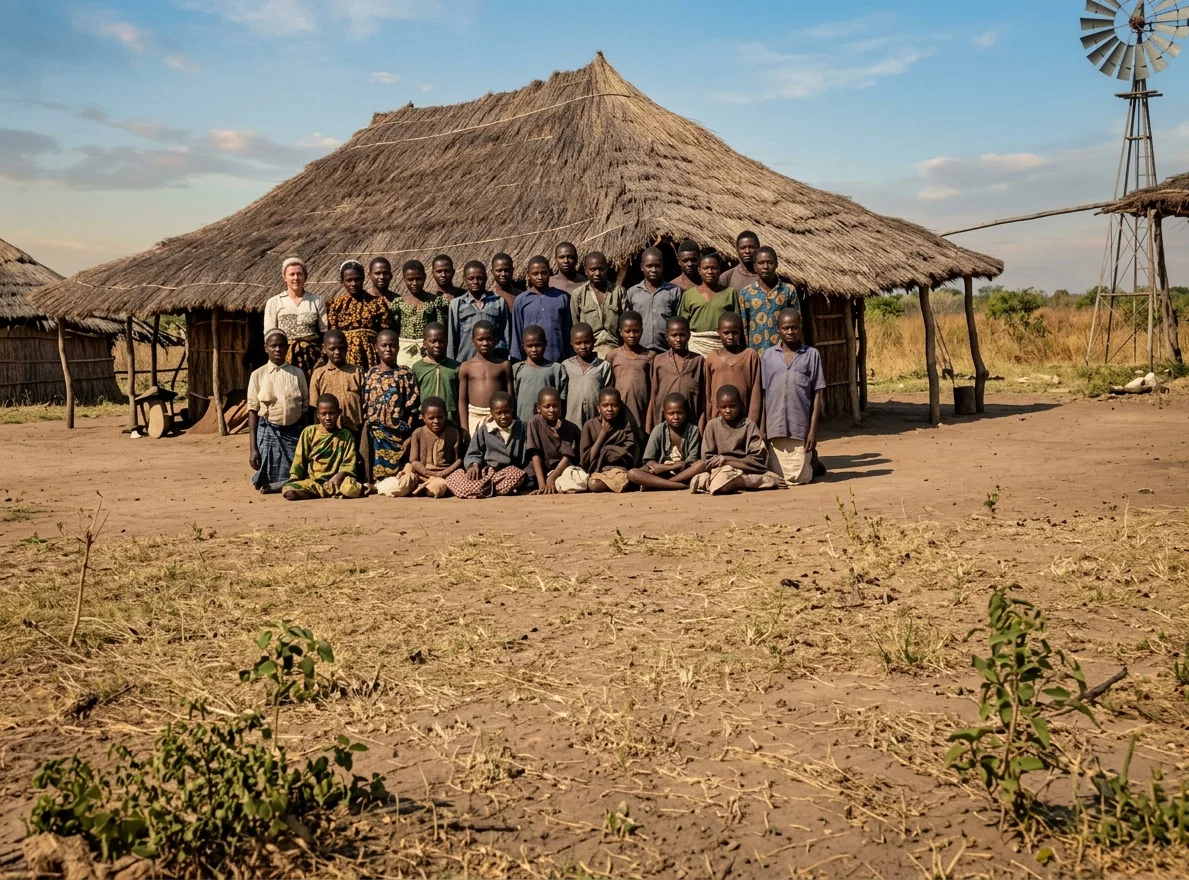
SCHOOL AT KALOMO MISSION, RHODESIA, BEYOND THE ZAMBESI
I HAVE just returned from a visit to our new outstation, and find that Jim, the teacher in charge, has his huts finished, and is now ready for aggressive work among the people in that place.
He reports that he would not ask for more faithful help than the three boys that I sent him. I had the privilege of seeing the native commissioner of the district where he is located, and he gave his hearty approval of our work there. The boys seem to have impressed him favorably, and he is doing what he can to assist us. I have received only the greatest of favors and kindnesses from all the officials here.
I now have the full written approval of the government for our farm site here. As soon as the land is surveyed we shall be able to get the title. As we are within the limits of the option of the railroad land, I have also obtained their written approval of the location. This makes it as secure as I know how to make it until the survey is made, which will be next year.
In harmony with a request from the natives, I have now opened a school about three miles to the north of here (Kalomo). Detja and Mwemba are in charge. They live here and go there and teach in the afternoon.
They report an attendance of twelve. This is the result of the short stay here in the school of a girl from that kraal. She came here to get a divorce from the man she had been sold to. When he gave back the lobola she went home.
But during her stay she became interested in the school, and has now interested others with the above results.
The opposition from the Jesuit fathers still continues very bitter. They have succeeded in bringing in some discontent; still some of the boys from near them entered the school last month. Surely God will give the victory to his truth.
We had a visit from Monze, the head chief of the Batongas, this month, and he expressed great surprise at what we had accomplished since we came here. He was especially impressed with our farming operations, and also the growing fruit-trees.
The head Mashukulumbweinduna from Jim's district was so impressed with the farm that he has promised to send two of his young men and ten oxen here to be trained to farm. We require the use of the oxen one year for training them, and we shall have the boys in school at least that length of time.
If the natives on the Kafui flats ever take to farming like the Makalangas have, they will be able to supply all the Johannesburg mines with grain. Their land is a heavy black loam like the corn belt of Illinois and Iowa. You see that the way is open for branching out.
I am thinking of asking for a man to help at the station here so that I shall be free next year to go north of the Kafui River and also to devote some time to exploring this country and opening outstations. I have secured a reversal of the decree that no alien natives shall be stationed on outstations away from a white man, for this district at least, and I am planning to open up the work here the next dry season.
Our school work continues about the same, and the interest is good.
Some left us this month, as they had completed their year, but their places were filled by new ones, so the attendance continues about the same. Five of our old boys have agreed to remain another year in the school. These are the best boys we had, and we are glad that they are remaining with us. I hope that others will agree to remain as the time comes for them to decide the matter.
I am going to Kalomo to-morrow to see about buying some cows and to attend to some other business.
The fruit-trees are still looking well, and the paw paws are setting on fruit. I am sending an order to Pickstone for oranges, lemons, and grape-fruit. They are to be sent on the first of next month so that I can get them in the ground before I go to conference.
Naomi has some fever to-day, and Mrs. Anderson had fever while I was at Jim's place.
Pray for us and the work here. There is much to do, and what are we among the many? Your brother in Christ.
W. H. ANDERSON.
Seventh-day Adventist Mission Farm, Kalomo, N. W. R., Nov. 13, 1906.
Continue reading: Canvassers’ Summary for January, 1907