The Youth’s Instructor, Vol. 33, No. 43.

A RAILWAY LESSON
Earlier text: A RAILWAY LESSON

SHOWERS OF DEAD BIRDS.

A CLEVELAND correspondent to a New York paper wrote, a few days since:—
“Every telegraph messenger boy that entered the newspaper offices last night had his pockets full of crippled or dead birds. Night policemen coming in at luncheon time had scores of them, and reported that they were continually dropping about the bases of the five electric light masts. Early risers this morning found the ground about the electric-light masts covered with dead birds.
“A similar phenomenon was observed about a year ago. A local naturalist, who works for the Smithsonian Institution, said: ‘The birds of which so many were killed were mainly warblers. I picked up over twenty species. The death rate was much less than one night a year ago. The warblers have a certain date for migrating southward, and from carefully kept records I can always tell within a day or two when to expect them. They come from various latitudes, but all seem to come together, as it were, at a certain rendezvous, to make their southern tour together. Some of the birds found dead here this morning were from so far north that their breeding ground is not definitely known. When migrating, they fly during the night, and rest and eat through the day. Under favorable conditions they fly quite a distance above the city, but last evening the air was light, and they flew low. This condition and the cloudy sky bewildered them, and the powerful electric lights attracted them. As they neared the tall masts, they were blinded by the light, and flew against the wires and masts with such force that they were killed by the concussion. It is a popular fallacy that they were killed by a shock of electricity from the wires.’
“Birds follow a certain route in migrating, and this city seems to be in the line of a great deal of bird travel. A close observer can, on a quiet night at this time of the year, hear for hours the chirp of myriads of birds winging their way southward. The warblers that are now migrating (principally pigeons and some species of ducks), make about thirty miles an hour. The birds seemed bewildered in nearly all sections last night. A locomotive entering the Union depot from the west, had a layer of dead birds on the pilot; and the engineers of south-bound trains were annoyed by birds flying apparently toward the head-lights, and striking continually against the cabs.”

BITS OF INFORMATION.

THE ends of gold pens are hardened by soldering on them small pieces of iridium—a very hard white metal resembling polished steel, found in connection with the ores of platinum, which occur chiefly in the alluvial districts of Mexico, Brazil, and the Ural Mountains. It is generally combined with osmium in the native alloy called iridosmine or osmiridium. It is a rare metal, being valued at $1000 per avoirdupois pound.
THE use of coined money cannot be traced further back than the ninth century B. C. Money, however, as a medium of exchange, existed much earlier, and when of metal, it passed by weight, no piece being adjusted to any precise weight, and all money being weighed when exchanged. Early metallic money was in the form of bars, spikes, and rings. That in the latter shape could be opened, closed, and linked in a chain for convenience in carrying. The Lydians are supposed to have been the first people who used coined money, and their example was soon after followed by the different states of Greece.
THE Phoenician alphabet is the oldest of which we have any record, and from it has originated directly or indirectly, all the modes of writing now in use throughout the world. It is the foundation of the Greek, the Latin, and the Arabic alphabets. Taking both ancient and modern times into account, as many as four hundred alphabets have been enumerated; but of those now in use, if slight variations of form are set aside, this number does not exceed fifty.—Golden Days.

Erratum in Lesson 9, Question 13

ERRATUM.—In lesson 9, question 13, the reference of Dan. 8:25 should also have been given.

Little Things: Learning Order in Everyday Life

LITTLE THINGS.—NO. 4.
I am now going to tell you about one of the most important things you ought to learn,—a thing which you will probably never learn at all unless you learn it while you are young. I mean that you should learn to have order about everything you do. Have a time for everything, and do it at that time. Have a place for everything, and keep it in its place.
If you do not do this, if you do things in a hap-hazard, disorderly manner, you will never be able to do a great amount of work in this world. You will always be in trouble because you cannot find things. How often I have heard children, when they lost things, call: “Mother, where is my hat? Jane, have you seen my hat? I can’t find my hat!” Then, perhaps the little boy sits down and cries; the rest are all at school, and he can’t go because he has lost his hat. Did you ever see children that were troubled in this way?
When the time comes for school, Mary can’t find her slate, she has lost her pencil, or she has forgotten where her atlas is. Mother and sister have to stop to find her lost things, and she goes off in a pet, because she is late to school. All this trouble comes from the bad habit Mary has fallen into of being disorderly.
When you take off your hat, always have a nail to hang it on, and put it there every time. Don’t fling it on to the lounge or chair. It does not take but a few seconds to hang it up, and then you will know where to find it. Put your playthings in their proper places. Always lay your books on the same shelf. An orderly boy has great advantage over a disorderly one, because he can gain time, and thus do things better.
I hope each boy and girl has a room of his own. I would like to get a peep into some of these rooms. They ought to be kept as neat as your mother’s parlor. The girls should take especial pains in this matter. Any one dislikes a disorderly, dirty house; and the little girl who keeps her room all cluttered up, will keep her house that way if ever she has one to keep. The boy who leaves his wagon out in the rain, his hammer under the tree, his jackknife in the barn, and his hat under the lounge, will never know where to find anything. When he gets to work for himself, he will always be in trouble, for no one will want to hire him.
It takes less time, children, to put things where they belong, than it does to hunt them up when you don’t know just where they are.
We judge people not only by their orderly habits, but we judge them by their dress. If their clothes are soiled and ragged, and their hair unkempt, we say right off that they do not amount to much. However poor we are, however old and cheap our clothes may be, we can always keep them neat and clean. It is not necessary to get your clothes all dirt whenever you work or play. Be careful with your clothes; they cost money and hard work, as you will find out when you have to earn them yourselves. If you do not learn to be careful of them now, I am afraid you will not do so when you are older. D. M. CARRIGHT.

A GREAT TEMPTATION.

Examination-day was close at hand in the boy’s school at Winston; and among the scholars of the higher grade the excitement ran high. At the beginning of the term they had been told that a reward would be given to the pupil who had the best record in deportment and studies during the term, and who passed the best examination at its close. The reward was a complete set of text books for the coming year, and was offered by a wealthy gentleman in the village.
The whole class of eight boys began their work with zeal; but before the term was half over, it could easily be seen that the prize would go to either Henry Howard or Robert Watson. It was a matter of no surprise to teachers or pupils that Robert Watson should put forth every effort, as he was a poor orphan, living with his aunt, a woman in moderate circumstances. The books would be a great help to him; perhaps without such help he could not go to school another year, and it was well known that Robert was trying to fit himself for a teacher. The boys often called him “school-ma’am” to tease him.
With Henry it was different. He learned much easier than Robert; but he was also very idle. He was often reproved for this fault, but he always replied that his father was rich, and that he would not have to earn his living, so it didn’t make any difference. All were surprised to see Henry Howard try for the prize. He had never been known to stick to anything before. It was soon whispered around, however, that a rich uncle of his had promised him a handsome gold watch if he would win the prize. It was this, then, rather than the books, that made the usually idle boy so diligent.
It was the last week of the term; a few more days would decide the winner of the prize. Henry and Robert stood equal in everything but arithmetic. The hardest examples Henry solved and explained with ease, while Robert spent hours of hard study upon them.
The day before the examination the problems were very hard, as the teacher had selected them for tests. Robert had finished all but one, and that one had taken all his spare time, and still he could not work it. Recess came. Henry had evidently completed his task; for with the other boys he laid aside his books, and was soon heartily engaged in a game of ball; but Robert felt the time was too precious for play, and only shook his head when the teacher stopped at his desk and told him to try a race in the open air.
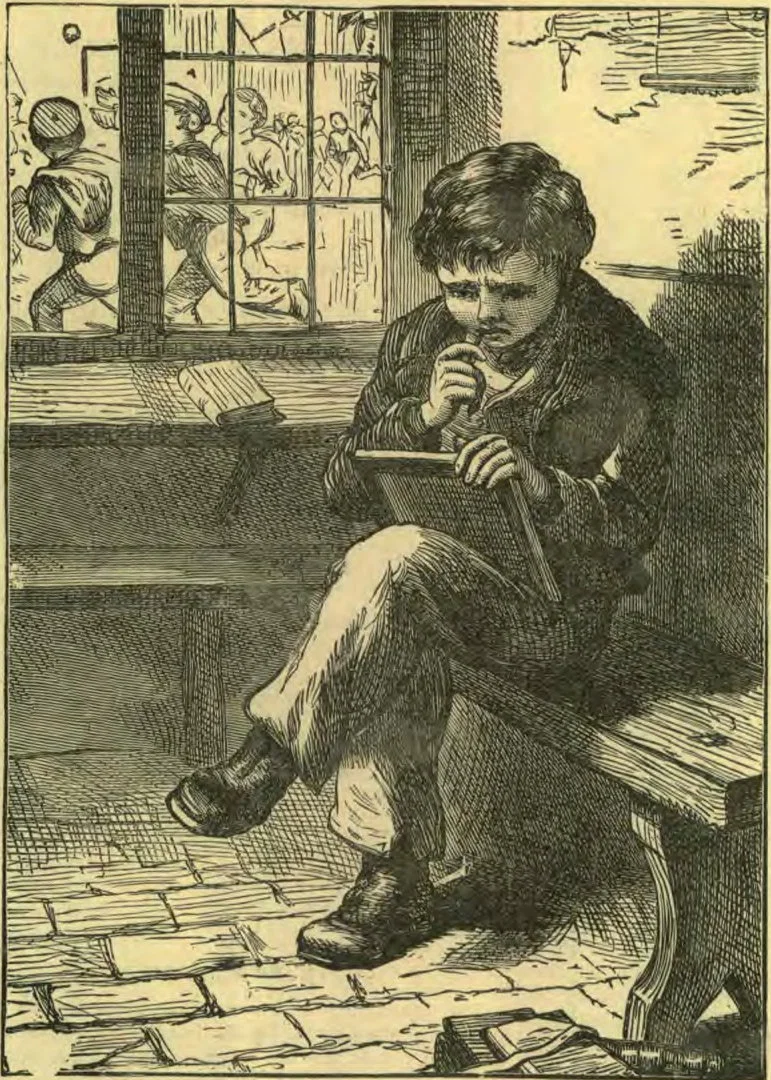
Left to himself, he tried to study all the harder. Soon the tears came rolling down his cheeks. Do what he would, they still came, until small rivers trickled over the sums on his slate, nearly washing them out.
“Must I give it up,” he thought, “and lose my only chance at school? Oh, I cannot!”
He turned to the window and looked out at the clear, blue sky, and then again at his slate; when his eyes fell on a book that lay on the desk close beside him. His heart almost stopped beating, and the waves of color came and went in his face. The book he saw was a key to the arithmetic. Within its lids was the answer for which he vainly sought. One glance, that was all. Should he do it, was the question. He did not question whether it was right or wrong; his conscience told him that, besides they had been told to seek no outside help. The conflict was a hard one, but he won the battle, and decided what to do. The teacher had probably laid it there when he stopped to speak to him, and had forgotten it. It was his, he was sure; for he had seen such a book many times on his desk.
Picking up the tempting book, he walked resolutely to the teacher, who stood looking out at the door. “Here is your key, Mr. Lewis. You left it lying on the desk. I didn’t look at it, sir,” he added as he saw the surprised look on his teacher’s face.
“But you were afraid you might?” asked Mr. Lewis.
“Yes, sir,” answered Robert simply, and took his seat. Mr. Lewis rang the bell, and placed the book in his desk; but as he did so, he started. His own book lay in its usual place; this book was not his. “I wondered that I could be so careless,” he said to himself, as he quickly turned to the fly-leaf. There, written in a bold hand, was a name,— Arthur Howard, Henry’s elder brother. This, then, was the secret of Henry’s perfect lessons. He had taken his brother’s key, and from it had found the answers to all his problems, the term through. Mr. Lewis said nothing until the arithmetic class had recited, and was waiting to be dismissed. Robert had failed in the hardest problem, and was almost in tears; Henry had solved it successfully. At last Mr. Lewis held up the tell-tale book, and asked whose it was. Robert started and flushed when he first saw it, but Henry did even more; he turned pale, and trembled violently, while Robert and the rest looked on in wonder. Mr. Lewis then quietly told the boys about the matter, and said that under the circumstances Henry could not have the prize. He then dismissed all but Henry, with whom he had a long talk.
We will not follow Henry in his disgrace, nor Robert, who, of course, being next in rank, took the prize; but we will say that overcoming this temptation which looked so small at first, but which held in store such good results for him, helped him to withstand greater ones in after years; for it taught him that it is always best in the end to do right.
S. ISADORE MINER.

Letter Budget.

TOMIE THOMPSON writes from Collin Co., Texas. He says: “Inclosed you will find seventy-five cents, for which you will please send me the paper one year and the premium entitled ‘Golden Grains,’—ten little books, if they still go with it as a premium. I have never taken the paper, but I have read it some, and I like it very well. I like to read the Budget very much. I have been picking cotton a part of the time this fall, and earned some money, and I thought I could not spend it for anything better than the YOUTH’S INSTRUCTOR. If I live, I shall be fourteen next November. There are five in our family, and we all try to keep the Sabbath. Pray for us, that we may be saved when Jesus comes.”
We trust Tomie’s investment will prove satisfactory, and that he will become a permanent subscriber. “Golden Grains” is still used as a premium.
LIZZIE JOHNSON writes a few lines from Marion Co., Iowa. She says: “I am a little girl eleven years old. I go to Sabbath-school every Sabbath, and learn my lessons in Book No. 2. I like my teacher very much. I am trying to be a good girl, so I can meet the INSTRUCTOR family in the new earth. I give my love to you all.”
We hope Lizzie has given her heart to the dear Saviour, and loves and trusts him so confidently that she is trying to make all her ways please him.
AMY DARLING writes from San Diego Co., Cal. She says: “I noticed in a late INSTRUCTOR that the letter box was getting empty, so I thought I would write a letter. I wrote once before, about two years ago. Papa is building a very large flooring mill in another town. He says it will be done this fall. When it is finished, we expect to go to that place to live. We have a very nice Sabbath-school here, which we shall miss in our new home, as there are but few Sabbath-keepers there. But as soon as we can after we reach the place, we will start a Sabbath-school, and try to get others to attend, and keep the Sabbath with us. We are getting ready for camp-meeting in Santa Ana. My brother and cousin are in Healdsburg College. It has been very warm here, but is cooler now. I will be thirteen next November. I hope to see this, from your little friend, printed.”
It was encouraging to read in Amy’s letter that in their new home they should open a Sabbath-school, and get others interested in it. A blessing usually attends the cheerful worker; and we can but expect that prosperity will crown their efforts to establish a school.

THE FLIGHT OF THE BIRDS.

O WISE little birds, how do you know The way to go, Southward and northward, to and fro,
Through the azure depths of the trackless air, Everywhere, Hither and thither, here and there?
What hand doth the fluttering pinion guide, In wind and tide, Safe to the nest on the other side?
Far up in the ether piped they: “We but obey One who calleth us far away.
“He calleth and calleth, year by year, Now there, now here, Even He maketh the way appear.”
Dear little birds, He calleth me, Who calleth ye; Would that I might as trusting be!
—Selected.

You have reached the end of this edition.

The Youth’s Instructor · Nov 11, 1885