The Youth’s Instructor, Vol. 47, No. 51.

CLIMBING MT. RAINIER
Earlier text: CLIMBING MT. RAINIER

THE PURPOSE OF FRUITS AND SEEDS

I
Some may think winter an inopportune time of year in which to begin the study of botany. It is true that plants have now ceased to grow in northern latitudes, and that flowers are scarce; but the majority of plants live through the winter, and there is therefore no month, no day, even, in the year when we may not pursue the study of plant life with profit.
Some of these days when you are outdoors, look about you to see if there are any seeds germinating. If you dig in the warm soil, and observe carefully, you will learn something that even some college-bred persons do not know; namely, that there is no day of the growing season in which some seeds, delayed for one reason or another, are not trying to sprout. The germination of seeds is closely associated with the spring; indeed, the season is so called because of the excessive growth springing from the earth at this time; and the seeds that then spring into life demonstrate the advantage of an early start, because those that germinate in the spring are the ones that become so conspicuous, later on, as almost to obscure those that are more tardy in making a beginning in life. Still, these later ones are only delayed; they do not cease trying, and at the first favorable opportunity they lift up their green heads, only to be nipped by frost, or to be crowded out by their more lusty companions.
September is the season of fruits. What is the purpose of fruits? I fear many readers of the INSTRUCTOR have thought that fruit fills its purpose when it becomes an article of food. There is such a purpose, but it is not the only purpose, and, indeed, it is not the final one. A certain teacher is supposed to ask his school this question about the use of fruits.
Teacher.—“Now, children,” addressing himself to the youngest, “I am going to ask you only one question to-day about this ear of corn. If you can answer it, I shall be very glad. If the little boys and girls on the front seat can not give the answer, I will let those in the next seat try; and so on till all have tried, unless our time should expire before the right answer is given. I shall not be surprised if none of you give the answer I am thinking of. As soon as I ask the question, those who are under seven years old, and think they can give an answer, may raise the hand. What is this ear of corn for?”
Several of the children raise their hands, and the teacher points to one after another in order, and they rise and give their answers.
Mary.—“It is to feed the geese with.”
John.—“Yes, and the hens and the pigs.”
Sarah.—“My father gives corn to the cows.”
By this time the hands of the youngest pupils are all down; for having been taken somewhat by surprise, their knowledge is exhausted. So the teacher says that those between seven and ten years of age may raise their hands. Several instantly appear. The teacher again indicates, by pointing, those who may give the answer.
Charles.—“My father gives corn to the horses when the oats are all gone.”
Daniel.—“We give it to the oxen and cows, and we fat the hogs on corn.”
Laura.—“It is good to eat. We shell it from the cobs, and send it to the mill, where it is ground into meal. Mother makes bread of the meal, and we eat it.”
Laura has looked a little further into domestic economy than those who answered before her; but the allotted time is nearly gone, though several hands are up, their owners’ faces beaming with eagerness to tell their thoughts. Let the teacher then say: “We will have no more answers to-day. You may think of this matter till to-morrow, and then I will let you try again. I am sorry to tell you that none of you have mentioned the use I was thinking of, though I confess I was expecting it every minute. I shall not be surprised if no one gives this answer to-morrow. I will now put the ear of corn in my desk, and no one must speak to me about it till to-morrow. You may now resume your studies.”
The children now breathe more freely, while the older ones take up their books, and the next class is called. In order to succeed, it is necessary that the teacher shall positively refuse to hold any conversation with the children on the subject till the time for the next “general exercise.”
During the remainder of the forenoon, the teacher will be likely to observe some signs of thoughtfulness on the part of those little children who have hitherto been habitually dull. And perhaps some child, eager to impart a new discovery, will seek an opportunity to make it known during the forenoon. “Wait till to-morrow,” should be the teacher’s reply. L. A. REED.
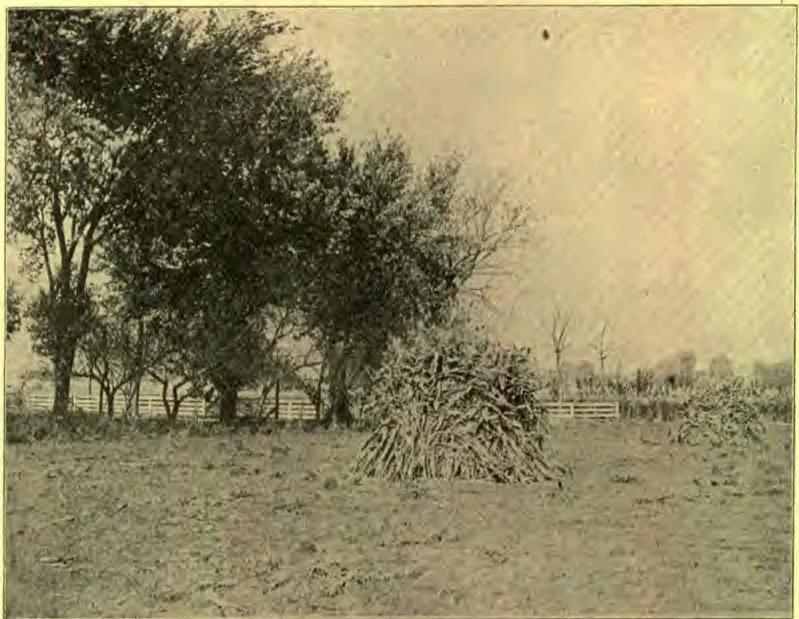
CORN IN THE SHOCK.
CORN IN THE SHOCK.

WHAT BERNICE LEARNED ABOUT THE TWELVE APOSTLES

II

THE next week was a busy one for at least one member of the family. It seemed to Bernice that there had never been so many steps for the active little feet, never so many errands to remember, and never so many or so hard lessons to be learned in school; and more than once she was tempted to give up, in sheer discouragement, her self-appointed task of learning something about the apostles. But Bernice had early learned a certain little motto, which it would be a first-rate plan for each boy and girl who reads the INSTRUCTOR to learn and remember: “Where there’s a will, there’s a way.” And so she had denied herself the hour or two, daily, which she usually spent among her dolls and picture-books, with a result that was both gratifying and encouraging.
“Well, Aunt Emma, I rather think we are all ready to begin,” smiled grandma, glancing at Bernice, who sat by grandpa’s side, with her Bible before her, leaning her head on her plump little hand in such a way as to shade her eyes from the bright glare of the lamp.
“Yes, I think we are ready. Bernice, can you tell us what you have learned this week?”
“I studied about Peter, Aunt Emma, because I like to read about him better than any of the others. I think the Bible tells more about his disposition than it does of the others.”
“What did you learn about his peculiarities, dear? Did you find that he was a very good man?” asked grandpa.
“I think he could not have been good, grandpa, when he told that wicked lie, and declared that he didn’t know Jesus at all,—that he wasn’t even acquainted with him.”
“True,” added grandma, sadly; “and if he had been really converted, I believe he would not have been ready to curse and swear in anger, because the maid insisted that she had seen him with Christ.”
“Well, I don’t like Peter for that,” said Bernice, decidedly. “And really I think he didn’t do right a number of other times.”
“How about the time he took his sword, and cut off the man’s ear in the garden?” asked grandpa.
“I don’t remember much about that; but if he did such a thing, it was surely wrong.”
“But suppose he did it in defense of his Master?” asked grandpa.
“I don’t believe, the Lord wanted him to cut a man’s ear off anyway; for he said once that we ought to do to other people just as we would like to have them do to us.”
“A very good answer, my child,” smiled grandma. “But can’t some one mention anything good that Peter did?”
“I think,” said grandpa, “that after he was truly converted, he did many good deeds. Probably he began to be converted on the night of his denial of Christ, when he went out and ‘wept bitterly,’ for sorrow for sin is certainly among the first steps toward genuine conversion.”
“Nero didn’t like Peter very well, grandpa,” said Bernice, “because he preached against the wicked things he did.”
“Can you mention any of these things that Peter denounced, thereby offending Nero?” asked Aunt Emma.
“Why, Nero had a number of wives, and of course neither Peter nor Paul thought this was right. That made the wicked king real angry, and he was all the more so because one of these women believed the apostles’ preaching, and became a Christian.”
“Very good, Bernice; I will tell you another thing that made Nero especially dislike Peter. The wicked emperor was quite infatuated by Simon Magus, the great sorcerer; and because Peter defeated this vile and corrupt man, Nero determined to be revenged.”
“I did not learn that part, Aunt Emma, though I’m glad to know about it; but I can tell what Nero did to Peter: he ordered him to be crucified. He and Paul died on the same day, but Paul was not crucified, because he was a Roman: he was beheaded. And just think,” added Bernice, with a shudder, “Peter was nailed to his cross with his head hanging down. He said he would rather die that way, because he felt that he wasn’t good enough to deserve to die just like the Lord. Paul and Peter both died on the twenty-ninth of June. His friends buried Peter in Rome, after they had put something on his body to preserve it a long time.”
“You have done so well, Bernice,” smiled Aunt Emma, “that I feel quite ashamed of the little I have learned this week. I found that Andrew also perished on the cross, but it was shaped differently from the one on which Peter died, being made in the form of the letter X. Anything made in that form is still called ‘St. Andrew’s cross.’”
“Was he nailed to it, Aunt Emma, as the Lord and Peter were?”
“No; he was tied to it; and so he lived two whole days in great agony.”
“O how dreadful!” exclaimed Bernice. “If I had been there, I would have begged them to take him down.”
“The people did plead for his life, but it was of no avail; for the cruel Ægenas, who was the proconsul of Achaia, was determined that St. Andrew should die the death of a martyr. But the two days he hung upon the cross were spent in preaching faithfully to the people, who flocked to hear him.”
MRS. L. D. AVERY-STUTTLE.

NATURE'S BASEBALL CLUB

How many of you have seen a club-gourd? I saw a family of them this fall. The best specimen was about four feet in length, and almost exactly the size and shape of a baseball club. But I imagine that had a stout boy hit a “high ball” with this bat of nature’s own making, the result would have been disastrous to the bat. As to the utility of the club-gourd, I can not see that it has any, though to any one interested in the queer pranks of nature, it is certainly a curiosity. In color the gourds are of a greenish cast. Hanging downward from a vine that has been trained over a lattice or porch, they present a formidable appearance. One would not imagine they were closely related to the happy-faced, golden pumpkins, but such is the case.
MRS. MARY E. WHEATON.

True Goodness Shines Unseen

“TRUE goodness is like the glowworm in that it shines most when no eyes except those of heaven are upon it.”

“Dickey Downy.”

By Virginia Sharpe Patterson.
This little volume is charmingly written, its object being to teach the children to love and protect the birds. That it is interesting, the following selected chapter headings will abundantly show:—
The Orchard.
Dickey Downy’s Meditations.
Dickey’s Cousins. A Winter in the South.
The Prison. The Hunters.
Polly’s Farewell.
The book is bound in cloth, and contains 192 pages, with four beautiful colored plates. Price, post-paid, 60 cents.
We offer this book, post-paid, or three new yearly subscriptions to the YOUTH’S INSTRUCTOR, at 75 cents each, or with the INSTRUCTOR one year for only $1.15.

“Beautiful Joe.”

An Autobiography By Marshall Saunders.
Beautiful Joe is a real dog, and “Beautiful Joe” is his real name. He belonged during the first part of his life to a cruel master, who mutilated him in the manner described in the story. He was rescued from him, and is now living in a happy home, with pleasant surroundings, and enjoys a wide local celebrity.—Author’s Preface.
This story awakens the interest of the reader in the first chapter, and sustains it to the end. It must make an impression for good, and in the interests of kindness and gentleness, upon all who read it.
The book is well bound in cloth, with gilt side-stamp; 304 pages; illustrated. Price, 75 cents. Bound in paper, 50 cents.
It will be sent, post-paid, for four new yearly subscriptions to the YOUTH’S INSTRUCTOR, at 75 cents each; or with the INSTRUCTOR one year for only $1.25. In paper covers, with the INSTRUCTOR one year, for $1.00.

(January 6, 1900)

SABBATH-SCHOOL LESSON—NO. 1

(January 6, 1900)

THE PASSOVER FEAST AND THE ORDINANCE OF HUMILITY

Memory Verses.—John 13:13–15.
Time: A. D. 31. Place: Jerusalem. Persons: Jesus, disciples.

QUESTIONS

1. The Passover having been prepared, what did Jesus and his disciples do? Matt. 26:20; Mark 14:17; Luke 22:14. With what thoughts did Jesus begin the celebration of this Passover feast? John 13:1.
2. What spirit had now taken possession of Judas Iscariot? V. 2. Though Jesus knew that he would soon be betrayed, by what knowledge was he strengthened for the closing struggle? V. 3; note 1.
3. Just before eating, what humble position did Jesus assume? What lowly work did he begin? Vs. 4, 5; note 2. With what words did Peter express his surprise at Jesus’ act? V. 6; note 3. What response was made by Jesus? V. 7.
4. What decisive reply did Peter then give? What equally positive word came from Jesus? V. 8; note 4. In what way did Peter then fully submit himself to the will of Christ? V. 9. What assurance did he receive? V. 10.
5. In addition to the statement that “he that is washed . . . is clean every whit,” what did Jesus say concerning the twelve? V. 10, last part. Why did he thus speak? V. 11. Having washed the feet of all, what question did Jesus ask them? V. 12.
6. To make plain his question, what instruction relative to their duty did he then give? Vs. 13–17. To show that what he said did not apply to all, what did Jesus then add? V. 18.
7. What purpose had he in speaking so plainly? V. 19. With what important truth did Jesus close the lesson? V. 20.

NOTES

1. No man can endure the power of temptation who does not possess the knowledge that he is of God, and that God gives him all things with which to meet the enemy. And it is equally true that he who, like Jesus, is acquainted with the power of fellowship with God, may always have perfect calmness and trust, even in the very shadow of a cruel death. The knowledge that they were of God, and were accepted by him, enabled the martyrs to go to the stake with rejoicing. Would you understand this? Only believe.
2. Both the act and the time of the act may profitably be given a word of special mention. Instead of the expression, “And supper being ended” (John 13:3), Young’s translation has, “And supper being come;” while Wilson renders it, “As supper was preparing.” The twelve, with Jesus, had seated themselves at the table, and the supper had come upon the table. At this point there was a spirit of strife among the disciples (see Luke 22:24) as to who should be the greatest, each trying to exalt himself in the eyes of the rest, and seeking for the best position. Therefore, before beginning to eat of the Passover feast, Jesus arose, and taking the place of a servant, he washed his disciples’ feet, that, having been taught real humility, they might truly and rightly partake with him of the Passover.
3. Another cause of dissension had arisen [among the twelve]. At a feast it was customary for a servant to wash the feet of the guests; and on this occasion, preparation had been made for the service. The pitcher, the basin, and the towel were there, in readiness for the feet-washing; but no servant was present, and it was the disciples’ part to perform it. But each of the disciples . . . determined not to act the part of a servant. Jesus waited for a time to see what they would do. Then he, the divine Teacher, rose from the table. Laying aside the outer garment, that would have impeded his movements, he took a towel, and girded himself. . . . “After that he poureth water into a basin, and began to wash the disciples’ feet.” When Peter’s turn came, he exclaimed, with astonishment, “Lord, dost thou wash my feet?” Christ’s condescension broke his heart. He was filled with shame to think that one of the disciples was not performing this service.—The Desire of Ages, pages 644, 645.
4. The service that Peter refused was the type of a higher cleansing. Christ had come to wash the heart from the stain of sin. In refusing to allow Christ to wash his feet, Peter was refusing the higher cleansing included in the lower. He was really rejecting his Lord. The truest humility is to receive with thankful heart any provision made in our behalf, and with earnestness do service for Christ.—Id., page 646.

HOW THE TWINS SOLD PLUMS

Eli and Eben, the twins, had a plum-tree. Grandpa and the man Joshua sprayed it in the spring when they sprayed the other trees, and grandpa helped thin the fruit. But the boys had to get up early two or three mornings a week all summer to jar the tree for curculio; they kept the grass and weeds away from it, they watered it and put salt and ashes about it, and in the fall they had a fine crop of plums to sell.
Eli could climb better than Eben, so he gathered the plums, while Eben held the stepladder under the tree.
Grandpa went through the shed while they were sorting the plums and putting them in little baskets.
“Don’t sell anything but plums, boys,” he said, pleasantly. “I’ve known folks to sell more than they meant to. A man up Caxton way took some pears down to the store one day to sell. They looked nice, and Mr. Brown bought them, but he had to throw away most all those in the bottom of the basket. That man can’t sell anything more to Mr. Brown. He sold the truth along with his pears.”
Grandpa went off to the barn, and the twins looked at each other.
“Let’s look the plums over again,” said Eli; “I don’t know about that basket over there.”
“I’m afraid there’s one in here that isn’t nice, too,” said Eben, soberly, picking up another basket. “We’ll sell good ones, or we won’t sell any.”
Eli nodded. “That’s so.”
They did sell good ones; for Mrs. Fitch, the minister’s wife, told grandma a week later that she hoped the twins would raise plums every year she lived in Demster; for she never bought such plums before.
“I’m glad they didn’t sell truth and honor when they meant to sell only plums,” said grandma.—Young People’s Weekly.

ANY OTHER WAY

“A TELEGRAM for Miss Archer.” Every head in the schoolroom was lifted in quick surprise and expectation. Florence Archer left her desk, and went forward, with changing color, to receive the yellow envelope whose seal so often covers fateful messages.
The message was clear and concise, but entirely inexplicable.
“Take the 9 P. M. express on P. & B. Meet me at Fluvanna Junction, 8 A. M. to-morrow, Thursday.”
The rest of the day was spent in hurried preparation. Many of Miss Archer’s friends opposed her going; even Miss Hall, the principal, seemed doubtful.
“Surely, my dear, your father did not know the difficulties in the way, or he never would have made such a plan for you. Does he know that you will have to drive twelve miles after dark to meet this nine-o’clock express?”
“Certainly he does, Miss Hall. Father is perfectly familiar with all these routes,” answered Florence, who continued her preparations amid the protests of her friends.
“Please, girls,” she cried at last, in desperation, “don’t mention the subject again. My father is the wisest man I know; he is the kindest man I know; if there had been any other way better than this, he would have chosen that way. I am sure that he has made the best plan that could be made for me under the circumstances. Now you must help me, and not hinder.”
This decided stand silenced Florence’s troublesome advisers; it silenced her own doubts and anxieties for the time.
At last she was ready for the first stage of her journey. It was very cold and dark when she started for her drive. Part of the way the road was a narrow pass round the base of a cliff on the right, with a deep gorge on the left. Florence got out again and again, and walked over the most dangerous places, while the driver led his horses.
“How could my father give me such a journey?” she thought; and again she settled it with the loving answer of faith: “If there had been any other way that was better, father would have taken that way.”
Altogether, it was a most uncomfortable and tiresome journey; and it was not until the lazy winter sun of another day had got up, that Florence reached Fluvanna Junction.
Then from her father’s strong, loving arms she was set down in a “vestibule limited,” and the first face to greet her there was her dear mother’s.
When the three were comfortably seated, the father said: “Now, little daughter, I am prepared to answer questions without stint; but first let me ask one: What did you say when you read the telegram?”
“Of course, I was surprised, father,” said Florence.
“Of course.”
“Of course I was perplexed.”
“No doubt.”
“I did wonder a little why you hadn’t told me more about it.”
“Very naturally.”
“Then,”—Florence’s sweet face was as bright as the new day,—“then I just said to them all, ‘My father has done the best he could; if there had been any better way for him to do, he would have done that way!’”
Her fond father gave her a bear’s hug; then Florence heard the story:—
Her mother, whose health was delicate, had been ordered to Florida, and had agreed to go only on the condition that Florence should go with her. But the very day the decision was reached, word came from the weather bureau that a big storm, and a big drop in temperature, were traveling in from the West.
“We had to outrun that storm, you see, Florence, for the mother’s sake; and the only way to get you in our possession was to give you that disagreeable night journey,” said her father.
“Was it disagreeable?” asked Florence, lying back in delicious repose; “I had forgotten it. I would take a dozen such journeys, gladly, to go on such a lark with you and mother.”
“I might have explained the situation, but there was no time for a letter,” continued her father, “and even a long and costly telegram would have left you uneasy, for you would have feared that I was keeping back something.”
“I am sure I should.”
“So, my child, I deliberately chose for you the physical discomfort and the mental perplexity.”
“Your way was the very best possible, father,” said the happy daughter.
Florence accepted thankfully and joyously her happy winter. But as the years went on, trials and difficulties and doubts met her, as they meet every human being. She could not always see why they were sent; but always there rose before her that night’s journey, with its hidden meaning, and its happy end.
“Shall I not trust my Heavenly Father, too?” Florence would ask herself. “Do I not know that if there was any other way through life better for me than this, my Father would choose that way for me?”
Then faith would whisper: “When you see your Heavenly Father’s face, you will say to him, too, ‘Thy way was the very best possible way.’”—Well-Spring.

Subscription Renewal Notice for January 1900

JANUARY, 1900

If the yellow address-label on first page of this paper, or on the wrapper, bears this month and year (John Brown 4-1-90), it indicates that the following blank should be filled out by you now, and mailed to Review and Herald, Battle Creek, Mich., before the end of this month:—
Name, ............................................................
Post-office, ....................................................
Street, ............................................................
County, ..........................................................
State, .............................................................
Enclosed find $........ (money-order, express order, registered letter, or bank draft), for which please send...... copies of the YOUTH'S INSTRUCTOR ...... months to above address.
P. S.—If you object to clipping this out of your paper, or wish to forward other subscriptions, please write names and full addresses on a separate sheet, stating amount enclosed for that purpose.

To Reach BATTLE CREEK

FROM
CHICAGO, BUFFALO, DETROIT, OR TOLEDO.
Purchase Tickets Reading over the MICHIGAN CENTRAL
“The Niagara Falls Route.”
A First-class Line for First-class Travel between Chicago and New York and Boston. Elegantly equipped through trains pass Battle Creek in each direction daily.
R. N. R. WHEELER, Ticket Agent, Battle Creek.
O. W. RUGGLES, Gen’l P. and T. Agt., Chicago, Ill.

TAKE THE Canadian Pacific Railway

For . . . CHATHAM, OTTAWA, MONTREAL, LONDON, GALT, QUEBEC, WOODSTOCK, TORONTO, BOSTON, PORTLAND, and
All points in New England, the Maritime Provinces, Great Britain, and the Continent.
Illustrated literature, time-tables, and full particulars, upon application to—
J. FRANCIS LEE, GEN. AGENT,
Passenger Dept. 228 SOUTH CLARK ST., CHICAGO
Branch Offices: 76 Ottawa St., Grand Rapids, Mich. Room D, Chamber of Commerce, Cincinnati, Ohio. 315 Chestnut St., St. Louis, Mo.
Continue reading: Cincinnati Northern Railroad Co