It is a somewhat novel experience to stand on the highest point in the United States,—the very topmost peak of our country,—and look down upon great mountain ranges that lie so far beneath that they appear like great rolling plains.
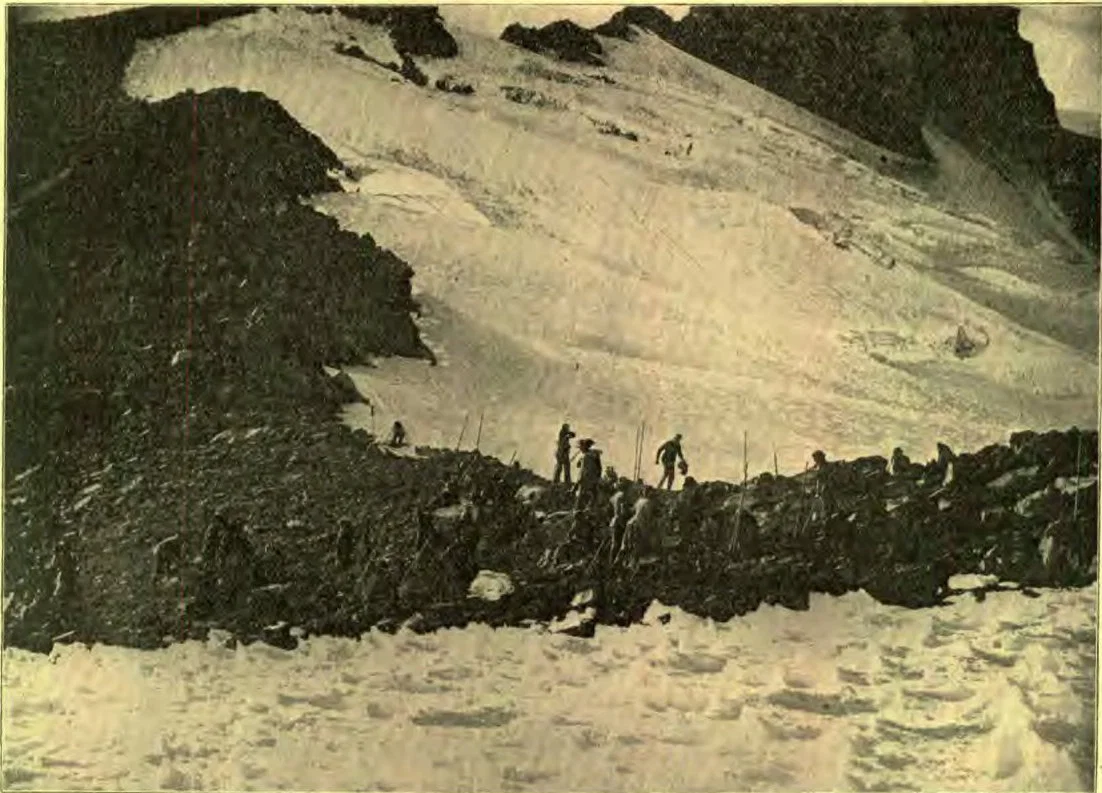
MAKING GRAVEL BEDS AT CAMP MUIR.
Hundreds of persons have undertaken the ascent of Mt. Rainier simply for the sake of this novelty, and have struggled up the mountain's rugged sides, buoyed up by the hope that they might afterward boast of having “been to the top.” Many of these have given up the ascent before it was half finished. Others have persevered to the end; and after a few minutes' rest on the warm rocks at the rim of the crater, have begun to drag their weary bodies down the inhospitable sides of the mountain, vowing never again to attempt so foolhardy a trip. Not many who have attempted to ascend Mt. Rainier without previous experience in mountain climbing, have carried to the summit sufficient strength and enthusiasm to appreciate and enjoy the grandeur of their surroundings.
But whether or not the would-be mountaineers are successful, they find themselves imbued, when the fatigue of the journey has worn away, with a love for the mountains that nothing can take away. With many, mountain climbing becomes a mania, which can be satisfied only by two or three tedious ascents each year. The writer can never look at a snow-capped mountain peak without feeling a homesick longing that can not be described, but must be felt to be understood.
The ascent of Mt. Rainier is fraught with difficulty and danger, even to the most hardy climbers. To one not endowed with sound heart and lungs, strong muscles, and steady nerves, it is practically impossible. And yet, with all the danger, there has been but one fatal, and few serious, accidents among the scores who have ascended, and the hundreds who have attempted to ascend, the grim old King of the Cascades.
A few years ago it was the good fortune of the writer to be one of a party of sixty-six who attempted the ascent, and one of the fifty-nine who accomplished it. That was an unusually large party; and the success that attended the effort was a surprise to all who understood the difficulties that must be overcome.
About nine o'clock the party left their comfortable camp in Paradise Park, and began their long tramp over the smooth ice-fields to the head of the Cowlitz glacier. It was a motley crowd that slowly followed the trail of the pack-horses that morning. We all wondered that our appearance did not provoke a smile from the frowning countenance of grim old King Rainier. A few of the party wore veils; but veils were troublesome, and not in general favor. Some had covered their faces with red or pink grease-paint, such as actors use. The less fastidious were content to besmear their countenances with vaseline and burned cork. The object of this decoration was to prevent sunburn; but whether or not it accomplishes this result, in even a small degree, is disputed. “In the interest of science,” one young woman blackened half her face, and left the other half unprotected. But the sun was hot; and that glittering mass of ice reflected its glare like the burning sands of a desert. In wiping the perspiration from her face, she tried to use a different hand for each side, but sometimes she forgot. In a short time both sides looked alike, and science was not benefited by the experiment.
About four o'clock we reached the head of the Cowlitz glacier, and began to prepare our camp. Of course we had no tents. In fact, we considered ourselves fortunate to get our blankets. It is no easy matter for pack-horses to reach that place, and quite impossible for them to go farther.
Near the head of the glacier is a pile of rocks embedded in sand and gravel. By displacing some of these rocks, most of the party were able to make fairly comfortable “gravel beds,” on which to spread their blankets. While they were thus engaged, a bitterly cold wind sprang up, and drove nearly the entire company to bed before sunset. But the wind went down with the sun, and many left the protection of their blankets to take a peep into the cold, emerald-tinted crevasses of the glacier, or to watch for signal-fires from the surrounding country.
Next day about half the ascent was over loose rocks, and the remainder over steep fields of ice. On the rocks it was often necessary to use the utmost caution in stepping from one to another to keep from starting an avalanche. At one point the entire party were compelled to pass, one by one, along a narrow ledge of rock, that scarcely afforded a foothold. Above rose a perpendicular wall of rock a thousand feet high. A thousand feet below lay the Nisqualli glacier, ready to receive in its icy embrace the daring adventurer who should make a misstep on that narrow ledge. It was decided to stretch a life line along this dangerous place. Strong hands held one end of the life line, and let it out only as needed, but the position of the man who carried the other end was an unenviable one.
The ice-fields were so steep that the life line was in constant use. Below, on every side, were crevasses and glaciers; and so great was the danger of an involuntary glissade to instant death in one of these, that all in the party were cautioned to neither let go the life line nor sit down to rest when we halted.
It was four o'clock when we reached the summit. Because of the lateness of the hour, it was thought best to halt but a short time before beginning to descend. Though this gave little opportunity for sight-seeing, it was no matter of590regret to most of the party. Some were suffering from mountain-sickness,—a nausea caused by the high altitude. Others were so nearly exhausted that they were glad to find a sheltered place among the rocks, where they could lie down, and get a few minutes' rest.
To those who were able to appreciate it, the panorama spread before them was indescribably grand. Northward and southward lay the Cascade Range, with here and there a snow-capped mountain peak, that spoke of long-inactive volcanoes. Eastward stretched the great plains of Washington and Oregon, with the Blue Mountains in the background. To the west one could look over sixty miles of forest-covered mountain and valley, to the placid waters of Puget Sound, lying more than fourteen thousand five hundred feet below. Beyond Puget Sound the rugged Olympic Mountains hid the Pacific from view.
The crater is shaped like a mammoth old-fashioned butter-bowl. The center, once a spring of molten lava, is filled with ice, but around the rim the steam still issues from every crack and crevice, and keeps the rocks so warm that snow melts as fast as it falls upon them.
No time was lost in the descent; and by dark the entire party had passed the dangerous places, and reached the temporary camp at the head of the Cowlitz glacier, without serious mishap. Here many chose to spend the night; but others shouldered their blankets, and trudged across the ice-fields to the more comfortable camp in Paradise Park.
J. EDGAR ROSS.
The Youth's Instructor
REMEMBER NOW
THY CREATOR IN THE DAYS OF THY YOUTH
VOL. XLVII.
BATTLE CREEK, MICH., DECEMBER 28, 1899.
No. 51.
David's Sling
By Mary Bassett Clarke
Not with the armor of King Saul,
Nor with his jewelled sword,
Went Israel's champion forth to fight
The battle of the Lord.
“Give me the weapons I have proved,”
The stripling said, and took
For service in his trusty sling
Five pebbles from the brook.
A single stone sufficient proved,
When guided by His will
Who gave the victory that day
On Elah's lonely hill.
Take thought, my soul, on David's faith,
Which leaned on God's strong arm,
Nor shrank from duty's path or work,
Through fear of loss or harm.
Take thought, my soul, on David's skill,
With armor wisely proved,
The simple weapons of his youth,
Whose use he knew and loved.
Not with another's armor thou
Canst gird thee for the fight
With giant sins, and bravely stand
The champion of right.
Another may have gift of tongues;
Another, songs of flame;
Thy single talent yet should serve
Thy Master's cause the same.
When doubts or fears beset thy path,
Take thought on David's sling,
And to the battle of the Lord
Thy simple service bring.
— Mary Bassett Clarke.
“TEMPTED IN ALL POINTS LIKE AS WE ARE.”
By Ellen G. White
II
Christ paid an infinite price to redeem the world. He sacrificed his honor, his riches, his glorious home in the royal courts, and endured the fierce assaults of Satan, that man might have strength to overcome as he overcame. The temptations that Satan brings to bear upon the human race are severe; but his test for the Son of God was a hundredfold more severe. It was not merely the gnawing pangs of hunger that made Christ’s sufferings so intense; it was the guilt of the sins of the world, which pressed so heavily upon him. He who knew no sin was made sin for us. With this terrible weight of guilt upon him, he withstood the fearful test upon appetite; upon the love of the world and of honor; and upon pride of display, which leads to presumption. Christ endured these great temptations, overcoming in our behalf, and working out for us a righteous character.
Many who fall under temptation excuse themselves with the plea that Christ’s divinity helped him overcome, and that man has not this power in his favor. But this is a mistake. Christ has brought divine power within the reach of all. The Son of God came to the earth because he saw that moral power in man is weak. He came to bring finite man in close connection with God. It is by combining divine power with his human strength that man becomes an overcomer.
When we are tempted to question whether Christ resisted temptation as a man, we must search the Scriptures for the truth. As the substitute and surety of the human race, Christ was placed in the same position toward the Father as is the sinner. Christ had the privilege of depending on the Father for strength, and so have we. Because he laid hold of the hand of infinite power, and held it fast, he overcame; and we are taught to do the same. He met every temptation with, “It is written;” and so must we. The one who resists evil in his strength can say, in the words of Inspiration: “The Lord God will help me: therefore shall I not be confounded: therefore have I set my face like a flint, and I know that I shall not be ashamed. He is near that justifieth me; who will contend with me? . . . Behold, the Lord God will help me: who is he that shall condemn me?”
The language of Christ on many occasions shows that he was placed in the same position that we are. He had to walk by faith, as we walk by faith; and when temptations came to him with overwhelming power, he used the language that every child of earth must use. “The Son can do nothing of himself,” Christ declared, “but what he seeth the Father do: for what things soever he doeth, these also doeth the Son likewise.” “I can of mine own self do nothing: as I hear, I judge: and my judgment is just; because I seek not mine own will, but the will of the Father which hath sent me.” “When ye have lifted up the Son of man, then shall ye know that I am he, and that I do nothing of myself; but as my Father hath taught me, I speak these things.”
Christ has wrestled with the powers of darkness. He has trodden the road over which every son and daughter of Adam must pass. He knows how fierce is the conflict, and he gives us the gracious words of instruction and encouragement: “Who is among you that feareth the Lord, that obeyeth the voice of his servant, that walketh in darkness, and hath no light? let him trust in the name of the Lord, and stay upon his God.”
This trust in God he contrasts with trust in self. “Behold, all ye that kindle a fire,” he says, “that compass yourselves about with sparks: walk in the light of your fire, and in the sparks that ye have kindled. This shall ye have of mine hand; ye shall lie down in sorrow.”
Christ is the Captain of our salvation. “It became him, for whom are all things, and by whom are all things, in bringing many sons unto glory, to make the Captain of their salvation perfect through sufferings.” The suffering that poured in upon the Son of God is beyond anything that man will be called to endure; yet Christ overcame, and perfected a spotless character. By his suffering and resistance he made plain to man that perfection of character can be obtained and maintained by humanity.
When Satan fails to lead men into sin by the first two temptations, those of appetite and presumption, he besets them with the third, the love of the world; and in almost every case he leads them into apostasy by this means. It is the glory of this world that attracts and ensnares. But we have reason to thank God that the Captain of our salvation was made perfect through suffering, and came off conqueror in our behalf. Every son and daughter of Adam may have this divine strength. The promise of the Comforter has been given us. “He that believeth on me,” said Jesus, “the works that I do shall he do also; and greater works than these shall he do; because I go unto my Father.” The power that came to Christ as a representative of the human race will come to every member of the human family who will make God his strength.
“We have a great high priest, which is passed into the heavens, Jesus the Son of God. . . . We have not an high priest which can not be touched with the feeling of our infirmities; but was in all points tempted like as we are, yet without sin. Let us therefore come boldly unto the throne of grace, that we may obtain mercy, and find grace to help in time of need.” We may take courage, and believe that we shall overcome every imperfection of character. Our Redeemer has taken our nature, fought our battles, and in his name we shall conquer. Human nature may take hold of the strength of God, and be victorious.
Mrs. E. G. White.
I HAD A FRIEND
“What is the secret of your life?” asked Mrs. Browning of Charles Kingsley; “tell me, that I may make mine beautiful, too.” He replied: “I had a friend.”
Truer words were never spoken. There is nothing that brings sunshine to our lives, takes us out of ourselves, and makes life really beautiful and worth the living, like a friend.
A true friend is heaven’s choicest gift. And when we have such, let nothing separate us. Let us love them and cherish them, and, above all, let us trust them. There may be actions and words that we do not understand and that pain us, but let our faith be stronger than these, and then nothing will separate us.
Let us cultivate in ourselves what we long for in our friends,—sweetness of character, evenness of temper, confidence, loyalty, patience, sympathy, and love.
Let us be kind, courteous, and true to all we meet; but let it be only the few—the choice ones—who come close to our hearts, sharing our deepest thoughts and inmost feelings, entering into the inner sanctuary of our lives.
Our rarest friend is He who said: “Ye are my friends, if ye do whatsoever I command you.” This Friend will make us worthy of friendship.
In eternity we shall know the friends we have loved here. “Friendships in Christ are forever. Those that live in the Lord never see each other for the last time.”—Selected.
MY FATHER'S HOUSE
By Marianne Farmingham
The Father's house has many rooms,
And each is fair;
And some are reached through gathered glooms,
By silent stair;
But he keeps house, and makes it home,
Whichever way the children come.
Plenty and peace are everywhere
His house within;
The rooms are eloquent with prayer;
The songs begin;
And dear hearts, filled with love, are glad,
Forgetting that they once were sad.
Thy Father's house is surely thine,
Therefore why wait?
His lights of love through darkness shine,
The hour grows late.
Push back the curtain of thy doubt,
And enter: none will cast thee out.
— Marianne Farmingham.
Reading the Bible as a Key to Culture
“It would be worth while to read the Bible carefully and repeatedly, if only as a key to modern culture; for to those who are unfamiliar with its teachings and its diction, much that is best in the English literature of the present century is as a sealed book.”
THE regular Outline of these studies is published in the Review and Herald and also in the Missionary Magazine. What is here given is only supplementary, and should be studied in connection with the Outline.
NOTES ON LESSON 5
(December 31 to January 6)
1. Recent Discoveries.—It is claimed that M. Oppert has recently identified the plain of Dura as Dowaïr, and that he there discovered the pedestal of a colossal statue. Further investigations, it is said, show that Nebuchadnezzar had inscribed upon the golden image the praises of Merodach, his god; so that obeisance to the image implied an acknowledgment of this deity.
2. The Cubit.—This is a measure that was widely used among the ancients. Originally, it was the distance from the elbow to the extremity of the middle finger, which is about the fourth part of a man’s stature; later, the cubit meant a definite number of inches, but the number varied in different countries. The lowest estimate now places the Hebrew cubit at eighteen inches.
3. “Cornet, Flute, Harp, Sackbut, Psaltery, Dulcimer.”—The forms of these musical instruments are known from the sculptures of that time, which are still preserved. The cornet was a straight trumpet, in the form of the English guards’ horn. The flute is supposed to refer to a pipe with two reeds, such as are still to be found in the East. The harps, or lyres, were of various shapes and sizes, some being small enough to be carried and played upon by one walking. The lower strings were played with the left hand, and the upper strings with a short iron rod, called a “plectrum,” held in the right hand. The sackbut took its name from the elderwood of which it was composed, and several instruments made from the same wood bear the same name. It is called the most feminine, or the highest sounding, of lyres. The name psaltery appears to have been applied to various large instruments of the harp kind. The dulcimer was quite unlike the modern instrument of that name. It is described as a sort of bagpipe, composed of two pipes connected with a leathern sack. When played, it gave forth a harsh, screaming sound.
4. Were They Sure of Deliverance?—All that they knew they had a right to say was, “If it be so, our God whom we serve is able to deliver us from the burning fiery furnace, and he will deliver us.” They knew that God could deliver them, but they did not know whether he would. It is this very uncertainty that makes their statement, “But if not, . . . we will not serve thy gods,” so grand. They deliberately chose not only possible, but probable, death, rather than to do wrong. If God had permitted them to perish, it would be no evidence that he was not pleased with their course. He delivers only when deliverance will glorify his name in the earth, and accomplish that which the death of his servants could not accomplish. John the Baptist was not delivered from prison, yet Jesus said of him, “There hath not risen a greater.” It was a precious experience for these men that their unwavering faithfulness added to the glory of God before the king, the nation, and a world of readers ever since.
5. Whom Shall We Obey?—The whole question was, and is, one concerning authority. Study the following texts, which set forth our duty to obey earthly rulers: 1 Peter 2:13, 14; 1 Tim. 2:1, 2; Matt. 22:17-21. We should settle it in our minds that we will obey all laws that do not conflict with the requirements of God; and that in all cases where they do conflict, our duty to God is first. We all need to keep in mind the answer of Peter to the high priest, “We ought to obey God rather than men.”
6. Jer. 27:6-11.—God had commanded all nations to serve King Nebuchadnezzar, and had said that whatsoever nation would not serve that same king, the Lord would punish. Yet here he wrought a wonderful miracle to deliver these men who had openly and directly refused to obey a positive command of the king. Why was this? Did God contradict himself?—Not at all. This command of the king was wrong. He was requiring a service which he had no right to require. He had given a command which he had no right to give. In making him king of the nations, the Lord had not made him king in the religion of the nations. In making him the head of all the nations, God had not made him the head of religion. But being an idolater, and having grown up amid idolatrous systems, Nebuchadnezzar did not know this. With idolaters, religion always has been, and still is, a part of the government; in heathen systems, religion and the government are always united: while in the true system—the divine, the Christian, system—they are always separate. . . . The God of heaven there taught to the king, and to all nations forever, that in the presence of the rights of conscience of the individual, the word of the king must change, the decree of the king is naught. And this was all written for our admonition, upon whom the ends of the world are come.—“Great Empires of Prophecy,” pages 18, 19.
THE evident lessons, not only for the latter days, but for all times, in the incidents recorded in the third chapter of Daniel are: (1) The divine right of every man to absolute liberty of conscience, free from all dictation and restraint; (2) loyalty to principle; and (3) personal acquaintance with God.
Shadrach, Meshach, and Abed-nego were exposed to peculiar and strong temptations. Though belonging to a subject and captive nation,—made such in the providence of God,—they had neither forfeited nor surrendered their God-given liberty of conscience. Indeed, the Creator himself could not take from them this right, and subject them in this respect to any created being, power, or dominion, without thereby himself abdicating the throne of universal moral sovereignty. And it would be well to remember that it is not only the right of every man to obey God always and in every place; but it is, first of all, the duty of every man. Indeed, man’s right to serve God is only the reverse side of God’s right to man’s service.
The king had placed these men in places of honor and responsibility, and was in a sense their benefactor. Thus they were exposed to the charge of ingratitude as well as rebellion. And in this there is a lesson for us. Fidelity often requires us to appear to our friends ungrateful and unappreciative. But our Lord says, “He that loveth father or mother more than me is not worthy of me: and he that loveth son or daughter more than me is not worthy of me.” Absolutely nothing is to come between the soul and the Creator. God is at all times and in all places supreme over all. There are no conflicting duties; nor has the Christian a dual citizenship or a dual allegiance. His citizenship is in heaven (Phil. 3:20, R. V.), and the rule of his life is: “Whether, therefore, ye eat or drink, or whatsoever ye do, do all to the glory of God.”
These men knew the truth, and it was this knowledge that made them free. Knowing the truth, their answer was ready: “We are not careful to answer thee in this matter. . . . Be it known unto thee, O king, that we will not serve thy gods, nor worship the golden image which thou hast set up.”
Knowing the truth, they knew God, for he is the truth, and were ready to witness with their lives that he is God. “Ye are my witnesses, saith the Lord, and my servant whom I have chosen: that ye may know and believe me, and understand that I am he. . . . I, even I, am the Lord; and beside me there is no Saviour.” Isa. 43:10, 11.
Only he who knows God as his personal Saviour can testify that he is God. And as God had his witnesses in ancient Babylon, so he has them in modern Babylon. And as those witnesses in ancient Babylon witnessed with their lives that he is God, so will these in modern Babylon witness. And as God vindicated his law and his witnesses then, so will he vindicate them in these latter days, when, with the same unwavering faith, his latter-day witnesses, knowing the truth, say, as did the three faithful Hebrews: “If it be so, our God whom we serve is able to deliver us, . . . and he will deliver us. . . . But if not, be it known unto thee, O king, that we will not serve thy gods, nor worship the golden image which thou hast set up.” C. P. BOLLMAN.
IN GOOD GROUND
By L. Flora Plummer
Did you ever feel that if you knew the loaning or selling of a book, tract, or paper would result in the salvation of a soul, you would surely make a determined effort to get this literature into the homes of your friends? I have felt that way many times. It is well always to remember that while God gives the increase, he depends on us to sow the seed. You and I, dear friends, must sow bountifully, or we shall certainly reap sparingly. We do not half appreciate what God is really doing to ripen the harvest. We are not scattering the seed as faithfully and carefully as we ought, else we should see more of it taking root and growing.
A little while ago I heard of a remarkable incident, which shows what the Lord can accomplish by simple means when those who profess to love him are genuinely in earnest in working for others. A brother and sister had been trying for a long time to interest a family592of their relatives in present truth; but they received no encouragement, their friends seemingly becoming more bitterly opposed to it. Finally they decided that they might as well cease their efforts, though they continued to pray for the family. The sister had lent a copy of “Prophecies of Jesus” to an acquaintance in the town near her home, and one day she called to get the book. Going home, she laid it beside her on the buggy seat. Taking a “short cut” home, she drove over a portion of the farm where her relatives lived. When she got home, she saw that she had lost the book, but did not know how or where. This was in the spring of the year. A little later the man was out breaking prairie with two ox-teams. Suddenly his oxen stopped, and even whipping them would not induce them to go on. (It may be that an angel stood in the way. See Num. 22:22–35.) When the man went around in front of the team, to see what was the matter, he found a book, “Prophecies of Jesus.” He took it home, and he and his wife read it. A few months later one of our Iowa ministers baptized them both. In relating this experience afterward, the man said that as he and his wife read the book, every word that had been previously said to them about the truths it taught came to their minds with startling distinctness.
Whenever I hear of such experiences, I feel that I must be more faithful in scattering the printed pages bearing the precious truth for this time. Do you not feel so too?
MRS. L. FLORA PLUMMER.
RELATION OF THE RELIGIOUS LIBERTY WORK TO THE PRESENT MESSAGE
By C. P. Bollman
RELIGIOUS liberty work is simply giving the message from the standpoint of human rights. So long have false systems of religion—and even so-called Christian nations and churches—trampled upon the most sacred rights of man, that before thousands of men will consent to hear the gospel, they must learn that it is a gospel of love and liberty, not of hatred and force. True religious liberty work can have but one object; namely, to bring men to a saving knowledge of the Lord Jesus Christ. It is to make clear to men the great truth that religious liberty—liberty of thought and action in the domain of religion—is only the reflection of the larger, more glorious, and more-to-be-desired liberty that every penitent, trusting soul finds in Jesus Christ.
The present message is threefold. The expression, “The third angel followed them,” implies not merely going over the same course, but at a considerable distance, as the hunter follows, by weather-beaten and indistinct tracks, the beast he would destroy, but a following as the disciples followed Christ. “They forsook all, and followed him;” that is, they went with him. The three angels’ messages belong together. They are necessary one to the other; and so the present message is not the message of the third angel, apart from the others, but it is the everlasting gospel, conjoined with a special warning against the worship of the beast and his image. And only so far as the religious liberty work gives this message is it fulfilling its legitimate mission.
C. P. BOLLMAN.
CHILDREN'S HOMES IN CUBA
By Estella Houser
As one result of the long, cruel war carried on in Cuba, fifty thousand children were orphaned and made homeless. The problem of caring for and educating these helpless little ones, upon whom so much depends, has demanded and received careful attention; and through the National Red Cross Society a movement has been begun, which, if supported, will lead to the founding of training-homes in all the towns and villages where they are situated. We are indebted to an article in the Independent, by Miss Clara Barton, president of the society, for the following interesting description of the beginning of this work:—
“It was a subject for both humane and medical study, and the plan decided upon will lead to the transformation of these thousands of helpless little ones into clean, wholesome, well-ordered children. Finding it impossible to institute large orphanages in the great cities, the children were gathered up where they were, into small asylums of the plainest and simplest kind. As far as possible, the authorities and people of the cities were interested in the plan, their co-operation was secured, and the work started in such a way that they could give it some care and oversight.
“As a picture of one is an index of them all, I will select one of the earlier towns of Havana province, as perhaps one of the least inviting. A notice was sent to the people that on a certain day the Red Cross would visit them. To our astonishment we were met, half a mile out of the town, by the mayor and other municipal authorities and a crowd of people.
“We learned that there were about sixty reconcentrado orphans in the town, and that the people were not able to do anything for them. They had an empty house in poor condition, which had been used for Spanish quarters for troops, but they were willing to let us have it. It was on the outskirts of the town, and had some land near it for gardens.
“We visited the great empty house in the midst of a grove of cocoanuts and bananas, and accepted it. A few men, with water, lime, brooms, white-wash brushes, and other utensils, were sent for; and all set to work to make that dingy Spanish fort a clean, white, comfortable home for the remnants it had left. A telegram went to the warehouse in Havana for sixty cots, with blankets, pillows, sheets, and a like number of tin and enameled plates, with knives, forks, spoons, cups, cooking utensils, small bath tubs, soap, towels, sulphur, pieces of calico, unbleached cotton, denims, thread, needles, shoes, and food enough to provide for sixty children two or three weeks. The second day completed the cleaning of the house. Two long, rough board tables, with benches to stand beside them, and some other rough board furniture, were made. The kitchen was found, with its little charcoal pots; the water was also found and tested. All the town was beginning to look curiously at the work. Meanwhile the once-a-day train from Havana arrived; and with it the supplies, which were quickly transferred to the building, and as quickly put in place for use. The little bath tubs were there, with the soap, sulphur, and salve.
“Does any one think these children had to be hunted up and gathered in? By no means! No one in all the town watched our movements as closely as they. Instinct, sharpened by necessity and experience, had taught them wisdom. They felt that all this meant something for them, and one invitation was sufficient. Their hair was clipped, the infected rags removed and piled up for the fire, and the little visitor put into a soap-and-sulphur bath.
“Meanwhile the cots had been set up in long lines, white, clean, and inviting. If the child was well, and any ready-made garments were among the supplies, it was immediately dressed; if none were there, the little pleased and astonished creatures were put into bed, to wait till some could be made. Long before this day was over, the good women of the town had learned that clothes were to be made. All the better families have sewing machines; and at eight o’clock the third morning, twelve ladies, with their machines, and as many more with scissors and needles to cut, baste, and finish, were at the house; and before night there was no child without a new, clean, prettily made dress or suit.
“The little charcoal fires were started, and the soup, vegetables, etc., put in course of preparation. The long tables were set, and the family of sixty little boarders sat down to it. For almost the first time in their remembrance, or perhaps in their lives, they sat at a table, and ate with a knife, fork, and spoon.
“The nurses and the ladies taught them to help clear away and wash their dishes; and when that was over, they came back to the long tables and benches, now become a school-room. Here they were provided with primers, and one looked through tears to see them pointing with their little skeleton fingers to tell the one sitting nearest them that this was ‘O,’ and this ‘S.’ Poor little creatures! Where were they a few days before?
“Later I visited an asylum three days old. The children were waiting to see me,—two long lines of them, comprising some one hundred boys and girls. As I entered the great door, the first little girl modestly lifted her hand; and as I took it, she bravely broke the silence with the sweetest little accent, ‘Good-morning.’ The next did the same, and the next, on to the end of the girls’ line, which I was able to finish; but when I turned to the first wee little boy, and he glanced up with his great dark Cuban eyes, and lisped in his pretty little accent, ‘Dood-morning,’ it was too much. I went through the lines, but did not see.
“Every asylum has its land, and the farmers frequently volunteer to plow up enough for a garden to begin with; hoes, shovels, and seeds are provided; and the larger children, boys and girls alike, are shown how to use them. It is interesting to see the small children dropping corn into the drill, and to witness their delight at its growth. Dr. — told us that at his last visit of inspection he saw, in several of the gardens, the children playfully trying on tiptoe to overlook the corn they had themselves planted only a few weeks before. With three or four crops a year, these children, small as they are, will not be helpless or hungry.”
There are usually two or more widowed mothers, with children of their own, whom the town recommends as desirable persons to live in the asylum with the children, and their care over them is invaluable.
Perhaps through this line of work, as well as others, the third angel’s message may be carried to these people.
ESTELLA HOUSER.
NOTICE!
By Editor
The notes on the Field are omitted this week in order to bring the dates in harmony with those in the Magazine.
The Shouting of the Reapers
“THE shouting of the reapers,
What sound is that we hear?
So full of joyous music
That falls upon the ear!
The harvest now is ready,
All over hill and plain;
And happy are the reapers,
While gathering in the grain.
The golden sheaves most precious,
Souls bought by bleeding love,
They're gathering in their gladness
For garners blest above.”
OUR NEIGHBOR'S CUP
By Emma C. Dowd
A HAPPY song, a knot of flowers,
The joy that seemed beyond our scope,
A glad word from some heart to ours,
Delights for which we dared not hope,
The music of a roadside rill,—
These are the things that help to fill
The cup that “runneth over.”
The spicy breath of woodland ways,
The treasure we had longed to own,
June sweets in drear December days,
A pleasure we had never known,
Assistance up some weary hill,—
These are the things that help to fill
The cup that “runneth over.”
Oh, what a happy day ’t would be,
If you and I should straightway go—
From every selfish thought set free,
Our faces with good cheer aglow—
And carry, for the dear Lord’s sake,
Some unexpected joy, to make
Our neighbor’s cup run over!
— Emma C. Dowd.
THE GOSPEL IN GREENLAND
When missions were begun among the Greenlanders, it seemed as hard to change them as it would be to melt the ice around the north pole. They made fun of the missionaries. One stole a Bible, and sewed the precious leaves together to make himself a coat. During preaching they would pretend to sleep and snore, or drown the singing by beating drums. They stole the food and papers of the missionaries, stoned them, and when their food was gone, refused to sell them any. The Eskimos were dirty and low in their ways; the mothers licked their children, instead of washing them, just as cats lick kittens.
At last the gospel story touched the heart of one Eskimo, named Kayarnak. He drew near to the missionary, saying, “Tell it to me once more; for I, too, want to be saved.” From that day Kayarnak’s heart and life were changed. Daily he came to the missionary’s hut, and sat, with tears rolling down his cheeks, listening to the stories of Jesus. The other Eskimos, seeing his changed life and actions, began to listen too. It must be a wonderful Book which had so changed him. They, too, wished to be changed. Cruelty gave place to kindness. Sins were confessed, and forgiveness was sought. They began to love, and even to help, others. Kayarnak became their teacher. He taught the missionaries the Eskimo language, and helped them translate the Bible.—Selected.
Missionary Progress and Conversions in China
IN ninety-one years of missionary work in China, three thousand missionaries have been engaged, and about one hundred thousand conversions reported.
Railway to Winton Opens with Beer Cargo
A FEW days ago a railway line was opened to Winton, Queensland, and the local orators pointed with pleasure to the fact that every blessing of civilization was now within reach of all. The first cargo the “iron horse” delivered was twenty-one hogsheads of beer.