A PAPAL interdict is “a prohibition of the pope, by which the clergy are restrained from performing, or laymen from attending, divine service, or from administering or enjoying some privileges of the church.”
John, who became king of England in 1199, was too indolent and cowardly a prince to defend his kingdom from the French. In his extremity he applied to Pope Innocent III to use his authority to compel the king of France to withdraw his army; but the king paid no attention to the order, and continued the war. John was defeated, and returned in disgrace to England; but the pope interceded, and a two-years’ peace was granted on this account.
At this time the church was ready to enter into contest with the most powerful monarchs, and after these transactions, took advantage of John’s weakness, and fixed her yoke firmly upon him. At the death of the chief ecclesiastic, or archbishop, in the national church, a successor was secretly elected by the monks without consulting the king. This enraged John, and accordingly a second archbishop was elected by another party, with the approbation of the king. Then there were two candidates for the office, and their claims were brought to the pope for settlement; but he set aside both candidates, and insisted that the court of Rome alone had the right to fill vacancies. This decision resulted in endless controversies and disputes. When the contending parties appealed to Rome, both contestants were set aside, and the offices were filled by those most pleasing to the pope.
This usurpation of power on the part of Rome filled John with rage, and he took revenge on the monks in the convent at Canterbury. They were ordered to leave the kingdom, or suffer death. When the pope heard of the threats made by the king, he exhorted him not to oppose God and the church, and warned him that if he persisted in disobedience, his kingdom would be placed under interdict. John persevered in his own course, though the prelates entreated him with tears to submit and spare his kingdom such disgrace. A description of the manner in which the interdict was finally carried out, is thus given by the historian Hume:—
“The sentence of interdict was at that time the great instrument of vengeance and policy employed by the court of Rome, and was denounced against sovereigns for the lightest offenses, and made the guilt of one person involve the ruin of millions, even in their spiritual and eternal welfare. The execution of it was calculated to strike the senses in the highest degree, and to operate with irresistible force on the superstitious minds of the people. The nation was of a sudden deprived of all exterior exercise of its religion; the altars were despoiled of their ornaments; the crosses, the relics, the images, the statues of the saints, were laid on the ground; and, as if the air itself were profaned and might pollute them by its contact, the priests carefully covered them up, even from their own approach and veneration. The use of bells entirely ceased in all the churches; the bells themselves were removed from the steeples, and laid on the ground, with the other sacred utensils. Mass was celebrated with shut doors, and none but the priests were admitted to that holy institution. The laity partook of no religious rite except baptism to new-born infants, and the communion to the dying. The dead were not interred in consecrated ground; they were thrown into ditches, or buried in common fields, and their obsequies were not attended with prayers or any hallowed ceremony. Marriage was celebrated in the churchyard; and, that every action in life might bear the marks of this dreadful situation, the people were prohibited the use of meat, as in Lent, or times of the highest penance; were debarred from all pleasures and entertainments; and were forbidden even to salute each other, or so much as to shave their beards, and give any decent attention to their person and apparel. Each circumstance carried symptoms of the deepest distress, and of the most immediate apprehension of divine vengeance and indignation.”
To an ignorant and superstitious people, such punishment must have seemed greater than they could bear. It was as the curse of God himself, and gloom and distress were on every side. Such an interdict came as one of the results of a union of church and state governments, and it was a blessing to England when such union was broken, and the interdict of the pope had no more weight with the people than the sentence of any other man.
MRS. VESTA J. FARNSWORTH.
SABBATH-SCHOOL LESSONS ON THE GREAT THREEFOLD MESSAGE OF REV. 14: 6-14.
Lesson 1.—The Need of a Reformation.
(January 4, 1896.)
I. FOR what purpose was the Scripture written? 2 Tim. 3: 16, 17.
2. What effect will the Scriptures have upon those who believe? Acts 4: 32, first part.
3. What desire did Jesus express in his prayer for all believers? John 17: 11, 20.
4. What would be the effect of such unity? John 17: 21.
5. Is God willing to give to his people the spirit of union and love? Luke 11: 9-13.
6. What did Paul say would occur after his departure? Acts 20: 28-30.
7. What did he say would be the condition of professed believers in the last days? 2 Tim. 3: 1-5.
8. Are there any evidences that we are living in the last days? (See note .)
9. What effect will this state of iniquity have upon many? Matt. 24: 12.
10. What condition of the heart is indicated by strife and divisions? 1 Cor. 3: 3.
15. When will this judgment begin?—Before the Lord appears in the clouds. (See Luke 20: 35 and note .)
16. What announcement of the opening of the judgment is foretold? Rev. 14: 6, 7.
17. On what will this announcement be based? (See note .)
NOTES.
Sabbath-School Hints.
By J. H. D.
A NEW year brings new responsibilities.
A NEW quarter’s lessons should lead us to consider improved methods in study.
WE may have adopted a plan for the study of the lessons of the last quarter, which fully met all our wants; yet it may not serve our purpose for the lessons of this quarter.
THE subject of this quarter’s lessons is one of very great importance, and none should pass over one of the lessons without being sure that the subject is fully mastered.
ANALYSIS OF THE LESSON.—This lesson may be conveniently divided into three divisions: 1. Christian unity, covered by questions 1–5. 2. Signs of the last day; questions 6–11. 3. The judgment; questions 12–17.
STUDY OF THE LESSON.—We would suggest a thorough study of each division by itself. Do not be satisfied when the references are found and the texts read. Study them until you can freely converse on the subject, and the thought of each text comes readily to the mind. After each division is thus carefully studied, study the lesson as a whole. Keep the line of thought in mind, and carefully consider each text to know that it proves the point that it is designed to prove.
ENLARGE UPON THE LESSON.—After the lesson is carefully studied, give some time to serious thought as to how each point could be made stronger. Look up other texts on the same subject, and learn them so that you may be able to use them in recitation when needed. If there is no opportunity to use them, you will have received sufficient personal benefit to repay you for all the time spent in looking them up.
A WORD OF CAUTION.—Do not trespass upon the time of the regular recitation to press your enlarged views upon the lesson. If the way is opened by the teacher to consider advanced thought, do not urge the class to wait to hear even the good things you may have to present.
J. H. D.
Living Under the Eye of God
By Bishop Henshaw
So live with men as considering always that God sees thee; so pray to God as if every man heard thee. Do nothing which thou wouldst not have God see done. Desire nothing which may either wrong thy profession to ask or God’s honor to grant.—Bishop Henshaw.
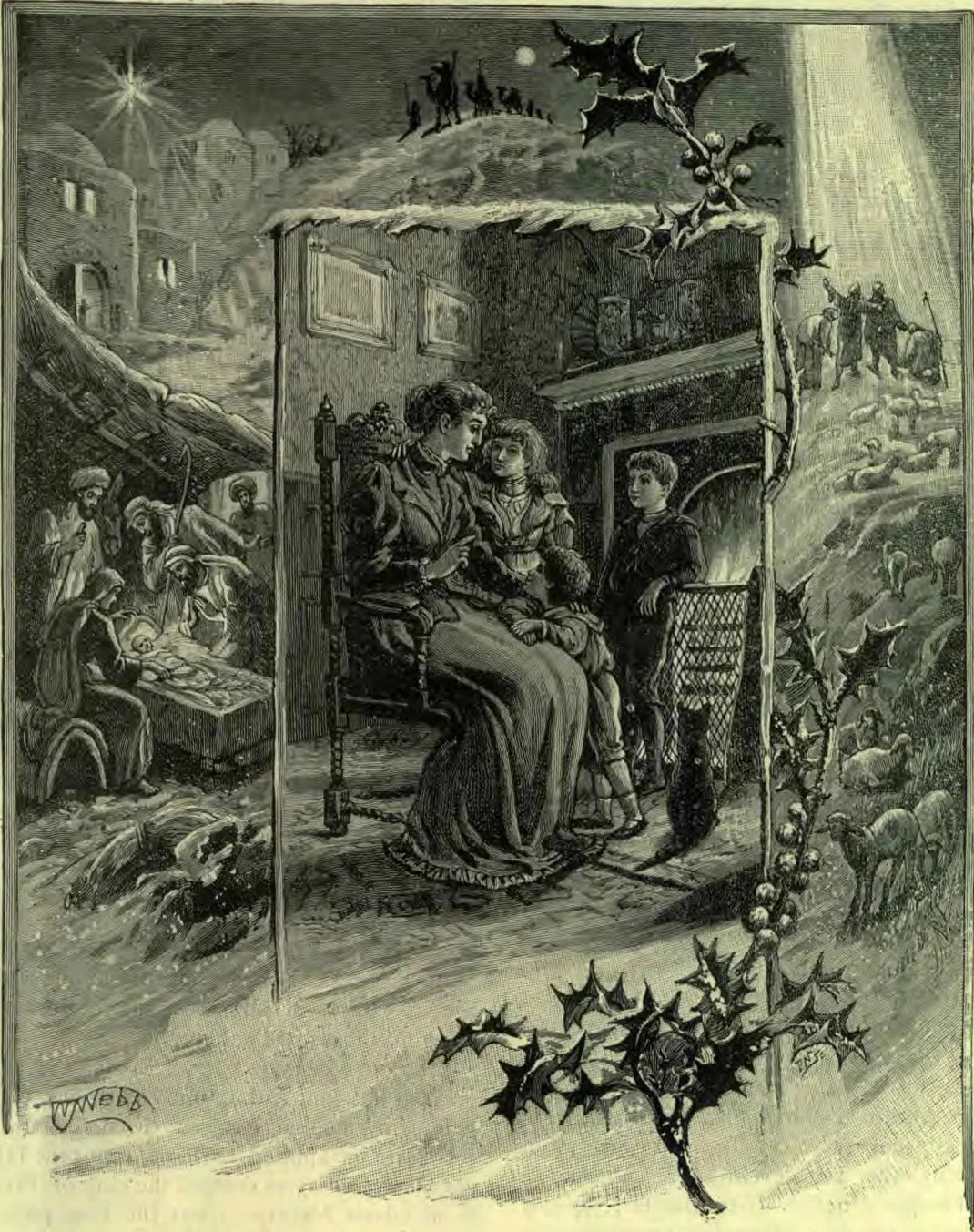
THE CHRISTMAS HOLIDAYS.
By C. B. Morrill
As, in childhood, play is the chief object of existence, so in the childhood of races, life is less prosy, more picturesque and playful, than in later and maturer periods. Our forefathers spent a fortnight upon Christmas; we find it hard to spare a single day. Machinery rules us now, and when it runs, we must run or fall behind, and so life has become an everlasting steeple-chase. Our fathers lived more slowly; their world was smaller; their obligations were lighter. Their duties to society began and ended in the parish; the whole world has claims upon us. They had few books; we are half buried in the multitude of ours. Their holidays furnished them with the substance, in its crudest form, of what we have, refined and concentrated, in music, literature, and art.
Not only the feverish haste of modern life, but the changes in our manner of living, have shut out many of the observances with which the winter festival was celebrated. In ancient times the Yule block was rolled into the immense fireplace, and lighted with a brand saved over from the last Christmas. In its light and warmth, the cheery customs of the season flourished. Long, wreathed candles added to the light of the fire a steadier beam.
The story-teller, who had fought Spanish buccaneers in the southern Atlantic, had seen the awful vision of the Flying Dutchman in the storm-clouds off the Cape, and the wonders of Calcutta and Cathay, began to unfold his wondrous creations. Now, for the fireplace, we have the steam radiator, the candles’ shining is dimmed by the electric lights, and the story-teller’s species is extinct.
The wassail, too, has lost its honorable place. In an age when many people are total abstainers, and intemperance is nowhere in good repute, the old customs of drinking are more honored in the breach than in the observance. The Lord of Misrule has departed also, his pranks not being in favor at the court of public opinion. All these have left a great breach in Christmas.
We still keep many customs, which we can manage to fit into our modern life, to remind us of the gay festival of past centuries, just as we keep a few withered wild flowers to remind us of a summer spent in the hills. Many observances are matters of course in England which are never followed by us, or followed only by way of reviving the past. Among these is the Christmas pantomime, a clumsy variety show which foreigners ridicule. We have, though, the holly and mistletoe, candles and Christmas gifts; while mince pie, among things eatable, is abundant, and plum pudding by no means rare. In addition to these things, we have the Christmas tree, which is not English, but German.
Nevertheless, the real spirit of the Christmas festivities is dying out. As a religious anniversary, Easter, which is not so much a holiday, seems to be taking the place of its sister festival. The pagan features of Christmas are too marked, since it is almost certain that Christ was not born in December; while on the other hand, it is just as certain that he did rise from the tomb at the Passover season, and, if we except Easter eggs, the pagan features of Easter are not at all prominent. As for mere holiday, we do not need such holidays as Christmas used to be. Our life is too full of excitement now; what we need is rest and opportunity for reflection. We need to unbend the bow, not to string it tighter. We have a wealth of literature and of art on every side of us, with which to make a holiday of every day, when our work is done. Every age and every country is our own. We may travel around the world in an easy-chair, and make nightly incursions into savage wilds, or visit the shrines of history and romance, lighted by our evening lamp.
But if we less often give up whole days to merry-making, we must not forget that we owe ourselves recreation and rest. The wealth of our opportunities often intoxicates us, and, in the effort to grasp all, we lose all. We should read slowly and reflect much; he who plows deep has a richer harvest than he who scratches a large surface. We should work carefully, and let progress be sure rather than rapid. And when festal days do come around, let us idealize them, so that they shall bring us strength and not weariness, and leave us broadened in mind and in character. If our holidays can be thus transformed, it will be worth the while to preserve them.
C. B. MORRILL.
CHRISTMAS
By Emma L. Kellogg
Long ago an angel band sang a song, and shepherds near,
Keeping guard around their flock, listened and rejoiced to hear.
Sweet the song the angels sang, sweeter than had e’er been sung;
“Glory unto God on high,” was proclaimed by every tongue.
“Glory unto God on high!” How the heavenly arches ring!
“Peace on earth; good-will to men! Christ is born the promised King!”
With the cattle round his bed, in a manger low he lies;
For the inn could not make room for Immanuel from the skies.
And the wise men came from far, came to worship and adore;
Brought him gold and incense rare, gave him gifts, a precious store.
Wondrous Babe of Bethlehem! Jesus Christ, the Lord on high,
Came to earth in lowly guise, came to suffer and to die.
'T was because God loves us so, that he sent his only Son;
To redeem poor fallen man Jesus died for every one.
On the cross his blood was shed; for our sins he did atone;
Now he stands at God's right hand, pleading for his loved, his own.
So to-day we kneel and pray to the Lord who rules above;
Help us to be more like thee; fill our hearts with perfect love.
May we look by eye of faith to the Saviour crucified;
Trust in his atoning blood — 't was for sinners Jesus died!
In the new Jerusalem, on the earth made free from sin,
May we through the pearly gates with the ransomed enter in,
There to join in songs of praise that the ransomed throng will sing,
There to share the joys of heaven in the presence of our King.
EMMA L. KELLOGG.
A TURN OF FORTUNE'S WHEEL.
By Mrs. M. A. Loper
“Well, Marie, I’m going to have a dinner party on Christmas day, and I wondered, seeing that you and I are such fast friends, if I could not depend on you to help me out a little in the details. Mama says I may have it, and I am so delighted. You know that will be my sixteenth birthday, and I shall enjoy it so much.”
“How many do you expect to entertain, Marguerite?”
“Well, I hardly know; there are so many I should like to invite.”
“Why, I think that is just the trouble. My mama told me I could have a tea party some of these times, and I do hate a small affair. But you know I should not like to choose my company from those much older than myself, nor from the children; and when I tried to count up enough to suit me, I could not find them. You see there are only about two dozen in our set at school, anyway.”
“What do you mean by our set, Marie?”
“Why, I mean girls that I fancy — those that are agreeable, and who know something of good society and refined manners. If you can count more than that number of girls of our age, you can beat me, Marguerite.”
“Oh, I was not trying to select from girls of that class. They have plenty to make them happy at Christmas time without my help. I have been thinking that I would like to invite those to whom it would be a real treat. My Sabbath-school teacher reminded us before Thanksgiving that Jesus says that when we make a feast we should invite the poor, for they cannot recompense —”
“Oh yes, but people don’t follow that nowadays. It would be considered a disgrace to have a lot of street urchins gathered in as associates on Christmas day. If you are going to do that, you will lose your standing in good society, and I’m not going to risk my reputation by helping on the scheme, either.”
“Very well, Marie, do as you like; but I care more for making some poor waif happy than I do for what people may think of me in a society way.”
“Marguerite, what has struck you, anyway? I never heard you sermonize in this way before.”
“To tell the truth, Marie, I never thought so much about it as I have since the poor family moved into the next house, and I have seen what a hard time they have to gain even the barest necessities of life. Sometimes they can find nothing to do; and when they get a job, they receive only very small wages. I am going to invite three from there, and all the girls of my age that I am acquainted with who have no means of being really happy at home on Christmas day.”
“Well, I think you will have no trouble in securing the desired number. But, dear me, do you intend to let such girls as Lucy Trowbridge into your nice home? She’ll steal everything she gets her hands on. You know she stole cookies out of your lunch basket at school.”
“Well, that was because she was hungry; and she felt sorry about it afterward. I told mama about it, and she lets me take something for Lucy to eat nearly every day now.”
“Besides the risk of losing your valuables, Marguerite, you’ll probably catch the smallpox or the measles.”
“Oh, I’m not afraid of that from them much more than I would be from some of our more fortunate neighbors. You know that some of the leaders in society have scarlet fever in their homes now, and we are often thrown in contact with disease, even when we avoid the slums of the city.”
“Well, Marguerite, if your mama allows you to have those ill-bred people at your birthday party, I suppose I can’t persuade you out of the notion; but really I do not see how you can enjoy it. Your guests will doubtless be rigged out in antediluvian style, and as I should feel myself quite out of fashion, I guess you may count me out. I think your brain will be sufficient to plan enough to make that crowd enjoy themselves without my help.”
“I am sorry, Marie, that you think that you would not enjoy it, for I shall be the happiest one present, I am sure.”
The mysterious wheel of fortune makes many unexpected turns; and before the snows of another year had draped the naked boughs in fleecy whiteness, Marie’s father had made an assignment in favor of his creditors, and for the first time in her life Marie felt the unwelcome touch of poverty. She could not now have all her foolish wishes gratified, and it was hard for her to submit to the unwelcome experience. Her early womanhood was crowned with disappointment and remorse. Her haughty associates made their visits less frequent, and poor Marie knew better than to return their calls. Her beautiful wardrobe was gradually losing its attractiveness, and her standing in society was sadly changed. One summer evening, as she sat musing on the bright scenes of the past and pondering over the present situation of her affairs, a neatly dressed girl came tripping up the walk.
“Good evening, Marie,” said Marguerite, as she seated herself beside her friend, while the shades of twilight deepened.
“Why, Marguerite, I supposed you were at the lawn social over at Mr. McGregor’s.”
“Oh no; I thought I would come over and sit with you a while instead.”
“Marguerite, how can you be so kind to me as you have always been, and especially during the long months since papa failed in business? Why don’t you shun me as the other girls do?”
“Why should I, Marie? You are just as dear to me now as you ever were.”
“Well, Marguerite, you always were different from all the other girls, and I never could appreciate it until now. I used to criticize you a great deal because you were such a friend of the poor; and I was so selfish that I never took time to think of their unsatisfied longings until since I have learned by sad experience,” and Marie’s eyes filled with tears. “But I am so glad that I have one friend who has not forsaken me in my hour of adversity.”
“You have a much better Friend than I can possibly be to you, Marie—a Friend who, although he was rich, for our sake he became poor, that we through his poverty might be made rich,—might have the enduring riches of heaven itself.”
“I see now,” sobbed Marie, “that I was wrong in supposing the accumulation of earthly riches to be the chief end of life. I completely overlooked the important part of dispensing them to the needy. I might have given happiness to many a poverty-stricken home in those days of prosperity, but, alas! I am left to mourn over lost opportunities. Were it not for the example of your quiet life, I should almost despair; but through it I have caught glimpses of a life far better than this, and it sweetens the bitter cup of the present hour.”
“I am thankful if I have ever been of any service to you, Marie; and I hope that instead of viewing the shadow, you will look at its silver lining; instead of brooding over past mistakes and present discomforts, you will live so near to the Source of true happiness that life will be a pleasure because lived for a noble purpose. But I must say good night now, hoping that you will cheer up, and come to see me often.”
As Marguerite disappeared among the shadows, she left Marie in possession of a depth of true friendship such as she had never before experienced, and with such an estimation of life’s mission as can be had only through living for the good of others.
MRS. M. A. LOPER.
Refused Honors and Wealth.
M. Pasteur, whose discoveries in the generation of disease have been of such incalculable value to the public, was offered, by a French capitalist, two hundred thousand dollars for his discovery of the method of preventing disease in cattle, the man in business knowing that the profits in an agricultural country would be enormous.
M. Pasteur refused the offer, saying that, as he was already in receipt of a government annuity, which sufficed for his wants, he thought it right to give his discoveries gratuitously to the public.
M. Agassiz’s reply to the letter from a German university, offering him a large income if he would accept a position,—“I have not the time to make money,”— is a household word in this country.
As fine was the answer of an eminent New York physician, when his friends endeavored to dissuade him from giving up home, family, and life to go to Memphis while the yellow fever was raging there. “You will die alone, amid indescribable horrors, for a people who can neither know nor thank you,” they said.
“It is not the manner of a man’s death which should concern him, but the manner of his life,” was the quiet reply.
He went, and never returned. The noteworthy point in these cases is that we are surprised and startled by them. If we, as a people, had not learned to rate money as a chief good, and the possession of it beyond the discoveries of science, the good of mankind, or the nobility of our own lives, we should accept these simple utterances of men who held wealth at its just value, as matters of course.—Household.
LARGE FAMILY.
At a recent public celebration in a New England town, at which several state dignitaries were present, an old gentleman of rural aspect propounded many questions in a hoarse whisper to his nearest neighbor.
“Who’s that sitting over there in the big chair?” he demanded.
“The governor,” responded his neighbor, laconically.
“And who are all those men gathered behind him?” persisted the old man.
“Suite,” replied the other, shortly.
“All of ’em?” gasped the old man.
His neighbor nodded.
“Well, I swanny!” ejaculated the questioner, after a moment’s stunned astonishment.
“We think we’ve got a pooty fair show o’ Emmonses in this town; but if all those fellows are Sweets, as near of an age as most of ’em look, I should like to see the rest o’ the family, that’s all I’ve got to say! My stars! What doin’s they must have, come Thanksgivin’ and Christmas!—Exchange.
HOW EVERYBODY CAN HELP.
A READING-ROOM for boys has been established in connection with the Medical Missionary College Settlement at Chicago. The boys are showing a very great interest in the reading-room, and devour eagerly the literature which is placed before them. There is no library, and no funds with which to buy one. It has occurred to us that we can make a library of scrap-books.
The purpose of this note is to call the attention of the friends of the work to this need, and to ask all who are interested to send in scraps and second-hand books. Simply-written histories, travels, interesting biographies of men who have made a success of life, picture books, books of animals, illustrated magazines, moral and religious stories,—anything which a boy will like and which will do him good,—will be most acceptable. The scraps, as received, will be carefully assorted, classified, and arranged in scrap-books, which will be just as interesting and helpful to the boys as the most beautifully-bound volumes. In fact, there is a sort of fascination about a scrap-book which boys appreciate.
A few nice pictures, especially of animals, will also be very acceptable. In many of our homes there is a superabundance of these things which make life pleasant for children, but of which the boys who visit the Chicago Medical Missionary College Settlement know nothing, for many of them live—or rather stay—in the dreariest homes imaginable, without a ray of either mental, moral, or physical sunshine.
Books, magazines, and heavier articles should be carefully boxed and sent by freight. It would be well for several friends who are interested to put their contributions together, so as to make their package weigh one hundred pounds, as the charge for sending one hundred pounds is no greater than for a smaller amount.
Scraps may be sent either by freight with books and magazines, or, if carefully wrapped, may be cheaply sent by mail, the charge being one cent for two ounces for printed matter; but no writing must be enclosed in packages mailed at this rate.
A good way to send scraps would be to put them into an envelope, and pass a thread through the envelope, scraps and all, tying on one side. The envelope should be sealed, then opened at one end, so the postmaster can look in and see the character of the contents.
Address scraps or books to the American Medical Missionary College Settlement, 744 Forty-Seventh Street, Chicago, Ill. Be careful to prepay the freight. Send freight receipt to the same address, enclosing with it the name and address of the sender, as we shall be glad to know who are interested in this work.
A CHRISTMAS SONG.
By Alice M. Avery-Harper
In solitude and gloom of night
An angel, robed in glory bright,
Sang in seraphic, blissful strains
To shepherds on fair Bethlehem's plains:
“Glory to God, and peace on earth—
Glad tidings of a Saviour's birth!”
A multitude of angels soon,
Far brighter than the shining noon,
In notes of joyful, glad refrain,
Join in the thrilling welcome strain;
And wondrous beauty lights the skies,
And fills their hearts with glad surprise.
The shepherds watch the effulgent star—
That radiant messenger afar;
When lo! it guides them to the place,
With joy they then behold his face.
In manger rude, with oxen there,
Is cradled this strange child so fair.
They haste to greet the new-born Lord,
Receive with joy the angels' word,
And myrrh, and spice, and offerings bring
To Christ, the mighty conquering King.
They give him gifts and incense sweet,
And prostrate fall at his dear feet.
Mrs. Alice M. Avery-Harper.
DEPTH OF THE SEA.
ABOUT three fourths of the surface of the earth is covered with water. The great oceans and the seas connected with them constitute the major part of the waters of the earth. Moisture from both land and sea is taken up by the atmosphere, and falls again as dew and rain. Water from the ocean undoubtedly percolates through the earth, and purified of its salt by the great filter through which it has passed, bursts out upon the surface again, forming springs, rivers, and lakes. The depth of the ocean varies greatly. Where the shores are low and level, the waters adjacent are shallow, gradually deepening at greater distance from the land.
Again, where the ocean is bounded by precipitous cliffs, the water drops down at once to a great depth. There are ridges like mountain ranges in the ocean, which come much nearer the surface than the other parts. These often extend a long distance. The first Atlantic cable was laid upon such a ridge. Deep-sea sounding is very difficult, because of the intense strain put upon the sounding apparatus when deep waters are sounded. The deepest water ever found has lately been discovered by the British ship “Penguin” in the Pacific Ocean, off the coast of Japan. The lead sank four thousand nine hundred fathoms, or about six miles, when the wire broke. This was deeper by two hundred and forty-four fathoms than any previous cast, and even then the bottom was not reached.
In these immense depths live creatures which, if brought to the surface, and removed from the intense pressure to which they are subjected, would fall in pieces, of their own weight. Well may the inspired psalmist speak of “this great and wide sea, wherein are things creeping innumerable, both small and great beasts.”
ONE OF THE GOOD-FOR-NOTHINGS.
An exchange reports a colloquy between the father and mother of a lazy son, who had given up one position after another, and seemed to believe that working between meals was injurious to his health.
“So George is going to give up his place again, is he? What is the trouble this time?” asked his father.
“He complains that the hours are too long,” the mother answered.
“H’m! I guess George would like to work from twelve to one, with an hour off for luncheon.”—Youth’s Companion.
THE LAST CHANCE.
SOME years ago there lived in Alabama a judge who was noted for the sarcasm which he dispensed lavishly during his administration of justice. On one occasion during a term of court at Montgomery, a young man was tried for stealing a pocketbook. The next case was for murder. The evidence in the larceny case was slight, but in the other seemed to the judge conclusive. To his amazement and wrath, however, the jury convicted the young man, and acquitted the murderer.
In passing sentence upon the convicted thief, after the discharge of the other prisoner, the judge said:—
“Young man, you have not been in this country long?”
“No, your Honor,” replied the prisoner.
“I thought not,” said the judge. “You don’t know these people; you may kill them, but don’t touch their pocketbooks!”
On another occasion, when the evidence seemed to point conclusively to the prisoner’s guilt, but when the judge, from long experience, distrusted the jurymen’s wisdom, the counsel for the defendant said: “It is better that ninety-nine guilty persons should escape than that one innocent man should suffer.”
In his charge to the jury, the judge admitted the soundness of this proposition, but he added impressively and severely:—
“Gentlemen, I want you to bear in mind that ninety-nine have already escaped!”—Exchange.
THE MINIATURE PROPHETIC CHART.
This is the title of an eight-page tract, printed on fine plate paper, size eight by five and one-half inches. The first page contains a prophetic chart of the prophecies of Daniel and John as commonly used by Seventh-day Adventists. The body of the tract is a brief and lucid exposition of the symbols of the chart. It would be a valuable help in the study of the prophecies, and an excellent tract to interest a person in the study of the same. Price, five cents each. Discounts to those taking a dozen or more, and to agents. Free copy will be sent to Sabbath-school officers who will send name and address. Address all orders to the author, Elder W. H. Littlejohn, Battle Creek, Mich.
The Purple Hyacinth
By Juniata Salisbury
by Juniata Salisbury (the Transatlantic Publishing Company, New York and London).—This is a dainty Christmas fairy story, charmingly illustrated. The story centers about little Gretchen, who is crippled and very poor, but who is full of courage, hope, and contentment. Her father and little sister are away at work all day, and as she sits alone in the gray dusk of the winter twilights, the flames in the fireplace seem like dancing fairies, and the snow-flakes falling round the window-panes look like beautiful white-robed creatures. She has one purple hyacinth, breathing perfume through the bare room, and calling to mind the fairy story of the Purple Princess, who turned into a hyacinth after her loving bravery had saved her two sisters from a dragon; and in the sweet breath of that purple hyacinth no evil spirits could live. A fairy story is nothing unless interpreted, and this one evidently means to show that even the vile and unholy lose their evil thoughts and desires when in the presence of the brave and loving-hearted.
Then on Christmas eve Gretchen's father saves a young lady's life, and she, in gratitude, sends loving gifts to his little girls, and, with her mother, visits them. Gretchen shows her visitors a little gray linen book with a purple hyacinth painted on its cover, and stories by Gretchen's father and his sister written by hand within. It is the only souvenir saved of the old home in Holland which was swept away, with all the family, as it was supposed, but Gretchen's father, when the sea carried away the town. Then the young lady's mother recognizes the Purple Hyacinth book as one she helped to write; and so a brother and a sister, each saved, unknown to the other, were united on a happy Christmas day, because of a brave act lovingly rewarded. Love and Bravery and Contentment are happy fairies whom everybody should know.
International Sabbath-school Quarterly Now Published
By Editor
The International Sabbath-school Quarterly is now published, and ready to be sent upon application. The lessons contained in this number are for the first three months of the year 1896. The topic discussed and to be studied is the threefold message of Rev. 14: 6–14. Sabbath-schools, and all who wish to study the lessons, should supply themselves at once. First come, first served. Order of tract-society secretaries or the Review and Herald. Tract-society secretaries would do well to secure a supply of these lesson pamphlets immediately. Price, single copy, five cents.