The Youth’s Instructor, Vol. 43, No. 51.

SUSANNA’S PEPPER-BOX

The Youth’s Instructor

Dec 19, 1895

S. D. A. Publishing Association · Battle Creek, Mich. · Dec 19, 1895

SUSANNA’S PEPPER-BOX.
By Myrta B. Castle.
“I say, Sue, get the money out of your pepper-box; there’s a tramp round the corner, and he’s coming this way!”
“O Phil! is there, really? and does he look hungry? and I do hope he hasn’t a sick wife and baby at home; ’cause I haven’t any money but the two dollars in my foreign-mission box.”
“Ho! ho! wife and baby—I guess not! He’s no bigger’n I am. But he does look hungry, that’s a fact, and awfully blue and cold.”
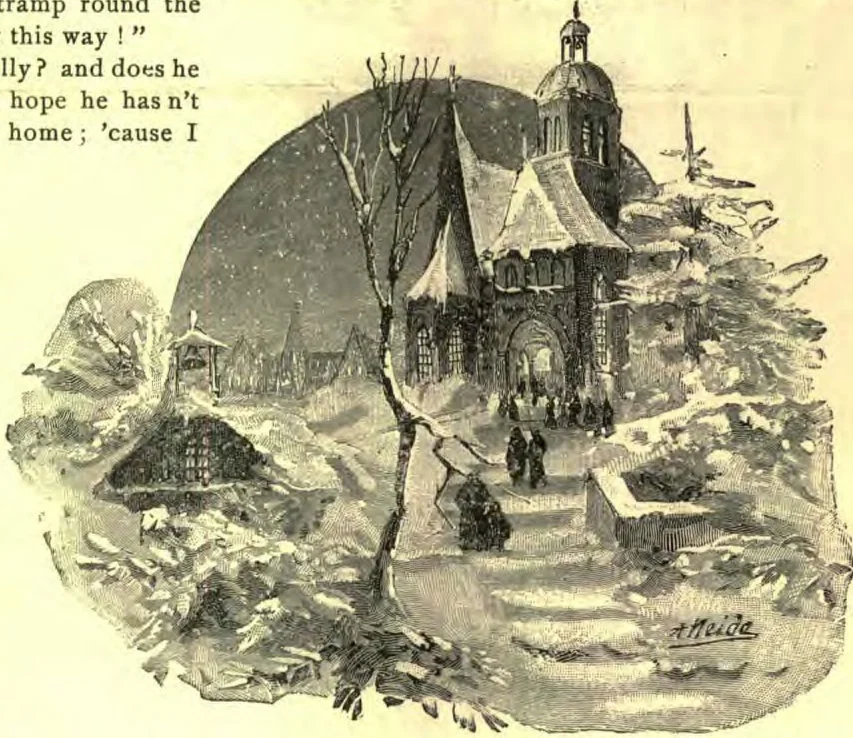
Just then, as a particularly wintry blast skurried the snow off the roof and down the path, a doleful little figure stopped at the garden-gate, and looked hungrily toward the home-like house back from the road. It was morning, and he could see through the wide windows the warm fire in the dining-room grate, the long family table set for breakfast, and Susanna’s mother bringing in the steaming food.
That splendid fire—oh, how his poor, half-frozen feet did ache for its warmth! That steaming food—he could almost smell the hot cakes and maple syrup, and his stomach was so empty! There stood a boy and a girl at the window, too, looking at him. He didn’t mind Sue; she was younger, and a girl; but to be pitied or laughed at for being a beggar by that boy just his size,—that he couldn’t stand, and he turned away with a big choke in his throat, and ran down the street as fast as his weak legs and numb feet could carry him.
But he hadn’t gone far when he heard a little girl’s voice calling: “Boy! O boy! wait! I can’t run so fast through the snow. Come back to breakfast. Mama says so, and so does Phil, and papa would too, only he’s away; and there’s plenty for you too, and a place all set—we always keep an extra place, ’cause once I had another brother,—Phil’s twin,—and he died!”
Just then Phil came running up with a shawl. “Here, old fellow, this will fix you a little snugger till you get into the house. This storm’s a regular northeaster, come to stay over Christmas—and so’ve you—mama said so—unless your folks live right near here. And you shall have my brother’s room while you stay—it’s always ready for company.”
“Company! O, that’s the first time I’ve been called anything but beggar and tramp since—since—”
“Poor child!” said Mrs. Phinney; “sit by the fire, and drink this hot milk right away; and I know Phil and Susanna are fretting to know what your name is and how old you are, and then you needn’t say another word till you feel like it.”
“My name is John Jones, and I’m fourteen to-day.”
“Hooray!” shouted Phil; “we’ll have a—”
“O Phil, come out into the kitchen this minute; I want to tell you something,” said Susanna. “Phil Phinney,” she exclaimed, the minute the door was shut, “what do you mean by letting cats out of bags like that—anyway, ’t would have been a secret if we’d had time to make it one. Don’t you see? we’ll give him a surprise! Won’t it be splendid?—and Christmas eve, too!” and she danced round on one foot till she was dizzy.
“What a jolly girl you are, Sue!” said Phil, with a look of brotherly admiration. “We’ll give the poor chap a day to remember or our name’s not Phinney. But come to breakfast now, or he’ll starve while we’re plotting.”
All day, as John lay on the couch before the fire,—he had taken a violent cold from his exposure,—he wondered what made the Phinneys so hilarious all over the house except where he was. He could hear them shouting through the chambers and in the attic, or from the pantry to the cellar. When they came into the sitting-room, though, they were as quiet and sober as if there were sick people in the house.
“I say, Sue, I’ve lots of old duds better’n those he’s wearing, but it’s no great thing to give away what you don’t want and would like to get rid of; and so I’ve been thinking, What’s the use of keeping all brother’s clothes, when they might do somebody some good? He willed his wardrobe to me,”—Phil’s voice faltered, for his twin had been dead only a half year; and Susie cried softly,—“and I think pa and ma will be glad if I give John brother’s school suit, which was almost new.”
“You’re so good, Phil! And—and—don’t laugh at me—but I think—he needs a pair of new shoes, not half worn ones—I’ll have to spend that two dollars I’d saved for foreign missions, and buy him some birthday shoes.”
“I knew it, Sue, I knew it! Didn’t I tell you to bring down the pepper-box? You always do, whenever a tramp comes along. If the heathen had got all the money you’ve put into that old pepper-box for them, some of them wouldn’t be heathen any longer.”
“I can’t help it; I think it’s worse to turn people away hungry and cold—just think of having no supper and sleeping in a snow-bank!—than it is not to send tracts to heathen who can’t read them; though I did want to help send a missionary to teach them to read the Bible. But never mind; I’ll save some more. John Jones is going to have some shoes (a boy ought to have something new, whose birthday is next day to Christmas), and you are going to the store to buy them right away—his feet are just as big as yours. Now I’m going to make him a birthday cake.”
That evening at seven precisely John Jones was invited into the dining-room, and there, near the head of the table, was a tall “birthday Christmas tree”—“presents look prettier on a tree than anywhere else,” Susanna had declared,—covered with loving Christ-tide gifts to each member of the family, and handkerchiefs, neckties, collars, underwear, stockings, new shoes, and brother’s warm school suit, for John. In the tip-top was a lighted candle, and underneath was the birthday cake, with—“John Jones 14” in red candles on the white frosting.
In a few days the uncle for whom poor orphaned John was looking came and took him away, and the children never saw him again, though he and Phil wrote to each other for a while. Then the Phinneys lost all track of their winter guest till, one day many years after, Susie got this letter from a far-away heathen land:—
“Dear Susanna: Phil told me before I went away from you, that winter so long ago, about your foreign-missionary pepper-box, and how your tender heart made you give the money always to the heathen that came to your door; and as you sacrificed your missionary savings for me too, I think you would like to know that the money which bought my shoes was foreign missionary money put out at interest; for Phil’s story of your sacrifice put the first thought into my mind that God might use me, some day, as he is now doing, in teaching the heathen in foreign lands to read the Bible. Yours, “John Jones.”

THE MESSAGE OF PEACE.

When heralds sang at Jesus' birth, The song of peace was borne to earth; A star arose in splendor bright, And broke the silent gloom of night. That “peace on earth, to men good-will,” Is through the ages ringing still; That glorious light, that beaming star, Shines yet in splendor from afar.
O lovely star, O wondrous ray, More glorious than the orb of day! Shine thou within my inmost heart, Till all the gloomy shades depart; Illume the solemn midnight sky With beams of brightness from on high. A message sweet, with joys divine, Is borne where'er thy glories shine.
JONATHAN SPENCÉ.

THE PEOPLE OF INDIA.

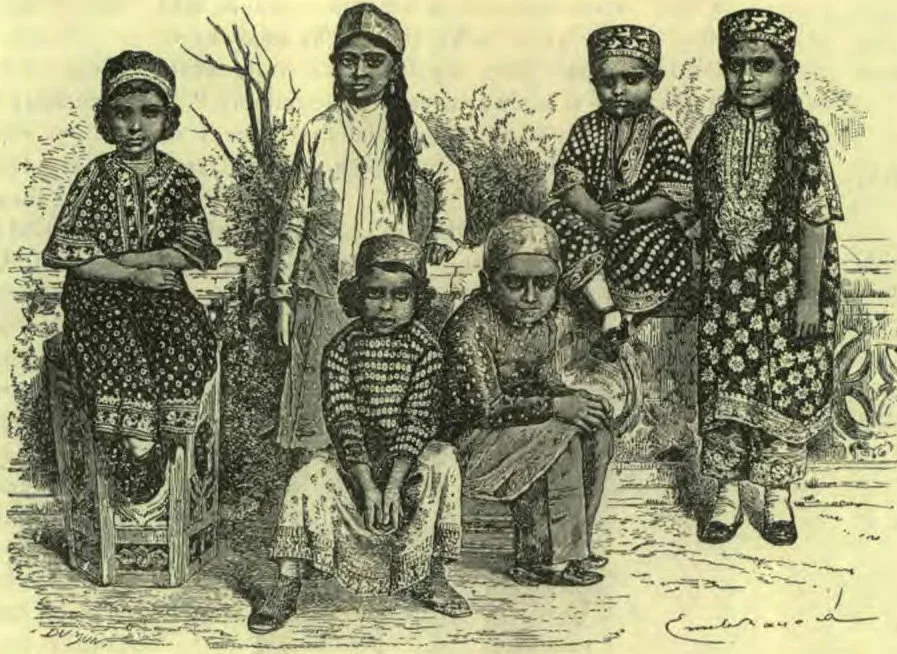
It has been well said that India, of itself, is a world. The question is often asked, What kind of people are the natives of India? It might as well be asked, What kind of people are the natives of Europe? for India contains more distinct and separate nationalities than Europe does. Nevertheless, there are many points of resemblance, which naturally lead to the conclusion that the people of India are of one common nationality.
HIGH-CASTE HINDU CHILDREN.
The family system is the same in all parts of the country, and in many respects resembles the condition which existed in the days of Abraham, the sons with their families remaining under the father’s roof throughout his lifetime, while all the family is supported from a common fund. Child marriage is also common in all parts of India, and widowhood is not only looked upon as the greatest misfortune, but the unhappy widow is regarded as the cause of her husband’s death, and is obliged to suffer all sorts of cruel penances for her supposed sin. A little girl may be left a widow before she is six years of age; but there is no exception made in her case. She is treated almost as an outcast all the rest of her days, and is never allowed to marry again.
As a class, the people of India are very poor. Millions belonging to the lower classes live in a state of wretchedness and poverty which it is impossible to describe. In most parts of the country a laboring man will work all day for a sum not exceeding five or six cents, and on this he has to support a wife and from two to six children. It is said that one half the people of India never know what it is to have enough to eat. They spend very little on clothing, and literally live from hand to mouth, so that their life from one year’s end to another is one hard struggle against absolute starvation.
Politeness is a characteristic of the Hindu. The East Indians are strongly attached to form. Some one has said that “manner is something with everybody, and everything with some.” Few attach more importance to it than the Hindus, and as they are often treated unkindly by the English, courtesy on the part of the missionary is the more appreciated. It produces a favorable impression at the start, and causes the gospel message to be listened to with more attention.
It is considered highly disrespectful to use the left hand in salutation or in eating—or, in fact, on any other occasion where it can be avoided. To remove the turban is disrespectful, and it is still more so not to put off the shoes on entering a strange house. Natives, when they make calls, never rise to go until they are dismissed. The best way to do this is to say, “Come to see me again soon,” or, “Always make a practise of visiting at my house,” which will be readily understood.
GEORGIA A. BURRUS.

MAGGIE’S GIFT.

THE minister’s eyes swept with intense searching the apathetic faces of his stylish, worldly congregation. He had made an impassioned appeal for help in the support of a little mission church among the mountains—a section where rough men and women knew scarcely anything of God and of the religion of Christ. He had hoped to inspire the people with the spirit of giving; to make them feel that it was a sweet, blessed privilege to give, and—he had failed. A feeling of desolation crept over his soul.
“God help me,” his lips murmured mutely. He could not see the bent figure of little crippled Maggie in the rear of the church—a figure which was trembling under the fire of his appeal.
“Lord Jesus,” the little one was saying, brokenly, “I ain’t got nothin’ ter give; I want the people in the mountains ter hear ’bout my Saviour. O Lord, I ain’t got nothin’ ter—”
What was it that made the child catch her breath as though a cold hand had taken hold of her heart?
“Yes, you have, Maggie,” whispered a voice from somewhere; “you’ve got your crutch, your beautiful crutch, that was give ter you, an’ is worth a lot of shinin’ dollars. You kin give up your best frien’ what helps you ter git into the park where the birds sing, an’ takes you ter preachin’, and makes your life happy.”
“O no, Lord,” sobbed the child, choking and shivering. “Yes, yes, I will. He give up more’n that f’r me.”
Blindly she extended the polished crutch, and placed it in the hands of the deacon who was taking up the scanty collection. For a moment the man was puzzled; then, comprehending her meaning, he carried her crutch to the front of the church, and laid it on the table in front of the pulpit. The minister stepped down from the rostrum, and held up the crutch with shaking hands. The sublimity of the renunciation unnerved him so that he could not speak for a moment.
“Do you see it, my people?” he faltered at last; “little crippled Maggie’s crutch—all that she has to make life comfortable? She has given it to the Lord, and you—”
There was a moment of silence. The people flushed, and moved restlessly in their cushioned pews.
“Does any one want to contribute to the mission cause the amount of money this crutch would bring, and give it back to the child, who is helpless without it?” the minister asked gravely.
“Fifty dollars,” came in husky tones from the banker.
“Twenty-five.”
“One hundred.”
And so the subscribing went on, until papers equivalent to six hundred dollars were lightly piled over the crutch on the table.
“Ah, you have found your hearts—thank God! Let us receive the benediction,” almost whispered the minister, as he suddenly extended his hands, which were trembling with emotion.
Little Maggie, absorbed in the magnitude of her offering and the love which prompted it, comprehended nothing that had taken place. She had no thought of the future, of how she would reach her humble home, or of the days in which she would sit helpless in her chair as she had once done. Christ had demanded her all, and she had given it, with the blind faith of an Abraham. She understood no better when a woman’s arm drew her into close embrace, and soft lips whispered into her ears:—
“Maggie, dear, your crutch has made six hundred dollars for the mission church among the mountains, and has come back to stay with you again. Take it, little one.”
Like a flash of light, there came the consciousness that in some mysterious way her gift had been accepted of God and returned to her, and with a cry of joy the child caught the beloved crutch to her lonely heart; then smiling through her tears at the kind faces and reverential eyes, she hobbled out of the sanctuary.—Gertrude M. Jones, in Christian Observer.

WEARY WORK.

THE worst part of martyrdom is not the last agonizing moment; it is the wearing, daily steadfastness. Men who can make up their minds to hold out against the tortures of an hour, have sunk under the weariness and the harass of small, prolonged vexations; and there are many Christians who have the weight of some deep, incommunicable grief pressing, cold as ice, upon their hearts. To bear that cheerfully and manfully is to be a martyr. There is many a Christian bereaved and stricken in the best hopes of life. For such a one to say quietly, “Father, not as I will, but as thou wilt,” is to be a martyr. There is many a Christian who feels the irksomeness of the duties of life, and feels his spirit revolting against them. To get up every morning with the firm resolve to find pleasure in those duties, and do them well, and finish the work which God has given us to do,—that is to drink Christ’s cup.—F. W. Robertson.

THE FIFTY-FOURTH CONGRESS.

The Fifty-fourth Congress of the United States assembled in the capitol at Washington, Monday, December 2. This Congress is not only a new Congress, in time, but it is also new in material; for it is largely composed of men who for the first time in their lives have been elected to Congress. In political complexion, the Fifty-fourth Congress is radically different from its predecessor. The former was a Democratic Congress, elected on a wave of proposed tariff reform. The personnel of the present Congress is sufficient evidence that the measures advocated and put in force by the previous Congress are not satisfactory to the country. The present House of Representatives is strongly Republican, having a majority of one hundred and forty. The former House had a Democratic majority of ninety. The Senate is more evenly divided, and the Populists have the balance of power.
Upon the organization of the House, Thomas B. Reed, of Maine, who was speaker of the House under the administration of Benjamin Harrison, and who, from his autocratic rulings, gained the appellations of “Boss Reed” and the “czar,” was again elected to preside. Mr. Reed is a very popular man in his party, and is one of the few Republicans who are looked to as the prospective leaders in the next presidential race.
There is no questioning that the present Congress, both Senate and House, is composed of able men of great independence and of various views upon all public questions. The complex condition of the affairs of this country, both in its foreign and its domestic relations, will give Congress a large field for discussion, which will be of great interest, and, we hope, profit, to the nation.

NATIONAL FINANCES.

ONE of the first things which will require the immediate attention of Congress will be the maintenance of the gold reserve, or to make some arrangements that will make it unnecessary to maintain such a reserve. It was thought that when money would begin to come here for crops, the golden stream would return; but the hard facts have not justified this expectation. Gold is now flowing to Europe faster then ever before, some weeks over a million a day going, and the gold reserve has now fallen to seventy-six million dollars. If it goes much farther, it will amount to a run on the United States government. In previous crises of this kind, the banks have come to the aid of the government, and have exchanged their gold for greenbacks, and thus relieved the treasury. They are now doing the same to a certain extent, and the secretary of the treasury has offered to pay the express charges both ways on all money thus exchanged. This is placing gold dangerously near a premium.
The making of gold the only standard redemption money, has made it the most valuable money, and the freest from any danger of depreciating in value. For this reason, those who desire to hoard money, and there are always thousands of such people, hoard gold; and it is now estimated that a very large amount of United States gold, not at present held by the government and the banks, is hoarded by private persons, and thus practically withdrawn from circulation. Several plans to remedy the financial stress will doubtless be presented to Congress.
The president advocates the permanent retirement of greenbacks. This may be done in two ways: by paying for them in gold, or by paying for them in bonds, which is simply giving government notes for them on long time and at such rates of interest as will make the purchase of the bonds a profitable investment. But greenbacks are very dear to the American people, and it is doubtful if any plan for their retirement will meet with the favor of Congress. Many Congressmen from all parties favor the free coinage of silver, and its restoration as standard money as it was before the year 1873. They contend that when silver is of equal value to gold at a rate agreed upon, the great demand for gold will cease, and that it will circulate as freely as silver, and that people who desire to hoard money will then be as likely to hoard silver as gold. These various positions will be fully discussed by Congress, but it is impossible to foretell the action of that body. This nation ought to have a settled and fixed financial basis. It is to be hoped that the present Congress will, at least, take some steps in this direction.

THE PRESIDENT'S MESSAGE.

CONGRESS having assembled, the president has placed his message before it. It contains, as is usual in such documents, a survey of the affairs of the government in its foreign and its domestic relations, with recommendations for action by Congress upon those things thought necessary. Among the many things mentioned, two are of special importance,—the Venezuelan question and the national finances. The Venezuelan question is important, because it involves the traditional policy of the United States to allow no European power to increase its territory in this hemisphere, and because this government's support of that theory in the case of Venezuela involves us in a serious dispute with Great Britain. Some features of this contention Great Britain has expressed a willingness to submit to arbitration; but she claims that the submission of the rightfulness of what is known as the “Schomburgk line” would be submitting to arbitration something to which her title is as good as it is to the British Isles themselves. The president's message shows that in the correspondence between the two governments this government has held that England's position in regard to the Schomburgk line is subject to doubt, and inasmuch as Great Britain is the more powerful of the two nations, a settlement by war would not be justifiable; that an impartial arbitration would be; and that not a part but the whole of the contention should be submitted for examination and decision. The position of the president is quite strong in regard to this question, and upon this point he will probably gain the most cordial support of anything introduced in his message.
The financial question is discussed in another article. This is far more important than any other question pertaining to the government. With gold almost at a premium, and what little is left in the treasury leaving at a galloping pace, with insufficient revenue to meet the actual expenses of the government so that the nation is getting into debt deeper every day, it may be clearly seen that there is an imperative necessity to do something. If the present Congress shall expend its energies in interminable talk, as did the previous Congress, and do nothing, business prospects will not be very flattering. The president urges immediate action, and the necessities of the nation certainly demand it.

THE BIBLE IN THE SCHOOLS.

The question whether the Bible should be read in the public schools has often been up before the people of this country, and it is now agitating the people of Chicago. There is no question in the minds of Christians but that the reading of the Bible will do good, anywhere and everywhere; but there are many people in this country who are not Christians; and these people, according to the freedom granted to American citizenship, have the privilege to protest against the reading of anything in school which will inculcate a religion they do not believe in. Then there are the Hebrews, who believe in the Old Testament but not in the New. For eighteen hundred years they have denied that Jesus Christ is the true Messiah, and they will not willingly consent that their children shall be compelled to hear a book read which teaches his Messiahship, and the guilt of the Jews in putting him to death.
Coming to the professed Christians, there are the Catholics and the Protestants, and each of these bodies has a version of the Bible which it holds to be the right one. While these versions generally agree, there are some points where the difference is very vital.
Among all these contending interests of Jews, Christians, agnostics, and infidels, it would seem the part of wisdom to leave the religious instruction to the home and the church, and confine the instruction in the schools to the affairs of this life. In Chicago, however, there is now a plan on foot for the use of such portions of the Scriptures as may be agreed upon by Catholics, Protestants, and Jews. Agnostics and infidels seem to be entirely ignored as if they had no rights in the matter. It is understood that nothing dogmatical, but only ethical, will be allowed to be read. The Catholics will not allow anything that savors of Protestantism,—justification by faith for instance,—to be admitted; the Protestants will be careful that no texts that would give comfort to a Catholic or would confirm him in his religion, shall be used; and the Jews will look to it that what is read shall not teach that Jesus Christ is the Saviour of the world. We can hardly see what advantage the reading of such an emasculated Bible will be to the scholars! The Bible is one book, and to be understood it must be studied all together. Just the name of reading the Bible in the schools will do little good. The Bible is a record of the origin of things, the dealings of God with mankind, and his plan for the salvation of the race. Any reading of the book which does not make these points clear and distinct is as useless as it would be to read an arithmetic without explaining the science of numbers and the art of computing by them.

M. E. K

It now seems probable that the war between England and Ashanti will be averted. There is in every country a war party, who seize upon every pretext possible to induce war. Those who do this are not necessarily braver than other people, but it is often the case that they occupy such positions that war will be a benefit to them. Young officers are often anxious for war, that they may have an opportunity to distinguish themselves, and gain promotion. Selfishness would thus lead to war.

M. E. K

THE GOLDEN RULE.

“THEREFORE all things whatsoever ye would that men should do to you, do ye even so to them: for this is the law and the prophets.” Matt. 7:12.
These words of Christ are called the Golden Rule. As gold is one of the most precious of metals, so this command is one of the most precious of commands. It cannot be fulfilled unless there is a spirit of love. If fulfilled, every duty between man and man would be discharged without any delay. Children would obey their parents, and brothers and sisters would always respect each other’s rights.
An anecdote published many years ago, of an Indian chief, may help us to understand how the Golden Rule can be lived:—
“One evening he was sitting at the fireside of a friend. Both of them were silently looking at the fire, indulging their own reflections. At length the silence was broken by the friend, who said: ‘I will tell thee what I have been thinking of. I have been thinking of a rule delivered by the Author of the Christian religion, which, from its excellence, we call the Golden Rule.’ ‘Stop,’ said the chief; ‘don’t praise it to me, but rather tell me what it is, and let me think for myself. I do not wish you to tell me of its excellence; tell me what it is.’ ‘It is for one man to do to another as he would have the other do to him.’ ‘That’s impossible. It cannot be done,’ the chief immediately replied. Silence again ensued. The chief lighted his pipe, and walked about the room. In about a quarter of an hour he came to his friend, with smiling countenance, and taking the pipe from his mouth, said: ‘Brother, I have been thoughtful of what you told me. If the Great Spirit that made man would give him a new heart, he could do as you say, but not else.’ Thus the Indian found the only means by which man can fulfil his social duties.”
The Indian’s answer was a correct one, and God has promised to give the new heart: “A new heart also will I give you, and a new spirit will I put within you.” Eze. 36:26. “If any man be in Christ, he is a new creature.”
J. H. D.

CHRISTIANS AND CHRISTIAN NATIONS.

THERE is good reason for believing that Christianity makes men better than they are by nature. Examples without number of the beneficent effect of the Christian religion upon individuals might be noted. It is also true that as far as the people who compose a nation imbibe the spirit of Christianity, so far will the principles of Christianity be manifested in the nation. So a nation can be Christian only in proportion as the people are Christians; and in this matter a mere profession of Christianity amounts to nothing. All the people of a nation might profess the Christian religion, and so receive the name of a Christian nation, but at the same time there might be but little Christianity in the nation, because there is so little in the people.
Furthermore, a decree of a king, an act of Parliament, or a decision of a court, cannot have the least effect upon the moral nature of the individuals composing a nation, or change their relation to Christ. The same is true of a nation. A declaration by Congress or court that a nation is Christian will no more make it so than a similar declaration in regard to a man; but it is very common at the present time for the press to speak of Christian nations and Christian governments, and how they ought to send war ships to Turkey to bombard and kill the wicked Turks. It does not need a very close observer to see in all this a spirit quite different from the Christianity of Jesus Christ. It is, however, quite in harmony with the Christian-nation variety of Christianity. A nation made Christian by the decree of a king or an act of Parliament may be expected to fight; for such religion is man-made, and men have the spirit of fight. A man made a Christian by the work of the Holy Spirit would not fight, and if a whole nation were so converted, the nation would not fight; and inasmuch as no nation that ever existed has refused, for Christian reasons, to fight, it follows that there is and never was such a thing as a Christian nation, except in the sense that a certain proportion of the people of a nation, and perhaps a majority, have a kind of belief in Christianity. So when what is called Christendom starts to fight the Turk, we must remember that ships of war and armies of soldiers are not the legitimate weapons of Christian warfare, whether used in the United States or in Turkey. Christian nations, so called, sometimes have been more corrupt in government and people than were nations of other religions. The empire ruled by Charlemagne was called a Christian nation, and it was so considered by the pope himself; but it was eclipsed in true greatness and justice by the contemporary Mohammedan califate of Harun the Just at Bagdad.
The vindictive spirit which is now manifested toward the Turk is a recurrence of the spirit of the Crusades, which in the middle ages disgraced the name of Christianity. There is plenty of fanaticism and hatred in it, but very little Christianity.
This spirit is not all vented on the Turks. Many of the clergy of our land, whose duty it is to preach the gospel, acting as ambassadors of Christ to beseech men to be reconciled to God, and to offer pardon to repenting sinners in the name of Jesus, have been seized with a spirit to spy, and cause the arrest and imprisonment by the civil law of criminals and sinners. Their gospel is the use of force to make men better. They would make men Christian by supreme law, and enforce it by magistrates, fines, and penalties. They cry for quick sentences and heavy penalties. In this there is a recurrence to the spirit of past ages that is painful to behold.
An illustration of this spirit may be seen in a remark made by Dr. Parkhurst in his Thanksgiving sermon. Alluding to the boys who wrecked a train near Rome, N. Y., he said he would be glad to see them hanged in a month! We would not say a word in extenuation of their crime, or their just punishment by the proper authorities; but the sight of a prominent minister of the gospel, who poses as the great moral and Christian reformer of this country, standing in his pulpit and advocating such hasty and extreme punishment, is little less than shocking. It shows very clearly that the spirit of such professed Christian reformers has no more resemblance to the true spirit of Christ than powdered charcoal has to snow. It is bitter, vindictive, cruel. A man with such a disposition is better fitted to be a hangman than a minister of the gospel; but thousands of preachers are looking to him instead of to Christ as the model for their ministry. This is not the fruit of the Spirit of God, but it is the fruit of the spirit of national Christianity. This fruit is now quite abundant, and promises a much larger crop in the immediate future.

BIBLE STUDY ON TURNING TO THE LORD.

Turning from Sin.—It is the Lord’s pleasure that sinners turn from their sins to him. “Turn ye, turn ye from your evil ways.” Eze. 33:11. This turning is conversion, for that is what the word signifies.
Conviction.—“Men and brethren, what shall we do?” Acts 2:37. The meaning of the word “repent” is “a change of mind.” The true penitent realizes his condition before God. All men say they are sinners; the penitent knows it. While others talk about it, he feels it. He has looked into God’s mirror (James 1:23, 25), and has seen his exceeding sinfulness. Do you see yourself as such?
Condemnation.—As long as a person indulges in a self-justifying spirit, and is disposed to excuse his sins, he is not penitent. He is not fully convinced of sin. Conviction must take hold upon an individual until he sees no good in himself. (See Luke 18:13.)
Contrition.—“The act of grinding, or reducing to powder.”—Worcester.
There cannot be any sincere repentance without deep sorrow for the sins committed. The apostle Paul speaks of “godly sorrow,” and the psalmist exemplifies it in the fifty-first psalm. Read these scriptures upon your knees, and ask the Lord to help you realize their full meaning. Do not let the sorrow be selfish, but mourn more for the sins as committed against God than for yourself. “Against thee, thee only, have I sinned, and done this evil in thy sight.” What views of sin were then in his mind! And oh, what views of God! (See 2 Cor. 7:10.)
Hatred for Sin.—A person who has been bitten by a serpent is not likely to caress the reptile. He will rather destroy the viper, or flee from him, and will ever after be inspired with fresh terror and dislike for the whole serpent family. He who is truly penitent should regard sin as the viper that has stung him, and ever hate it, and watch against it. (See 2 Cor. 7:11.) Things that he formerly loved he now abhors. “Old things have passed away.”
Forsaking Sin.—True repentance never leads a man to see how near he can approach evil practises of the past without committing them. (See Prov. 28:13.) It will the rather lead him to flee as far as possible from the very appearance of evil. (See again 2 Cor. 7:11.)

THE INSTRUCTOR.

We hope none of our young readers have lost their interest in the INSTRUCTOR, but that they will continue to work for the increase of its circulation. We are approaching the holiday season, and what nicer present can you give a friend than a year's subscription to the INSTRUCTOR? It will be a weekly reminder of the donor to the one receiving it, and will make a handsome volume for future reference. And then there are those who may be induced to subscribe. Just think of it! if each one of our present subscribers would get just one subscriber,—and this would not be a great task,—our list would be doubled! Many could do much more than this. Who will try to do it? M. E. K.
Continue reading: THE POPE'S INTERDICT