OUT of the depths a poor, struggling soul exclaimed: "O, if I could feel the blessed nearness of the dear Lord's presence; if I could realize that he was so close beside me that no hidden foe could thrust himself between, and no unseen enemy could intervene and separate me from my beloved Saviour, then would my soul rejoice with exceeding joy; then would I feel the perfect security, 'the perfect love that casteth out all fear!'"
And, full of vague longings, the wearied soul fell asleep, and, sleeping, dreamed: And behold the Saviour stood close beside her. She felt the clasp of the dear, nail-scarred hand; she looked upon the thorn-crowned brow, and gazed into the holy countenance beaming with infinite love and tender compassion, and her soul was filled with ecstasy, with exaltation.
"Now I am safe, perfectly safe. No evil can befall me, no temptation can assail me. I see my way clearly."
She was startled by a touch on the arm, and, turning back, she looked full into the mocking, triumphant face of the arch fiend.
Horrified with amazement and alarm, she dropped the Saviour's hand, and gazed spell-bound into the demoniac countenance before her. Then, summoning all her remaining strength, she turned from the tempter and looked for her Saviour, and lo, he was gone!
"O my God, why hast thou forsaken me?" she cried in her bitter anguish. And a voice of infinite sweetness replied: "I will never leave thee nor forsake thee, but 'wherefore let him that thinketh he standeth take heed lest he fall.' Wouldst thou meet thy Saviour in the air, leaving the measureless weight of sorrow and grief and wo for other burdened souls to bear? Take up thy cross and follow whithersoever the Lamb leadeth, even through the wild depths of the wilderness, over the dreary, burning waste of the desert, and across the trackless path of the boundless ocean, and the shadow of the blood-stained cross shall follow after thee and hallow thy works. My grace shall be sufficient for thee."
The voice ceased, and the sleeper awoke, full of praise and thanksgiving for the lesson she had learned.
MRS. JOSIE BRYNER.
Jonesboro, Ind.
The Outlook
By Editor
"I will stand upon my watch, and set me upon the tower, and will look forth to see what He will speak with me."
LABOR-SAVING MACHINERY.
WHILE much of the machinery invented in these last days is considered to be of wonderful benefit, and man having used it would not like to dispense with it, yet it seems to us that its curse has been greater than its blessing, used as it is by capital and trusts. Its present use makes man a part of the machine, and takes away his independence. A workman rarely learns a whole trade now. He is forced to be part of a great factory machine, to which part is attached the proper number. There is truth in what Bishop Potter said in a recent address, with reference to the use of machinery:—
"It is doing away with intelligence in labor. It is turning the laboring man into a simple idiot. Not long ago I visited a large factory in this State, and was much impressed with what I saw. The owner proudly showed me around, pointing out the manner in which labor was simplified. I saw a young man sitting before some sort of a large hammer. He sat with his legs crossed, and all his work consisted in shoving into an opening in the machinery a small piece of iron. He would turn the metal two or three times, throw it into a large box, and take another piece. That was this man's work day after day, week after week. No wonder that at night-time he drank, gambled, and fought. He had to; otherwise he would go mad. How many of us would stand this and not cry out? Not one of us but would become a striker, myself among the first."
One of the great evils of the introduction of labor-saving machinery is the artificial, unnatural social life which it creates and fosters. The little home, the little shop, the individual tradesman, are all gone; the great corporations have swallowed them up. But is the world better or happier? And yet we do not believe that it is necessary to drink or gamble or fight or strike under present circumstances. The power of Christ is sufficient to keep men; and the admonition of the Spirit in these days of inequality and abnormal conditions is, "Be patient therefore, brethren, unto the coming of the Lord." James 5:7.
WHILE WE HAVE TIME.
By Sydney Dayre
'WE ought to step in and see Helen Marsh,' said Mary Lee to her schoolmate, as they walked home at noon.
'Dear, I can not bear to see any one who is in such distress,' said Janet Harrow.
'I know it is hard,' said Mary, 'and I never know what to say.'
'We have so little time just now.'
'Yes, but this day after her mother's funeral must be such a trying one to her, and we can show that we are thinking of her in her trouble, and that will be something.'
The door was opened to them by a sad-faced girl, who looked to her young friends as tho years might have gone over her head since they had last seen her as one of the merriest among them.
'Perhaps you are busy,' said Mary, as she led them in. 'It is not exactly the time of day for a visit, but we wanted to let you know that we did not forget you.'
'Yes, I am busy, but not too busy to be glad to see you.'
'When are you coming back to school, dear?' asked Janet.
'I don't know,' said Helen, with a sorrowful shake of her head. 'I find more to do here at home than I ever dreamed of before. And I used to let mother do it all,' she said, bursting into sobs, which shook her whole frame.
'Why, Helen,' said Mary, anxious to say something comforting, 'you were in school—you had so much studying to do. You had no time for helping.'
'So I used to think, but I can see it differently now. And it seems to me that I would gladly give half of my life if I only had the chance of helping her. And I never, never can—and sometimes I think that perhaps if I had, she might be here now.'
'Dear Helen,' said Mary, greatly moved by her friend's distress, 'you must not think so. God knew when to take your dear mother.'
'Yes,' said Helen, 'and all my thinking what I might have done is of no use now.'
'O girls,' she said, as they bade her good-by, 'do be thankful that it is not too late for you to help your mothers! If I only could see my mother smile, and hear her loving words, it seems as tho I would never think anything hard again.'
Little was said by Helen's friends as they walked toward their homes. Janet's heart was full, and she felt as tho she could not wait for an opportunity to throw herself into her mother's arms and speak to her of what she felt.
But as she drew near the gate, she saw her mother stepping into a chaise which stood there.
'It is an inconvenient time for me to be going away,' she said to Janet, looking into her face as if in fear of some petulant objection, 'but little Dolly has been taken ill, and your Aunt Eleanor wants me to see her. I will come back as soon as I can. The dinner is all ready for you and father and Will to sit down; and, Janet, my dear, be sure to keep those crab-apples warm on the back of the stove. I was just ready to make the jelly. Good-by, my daughter.'
Janet had been marking the lines of care in the dear, patient face as she talked, and as the chaise drove away, she turned into the house with a feeling of discontent.
She had wanted to begin at once to show how she intended to help her, and now she was gone, and things looked cheerless and comfortless without her. Father evidently thought so; for he hurried away as soon as dinner was over.
'It seems lonely,' said Will. 'I wonder what we'd do if mother was away every day.'
Janet was looking at the dishes on the table, thinking how she hated to wash dishes. But Will's words recalled something Helen had said.
'I'll have everything done by the time mother comes back,' she said. 'I'll run and take off my school dress. I can always work better when I go at it thoroughly. O Will, won't you see if the fire is all right to keep the crab-apples hot till mother comes?'
Returning to the kitchen, she found Will looking at a row of glass jars.
'It's a pity mother couldn't have finished her jelly before she had to go,' remarked Janet. 'She will be so tired when she comes back.'
'Why don't you make the jelly?' asked Will.
'I? Why, I never made jelly in my life.'
'It's time you did, then, isn't it?' said Will bluntly but not unkindly. 'Doesn't the cookery book tell all about it?'
'Sure enough,' said Janet, running to look at it. 'Yes, here it is—so much sugar to so much juice. Why, Will, wouldn't it be delightful to have it done when mother comes?'
'Delightful to her, I guess,' said Will. 'I'll help.'
His strong hands gave valuable help in the squeezing. Janet let the other work wait until the jelly was made, and then she declared she was so taken up looking at the glasses of bright-colored jelly that she could scarcely wash the dishes. Will brought a towel to wipe them as she washed, and both made such good use of their time that the kitchen was in perfect order, and Janet had changed her dress again, and was busy over her geometry, when mother drove up to the door.
'How is little Dolly, mother?'
'Doing well now, but Eleanor was too frightened about her to let me come away before.'
'Don't put on your kitchen dress again, mother,' said Janet. 'You must not do any more work to-day.'
'Yes, I must, dear; there is that jelly. O, did you keep the crab-apples hot, as I told you, Janet?'
'No, mother, I didn't.'
'Dear me! Will, do bring some wood. Perhaps they will do warmed up again.'
But she stopped at sight of the clean kitchen and the jelly glasses, with a smile on her face which it did Janet good to see.10'Everything done!'
'Now come and rest, mother,' said Janet, taking her arm.
'My dear daughter, what a comfort and blessing you are to me!'
The words were very sweet to Janet.
'And I'm going to deserve just such words and many more such, if God will only let me keep my mother,' was her inward resolution. —Sydney Dayre.
TRADES UNIONISM NOT AN ADEQUATE REMEDY.
By W. N. G.
WHEN such men as Eugene V. Debs admit that trades union methods fail to solve the problem of harmonious action between capital and labor, it is pretty clear that such is the case. He has practically carried the idea of labor's combination against capital further than any other man in America, and his opinion as to the benefit the laboring classes are likely to derive from such a course is worthy of consideration. His latest proposition is to colonize the unemployed in some of the sparsely-settled western States, and help them to build homes for themselves. We give below an extract from Mr. Debs' recent expression on the subject of the condition of the masses, because it is one of the prominent signs of the times:—
"Never were the masses in America so badly off as at present. Menacing the happiness of the country and the continued freedom of its people from turbulence is an army of not less than 5,000,000 persons out of employment. Every passing hour adds to their ranks. We propose to take them where they can, at the worst, find a means of existence and may discover prosperity and have congenial occupation.
"Trades unionism furnishes no adequate remedy for the terrible evils which confront the toilers. If all the workers in the country were organized at the present time and engaged in a concerted warfare with capital, they would be beaten. I have deep faith that our project will be successful and will exert a beneficial influence on all mankind. Even if it should fail, it may be the means of opening up avenues toward some other movement that may yield the desired results.
"A terrible revolution may be avoided. It has not yet arrived, but it is near enough to be threatening. The unrest and discontent of the idle, which the ordinary citizen does not see, is like the seething of a gigantic subterranean caldron. We seek to remove these conditions, which is the result of want and inaction, by substituting for them occupation and opportunity of subsistence."
We do not propose to speculate as to the feasibility of the proposed remedy, but it is certainly more sensible than organized warfare. It may be feasible, and it may meet a measure of success, but that it will draw a tithe of 5,000,000 into its plan is hardly probable. The prophecy of James 5:1-6 is fast fulfilling, and will be fulfilled; yet the scripture does not intimate that the uprising will in anywise remedy the evil, or ameliorate the condition of those who engage in the riotous proceedings. It will be merely an episode in the culmination of wickedness that, in the light of God's Word, is to characterize the days just prior to the coming of the Lord. The condition of things, as stated not only by Mr. Debs but by many other observers, presages events foretold in Scripture, and which are coming on apace. In the face of these fast-approaching events, the "sure word of prophecy" further enjoins the people of God to "be patient therefore, brethren, unto the coming of the Lord." And again, "Stablish your hearts; for the coming of the Lord draweth nigh."
W. N. G.
REFORM BY POLITICS.
A Bid for Power.
A CORRESPONDENT of the Christian Statesman notes a series of lectures in Butler, Pa., by Dr. Carlos Martyn, of Chicago, under the auspices of the Pennsylvania Sabbath Association. He says: "The current evils of the day were graphically portrayed—the grog-shop, the social evil, gambling, Sabbath desecration, etc. The remedy prescribed was united effort on the part of all Christian citizens. Before this can be accomplished, Christian people must be aroused from their apathy and indifference, brought to realize the danger, and, laying aside all party prejudices and affiliations, combine as Christians and patriots, for the honor of Christ and the preservation of our free institutions." This is a direct bid for a Christian political party, and this is the primary aim of the "Christian Citizenship" movement in general. The logic of the movement is, if Christians can control the government—municipal, State, and national—then church decrees and institutions can be enforced by civil law. And this they call Christian reform. But such ideas of reform never was and never can be anything else than religious persecution.
THE DEAR LITTLE WIFE AT HOME.
THE dear little wife at home, John,
With ever so much to do—
Stitches to set, and babies to pet,
And so many thoughts of you—
The beautiful household fairy,
Filling your heart with light;
Whatever you meet to-day, John,
Go cheerfully home to-night.
For, tho you are worn and weary,
You needn't be cross or curt;
There are words like darts to gentle hearts;
There are looks that wound and hurt.
With the key in the latch at home, John,
Drop troubles out of sight;
To the dear little wife who is waiting
Go cheerfully home to-night.
You know she will come to meet you,
A smile on her sunny face;
And your wee little girl, as pure as a pearl,
Will be there in her childish grace;
And the boy, his father's pride, John,
With eyes so brave and bright;
From the strife and din to the place in peace,
Go cheerily home to-night.
What tho the tempter try you,
Tho the shafts of adverse fate
May bustle near, and the sky be drear,
And the laggard fortune wait,
You are passing rich already;
Let the haunting fears take flight;
With the faith that wins success, John,
Go cheerily home to-night.
—Reynolds Newspaper.
THE GREAT SUN TEMPLE AT KARNAK.
IN a recent lecture on “Upper Egypt—Karnak,” at the American Museum of Natural History in New York, Prof. Albert L. Bickmore said, speaking of the great temple:—
“The temple was dedicated to Ammon-Ra, and is by far the grandest religious structure of the globe. The cathedral of Notre Dame, Paris, could be placed in its inner court, and the area of the temple is three times as great as that of St. Peter’s, Rome. Homer calls it ‘the hundred-gated Thebes,’ and the accuracy of the description is proved by the majestic ruins. The extreme length of the temple is 1,560 yards, or more than four-fifths of a mile; its breadth is 620 yards, and the circuit of its walls is two and a half miles.
“A single obelisk remains, and it bears the statement that it was erected by Queen Hatasu, in the space of seven months. It was dedicated to Ammon-Ra, and was covered with gold, so that when the sun rose the rays of light were reflected for miles, and kept in memory the name and power of the god. The astronomer Lockyer has shown that the avenue of columns and sphinxes looked out toward the sun as it set during the winter solstice, and the records establish the fact that the temple was oriented with this idea in view. On one of the walls is the inscription of Sheshenk, or Shishak, who conquered Palestine in the time of Rehoboam, and a full description in pictures of the ancient processional of the priests of Ammon.”
THE GOSPEL AMONG THE INDIANS.
By Archdeacon Phair
BY ARCHDEACON PHAIR, (Winnepeg, Manitoba.)
THE Gospel is the power of God. Imagine a missionary going without it! Let me give some facts to illustrate the power of the Gospel among the heathen:—
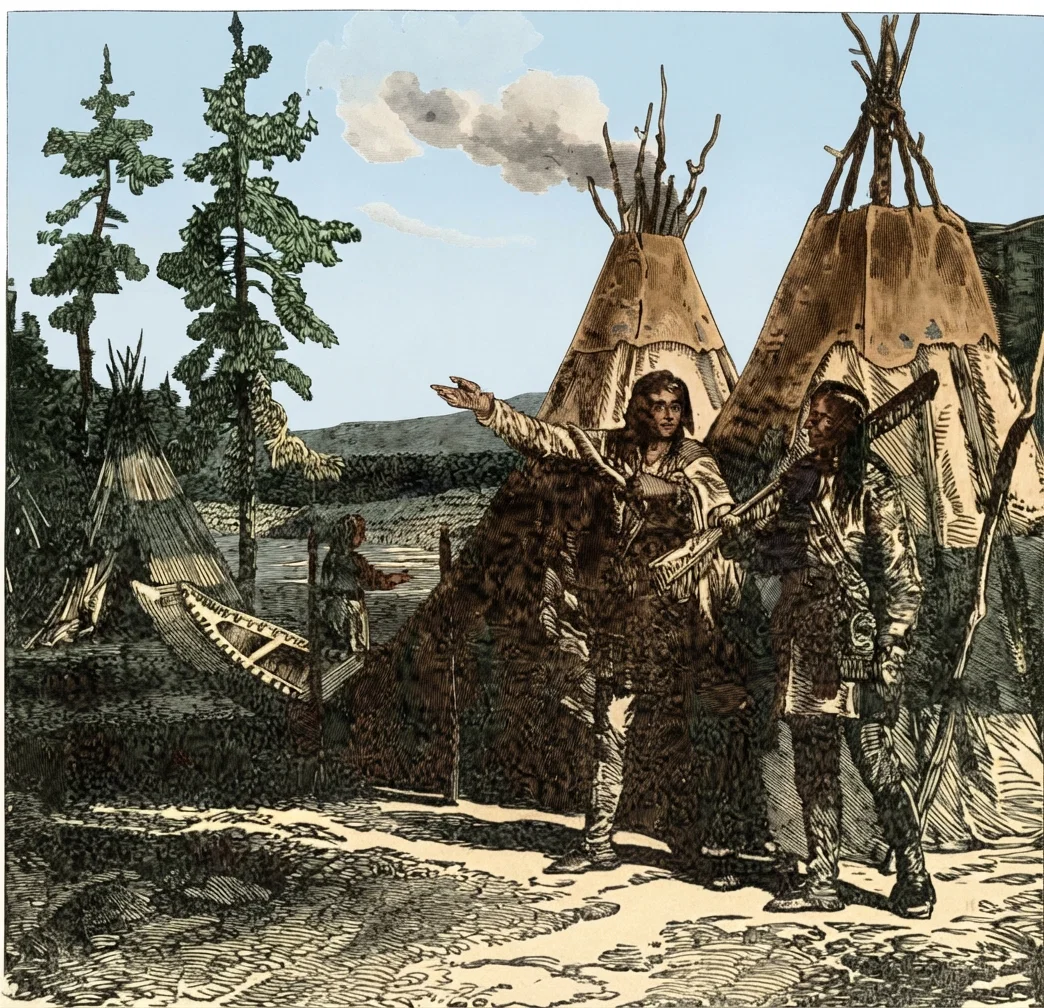
Thirty-four years ago I left England for the great northwest, going by way of New York, and then up through Minnesota into the great lone land, with its mighty forests and its miserable savages. A few months ago I was called to revisit some of the scenes of my early ministry. I looked at an old Indian with gray hair and wrinkled face, but with the light of God's peace upon his countenance, and his hand upon his Bible, that he loved so dearly. I asked the old man why the "big praying Book," as they call it, was so dear to him. The old man answered: "Big night, all dark, no light. Do not know where to put my feet. Dark night, dark above, very dark. Within, big dark night. This Book was like the sun rising. It showed me where to put my feet. Its words were sweet. Everything that I have got is between the covers of this big praying Book; everything I have is within the Book, and so I keep it near me." Will you please tell me what other book I could put into the hands of that Dakota Indian that could give him the comfort and the hope of this blessed Bible?
Much of our work is among the Ojibway and Kree Indians. When I first went to them I had a great big box of books. They said they did not want the books, that they would only bring them trouble. They could not eat the books, and they would make trouble with their wives and conjurers. Most of these people were polygamous and under the power of the witch doctors, and they knew the Bible would break up all these things, and it has. The very physical appearance of the country has been transformed. Peaceful, happy homes and smiling fields and gardens take the place of the once dreary wilderness. And woman, O, how she has been elevated! Under heathenism the Indian woman has to take a back seat everywhere. She paddles the canoe, while the man11sits in a comfortable blanket in the middle of the boat. When they come to a portage, the woman carries the boat. When the time for eating comes, she gets out the fish and cooks it, and then the man sits down and eats it, and if there is anything left she gets it. But when the Gospel comes woman takes her true place.
There was an old Indian who gave me much trouble. He had five wives and he used to beat them cruelly. There was one older than the rest that he disliked most of all, and he had beaten her until she was quite mutilated from his blows. One morning he called them into his wigwam and told them that they were all free, that the big Book had shown him that he was bad. He told them he was sorry and now in a few days he was going to get the praying water put on him (baptism), and then he was going to get married to one of them. And, sure enough, the day he was baptized he married the old, mutilated, despised wife, and set the others free. What power but the Gospel of Christ could ever have made a selfish human heart to act like that?
On another occasion it was necessary to take the missionary from a station and send him far into the interior to a neglected field. I went to the station and called the Christian Indians together and made the proposition to them. I said:
"Now, I have a big question, a very big question, to ask you; open your ears wide. I want you to lend me your missionary for six months, that I may send him to the people far away, who know not God and never heard a word about this Book. Do let me have him, and I will promise you that I will let you have him back in six months. Now, what will you do when he is away, about your sermons and meetings?" I waited awhile, and then an old Christian Indian arose and said the white man was very foolish. He said:—
"Now, don't you know that the white man can not take away God's Book? You sermon-making men, you are full of words, you never stop talking, but this Book is God's Book, and there is a boy here that can eat this Book (he meant read it), and so I will have him read it to me the day after the praying day (Monday), and then I will go to the Big Chief in heaven and ask him to make me understand it, and I will think about it all the week until the praying day, and then the Big Chief will go with me, and we will talk to the people all that he has told me."
So the arrangement was made, and the missionary left for the distant station. Two months later I visited the station that had been bereaved of its pastor. They asked me to preach, but I said, "No, I will listen." And the old man said, "Yes, that is very wise, it is a much bigger thing to listen than to preach," and so he began to talk. He said:—
"There were two boys that the big Book tells about. One was foolish and the other was very foolish. One went away and left his father, and did very bad; but the other one that staid home was more foolish, because he grumbled when he ought to have been glad when his brother gave up his foolishness and came back to his father."
I wonder if seminaries can produce as good preaching as that. Ah! it is the God back of the Book that triumphs. How this work brings us in touch with God! Beloved, it is not sitting here and singing that makes us happy, but it is to go out and make others happy with his love. You must go out and see its triumphs among the heathen.
Let us describe a visit to what we call our baby mission. After a long journey we reached the place about one o'clock in the morning. Our host, Mr John Rattlesnake, got up, made a fire, and gave us some fish to eat. We told him what we came for. We came with a big message that filled our hearts—God loved them and wanted them to know him. So in the morning John went out and beat his frying-pan with a stick, as the church bell, and the people came and we had some hymns. Then we talked to them from the Bible, and then I said:—
"Now let us stop talking and let God talk. Are there any of you that want anything from God? If so, let him stand up and say so." Then an old woman stood up and said: "I do not know anything about God, but your words are good. I want you to tell God who I am, and that I would like him to help me and give me power to keep his words, for I do not know how." Then another woman got up and said: "I want you to tell God about me. I have two boys; I am afraid they will walk crooked. I want him to make them good." And then we prayed. Some of them were converted and our hearts were so happy. That night we did not go to bed at all, but just talked and prayed all night.
Next day we went over to see some Indians that had not been there. And there was a poor boy lying on a wretched thing called a bed. He had been a year and a half there. I sat down and talked to him and asked him if he ever got anything from God. He said, "Many things." I asked him if he ever thanked God for those things, and he said, "No, I did not know where he was."
"Would you like to thank God?" And then, do you believe it, that poor, emaciated creature crawled off his bed and stood up and stretched up his right hand to heaven, and said:—
"O Big Chief in heaven, I got your things and I never said a word to thank you. I took them and used them. I am so sorry now and thank you. If you will give me more things, I will always thank you. I liked the things, but I would like to know yourself more than the things."
Ah, friends, that poor heathen boy will be nearer to Christ in heaven than some with finer prayer-books and more cultured prayers!
In one station we have 1,200 Indians, and there is not a single heathen on the place. When an old Ojibway Indian becomes a Christian, he is out and out for God.—The Christian and Missionary Alliance.
THE MAKING OF BIG GUNS.
THOSE tremendous engines of destruction, solid pieces of steel, some of them weighing over sixty tons, what a costly piece of mechanism one of them is! Says Harper's Round Table:
'It has a chamber running nearly its entire length 13 inches in diameter. At the breech of the gun that chamber is enlarged to a diameter of 15½ inches for 6¾ feet. The long tube of the gun is strengthened by an enormous band, reaching almost half its length, and called a 'jacket,' and in addition it has what is called a hoop or band, with the appliances whereby the gun is fastened or locked to its carriage. Inside the tube of the gun there are about 50 spiral grooves, which give the projectile or long bullet a twist as it leaves the gun. That twist causes the projectile to turn nearly 75 times a second as it plunges through the air. This projectile weighs 1,100 pounds, and it requires no less than 500 pounds of powder to give it its full force. Every discharge of the gun costs in powder and projectile fully $600. The cost of one of these guns is not far from $100,000.
'To make one of these implements of war requires not only great skill, but the use of very costly machinery. Not only must the steel be cooked in enormous furnaces, but it must be seasoned as delicately as the most expensive dish for a banquet. Chemistry is called upon to say just when the metal of which the gun is made is of the proper degree of purity. Then the steel is cast into a long casting. When it is cooled it is forged or elongated under pressure while hot. Then it is 'turned' outside and inside on enormous lathes. Then it is tempered, so as to harden the metal and to distribute the molecules evenly through the mass, to prevent dangerous strains and bursting when the gun is fired. Then it is 'turned' again outside and inside with absolute accuracy as to size. Then the powder chamber is finished, and the mechanism for the fastening of the breech-block is made. Then the gun is ready for its carriage, without which, of course, it could do no work.'
THE JAPANESE FIREPLACE.
By Religious Herald
The kotatsu, or fireplace, is a very important feature of the winter life in Japan.
Its beginning is a hole in the floor from one to two feet square; in this an iron pot is sunk, in which live charcoal is piled. Then a wooden frame or rack, big enough to cover the hole, and about a foot high, is placed over this; and over all is thrown a large, thick quilt, the edges of which spread far out into the room. This is the heating apparatus of the house, and around it the family spend all their leisure time. The method of sitting is to put either one's feet or one's knees to the fire, and draw the quilt up as far as possible over lap, hands, and arms. On top of the quilt, where it falls over the frame, is often put a large, square, polished board, which serves as a table.—Religious Herald.
TRIFLING WITH DANGER.
By William Taylor
I WAS sitting at the table of an Irish merchant in S— a few years ago. He had eight beautiful children. He had his wines and brandy on the table, and of course asked me to drink, and I had to give my reasons for declining. This gave me an opportunity to put in a little temperance, and, while I was making my little speech by way of apology, I made this remark: 'I would like to see the man who could truthfully say, 'No relative or friend of mine ever fell through intemperance.'' I saw that this had struck him; his knife and fork fell from his grasp, and he remained silent for some seconds.
'Well,' said he at length, 'I am not that man. My first Sunday-school superintendent was a man of genial spirit and noble mien. He went into the wine trade, and died a drunkard before he was forty. My first class leader, I believe, was a good, intelligent, useful man; but he, too, yielded to the habit of intemperance, and died a drunkard. My own father suffered through intemperance.'
'Yes,' I exclaimed, 'and you yourself are parading before your friends and your children the instruments of death which slew your first Sunday-school superintendent, your first class leader, and your father. The very rope with which they were hung, you are adjusting to catch your own children. I can not afford to put my head in such a halter as that.'—W. Taylor.
"THE GRUMBLE FAMILY."
DID you ever hear of this family? O, so many belong to it! They are all over the world, and you can tell them just as soon as you see them.
They travel a good deal, too, on steamboats and cars; yes, and they stop in hotels.
The big family are all the time on the watch for something to grumble about. You can't suit them any way, no matter how hard you try.
Don't grow up to be grumbly children; you will never be liked if you do, and the family is too large already.
Look bright and cheerful and happy, satisfied with everything that is done for you. Join that other large company, the "happy family," and so bring comfort and cheer to everybody about you.—Observer.
BLASTS FROM THE "RAM'S HORN."
THE devil often wears a white cravat.
The world is full of religion that did not come from Christ.
Joy that isn't shared with somebody else soon becomes moldy.
If God puts mountains before us, it is that we may obtain nearer views of heaven from their summits.
No woman can be a good housekeeper who does not hate dirt.
EVERY-DAY WORK.
GREAT deeds are trumpeted; loud bells are rung,
And men turn round to see;
The high peaks echo to the peans sung
O'er some great victory.
And yet great deeds are few. The mightiest men
Find opportunities but now and then.
Shall one sit idly through long days of peace,
Waiting for walls to scale?
Or lie in port until some "Golden Fleece"
Lure him to face the gale?
There's work enough. Why idly, then, delay?
His work counts most who labors every day.
A torrent sweeps adown the mountain's brow
With foam and flash and roar.
Anon its strength is spent; where is it now?
Its one short day is o'er.
But the clear stream that through the meadow flows,
All the long summer on its mission goes.
Better the steady flow; the torrent's dash
Soon leaves its rent track dry.
The light we love is not the lightning flash
From out a midnight sky,
But the sweet sunshine, whose unfailing ray,
From the calm throne of blue lights every day.
The sweetest lives are those to duty wed,
Whose deeds, both great and small,
Are close-knit strands of one unbroken thread
Where love ennobles all.
The world may sound no trumpets, ring no bells;
The Book of Life the shining record tells.
—Selected.
Caste and the Plague
ONE of the great barriers in India to the work of prevention of the bubonic plague and the cure of plague patients is the accursed system of caste in vogue in India. One writer says that "a man prefers to die in his windowless, blood-poisoned hut, rather than break his caste by going to a hospital where a man of another caste has previously taken refuge." They know not of the truths, "God is no respecter of persons," and "all ye are brethren."
THE WILD NATIVES OF MASHONALAND.
IN Mashonaland there are, besides large numbers of natives who are brought into contact with the whites, tribes of wild natives. The bishop of Mashonaland, in Mission Fields for June, tells of an interview with a powerful chief of an ancient race:—
“I had an interesting but sad visit to the perfectly savage chief M'tasa, where we have begun a small work. He had been drinking, and was in a morose and sullen mood. He said the teacher was his friend, but why did the white man take his country and his cattle and his women? I told him that I had nothing to do with the government, and I had to pay taxes, and obey the queen's laws, as well as himself, and that the laws were for his protection as well as mine.
“I then rebuked him for allowing white men to bring whisky amongst his people, and warned him that the great Spirit would take the kingdom away from him unless he protected his people from evil and governed righteously. He said we might teach his people, and the missionary was his friend. M'tasa is the paramount chief in this district, and represents the old dynasty of the Monomotopo, dating from 1000 B.C. at least, but how degenerated by their native worship, their Baal and Astarte, their Chiun and star-gods, their Moloch and five demons, their divinations and their sorceries, their animal and material worship, and their degradation of all national, social, and the individual life by the triple tyranny of slavery, polygamy, and witchcraft!”
OUR WORK AND WORKERS.
By Editor
ELDER A. E. PLACE reports the baptism of five adult candidates at Williamstown, N. Y.
BIBLE-WORKERS report that ten persons have accepted the Sabbath of the Lord in Houston, Texas, within three months.
ELDER M. A. ALTMAN reports the organization of a church of eight members at Fort Morgan, Colo., and the baptism of four candidates at Sterling.
ELDER W. T. KNOX has been chosen to fill the place on the St. Helena (Cal.) Sanitarium board made vacant by the death of Elder Wm. Ings.
A LOCAL camp-meeting will be held at Brenham, Texas, July 14 to 21. The State camp-meeting will be held at Fort Worth, July 30 to August 9.
ELDER D. C. BABCOCK gives notice that he will be at Kilmarnock, Va., July 3 and 4, at which time the new house of worship will be dedicated.
THROUGH an invitation to preach in the Baptist Church at Burton's Creek, Va., such an interest was aroused that Elder J. P. Neff has pitched a tent there, and reports a good attendance.12ELDER L. D. SANTEE notes the organization of a church of eleven members at Peoria, Ill., with as many more ready to unite. A new tabernacle is being erected.
ELDER H. W. DECKER has been elected president of North Pacific Conference. Elder W. M. Healey, who had been president for three years, has returned to his home in California.
IN the report of Elder R. A. Underwood in the Review we notice mention of the organization of a church of twenty-two members at Erie, Pa. Elder L. S. Wheeler has been laboring there.
TENT meetings have again been instituted in Louisville, Ky., by Elder J. W. Collie and a corps of assistants. Among the number is Sister Hattie Andre, who spent about four years as teacher on Pitcairn Island.
AT the recent session of the Upper Columbia Conference, Elder R. S. Donnell was reëlected president of the conference and tract society. Elder W. W. Steward was chosen president of the sabbath-school association.
IOWA Conference has reëlected Elder C. Santee president of the conference and tract society. Mrs. L. Flora Plummer was chosen secretary of the conference, and Miss Jessie V. Bosworth secretary of the tract society.
ON Sabbath, May 15, fifteen members were added to the church at Omaha, Neb. The Christian Help work and work with the Signs of the Times are receiving special attention. The Bible workers are also kept busy. So says Brother A. J. Howard.
WE learn from Field Tidings that the following named persons recently left England for South Africa: Elder O. A. Olsen and wife, G. T. Kerr and wife, Prof. J. L. Shaw and wife, and Elder Frank Armitage and wife and child. The last named go to join the Matabele Mission. Elder Olsen will remain in Africa for at least six months, perhaps twelve.
AT the general meeting for the Maritime Provinces, held at Hopewell Cape, N. B., in May, there were about one hundred and twenty-five present. As instructors there were Elders R. A. Underwood, R. S. Webber, G. E. Langdon, H. J. Farman, and Brother F. W. Morse of Toronto. During the meeting six candidates were baptized. There was a good outside attendance. There are now two tents in that field.
ELDER D. T. BOURDEAU, who has been laboring among the French on the Michigan peninsula, reports the baptism of eight persons at Wilson, five of whom had been members of the Catholic Church. And others had decided to accept the message he was giving to the people, notwithstanding the fact that there was great opposition by French ministers, who declared that they would "destroy the last rag of Adventism."
FROM Elder C. McReynolds' report in the Review we cull some items of interest regarding the work in Texas. Seven were added to the church at Mt. Pleasant, after a ten days' meeting. In Cass County a church of twenty-four members has been established, and a house of worship erected. At Dallas eight were added to the church, six by baptism. At Hutto, where Elder J. P. Lorenz was laboring in the interest of the German population, eight members were added to the church by baptism. There were six accessions to the church at Austin, where Brother Abel Gregory was laboring.
THE officers of the California Conference for the ensuing year are as follows: Conference executive committee, Elders W. T. Knox (president), N. C. McClure, R. S. Owen, M. C. Wilcox, G. W. Reaser, E. E. Andross, and H. F. Courter; secretary, J. J. Ireland; treasurer, Pacific Press; auditor, M. H. Brown. Trustees of the California Conference Association: W. T. Knox, N. C. McClure, H. F. Courter, C. H. Jones, E. A. Chapman, Reuben Gray, and E. E. Parlin. Tract and missionary society: President, W. T. Knox; vice-president, M. C. Israel; secretary, J. J. Ireland; corresponding secretary, Hannah Mott. Executive committee of the sabbath-school association: Henry Scott (president), F. M. Burg (vice-president), Mrs. M. T. Poston (secretary and treasurer), M. H. Brown, A. J. Osborne. The board of control of the Home of the Friendless is composed of W. T. Knox, C. H. Jones, J. J. Ireland, E. E. Parlin, Mrs. E. H. Mattner, Mrs. H. S. Maxson, M.D., and Mrs. C. H. Jones.