The Youth’s Instructor, Vol. 47, No. 38.

CAPTAIN ALFRED DREYFUS
Earlier text: CAPTAIN ALFRED DREYFUS

HORSE-CHESTNUTS

GRANDPA was starting out for his morning walk; and Harold, George, and Annette ran after him, to ask if they might go, too. They dearly love a walk with grandpa, and he is always glad to have them.
It was a warm morning, but all along the street were rows of large trees, whose spreading branches made it cool and shady.
“I wonder,” said Annette,—you would hardly believe how many times a day Annette says “I wonder,”— “why we call these trees horse-chestnut trees.”
“Oh,” said Harold, who says “I guess” as often as Annette says “I wonder,” “I guess it must be because the nuts are as much bigger than the chestnuts we eat as a horse is bigger than a man.”
“No,” said George, who seldom guesses, but can almost always tell you something he has heard or read, “John, down on the farm, told me last summer that they are good for horses to eat when they have colds and coughs. That’s the real reason they are called horse-chestnuts, isn’t it, grandpa?”
Grandpa smiled. “It is a very good reason,” he said, “but I am not sure that it is the only one. What do you think of this?”
He broke a stout leaf-stalk from one of the lower branches of the tree under which they were passing, and held the thick end of it for the children to see.
They looked at it closely for a moment, and then each gave a little exclamation of surprise.
“Why, it’s exactly like a tiny horseshoe!” cried Annette.
“So it is,” said the two boys, “with marks for the little nails and all!”
And when they had examined the ends of several other stems, which grandpa obligingly broke off for them, and found them all alike, they agreed that this was the most curious and interesting of all the reasons for the name of the horse-chestnut tree.—Youth’s Companion.

GOOD AND BAD FRUIT

ALL of you, dear children, are little trees that God has planted in his garden. You know that all trees are not alike, but we can tell the nature of the tree by the fruit that it bears. “The tree is known by his fruit.” Jesus says, “He that abideth in me, and I in him, the same bringeth forth much fruit.” This fruit is shown in the life: if we abide in Jesus, his life will be in us, and we shall live as he lived when he was upon the earth.
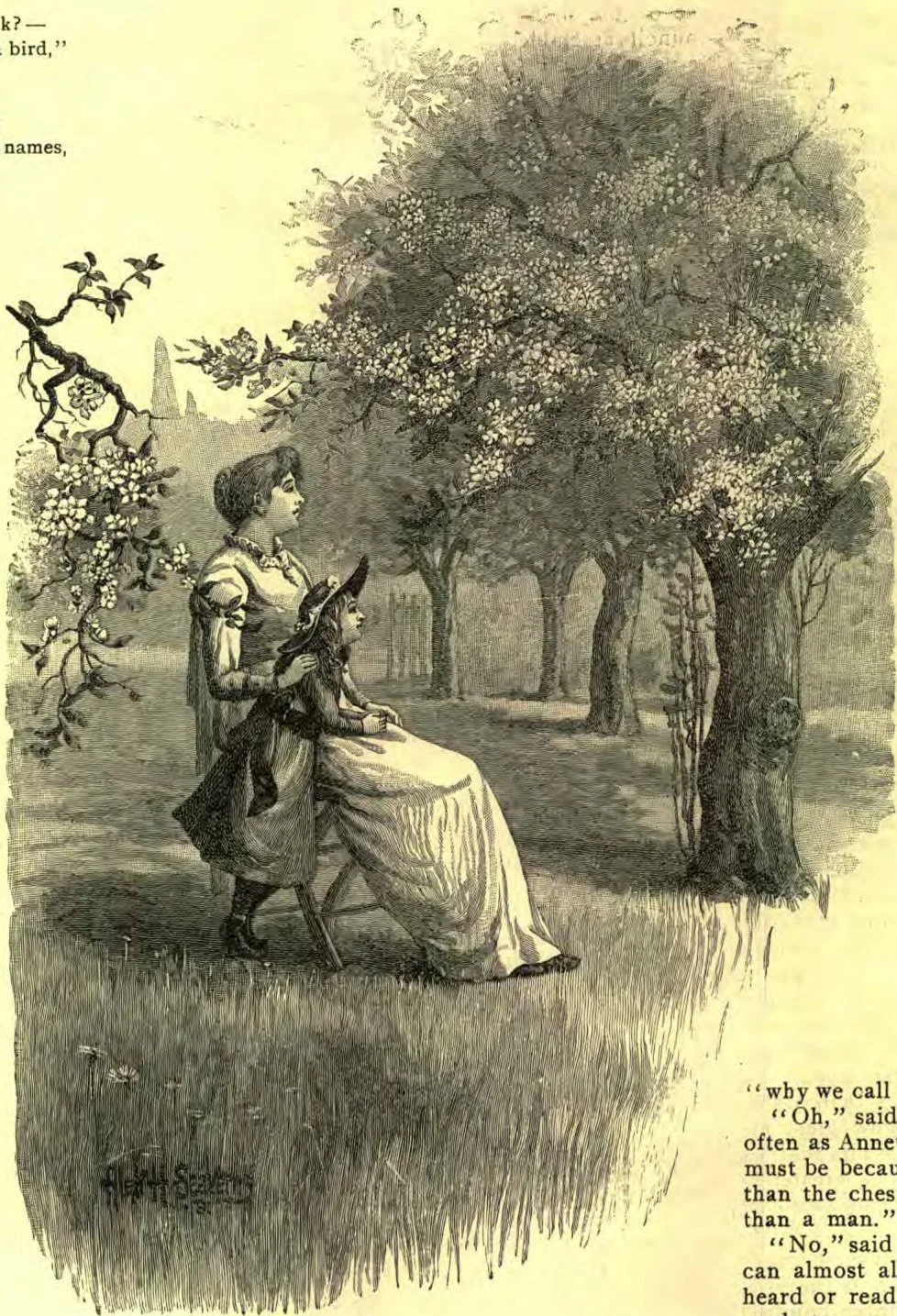
IN BLOSSOM TIME.
IN BLOSSOM TIME.
If there is a tree in the orchard whose name you do not know, you will watch to see what kind of fruit grows on it, and then you will know. If it is an apple-tree, it ought to have apples on it; and at the right time of year it will, if it is a good tree. “Ye shall know them by their fruits. . . . A good tree can not bring forth evil fruit; neither can a corrupt tree bring forth good fruit. Wherefore by their fruits ye shall know them.”
If we are rooted in Jesus by faith, believing in and loving him, we shall draw his sweet life into us continually, and give it out in good fruit. But God’s word tells us of another root,—the root from which those bad trees spring that bring forth evil fruit. Satan is this deadly root, the one from which comes all the bad fruit found in the lives of the people in this world.
Very early in the history of the world we find these two kinds of fruits growing here. Look at the first two brothers who ever lived on this earth, and see what kind of fruit they bore.
Almost the first thing that we learn of Cain, the first-born son of Adam, is that he was jealous of his brother Abel. And this feeling of jealousy that he allowed Satan to put into his heart, was the bad seed that brought forth the hatred that led him to kill Abel.
Envy, hatred, murder,—you will find all these mentioned in the list of bad fruits given in the fifth chapter of Galatians, contrasted with the sweet fruits of the Spirit of Jesus. Then what sort of tree was Cain? From what root did he come? You will find the answer in the third chapter of the first epistle of John: “For this is the message that ye heard from the beginning, that ye should love one another. Not as Cain, who was of that wicked one, and slew his brother.”
Of all such trees, which are of the wicked one, and so can bring forth only the bad fruit that comes from this root, we are told what the end will be: “For, behold, the day cometh, that shall burn as an oven; and all the proud, yea, and all that do wickedly, shall be stubble: and the day that cometh shall burn them up, saith the Lord of hosts, that it shall leave them neither root nor branch.” Satan, the root, and his followers, the branches, will be destroyed, and only those who abide in Jesus and bear good fruit will remain.
But of Abel, the brother of Cain, we are told that “by faith” he offered unto God an acceptable sacrifice. Faith, you will remember, is one of the good fruits of the Spirit, and the one that brings to us all the other fruits,—love, joy, peace, gentleness, and goodness. For it is faith that brings Christ Jesus to dwell in our hearts, so that his life may flow out in all these good fruits.
These two, Cain and Abel, were brothers, living in the same home, having the same teaching from their father, and the same blessings from God, yet one became a bad tree, bearing evil fruit; while the other was a good tree, bringing forth the fruits of righteousness.
Have you noticed how the life-giving sunlight shines on every part of the land, and how the gentle, refreshing rain falls over all the earth, on all the trees and bushes and plants; yet some bring forth only thorns and thistles, briars and poison berries, while others bear beautiful, fragrant blossoms and useful fruit? It is just so in the Lord’s garden, where his human trees are planted. His gentle, loving, tender Spirit comes to each one, pleading with all, seeking an entrance into the hearts, and drawing them to God. Those who yield to his movings, and open their hearts to his sweet influence, he will fill with good fruit, just as the rain and the sunshine load the trees with fruitfulness. But those to whom he comes in vain, who harden their hearts by refusing to let him in, will bring forth only thorns and briars and bad fruits, “whose end is to be burned.”
Dear children, which will you be? You may choose now, if you will let the Spirit of Jesus fill you with his life, and make you a good tree that brings forth only good fruit; or if you will grieve him away, and quench the sweet sunshine of his presence, and so bear no fruit to his glory.
EDITH E. ADAMS.

THEIR OWN NAMES

I knew a charming little girl, Who'd say, "Oh, see that flower!" Whenever in the garden On weeds she spent an hour; And sometimes she would listen, And say, "Oh, hear that bird!" Whenever in the forest Its clear, sweet note she heard.
But then I knew another — Much wiser, don't you think?— Who never called the bird "a bird," But said the "bobolink," Or "oriole," or "robin," Or "wren," as it might be; She called them by their first names, So intimate was she.
And in the woods or garden, She never picked "a flower," But "anemones," "hepaticas," Or "crocus," by the hour. Both little girls loved birds and flowers, But one love was the best; I need not point the moral, I'm sure you know the rest.
For would it not be very queer, If when, perhaps, you came, Your parents had not thought worth while To give you any name? I think you would be quite upset, And feel your brain awhirl, If you were not "Matilda Ann," But just "a little girl." —Independent.

(October 7, 1899)

SABBATH-SCHOOL LESSON—NO. 1

(October 7, 1899)

ANOINTING OF JESUS IN THE HOUSE OF SIMON

Memory Verses.—Mark 14: 6–9.
Time: A. D. 31. Place: Bethany. Persons: Simon the leper, Mary Magdalene, Martha, Lazarus, Jesus, disciples, Jews, chief priests.

QUESTIONS

1. What place did Jesus visit just before his last Passover? John 12: 1. What special friend resided here? Id. What was done at this time in honor of Jesus? By whom? V. 2; Mark 14: 3;
2. Who were present at the feast besides Jesus and his disciples? John 12: 2.
3. As they were reclining at the table, what did a certain one do? Mark 14: 3; Who was it that thus anointed Jesus? John 12: 3. Besides anointing his head, what else did she do? Id.
4. By whom and with what words was Mary’s act of love criticized? Vs. 4, 5. What motive led him thus to criticize? V. 6. Influenced by the example of Judas, what were the feelings of the other disciples? What did they say? Matt. 26: 8, 9; Mark 14: 4, 5.
5. Hearing their criticisms, what rebuke did Jesus administer? V. 6. What did he say was the real meaning of Mary’s act? Id.; Matt. 26: 12; John 12: 7. To show that she was right in expending this valuable ointment upon himself rather than the poor, what did Jesus further say? Mark 14: 7.
6. What blessed promise for the encouragement of Mary, as well as of all his people to the close of time, did Jesus then utter? V. 9.
7. Stung by Jesus’ rebuke, what did Judas do? V. 10; How was he received by the priests? V. 11. For how much did he agree to betray Jesus? Matt. 26: 15. From this time forth, what purpose did Judas constantly cherish? V. 16.
8. Who besides Jesus was at this time attracting much attention? John 12: 9. What was the effect of his work? V. 11. What therefore did the priests plan to do? V. 10.

NOTES

ADVICE TO BOYS

WELL, boys, on account of the break in the lessons, you may be thinking that I have forgotten you. This is not so, however. I think of you every day; but on account of sickness in my family, it became necessary to postpone for a while the building of our cottage. We were about ready to draw plans for it, previous to its construction; but I wish to have a little talk with you before we take up the work again, hoping to impress upon your minds the importance of intelligence and thoroughness in any line of work with which you may connect. Especially is it important, in building, to have a correct understanding of what you wish to make before you begin.
There comes to my mind just now the circumstance of a cooper bringing to the shop where I worked as an apprentice a cheese-tub to be painted. He had made it himself,—and it was not a job to be proud of. I am sure none of us wish to do our work in that way, but desire rather to do it as nearly perfect as possible.
It has always been my motto that “what is worth doing at all is worth doing well.” No doubt you have many times heard it said, by persons who knew they had done a poor job, “Well, it is good enough.” It is good enough, boys, when it is right. Set your mark at perfection, and do your best to reach it.
When about to build a house, a man sometimes thinks, “Well, I do not need an architect’s plan to build from. I can make a plan myself.” So he gets a piece of paper, and begins to mark out his house. He will make it a certain number of feet square, will have a parlor twelve by fifteen feet, a hall six feet wide, and other rooms to suit his fancy. Having made his plan, he builds the foundation wall, and puts up his house, afterward finding that he has lost a foot and a half because he did not allow for the outside wall and partitions.
I had two uncles, one of whom was an excellent musician, and taught “singing school” all his life. The other did not know one tune from another. In speaking of singing, persons would sometimes say, in the presence of the latter, “Here is Norton; he can sing without any tune.” But, mind you, he never made any music.
To understand the folly of trying to build a house without knowing just what you wish to make, and without correct plans by which to work, you have but to examine a house that was once erected in Battle Creek. The builder discovered, after the frame was all up, that it was topsy-turvy, or wrong side up. The second story was higher than the first; but as the work was so far along, he had to finish it that way.
There are three important things for a builder to remember: First, to have things square; second, to have them level; third, to have them plumb.
I once knew a carpenter who took a job of siding up a house with matched ceiling. He thought the stay-laths were in the way, and knocked them off. When the job was done, the front of the house was four inches out of plumb. It was too late to remedy it, and thus it stands to-day.
Be careful in all your work. Haste often makes waste. As Elder White used to say, “Make haste slowly.” Benjamin Franklin, in “Poor Richard’s Almanac,” says: “For the want of a nail, the shoe was lost; for the want of a shoe, the horse was lost; for the want of a horse, the rider was lost; being overtaken and slain by the enemy, all for the want of care about a horseshoe nail.” He also says, “He that hath a trade hath an estate; and he that hath a calling hath an office of profit and honor.” When I am about my work, I often think that the carpenter’s trade is the most honorable of trades; for our Saviour followed it from his boyhood until he began his ministry. Let us follow the pattern he set for us, and try to do faithfully all that we undertake.
W. K. LOUGHBOROUGH.

NOT TO BE BALKED

A COMPARISON made by an old carpenter twenty years ago may be applied in a much wider sense than he had in mind. He was speaking of two boys, brothers, who had been sent to him to learn the trade. They were bright boys; and their father, in telling the carpenter of his pleasure at their progress in their work, said he could not see but one had done just as well as the other.
“Un’m!” said the carpenter. “I presume to say their work looks about of a piece, but I’ll tell you the difference between those two boys: you give Ed just the right tools, and he’ll do a real good job; but Cy, if he hasn’t got what he needs, will make his own tools, and say nothing about it. If I was cast on a desert island and wanted a box opened, I should know there’d be no use asking Ed to do it unless I could point him out a hammer. But Cy!” added the old carpenter, with a snap of his fingers, “the lack of a hammer wouldn’t stump that boy! He’d have something rigged up and that box opened, if there was any open to it. I suspect Cy’s going to march ahead of Ed all his life.”
Twenty years have proved the truth of the words; for while the boy who “made his own tools” is rich, his brother is still an ordinary workman.—Youth’s Companion.

THE IDLE FOOT

A LADY was watching a potter at his work, whose one foot was kept with “never-slackening speed, turning his swift wheel round,” while the other rested patiently on the ground. When the lady said to him, in a sympathizing tone, “How tired your foot must be,” the man raised his eyes, and said, “Ma’am, it isn’t the foot that works that’s tired; it’s the foot that stands! That’s it.”
If you want to keep your strength, use it. If you want to get tired, do nothing. As a matter of fact, we all know that the last man to go to for a helping hand for any new undertaking is the man who has plenty of time on his hands. It is the men and women who are doing most, who are always willing to do a little more.
The people who are tired of life are not those who work, but those who are too proud or too lazy to do so. Many of the rich are morbidly restless, while those who have to earn their daily bread are comparatively contented and happy. The Bible says that “the sleep of a laboring man is sweet, whether he eat little or much;” and the busy worker has health and blessing that the listless idler never knows.
—Selected.

Purposes Perish by Procrastination

“Purposes perish by procrastination.”

The Missionary Reading-Circle

“IT IS THE DUTY OF THE CHURCH TO LET ITS LIGHT SHINE”

But the church, like the wise virgins in the parable, must have oil in its lamps if its light is to continue. One filling will not last always; they must be constantly replenished with the truths of God’s word, a prayerful study of which is always accompanied by the presence of the Holy Spirit, the source of all light.
For this study of the fundamental doctrines of the gospel the “Berean Library” has been planned. Its issues will offer our best books in a form so cheap that all can procure them. The first number, “Steps to Christ,” is already out, and the next, “Thoughts on Daniel,” will be ready soon. Every three months a new number will be published. It is planned to carry on a systematic course of study of the Bible and these publications, beginning the first of October. It is greatly desired that every Seventh-day Adventist family shall join in this reading course, which all must see will be productive of unmeasured good, if carried out.
The “Review” and the “Missionary Magazine” (150 Nassau Street, New York City) will contain lessons from the “Berean Library” issues, which will be of great help in this study, and will enable all to work in unison.
For years there has been a demand for our books in a cheaper form by those who felt unable to pay the regular price. This has been especially true of the larger subscription books. Now this demand can be at least partly met. Just think of obtaining “Thoughts on Daniel” and “Thoughts on Revelation” for twenty-five cents apiece! And even this price is reduced by subscribing for a year, as a year’s subscription includes four numbers, and the price is only seventy-five cents for all when ordered that way.
“There are scores who have real ability, and are rusting from inaction; and yet many of them do not know how to set themselves to work for the Master. But let some one who has ability to devise ways whereby this talent may be utilized, lay out before these inactive ones the line of work that they could do, and let them understand that this is expected from them, and many who are now unemployed will become true laborers.”
This Reading-Circle is one plan set on foot for this purpose. When a person is himself filled with the truth, he will communicate it to others. This plan will accomplish this for each one who thoroughly enters upon it.
It is proposed that each church elder, and the leader of each unorganized company, shall see that every one in his flock is supplied with the “Library” as it is issued, and that a regular Reading-Circle be organized before the date mentioned, October 1. Let all take hold of it in earnest.
Address your State tract society, or the REVIEW AND HERALD PUB. CO., Battle Creek, Mich.

Organizing Missionary Reading Circles for Home and Field

Now is the time to think and plan for the Missionary Reading-circles, including the study of the message and the study of the field. One of these circles should be formed wherever there is a Seventh-day Adventist. Where three or four Sabbath-keeping families live near one another, a neighborhood circle might be formed; but this work is pre-eminently adapted to the home circle, isolated Sabbath-keepers, and those who, for various reasons, do not have the privilege of meeting with others of like faith. The study of the truth will fill every heart with a love for it and a desire that others may have it; and a study of the field will give an intelligent sense of its needs, and the opportunities for labor. May these circles widen till all have heard the good news of the Saviour’s soon coming.

A LOST DAY.

Where is the day I lost,— The golden day,— Beyond all price and cost, That slipped away
Out of my wandering sight, My careless hold? Where did it lift in flight Its wings of gold?
What were the treasures rare It bore from me? What were the pleasures fair I shall not see?
Ah, never day was yet So fine, so fair, So rich with promise set, So free from care,
As that we mourn and sigh When we do say, “Alas! how time doth fly; I’ve lost a day!”
— Selected.

Office Young People Form Missionary Reading Circle

About thirty of the young men and women employed in the Office met Sunday evening, September 17, to form a Missionary Reading-circle and a society for active missionary work. Officers were elected, and meetings will be held weekly. We hope to give reports of the work from time to time.

Discerning the Signs of the Times

“The days are growing short,” we say; “fall is here, and winter is coming.” These frosty mornings whiten our breath, and make us shiver in thinking of colder days to come. We make things snug about our homes, and lay in a supply of food and fuel for the long, cold months that we know are coming. In thinking of these things, how forcibly the words of the Saviour to the unbelieving Jews come to mind! “Ye can discern the face of the sky,” he declared to them, “but can ye not discern the signs of the times?” As in that day, so in this, men are far more willing to discern what will immediately affect their temporal affairs than to give heed to that which will affect their eternal interests. We are in the time of harvest, but that time is short. Signs of the end of all things increase on every hand. Oh that all would discern the signs of the times, and prepare, not for a season of cold and death, but for the coming of Him who will restore all beauty to the earth, and give everlasting life to his children!

Railroad and Ironworker Rules Against Drinking on the Job

It is a well-known fact that the railroads uphold the rule that forbids the employment of men in responsible positions, such as locomotive engineer, fireman, conductor, brakeman, or switch-tender, who indulge in a “social glass” either on or off duty. The Philadelphia Record gives the following paragraphs showing that a similar rule controls those who erect high buildings:—
“The daring men who daily swarm over the new skyscrapers that are going up all over town are not without their measures of precaution. The ironworkers themselves, as a class, are men who will indulge in a social glass whenever they feel like it, but they take good care never to go on a job when under the influence of liquor.
“However, no matter what they do themselves in their hours off, they will not permit the employment of any one in the capacity of scaffold-building or derrick-man who is known to take a drink, either off or on duty. The ironworkers themselves insist upon this, and they do it simply as a precaution of safety to themselves.
“If any one of them sees or hears of a derrick- or scaffold-man taking a drink, it is his duty to report the fact at once, and the man is watched. When proof is found, the offender is instantly discharged. The contractor might protest against such extreme action, but he has the alternative of either abiding by the rule or procuring a new gang of ironworkers.”

HE KNEW HOW

A baby beaver was caught, and given to a gentleman as a pet. Beavers, as you know, build dams in which they make their houses. But here was this poor baby living in a house where there was no possibility of his having the kind of home that he would love to have. One day when the little beaver was in the kitchen, a leaky pail was put on the floor. The moment he saw the water running in a little stream across the floor, he ran out in the yard, and appeared in a moment with a chip. The gentleman who owned the beaver was called to see him. The chip was placed in such a way as to stop the water; and the beaver hurried out and brought another bit of wood, and then some mud. Orders were given that the beaver was not to be disturbed, but allowed to work out his plan; and in four weeks he had built a solid dam around the pail in which was the water.—Sabbath Recorder.

SPECIAL OFFER.

We will send the YOUTH'S INSTRUCTOR FREE for one year to any one sending us four new subscriptions at 75 cents each; that is, for $3 we will send five copies one year, your own and four others.
Now is the time to work. Who will take advantage of this offer to secure a copy free of cost?

Self-Pronouncing S. S. Teachers’ Reference Bible.

CONTAINS the celebrated Teachers’ Helps, comprising nearly 400 pages. Also a complete series of fifteen new maps.
Description. — Imperial Seal Binding, Tuck Edges, known as “Divinity Circuit,” Rounded Corners, Full Red under Gilt Edges.
We offer this Bible, post-paid, for only _SIX NEW YEARLY SUBSCRIPTIONS_ at 75 cents; or _TWELVE NEW SIX MONTHS’ SUBSCRIPTIONS_ at 40 cents.
We will also send it, post-paid, with the INSTRUCTOR one year for $2.25. For 20 cents extra we will stamp your name in gold upon the cover.

TAKE THE Canadian Pacific Railway

for . . . CHATHAM, OTTAWA, MONTREAL, LONDON, GALT, QUEBEC, WOODSTOCK, TORONTO, BOSTON, PORTLAND, and
All points in New England, the Maritime Provinces, Great Britain, and the Continent.
Illustrated literature, time-tables, and full particulars, upon application to—
J. FRANCIS LEE, GEN. AGENT,
Passenger Dept. 228 SOUTH CLARK ST., CHICAGO.
Branch Offices: 76 Ottawa St., Grand Rapids, Mich.; Room D, Chamber of Commerce, Cincinnati, Ohio; 315 Chestnut St., St. Louis, Mo.

Grand Trunk Railway System

Time Card in Effect February 5, 1899.
C. & G. T. DIVISION.

WEST-BOUND FROM BATTLE CREEK.

LEAVE. No. 11, Mail and Express, to Chicago — 12.00 M. No. 1, Chicago Express, to Chicago — 9.00 A. M. No. 3, Lehigh Valley Express, to Chicago — 3.40 P. M. No. 5, Pacific Express, to Chicago, with sleeper — 12.55 A. M. No. 75, Mixed, to South Bend — 7.30 A. M.
Nos. 11 and 75, daily, except Sunday. Nos. 1, 3, and 5, daily.

EAST-BOUND FROM BATTLE CREEK.

No. 10, Mail and Express, to Pt. Huron, East, and Detroit — 3.45 P. M. No. 4, Lehigh Express, to Pt. Huron and East — 8.27 P. M. No. 6, Atlantic Express, to Pt. Huron, East, and Detroit — 2.25 A. M. No. 8, Lehigh Exp. to Saginaw, Bay City, Pt. Huron, and East — 6.50 A. M. No. 74, Mixed, to Durand (Starts at Nichols) — 7.35 A. M.
Nos. 10 and 74, daily, except Sunday. Nos. 4, 6, and 8, daily.
E. H. HUGHES, A. G. P. & T. Agt. Chicago, Ill. A. S. PARKER, Ticket Agent, Battle Creek.

ATTENTION!

EVERY mail brings letters of inquiry concerning the number of the INSTRUCTOR that was omitted at the time of the Michigan camp-meeting. Notice was given in No. 35 that no paper would be printed that week, and lessons for two Sabbaths were given, that there might be no break in the Sabbath-school work; but notwithstanding all this, many individuals and several clubs have written asking “why my paper didn’t come.” This explanation is written for the benefit of all such.

To Reach BATTLE CREEK

FROM CHICAGO, BUFFALO, DETROIT, OR TOLEDO,
Purchase Tickets Reading over the MICHIGAN CENTRAL
“The Niagara Falls Route.”
A First-class Line for First-class Travel between Chicago and New York and Boston. Elegantly equipped through trains pass Battle Creek in each direction daily.
R. N. R. WHEELER, Ticket Agent, Battle Creek.
O. W. RUGGLES, Gen’l P. and T. Agt., Chicago, Ill.

You have reached the end of this edition.

The Youth’s Instructor · Sep 28, 1899