The American Sentinel, Vol. 11, No. 41.

PAPAL POLICY
Earlier text: PAPAL POLICY

JOHN COTTON'S IDEA OF LIBERTY OF CONSCIENCE.

BY GEO. E. FIFIELD.
As THE SENTINEL has again and again asserted, there is, and can be, no real liberty of conscience unless men are allowed the same civil right to think, and speak, and act wrong religiously, as to think, and speak, and act right religiously, in purely religious matters as distinguished from those purely civil. This is the point that so many honest, well-meaning people fail to see. Why, say they, should I permit my brother to do wrong, when I might restrain him by law? Will he not be punished for the wrong? and will I too, not be guilty? These people forget that God knew in the beginning that some people would do wrong, and that misery, pain and death would be the result of that wrong; and that He, while knowing this, still made them as free to do wrong as to do right.
God himself refused to use any compulsion; but even after men had sinned, in infinite love, he sent his own Son to win them to the right way. When men therefore attempt to use force in matters of conscience, even to restrain men from the wrong, they at once exalt themselves above God. The fact is, no man ever, in any nation, sought to use force in religious matters, without thinking, and perhaps honestly, that he did it to restrain men from the wrong. Why did God make men free to do wrong in the beginning? Simply because there can be no liberty and freedom in the choice of the right, unless there is freedom also to choose the wrong. The statement that men may have perfect liberty of conscience to think and act right religiously, but they shall not have liberty to think and act wrong, is contradictory and self-destructive. It at once implies that some one besides the individual is to decide with reference to every thought and act, whether it is right or wrong, and then give permission accordingly. But it was for this very purpose, and only for this purpose, that conscience was given to the individual, and if conscience is denied freedom of action in this sphere, and it has no other sphere of action, then the conscience is wholly and completely enslaved. There is no room left for any individual conscience, its duties and privileges being wholly usurped by the decisions of some dominant sect in alliance with the civil power.
Thus is proven the fact that there can be absolutely no liberty of conscience unless there is as much liberty to do wrong as to do right. The discussion between Roger Williams and John Cotton turned on this very point.
Failing to see this point John Cotton, perhaps honestly enough, justified the cruel banishment of Mr. Williams, and involved himself in a maze of contradictions. Roger Williams said:—
Mr. Cotton expecteth farre greater light than yet shineth, . . . and yet, expecting more light, he must (according to his way of persecution) persecute Christ Jesus if he brings it.
To which John Cotton replies as follows:—
Doth Mr. Williams hold me so farre forsaken of common sense as to frustrate and destroy mine own expectations? If I expect more light, must I (according to mine own way) needs persecute him that brings it, yea, persecute Christ himself, if he brings it? But thus when a man's head runneth round, he thinketh all the house runneth round about him.
But what is my way of persecution, according to which, I expecting more light must needs persecute him that brings it? 1. It is but a few days ago since there came to my hand a book published by Mr. Williams, and entitled, “The Bludy Tenets,” in which Mr. Williams publishes a letter of mine, and therewith a confutation of it, touching persecution for cause of conscience. In my stating of the question, which he relateth on the seventh page of that book, he declareth my judgment to be so farre from persecuting any for cause of conscience, that he layeth it downe for my first conclusion; that it is not lawful to persecute any for conscience sake rightly informed (that is to say, bringing more and true light). 2. For an erroneous and blind conscience (even in fundamental and weighty points) it is not lawful to persecute any, till after admonition once or twice, according to the apostles direction. Titus 3:10, 11. That so, such a man being convinced of the dangerous error of his way; if he still persist, it may appear that he is not persecuted for cause of conscience, but for sinning against his own conscience. 3. In things of less moment, whether point of doctrine, or worship, if a man hold them forth in a spirit of Christian meekness and love (though with zeal and constancy), he is not to be persecuted but tolerated till God may be pleased to manifest his truth to him. 4. But if a man hold forth or profess any error, or false way, with a boysterous and arrogant spirit, to the disturbance of civil peace, he may justly be punished according to the measure of the disturbance caused by him.
It is perfectly plain to us that in all of these propositions Mr. Cotton makes himself, or the dominant sect in alliance with the civil power, the absolute judge of conscience, not only as regards the truth of the opinion entertained, but (what is far worse) as regards the sincerity of the person in entertaining it. If he regards the opinion false, or the person insincere, he justifies his persecution and this is all that any persecutor ever did. Mr. Williams saw this, and from these very words proved that Mr. Cotton justified persecution for conscience' sake. But Mr. Cotton was so far from seeing it that he proceeds as follows:—
This is the way of persecution which Mr. Williams expresseth to be mine. In all which I durst appeal to Mr. Williams's own conscience (were it not leavened with over deepe prejudice) whether in all this way there can be any crevice opening a doore for the persecution of Christ himself bringing further light?
It may be added right here that the people who persecuted Christ to death for bringing more light, did enter through this very door. They said that Christ's light was darkness, that he was a Samaritan and had a devil, and that he persisted in his blasphemy to the disturbance of the civil peace. Mr. Cotton did not see this, however, for he continues with much warmth:—
If extreme prejudice were not predominant in Mr. Williams's mind, I should stand amazed how a man of understanding could, out of such conclusions, make up this inference, which he gives in the title of that chapter, page 7. “That I do professedly maintain persecution for cause of conscience.” I that do expressly, professedly, deny persecution of any, even of hereticks, unless it be when they come to persist in heresie after conviction against conscience; how can I be said to maintain persecution for cause of conscience? But oh, the perversity and blindness of a conscience when it is left of God to be so farre transported with prejudice, as to be able to judge a cause of conscience, and a cause against conscience, to be all one.
After this need it be wondered that the National Reformers and others, while they are making themselves the judge of other people's consciences, and clamoring for laws to persecute all whose consciences differ from theirs, should so deny the intent to persecute? How near Mr. Cotton came to see that his theory made him the judge of other peoples' consciences, and thus invaded the rights of conscience, will appear from the following:—
Mr. Williams saith, That I publickly taught that body-killing, soul-killing, and State-killing doctrine of persecuting all other consciences and ways of worship but mine own, in the civil State, and consequently in the whole world, if the power or empire thereof were in mine own hand. Reply: Were it not that I have learned from the word of truth, that when men are cast out of the Church of Christ they are delivered up to Satan, and so neither their wits nor their tongues are their own, I could not easily have believed that Mr. Williams would so confidently and openly have avouched such a notorious slander.
Since the Lord taught me to know anything, what conscience or the worship of God meant, it hath been my constant judgment, and doctrine, and practice to the contrary. Besides to teach the killing of the bodies of all such consciences and ways of worship as are not mine own (italics his) is to make mine own conscience and way of worship the infallible rule and sovereign standard by which all consciences and ways of worship, throughout the world were to be regulated, yea, and as if this were a light measure of arrogance and usurpation, I make it a capital crime (a body-killing offense) for any man to swerve from my conscience and ways of worship.
This is good sound truth, even if it comes from the pen of John Cotton, but he immediately contradicts it all, and makes himself, or some one else as human or as weak as he, the infallible judge of other people's consciences by saying:—
But I durst appeal even to the conscience of Mr. Williams himself (if it were now in the gracious keeping of Christ, or of himself as in former times), that himself knoweth, I doe not thinke it lawfull to excommunicate an heretick, much less to persecute him with the civill sword till it may appear, even by just and full conviction, that he sinneth not out of conscience, but against the very light of his own conscience.
From all this the conclusion stated at the beginning is evident. There can be no liberty of conscience unless it includes as much liberty to do wrong as to do right.
These quotations are from the reply of John Cotton to Roger Williams.

ANOTHER DECISION AGAINST SUNDAY LAWS.

[From Tacoma Daily News, Sept. 29.]
THE Supreme Court decided yesterday in favor of Henry Krech on his appeal from the Superior Court.
Krech was convicted in the Municipal Court of violating the Sunday-closing ordinance in keeping his barber shop open Sunday. He has been proprietor of the Hotel Fife barber shop for ten years, and the prosecutions against him were instituted by rivals in the business. He could have availed himself of the exception to the law in favor of barber shops in connection with hotels, but insisted that he had a right to keep his place open Sundays.
The Supreme Court says that the ordinance is unconstitutional, as being special legislation, granting privileges and immunities to one class of citizens which are not allowed equally to all. If this law is valid, says the court, then the legislature would have the right to prohibit farm labor, printing and nine tenths of the employments which citizens usually engage in in this country and leave the other one tenth to pursue their vocations. The ordinance in question is deemed as special legislation, and while it is true that there have been some decisions, notably in New York, holding the contrary view, this court is satisfied that the ordinance is unconstitutional and reverses judgment with instructions to dismiss the case.

ALL SUNDAY “LAWS” OUGHT TO BE ABOLISHED.

BY H. W. REED.
WHY ought Sunday statutes to be abolished? Because such statutes are religious, and therefore contrary to the Constitution of the United States, though in harmony with English law, whence we directly received our Sunday statutes. These “laws” were transplanted to the colonies and were not dropped, as they should have been, when these colonies became States. Sunday “laws” were and are contrary to the Declaration of Independence, to the spirit of the National Constitution, and to the constitutions of the several States.
Some of our politicians are strongly opposed to England’s lead or dictation to them in money matters. They are right. But why will they not be as consistent in opposing Sunday “laws” which we received from England? They should, and we ask that all Sunday “laws” be abolished in the United States.
The terrible “beast” of Daniel 7, with ten horns, represents Rome with its ten divisions. In the time of Constantine, Church and State were united in Rome, and after this union the horns were developed, and of course they partook of the nature of the “beast,” that is, there was in them a union of Church and State. As England was one of these horns she had union of Church and State, and as she planted the colonies, that principle was in them, and when they became States, that union of Church and State should have been everlastingly broken, but it was not. How much better it would have been for this nation if she had broken that union instead of forging chains, as she has done, to strengthen it. Then there would have been no conscientious Sabbath-keepers imprisoned and deprived of their natural rights because they worked upon the first day of the week, as God commands them to do. If these Sunday “laws” were abolished, as they ought to be, then Mr. B. A. Philpott, of Dillton, Tenn., would not be under arrest for Sunday labor. Now he is to be tried as a criminal, at Murfreesboro, in the next session of the Circuit Court, for being in harmony with God, the Constitution of the United States, and the constitution of the State of Tennessee (in which State he was born); but not in harmony with an unconstitutional “law” received from England. How unjust these Sunday “laws” have been the eternal decisions of the court of heaven will decide. The persecuted, however, do not stand so much in need of pity as do the persecutors.
The Sunday “law” has come to us from the Papacy through England. What is the Papacy? The Papacy is the papal church, and the papal church is the awful result of an unlawful marriage between paganism and formal Christianity. Every specification that is predicted in Daniel 7:25, is found wrought out in the history of this power. The history of her guilt is exposed to the world; still she conceals much of her corruption in garments of purple and scarlet, ornamented with gold, pearls and precious stones. She boasts of having changed the law of God, and courts the worship of the world. The honest in heart will reject her bids and heed not her haughty claims to their adoration. Shall Protestants yield to her the victories gained by the Reformation and fall under her tyrannical rule? The father of Sunday was a pagan, but its mother was the “mother of harlots.” Nourished by this maternal antichrist, it grew to be an enemy of God, and to-day, with giant-like powers, it is seeking to cast down the perfect gift of God—his law.
Unconsciously honest-hearted Protestants have nourished this child of the Papacy. They have done this not knowing its origin, or the corrupt propensities it possesses. To cherish and caress this papal sabbath is but to honor the worst system of religion in this fallen world. It is like pressing to the heart a venomous serpent, but the venom of error produces eternal death, while the venom of the serpent produces only temporal death.
This “mother of harlots” has with impious hands smitten the law of God, and with unhallowed feet she crushes the fourth commandment to the ground, thinking to stamp it out of existence. Thanks be unto God, truth can never die. Let us plant our feet on the rock of the living God—Christ Jesus—and through his grace magnify the law and make it honorable; but not by religious legislation, for this will either make martyrs or hypocrites. God forbid that we make either. Then in order that we do not, let us abolish religious legislation, and if we do this we will abolish all Sunday “laws.” If the Sunday statutes are not abolished many just persons will suffer unjustly, for which suffering a just reward will be measured out upon its authors by Him who is the fountain of all law.

THE STATE AND THE CHURCH.

In 1848 Baptist W. Noel (England), a writer of acknowledged ability, published a work on the subject of Church and State, in which he reviewed some of the positions taken by Mr. Gladstone on this subject. His work was not a review of Gladstone, as was Macaulay’s essay, but his points are equally well made. Unlike Macaulay, he is “a dissenter” and a minister. The following extract is from Mr. Noel’s book, page 29:—
“How many members of Parliament profess to trust wholly in Christ for their salvation from hell, and therefore make his word their exclusive rule of conduct? If the majority are without this faith, they are unchristian and ungodly; and the union between the Church and the State is the union between the churches of Christ and a body of unconverted men—it is the union of the Church with the world. And since all who are not with Christ are against him, it is the union of his friends with his enemies. The effect of the union does not depend upon what the State ought to be, but upon what it is; and to advocate the union because the State is bound to be evangelical, is the same thing as to say that a thief should be made the trustee of a property because he is bound to be honest; or that the Lord’s supper should be administered to a drunken profligate because he is bound to be virtuous and sober. The advocates of the union constantly argue, not from what the State is, but from what it ought to be; and infer most erroneously the effect of the union of the churches with the actual State from what they suppose would be the effect of their union with the Utopian State. The actual State is irreligious, and the churches are bound to dissolve their union with it.”

THE RIGHTS OF THE PEOPLE.

WHEN the servants of the people who have been selected and sworn for the sole purpose of maintaining the constitutional provisions which the people have established for the security of their rights, fail so completely to do what they have been appointed to do, and really subvert the Constitution instead of supporting it, then the right to do this themselves, in their own proper persons, rests by a double tenure with the people.
First, it is always the right and just prerogative of the people to set the actions of these servants alongside of the Constitution and judge whether they have indeed supported it or failed to support it. Remember the words of Dickinson, that “the people must restore things to that order from which their functionaries have departed;” and of Wilson, that “the supreme power resides in the people, and they never part with it;” the words of Bryce, that “the people censure any interpretation which palpably departs from the old lines;” and the words of Lincoln, that “the people of these United States are the rightful masters of both Congresses and courts; not to overthrow the Constitution, but to overthrow the men who pervert the Constitution.”
This right rests always with the people, for them freely to exercise. But when the agents which they have appointed for the very purpose of detecting unconstitutional laws and protecting the people from their injustice—when these agents themselves not only fail to do this, but actually aid in fastening unconstitutional statutes upon the people, then the right of the people to test the statutes by the Constitution, being “incapable of annihilation,” returns to the people, and rests with them, by additional tenure, and it then of right devolves upon the people, themselves and for themselves, and each one for himself, to decide the case, declare such law unconstitutional and void, and treat it so in all their actions.
This is not to say, nor even to imply, that every man is at liberty to disregard, or disrespect, whatever action of the government he may not personally agree with. It is to say that it is absolutely incumbent on every citizen to be so well read in the Constitution and the Declaration that he shall know for himself the limitations upon the government, and act accordingly. Every citizen must hold himself, as well as the government, strictly to the Constitution. The Constitution is a limitation, not, indeed, upon the power of the people, except in the prescribed way, but upon the passions and caprices of the people. This is sound American principle. It is the fundamental principle of a government of the people. Let it not be forgotten that one of the chief fathers of this nation, Alexander Hamilton, in persuading the ratification of the Constitution, declared that—
Justice is the end of government. It is the end of civil society. . . . In a society, under the forms of which the stronger faction can readily unite and oppress the weaker, anarchy may as truly be said to reign as in a state of nature, where the weaker individual is not secured against the violence of the stronger.—Federalist LI.
And another of these, James Madison, nobly said:—
An elective despotism was not the government we fought for; but one which should not only be founded on free principles, but in which the powers of government should be so divided and balanced among several bodies of magistracy as that no one could transcend their legal limits.—Federalist XLVIII.
And when the agents of the people, appointed under the forms of constitutional government, take the very unconstitutional course that brings about just the anarchy and elective despotism here pointed out, then it is the right of the people, by this double tenure, to see to it that such unconstitutional laws and proceedings are disregarded, and the Constitution made to prevail.—Alonzo T. Jones, in “Rights of the People,” 1895, pp. 258-260.

NEWS AND NOTES.

THE “Sabbath Alliance” of Scotland has started a crusade against public bathing in Glasgow, on the ground that such bathing on Sunday constitutes a violation of the “sabbath.”
THE Supreme Court of Indiana in a recent decision affirms the constitutionality of the Nicholson liquor law, and declares that the “natural right to pursue an ordinary calling” does not justify the act of selling intoxicating liquor at retail.
THE St. Louis Post-Dispatch makes the statement that the total number of qualified voters in this country is 15,137,889, and that of those actually voting about 10,000,000 are nominally Protestants, and about 2,000,000 are Roman Catholics.
THE Christian Statesman sees in the observance of October 8 as a day of fasting and prayer by Christian people in answer to the call sent out by the Chicago ministers’ union, a token of success for “national reform” measures which will be brought before the country in the near future.
A POLL of bishops, ministers, and delegates in attendance at the centennial celebration of the A. M. E. Zion Church of America, revealed the fact that the political sentiment of these representatives of that church is unanimously in favor of the Republican candidate and platform. The membership of the church is about 500,000.
THE Congregational ministers of Chicago, in connection with the International Sunday Observance League, have begun an agitation against the use of a public gymnasium in Douglas Park, Chicago, on Sundays. A protest has been sent to the park commissioners against such use of the gymnasium, and it is expected that a spirited controversy over the question of Sunday observance will be the result.
Oshkosh, Wis., is still agitated over the question of the suppression of Sunday baseball playing. Up to the present time Sunday games have prevailed against the opposition of the Sundayists in that place, and the baseball season being now ended, the settlement of the question will naturally be deferred to next year. The waning interest of the public in the “national game,” with the resulting decrease in receipts has made Sunday games almost a necessity to the financial success of baseball as a business. Hence it may be expected that Sunday baseball will be a point about which the contest for enforced Sunday observance will wax warm during the summer of 1897.
REPORTS from several counties in eastern Kentucky state that the mountaineers are greatly stirred up against Mormon preachers who have been making converts there, and have decided upon summary measures for driving them from the State. The trouble began when the Mormons held a camp-meeting only three miles distant from a Methodist camp-meeting which was in progress in the vicinity of Jackson. Word was sent to the Mormons that if they did not leave they would regret it, and this was followed by some fighting, in which it is said the Mormons were roughly used. A committee authorized by the Methodists and Baptists, have notified the mountaineers in the counties most affected by the Mormon crusade, that if any person sells or gives to the Mormons any kind of food, his home will be burned and his stock killed.
THE New York Herald, of October 4, states that great commotion has been occasioned among “high church” people in London, Eng., by the display in the shop window of Mr. Kensit, the anti-Catholic bookseller, on Paternoster Row, of a variety of instruments of torture, with an accompanying statement that they are used by English “high church” people for the purpose of penance. The display includes a horse-hair belt, a steel “discipline,” cord “discipline” (to be used for flagellation), breastplate covered with steel points, and steel spiked anklet. At the shop where these instruments were sold it was stated that many more were sold to “high church” Anglicans than to Roman Catholics.

HUMAN LORDSHIP OVER THE CONSCIENCE HOSTILE TO CIVIL AND RELIGIOUS LIBERTY.

[Christian Statesman, September 19, 1896.]
Obedience is to be rendered to rightful human authority for conscience’ sake. But even in such cases the conscience is toward God. It recognizes the ultimate divine authority in all duties to man as well as in all duties to God. It is to be kept void of offense toward man as well as toward God, but its Lord is always and in all duty divine.
The assumption by any human being or social body of the right to pronounce final and irreformable moral judgments, and to hold men to conscientious obedience to these definitions and interpretations as of ultimate authority, is to claim divine lordship over the consciences of men. To regulate human life according to this assumption must beget and nourish the spirit of despotism. It cannot fail to repress the exercise of the intellectual faculties and dull the moral sense. It will ever stand as a wall of separation between God and man. It smothers discussion and investigation. It strangles liberty of thought and speech and conscience in their very cradle. It forces the free action of mind into the shackles of stereotyped impressions. It dwarfs and hinders the work of the Holy Spirit, repressing the longings of man’s soul for the indwelling of the divine Enlightener, and erecting a barrier in the way of the communion of the souls of men, individually and socially, with God as God by his Spirit speaking directly to them in his Word. It impedes the immediate shining into the human soul of the truth by which the conscience is made quick and tender.
God has given moral law to men in all the relations of human life in such form as to stimulate thought and quicken conscience. Every individual is to decide finally for himself, like Peter and the other apostles, when he ought to obey God rather than man (Acts 5:29; comp. also 4:19). And councils and officers of the Christian Church as well as civil rulers are included here in the word “men” no less than the Jewish Sanhedrin.
Whenever it is required of men to take the interpretation of God’s law as given by any man or any body of men as infallible and ultimately authoritative and thus binding on the conscience, the mainspring of the study of God’s word, and of the investigation of the claims of divine law, and thus of all man’s highest moral quickening is weakened or it may be broken. Such a demand leaves no room for individual or social responsibility under the immediate obligations of divine law. Men become slavishly dependent upon the power that in any emergency of human life pronounces the infallible and irreformable decree to which, as with conscience toward God, all are bound to submit. This robs obedience to moral law of its highest sanction by making it obedience to man as if it were to God and not to God himself.
Reform and progress are terms that find no place in the vocabulary of such a system. The only liberty of which men can be possessed under this system is liberty to repeat a treadmill round within the boundaries of its paramount and unchangeable decrees. With despotic mien it stands at the doors of human reformation and progress locked and barred with irreformable definitions. And worse still, the intellects and consciences that submit to the fetters which this system imposes sooner or later lose their desire to enter these doors even when thrown wide open.
The system which has been described in an abstract way in the foregoing paragraphs is in the concrete the system of Romanism. Its assumption of infallibility, of which fact there is no question, is in its very nature a claim of divine lordship over the consciences of men. It is the claim by a great system as well as by its official head, of the rightful authority of a mere mortal man, when speaking ex cathedra, or as the ultimate human mouth-piece of the ecclesiastical government, to give deliverance on all moral questions that are to bind the consciences of all other men as if these utterances were the very voice of God.
This system appeals to the decision of the council at Jerusalem, of which we have the record in the 15th chapter of the Acts, as a warrant for the imperative and absolute authority of its own official decrees. But it must be remembered that that council or synod at Jerusalem was divinely inspired in doing what became a part of the infallible record of the Word of God. What it decreed was what seemed good to the Holy Ghost as well as to the council itself (Acts 15:28). Its decrees thus became God’s revealed law with claims on the conscience which no uninspired record of ecclesiastical acts can ever possess. To put the decrees of later councils or of supreme pontiffs on the same high ground is to make them in effect a part of the inspired and infallible Word of God.
It is the determination of the system of Romanism to be possessed of an authority from which the consciences of men are to be allowed no release that has driven it with irresistible logic to the promulgation of the blasphemous dogma of the papal infallibility. And in this assumption it has planted itself in the pathway of the attainment and development of the civil and religious liberties of our race. Nay, more. Wherever and whenever it can assert its essential claims and develop its own inherent character, without the restraints of any controlling power, it throws its deadly blight over the fair tree of civil and religious liberty, and, however full of blossoms of promise or ladened with ripened fruit, shrivels it to the root.

BACK NUMBERS OF THE SENTINEL.

THE fact that many of our recent issues of the SENTINEL have been excellent for distribution among those not familiar with its teachings has doubtless been appreciated by many of our readers, and a number may desire to secure some for missionary work.
To such we wish to say:
First, that we can send assorted lots of about six recent issues at the rate of one cent per copy. Call to your mind the illustrated number of September 24. We would also call special attention to our issue of October 8. This is one of the very best numbers for missionary work ever issued. It is especially valuable for use among Baptists and Methodists.
Second, send a list of the names and addresses of your friends, plainly written, and we will send one or more copies of the issues mentioned above to any number of names for one and a quarter cents each. Where more than one copy is desired sent in the same wrapper, send one cent for each paper and a quarter of a cent for addressing and wrapping.
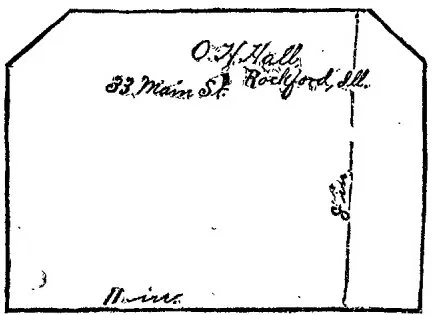
Third, send wrappers, shaped and addressed similarly to the following cut, and we will send the SENTINEL you desire to one hundred names for one dollar.
Wrappers of thin manilla paper are the best. Be careful to write the names and addresses plainly, and write them about an inch or an inch and a half from the edge. The wrappers should be about eight by eleven inches; with the corners clipped, as in cut. In mailing the wrappers to us, don't fold them but roll them.
Stamps will be acceptable for small remittances.

The Story of Pitcairn Island

BY ROSALIND AMELIA YOUNG, A Native Daughter.
PITCAIRN ISLAND, one of the volcanic gems of the Pacific, has been heard of wherever the English language has been spoken. The story of the working out of the problem of human life on its limited territory Reads stranger and more thrillingly in many respects than a romance. But most if not all of the tales told and books printed have either been too fragmentary, or incorrect and misleading. It will be interesting to the friends of that miniature world to know that An Authentic History has been written, and that by a native of the island, one to the manor born. The title of the new work appears above. It is written by Miss Rosa Young, one of the direct descendants of the mutineers of the Bounty. The book, of 256 pages, is a plain, unvarnished tale of Pitcairn and its inhabitants from its settlement to the year 1894. It is written with a Charming Simplicity of Style which refreshes the reader and invites a continued perusal. This work is illustrated with 26 engravings by the half-tone process, and its 23 chapters have each a neatly engraved heading.
PRICE $1.00, POSTPAID.
Thousands can be sold by those who will canvass their neighborhood. Address any State Tract Society, or
Pacific Press Publishing Company,
Kansas City, Mo. Oakland, Cal. New York City.

His Glorious Appearing.

An Exposition of Matthew 24.
REVISED, ENLARGED, AND ILLUSTRATED.
Contains ninety-six pages, with twenty full-page illustrations. The work takes up Christ’s great prophecy of his own second coming, and the signs of the times are clearly pointed out in relation to that greatest of all events.
JUST THE BOOK FOR THE TIMES.
Interesting, Timely, and Instructive.
Price, attractive board cover, . . . .25
With Sentinel, one year, . . . $1.10
ADDRESS, AMERICAN SENTINEL,
39 Bond St., New York.

The Grand Trunk Railway of Canada and the Chicago & Grand Trunk Railway

Form the GREAT THROUGH LINE to all Points in the West,
AND OFFER TO THE TRAVELING PUBLIC THE ADVANTAGE OF THROUGH TRAINS WITHOUT TRANSFER, AND A VIEW OF
THE ST. CLAIR TUNNEL,
“THE LINK THAT BINDS TWO GREAT NATIONS.”
It is the greatest submarine tunnel in the world, extending from Port Huron, Mich., under the St. Clair River to Sarnia, Ontario, and connecting the Grand Trunk Railway System of Canada with the Chicago & Grand Trunk Railway. It has just been completed at a cost of $2,700,000.
The tunnel proper is a continuous iron tube, nineteen feet and ten inches in diameter and 6025 feet, or more than a mile, long. The length of the approaches, in addition to the tunnel proper, is 5603 feet, making all told a little over two miles.
Trains of the Grand Trunk and Chicago & Grand Trunk Railways are hauled through this tunnel by engines specially constructed for the purpose. They are said to be the largest engines in the world. The entire weight of the engine and tender rests upon ten drive-wheels. The weight of one of these monster engines in actual service is found to be approximately one hundred tons.
N. J. POWER, G. P. A. Grand Trunk Ry., MONTREAL, CANADA.
W. E. DAVIS, G. P. & T. A. C. & G. T. Ry., CHICAGO, ILL.
FRANK P. DWYER,
Eastern Passenger Agent, G. T. Ry.,
271 BROADWAY, NEW YORK CITY.
Continue reading: BOOKS FOR THE CHILDREN