The Youth’s Instructor, Vol. 43, No. 52.

WOMEN OF INDIA

The Youth’s Instructor

Dec 26, 1895

S. D. A. Publishing Association · Battle Creek, Mich. · Dec 26, 1895

WOMEN OF INDIA.
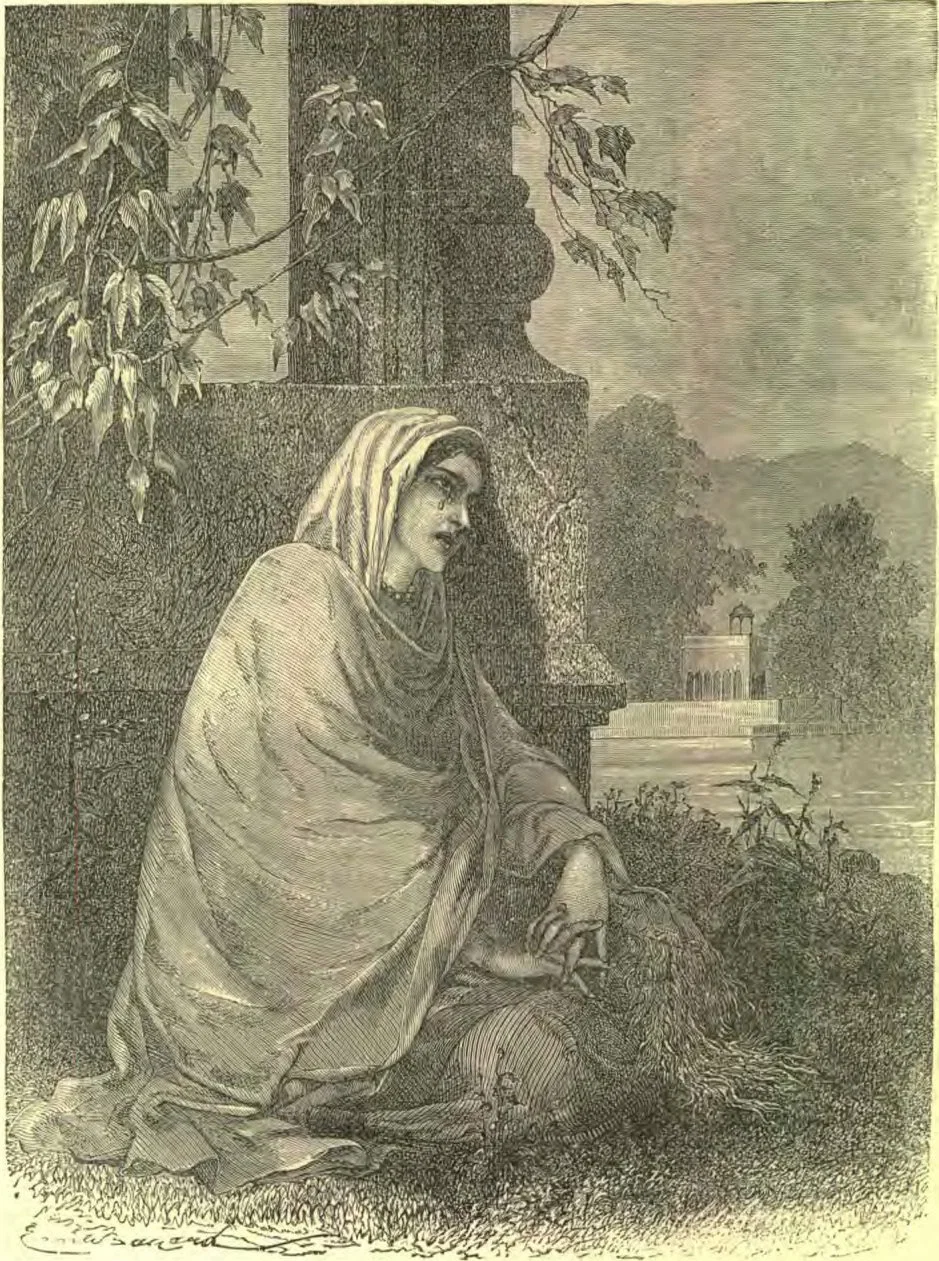
A HINDU WIDOW.
A HINDU WIDOW.
In no country is the freedom of woman more restricted than in India. Why, one may not ask a man how his wife is; the nearest he may come to it is to say, “Is your house well?” Except among the lowest classes, women are never allowed to be seen in public.
The wife in India occupies a position in the household very similar to that of one of her children. She lives in absolute obedience to the law of her husband, and if the rod is used to enforce discipline, it is applied to her as readily as to one of her daughters. The right of a husband to punish his wife is never questioned.
The Hindu wife is not allowed to eat with her husband. The food is prepared and set before the master of the house; and it is the wife’s duty to wait upon him while he eats, and her privilege to eat what he has left. If there are children, the boys eat with the father and the girls with the mother.
The condition of Hindu women is thus described by one of their own writers: “The daughters of India are unwelcomed at their birth, untaught in childhood, enslaved when married, accursed as widows, and unlamented when they die.”
The dress of the women is very simple, consisting of a single piece of cloth about one yard in width and five or six yards long, so arranged as to cover the whole person gracefully, and requiring neither buttons nor pins. The right arm is left free, and the right shoulder is partially exposed. This costume is very pretty. It is generally white, often with a narrow border of blue, red, or yellow.
The women of all classes are very fond of jewelry. They wear bangles on their arms, great massive rings on their ankles, and necklaces, earrings, nose-rings, toe-rings, and the like. Some of the toe-rings have little bells attached, so that the wearer literally “makes music wherever she goes,” or at least makes a jingle.
The poorer classes, who cannot afford the precious metals, array themselves in heavy pewter or earthen-ware ornaments. The poor man’s bank is his wife. If he is able to save any money, he invariably buys ornaments for her. He is thus able to keep his money safe, and please his wife at the same time! These he can sell again, if necessary, for almost the same price he gave for them.
Formerly it was not the custom in India to teach girls anything; and even in the richest families a woman could hardly be found who could read or sew. Women and girls of all classes are despised; and although those belonging to the upper class have more money, they are all equally ignorant.
When missionaries first came to India, they could not reach the women, because of these sad customs. It was necessary that there should be Christian ladies to go into these homes and teach the women. The part of the house where Hindu women and girls live is called the zenana, and the ladies who visit them and teach them in their homes are called zenana missionaries.
The children are taught in the mission school to sing hymns, and repeat verses from the Bible in their own language; and then they talk to their mothers and sisters of what they have learned. One poor heathen woman had a little girl who was taught the “Old, Old Story” at school; and the child repeated it so often that her mother, who could not read, learned it. One day this woman was on a visit to some friends, and there heard a girl repeating the same hymn; and she said, “I can say that, too; my little girl, who is now dead, taught it to me.” So in this way, by the children’s singing at home the Christian songs and telling the stories of Christ, the mothers learn of the Saviour, too.
GEORGIA A. BURRUS.

CONSTANTINOPLE

Doubtless few cities of the world combine such natural advantages and beauty of situation as Constantinople. Near the mouth of the Bosporus a body of water half a mile wide extends three and one-half miles into the European shore; this is called the Golden Horn. Between the Golden Horn and the Sea of Marmora is a cone-shaped peninsula, quite elevated in the center throughout its entire length. It was at the point of this tongue of land that ancient Byzantium was founded as a Greek colony, by the citizens of Megara, a city near Athens.
Under Constantine and later Roman emperors, the city was extended westward till it occupied the whole peninsula. Being surrounded on three sides by water, the city was easily fortified by a wall three and one-half miles long across the base of the peninsula. Much of the old wall still remains, and marks the limits of the present Turkish quarter of Constantinople, called Stamboul. It was at the extreme point of this peninsula that the grandeur of Constantine’s new capital was centred. Lined with palaces of marble and gardens beautified with cypresses, the city must have been a charming sight from the sea.
Even now, it presents a view not easily surpassed.
Of the old city, there are but few remains; chief among these are the walls, St. Sophia’s, and a few columns of the forum. Of the present city there are no buildings of note except the mosques and the palaces of the sultan. Some of the latter, situated on the water’s edge, and built of white marble elaborately and delicately sculptured, are the most beautiful royal palaces in Europe.
Much of the modern city lies north of the Golden Horn, and is known as the European quarter. All the foreign ministers and consuls are located here, and the sultan himself lives here, in a palace about a mile up the slopes from the Bosporus. He seldom leaves this palace. Once a year, at the great fast and feast of Ramazan, he visits a mosque in Stamboul, the Turkish quarter. During the remainder of the year, he goes to a mosque near his palace for prayers every Friday. At this time there is a grand military display, the way from the palace to the mosque being lined on both sides by hundreds of soldiers, while a large body of cavalry is drawn up in the distance. A large crowd of spectators assemble to see the sultan; but they usually see only the display, as he rides in a closed carriage. The present sultan never visits his dominions, and is never seen even in Constantinople, except under very strong guard.
The European quarter of the city is connected with the old part by two bridges across the Golden Horn. Below the first bridge is the commercial harbor, and above the second is the war harbor. Here lie a dozen or fifteen gunboats, most of them small, and some of them quite old in appearance.
The streets of the city are narrow, crooked, wretchedly paved, and full of filth and dogs. The most of the people are a fit complement of the whole scene. From before daylight until after dark, the streets are full of hawkers vying with one another in screaming out their wares. All kinds of fruits and vegetables are carried by these in large crates on the back, or trays on the head; others balance on the shoulder a long pole strung with sheeps’ heads or lungs; while still others carry a whole dry-goods store in two boxes with shelves, balanced, like saddle-bags, on a donkey. Sometimes the shouting of these on the streets renders it difficult to understand ordinary conversation in the house. Scarcely has the din ceased in the evening, when the dogs awake from their drowsiness, and spend the night in barking and fighting. Then the night-watchmen pass, every few minutes, thumping hard on the pavement with heavy iron-shod clubs.
It requires some time for one to become accustomed to sleeping in Stamboul; but the inhabitants don’t mind the noise. In fact, it is life to them; they complain of the quiet of American cities, saying that they are monotonous and dead. This is but another illustration of the fact that “there is no place like home.”
I have never visited a capital which is in such a miserable condition as Constantinople. Everything seems to be on the verge of ruin, and a standing temptation to an earthquake. On visiting the place, one is impressed with the feeling that it is a thousand pities that such a magnificent opportunity should be so miserably used. H. P. HOLSER.

ISLANDERS OF THE PACIFIC OCEAN.

The islands of the Pacific Ocean are inhabited by two entirely distinct peoples, differing in racial characteristics as widely as the Indians and negroes of North America. Indeed, one of them resembles the African negro so closely that no one familiar with that people would fail to call them negroes at first glance. They are black. Their hair is black and curly, and many of them have the broad, flat nose of that race. These occupy the westerly groups in the South Pacific, though a few of them may be found scattered more or less throughout the islands.
Ethnologically speaking, the dwellers in the eastern part of the Pacific are not colored. Some of them are as light as dark-skinned persons who may be seen in the United States, while none of them are darker than some Turks. The geographical line separating these two races in the southern ocean very nearly coincides with the “day line,” one hundred and eighty degrees west from Greenwich.
Generally speaking, the islands east of this line are inhabited by the light natives, while the islands west of the line are inhabited by the black race. People who have lived among them generally believe the blacks to be far inferior to their lighter neighbors. Though certain of the western groups are not yet well known, some of them still remaining in their original heathenism, the natives are believed to outnumber by far the inhabitants of the more enlightened easterly islands. A sea captain who trades among the Solomon Islands, told me that there are uncounted myriads of natives there, perhaps millions, who have given up cannibalism, but who are still practically heathen.
These light-skinned natives were doubtless originally of Malay parentage, since their color, form, and language so nearly resemble those of that people in southern Asia. Their traditions, too, point to Asia as their original home. A few days ago a chief of Raratonga repeated for me a part of a song said to have been handed down to them by their ancestors, which clearly states that “Atia [Asia; they generally substitute ‘t’ for ‘s’] is the trunk of the tree from which we came.” A couplet of another song which used to be sung in heathen times in idol worship, says,—
“Atia is the original land From which we sprang.”
The time that has elapsed since the settlement of these South Pacific islands by their present inhabitants, must be little more than a matter of conjecture. The Rev. William Wyatt Gill, in his “Life in the Southern Isles,” estimates the settlement of the Cook Islands at five or six centuries ago. Before their discovery by Europeans in the eighteenth century, these people used stone axes and other stone implements. The present inhabitants of Pitcairn occasionally find these axes in different parts of that island. When the mutineers of the “Bounty” settled there near the close of the last century, the island was uninhabited. How long it had been so no one can tell; but the axes distributed in various parts of the island give evidence of a former fixed settlement. The similarity of these axes to those found in other parts of the Pacific suggests a common origin for their makers. I have in my possession an ax found on one of the Chatham Islands, near New Zealand. It is identical in appearance with those found on Pitcairn. The facts above named, particularly the wide distribution of those who used these and other stone implements, suggest a longer period since the settlement of most of the islands than that named by Mr. Gill for Cook Islands.
There are some very interesting similarities between some words in the Polynesian languages and words in the Hebrew. Mara means “bitter”—Hebrew, marah. Mate means “death”—Hebrew, mawah. Rapau means “to heal”—Hebrew, rapha. Pae means “side”—Hebrew, pa’ah. Ina means “behold”—Hebrew, hinneh. It makes no difference that these, and other such words, are not spelled alike; they sound alike when spoken, and have the same meaning. When these islanders were idolaters, they had no written language. The remarkable thing is the coincidence of sound and meaning. The word for “sun” in the South Pacific dialects is ra, the same as in the Egyptian tongue, under which name that ancient people made it their object of worship.
J. E. CALDWELL.

Institutions Need Earnest and Capable Men

UNLESS institutions are souled by earnest and capable men, they have no more chance of prosperous and beneficent activity than dead bodies have of climbing mountains.—Peter Bayne.

MYRTA B. CASTLE

1896.

THE old year dead? Nay, say not so! It is but born anew, To bring fresh joy, and love, and peace To all whose hearts keep true.

MYRTA B. CASTLE

RUSSIA

RUSSIA is a land of marvels. It lies in two continents, and is situated in the far North Temperate and Arctic zones.
Unlike China, its Oriental neighbor, it is thinly peopled, containing only about one fourteenth of the inhabitants of the globe, while the area comprises nearly one sixth of the land surface of the earth. Much of this territory lies in the region of intense cold, and almost perpetual snow.
The cold of Siberia is so great in winter that nearly every kind of perishable provision is kept by simple freezing. Milk is offered for sale in solid cakes or bricks, with a string frozen in one corner by which to carry it. Frozen chickens, partridges, and other game are thrown together in heaps like firewood. Meat cannot be cut with a knife, after the cold has worked its will upon it. Many butchers place their animals in fantastic positions before freezing. Frozen fish are piled in stacks. Cold is supreme, and frost is king, in these high northern regions.
The Russians are a musical people. All the monks of the Greek Church are singers. Bass voices in Russia frequently reach an octave below the usual range, and are remarkably deep and powerful. The imperial chapel in St. Petersburg has a choir of one hundred and twenty singers, the finest in all Russia, and perhaps in the world. The members of the choir have no other business, and take the utmost care of their voices. Their time is occupied with constant musical study and practise. The result is marvelous. Some travelers have thought that no such music can be heard anywhere in the world outside of St. Petersburg.
The Greek Church is the established form of religion in Russia. There is no liberty for any other form of worship, and many sects are bitterly persecuted, even to banishment and death.
The government is oppressive. Siberia is a vast prison-land for the unfortunate ones who have aroused the suspicion of government officers.
The present czar seems to be more inclined toward liberty and progress than those before him. The world is watching to see what he will accomplish in this direction.—Sunshine.

THE OLD YEAR.

By the time this number of the INSTRUCTOR reaches our readers, the year 1895 will have passed, to join itself to the long procession of the years which have preceded it. We do not know that the past year can lay claim to having been any more remarkable or eventful than the years immediately preceding it.
There has been something of a stagnation of business, especially in this country, but this was the inheritance received from the preceding years. A few great political changes that have occurred during the year may be noted. By the death of the czar Alexander, his son Nicholas has become the ruler of Russia. His reign, at first mild, now appears to be settling down into the regular Russian way of autocratic government. Italy has passed through a very critical time safely, and has celebrated with great heartiness her attainment of unity by the suppression of the temporal power of the pope. In Great Britain the Liberals suffered a great defeat. The Tories now have the field, and home rule for Ireland now seems to be an event impossible of attainment. In this country the Republicans have swept the country like a tidal wave. In South America about the usual amount of successful and unsuccessful revolutions have divided and distracted the people without any material results.
Of wars, there have been two,—one between Japan and China, and one between Spain and the rebels against her government in Cuba. In the Eastern war the Japanese were successful, but they were prevented from gaining all they desired by the jealousy of the powers of Europe. By this war Japan has suddenly sprung into prominence as a first-rate power, the only first-rate power whose inhabitants are not professedly Christian since the decadence of the Ottoman empire. The war is still going on in the island of Formosa, whose inhabitants refused to acquiesce in the treaty which gave the island to Japan. The war between Spain and her rebellious subjects in Cuba is still in progress. Spain has lost many of her troops by battle, and more by disease, and the insurgents are apparently as strong as ever. This war so near our shores excites much sympathy from the American people for the people struggling for greater freedom, but it is the policy of this government to maintain a strict neutrality. The troubled condition of Turkey, almost amounting to civil war between the Mohammedan and the Christian population of the empire, is the great question now before the world for settlement.
Religiously the world evidently is moving on in about the usual lines. Missionaries are making some progress among the poorer classes in India. In Africa and among the islands of the sea their success is greater. Japan bids fair to receive a kind of national Christianity which will do her more harm than good. China is yet practically untouched by Christianity. Little impression is made upon the old religions of Hinduism and Mohammedanism. Still, enough is being accomplished to warrant the hope that at least the gospel of the kingdom will soon be preached in all the world for a witness to all people, preparatory for the final end.
Among professed Christians, the growth of the Catholic Church is very marked, but other churches claim as great growth in this country. The most noticeable thing in religious affairs in the United States is the tendency toward a national religion, and the opposition to it. There are many skirmishes between the opposing forces, but the church-and-state party is evidently making slow but sure progress. As a church-controlled country is as sure to be practically godless as a heathen land, the outlook for America is not bright religiously.
So the years pass on with their burden of joys and sorrows, of hopes and fears, of good and evil, as they have done heretofore. We cannot stop them in their swift flight; but we should be careful that they bear no record of evil against us, and we should look well to it that “our little span of life may be well trod.”

CONSTANTINOPLE

Not for many years have the eyes of the civilized world been directed toward this ancient and historic city as during the past few weeks. It is the seat of empire of an ancient kingdom, boasting a long line of powerful monarchs. But the power of the Ottoman empire long since passed away; and so weak has it become, that, compared with the robust governments of western Europe, Turkey has not inaptly been called “the sick man of the East.” Not only is Turkey the sick man, but the sickness is evidently unto death; but as people suffering from mortal sickness often outlive all the calculations of those who are anxiously expecting their demise, so the Turkish power clings to life, to the surprise of the world waiting in daily expectation of the end.
There are two main causes which operate together to hold the Turkish empire from destruction. The first is the jealousy of the great powers of Europe for each other. They cannot agree among themselves as to the disposition of the sick man’s effects upon his decease. The sultan and his advisers know this, and they are thus able by magnifying to each power the evil intentions of the other, to maintain the empire. Russia wants Constantinople and the strait upon which it is located. England and Austria, also, would each be glad to gain that important position. Other of the powers, who can have no hope of securing it, would be pleased to see it made the capital of a smaller power, protected by Europe, and the strait free for navigation by the ships of all countries. It is likely that Russia will never consent to any division of Turkey that will not give her the exclusive right to Constantinople and the strait from the Mediterranean to the Black Sea. Strengthened by these cross purposes of those who are agreed in wishing him out of the way, the sultan still maintains with dogged pertinacity his position on the throne of Othman, founder of the Ottoman empire.
The other principal reason that the empire is still preserved may be found in the staying power of the Turks as a people, resulting from their fanatical faith in the religion of Mohammed. There is nothing like an intense religious faith to sustain and keep a nation from falling. In the year 1402, Tamerlane swept down upon Bajazet, sultan of the Turks, at Angora in Asia, and entirely routed him. Gibbon, describing this war, says that the Turkish empire was like a giant tree bent to the ground by the blast, but upon the passing of the storm it again straightened up in its place as before. This inherent vitality, which enabled the Turks to hold their position among the nations, is the fruit of their religion; and even if the Turks should be driven from Europe, this would not mean the immediate destruction of the empire.
At the present time all the energies of the Turkish authorities are absorbed in doing two things,—maintaining order in the provinces, and preventing the fleets of the powers from entering through the Dardanelles and the Bosporus into the Black Sea. There are two great water gateways to Constantinople,—one from the Mediterranean into the Sea of Marmora, called the Dardanelles; the other from the Sea of Marmora into the Black Sea, called the Bosporus. These channels are commanded by strong forts, and are lined with torpedoes. England and Italy have been demanding a firman, or decree from the sultan, allowing their ships to pass these gateways by Constantinople into the Black Sea, for the protection of missionaries and Armenians. The firman was granted, and afterward taken back, the sultan claiming that there is not now any necessity for such action. So great is Russia’s jealousy of England and Italy, that it is said that if the fleets of England and Italy should force their way through the Dardanelles, the fleet of Russia would at the same time come down through the Bosporus to meet them at Constantinople. The latest accounts declare that after all this long delay the sultan has issued a firman granting the freedom of passing the Dardanelles to an extra guard-ship for the foreign embassies, and a few gunboats also have passed through for their protection; but the powers have gained a barren victory. Such is the present condition of affairs. The crisis in the provinces appears to have passed; but Constantinople is now the theater where a tragedy that will move the world is likely to occur at any time.

WHAT OF THE UNITED STATES ARMY?

A SHORT time ago a young man of education and ability, and who possessed enough of the world's wealth to make him quite a figure in social and commercial circles, suddenly enlisted in the United States regular army as a private soldier. The furor which this simple affair created is surprising. That a young man with any prospects in life should so demean himself as to enlist as a soldier in the service of his country is looked upon as almost an aberration of mind sufficiently grave to warrant an examination as to his sanity!
The particular thought that impressed itself upon our mind when we read of this occurrence was this: If the enlistment of a young man of intelligence and some prospects of life into the United States regular service is so remarkable an event as to call for so much attention in the newspapers, of what is the rank and file of the United States army composed? And then we remembered to have read that there were three or four thousand desertions from the army in one year! This would indicate a surprising lack of honor in the men composing the army. In other countries it is considered an honor to serve under the flag, and the conscription by which the European armies are supplied with recruits spares no one. The rich man's son and the peasant boy must take their places side by side. At the time of our civil war, when the country was in danger, the finest men took their places in the ranks without thought of promotion; but now in these piping times of peace it is thought remarkable for a gentleman to enter the army. From these facts we fear that the United States army is composed of poor material, and that in case of war it would not be up to the standard of European armies.
M. E. K.

GREAT GIFTS.

THERE is a record in the word of God of a poor woman who placed in the treasury of the Lord “two mites, which make a farthing.” Others were giving large sums, for “many that were rich cast in much.” It is also on record that “Jesus sat over against the treasury, and beheld how the people cast money into the treasury.” It pleased the Lord upon that occasion to refer directly and pointedly to one of the donors in terms of the highest praise. Whom did he mention? “O,” says one, “of course he mentioned the one who gave the most.” We admit this; he mentioned the one who gave the most. But now come more interesting questions, Who gave most? and, Did the Lord measure the gift by the amount of the gift, or by the ability and heart of the giver? In other words, How does God measure offerings to his cause? Here is the answer: “And he called unto him his disciples, and saith unto them, Verily I say unto you, That this poor widow hath cast more in, than all they which have cast into the treasury: for all they did cast in of their abundance; but she of her want did cast in all that she had, even all her living.” Mark 12: 41–44.
We draw from this the comforting thought that the smallest acts of mercy are noticed by the Lord, and that they are more worthy to be noticed than the greater works which often draw all the praise. In other words, the greatness of a work of love consists in the spirit of sacrifice which prompts it, and the difficulty of performing it, owing to the condition of the one making the sacrifice.
But in spite of these words of Christ’s and the manifest lesson, the world will not look at things in that way, and Christian people persist in measuring gifts by the size of the gift. Those who give much, after the world’s standard, are praised for what they do. We recently saw an illustration of this way of valuing gifts. A magazine devoted to benevolent purposes gave a considerable space to telling what a wealthy patron of a certain benevolent object had done. The person referred to could not but feel flattered at the attention which was called to his donation. In the same number was printed the names of other donors to the same purpose, and the amount of their donations. Glancing over the list, one of the first names we saw was that of a poor girl who works for a living at low wages, and who is obliged to practise close economy. The sum placed opposite her name was small, to be sure, but it was much greater than that of the wealthy donor, if we measure it by the rule given us by the Saviour. To her it represented real self-denial,—perhaps the giving up of something really needed. No doubt the same might be said of others whose small donations stood in the same company.
It is not our purpose to make any invidious comparisons, but simply to impress a principle taught by our Lord. We do not say that the gift of large sums of money may not be prompted by the best of motives; but we wish to call attention to the fact that the gifts of large sums generally get the praise here, and that the Lord has another way of measuring gifts. Know, then, that as of old the Lord stands over against the treasury,—where money and gifts of any kind for every good work are received,—and notices what each one does. In this, as in other things, he “seeth not as man seeth; for man looketh on the outward appearance, but the Lord looketh on the heart.” The gift of the two mites of the poor widow was recorded in the archives of heaven. So is every other humble gift, bestowed for the love of the Master and for mankind. And when the judgment shall be set and the books shall be opened, many gifts that have seemed great in the world will not look so great, and O, how many small gifts will be surrounded with a halo of glory, since they will represent the love and the sacrifice of the givers! The greater portion of God’s children are poor, rich only in faith; but the faith adds value to the gift, for faith leads to works which are pleasing to God.

A KINDLY MANNER.

THE word of God has admonished us to “be kindly affectioned one to another.” While this surely applies to the family and the church relation, it does not stop there. It applies to our relation toward every person. How sweet was the manner of our Saviour toward all who came in contact with him, especially if they were in want or in trouble of any kind! His face must have shown his sympathy and interest toward those for whom his miracles were wrought. True, he denounced sin, but he treated the sinner kindly. He knew the hearts of men, and thus was able to reprove with severity the scribes and Pharisees, who, as he knew, were determined to reject the truth. But it is not given to us to know other people’s hearts; and sad to say, we often do not know our own; and then we try to judge and condemn other people, treating them with no consideration, for doing things of which we are as truly guilty as are they! We should remember that if others have done wrong, it is not at all likely that we have always done right. We cannot always grant every favor asked of us; but we can at least treat the applicant so that he will be convinced we feel no enmity toward him, and more, that we are his friend.
Sometimes favors are granted and real kindness shown to people, but the manner of the one conferring the favor is so harsh that the good effect of the favor is entirely spoiled. We once saw a policeman in an Eastern city show a kindness to a little girl, which was spoiled by his rudeness. She wanted to take a train for another city, and he told her how to do it. She was to sit in such a place, and wait so long, until the ticket-office window would open. The ticket would cost just such a sum; the train would be on such a track, headed such a way,—in short, he was very painstaking to make it so clear that she could make no mistake; but his manner was so cold and harsh that after he had gone, the little girl had a long cry to herself, to relieve her overwrought feelings.
Now if the policeman had unbent from his dignity, taken her by the hand, and in a kindly manner imparted to her the information she sought, his act of kindness would have been a comfort to her on the journey; and who can say but that she would have remembered it as long as she lived? for children’s minds are very tenacious to retain acts of kindness shown to them.
We have often admired the manner of the chief captain, as recorded in Acts 23. The Jews were determined to kill Paul, and this plot became known to Paul’s nephew. The nephew reported the matter to Paul, and he at once called a centurion, and requested that he would bring his nephew to the chief captain, as he had something of importance to communicate. So the young Jewish youth was brought before the Roman officer, who had the chief command in the city. Did he receive the boy in a pompous way?—Not at all. “Then the chief captain took him by the hand, and went aside with him privately, and asked him, What is that thou hast to tell me?” This was kindness itself; and how well was it calculated to place this young Jew perfectly at ease, so that without embarrassment he could tell what he desired to make known. Yet how often those who profess the religion of Christ do not show the civility of this Roman heathen!
We make friends by showing ourselves friendly; and when persons have no strong personal friends, it is undoubtedly because they live so to themselves,—are so absorbed in their own purposes,—that they never cultivate the kindly amenities of life which would draw others to them. Some people scarcely have a friend in the town where they live, and where they are the best known. Other men in the same town have friends everywhere. They have manifested a kindly spirit toward others, and that spirit has been recognized and reciprocated. And if we want to benefit people spiritually, to help them toward the kingdom of God, we must first convince them that we have a friendly, personal interest in their welfare. One may have the tongue of an angel, and still not be able to draw any one toward salvation.
More than anything else, we must have kindly hearts if we would affect others for good. Said the apostle: “I Paul myself beseech you by the meekness and gentleness of Christ.” The Saviour was gentle; he was kindness itself. When we have his spirit, we will have a kindly spirit toward all; people will be drawn to us, and our sphere of usefulness will be greatly enlarged.
M. E. K.

SWEARING

The sinful practise of swearing, which is so common in the streets and around public places, is often mere bravado. Boys think it sounds manly to be profane, and men who swear think it gives force and character to their sayings. Unlike most other vices, it is done openly, and is intended for other people’s ears. Boys hear men utter oaths, and think it is an evidence of courage and bravery. But such is not the case. Oftentimes a profane man is the greatest coward.
One time a man was in company with another who used oaths quite frequently in his conversation. The man said to the blasphemer, “I will give you three dollars if you will go into the graveyard at twelve o’clock to-night, and swear the same oaths you have uttered in my hearing, when you are alone with God.” “Agreed,” said the other; “this will be an easy way of earning three dollars.” “Well, come to-morrow and say you have done it, and you shall have the money.” Midnight came. It was a night of great darkness. As the blasphemer entered the cemetery, not a sound was heard; all was as still as death. The gentleman’s words came to his mind. “Alone with God!” rang in his ears. He did not dare to utter an oath, but fled from the place, crying, “God be merciful to me a sinner!” Is it not better to heed the words of Christ, “Swear not at all”?
J. H. D.

CONSIDER HER WAYS.

“Go to the ant, thou sluggard; consider her ways, and be wise.” The above injunction calls our attention to one of the smallest of the animal creation, yet all who will may learn from it one of the most important of life’s lessons. We are prone to overestimate some things, and to underrate others; and sometimes the things we consider most essential are of the least importance.
God would not have us overlook the value of little things; for he who learns and does the little things in life well, is the one who can be entrusted with greater responsibilities. The pupil in beginning his education must first become familiar with the alphabet. Unless this step is taken, the important results can never be attained. This principle obtains in the life of an apprentice. He must first learn the lesson of faithfulness. His master watches him, not so much to see how much work he can accomplish, as to see whether he is trustworthy in the discharge of every duty.
“Whatsoever thy hand findeth to do, do it with thy might.” This is the lesson God would have us learn in considering the ant. There is also another part to this lesson, which we will do well to learn. It is the readiness of these little creatures to improve every opportunity that presents itself, and the wisdom with which they select their time to work. In parts of the city of New Orleans the ants are about as numerous as were the frogs in Egypt. The soil in some localities seems to be especially suited to them. They exist in millions; but few are seen, however, until something is accessible which they desire to store away. When such a find is made, a few report the discovered treasure, and the others are soon seen coming in line, in perfect order, to get the prize. When it is secured, they return in the same order, each carrying a load. As they meet the others that are coming, they stop, and put their heads together as if to report the success of the undertaking. If you leave a quantity of sugar exposed, they will persevere night and day until it is all safe in their storehouse. A paper once fell and lodged between the wall and the cupboard. This formed a bridge for them, and, although the cupboard was standing in four dishes of kerosene and carbolic acid, in the morning everything was literally covered with these industrious little creatures. In the first place we had tried to keep the ants out of the cupboard by placing the four legs in dishes of water; but this did not daunt them; they swam the water, and took possession just the same.
In the action of these minute creatures we find an example which we would do well to imitate. Life is short, and there is so much to be done that no one need be idle. If we need not work in order that we ourselves may live, there is plenty we may do to help others to live. Like the ants, be busy; watch for an opportunity to do something useful, and do not allow seeming difficulties to thwart your plans, and destroy your courage. J. E. EVANS.
Continue reading: SABBATH-SCHOOL HINTS