The Youth’s Instructor, Vol. 43, No. 52.

WOMEN OF INDIA
Earlier text: WOMEN OF INDIA

SABBATH-SCHOOL HINTS.

A GOOD recitation gives life to the whole class.
IF you wish to see a live school, aid it to be such by being prompt in attendance and recitation.
ONE live pupil in a class, who has the lesson well prepared, and a good general knowledge of the subject, will inspire the whole class with life.
HE who knows how to give three or more different recitations on a subject, will be very apt to bring into the class much valuable thought. Such a pupil assists the teacher without assuming his position, or leading the class beyond the boundary of the lesson.
THE GOSPEL.—The evidence which our Saviour proposed as proof of the divinity of the gospel system, was its practical effect upon individuals who receive and obey the truth. “If any man will do his will, he shall know of the doctrine, whether it be of God.”
THE GOSPEL AS LIGHT.—The gospel is light. This marks its origin from heaven. It is no human device, but comes from God himself. It is the truth, and for this reason it is light. It is very fitting that what is truth, without mixture of error, should be compared to the most simple substance in nature.
IT IS CALLED light because of its penetrating nature. Where it shines, there is no shade so dark that it cannot penetrate it; there is no imposture so well devised that light will not expose it; there is no conscience so callous but this light will search it.
ITS ORIGIN AND GLORY.—As to the origin and glory of the gospel, it might well be compared to an angel standing in the sun. Its territorial range and commission might be likened to an “angel flying in the midst of heaven.” As to the gracious mysteries of salvation which it contains, it may be compared to the angels looking into the ark of the covenant. As to the hopes and inspirations which it warrants and sustains, it may be likened to an angel at heaven’s gate, saying to us, “Come up hither.” Looking upon the relations of the gospel to men in the every-day business of life, we may regard it still as an angel full of condescension and brotherly companionship—an angel mingling with us, and guiding and comforting us. It is an angel recognizing our earthly wants, and sympathizing with us in our earthly trials, like the angel who came to Abraham under the trees of Mamre, and to Lot in his house at Sodom. Thus does the gospel revealed in the Bible come home to us, and enter fully into our temporal circumstances, necessities, duties, and trials.
J. H. D.

BIBLE TERMS.

HERE is a handy table which it would be well for you to cut out or copy for reference in your Bible studies:—
A day's journey was about twenty-three and and one-fifth miles.
A Sabbath day's journey was about an English mile.
A cubit was nearly twenty-two inches.
A hand's breadth is equal to three and five-eighths inches.
A finger's breadth is equal to one inch.
A shekel of silver was about fifty cents.
A shekel of gold was $8.00.
A talent of silver was $538.30.
A talent of gold was $13,809.
A piece of silver, or a penny, was thirteen cents.
A farthing was three cents.
A mite was less than a quarter of a cent.
A gerah was one cent.
An ephah, or bath, contained seven gallons and five pints.
A hin was one gallon and two pints.
A firkin was about eight and seven-eighths gallons.
An omer was six pints.
A cab was three pints.—Selected.

LESSON 2.—THE EVERLASTING GOSPEL.

WHAT IT IS—ITS POWER.

(January 11, 1896.)
1. What announcement is made by the angel of Rev. 14 : 6, 7?
2. What is the meaning of the word “angel”?—Messenger or minister, and it may apply either to heavenly or earthly messengers. (See Heb. 1 : 7, 14; Rev. 22 : 9.)
3. Is there any particular time when the proclamations of these three angels are to be given?—Just before the second coming of Christ. (See Rev. 14 : 14.)
4. To whom does this proclamation go? Rev. 14 : 6.
5. What does this angel preach? Verse 6.
6. What is the “everlasting gospel”? (See note .)
7. What power is there in the gospel? Rom. 1 : 16.
8. What can you say of this power? Jer. 10 : 12. (See note .)
9. To whom is this power promised? Rom. 1 : 16.
10. How many would the Lord have receive the gospel? 1 Tim. 2 : 4.
11. How many are in need of this saving power which is found in the gospel? Rom. 3 : 23.
12. What is the wages of sin? Rom. 6 : 23.
13. By whom alone is man redeemed from sin? Acts 4 : 12.
14. What does the believer receive through the everlasting gospel in the place of his sins? Rom. 3 : 21, 22.
15. What is the outward evidence that an individual has received this righteousness? 1 John 3 : 7, 10.
16. Can the natural man, without the power of the gospel, do righteousness? Rom. 8 : 7, 8; Matt. 12 : 33–35.
17. By what means and power is this change wrought? 1 Peter 1 : 23, 25; John 15 : 3.
18. What is there in the word of the everlasting gospel that gives the believer a new life? John 6 : 63; Titus 3 : 5–7.

NOTES.

DO YOU KNOW HER?

I HAVE a little friend who doesn't like to mend, To dust, or set the table, or even make a bed; The very thought of sweeping nearly sets her off a-weeping, And she always goes about it as though her feet were lead.
She "hates" to rock the baby, and says that some day, may be, She'll go away, and linger where they have no babies round, To keep folks busy rocking—but really this is shocking, And she doesn't mean a word of what she says, I will be bound. — Selected.

“I’LL STUMP YOU TO.”

“You dasn’t.”
“I dast.”
“Well, I say you dasn’t.”
“And I say I dast.”
“Well, I’ll stump you to.”
And that was enough. No boy with any spirit would dare take a “stump.” It was altogether out of the question for John to take a stump, as he was one of those lads who delighted in being called brave; and he would do anything rather than be called a coward.
Of course when Harry said, “I stump,” that meant that Harry was to go first—and go Harry did.
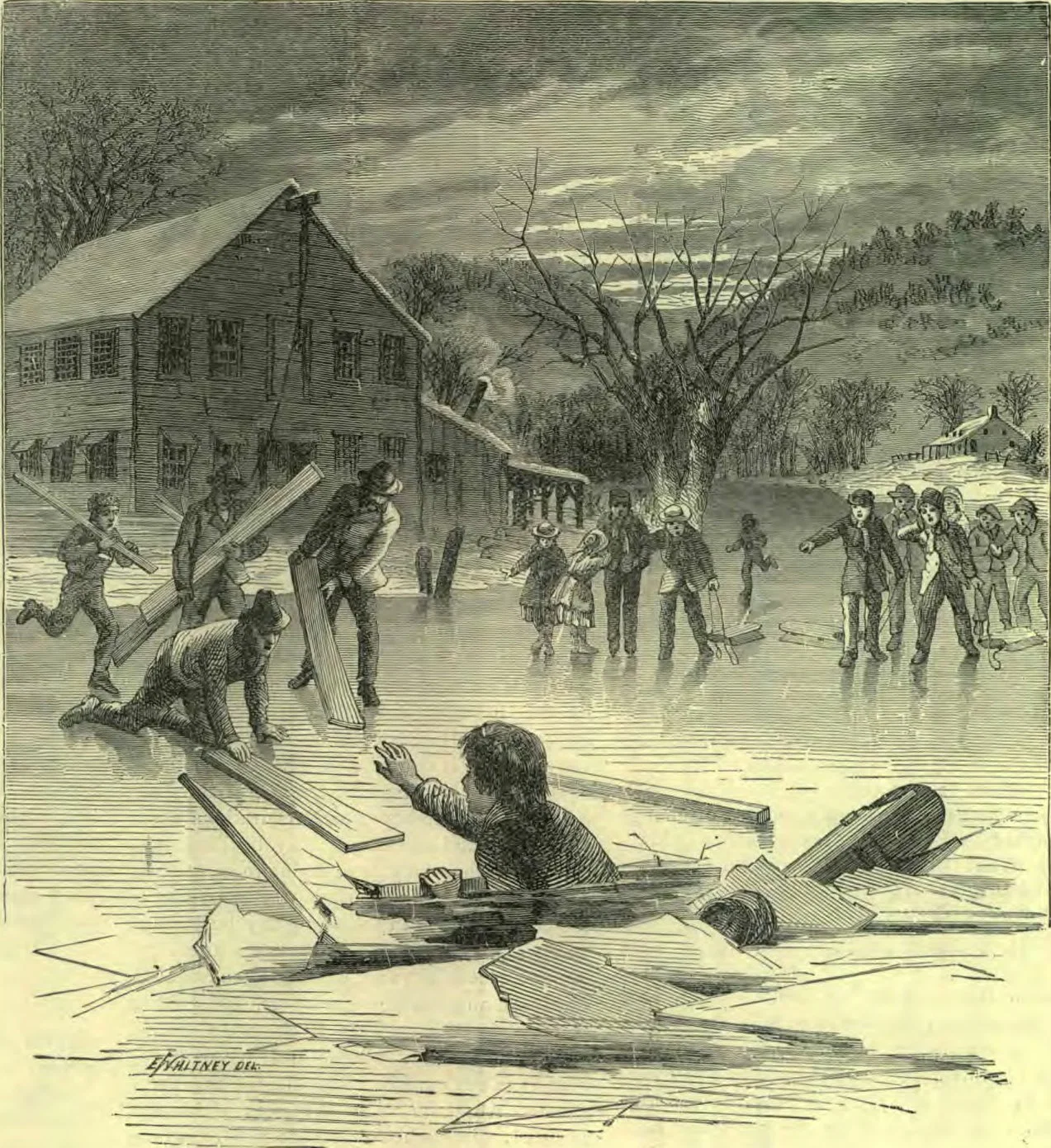
It was by the side of a small stream in one of our inland towns, on a day in February. The ice had been frozen quite thick, and then broken into cakes about three or four feet across; and a light freeze had put a thin cement between the larger cakes. It was not far from the school-house, and the boys delighted to run down there at noon, and skate or play upon the ice.
John and Harry were about the same age,—twelve years,—and worked together most of the time. As a rule there was a good-natured rivalry between them, but in the present instance it was manifesting itself in foolhardy attempts to cross the river on the ice-floes. They and the other boys had crossed and recrossed, until there was not a place in which the thin films of ice had not been broken, and the large cakes were bobbing about in the current. But there always must be some narrow escape before boys will let such things alone. John had been particularly warned this morning that he must not go near the river, and, with a thoughtless toss of the head, had said, “I won’t, mother,” and straightway began to forget that he had said he would not.
The boys had been at this kind of sport until both began to see there was considerable danger in it, and the climax had come when Harry had stumped John to go again. Harry succeeded in getting across; for, of course, in giving the stump, that one must do the thing himself. And now John must go or be called a coward,—and that would never do. Stepping back about a rod from the edge of the river so as to get a good start, with a quick eye he placed his steps in the centers of the ice-floes, until he was within ten feet of the opposite bank. Feeling sure that he was going to get across, the thought of how well he was doing went through his head, when his foot slipped to the edge of the cake, he could not spring to the next, and into the river he went. The boys on the bank pushed out a pole, and he arrived safely on shore with his teeth chattering, and the thought all the while pressing upon him, “You told your mother you wouldn’t.” There was about as much loss of prestige in failing to do what he had attempted as in being called a coward; while the knowledge that he had disobeyed his mother weighed upon his mind with even greater force than did his wet clothes or his danger of taking cold.
He arrived at the school in the midst of laughter at his expense, and the teacher decided it was best for John to go home; so there was a half day of school lost, a sorrowful heart at home for his disobedience, and the loss of that for which he had striven and refused to be stumped.
John is a sample, so to speak, of a large number of boys. There are very few that do not have those childish ambitions to be considered a leader; to be just as smart as some one else; to be considered one that is worthy to be looked up to in matters of prowess or daring. But now, boys, is it not true that many times when you thought you were doing so well and performing such brave feats, some accident or circumstance would show you that you were worse off than all the rest put together?
The average boy of twelve desires to be thought manly, and wishes to grow into a man very much quicker than nature thinks that he should. That desire to be a man is all right, and the earnest purpose of your heart to be one is certainly honorable; but don’t you think that there are different ways in which one can become manly? and would it not be well for you to stop to think whether a certain action that you contemplate, or a certain enterprise that is suggested to you by your playmates, will really place you in a manly position, or put you ahead of others, or increase your popularity?
I believe, boys, that if you would only take time to consider these things, you would be spared many of the embarrassments which come to you during your boyhood days. I can look back now at what John did, for it was my own experience; and a flush of shame goes all through my being as I consider what my motives and desires and ambitions were in performing certain acts. In future years you will often regret such early experiences, as I now regret mine. Then stop a moment and think: “Would it be best? Is it right? Am I adding to my manliness, or am I following some foolish impulse? Is the honor of my playmates worth more to me than my parents’ approval? If I were in trouble, who would come to me first, my father and mother, or a school-boy friend?” If you once acquire the habit of stopping to think, you will never be stumped to do a thing that your mother has said not to do, and no amount of coaxing will cause you to forget that your father’s counsel, as a rule, is better than that from those of your own age.
J. GRANTELLE.

THE SCHOOL VACATION.

School recesses have been so far diverted from the use for which they are supposed to be intended, that there is a respectable party among educators which favor the reduction of these periods to a much shorter time than is now given to them, if, indeed, these educators do not desire to see them banished entirely from the school calendar. It would be unfortunate if such a movement came to be regarded as necessary; though, under present circumstances, much can be said in favor of shortening holiday periods.
Holidays are needful. School is the drill-ground for the battle of life. The faculties of the mind are put to the stretch, to develop them to their fullest capacity. Tests of all sorts are the rules—tests in which, as in the trial run of a piece of machinery, the safety-valve is tied down, and the greatest strain possible is brought to bear. No machine could endure a daily test of this sort; nor can the mental machinery of the average youth. School work would soon become a matter of mere cram; and instead of a finely drilled and disciplined mind, the student would carry into the world a feeble, dyspeptic, and invalid intellect.
Every student knows the man who is overworking. Out of study hours he is listless, preoccupied, and sad; when others laugh, he only smiles mechanically; in society he is a bore. Vacation comes, but he tells his friends that he expects to be busier than in school-time, and he plunges at it as soon as the last examination paper is in. Happily, if his friends are wise, he is enticed into some recreation,—“just so he can study better,” say his friends. It is a deep plot. They don’t intend that he shall study at all. But he steps innocently into the trap, and the next thing he knows it is school-time, and nothing done. If his friends are not wise, he probably leaves school at the end of his junior year, and goes upon a ranch in the West for the remainder of his life. He has burned the candle at both ends.
The over-studious fellow is not, however, a type of the most numerous class of college men. He is as far from the common average as is the smooth-haired, high-collared, “fraternity” enthusiast. The average student doesn’t kill himself. He avoids cramming, not because he has reasoned the matter out, and knows that the man who “grinds” often grinds the edge off his intellect, but simply because it goes against his disposition to cram. He rather believes it a proper thing to “flunk” now and then, so as not to seem uppish, and so as to show himself a good fellow with the boys; but he has an exact knowledge of where the dead line is, and he is careful not to get “plucked.” It is this average student who makes all the trouble about vacations. Somehow, his train never makes connections, his relatives are always afflicted with some serious illness, or he sprains his ankle, or meets some other dire mishap, just the last day of the vacation. He it is who always applies for permission to leave town two days before the recess begins. He it is who needs a week to recuperate from the effects of his holidays; and it is chiefly on his account that classes seldom get down to genuine work until several recitations after an intermission. It may be added that it is this young person who has brought the vacation into disrepute.
When he does get down to serious business, though, what an agreeable change there is in him! For the last two weeks before the holidays, his recitations were painfully mechanical. Now they are brilliant. He recites as if it were the one pleasure of his life to furnish information. His instructor sits with a genial smile, looking much as if he were at a concert, and encourages this prodigy to pour forth his wealth of knowledge. It is all the vacation.
It has been often remarked that the best students,—the men who carry off honors,—are seldom heard from in after life. They use up the mental force of a lifetime in the few years they spend in school. It is the severity of the effort to lead the class, in this case, which uses up, prematurely, the reserve power of the mind; but incessant labor, without the unbending which vacations afford, would tend to the same result; and the average student, rather than the rare candidate for honors, would be the sufferer.
It is the abuse of holidays that is complained of. If they are well employed, they may be an important part of the process of general expanding which we call education. There is a time for study, and a time to impart the results of study, not in lectures or articles, but in elevating and unaffected conversation. We do not live for our own enlargement alone, but that we may help to enlarge others. The student’s friends who do not go to college look forward to his occasional visits to his home, expecting to be entertained and instructed—to share in his larger life. They ought not to be disappointed. The young man home from college owes a duty to society at home,—often the small society of a country hamlet,—a duty to his family and friends. He is admired and copied in secret by his former companions. He should not look on the vacation as an occasion for his own enjoyment merely. He should seek to bring into the lives of those at home as much as possible of the broader culture which he has received; and in so doing he will refresh his own mind, while his ideas will be acquiring a savor of originality; will be losing the musty odor of books. And above all, he ought to be on hand at the first exercise after vacation, as thoroughly prepared for it as he hopes to be for his final examination. C. B. MORRILL.

HOW THE SULTAN WORSHIPS.

As everything in regard to the sultan of Turkey and his capital city is at the present time particularly interesting, we insert the following description of the sultan’s visit to the mosque, as seen by a correspondent of the London Chronicle:—
“Every Friday—the Moslem Sunday, of course—those moribund sea-monsters that comprise the Turkish navy, lying moored stem and stern, unmoved for a dozen years, impotent as turtles on their backs, within the Golden Horn, fly the Crescent and the Star. The marines put on their whitest trousers, and perhaps they give a burnish to their arms. A wild sort of march, well played, sounds from near the Turkish admiralty, and the band and troops come striding up the hill. Everybody in the city, except our own military attaché, who, I am told, generally deprives this brilliant ceremony of his presence and the uniform of his queen, is going to the Selamlik, the sultan’s drive from his palace to his mosque, a distance of about two hundred yards. You pass several regiments of cavalry and infantry, winding up the long hill to Yildiz Kiosk, and by the time you are received, in a small pavilion opposite the mosque and just outside the palace gates, by a glittering aide-de-camp, the wide-curving road is filling with troops. The mosque is in front of you, and the palace gates to the left. Hardly have you swallowed your cup of coffee before the bands of more approaching regiments are heard. They are all fine fellows, and they advance with the queer pointed parade-step taught them by their German instructors. Particularly noticeable are the Zouaves, their green scarfs knotted round the fez with a dexterity a Paris milliner might sigh to imitate. Soon upward of five thousand troops are in position. Men are picking up stones upon the road; others are hurrying up carts filled with sand, spreading it, and sweeping, like lackeys in a circus, wherever a horse has set his hoofs. Presently a magnificent young man, with a strong resemblance to an Italian tenor, and in a uniform of a dazzling detail, steps from a carriage before which runs a servant dressed like the smartest park ‘tiger,’ salutes, smiling superbly, and disappears within the palace, while a distinct hint of patchouli (an oriental perfume) fills the air. This is the son of Osman Pasha, and the dandy of Constantinople. Opposite me, in ostensible command of the armies, is a stoutish young officer, with a face as white as snow, and nervous eyes. He is the son of Abdul Aziz, and if you were the son of the last actual sultan of Turkey, who is kept under strict watch and ward in the palace of his successor, you would be as white and nervous as he.
“Now nobody is in sight but the troops; every stick and stone is gone from the road; the last sweep of the brush in the sand has obliterated the last hoof-print; the hurrying water-carrier has given to a soldier the last cupful from his dripping skin; the last officer has had his boots dusted with the handkerchief of the nearest private; and the last diplomat has hastened to his post of vantage. Followed by a servant carrying a small Gladstone bag, which contains his clothing for the mosque, his excellency Yever Agha, chief eunuch, an enormous, bloated, and unspeakably repulsive figure, passes down the hill, leaning on his stick and glancing arrogantly to right and left. Then come several carriages filled with the sultanas and ladies of the harem. One has her yashmak dropped—needless to say she is pretty. Then comes a gorgeous procession of aides-de-camp and the foreigners in the Turkish service—one wonders what they think of themselves as items in the weekly farce; then the sultan’s bodyguard, as fine a hundred men as I have ever seen; lastly, a dozen little manikins, in varying uniforms, with pretty white faces and merry black eyes—a few of the sultan’s sons. Suddenly, when the tension and perfection of the scene have become almost unbearable, the high falsetto of the “Imam” rings out from the minaret, calling to prayer; and as the long-drawn syllables, “Allah illaha ill’ Allah,” die away, a burst of music from Yildiz announces the coming of the Shadow of God, the troops spring to the salute, and from all their throats goes up a sudden fierce, hoarse shout, and then another.
“A carriage drawn by two big bay horses, and driven by a black coachman in scarlet and gold, turns into view. It is a high barouche, and within it sits his Majesty Abdul Hamid II, faced by Osman Pasha. Yellow and drawn and anxious is the face of the sultan, as he stoops brokenly within the plainest military overcoat. His left hand is on the hilt of his sword, and his right touches breast, lips, and forehead in frequent salute; not a smile, not the relaxation of a line of that inscrutable visage, as he slowly passes. Behind him come five led horses, his private Arabian thoroughbreds, saddled and bridled and clothed, in case he should desire to mount one on his return. For a moment he stands at the top of the carpeted steps. Then he disappears to his conscience and his prayers. The pageant waits patiently outside, but one onlooker wonders whether the praying padishah ever says to himself, like another uneasy monarch:—
“My words fly up, my thoughts remain below; Words without thoughts never to heaven go.”
“After a while most of the troops march off in silence; a low, hooded phaeton, drawn by a pair of immense white Arabs, is brought, and after half an hour the sultan drives himself back, with a crowd of panting officials and lackeys running by his side. Then Emin Bey, the master of the ceremonies, brings you his Majesty’s compliments, and the strange scene—the strangest of all the strange scenes of the coveted city—is over.”

WHAT RELIGION?

THERE is a little boy in Bulgaria, only two years old, but over him the partisans of two rival religions are quarreling. This child is Prince Boris, son of Prince Ferdinand, and heir to the throne of Bulgaria. His father has declared his intention of having him baptized into the Greek Church, but the power of the Roman Catholics of Bulgaria is so strong that his baptism, which in those countries usually takes place when the child is but a few days old, has not yet taken place. Each party accuses the other of keeping the child a heathen, but there seems to be more heathenism in those who are fighting about him than there is in the innocent child. It never seems to occur to the devotees of these very churchly religions that the boy has an undoubted right to grow up and make his own choice.

LOSING FRIENDS.

ONE of the things that most people wake up to when they are approaching middle age, is that they have lost a good many friends through their own carelessness. You receive an invitation to the wedding of one whom you knew well eight or ten years ago. He has quite passed out of your life; though, if you were living near each other so that you would meet occasionally, he is the kind of man in whose society you would find real pleasure. When the invitation comes, you express your pleasure that Dick or John is to be married, and hope that he may be happy. And that is the end of it. You do not send a present, or, what is better—and often costs more—a friendly note conveying your congratulations and good wishes. The occasion passes without any sign from you, and you have lost an opportunity of identifying yourself with your friend's happiness. He will not associate you with that epoch of his life, and very likely will resent your silence. It is the same when you fail to take note of a friend's afflictions. It is a real effort to write a letter of sympathy. But such a note may mean a vast deal to one in trouble, and by it you can bind a heart to your own with a hook of steel. The people who complain that they have so few friends, have themselves to blame for it. They have lost them through indifference or thoughtlessness. “A man that hath friends must show himself friendly.”—Watchman.

TWO KINDS OF REFUGEES.

A TEXAS paper prints a long account, as many other papers are doing, of the way the Armenians are being driven from the province of Van. But, curiously enough, in the Texas paper, exactly opposite the heading, “Refugees from Van,” is another article with this heading, “Mormons Driven Out.” Under this last head the statement is made that two Mormon preachers had been preaching in a town in Kentucky, that the citizens held an indignation meeting and sent a committee which warned them to leave the State, and that they had fled into West Virginia. Now those two articles were no nearer together in the paper than the actions they described are alike in character and principle. If the dominant religion in Kentucky has the right to drive the Mormons out of Kentucky, why has not the dominant religion of Turkey an equal right to drive the Armenians out of any Turkish town? And this question prepares the way for another: Is a Christian(?) persecutor any better than a Mohammedan persecutor?

LIFE

METHINKS that I stand by a deep, mighty river, That silently flows toward an infinite sea; And sometimes the waves dash in pitiless grandeur, And sometimes they murmur like music to me.
And look! there are barges with white banners streaming, So swiftly and silently passing along; And the prayer of the saint and the curse of the scoffer Are strangely commingled with revelous song.
Ah, some of the barks are enshrouded with blackness, And some wear a halo of heavenly light, And some are led on by the hand of an angel, And some by the furious demons of night. And some are in quiet, and some are in strife,— Ah, this is a picture—a picture of life!
MRS. L. D. AVERY-STUTTLE.

An Oriole’s Vengeance.

A LADY who was one day watching a pair of redstarts as they worked in a tree, was startled by a violent commotion that arose in the shrubbery hard by. Catbirds screamed, wrens scolded, and the robins shouted, “Quick! quick!” with all their might. A squirrel was dragging a baby catbird by the leg from its nest, and all the birds round had come to help make a row about it, including a Baltimore oriole. The screaming and the swish of wings as the birds darted about made the little squirrel abandon its prey, and then the commotion subsided as quickly as it had risen. All the birds but the oriole went about their business elsewhere. The oriole had not said a word so far, and, beyond countenancing the hubbub by his presence, had had no part in it. The squirrel, having dropped the baby catbird, cocked itself upon a limb, and began to chatter in a defiant way, while the oriole sat not far away, looking at it, but doing nothing else. But in a few moments the squirrel left its seat, and ran out on the limb it had been sitting on until it had to use care to keep its hold, and then the oriole’s opportunity for a terrible assault had come. Flashing across the space, he struck the squirrel in one eye with his sharp, pointed beak, and then, turning instantly, struck the other eye in like manner. Quivering with pain, the squirrel let go the limb, and dropped to the ground, where it rolled and struggled about, apparently in the throes of death. The oriole flew away to his favorite elm, where he sang in his most brilliant fashion. The lady put the squirrel out of its misery, and then saw that the oriole had destroyed both eyes.—Boston Journal.

JEWELS FOR TEARS.

Dr. A. T. Pierson relates that the Princess Eugenie of Sweden was once ordered by her physician to go to an island off the coast for her health. She went, and found there some sick and helpless cripples, for whom she wished to build a hospital, but lacked the means. She wrote to her brother, begging leave to sell her family jewels for Christ’s sake. He consented, and the hospital was built.
One day the princess was visiting it as was her custom, and was sitting by the bedside of a dying woman, who, with her last failing strength, raised herself in the bed to caress the hand of her benefactor, and then fell back dead.
The princess looked down on her hand, and saw the grateful tears that the poor creature had shed, glistening on it in the sunshine, and lifting her eyes to God she said, “O my Saviour, I sold my jewels for thee, but thou hast returned them, and O, how much more beautiful!”
Are there not other Christians who can obey that ancient command, “Sell that thou hast, and give to the poor, and thou shalt have treasure in heaven: and come and follow me”? Are there not many jewels which if sold and given to the sick and needy might cause tears of gratitude to flow, and inward joy to spring up, and bring to the kind givers at last the gracious words, “Ye did it unto me”?—The Christian.

THE UNDERGROUND SWELL.

THEY tell a good story about a young man who was prone to unlimited brag about his ancestors, and who was wont to remark with annoying frequency about his splendid lineage. When he was in the country, one day, an old gentleman who had listened as long and as patiently as he could to the young man’s bragging, ventured a remark:—
“Young man, you make me think of our ’tater crop.”
The young man was anxious to know how he, the representative of so splendid a line, could lead any one to thoughts about this humble vegetable production.
“I’ll tell you why,” the old man remarked; “it’s because the likeliest part of you seems to be underground.”—Minneapolis Journal.

CLOSE OF THE VOLUME.

THIS number of the INSTRUCTOR closes the volume. We trust that many of our readers have saved their papers and sewed them together, so that they now will have the whole year's papers in one volume. Sometime it may be a real pleasure and benefit to take the volume of the INSTRUCTOR for 1895, and look it over. It may also be shown or lent to children with good results. The year 1895 is in the past; but time does not stay its swift course. Hard upon the heels of the flying year comes the new year 1896. New years bring new things, and we expect that the INSTRUCTOR will keep up with the times in spreading a full board every week for its hungry readers. No chaff will be allowed in the INSTRUCTOR; nothing but the finest wheat, well winnowed, will be used. That we may have a large amount of good matter from which to select, we invite all our old contributors to continue to write for the INSTRUCTOR, and new contributors to our columns will also be gratefully welcomed. We hope to make the INSTRUCTOR so worthy of patronage that every subscriber will be glad and anxious to work for its success, to the great extension of our list, and the good of many more thousands.

You have reached the end of this edition.

The Youth’s Instructor · Dec 26, 1895