The Youth’s Instructor, Vol. 66, No. 13.

The Foe Behind the Lines
Earlier text: A Unique Business Meeting

Congress and Booze

The liquor people have long escaped their just dues by hiding under the friendly coat of the Federal Government. But we are glad to say the Government is fast divorcing itself from such false, degrading, and tyrannical friendship, Congress having passed more dry legislation in the last nine months than in fifty years before. Wayne B. Wheeler, national attorney for the Anti-Saloon League, says to the boastful liquor traffic: “If a man had battered me up fifteen or twenty times in the last few months, I should not regard him as a very special friend; and that is just what the Federal Government has done to you.”

Uncle Sam’s Heavy Blows

The Government began to show its unfriendly attitude toward the liquor traffic when in 1903 it banished intoxicating liquor from the national capitol; and again when in 1914 Secretary Daniels issued his famous Wine Mess Order.
During 1917 the blows came thick and fast, as shown by the following actions:
January 8, the Supreme Court of the United States recognized the Webb-Kenyon dry law as Constitutional. This law forbade the shipping of liquor from wet into dry territory.
January 11, the Federal Anti-liquor Advertising Law was passed by Congress. This law closed the mails “to all letters, advertisements, and newspapers which are addressed to any person, firm, corporation, or association in any State or Territory where the sale and manufacture of intoxicating liquors have been prohibited.”
February 14, Alaska was made dry by Congressional enactment.
March 2, Porto Rico was granted prohibition, subject to a referendum of the voters of the island.
March 3, the District of Columbia was made dry by Congressional enactment, to take effect November 1.
May 18, the act forbidding the sale of intoxicating liquors, including beer, ale, or wine, to any officer or member of the military forces, while in uniform, was passed.
August 1, the Senate passed the resolution to submit to the States for ratification a prohibition amendment to the Federal Constitution.
August 10, the manufacture, exportation, and importation of distilled spirits during the war were prohibited.
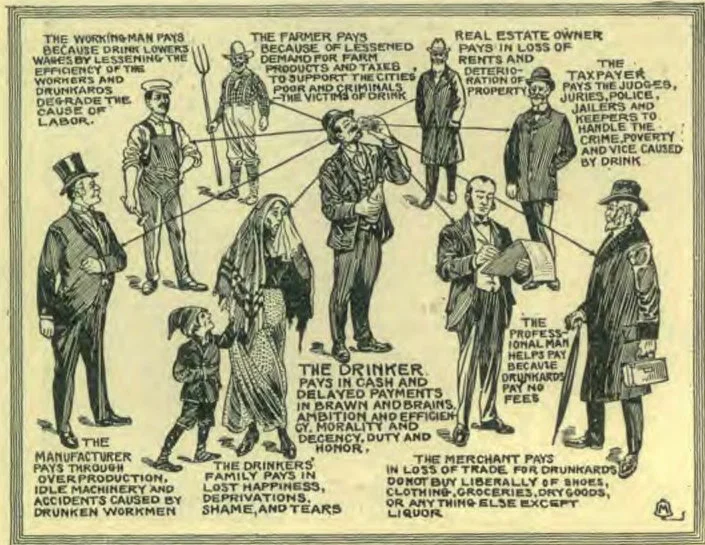
The price of a drink falls chiefly on those who do not drink.
November 27, the President made an order that not more than 70 per cent of the usual amount of food materials should be used in the manufacture of beer during 1918, and forbade the manufacture of beer with an alcoholic content of more than two and three-fourths per cent by weight.
December 17, the House passed the prohibition amendment bill that had been passed by the Senate during the summer.

What Uncle Sam Should Now Do

There no doubt will be a full ratification by States of the prohibition amendment law as soon as possible; but Uncle Sam cannot afford to wait for this action, for it will take two or three years at best to get prohibition by this method.
There should therefore at once be a Congressional law or Presidential order giving the nation prohibition as a war measure. Let us work and plead for this until we get it.
There should be a Presidential order or Congressional law forbidding any man in the army or navy, whether in this country or on foreign soil, to partake of intoxicating beverages.
Having done this, the Government will have entirely divorced itself from the liquor traffic during the war. There is no doubt but that the benefits of national war prohibition will be so apparent and so great that the traffic with all its kith and kin, will, immediately after the war or before, be driven from the territory of the United States for all time.
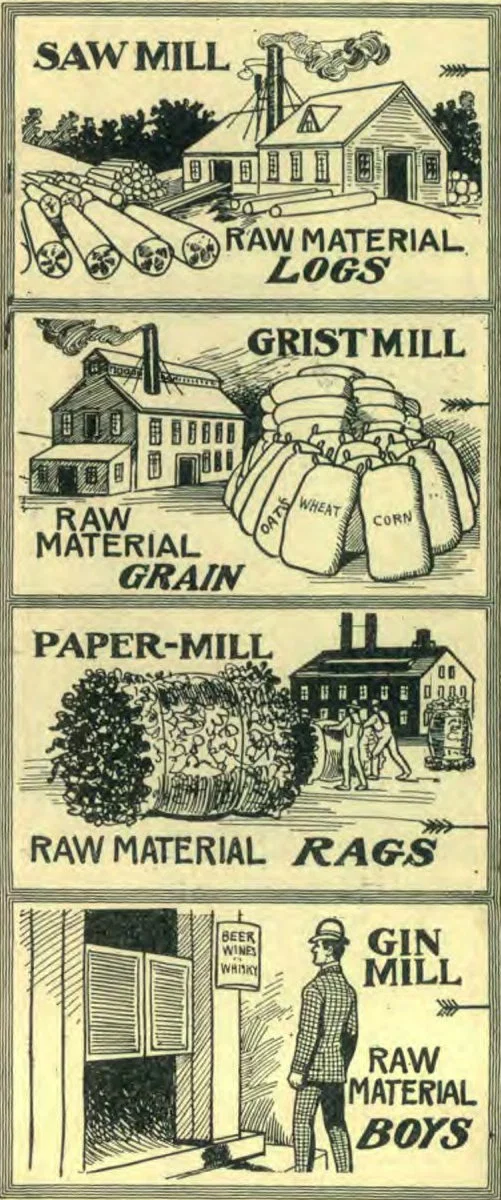
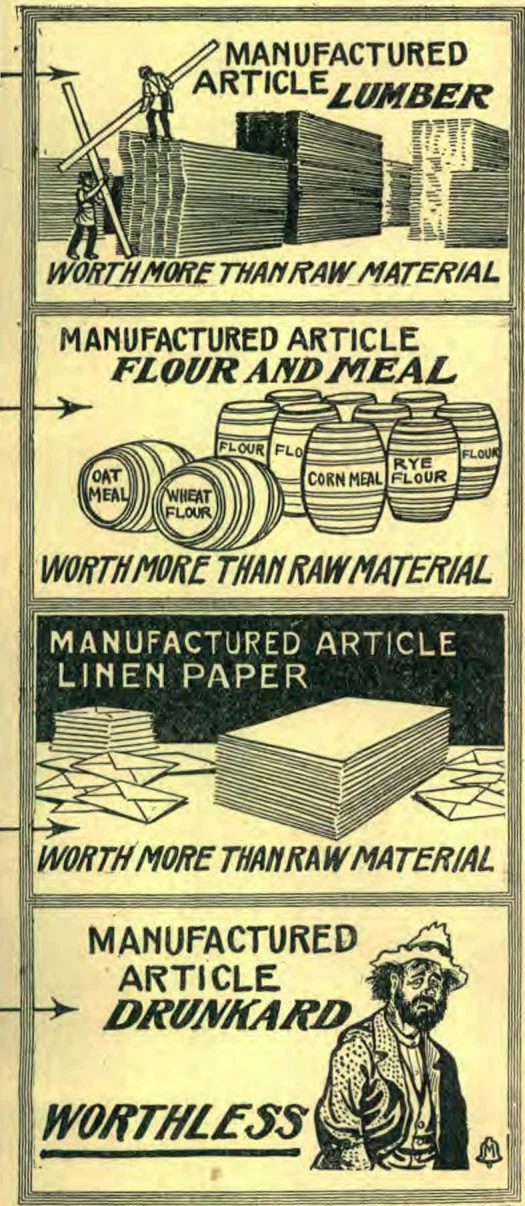
The Four Mills—all create values except the gin mill, which turns out a debased product.
The gin mill, therefore, is not a legitimate business, and has no right to exist.

Bailing Water While the Faucet Runs

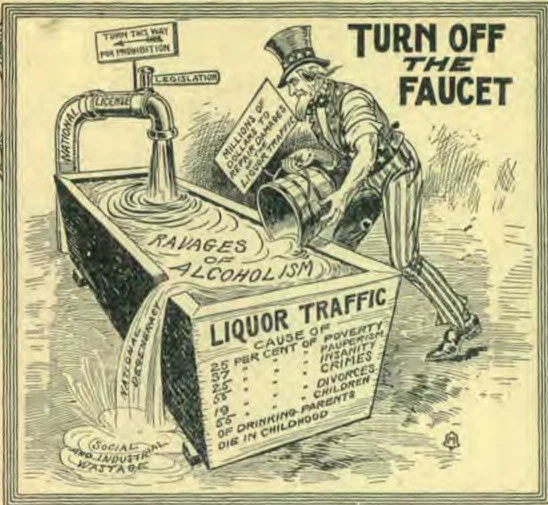
Inmates of an asylum were put to work bailing water out of a trough into which water was pouring from an open faucet. Those who stopped the flow were regarded as hopeful of recovery, while those who worked oblivious of the open faucet were diagnosed as hopelessly insane. Uncle Sam has long been bailing. When will he turn off the faucet?

Elimination Demanded

NATIONAL safety demands the elimination of the drink traffic. Why?—Because of the following true indictments made against it:
“It wastes millions of tons of food and fuel.”
One pound of coal is the average amount consumed in the production of every pint of beer. The 1,000 breweries and 200,000 saloons of this country use more than 14,000,000 tons of coal annually,—enough to give comfort to 6,000,000 soldiers in army cantonments, enough to send a fleet of 23 battleships 3,000 miles across the Atlantic to guard our transports, enough to heat 1,500,000 homes for six months, each home using 100 pounds a day.
According to the United States Census report for 1910, the brewers used three and one-half times as much coal for the production of malt liquors as the bakers use; nine times as much as the boot and shoe manufacturers; and almost four times as much as the printing and publishing industries. Think of it!
Schools, churches, and reputable businesses are closed, to save coal; while the brewers continue to burn up millions of tons of coal. It is not just. It is not good sense. It is not good business.
“It raises the cost of food for our homes.”
You cannot destroy food without making what is left cost more, or else cause some one to go hungry. The grain used in the making of liquor in America would feed the entire country for thirty days each year; it would add 11,000,000 loaves of bread to the daily output of our bakeries.
The barley alone wasted in the manufacture of beer would supply 8,000,000 persons with their normal bread ration.
Tons of sugar used in the making of beer would be gratefully received by the housewives of the country.
The brewers of the United Kingdom of Great Britain destroy once a month five weeks’ food supply for Scotland, or what submarines would destroy if they sank eight 6,000-ton food ships; and American brewers are about as active as the British in destroying food materials.
“It reduces the output of munitions and equipment.”
A department superintendent of one of the big tire factories in Akron, Ohio, uses sixty men in each shift. They are making gas masks, miners’ respirators, and other vital war material. That department is working only two shifts a day instead of three because of the scarcity of labor. They pay off on Friday. On one Saturday only six of the sixty men in one shift reported for work. The superintendent says: “Ninety per cent of our labor troubles are due to booze. If the Government would shut down on the liquor traffic, we could increase our output enormously. There is no lack of labor. The only trouble is to keep it working full time.”
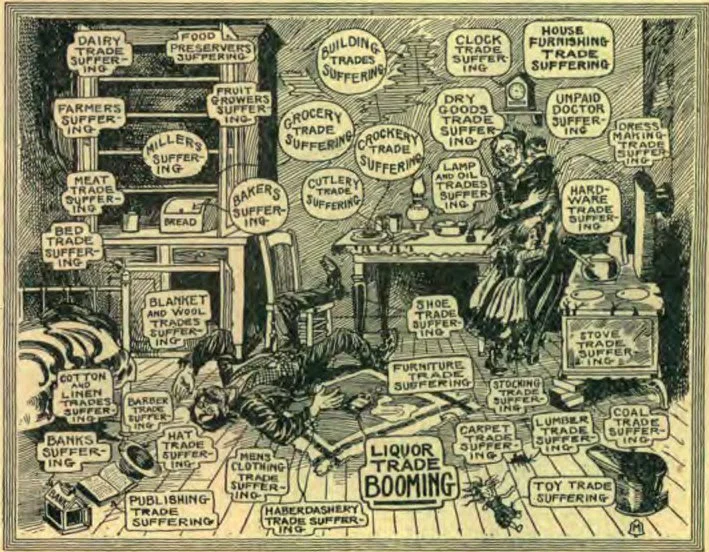
Every legitimate trade suffers when the liquor trade thrives.
The Bessemer Coal and Coke Company, the Superior Fuel Company, and the Ford Colliery Company claim operating efficiency is being greatly lowered, and the output lessened at the rate of 2,000 tons of coal a day, because of drinking places contiguous to their plants.
“It imperils the shipbuilding program and helps the submarines.”
The shipbuilding program would be 20 per cent farther advanced today if the liquor traffic had been prohibited in April. This is a low estimate according to some authorities, who claim that the shipyards of the country are averaging only 48 hours a week, and the efficiency of their labor ranges from 50 per cent at the end and beginning of each week, to 90 per cent on Wednesdays and Thursdays.
“It congests railways, docks, and warehouse systems.”
The railroads of the country are carrying 7,000,000 tons of intoxicants yearly. Ten per cent of the freight cars available for use in this country are counted as a conservative estimate of the number required in hauling the carloads of alcoholic liquors consumed and the materials that enter into their production.
Robert Grant, of the New England Coal and Coke Company, said: “The greatest cause of delay to prompt delivery of coal in New England is due to labor, as intoxication is common.”
Three thousand trains a day are used to carry coal, sugar, grain, and other products to the breweries, says Ohio’s assistant fuel administrator. Thousands of refrigerator cars are regularly assigned to breweries and in daily use on the railroads of the United States, loaded to full capacity, carrying beer to saloons and blind pigs.
One million eight hundred thousand cars would be released for transportation of foodstuffs and coal to the people if the liquor traffic were abolished, says the Chicago Blade. In one month the fuel administrator of Philadelphia diverted to city institutions five cars of coal consigned to the breweries. National prohibition would divert all such cars to legitimate uses. Let us have it.
“It deprives the country of the services of thousands of soldiers whom it afflicts with insanity and disease.”
More than a year ago the Surgeon-General of the United States Army made the startling statement before the joint military committee of Congress that “more than half of the young men who applied for enlistment in the army and navy and were rejected, owed their rejection to drink and the excesses which those who drink so often indulge in.”
“It embitters the hearts of mothers who are willing to give their sons for war, but not for drink dividends.”
It is estimated that at various times the equivalent of eight full divisions of the French and British armies have been incapacitated because of disease usually contracted under the influence of liquor. Canada said: “Great numbers of our men never saw France. Canadian boys cried because they had no munitions. England reeled and beer flowed like water while thousands of our boys went down into their graves. We will never forget it in Canada.”
America will pass through this same bitter experience unless the liquor traffic is entirely divorced from the army both abroad and at home.
“It is the chief instigator of crime and insubordination.”
“The case at bar is the seventy-sixth murder case I have tried, either as State attorney or as judge during the past nineteen years. I have kept a careful record of each case, and I have to say that, in seventy-five out of the seventy-six, liquor was the exciting cause.”—Judge Butler, of Cairo, Illinois, at the close of a murder trial.
These are some of the reasons why the people of this nation now demand the immediate abolition of the unpatriotic, health-destroying, money-consuming liquor traffic.

“Whisky Point”

WHISKY POINT is the name given to a block containing thirteen saloons in a section of the resident district back of the Chicago stockyards. In this section there are 300 saloons, and but 225 retail food stores,—seventy-five more saloons than food stores, and Uncle Sam permits it, even in war times! According to a Y. M. C. A. report $4,500,000 is squandered by the stockyard employees annually in these saloons. It is evident that true American patriotism cannot grow in such an environment; therefore all such breeding places of inefficiency, anarchy, and treason should be burned out by a national war prohibition enactment.
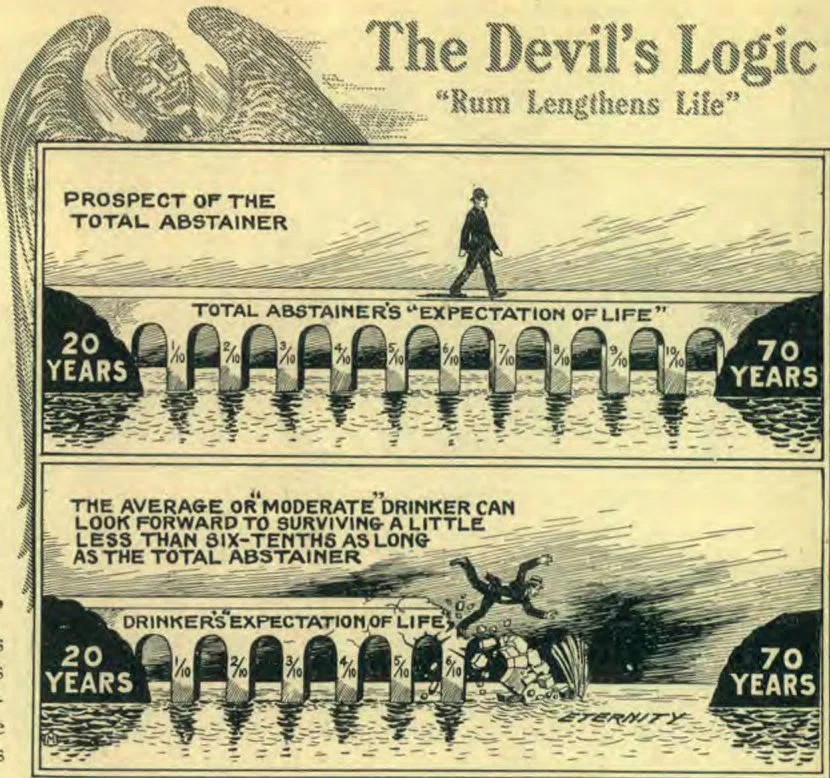
An insurance company, as the result of calculations based upon extended observations made upon 124,673 persons, says the drinking habit lessens by forty-three per cent the “expectation of life” between twenty and seventy years of age. The total abstainer, therefore, is the best insurance investment.

The Drunken Man on the Train

DR. JOSEPH PARKER, once London’s most famous preacher, and a prolific writer, built the great City Temple of the world’s metropolis. He was an enthusiastic temperance orator, and it was he who dared to rebuke the king of England for brewing beer at Briton’s brewery. Had not one man lent a helping hand to a woman in distress, very likely Joseph Parker would never have seen the inside of a pulpit. Nearly sixty years ago George Charlton was on his way to deliver a lecture. In the train on which he was riding was a drunken man with his wife and young son. The man made himself a public nuisance, greatly to the embarrassment of his wife.
Notwithstanding her earnest effort to quiet him, he persisted in his ugliness. Finally Mr. Charlton went over and volunteered to sing, hoping by this means to restore quiet. He sang a temperance song, then an old, well-known hymn, which produced a wonderful effect on the intoxicated husband. The wife thanked the singer heartily, and although Mr. Charlton and the afflicted family left the train at the same station, they separated, not to meet again for years, not until the singer again came to this place to deliver a lecture in the Presbyterian church.
He was met at the station by a fine-looking gentleman, and taken directly to the church, where a “tea party,” as the English people call such gatherings, was being held in the chapel. The lecturer’s wants were looked after generously and graciously by a certain woman, and he noticed that the gentleman who had met him at the train was also solicitous of his welfare. These attentions aroused his curiosity, and he ventured to ask the lady: “Who is that fine-looking gentleman?” “He is my husband,” she replied, “one of the elders in the Presbyterian Church.” Then she asked Mr. Charlton if he did not remember when he sang on the train to quiet a drunken man. He replied affirmatively, and the lady informed him that her husband was the one who caused the disturbance, but added that the hymn the lecturer sang that night had led her husband to God. “He signed the pledge, joined the church, and we have since had one of the happiest homes in England.” “Well,” said the lecturer, “what about the boy?” “When my husband quit drinking, Joe was able to realize his desire for an education. Today he is the Rev. Joseph Parker of Cavendish Street Chapel, Manchester,” proudly remarked Mrs. Parker. Later he became London’s great preacher.
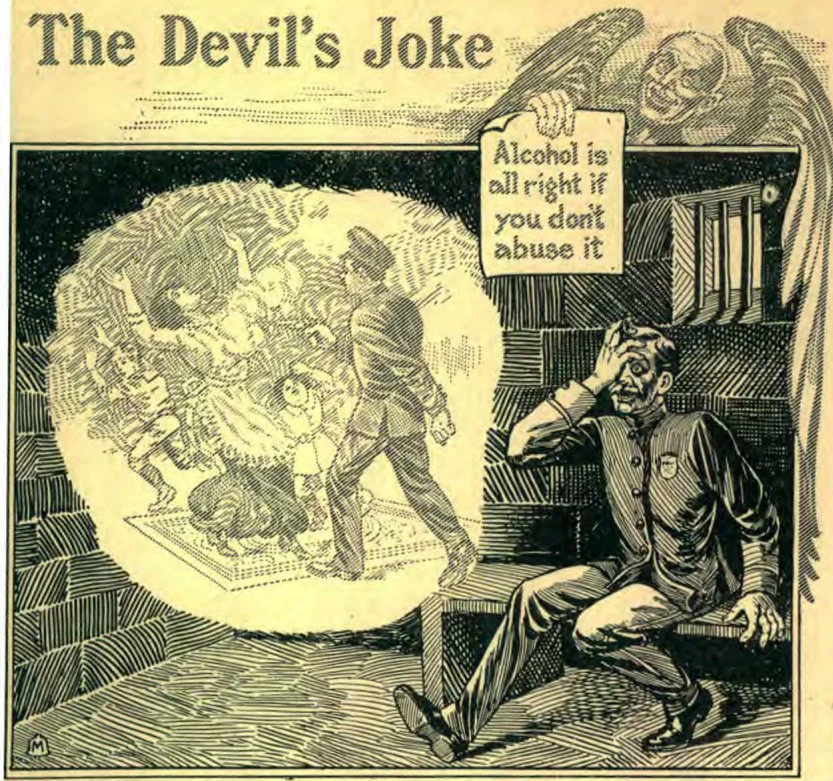
A New York policeman, crazed with drink from the “social glass,” killed his wife. When he recovered his reason, he was horrified to learn what he had done. In his pitiful remorse he cried, “It was the devil’s joke!” Yes, and a joke that has wrecked millions of other lives.

The Alcoholocaust

ALL my life I've wanted to tell Youth a few things. I don't expect many of them to listen, or to believe. But if even one does, then will the time and effort be well spent, and I shall be glad. . . .
“I've wanted to tell girls, ‘Don't drink.’ Clean men don't like it. It makes dirty men think dirty things of you. It coarsens your looks. It makes wrinkles in your face. It makes your figures fat and gross. It cheapens you in every way, physically, mentally, morally. And it's dangerous.”
“I've wanted to tell boys not to drink. It isn't that I'm an old prude. I know what I'm talking about. Booze stimulates the body for evil; and with body stimulated, the will weakens, the mind grows flaccid. It leads to nasty thoughts. And in nastiness of thought lies nastiness of action. And in nastiness of action lies sickness, and the horrid, rotting diseases of flesh and brain that make a man wish to God he had died instead! And before you, lie only years of shame, and torture, and horror,—the contempt of all decent people,—and when you want to grow up to be a clean man, and maybe have boys of your own, you cannot, because those boys will be as rotten, as diseased, as you are. . . . College coaches teach you to cut out alcohol, to live cleanly and regularly. Why? It isn't to please them, is it? It's because you can do better work; it's because it makes you strong, healthy, vigorous.”
“For, after all, your body is merely the machine in which you, as an individual, ride around. You wouldn't think of throwing sand in the gears of your automobile, would you? Then why throw alcohol into the gears of your body? Don't you care as much for your body as you do for your automobile? Then why take such good care of your automobile, and such poor care of your body? Bodies don't cost anything, you say? True. But you can buy a new automobile when the old one wears out, but you can never get another body. . . . Take care of it when it's young, or you'll be mighty sorry, when it begins to get old.”
“And I've wanted to tell parents: ‘Don't bring up your children in ignorance.’ If you don't think they've got sense enough ever to understand anything, then hire a keeper for them. But if you do turn them loose on life, at least point out the pitfalls. Would you send a child out to play in a meadow full of hidden wells? Then why send a child out to play in the fields of life that are full of poisoned traps a thousand times worse than death?”
“I knew the mother of two of the most beautiful girls I've ever seen. Before taking them out to dinner, she would split a pint of champaign between the two, to make their eyes bright, their conversation sparkling. Whose fault if these two girls go straight to hell and stay there? A mother like that isn't fit to have children. Nor is the husband of that mother fit to have children. They haven't even the sense of animals; they are a form of human swine beyond the contempt of decent people.”
“When God gives you the joy of having children, he gives you also the responsibility of their care. See to it that you fulfil that responsibility; nor by laziness, selfishness, and ignorance let them reap the fatal consequences of your own neglect.”
“Booze is an open cesspool on the highway of life. It should be filled in, graded off, and forgotten. And it should be done now.”—Porter Emerson Browne, in McClure's for February, 1918.

A Temperance Dog

A FARMER was one day standing beside his wagon in a market town. Many who passed noticed his honest, cheery face, his well-fed horses, and the fresh green vegetables with which his wagon was loaded.
They also noticed the farmer’s dog, a fine large Newfoundland, with a jet-black coat and a big white patch on his breast. There were a few white hairs about his muzzle, and any one could see that the dog was no longer young.
He seemed quiet and gentle, and he let the children stroke his curly hair; but when a tipsy man came along the street he showed his white teeth with a growl, and kept close to his master.
A gentleman who saw this said to the farmer, “Your dog has no love, I see, for booze. I suppose he’s a temperance dog?” he added with a smile.
“That he is, and no mistake,” said the farmer, “and a temperance preacher as well. I could tell you something of Neil’s preaching if you cared to listen,” he went on, patting the dog’s head.
“I should like to hear it,” was the answer.
“Well, many years ago this dog belonged to a young farm laborer called Jim Snow. Jim bought him from a tinker, who was often tipsy, and at such times treated the dog cruelly. That, no doubt, explains Neil’s dislike for drunken people.”
“Some weeks later Jim was in town and, as usual, he was pretty nearly drunk when he got home. Neil went to meet him, but as soon as his master came near, the dog ran back growling as you saw him do just now when the tipsy man passed.”
“Jim followed him, and put out his hand to take hold of the dog, but he got a sharp bite from those long white teeth.”
“The next day the dog was as good tempered and as fond of his master as ever, and all was right again until Jim’s next visit to town.”
“When he came home the dog went up and sniffed at him. Then smelling the drink, he ran away growling, and hid himself. This time Neil kept away from his master for two days, and spent the time lying in an outhouse.”
“Jim began to think over this, and at last it came into his head that the dog was ashamed of him when he had been drinking. The end of it all was that Jim began to feel ashamed of himself, too, and from that day he never touched a drop of strong drink.”
“What became of Jim, then, and how did you come to own the dog?” asked the stranger, who had listened with much interest.
“Oh, well, you see, I’m Jim!” the farmer said. And then he added, “I have my good dog to thank that I am not still a poor farm laborer and drinking all my wages. He taught me this, that a tipsy man is not fit company even for a dog; and I never forgot the lesson. By his help I began to save my earnings, and now I have a good farm of my own.”—Selected.

Our Privilege and Duty

LINCOLN, the emancipator of the Negro, pleaded for abolition of the liquor traffic, even before he sundered the chains of chattel slavery — but pleaded in vain. Wendell Phillips, with the broken bonds of slavery beneath his masterful feet, begged for its overthrow, but could get no answer. John B. Gough and Francis Murphy, with souls afire and tongues aflame, implored its abolition, but died and went their way leaving its strangling grip unloosened. Women — the best and tenderest our land has known — have prayed for half a century for its abolition and sought to melt with their hot tears the fetters that have bound us, but their prayers and tears, fervent and scalding as they have been, have not been sufficient. The prayers have failed, and the tears, enough to fill the sea and make its waters bitter with their brine, have left the chains upon which they fell uncorroded.
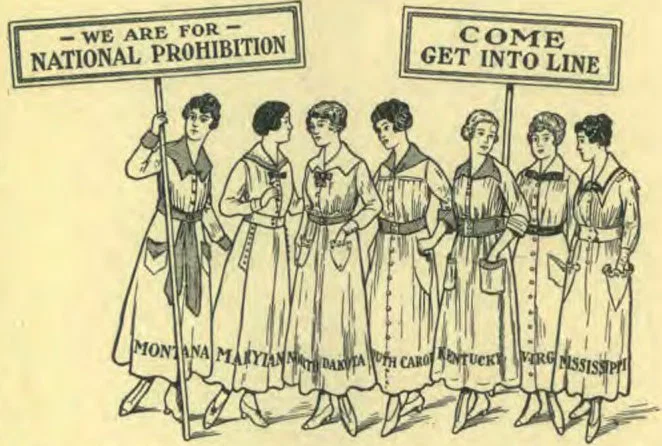
States That Have Ratified the Amendment for National Prohibition
So in our shortsightedness and impatience we have thought and said, but we erred both in thought and word; for now all that has been spoken, or written, or prayed, or wept for, lies within the cup outstretched to us, in one converged, climacteric hour.
Twenty-seven States have filed their answer in public law or constitution. Seven more are writing their answer now and will file it in November. Alaska and Porto Rico are free. The District of Columbia — seat of the nation's capital — has been redeemed. The traffic's advertisements to dry States have been excluded from the Federal mails and the arteries of interstate commerce closed to the transportation of its products into dry territory, and the Congress of the United States — the supreme lawmaking body of a hundred millions of people — has submitted to the States for their ratification an amendment to the Federal Constitution, providing for its abolition throughout the jurisdiction of the Republic. Seven States have already recorded their confirmation, others are soon to follow. In November the members of forty-five legislatures are to be elected. These legislatures, when convened next January, will constitute the battle ground for its Armageddon. If we, as a people, do but rise to the prize of the mark of our high calling we can make this hour the most signally significant in human history.— Ex-Governor Hanly of Indiana.

Lost Because Some Stayed at Home

THERE were 100,000 dry voters in Iowa, it is claimed, who failed to register their vote at the polls for Constitutional prohibition. As a result the amendment failed to pass.
There were six hundred farmers in Ohio who, instead of going to the polls and casting a vote for a dry State, stayed at home on election day. These helped to retain the iniquitous liquor traffic in Ohio during 1918, and so must share the responsibility of the wrecked manhood and the ruined homes consequent thereupon. Every man or woman who has a chance to vote to outlaw the liquor traffic and does not improve it, is surely held responsible by God for a share in the hellish work carried on by the traffic. The only way one can be absolved from being a copartner with the liquor traffic is by voting against it.
Death, and sickness of a serious character are the only things that should keep a person from the polls when a dry or wet question is at stake. The words of Mrs. E. G. White, in her appeal, should arouse to action. She says: “Every individual exerts an influence in society. In our favored land, every voter has some voice in determining what laws shall control the nation. Should not that influence and that vote be cast on the side of temperance and virtue? . . . The advocates of temperance fail to do their whole duty unless they exert their influence by precept and example — by voice and pen and vote — in favor of prohibition and total abstinence.”
Now that the campaign for the ratification of the amendment to the Federal Constitution is on, it would be a crime for any voter who favors national prohibition, to fail to register his vote.

Liquor Fills, Prohibition Empties Jails
JUDGE LONGINO, of Clarksdale, Mississippi, says that he had a letter from the director of the State convict farm, complaining of the scarcity of labor, and asking why we were not sending sentenced men there for service. The judge said he had to reply: “I have not had the men to send. Crime has become so reduced among the Negroes that it seems impossible to maintain the State farm.”
“The jail at Little Rock, the largest city in Arkansas, and the one at Pine Bluff, have both been empty upon several occasions. Little Rock has 60,000 inhabitants, besides a large military camp. Bank deposits in Little Rock have almost doubled during the past year of prohibition.”
It is the same in the West. “Vancouver, British Columbia, records so marked a decrease in the minor crimes, and especially drunkenness, since the advent of prohibition in the city, that the need for an auxiliary jail has ceased to exist. At the meeting of the board of police commissioners, Chief McRae recommended that the new police jail in Ward 7 be closed and the jailers and guards employed there be moved into police headquarters.”
Three years ago when whisky was being sold openly in Augusta, Georgia, the September grand jury returned thirteen indictments for murder; but under prohibition, “for the first time in the history of Richmond County, perhaps,—at least, as far back as local courthouse officials have been able to search the records—a September grand jury has met and adjourned without having to consider a single indictment for murder. Not a murder case or any crime of a particularly violent nature.”
“Prohibition doesn’t prohibit?” “It does prohibit,” is the cry that comes ringing from every jail in prohibition territory. And may the cry of every State in the Union, as it registers its ratification vote, be, “Let it prohibit!”
Continue reading: FIRST AID TO A TEMPERATE LIFE