“The use or introduction for drinking purposes of alcoholic liquors on board any naval vessel, or within any navy yard or station, is strictly prohibited, and commanding officers will be held directly responsible for the enforcement of this order.”
PREVIOUS to July 1, 1914, an order prevented any enlisted man from drinking a glass of beer on board a warship. There remained, however, the wine mess of the officers. It was not common for officers of the navy to become intoxicated; but wine was served at the wardroom meal, and was allowed in the officers’ individual lockers. Drinking even to intoxication therefore was sometimes known.
A United States naval officer in command of one of our cruisers says: “The Wine Mess Order has been of the greatest benefit to the navy. Mr. Daniels has done many big things for the navy, but I believe the Wine Mess Order is the biggest.”
Secretary Daniels’ Own Story
as given in the Sunday School Times, of what led him to issue the order, is of interest. He says:
“One day, shortly after I had become Secretary, a gentleman came into the Department to plead for the restoration of a young relative of his, who had been dismissed from the navy for intoxication. I showed him the record, which proved that this young officer had not only been drunk, but had at the same time made a public exhibition of himself. I explained that there was no course to be pursued but to act firmly and finally in approving the court-martial which had recommended the young officer’s dismissal.
“When I made it plain that the young man must inevitably pay the penalty, this gentleman protested earnestly and with much feeling against what he insisted was the injustice his young relative had received at the hands of the navy. ‘Now that he is the product of your system,’ said my visitor, ‘you have turned him out in disgrace.’ He then went on to tell me the following story:
“‘I am a Friend, a Quaker, and the boy’s father was a Quaker. He was a little shaver when his father died, and the lad came into my home, and has always been to me as a son. I never even had so much as a glass of wine in my home, and when the boy left for Annapolis to enter the Naval Academy he did not know what the taste of liquor was like. I gave him to the American navy, pure-hearted, unsullied, believing absolutely in the old-fashioned Quaker ideas in which he had been reared.
“‘In the seven years you have had him in the navy you gave him wrong ideas about drinking. You taught him that it was all right for a gentleman to have his toddy. You legalized the wine mess. You had a code that made a youth feel that he was narrow-minded if he turned down his glass at the table; but now that my boy has been ruined by you and your system, the navy kicks him out, and puts a stigma on him.’
“Much more than this he said, but this is the substance of his strictures. He was a strong man, and his feeling for the youth whose drinking had wrecked his life was pathetically deep and genuine. When he went out, I could not throw off a stinging sense of justice in his accusation. All day it haunted me that in the discharge of my official duty I had been compelled to approve a decree for which a navy practice was largely responsible.
“For days I was oppressed by the thought that every young man in the navy, many coming from homes like that described by my Quaker visitor, was subject to similar temptation.
“As time went by there were more court-martials—not many, but enough to add to my profound conviction that the old Quaker had pointed me out unerringly the path of duty.
“I knew very well what the issuing of the Wine Mess Order meant. I counted the cost. I knew that many officers in the navy, temperate, honorable, as high-minded as King Arthur’s knights, without fear and without reproach, would resent it, resent it bitterly ; they would feel that the order would convey a wrong impression to the world.
“I realized that the order would be assailed by a multitude of people who would regard it as puritanical. I anticipated that the protest against it might reach into the houses of Congress. But if I was at any time tempted not to take the step for any of these reasons, the reflection that every year there came into the navy hundreds of young men, some of whom might find their undoing in indulgence, made my duty plain. If I had not issued it, I could not have rested with a clear conscience unto this day.
Order Welcomed by Parents
“The order was hailed with so much satisfaction by the fathers and mothers of the country that my mail was doubled and trebled for a month or two. By the time Congress assembled, those who had thought to attack the order upon the floors of Congress found there was not a man in either house who ever raised the issue. By that time, too, the navy officers had learned that it was far from any thought of mine to reflect upon the service. I took occasion to let the public know that so far as the mass of the officers were concerned there was no need for the order. It was issued to safeguard the young men who were coming into the service. The public well understood the reason and heartily approved it.”
Conditions that made the Wine Mess Order opportune for the navy demand a Federal order for a dry nation, that our young men everywhere in the business and social world may be free from the great liquor element that altogether counteracts the good that conscientious, patriotic fathers and mothers have sought to instil in their boys.
Liquor Traffic Compared to German Submarines
“Booze is the German submarine on this side of the Atlantic.”
Don’t Drown Girl Babies Here
In China signs are sometimes seen by the side of fishponds of palaces of mandarins, saying, “Don’t Drown Girl Babies in This Fishpond.” While the government permitted and expected that babies would be drowned somewhere, the owner of a fishpond had a right to prohibit his pond from being so used.
A similar policy exists in America. It is expected that boys and girls will be ruined by the liquor traffic, though some towns, counties, and States refuse to allow it to be done within their domain. The Federal Government, however, gives license privileges to 200,000 men, virtually saying to them, “Take any man’s sons and daughters that you, with all your evil machinations, can persuade to follow you, and do your worst by them, only you must not touch those that live in certain protected districts.”
It is for the Chinese government to stop the drowning of all girl babies in any and every place. So is it for the Federal Government of the United States to stop the debauchery of men and women, of our sons and daughters, by the infamous liquor traffic. And the only way to do it is to abolish the traffic by legislative enactment.
War Prohibition Imperative
“PROFOUNDLY for war-time prohibition.”—Luther Burbank, the “Plant Wizard.”
“In favor of national prohibition during the war and forever after.”—David R. Forgan, National City Bank, Chicago.
“Sale of liquor should be prohibited.”—Simon Lake, inventor of submarine.
“Conditions loudly call for diversion of foodstuffs from distilleries, breweries, and bars to gristmills, bakeries, and breakfast tables.”—Louis F. Post, Assistant Secretary of Labor.
“Favor national prohibition during the war to prevent disease, save food wasted in the manufacture of liquor, and promote national efficiency.”—B. F. Harris, president First National Bank, Champaign, Ill.
“No greater saving financially and in manhood could be made than war prohibition. Every bushel of grain used to make liquor takes bread from the poor.”—Richard H. Edmonds, editor Manufacturers’ Record, Baltimore, Md.
“Entire Interurban Clinical Club approve national prohibition.”—Dr. George Blumer, Yale University.
“For economical reasons as well as others, strongly favor national prohibition.”—C. C. Chesney, manager General Electric Company, New Haven, Conn.
“Favor well-defined war prohibition.”—J. P. Reeves, treasurer Chicago and Eastern Railroad Company, Chicago.
“I am for nation-wide prohibition as a war measure, because of effect on food, economic, and health conditions.”—W. A. Evans, editor of health department, Chicago Tribune, Chicago.
“National prohibition during war has unqualified approval.”—J. H. Wesson, president Smith & Wesson, Springfield, Mass.
“I strongly favor national prohibition during the war.”—Frederick Palmer, author, correspondent, British army and fleet.
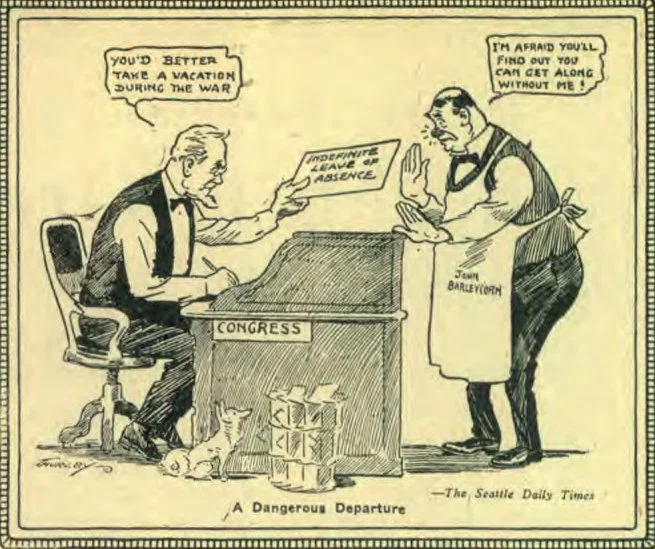
A Dangerous Departure
“Statistics show clearly that the United States should immediately adopt national prohibition as a war measure.”—Roger W. Babson, Babson’s Statistical Organization.
“Favor war prohibition. Effect on health, efficiency, and national economy would be great.”—Howard Elliott, president New York, New Haven, and Hartford Railroad.
“Favor war prohibition as measure of economy and efficiency.”—John Crosby, Washburn-Crosby Company, Minneapolis.
“Unqualifiedly for national prohibition.”—Charles K. Haddon, vice-president Victor Talking Machine Co., Camden, N. J.
“Seriousness of the task before us demands prohibition to conserve food supply, raise efficiency of the nation, and open far richer sources of revenue.”—F. A. Vanderlip, president National City Bank, New York City.
“I firmly believe national prohibition would be of great benefit.”—Samuel S. Childs, Childs Restaurant Company.
“Prohibition would enormously reduce disease, would save food now wasted, and promote national productiveness more than a dozen other measures.”—John D. Rockefeller, Jr.
“National prohibition absolutely essential to preserve food supply.”—John T. Stone, president Maryland Casualty Company.
— Compiled by the American Issue.
Beerless Days
WE have our wheatless, meatless, and wasteless days. This is well. But we call for liquorless days, three hundred and sixty-five of them each year. The secretary of the Board of Food Control in Canada, we are told, resigned his position because he could not serve on a board that limited the individuals of the country to two ounces of sugar, one of the greatest needs in food, while millions of tons of sugar and millions of gallons of molasses were allowed to be made into booze.
We honor the worthy gentleman’s conscience, and we are glad there are those with him who see the injustice of cutting down the supply of real food to the people, while vast quantities of grain, sugar, and molasses are used in the liquor traffic, which is only an evil.
Hard at Work Destroying Foodstuffs
The brewers destroyed 549,810,000 pounds of sugar during 1916, by converting it into beer; and each gallon of beer cost four and a half one-pound loaves of bread. Since there were manufactured 58,000,000 barrels of beer, it is an easy problem to see that they destroyed 9,000,000,000 full-pound loaves of bread. To do this they used nearly 70,000,000 bushels of grain, more than the U-boats sank, besides using the hops grown on 60,000 acres of land that might have been used for growing foodstuffs. The toil of 75,000 farmers for six months was used to provide brewers with material. According to a labor expert, the time of 300,000 persons is permanently devoted to converting good food material into beer and dispensing it, that should be used in legitimate work for the country.
Hard at Work Knitting Men for War Service
But a still more serious indictment against the liquor traffic is made by the Albany Knickerbocker Press: “Despite the relaxing of the former physical requirements, rejections of drafted men for physical reasons have approximated 50 per cent. Had the percentage of deficients for the nation been the same as that for Kansas, a prohibition7State of thirty-six years’ standing, 4,000,000 of the nation’s 5,000,000 physically deficient men of draft age would be able to serve the nation in its time of need.”
The Need of Liquorless Days
and years is evident. Women who have given their husbands to the call of their country demand the conservation of all foodstuffs that our soldiers may not want. Fathers and mothers demand liquorless days, three hundred and sixty-five of them, not alone to conserve food to minister to the physical needs of their boys and the Allied armies, but because they demand clean environment for their boys. They know that wherever booze drags its slimy body, there lurk disease, death, and immorality. These, who have made the greatest possible sacrifice for their country, have a right to speak, and it is our duty to listen.
The nation, if wisely farsighted, will early recognize these demands for the conservation of food materials, and for the more important conservation of its man power. May all patriotic, humanity-loving people energetically work to the immediate securing of this important end.
From Albany to Buffalo
THE liquor-selling places of New York State, if placed end to end, would make an unbroken line from Albany to Buffalo. The cost of the liquor traffic to the State would build a road 300 miles long, connecting these two cities 133 times every year, at the rate of $15,000 per mile. Every mile of this road there would be a road house with 60 girls, every mile a jail with 275 prisoners. There would be practically a solid human wall of liquor delinquents and dependents. Each year, because of the traffic, there would be a new gravestone every 120 feet along this road. This is all permitted in order that 75,000 men engaged in the liquor traffic may continue to make inflated profits.”
“Liquid Bread” Notes
SUPPOSE beer were harmless, it would be neither wise nor patriotic to use it during the war; for according to Prof. G. O. Hugley, of the Department of Chemistry of the Wesleyan University, to furnish a hard-working man with the protein he needs, he would be compelled to drink 108 glasses of beer a day, at a cost of $5.40; while 16 cents’ worth of flour would more than supply the needed protein.
A German privy medical councilor appealed to the German chancellor Von Bethmann Hollweg to stop the brewing of beer, “for 2,100 tons of grain were being used daily for brewing purposes, a quantity sufficient to feed 10,000 persons.” A German paper commenting on this appeal said: “If a man drinks three quarts of beer a day, he consumes 25.5 ounces of barley, or more than the bread rations of three persons.”
The “liquid” product must give place to real bread.
Why Favor John Barleycorn?
ALIEN enemies have been barred from a zone reaching inland one hundred miles from every part of our coast line. This was easily done when the necessity became evident. The courts agree in pronouncing John Barleycorn our most dangerous alien enemy. The food destroyed by him is sufficient to feed 7,000,000 men a year. He wantonly destroys annually 11,000,000,000 loaves of our life-giving bread. Besides this he destroys and debauches more persons each year than England has lost on Europe’s bloody battle field in three years; and yet we let him live. We license him to carry on this hellish work. Shame on every man or woman who has voted to license the liquor traffic!
Besides destroying food and men, he robs our youth of an education. Were it not for the money wasted on him, we could build and maintain fifty universities in each of the forty-eight States. And still we let him live! We do not even intern him during the war. But from every corner of the land is coming an appeal to the Government to intern or destroy the traitor, and this cry will swell until the death fiat will go forth.
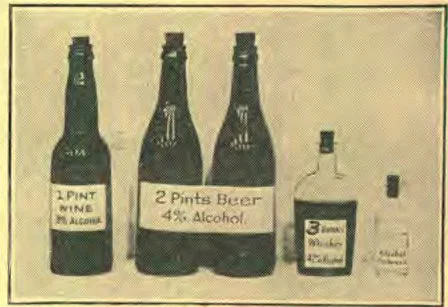
Comparative Alcohol Content of Whisky, Wine, and Beer
Get rid of the idea that one must drink a barrel of beer to receive the alcoholic harm that one would get from a flask of whisky. The quantity of alcohol in a one-ounce drink of whisky, a three-ounce drink of wine, and a half-pint drink of beer is very nearly the same. Get rid, too, of the idea that French wine is harmless. One pint of this wine contains as much alcohol as is contained in six ordinary drinks of whisky.