ONCE there was a poor man (so the story runs) who was wandering all alone upon the side of a rugged mountain, when he came to a tiny, trickling stream, flowing from the rocks. He followed its course, and it led him into a wooded glen, where the fresh green grass was growing. On the banks of the stream he found a tiny blue flower. It was so long since he had seen a flower, that he eagerly picked it, and tied it to the head of his staff.
Just as he turned to go on his way, he saw an opening in the rock, which led him into a large cave filled with gold and silver and jewels and precious stones. He threw down the “luck flower” that had brought him this good fortune, and filled his pockets and his arms with all that he could carry of the treasure that he had found. The treasure that he had collected vanished, and not even his staff with the “luck-flower” on it remained to him. He sought in vain for the “luck-flower” that had gained him an entrance to the cave, but he never succeeded in finding it again.
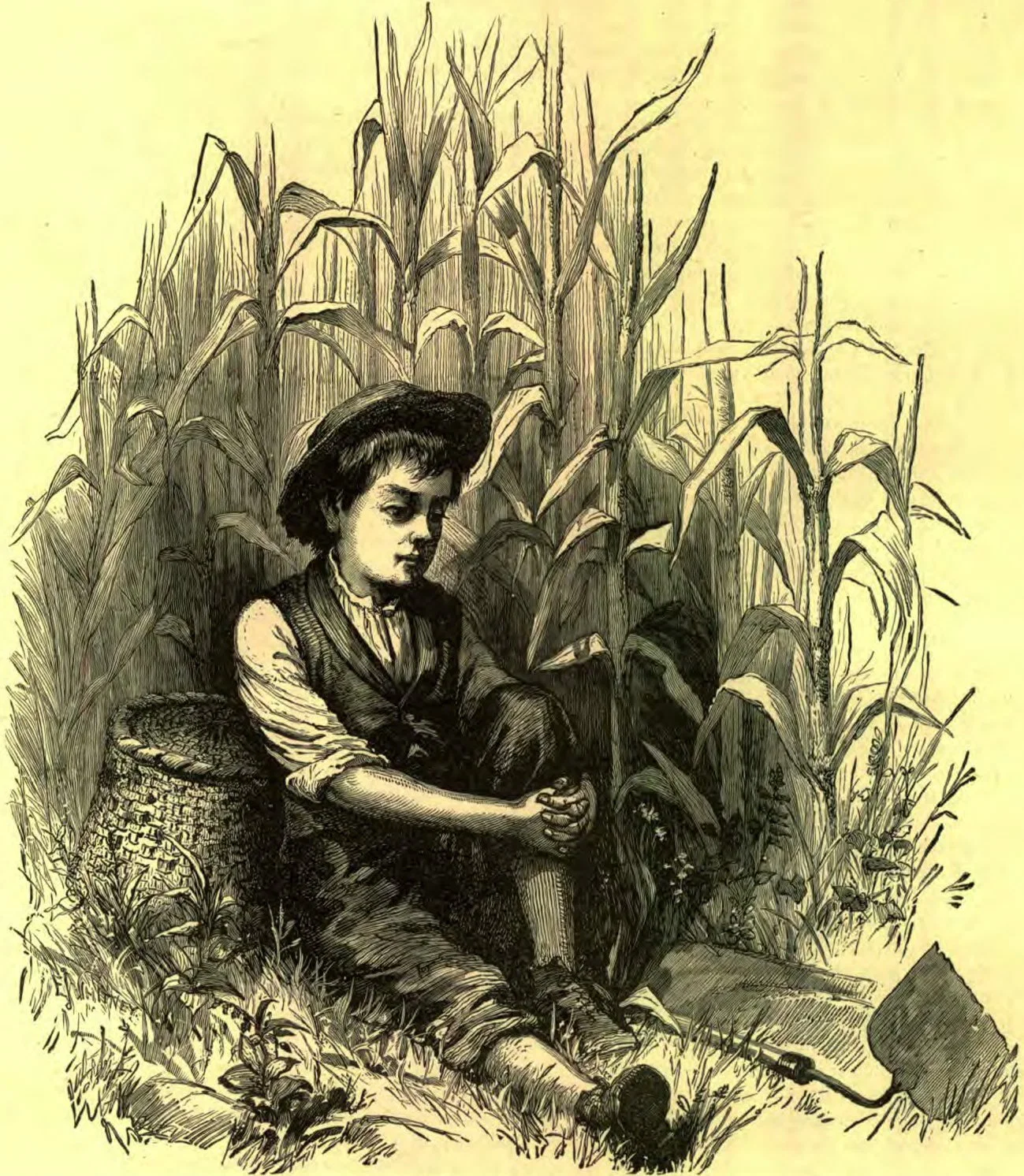
HE FANCIES THAT THE WAVING HEADS ALL BOW WITH COURTEOUS CHARM
You will, I think, see the meaning of this little fable without any explanation. The stream whose course he followed shows how God guided the poor man, in his want and loneliness, to the place where he would find an abundance.
Then the finding of the “luck-flower,” as he called it, which gave him entrance to the cave, showed how God opened the way for him to get wealth. Did you ever hear any one talk about “luck” or “chance”? Did you ever think, yourself, when any good fortune came to you, that it was “a piece of good luck”? There is no such thing. All things are ordered for us, and every good thing comes to us from God.
Then when he forgot his benefactor in his eager, greedy grasping after the treasure it had brought him, he was an example of what so many do,—forget God, and leave him altogether out of their reckoning, in seeking to fill their hands with the riches that he himself has bestowed. Take care, dear children, that you are not so taken up with the good things God has given you, that you forget the Giver of “every good and perfect gift.”
Many think that it is all their own skill and wisdom that bring their good fortune, and to such God says: “Beware that thou forget not the Lord thy God, . . . lest when thou hast eaten, and art full; and hast built goodly houses, and dwelt therein; and when thy herds and thy flocks multiply, and thy silver and thy gold is multiplied; . . . then thine heart be lifted up, and thou forget the Lord thy God; . . . and thou say in thine heart, My power and the might of mine hand hath gotten me this wealth. But thou shalt remember the Lord thy God: for it is he that giveth thee power to get wealth.”
From all his works his sweet voice cries to us continually, “Forget me not! Remember me, the Giver of every good and perfect gift; for my hand made all things.” It is for our sakes that he thus calls to us; for he knows what must be the end if we do forget him. We shall at last find ourselves shut out from his presence, with all the things that we have allowed to take his place faded from our grasp. We shall be left empty-handed, like the poor man on the bleak mountain-side.230
How much better it is to remember God, and love him, even though we have no earthly treasure, than to have all the riches of earth, and forget the source from which all our blessings come! EDITH E. ADAMS.
THE GREAT NORTHERN SHRIKE
By Edward Brayton Clark
Of the great family Laniidae, the shrikes, of the order Passeres, we have in America only two species, the great northern shrike, Lanius borealis, and the loggerhead shrike. The name of the great northern shrike is much more than a mouthful, and is all out of proportion to the size and importance of the bird.
There are two hundred species of shrikes altogether, nearly all of them being confined to the Old World. When one comes to know fully the characteristics of the creatures, he feels that the birds would not have been out of place if they had been classed in the order Raptores, because they possess the distinguishing traits of the bird of prey. The shrikes, however, do not have talons, and they are singers of no mean order,—facts which perhaps disqualify them for association with their larger rapacious brethren.
The great northern shrike, more commonly called butcher-bird, comes from northern British-American territory to the latitude of Chicago in the fall, and stays through the winter, when it leaves for the vicinity of Fort Anderson in the crown territories, to build its nest. This is placed in a low tree or bush, and is composed of twigs and grasses. The eggs number four or five. During the winter the shrike’s food consists almost entirely of small birds, with an occasional mouse to add variety. In the summer its diet is made up chiefly of the larger insects, though at times a small snake is caught and eaten with apparent relish.
The great northern shrike has the habit of impaling the bodies of its victims upon thorns, or of hanging them by the neck in the crotch of two small limbs. The bird has a peculiar flight, hard to describe, but which, when seen a few times, impresses itself so upon the memory that it can never afterward be mistaken, even when seen at a long distance. Its favorite perch is the very tiptop of a tree, from which it can survey the surrounding country, and mark out its victims with its keen eye. In taking its perch, the shrike flies until one gets the impression that it is to light in the very heart of the tree. Then it suddenly changes direction, and shoots upward almost perpendicularly to its favorite watch-tower.
One has to have something of the savage in him to enjoy thoroughly the study of the shrike. As a matter of fact, the close daily observance of the bird involves some little sacrifice for the person whose nature is tempered with mercy. The shrike is essentially cruel. It is a butcher, pure and simple, and a butcher that knows no merciful methods in plying its trade. More than this, the shrike is the most arrant hypocrite in the whole bird calendar. Its appearance as it sits apparently sunning itself, but in reality keeping sharp lookout for prey, is the perfect counterfeit of innocence.
My own observations of the shrike have been limited to Chicago, and to the fields immediately beyond its walls. For those unfamiliar with the subject it may be best to say that in the winter the shrike is abundant in the parks of the great, smoky city by the lake, and not infrequently it invades the pulsing business heart of the town. No one ever saw the placidity of the shrike disturbed in the least. It will perch on the top of a small tree, and never move so much as a feather, barring its tail, which is in well-nigh constant motion, when the clanging electric cars rush by, or when the passing wagons shake its perch to the foundation.
As far as my own observation goes, the great northern shrike in winter does not put very much food in cold storage. I have never seen many victims of the bird’s rapacity impaled upon thorns. Perhaps I should qualify this statement a bit by saying that I have never seen many victims hanging up in one place. I have watched carefully something like a score of the birds, and while every one occasionally hung up one of its victims, there was nothing approaching the “general storehouse” of food so often described. It is my belief that this habit of impaling its prey upon thorns, or of hanging it by the neck in a crotch, is one that is confined largely to the summer season, and especially to the nesting period.
Every morning during February, 1898, a shrike came to a tree directly in front of my window on Pearson street, in Chicago. The locality abounded in sparrows, and it was for that reason the shrike was such a constant visitor. The bird paid no attention to the faces at the window, and made its excursions for victims in plain view. The shrike is not the most skilled hunter in the world. About three out of four of its quests are bootless; but as it makes many of them, it never lacks for a meal. The Pearson street shrike one day rounded the corner of the building on its way to its favorite perch, and encountering a sparrow midway, struck it down in full flight. The shrike carried its struggling victim to the usual tree. There it drilled a hole in the sparrow’s skull, and then allowed the suffering, quivering creature to fall toward the ground. The butcher followed with a swoop much like that of a hawk, and, catching its prey once more, bore it aloft, and then dropped it again, as it seemed for the very enjoyment of witnessing suffering. Finally, when the sparrow had fallen for the third time, it reached the ground before the shrike could reseize it. The victim had strength enough to flutter into a small hole in a snow bank, where it was hidden from sight. The shrike made no attempt to recapture the sparrow. It seemingly was a pure case of “out of sight, out of mind.” In a few moments it flew away in search of another victim. The sparrow was picked up from the snow bank and put out of its misery, for it was still living. There was a hole in its skull as round as if it had been punched with a conductor’s ticket clip.
It has been my experience that the great northern shrike hunts most successfully when he, so to speak, flies down his prey. If he gets a small bird well started out into the open, and with cover at a long distance ahead, the shrike generally manages to overtake and overpower his victim. If the quarry, however, is sought in the underbrush or in the close-twined branches of the tree-top, it generally succeeds in eluding the butcher. One of the most interesting incidents of all my bird observations was that of the attempted capture by a great northern shrike of a small brown creeper. The scene of the action was near the south end of the Lincoln Park lagoon in Chicago. The creeper was nimbly climbing a tree-hole, industriously picking out insects, as is his custom, when a shrike dropped down after him from its high perch on a tree which stood close, and overshadowed the one from whose bark the creeper was gleaning its breakfast.
The shrike was seen coming. The creeper, for the fraction of a second, flattened itself, and clung convulsively to the tree trunk. Then, recovering, it darted to the other side of the bole, while the shrike brought up abruptly and clumsily just at the spot where the creeper had been. The discomfited bird went back to its perch. The creeper rounded the tree once more, and down went the shrike. The tactics of a moment before were repeated, the shrike going back to its perch chagrined and empty-clawed. Five times it made the attempt to capture the creeper, and every time the little bird eluded its enemy by a quick retreat. It was a veritable game of hide and seek, amusing and interesting for the spectator, but to the birds a game of life and death. Life won. I have always believed that the creeper thought out the problem of escape for itself. The last time the shrike went back to its perch, the creeper did not show round the trunk again, but instead flew away, keeping the bole of the tree between itself and its foe. It reached a place of safety unseen. The shrike watched for the quarry to reappear. In a few moments it grew impatient, and flew down and completely circled the tree. Then, seemingly knowing that it had been fooled, it left the place in disgust.
Of the boldness of the great northern shrike there can be no question. It allows man to approach within a few feet, and looks him in the eye with a certain haughty defiance, showing no trace of nervousness, save the flirting of its tail, which is a characteristic of the bird, and in no way attributable to fear or uneasiness. One morning early in March, when the migration had just started, I saw two shrikes on the grass in the very center of the ball ground at the south end of Lincoln Park. They were engaged in a pitched battle, and the feathers literally flew. I looked at them through a powerful field-glass, and saw a small, dark object on the grass at the very point of their fighting. Then I knew that the battle was being waged for the possession of an unfortunate bird victim. Being anxious to find out what the dead bird was, I walked rapidly toward the combatants. They paid no heed to me until I was within twenty feet of the scene of their encounter. Then they flew away. I kept my eyes on the ruffled body of the little victim lying on the grass, and, walking toward it, stooped over to pick it up. At that instant, as quick as the passing of light, one of the shrikes darted under my hand, seized the quarry, and made off with it,—an exhibition of boldness that did not fail to win admiration.
I once saw a goldfinch in winter plumage escape a great northern shrike by taking a flight directly at the zenith. The shrike followed the dainty little titbit far up, until the larger bird was only a speck, and the little one had disappeared entirely. The shrike apparently could neither stand the pace nor the altitude, and the watchers, with whom the goldfinch was the favorite in the race, rejoiced with the winner.—Edward Brayton Clark, in Birds and Nature.
THE CRICKET'S SONG
WHAT'S the song the crickets sing—
Summer, autumn, winter, spring?
When I take my little broom
And go dusting through the room—
“ sweep! sweep! sweep! sweep!”
When I go to bed at night,
Then I hear them, out of sight,
“Sleep! sleep! sleep! sleep!”
When I waken every day,
If it's sunny, then they say,
“Peep! peep! peep! peep!”
But they feel as bad as I
When it rains; for then they cry,
“Weep! weep! weep! weep!”
1. When the angel again came to explain “the vision” to Daniel, with what words did he begin? Dan. 9:24; note 1.
2. What is the meaning of “determined”? Note 2.
3. Into how many periods are the twenty-three hundred days, or years, divided? Dan. 9:25, 27; note 3.
4. When did the period of seven weeks (or forty-nine years) begin? Dan. 9:25, first part.
5. To whom was this commandment given? When did it “go forth”? Ezra 7:11; note 4.
6. To what event would the “seven weeks, and threescore and two weeks” reach? Dan. 9:25; note 5.
7. Who was the Messiah? When did he come? John 1:41; note 6.
8. When the Messiah came, what would he do? Dan. 9:27, first part.
9. In what way did Jesus fulfill this prophecy? Mark 1:14, 15.
10. What did the angel say would occur in the midst of the week? Dan. 9:26, first part; 27.
11. How could it be true that Jesus would “confirm the covenant”—preach the gospel—for one week, and yet be “cut off”—crucified—in the middle of the week? Note 7.
12. In what year was Jesus crucified? At what time of the year? Note 8.
13. Three and one-half years later—at the end of the seventy weeks—what took place? Note 9.
14. At the close of the seventy weeks, how many of the twenty-three hundred years still remained? Note 10.
15. In what year, then, would the twenty-three hundred years come to an end?
16. At their close, what had the angel said would take place? Dan. 8:14.
NOTES
1. There was but one part of the vision that the angel had not previously explained; that was the twenty-three hundred days, or the time part. The first thing, therefore, which he mentions, as he again takes up the vision to make it plain, is time. This shows that “the vision” which the angel mentions (Dan. 9:23) is the same vision as that of chapter 8.
2. “Determined” signifies “to cut off.” To say that “seventy weeks are determined,” is but to say that seventy weeks are cut off. If the seventy weeks were cut off, and they were, they must have been cut off from some other period of time, or from the twenty-three hundred days, which the angel mentioned when he first gave Daniel the vision. And we may know, too, that when the seventy weeks were cut off, they were cut off from the first part of the twenty-three hundred days, just as, when we purchase cloth, the merchant cuts off our portion from the first part of the bolt, or roll.
3. There are four divisions,—(a) seven weeks; (b) threescore and two weeks; (c) one week; and (d) the remainder, after deducting the first three. To make it plain by figures, we may state it as follows:—
Seven weeks = 49 days
Threescore and two weeks = 434 days
One week = 7 days
Total, 490 days
2300 days − 490 days = 1810 days
The four divisions are, therefore,—49, 434, 7, and 1810. A prophetic day equals a literal year. Num. 14:34. The twenty-three hundred days therefore equal twenty-three hundred years. And as the seventy weeks are taken from the first part of the twenty-three hundred days, the beginning of the seven weeks (forty-nine years) is the beginning of the twenty-three hundred days.
4. The “going forth” of the commandment refers to the time when the work of building actually began, which was in the fall of 457 B. C. The date 457 B. C. is found in the margin of Ezra 7, and is undoubtedly correct. From 457 B. C. is the time to reckon the beginning of the twenty-three hundred years; for at that time the commandment was given to Ezra.
5. The sixty-nine weeks were to reach to the Messiah. The Lord has stated it very plainly, that no one may misunderstand. Seven weeks were to be spent in the building of Jerusalem, and history says that this was just the time taken. Sixty-two weeks later Messiah was to come. This, too, was exactly fulfilled. It was just four hundred and eighty-three years from the time that Ezra began to build Jerusalem to the time when Messiah came.
6. The word “Messiah” means “the Christ” (John 1:41); and the margin reads, “the Anointed.” Jesus, when baptized in the Jordan, was anointed with the Holy Ghost (Matt. 3:16; Acts 10:38), and at that time began his work of preaching the kingdom of God, of saving his people. The sixty-nine weeks, therefore, were to reach to his baptism. By looking at the margin of Luke 3:21, 22, we find that the date of his baptism was A. D. 27. The twenty-three hundred years began in the fall of the year; therefore the close of the first sixty-nine weeks was in the fall of A. D. 27.
7. Jesus himself worked for his people, the Jews, only three and one-half years; but he continued to work for them, by his apostles, another three and one-half years,—seven years in all.
8. Jesus was baptized in the fall of A. D. 27. He worked for his people three and one-half years. By adding the three and one-half years to A. D. 27, we are brought to the spring of A. D. 31, and to the time of the feast of the passover. Nearly all know that Jesus was crucified at the time of the passover. See John 18:28.
9. Three and one-half years after Jesus was crucified, in the fall of A. D. 34, and when the seventy weeks ended, the Jewish people entirely rejected the gospel of Jesus Christ, and so the apostles said to them the words written in Acts 13:46. The four hundred and ninety years given to the Jewish people ended in the fall of A. D. 34. At that time the apostles turned to the Gentiles.
10. We have already seen that after the seventy weeks ended, there would still be 1810 years remaining. Adding 1810 years to the fall of A. D. 34, we are brought to the fall of 1844. At that time the cleansing of the sanctuary in heaven began.
Laying Aside Ill Temper Through Trust in Christ
By F. B. Meyer
WHAT a shadow is cast over our lives and homes by bad tempers. How may those afflicted with ill temper be delivered? The apostle says, “Laying aside all malice.” That “laying aside” is a remarkable expression; for it means that the thing may be done by one sudden, definite act. We are not to wait till these evil things die down in our hearts, but are to make up our minds, once and forever, to lay them aside, as a beggar his rags when new clothes are offered to him. It is a definite act of the will. Will you make it now? Will you say, “From this moment I choose to be free from these things, and I deliberately put them off”? But you fear this will not help you, you have so often made good resolutions before, and broken them. Then take one further step. Trust Christ to keep you. Say, “Lord, I have often tried to keep my temper, and failed, but henceforth I trust its keeping to thee.” Every morning look up into his face, and say “I am still trusting thee to come between me and my evil past, and to fill me with thine own sweetness, gentleness, and patience.” In moments of provocation, dare to trust him still. Live thus, and you will be known for the very opposite temper to that which has so often caused you poignant regret.—F. B. Meyer.
JUST A LITTLE SONG
Just a little song, dear,
When the heart is gay;
Just a lilting measure
In the lonesome day;
Just a thread of melody
On the weary way.
Just a little song, dear,
When the burden binds;
Just a snatch of music
When the toiler finds
Life a little wearing,
And the day's work grinds.
— Collier's Weekly.
THE VERI
Seventh-day Adventists coming to the Pan-American, STOP AT
“THE VERI”
787 Niagara Street (near Vermont Street).
BRO. C. H. HARRIS, Mgr. BUFFALO, N. Y.
GRAND TRUNK R'y. SYSTEM.
By W. C. Cunliffe
Taking Effect June 2, 1901.
Trains leave Battle Creek.
WEST-BOUND.
No. 9, Mail and Express, to Chicago 12.15 P. M.
No. 7, Limited Express, to Chicago 7.00 A. M.
No. 1, Chicago Express, to Chicago 9.23 A. M.
No. 3, Lehigh Valley Express, to Chicago 3.50 P. M.
No. 5, International Express 2.17 A. M.
No. 75, Mixed, to South Bend 7.30 A. M.
Nos. 9 and 75, daily, except Sunday.
Nos. 1, 3, 5, and 7, daily.
EAST-BOUND.
No. 10, Mail and Express, East and Detroit 3.45 P. M.
No. 8, Limited Express, East and Detroit 4.50 P. M.
No. 4, Lehigh Valley Express, East and Canada 8.22 P. M.
No. 6, Atlantic Express, East and Detroit 2.10 A. M.
No. 2, Express, East and Detroit 7.00 A. M.
No. 74, Mixed (starts from Nichols yard) 7.15 A. M.
Nos. 10 and 74, daily, except Sunday.
Nos. 4, 6, 8, and 2, daily.
W. C. CUNLIFFE, Agent,
BATTLE CREEK.
SELF-PRONOUNCING S.S. Teachers’ Reference Bible
By Editor
Contains the Celebrated Teachers’ Helps,
Comprising nearly 400 pages. Also a complete series of fourteen new maps.
DESCRIPTION
IMPERIAL SEAL BINDING, TUCK EDGES, known as “DIVINITY CIRCUIT,” ROUNDED CORNERS, FULL RED UNDER GILT EDGES.
We offer this Bible, postpaid, for only six new yearly subscriptions at 75 cents; or twelve new six months’ subscriptions at 40 cents.
We will also send it, postpaid, with the INSTRUCTOR one year for $2.25. For 20 cents extra we will stamp your name in gold upon the cover. Address— THE YOUTH’S INSTRUCTOR, Battle Creek, Mich.
Baby's First Wardrobe
Hygienic Patterns
Complete outfit based on healthful principles—22 Neat Patterns—with full instructions for making, and an illustrated booklet on baby's care and clothing. All sent in a plain envelope for 50 cents in stamps or silver.
If interested in the best books, patterns, materials, garments, and accessories for mothers or children, send a stamp for information, or remit for patterns to— Mrs. F. M. Kellogg, 36 Washington Ave., Battle Creek, Mich.
A GIRL'S BATTLE
By Frederick E. Burnham
Julia Vincent was employed in one of the great cotton factories of Lawrence. She had been there since she was a mere child of a dozen years; and at sixteen the discouraging fact stared her in the face, as it did hundreds of others, that it was impossible to earn more than a dollar a day in busy times, to say nothing of the weeks when the mill was practically at a standstill.
A shopmate relieved the monotony of work by reading from a novel, which she contrived to keep open before her as she worked at the spindle. The thought occurred to Julia that she could improve her mind while at work by studying from an open book. She knew that it could do her no harm, and it was possible that the open book would prove the door to a more congenial and better-paid position. The mill girl determined to make the effort.
She knew little or nothing of the branches taught in the grammar school; and it was at the bottom of the ladder that she began her self-education. An arithmetic was the first book that she purchased, and immediately she began to dig out the simple problems, difficult enough for her.
The foreman smiled as he passed, seeing the open book before her. “Can’t you keep track of your surplus wealth?” he asked.
“I haven’t been able to discover a surplus yet,” the girl replied, looking up. “I thought that perhaps the arithmetic would show me where to look for it.”
“So it will,” said the foreman, smiling; “stick to your books, and they will show you the way to a better position.” It was only a passing word, but somehow it encouraged the girl wonderfully, and she did not forget it, though years passed.
The girls at the mill found much merriment at the expense of the girl who had made up her mind to rise above her surroundings, but she gave little thought to their taunts; her mind was in other fields.
The days lengthened into weeks, and weeks into months, and the mill girl persisted in her resolve. Evenings and holidays were the golden opportunities for study which she most carefully improved. To arithmetic she added other branches, and the results soon became apparent. Copies of the examinations held in the public schools of the city were secured, and she found that to pass them was little more than pastime.
A party was to be held by the employees of the mill; there were few of the girls who would not attend. Preparations had been going on for weeks; many of the girls who were working for almost starvation wages had managed to set aside a little sum with which to purchase a tasty dress, or make over an old one. For once, the girl who had denied herself almost every pleasure, that she might study, decided to have a part in the coming festivities. She contrived to lay aside ten dollars with which to make and purchase a new dress; no extravagant amount, to be sure, but sufficient for a dress which would please the quiet mill girl.
One evening it dawned upon the girl that she was sorely in need of a tutor’s assistance. She had come to a point where help seemed imperative; there were problems in the algebra which she was unable to solve, passages in the first year’s Latin which she could not translate. It came to her with almost overwhelming force, that either the studies or the new dress must wait.
It was a girl’s battle that was to be fought in the little room of one of the corporation houses,—a struggle between a girl’s longing for pleasure and a girl’s desire to see the ambition of her life a reality. It was a girl’s battle, marked by a girl’s tears; but it was sound sense that won, and when at last the conflict was over, she was no longer a girl, but a woman.
The ball was held, and Julia did not attend; but the problems and Latin translations were successfully disposed of, and though some of the girls sneered, she was content.
Six years passed, and the girl who had clung through thick and thin to her books, was ready to attempt the normal school examinations. Wages at the mill had not increased during that time, and the dress she wore was an old one, ill-fitting, and of cheap material, but that did not seriously annoy her. Several of the young ladies who were seated near her, curled the lip and smiled, and the laugh went round, but that was merely a passing trifle. The mill girl’s time to laugh came later in the day, though she did not avail herself of it.
An hour passed, and nothing was heard save the scratching of pens. Not a few who had smiled at first began to look worried; they looked at the examination papers and then at one another. It was apparent that they were not at ease.
Meanwhile the mill girl’s pen was busily at work; page after page was being filled, punctuated with few pauses. Those years had not been spent in vain; there was a fund of knowledge at her disposal which was ample, and long before the allotted time had expired, her paper was handed in. Other examinations followed in order, and were successfully passed. No one now thought of remarking the plain dress; many would gladly have changed places with her, could they have felt as secure as to the future.
One morning Julia Vincent received a letter from the principal of the normal school, informing her that there was a position at her disposal,—a little school among the Vermont hills. For an hour the young woman, who had denied herself almost every luxury that she might win, held the letter tightly in her trembling hands—the happiest hour of her life. It was then that she realized that the books had led the way to a more desirable position.
At the mill no one was more pleased than the foreman who had encouraged her at the start; and as she parted with the mill operatives with whom she had worked, there were those who heartily wished that they had followed her example. Some called it luck; they said that Julia was always lucky. They didn’t call her lucky when she had remained away from the party four years before; they called her mean in those days. Well, if she was lucky, many of those who envied her lot might have been lucky, too; it was merely a question of self-denial and perseverance.
A year passed, and the young schoolmistress filled her position so satisfactorily that a better position was offered her in the same town. The knowledge of her ability as a teacher, however, was not confined to that township; her career had been watched with interest by the faculty of the normal school. A choice position was awaiting the right person in one of the large city schools; Julia Vincent’s name was mentioned. The recommendation was sufficient, and the place was assured.
Such is the story of the Lawrence mill girl. Sound sense and perseverance were the factors which wrought such changes in her life,—qualities which will turn failure into victory as surely as the rising sun brings daylight.—Frederick E. Burnham, in the Well Spring.
“OVERLOADED VESSEL SINKS”
Such was the glaring headline in a daily paper. Sometimes a ship does not have sufficient load, and then it goes bumping along, at the mercy of every wave. It is in almost as great danger as the too heavily loaded vessel, and gives great discomfort to those who may be compelled to journey in it.
Both extremes are to be avoided—in ships and in other things. Think how many overworked mothers and fathers are overloaded these summer days, while their thoughtless sons and daughters are almost free from the responsibilities and burdens it should be their pleasure to share. Sometimes, alas, some overloaded human vessel sinks: the strain is too severe. Then those who have shirked their share of the load wake up to find that they must take it upon inexperienced shoulders, and, worse still, that they must bear with it the additional burden of a lifelong regret.
Look out for mother these days. If it is warm for you in the shade, where you have taken a book or some light work, how do you think it is for her in the hot kitchen, whose very breath in passing causes you to gasp? Oh, do not think she is “used to it,”—that she “does not mind”! Get her to put on a thin dress, and sit in the shade, while you prepare the meals, or wash the dishes, or do the ironing. You will see very soon how much she will appreciate your thoughtfulness, and by that you may know how much she has “minded” the long, overheated hours in the kitchen.
And father—in the field or at his daily work—do not add a straw to his burdens and anxieties by needless or heedless requests and demands. Instead, be ready to meet him with the cooling drink he likes best, see that he has the comforts that will refresh him after his long day’s work, and in every way try to lighten the necessary things to be done that would eat up his short hour or two of rest. He will appreciate it, never fear.
And if the burdens are thus equally divided and adjusted, there will be less danger of any one giving out under the strain, even if all have to work hard.
Truth as a Swivel in the Golden Chain
TRUTH is a link that acts as a swivel in the golden chain of life. It keeps the chain from becoming tangled, regardless of the way it is interwoven, and always serves the same purpose, and has the same appearance, no matter how many times it has been turned.—Our Boys’ Magazine.