The Youth’s Instructor, Vol. XLIX, No. 29

TRAINING SQUIRRELS

The Youth’s Instructor

July 18, 1901

Review and Herald Publishing Company · Battle Creek, Mich. · July 18, 1901

TRAINING SQUIRRELS
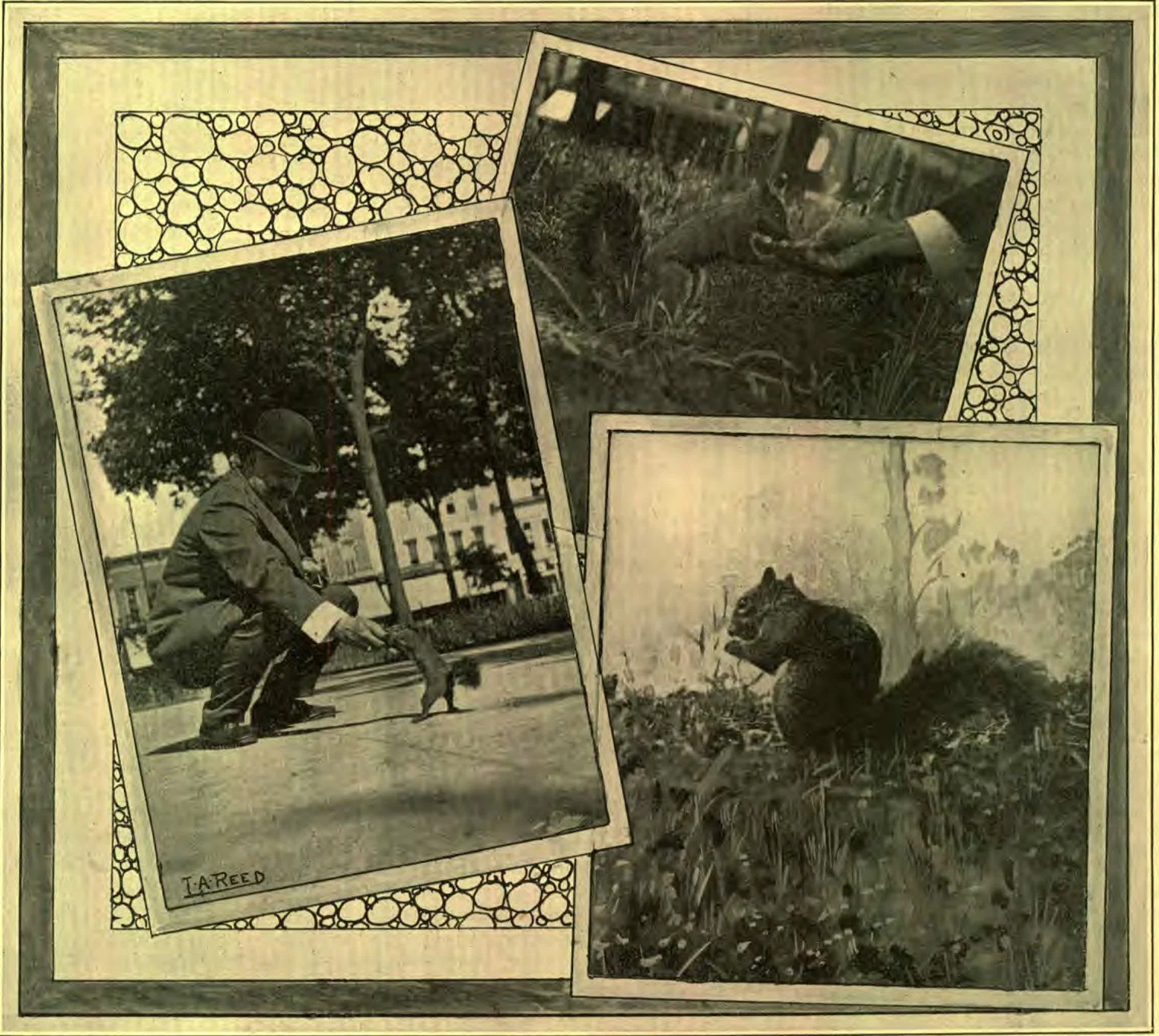
In the public square, or park, as some call it, in Jacksonville, Ill., are a number of large maple trees. Several years ago some kindly disposed persons placed squirrel-houses in the branches of these trees, and the squirrels that live in the park have become very tame. During the present summer some miserable dogs killed off a number of the old squirrels, and there are now not more than one or two of the older ones left. But the policemen attended to the dogs, and several of the squirrel-killing curs were shot.
Such of the younger squirrels as are left are learning, with kind treatment, to trust those who seek to do them no harm. If one will go to see them for a few days, and feed them, never scaring them, they will come very close, and even eat out of the hand.
My brother, Mr. R. O. Reed, of Seattle, Wash., visited me for a short time not long ago. He is a great lover of dumb animals, and soon made friends with these interesting squirrels. After the second or third visit to the park, he struck up a real friendship with one of the animals. The little creature would eat out of his hand, and on several occasions crawled along his arm, perched upon his shoulder, sitting upon its haunches and eating the nuts he gave it, and then ran back to the tree whence it came.
My brother would hold a nut inside his hand, where it was difficult for the squirrel to reach it. In the picture you will see the little thing pulling with both fore-paws and teeth, seeking with great determination to pull the nut out of his hand.
In the upper picture, the squirrel is eating nut meats from my brother’s hand, and in the lower picture it is eating a meat he has just given it. I was not more than seven or eight feet from the squirrel when I took the picture showing my brother. In taking the upper picture, I was about six feet away, while in taking the one of the squirrel alone, I was not more than three or four feet from it. At first I had some difficulty in getting anywhere near it, as the camera was a new thing, and its sharp “click!” “click!” seemed to make the little fellow nervous.
How tame these squirrels would become if they were never injured nor frightened, it is hard to say. In spite of dogs, mischievous boys, and foolish, unthinking older persons, who often molest them, they learn that some will treat them kindly, and with them they become quite tame. It is quite wonderful how they are able to make this distinction, but that they do make it is very evident to one who watches them for even a short time. On one occasion when my brother and I made a trip to the park, a stranger was trying in vain to get one of the squirrels to come to him. As soon, however, as my brother called, and began to crack a nut for the little creature, it came bounding to him, taking the nut from his hand without any apparent hesitation.
Their being wild or tame all depends on how they are treated. And so it is largely with us all. Some people in the world have had a hard time. Like the squirrels that the dogs have chased and nearly killed, they have come to a place where they do not know whom to trust. They are at war with the world and with their own souls; at times they are even tempted to blame and defy God. Such are wild. As in the case of the wild squirrels, it is ill treatment that has made them what they are. But, like the squirrels, they, too, can be tamed. Treat them as you would like to be treated. Let them know you wish to help them. Kindness will tame them; love will find its way to the hardest heart.
Let us love the squirrels, and treat them so kindly that they will not be afraid to eat from a friendly hand; and God help us to be so true and kind to our worried, ill-treated fellow men that they will lose their fear of the friendly hand, and perhaps come at last to trust a kind and beneficent God.
L. A. REED.

IN THE WILDERNESS WITH GOD

Obedient to the onward movement of the pillar of cloud, the children of Israel left Rephidim, and began their march to the desert of Sinai. They wound their way through narrow defiles, with high cliffs rising abruptly on either side. They climbed steep ascents, and descended into deep valleys.
With intense interest the Israelites watched the movements of the cloud, which was leading them over plains of desolation, broken by rugged mountains. Often the question arose in their minds, Where will this weary march end? Was God leading them through the wild passes of the wilderness to their destruction? Again and again, when passing through the mountain fastnesses, they came to a place where their way appeared to be entirely hedged in. Then a passage would open before them.
What a sight was this!—More than a million persons marching through the desert, led by day by a pillar of cloud, and guarded at night by a pillar of fire!
Thus God led his people. The wilderness was their school. Christ was their Instructor. He desired to teach them to depend on him in all the circumstances of life.
During all their march through the wilderness, the children of Israel were sustained by bread from heaven. The hoary-topped mountains, could they speak, would bear witness to the way in which the people were fed by the miraculous power of God. As the people lay in their tents, wrapped in slumber, bread from heaven fell quietly round the encampment.
At length the people came in their march to a long range of mountains, with one lofty peak towering above the rest. Here the pillar of cloud rested, overlooking the plain where the people were to encamp.
The encampment was placed in order. In harmony with God’s direction, captains were appointed over different companies. The elders and judges chosen to relieve Moses of some of his many burdens, were given their work, that order and harmony might be preserved in the camp.
I would that those who to-day rebel against rules and regulations could realize that it is God’s plan to have all things done with order and discipline.
In the morning, as the sun began to rise behind the ridge of eastern mountains, filling with light the dark gorges, it seemed as if golden beams of mercy from the throne of God were shining upon the weary, almost discouraged travelers.
The encampment was soon astir, and the busy activities of the day began. With anxious eyes the people looked upon the pillar of cloud resting over the mountain, wondering where next it would lead them. Around them lay a country strange and solemn. Immense piles of rugged rock, stretching upward into the heavens, looked like the ruins of a world. Frequently the people contrasted the verdant valleys of Egypt with these dark and cheerless ravines.
God had a purpose in leading his people to this place. He had gathered them to himself, apart from the world, that he might talk with them. In these mountain solitudes, where there was nothing to lead the mind away from the Creator, God was to give the people his law. Everything in this wild region tended to make the people feel their own nothingness, and the greatness of him who weigheth the mountains in scales, and the hills in a balance.
God has left these hoary sentinels to stand through all the ages as a memorial of the time when the Infinite held communication with mortal man, giving him the law which was to rule the nations of the world through all time.
God called Moses to come up into the mount, and Moses immediately obeyed. Placing his feet in steps made without hands, he ascended the mount, and entered the presence of God. Here the Lord told him that it was his design to take Israel into close connection with himself. They were to be his church, a nation governed and controlled by him.
For three days before the giving of the law, the people were encamped before the mount. They were given ample opportunity to review their past experiences, and to repent of their continual distrust and unbelief.
God commanded Moses to sanctify the people, to instruct them, to point out to them what God required. Much was included in this command, and great responsibility was laid upon Moses. Faithfully he was to point out to the people their past wrongs, and show them their need of humbling the heart before God.
The people were to spend their time in fasting and prayer. All outward impurity was to be put away, and their hearts were to be cleansed from all iniquity. Had there been one in that vast multitude who was defiling himself by the use of tobacco, he would have been required to cleanse himself from all filthiness. Had he failed to do this, he would have been slain by the bolts of God’s wrath at the first revelation of his glory.
The children of Israel were to do all in their power to cleanse themselves from inward and outward defilement. This is the work God requires us to do if we would be brought into close communion with him. The battle with wrong habits and sinful indulgence will be long and severe, but it must be undertaken. Through Christ, victory is sure.
The divine presence of Christ could bring to the aid of the Israelites a power which, when combined with human effort, would sanctify them to God. So to-day this Presence can bring us power to consecrate ourselves wholly to God.
Many look upon the days of Israel as a time of darkness, when men were without Christ, without repentance and faith. Many hold the erroneous doctrine that the religion of the children of Israel consisted in forms and ceremonies, in which faith in Christ had no part. But men in that age were saved by Christ as verily as men are saved by him to-day. They were under a discipline of mercy, and had special privileges in their day, even as we have in ours. Christ was shadowed forth in the sacrifices and symbols, which were to last till type should reach antitype in his coming to our world. The Hebrews rejoiced in a Saviour to come. We rejoice in a Saviour who has come, and who is coming again.
Shrouded in the pillar of cloud, the world’s Redeemer held communion with Israel. Let us not say, then, that they had not Christ. When the people thirsted in the wilderness, and gave themselves up to murmuring and complaint, Christ was to them what he is to us,—a Saviour full of tender compassion, the Mediator between them and God. After we have done our part to cleanse the soul-temple from the defilement of sin, Christ’s blood avails for us, as it did for ancient Israel.
MRS. E. G. WHITE.

BABY STARFISHES

How old is a starfish? Sometimes you find one no bigger than the head of a pin, and again one as large as a soup-plate. Did you ever wonder how many days or years old either one of them might be? Or whether the larger one might be the older brother or great-great-grandfather of the little one? Curiously enough, nobody has been able, till within a year or two, to answer these questions. But now, fortunately, we are wiser. You know that boys and girls eat their three meals a day, and grow fairly regularly, so that boys of the same age are of pretty much the same size. You certainly would never mistake a child of three for a man of thirty. With the starfish, however, it is entirely different; for the baby stars, which are all hatched late in the spring, within a few weeks of one another, may go through the entire summer with virtually nothing to eat. All this time they remain perfectly healthy, but grow scarcely at all; and at the end of six months they are not so very much larger than a pinhead. If, on the other hand, the starfish happens to be born where he can find plenty of barnacles and small clams and mussels, he does little except eat, and grows astonishingly fast. Thus it may happen that, of two starfishes hatched the same day, the one which has been well fed may, at the end of half a year, be very many times larger than the other, which has gone hungry. You will see how remarkable this is if you will remember that a grown man is only about five times as large as a child of two, even though he may be twenty times as old. So, you see, a starfish of average size may be a very young animal, which has been well fed, or a very old one, which has lived on short rations.—St. Nicholas.

The Mountain and the Squirrel: Emerson Verse

The mountain and the squirrel Had a quarrel, And the former called the latter, “Little Prig.” Bun replied: “You are doubtless very big; But all sorts of things and weather Must be taken in together, To make up a year And a sphere. And I think it no disgrace To occupy my place. If I’m not so large as you, You are not so small as I, And not half so spry. I’ll not deny you make A very pretty squirrel track. Talents differ: all is well and wisely put; If I can not carry forests on my back, Neither can you crack a nut.” — Emerson.

THANKS FOR ALL

How can I count Thy mercies up? What boisterous seas hast thou made calm, What sad sights changed to joyous psalm, And what rich wine has filled my cup! My day and night, my work and rest, Even my sorrows, thou hast blessed.
Thou gavest, and I took my share Of pain and trouble, grief and tears; But ever through the stormiest years My peace was greater than my care. Unworthy I! And yet I pray, O Lord! accept my thanks to-day. — Marianne Farningham.

A WORD IN SEASON

A FEW years ago I had an experience that impressed upon me the absolute necessity of promptly carrying out the leadings of the Spirit of God, to speak a word in season to him that is weary. A patient under my care was seriously ill, and rapidly failing. I had entertained the idea that he was a Christian; but one evening as I was about to leave my office to teach a class, the impression came very vividly that I ought at once to ascertain whether this man was prepared to meet his Maker. Responding to the impression, I went immediately to the patient's room, called out his wife, and asked if her husband was a Christian. She said, “No, he has never been converted.”
I stepped to his bedside, and inquired if he would not allow me to help him see a little more clearly what Christ was willing to do for him. Tears came to his eyes as he said that he would.
With a silent prayer for wisdom, I then simply and briefly explained to him that God holds nothing against his wayward children; that he only wishes them to surrender completely to him; that salvation is for all, only all will not accept its provisions, and therefore can not share its benefits. The poor man said he could grasp that, and would accept it. I knelt at his bedside, and committed him to that God who pays the full “penny” to those who come in even at the “eleventh hour.” A new light illuminated the invalid's eyes, and I hurried away to my class.
When I returned, an hour later, the man was unconscious, and he remained so until two o'clock that morning, when he passed away. As he died, his poor wife said to me, in agony of spirit, “Oh, if I could only be sure that he died a saved man!” How glad I was that I could assure her that he died penitent and forgiven. But suppose I had smothered the prompting of God's Spirit earlier in the evening,—could I ever have forgotten the heart-rending words of that poor woman, or cease to regret my failure to respond to God's suggestion?
This may seem like an exaggerated case; but it illustrates, as far as the principle is concerned, the supreme importance of momentarily yielding to the guidance of that divine Spirit which dwells within us, and which will lead and guide us aright, if we will only learn more and more the sweet lesson of yielding to its blessed influence.
DAVID PAULSON, M. D.

STUDIES IN THE CHRISTIAN LIFE

Chapter IV — Confession

(July 21-27)
He that covereth his sins shall not prosper; but whoso confesseth and forsaketh them shall have mercy.
Confess your faults one to another, and pray one for another, that ye may be healed. . . . For we have not an High Priest which can not be touched with the feeling of our infirmities.
The Lord is nigh unto them that are of a broken heart, and saveth such as be of a contrite spirit.
We have added unto all our sins this evil, to ask us a king.
Wash you, make you clean; put away the evil of your doings from before mine eyes; cease to do evil; learn to do well; seek judgment, relieve the oppressed; judge the fatherless, plead for the widow.
If the wicked restore the pledge, give again that he had robbed, walk in the statutes of life without committing iniquity; he shall surely live, he shall not die.
Ye sorrowed after a godly sort; what carefulness it wrought in you; yea, what clearing of yourselves; yea, what indignation; yea, what fear; yea, what vehement desire; yea, what zeal; yea, what revenge! In all things ye have approved yourselves to be clear in this matter.
ADAM: The woman whom thou gavest to be with me, she gave me of the tree, and I did eat.
EVE: The serpent beguiled me, and I did eat.
PAUL: Many of the saints did I shut up in prison, having received authority from the chief priests; and when they were put to death, I gave my voice against them. And I punished them oft in every synagogue, and I compelled them to blaspheme; and being exceeding mad against them, I persecuted them even unto strange cities. Jesus Christ came into the world to save sinners, of whom I am chief.
If we confess our sins, he is faithful and just to forgive us our sins, and to cleanse us from all unrighteousness.

QUESTIONS

1. What are the conditions for obtaining mercy of God?
2. What kind of confession is acceptable?
3. Give an example of confession that is definite and right to the point.
4. What work on our part must go with confession?
5. What forcible illustration of this is given in our lesson?
6. What was wrong with the confession of Adam and Eve?
7. Paul's confession was of the right kind. What others do you find mentioned in the Bible?
8. What is God's promise to us if we confess our sins? Can it fail?
G. E. A.

Young People's Meeting at the Battle Creek Tabernacle

FROM THE BATTLE CREEK COMPANY

Although services had been held all day, and many were weary, a larger number than usual gathered in the Tabernacle at the hour appointed for the young people’s meeting, Sabbath, July 6. After song and prayer a little time was spent by the leader in explaining the plan of Bible studies suggested for the young people’s companies during the summer and early fall, as has already been set forth at length in the INSTRUCTOR.
Following this the first of these regular studies was taken up, and the subject of “God’s Love to Man” was clearly and touchingly presented. Questions asked by the leader brought out many beautiful thoughts on the topic, and showed that the lesson had been attentively studied.
The remainder of the hour was devoted to a praise service, in which a large number took a willing part, several standing at the same time, waiting for an opportunity to speak. The testimonies were all expressive of gratitude to God for his great love to his children, and a determination to live for his service. The Spirit of God witnessed to the words spoken.
As it is thought best to open these meetings promptly, and close them on time, all present did not have an opportunity to speak. In order that such might show their willingness to do so, had there been time, they were asked to rise; and nearly all who had not already spoken responded.
As we enjoyed this good meeting, our hearts and thoughts went out to the other companies of young people in different parts of the world, who will take up these studies with us week by week, and meet to encourage one another in the way. Many, we know, are not, as far as outward circumstances are concerned, so favorably situated as is this large company. But it is well for all—those whose conditions are fortunate, with those who must meet difficulties and obstacles at every step—to remember that God is no respecter of persons or places. The conditions on which his blessing may be received are very simple, and they are the same for every one of his children. Unfavorable surroundings or circumstances, which are beyond his power to improve, can never keep from the willing, longing heart the blessing that “maketh rich.”

Sabbath-school Department Corresponding Secretary's Address

The address of the Corresponding Secretary of the Sabbath-school Department, Mrs. L. Flora Plummer, is 705 Northwestern Building, Minneapolis, Minn. All communications or inquiries concerning any of the lines carried on by the Department should be sent to Mrs. Plummer at the address given above.

Encouraging Report from the North Pacific Camp-Meeting

WE are glad to read the report from the work at the North Pacific camp-meeting. It is indeed encouraging to read of the earnestness shown by the young people, and of their purpose to serve the Lord. We trust that as our workers visit the camp-meetings this summer, they will note the work done for the young people, and send reports of it to the INSTRUCTOR.

Improving Opportunities to Speak a Word in Season

As you read the article on this page by Dr. Paulson, telling one of his experiences in speaking a “word in season,” perhaps you will say that such opportunities must often come to a man who is constantly brought in contact with sick and dying men and women. That is true. But remember—no one is held responsible for any opportunity that is given to some one else; and it is also true that no one need ever be kept from work for lack of opportunities. Some day, perhaps to-day, you, as you are engaged in your ordinary duties, will hear a gentle voice whispering to your heart, telling you to speak a loving, faithful word to some one who “is ready to perish.” If you listen to the voice, if you heed the call, you may become, in the Lord’s hand, the means of comforting the discouraged, lifting up those who are cast down,—of doing the very work he did while he lived among men as his servants must live among them to-day. Let us not bemoan our lack of opportunities, but instead, hold ourselves always ready faithfully to improve those that come to us, remembering that to each one are given as many opportunities as he will wish to account for in the Judgment.

APOLOGIZING AND CONFESSING

“To every acknowledgment of his guilt he adds an apology in excuse of his course, declaring that if it had not been for certain circumstances, he would not have done this or that, for which he is reproved.”—“Steps to Christ,” page 49.
Thousands of young and inexperienced Christians have not learned that the various unfortunate circumstances that they meet serve only to bring to the surface something that already exists within them. The young man who utters an oath because he is so terribly provoked by what some one else does to him, does not appreciate the fact that the “swear” was in him all the time, and what the other man said simply brought it to the surface in all its hideousness.
When I was a boy, there was an old rain-barrel that stood at the corner of the house to catch the water from the eaves-trough. One day I took a stick, and stirred up the water in this barrel, thus bringing to the top considerable filth and sediment that had accumulated at the bottom. My mother reproved me for making the rain-water dirty, but in reality I had only stirred up what was already in the barrel. So when something happens to us that does not meet our approval, or we are bitterly disappointed, and as a consequence manifest a disagreeable spirit, or utter aggravating words, it is well for us to remember that these things were in us all the time. Really it is fortunate that God permits such a train of circumstances to be brought about as will cause these things to rise to the surface, so that we, as well as our friends, can see what is actually lying dormant in our hearts. It is much better to find out what is within us, so we can seek divine help to be cured, than to go on to the Judgment, deceiving ourselves day by day, and then find that there is so much sediment of sin still in our characters that it would not be safe to take us into heaven, since sooner or later some circumstance would arise which would bring our true traits of character to the surface, and we would spoil the harmony of heaven, just as we are spoiling the harmony of that heaven which Christ is seeking to create for us here below; for God is giving us each day just as much heaven as he can trust us with.
Recognizing this as the absolute truth, how childish and absurd it is for us to plead that if it had not been for so and so, or what Brother A or Brother B said or did, we should never have done what we did. That kind of confession may deceive men, but it will never satisfy God; for he says, “Be not deceived; God is not mocked.” Let the confession be whole-hearted, and as open as the sin. Do not weary and disgust men with a detailed account of various misdeeds that should never be dropped into human ears. Some actually appear proud of the fact that they have been wicked, and seem anxious to enlarge and exaggerate the sin as much as possible, evidently forgetting the divine admonition that it is only our “faults” we are to “confess one to another,” while our sins are to be confessed to God alone.
DAVID PAULSON, M. D.

COLPORTEUR WAGON WORK

Among many methods of reaching the people with Bible truth, the work of the colporteur wagon is a promising one for many who are doing less than they ought, and wish, to do. It saves costly bills for board, bed, carfare, etc., and the worker can go where he will.
By adding instrumental music and a pulpit platform, a crowd can be gathered and held in any populous place to hear the message. Charts, Bible texts, maps, etc., can be displayed outside the wagon, and a vivid and direct appeal thus be made. One brother has sold tracts, the Signs of the Times, Good Health, and other publications, on the streets of Denver, Colo., on Sundays with good success. His sales have run from $5.50 to $120 a trip; while at the same time he was preaching the word to crowds of from one hundred to three hundred at from three to six different places along leading streets.
Why can not companies of young people associate themselves with a teaching laborer, and thus fulfill Luke 14:21: “Go out quickly into the streets and lanes of the city, and bring in hither the poor, and the maimed, and the halt, and the blind”?
Yours for the world-wide message,
LLOYD J. CALDWELL.

THE FIRST MIRACULOUS DRAFT OF FISHES

II

For a Draft.—The Lord never bids his servants bear useless burdens. He never sends us to a needless task. He first told the disciples to “launch out into the deep,” and then to let down their nets for a draft. When the Master says, “Go, work to-day in my vineyard,” you may be sure there is work for you to do. When he says: “Go yonder, let down your nets,” it is because his infinite eye has there beheld a soul in peril, and he would send you to the rescue. He never commands us to let down the net except “for a draft.” The soul that is led by God will not be directed to do useless work.
Toiled All Night, and Taken Nothing.—When the Lord is providentially leading us out to do a great work, to catch a net full of fish, there may be little difference between the appearance of our present circumstances and surroundings, and those which figured in our last defeat. It was in these same waters that the disciples had toiled all night, and caught nothing; but now they were about to witness the miraculous draft. The Master knows where the fish are. We can see but a short distance below the surface. Nevertheless, we let down the net at his word, and trust him to do the rest. We may have taken nothing without Christ; but working with him, we shall not lower salvation’s net in vain.
Nevertheless at Thy Word.—The disciples had toiled all night, and taken nothing; yet Peter said, “Nevertheless at thy word I will let down the net.” This should be the attitude of every true follower of Christ,—ever listening for the word, and acting when it comes. Night was the most favorable time for fishing, but they had failed; nevertheless now, in obedience to the Saviour, and against every appearance, they let down the net.
Peter could have had no greater incentive for casting in the net than the simple fact that the Lord had spoken. The word of God is all-powerful. It was by his word that worlds were created, and by his word they are upheld. Sometimes as we toil all night with sinners and wanderers, the dawn of another day finds us well-nigh disheartened and discouraged; but we must look up, we must not faint. If Jesus has said, “Cast in the net,” let us leave the results with him. His word has in it that divine power which guarantees success when we yield obedience. The word was spoken to Peter personally; it demanded his personal obedience. He did not linger. He did not recount the useless struggles of the night just past; he did not repeat that they had accomplished nothing; he simply obeyed the Master’s word. He cast in the net, and success rewarded his obedience. When we have toiled long and faithfully, it would seem without success, let us not cast about to find some new way of “catching” men; but at his word cast in the net again.
I Will Let Down the Net.—It is not enough to hear the Master’s word, or to profess to obey it; we must yield immediate, actual, and exact obedience. Christ had said, “Let down the net;” the word was spoken to Peter, and notwithstanding the remembrance of his night of fruitless toil, Peter says, “Nevertheless at thy word I will let down the net.” Oh, that we might learn always to do just as the Master commands, just as he directs! We never reap before we sow; and so on this occasion the disciples did not secure the miraculous draft of fishes until they willingly and exactly carried out the Master’s directions.
They Inclosed a Great Multitude of Fishes.—Note carefully that the multitude of fish did not enter the net until the disciples had obeyed the Master’s command, “Let down your nets for a draft.” It is not enough merely to launch out,—enter the Lord’s work; and to let down the nets,—put forth direct efforts for souls. We must do all this in faith; that is, “for a draft.” We must not expect to succeed as fishers of men unless we work in faith, expecting to see souls saved; and go about it in harmony with the Master’s directions, never doubting that our efforts will accomplish that which will please him.
And Their Nets Brake.—The net broke,—a suggestion that we are not to glorify the net, or show off the means, methods, or occasions which the Lord may choose to use at our hands in the work of saving souls. They are of no real value in themselves. It is the word upon which we are to let down the net, that is to be glorified,—not us, nor any of the means or methods we may use. The Christian worker is often compelled to witness what appears to be a breaking of the net. Difficulties, obstacles, and even misunderstandings among his fellow workers, cause things to appear as if the nets were breaking; but let the sincere worker for God and humanity rest secure upon the fact that the work is the Lord’s, and that it is his word that has given the command to launch out into the deep.
W. S. SADLER.
(To be continued.)

A CHEERING REPORT

In many respects the North Pacific camp-meeting was the best that I have ever attended. There were from one hundred to one hundred and fifty young people present. I have worked many times among this class at our camp-meetings, but never in my life have I met a more earnest company of young people. It was an inspiration to stand before them, and look into their faces. Many of those who had not accepted Christ would sit down and talk the matter over soberly and quietly, in a way that was truly refreshing. Believers were encouraged and built up, and a goodly number found the Saviour for the first time.
Twenty of the youth and young people were baptized, and several who were not prepared to go forward in baptism gave evidence of a thorough conversion. Two of these were young ladies who are connected with our sanitarium at Spokane. Three others had not openly accepted the Sabbath faith before coming to the camp-ground.
In all the instruction, the thought was made prominent that the blessing of God is given for service, and that service must begin right where we are. Our social meetings were one voice of praise from first to last. B. L. Howe.

JUDGE NOT

JUDGE not; the workings of his brain And of his heart thou canst not see. What looks to thy dim eyes a stain, In God's pure sight may only be A scar, brought from some well-won field, Where thou wouldst only faint and yield.
The look, the air, that frets thy sight, May be a token that, below, The soul has closed in deadly fight With some infernal, fiery foe, Whose glance would scorch thy smiling grace, And cast thee shuddering on thy face.
The fall thou darest to despise,— Perhaps the angel's slackened hand Has suffered it, that he may rise, And take a firmer, surer stand; Or, trusting less to earthly things, May henceforth learn to use his wings.
Then judge none lost; but wait and see, With hopeful pity, not disdain: The depth of that abyss may be The measure of the height of praise And love and glory that may raise The soul to God in after days!
— Adelaide A. Procter.

HIS COMPANIONS

I KNOW a happy little child, His years scarce number eight, Who has no one to play with him, Not even one small mate.
You’d think he would be lonely? Ah, that’s the strangest part; Day after day this little boy Lives close to nature’s heart.
He goes into the wind-swept fields, While yet ’tis early morn, And wades waist-deep in grass, to say “Good morning” to the corn.
He fancies that the waving heads All bow with courteous charm, And thinks each leaf the breezes sway A friendly, beckoning arm.
The smiling sunflowers by the fence Look down with faces gay, And so he gives them smile for smile, A hundred times a day.
He’s learned in all the mysteries The maple trees unfold; They talk to him all summer long, Till green leaves turn to gold.
He knows and loves the pretty flowers That bloom beneath his feet; And e’en the stars look down on him In benediction sweet.
He’s safe in such companionship, And wiser grows each hour; For God himself is teaching him, Through star and tree and flower.
VIOLA E. SMITH.
Continue reading: THE “LUCK FLOWER”