THOSE whose business makes it necessary for them to come into contact with worldly men should stand constantly on guard, keeping strict watch over themselves, and praying always, lest the enemy take them unawares. To those of His followers who are of necessity compelled to deal with worldlings, God gives grace according to their need. If they stand ever on guard, special wisdom will be given them when they are obliged to be in the company of those who do not respect the Lord Jesus Christ. Their every transaction is to reveal the fact that they are Christians. They are to be kind and courteous in all that they say and do, showing that they are under the control and discipline of God, that they are serving the Lord Jesus Christ. The followers of Christ are to be separate from the world in principles and interests; but they are not to isolate themselves from the world. "As Thou hast sent Me into the world," Christ said, "even so have I also sent them into the world." And He said again, "Ye are the light of the world." We are not to withdraw ourselves from the world in order to escape persecution. We are to abide among men, that the savor of divine love may be as salt to preserve the world from corruption.
Hearts that respond to the influence of the Holy Spirit are the channels through which God’s blessings flow. Were those who serve God removed from the earth, and His Spirit withdrawn from among men, this earth would be left to desolation and destruction. Tho the wicked know it not, they owe even the blessings of this life to the presence in this world of God’s people, whom they despise and oppress. But if Christians are such in name only, they are as salt that has lost its savor. They are no influence for good in the world. Through their misrepresentation of God they are worse than unbelievers.
Without a living faith in Christ as a personal Saviour, it is impossible to make our influence felt in a skeptical world. We can not give to others that which we do not ourselves possess. It is in proportion to our own devotion and consecration to Christ that we exert an influence for the blessing and uplifting of mankind. If there is no actual service, no genuine love, no reality of experience, there is no power to help, no connection with heaven, no savor of Christ in the life. Unless the Holy Spirit can use us as agents through whom to communicate to the world the truth as it is in Jesus, we are as salt that has lost its savor. By our lack of the grace of Christ we testify to the world that the truth which we claim to believe has no sanctifying power, and thus, so far as our influence goes, we make of no effect the Word of God.
GOD’S DISTINCTION BETWEEN THE TWO LAWS.
By C. E. Soper
BY C. E. SOPER.
WHEN Moses was about to depart this life, feeling a deep interest in the future welfare of the people he had led and instructed from childhood, he called all Israel before him and said, "Hear, O Israel." Then he went over carefully with them the account of all their journey through the wilderness, pointing out every important event, everything that God had done for them. Following this rehearsal, Moses cautioned the people, "Beware that thou forget not the Lord thy God, in not keeping His commandments, and His judgments, and His statutes, which I command thee this day" (Deut. 8:11), and directed them to bind the laws upon themselves, and to talk of them constantly, in their homes and about their work, to their sons and to their sons’ sons, that the memory of God’s goodness might be ever before them.
Altho the most of these "wonders" had been performed when those then alive were children—the time when impressions upon the mind are most vivid and lasting—still Moses considered it essential to "stir up" their "minds by way of remembrance," for they were "a stiff-necked people." Deut. 9:13. It is natural for fallen humanity to be most deeply impressed with those things or occurrences that most effect their temporal welfare, bringing loss of property, loss of life, loss of friends, etc. Moses knew this, and therefore tried to make most impressive those words, those rules of life, which more directly concerned them spiritually, and were in danger of being overlooked; so he drew special attention to them.
"Only take heed to thyself, and keep thy soul diligently, lest thou forget the things which thine eyes have seen, and lest they depart from thy heart all the days of thy life; and teach them thy sons, and thy sons' sons; specially the day that thou stoodest before the Lord thy God in Horeb, when the Lord said unto me, Gather Me the people together, and I will make them hear My words, that they may learn to fear Me all the days that they shall live upon the earth, and that they may teach their children." Deut. 4:9, 10.
So much was the verbal expression of God’s character; so much was God’s divine law, which was everlasting, co-existent with God. "Concerning Thy testimonies, I have known of old that Thou hast founded them forever." Ps. 119:152. Again, "The works of His hands are verity and judgment; all His commandments are sure. They stand fast forever and ever, and are done in truth and uprightness. He sent redemption unto His people; He hath commanded His covenant forever; holy and reverend is His name." Ps. 111:7-9. Accordingly, in order that man be in harmony with his Maker, this law was given them with a voice of power, that it might be stamped indelibly upon their hearts, and that they might be imbued with all its spirit, in order to impart it again to their children in a manner that would perpetuate it in their hearts. Then He says, "O that there were such a heart in them, that they would fear Me, and keep all My commandments always, that it might be well with them, and with their children forever!" Their not having received it into their hearts forty years thereafter (see Deut. 29:4), was no fault of God’s. He had done His part; but they were looking for personal, worldly benefit.
Concerning the fact that God placed distinction between the moral and the ceremonial law, we find: (1) The Ten Commandments were written on tables of stone, which would indicate their enduring nature (Deut. 4:13; 9:10; 10:4); while the ceremonial law was written in a book. Deut. 31:24. (2) The Ten Commandments were written by the finger of God, on two sets of tables—those that Moses broke (Ex. 24:12; Deut. 4:13; 9:10), and those that Moses hewed out (Deut. 10:4); while the ceremonial law was written by Moses. Deut. 31:24. (3) The Ten Commandments on tables of stone were put into the ark (Deut. 10:5; 1 Kings 8:9, 21), while the book of the law was placed in the side of the ark. Deut. 31:26.
In Deut. 29:14, 15 we read, "Neither with you only do I make this covenant and this oath; but with him that standeth here with us this day before the Lord our God, and also with him that is not here with us this day." The expression "him that is not here with us this day" would include everybody, even down until "time shall be no more."
So it includes us, and if the Israelites are to be judged by this "law of liberty," so are we. It is the reed by which "the temple of God, and the altar, and them that worship therein" (Rev. 11:1) are to be measured; it is that by which we shall be tested. Now in what point will we be particularly tested? The deliverance of the children of Israel from Egypt very fully represents the deliverance of God’s people now, preparatory to their entering into their inheritance. We find in the sixteenth chapter of Exodus that God wished to test the children of Israel on keeping His law; so He singled out the fourth commandment and made the test wholly upon keeping the Sabbath. "Then said the Lord unto Moses, Behold, I will rain bread from heaven for you; and the people shall go out and gather a certain rate every day, that I may prove them, whether they will walk in My law, or no." "And it came to pass, that there went out some of the people on the seventh day for to gather, and they found none. And the Lord said unto Moses, How long refuse ye to keep My commandments and My laws." Ex. 16:4, 27, 28. And shall not we, at this similar time, be tested on the same point?
JESUS.
By William J. Bird
JESUS my Guide,
The way is all unknown, walk Thou before,
So I may plant my feet where Thine have been,
And stray no more.
JESUS my Light,
When night falls thickly down, shine through the dark,
So shall I fearlessly press on until
I reach the mark.
JESUS my Life,
Tho heart and flesh may fail, Thou art the same,
Given of the strength, so shall my soul forget,
Her weary frame.
JESUS my King,
Let me but hear Thy voice, and I obey;
Thou art my Life, my Light, my Guide through gloom,
To endless day.
JESUS my God,
The close can not be far, of earthly years;
The time draws near when Thine own tender touch
Shall dry my tears.
—William J. Bird.
WHAT DO YOU SEE?
A GERMAN allegory tells of two little girls. They had been playing together in a strange garden, and soon one ran to her mother full of disappointment.
“The garden’s a sad place, mother.”
“Why, my child?” asked her mother.
“I’ve been all around, and every rose-tree has cruel thorns upon it.”
Then the second child came in, breathless.
“O, mother, the garden’s a beautiful place!”
“How so, my child?”
“Why, I’ve been all around, and every thorn-bush has lovely roses growing on it!”
And the mother wondered at the difference in the two children.—Zion’s Outlook.
JOHN.
By F. D. Starr
By F. D. Starr.
"For God so loved the world, that He gave His only-begotten Son, that whosoever believeth in Him should not perish, but have everlasting life." John 3:16.
THIS verse gives the key-note of the entire book to the study of which we are now brought. We have to confess ourselves entirely incompetent to express in words any adequate appreciation of the contents of this book. As we pass from one volume of Sacred Writ to another, transported as it were from glory to glory or from grace to grace, we feel like exclaiming, especially in this case, Will wonders never cease?
"I stand all bewildered with wonder,
And gaze on the ocean of bliss."
The manifestation of the love of God is most vividly described by him who was himself styled the "beloved disciple." How can a mortal doubt this love after reading this inspired record? The writer takes us back to Creation in the first statements he makes, showing that He who became flesh for our sakes, was the Being through whom the world was created. Creation and redemption are thus brought together and their relation to each other plainly set forth. The memorial of the one is the memorial of the other.
The writer informs us that only a part of the life-work of Jesus is written in this book, but what is here contained is sufficient to give a consistent understanding and belief of His work. We have surely found a precious mine of truth here. Let us glance at the contents of each chapter.
In the first we have the relation of the work of John the Baptist to that of Christ. This wonderful forerunner of the Messiah, claimed to be merely the materialization of the voice of the prophet that had predicted the Saviour's birth so many centuries before.
In the second chapter we have the description of the social scene at the marriage where Christ began His miracle-working career.
In chapter three is contained the interesting account of the learned rabbi, Nicodemus, who came to Jesus by night to inquire concerning the truth, and was taught the impressive lessons regarding the new birth.
In chapter four is recorded the conversation of our Lord with the woman of Samaria and the beautiful illustration of the water of life.
Chapter five contains the motto we have had before us from week to week in this series of articles, "Search the Scriptures."
The sixth chapter gives us instruction concerning the bread of life; the seventh tells us further concerning the water of life that shall flow from every believer.
In the eighth we are told what shall bring to us true Gospel liberty—"Ye shall know the truth, and the truth shall make you free."
Chapter nine gives the account of the blind man who was healed and was cast out of the synagog for his belief in Christ.
The loving Good Shepherd is brought to view in the tenth chapter.
The eleventh gives the soul-thrilling account of the resurrection of Lazarus.
The twelfth chapter contains the Saviour's remarkable declaration: "If any man hear My words, and believe not, I judge him not; for I came not to judge the world, but to save the world."
The thirteenth chapter gives the instructive account of Jesus washing the disciples' feet.
The fourteenth tells of the many mansions in the Father's house.
The fifteenth sets before us the parable of the true Vine.
Chapter sixteen predicts a time when it would be thought to be an act acceptable to God to put the saints to death.
The noted prayer of the Saviour just before His sufferings is found in chapter seventeen.
In chapter eighteen is the account of the trial of Jesus, and His crucifixion is recorded in the nineteenth.
Chapter twenty tells of our Saviour's resurrection, and twenty-one records the meeting with the disciples after their fishing experience, and Jesus' commission to Peter, "Feed My lambs; . . . feed My sheep."
These are merely hints of the many wonderfully-interesting things to be found in this book, but surely these are enough to excite an earnest desire to become intimately acquainted with all that is contained in it. It is a very profitable practise to fix in the mind some item or items to be found in each chapter of a book, and thus aid the mind in retaining a general idea of what is to be found in the entire book.
John wrote his gospel over sixty years after the Crucifixion, near the close of his life, when he was nearly a centenarian.
When our school here on earth is finished, we may learn more of the wonderful life divine that was manifested in the flesh.
CAN NOT STOP THE WIND.
By H. A. St. John
BY H. A. ST. JOHN.
"If you have tasted that the Lord is gracious, if you know His saving power, you can no more keep from telling this to some one else than you can stop the wind from blowing."
The above remarkable but truthful statement occurs in one of the Week of Prayer readings. Is it not a strong and clear statement of a naked truth?
When persons have been persuaded to taste and see that the Lord is good and gracious, and thus have come to know His saving power, they will not need to be urged or exhorted to seek the lost and erring. They will tell with gladness what great things God has done for them, and they will seek out the lost to win them to Christ.
Many a time I have traveled in a cold, sharp wind, and I would gladly have stopped it, but I was never able to do so in a single instance. Likewise, a soul that knows the power of God, and has tasted the joys of His salvation will find his greatest pleasure in portraying a Saviour's love. Without fainting, untiringly, impelled by love divine, all love excelling, they will be occupied in gathering with Christ.
And further, may it not be just as truly said that those who have "tasted that the Lord is gracious," and know His saving power, can no more keep from giving tithes and offerings as the Lord has prospered them, than they can stop the wind from blowing. The Lord's treasury will then be filled to overflowing, and will be kept full, and these same souls, in great numbers, will everywhere be crying and praying, "Lord, here am I, send me." And thus the great harvest will be supplied with laborers, consecrated souls, who will be true workers together with Christ. All earthly treasure will not be in the heart, but simply in the hand, to be used as the Lord may direct for His glory, and they themselves will keep themselves in the hand of the Lord, as vessels sanctified to the Master's use, ever pleasing God in all things, because His Spirit will ever work in them both to will and to do His good pleasure.
THE GRACE OF PATIENCE.
1. A Great Need.
"Ye have need of patience, that, after ye have done the will of God, ye might receive the promise." Heb. 10:36.
2. Sources of Patience.
"Tribulation worketh patience." Rom. 5:3.
"The trying of your faith worketh patience." James 1:3.
3. Not to Be Hindered.
"Let patience have her perfect work, that ye may be perfect and entire, wanting nothing." James 1:4.
4. A Source of Hope.
"Whatsoever things were written aforetime were written for our learning, that we through patience and comfort of the Scriptures might have hope." Rom. 15:4; also chapter 5:3, 4.
5. To Be Commended in Christians.
"We ourselves glory in you in the churches of God for your patience and faith in all your persecutions and tribulations that ye endure." 2 Thess. 1:4.
"If, when ye do well, and suffer for it, ye take it patiently, this is acceptable with God." 1 Peter 2:20.
6. Examples in God and Christ.
"For even hereunto were ye called; because Christ also suffered for us, leaving us an example, that ye should follow His steps." 1 Peter 2:21.
"Now the God of patience and consolation grant you to be likeminded one toward another according to [margin, "after the example of"] Christ Jesus." Rom. 15:5.
7. A Feature of Christian Growth.
"Giving all diligence, add to your faith virtue; and to virtue knowledge; and to knowledge temperance; and to temperance patience; and to patience godliness," etc. 2 Peter 1:5-8.
"Let us run with patience the race that is set before us, looking unto Jesus the Author and Finisher of our faith." Heb. 12:1, 2.
8. Essential to the Ministry.
"In all things approving ourselves as the ministers of God, in much patience, in afflictions, in necessities, in distresses," etc. 2 Cor. 6:4.
9. Essential to Contentment.
"If we hope for that we see not, then do we with patience wait for it." Rom. 8:25.
10. Essential in the Trials of the Last Days.
"Be patient therefore, brethren, unto the coming of the Lord. Behold, the husbandman waiteth for the precious fruit of the earth, and hath long patience for it, until he receive the early and latter rain. Be ye also patient; stablish your hearts; for the coming of the Lord draweth nigh." James 5:7, 8.
The Glory That Will Endure
"THE God of all grace, who called you you unto His eternal glory in Christ, after that ye have suffered a little while, shall Himself perfect, stablish, strengthen you." 1 Peter 5 : 10. That is a glory worthy the most ardent seeking, a glory as enduring as eternity, a glory to which all the glories of this world are not for one moment to be compared. Share it—it is your privilege. God is holding out the gift to-day—take it, and learn to know the joys of that better world. Imitate the choosing of Christ, who brushed aside the most flattering temptations of this world. The glory that God will give is the glory that will endure.
LIVINGSTONIA, AFRICA.
By W. H. Anderson
[From the Welcome Visitor.]
I AM here on the north bank of the Zambesia River, camping under a big tree. We will remain here a week, loading our wagon, buying oxen, and getting ready to “trek” to the north.
As you have undertaken to support one of our helpers here, I thought you might be interested in him. His name is Detja. He belongs to the Makallanga tribe. He tells me he was born the year before the army raided on Lake Ngami the first time. That is the only way they have of telling their age. One was born when they raided one tribe, another when they raided another place. That would make his age about twenty-three years. He is a natural linguist. He speaks Tabele, Sekalanga, Sesuto, Secuana, Zulu, Sekololo, and Batonga. I have him with me as an interpreter. He was with me when I was in this country before. I never had a more faithful boy. When I was sick he watched me and cared for me like a mother would a child, and I can not describe the gratitude that shone in his face when he saw that I was recovering. He anticipates my every want and is very attentive. He is dull in his studies and does not advance as rapidly as some of the others. He was baptized two years ago and has led a consistent Christian life ever since. His Bible is his constant companion, and he is very studious.
His earliest recollection was to see all the men of his village killed for witchcraft by order of the Matabele king. He was sold as a slave. When he grew up he ran away from his master and went to work for the white man. He had a position and was getting twenty dollars a month when he entered our school. I asked him what led him to give up his work and come to the school. He said that he had a school near his place and he had heard the old men talk about it. Some said that the old way was the best way and that they must not leave it. Others said that the God of the white man must be superior to that of the black man, as the white man had better things than they had. Then they told him that the Book contained God's words to us. He had been deceived by the white man and the black man, but he was sure that God would not deceive him. So he came to the school to learn about God. He is now going to give himself for the work among the Batokas.
He asks little wages, only that he may have plain food and little clothing. He told me yesterday that he wanted to lay up his wages in heaven so he would have something coming when Jesus comes. He said if he drew it all now he would have nothing when He came, and he did not want that. He wanted to have some treasure laid up for himself in heaven.
Dear young people, can we not learn something from this boy? He does not want to consume all upon himself. He can get twenty dollars a month any time that he wants to go from me, but he prefers to work for the Lord for seven dollars a month, to serving self for twenty. This is the spirit of Christ. May we lay all upon the altar to be used as God sees best, and be willing that He shall direct us in all things.
Good-by for this time. Let me hear from you often. I will write to you as I have time. May God bless you and keep you all true and devoted to Him is my prayer. Your brother in Christ,
W. H. ANDERSON.
Kalomo, N. W. Rhodesia, Africa.
SOME RESULTS OF THE LATE WAR.
1. THE menace of a Greek Church dominance in China is suddenly taken away. A few years ago it was beginning to gather blackness, like a portentous cloud. The intolerant spirit of Pobiedonostseff had shown an ambition to extend the power of the Greek Church. This spirit of propagandism was already displaying itself. What that meant to the Protestant faith can be learned from the persecution which the poor Stundists have suffered, and from the known intolerance of the Greek Church generally. It is furthermore known that it is a dream of the Greek Church to get hold of Jerusalem some day, and make it the center of Greek Christendom. Could that be accomplished, it would go far to settle in its own favor the long-standing controversy of the ages as to the supremacy between itself and the Church of Rome. If Russia had succeeded in forcing back Japan, all Manchuria would have become at once a field for Greek Church exploitation, and the northern provinces of China would soon have become the prey of the mighty.
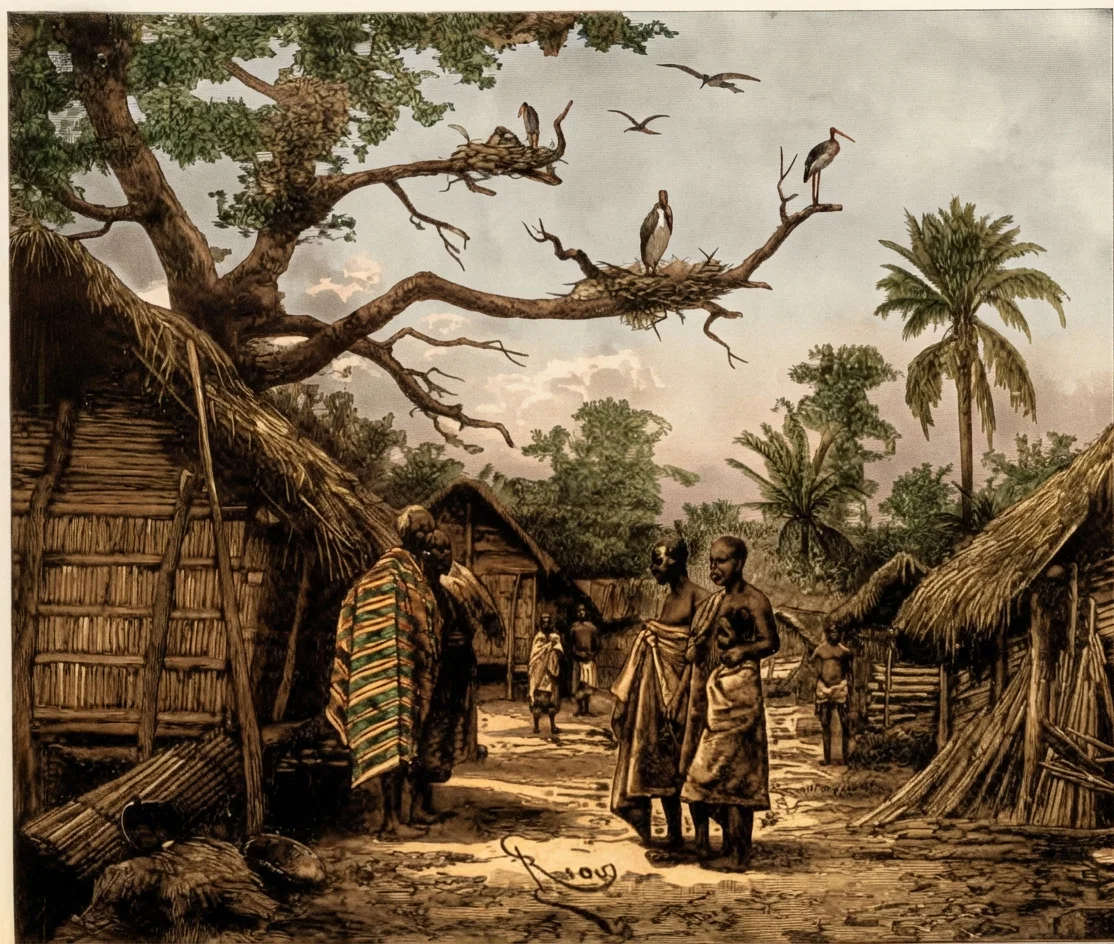
Waiting for the Gospel in Dark Africa.
2. The aggressiveness of political Romanism has received a setback. The old concordat between the Emperor Napoleon and the Vatican was continuing its sway in China long after its nerve-power was beginning to be paralyzed at home. The church was to back up the state, and the state was to back up the church. It has been well understood that France has been anxious to get more of a foothold in southern China, and was quite willing to use the priests and their converts for that purpose. The priests played into their hands by furnishing occasions for political intermeddling, and they, in turn, sustained the priests in quarrels with their neighbors. A serious crisis was rapidly hastening, which threatened to destroy friendly relations altogether. Chinese Roman Catholic converts often refused to obey their own magistrates altogether, unless told to do so by the priest. Of course, the magistrates were angry, and the people were angry, and there were collisions, riots, and bloodshed. A few of the magistrates had courage enough to resent this interference with their prerogatives, but the more timid ones were afraid, and put up with many indignities rather than come into collision with the powerful Romish priesthood; for behind the common Roman Catholic converts were the French priests, and behind the priests were the consuls, and behind the consuls was the minister at Pekin, and behind the minister at Pekin was the entire French Government, and at the elbow of the government was the pope and the Vatican.
In all these tumults the Protestants suffered heavily. The less intelligent of the Chinese officials were unable to discriminate between Protestants and Romanists; they were there, all parts of Christendom together, and the measure of hatred filled up to overflowing against Romanists, was dashed over Protestants as well. Now, however, China is being greatly stiffened against foreign influence by Japanese success, and Rome will be the loser.
Apprehension is felt that the success of Japan will put her in the place of mentor to China in confirmation of this, attention is directed to Chinese students in Japan, to the employment of so many Japanese teachers in China, and to the number of Japanese filling places of trust and emolument in the different centers of influence in China.—Wm. Ashmore, D.D., Baptist Missionary.
[It is safe to assume that any setbacks that Rome receives at the present time are but temporary. We are close upon the time when all the world will wonder after the beast, excepting a certain class (Rev. 13:3, 4, 8), and great political support will be given to that church for a short time before the coming of the Lord. Rev. 17:12-14.]
Think Truly, Speak Truly, Live Truly
By Horatius Bonar
THINK truly, and thy thoughts
Shall the world's famine feed;
Speak truly, and each word of thine
Shall be a fruitful seed;
Live truly, and thy life shall be
A great and noble creed.
—Horatius Bonar.
What a Little Thing
"O, WHAT a little thing can turn
A heavy heart from sighs to song!
A smile can make the world less stern;
A word can cause the soul to burn
With glow of heaven all night long!"
OUR WORK AND WORKERS.
By Editor
In the Workers' Record, Brother R. C. Porter, president of Missouri Conference, reports the baptism of seven candidates at St. Louis.
A letter from Brother G. E. Langdon, who, with Brother G. W. Rine, has been laboring at Cloverdale, Cal., notes the addition of three to the ranks of believers.
The labors of Brethren W. W. Williams, E. L. Sanford, and Milo Emmerson, together with Sisters Sanford and Maud Dortch, at Richmond, Ky., followed by a camp-meeting, resulted in thirteen persons taking their stand for the truth. Afterward Brother Sanford and company pitched their tent at Panola, where six more accepted the faith.
In reporting progress of a tent-meeting at Sunset, Ark., Brother H. Clay Griffin says: "My tent is pitched on land belonging to a Roman Catholic, just across the road from his store. He is a justice of the peace and post-master. My cottage tent is in his front yard, and I am boarding with him. He and his boys have helped to put up the tent and seat it."
Tell the people. This thought is suggested by a statement from one of our conferences showing the condition of the conference, and its improvement in finances the last few months. We even wished that it was fuller; but it was, perhaps, sufficient for that conference. Let the people know, not only the assets, but the liabilities; not only the profits, but the deficits.
Under date of September 14, Brother H. Nicola writes from Battle Creek, Mich.: "The good work here at the old battle-field is yet going forward. God is blessing. Souls are being converted. I had the privilege of baptizing seven candidates on the 9th inst., and several others will go forward soon. At the late West Michigan camp-meeting forty-one were baptized."
At the late meeting of Wisconsin Conference, officers were elected as follows: President, C. McReynolds; secretary and treasurer, R. T. Dowsett; field secretary, A. J. Olsen; superintendent church and Sabbath-school department, Mary E. Cook; secretary and treasurer tract society, N. P. Neilsen; executive committee—C. McReynolds, R. T. Dowsett, N. P. Neilsen, F. F. Peterson, C. P. Farnsworth, A. W. Hallock, W. J. Pflugradt.
At the late camp-meeting held in connection with the Quebec Conference meeting, fourteen candidates were baptized. The conference is clear of debt, and has a little surplus on hand to start the new year's work. Officers were elected as follows: President, H. E. Rickard; secretary and treasurer, W. H. Libby; secretary Sabbath-school department, Cynthia E. Jones; executive committee—H. E. Rickard, S. A. Farnsworth, W. H. Libby, D. Dingham, H. McCleary.
At the recent meeting of New York Conference the election of officers resulted as follows: President, S. H. Lane; secretary and treasurer, T. E. Bowen; secretary educational department, H. W. Carr; secretary religious liberty department, J. S. Wightman; secretary Sabbath-school department, Mrs. L. M. Calkins; state agent, H. S. Merchant; conference committee—F. H. DeViney, H. W. Carr, Courtland D. Green, H. D. Church, William Groff, F. W. Gotts. Delegates to Atlantic Union Conference, F. H. DeViney, C. C. Harris, B. E. Fisk, J. S. Wightman.
Writing to the Record, Coorangbong, N. S. W., from Lau District, Fiji, Sister Myrtle Parker says: "Our young people will be interested in a blind boy who is yet in his teens. He is the son of a chief. It is less than two years since he gave his heart to the Lord, and gave up tobacco and the native grog, and he now desires to fit himself to proclaim the closing message to his people. He has a ready mind and is committing books of the Bible to memory. Rätu Müdre is already a good help in conducting services. Pray for him, dear young people, that he may keep pure and be kept from the wiles of the enemy."
From the Messenger, organ of the N. S. W. Conference, we take the following items of interest: A church of thirty-six members witnesses to the efforts expended in the recent camp-meeting and tent-meetings in the vicinity of North Sydney. A church of twenty-six members has been organized at Hornsby by Brethren S. M. Cobb and F. W. Paap. Churches have also been organized at Forbes and Parkes—the former with thirteen members, and the latter with twenty-two. Brother W. J. McGowan has been engaged in the work in these places. The baptism of six persons at Grafton, by Brother J. L. McElhaney, is also noted.
A report of the young people's work in Cleveland, Ohio, noted in the Visitor, says: "A number of the members have been actively engaged in the distribution of the SIGNS OF THE TIMES and other literature, delivering the papers weekly, thus enabling them to keep in touch with the needs of those interested. This often leads to Bible readings, or to the sale of our larger books. The society's method of distribution has been that of placing wall-pockets in railway and street-car waiting rooms, as well as in the post-office. After placing a few of these pockets in the railway offices, the railway officials requested that more waiting rooms be supplied with such pockets. We might state, however, that the committee had some difficulty in obtaining permission to place these pockets in some of the best station rooms until they had convinced the railway officials that they were neatly constructed and would be regularly cared for by the society."
DISPUTATIONS.
By A. H. Darrow
BY A. H. DARROW.
"WHERE is the disputer of this world? hath not God made foolish the wisdom of this world?" 1 Cor. 1:20. "Do all things without murmurings and disputings." Phil. 2:14. "Perverse disputings of men of corrupt minds, and destitute of the truth, from such withdraw thyself." 1 Tim. 6:5.
Not very long ago, I received from the editor of a First-day Adventist newspaper a pamphlet written against the Sabbath. After perusing it, I wrote him that I had read about all there was to read on that side, and found nothing new and little that was true in them. I then said: "You can not drag down that one only Sabbath of Jehovah (Christ) without dragging the Bible down with it."
His reply was printed as an editorial of about two columns in his paper; and twice he gave utterance to substantially the following exclamation: "Drag the Bible down, if it does not teach the Saturday Sabbath! Could inconsistency and perversity go farther than this?"
And yet, there was not a word in my remarks, written or printed, which justified such a statement, nor could any such meaning be drawn from my words as he printed them. Any one could see that I expressed no intention to drag the Bible down under any circumstances, and counselled no one else to do so.
There is probably not a more humble, sincere Christian, nor a more candid, fair-minded man to be found in the ranks of those who oppose the Sabbath of the Bible, than this same editor. How, then, shall we account for this manifest unfairness?—Answer: Simply by attributing it to an intemperate zeal in controversy, an excessive fondness for disputation.
Let us be careful that we do not carry this disputatious spirit into our church assemblies and Sabbath-schools. Ministers, elders, Sabbath-school superintendents, and teachers, being elected according to God's order by the votes of the members of Christ's body, hold their positions by virtue of a divine appointment, are divinely-constituted leaders and guides, and should not be subject to unreasoning contradiction, merely to gratify our ignorant self-conceit. We should remember that "God is not the author of confusion, but of peace," and that an adversary to God's order is a servant of Satan. It is the spirit of Satan, not of God, which foments disputations and arrays adversaries against the work of God.
In a letter received from an elder and president of a conference, I find the following language: "Do you train with the ungodly set that Mrs. White is leading around? Better get your eyes open. I am fighting the devilish delusion, you bet."
How much better it would be if he and all others were fighting the good fight of faith, keeping the commandments of God and the faithful testimonies of Jesus Christ, instead of nurturing a spirit of discord and enmity. If they could only see the brink of the pit on which they stand when they rashly assert that the weekly Sabbath did not come once a week, that the first of the Sabbaths was instituted at the close of the last of the Sabbaths, and that "the spirit of prophecy" means a record of prophecy,—what an awful predicament might these dear brethren escape! and what joy in the Holy Ghost might be theirs on the Lord's Day! Let us pray that the Spirit of Truth may so lead them.
WANTED FOR MISSIONARY WORK.
By Editor
(Always prepay postage.)
ANY of our literature suitable for rack work. Address, Addie Draper, Claremore, I. T.
SIGNS, Life and Health, and tracts. Address, George R. Close, Glendale, Cal. (Sanitarium).
LATE, clean copies of SIGNS and Life Boat, Address, Mrs. Jane E. Harris, 521 Senate Street, Columbia, S. C.
LATE, clean copies of the SIGNS and other periodicals. Address, Mrs. N. C. Freeman, 1609 Sixteenth Avenue N., Birmingham, Ala.
LATE, clean copies of Save the Boys, Life and Health, Life Boat, or other of our periodicals; also the anti-tobacco leaflets. Address, Belle Waterman-Findlay, Box 481, Ashland, Ore.
SUNSET MAGAZINE
DESCRIBES
California
Not only California, but all the great West, is truthfully described in the beautifully illustrated pages of this virile Western monthly. Its fine half-tones make you SEE the country, while its descriptive and industrial articles TELL YOU EXACTLY what is to be found there. It is
"Opportunity"
in visible form, for it shows the wonderful chances for success now open in the new West for wide-awake people.
If your news dealer doesn't carry SUNSET, send us his name and address and write for sample copy.
HOME OFFICE: 431 California St. San Francisco, California.
THE NORTHWESTERN LINE RUSSIA-JAPAN ATLAS.
Send ten cents in stamps to R. R. Ritchie, No. 617 Market Street, San Francisco, for Russo-Japanese War Atlas, issued by the Chicago & Northwestern Railway, three fine colored maps each 14x20, bound in convenient form for reference. The Eastern Situation shown in detail with tables showing relative military and naval strength and financial resources of Russia and Japan.
TEN DOLLARS A WEEK.
SOME agents are making as high as $10 a week selling E-Z Washing Tablets. Why not you? Sample bar sufficient for a month's washing for 10 cents post-paid. TERMS FREE.
Address, Alfred Mallett, Elkridge Sta., Baltimore, Md.
MILLENNIAL TEXT-BOOK.—Every known reference, over 500 arranged according to events, adapted for instant reference or profound Bible study; result of 12 years search. Mailed for 10 one cent stamps or a dime. Eugene A. Brown, Phoenix, Ariz.