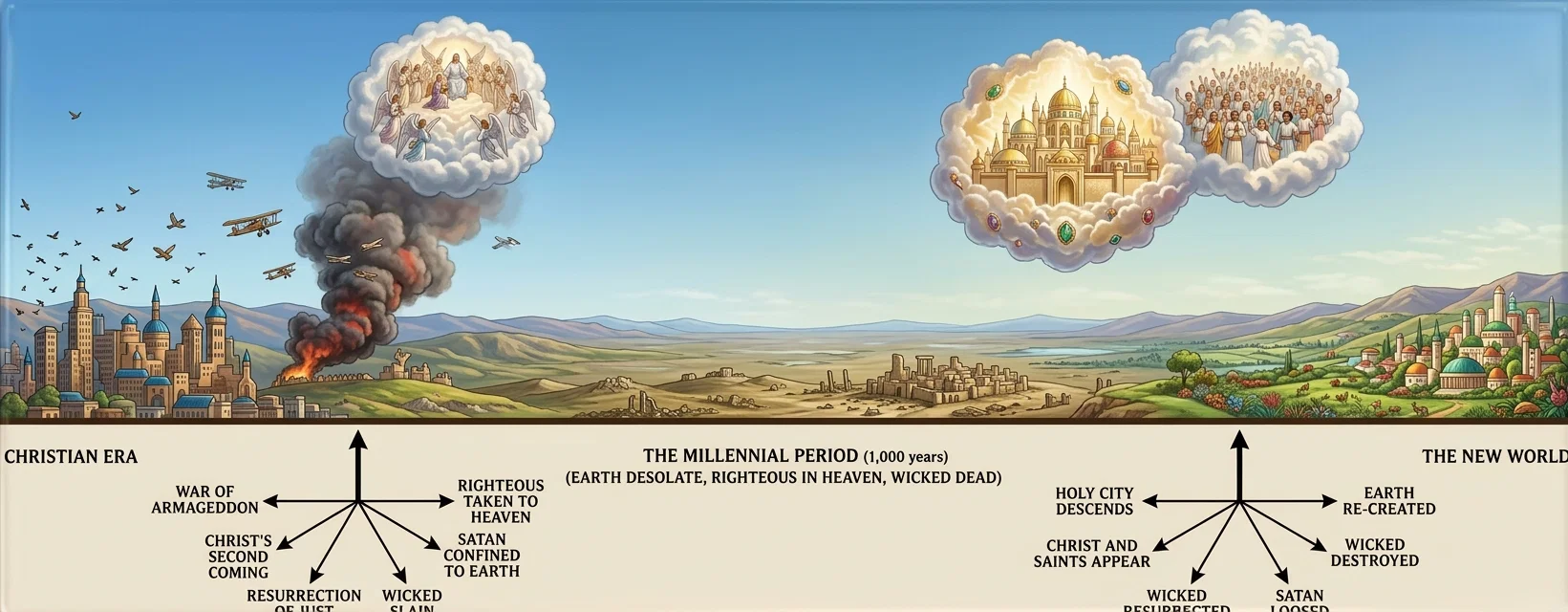
This is a glad millennial year. Away up by the arctic circle, amid volcanoes, lava beds, glaciers, mossy wastes, and where fishing and sheep raising are the principal industries of the sparse population, there is unbounded rejoicing. Iceland is celebrating the thousandth anniversary of her island parliament, or althing; and two tented cities with accommodations for an overflow of fifty thousand tourists and visitors have been erected. Among the distinguished guests are the Crown-Princes of Norway and Sweden; while upon the traditional spot where the first althing met a thousand years ago, King Christian of Denmark delivers a royal address of felicitation.
Iceland, so we are told, is not spending a dollar for army, navy, or other fighting equipment; and the government is free from debt. For these reasons, as well as for the permanence of her institutions, we tender hearty congratulations.
AN OLD PARLIAMENT
A thousand years is a long time. When this parliament had its birth, the sea-roving Vikings, or Northmen, were still raiding the coasts of England and France; the papacy had not yet risen to the height of its power; the crusades were as yet not even a dream; Chaucer’s “Canterbury Tales” were not penned until four centuries later; while more than five hundred years were to elapse before Christopher Columbus and Martin Luther were born.
Looking, not backward, but forward, a millennium portrayed in Biblical lore stretches on before us. Will it bring war or peace? increasing crime or universal righteousness? intellectual decay or scientific triumph? biologic living and health betterment or racial suicide? All these questions are definitely answered in the Book of books.
The word “millennium,” derived from two Latin words,—mille, meaning thousand, and annus, year,—does not occur in the Bible; while the thousand-year period is mentioned six times, all of which are in the twentieth chapter of Revelation. Concerning the redeemed from this earth, the prophet has written, “I saw thrones, and they sat upon them, and judgment was given unto them: . . . and they lived and reigned with Christ a thousand years.” Verse 4.
While the Saviour was yet with His disciples, He gave them the definite promise, “I will come again, and receive you unto Myself.” His coming, the Bible assures us, will be personal, glorious, premillennial; and among the many prophetic signs heralding that event we note the increase of wickedness, juvenile delinquency, moral decline, weakening wedlock, the craze for pleasure and wealth, and the decay of true religion. This inspired picture of the time of the end begins with the forceful sentence, “This know also, that in the last days perilous times shall come;” and in the same chapter there is added the significant statement, “But evil men and seducers shall wax worse and worse.” 2 Timothy 3:1, 13.
In another prophecy the apostle Paul reveals that in the period of time just prior to the coming of Christ, Satan will work “with all power and signs and lying wonders, and with all deceivableness of unrighteousness;” also, speaking of those engaged in this work of deception and wickedness, it is stated that “the Lord shall consume [them] with the spirit of His mouth, and shall destroy [them] with the brightness of His coming.” 2 Thessalonians 2:9, 10, 8.
Our Saviour referred to that notoriously wicked city, Sodom, saying: “The same day that Lot went out of Sodom it rained fire and brimstone from heaven, and destroyed them all. Even thus shall it be in the day when the Son of man is revealed.” Luke 17:29, 30. These Scriptures give clear evidence that the whole world will not be converted; also that the millennium does not begin until after Christ’s second advent.
To the wicked that day brings “sudden destruction” (1 Thessalonians 5:1-5); to the righteous, fullness of joy: “The Lord Himself shall descend from heaven with a shout, with the voice of the Archangel, and with the trump of God: and the dead in Christ shall rise first: then we which are alive and remain shall be caught up together with them in the clouds, to meet the Lord in the air: and so shall we ever be with the Lord.” 1 Thessalonians 4:16, 17.
CHRISTIAN ERA
WAR OF
THE MILLENNIAL PERIOD (1,000 years)
RIGHTEOUS (EARTH DESOLATE, RIGHTEOUS IN HEAVEN, WICKED DEAD)
HOLY CITY
THE NEW WORLD
EARTH
EARTH LEFT UNINHABITED
Since all the impenitent are dead, and all the saints are in heaven, this world is accordingly left without a human inhabitant. Jeremiah the prophet gives this description: “I beheld, and, lo, there was no man, and all the birds of the heavens were fled. I beheld, and, lo, the fruitful place was a wilderness, and all the cities thereof were broken down at the presence of the Lord, and by His fierce anger.” Jeremiah 4:25, 26.
Immediately following the coming of Christ as the “King of kings, and Lord of lords,” as narrated in Revelation 19, the seer of Patmos gives this view: “I saw an angel coming down out of heaven, having the key of the abyss and a great chain in his hand. And he laid hold on the dragon, the old serpent, which is the devil and Satan, and bound him for a thousand years, and cast him into the abyss, and shut it, and sealed6it over him, that he should deceive the nations no more, until the thousand years should be finished.” Revelation 20:1-3, A. R. V.
The “abyss,” as here mentioned, is from the same Greek word used in the translation of the phrase in Genesis 1:2, “Darkness was upon the face of the deep [abyss].” It indicates the chaotic condition of this planet during the one thousand years. The “key” and “chain” are emblems of authority; and on this desolate sphere Satan is “bound,” or confined by a chain of circumstances. For six thousand years he and his host have been intensely active in the warfare against heaven. But now the loyal angels and the sinless inhabitants of other worlds are wholly disillusioned. They see the enemy unmasked, and any further attempts to shake their allegiance are futile. Thus chained to this uninhabited planet with its broken-down cities and once fruitful lands a vast wilderness, Satan has a thousand years of solitary confinement in which to reflect upon the ruin his rebellion has wrought.
RIGHTEOUS IN HEAVEN
Of the righteous during that time it is written: “Blessed and holy is he that hath part in the first resurrection: on such the second death hath no power, but they shall be priests of God and of Christ, and shall reign with Him a thousand years.” Revelation 20:6. As that long period closes, the New Jerusalem, together with the Redeemer and the redeemed, descends to earth; and the voice of Christ summons the wicked dead of all ages to awake. (Revelation 20:5; John 5:28, 29.)
The resurrection of the righteous occurs at the beginning of the thousand years; the resurrection of the wicked marks its close. Christ referred to the second resurrection as “the resurrection of damnation.” Naturally, the mighty host of the unregenerate come forth from their graves with the same sinful hearts and rebellious spirits that characterized them in this life. Then for “a little season” (verse 3) comes the change in the archrebel’s condition. “When the thousand years are expired, Satan shall be loosed out of his prison, and shall go out to deceive the nations which are in the four quarters of the earth, Gog and Magog, to gather them together to battle: the number of whom is as the sand of the sea.” Verses 7, 8.
Just how long the “little season” continues, we are not told. Evidently, there is time to construct engines and munitions of war, and to organize the mightiest army this world has ever seen. Then follows the last act in the seven-thousand-year controversy between Christ and Satan: “They went up on the breadth of the earth, and compassed the camp of the saints about, and the beloved city: and fire came down from God out of heaven, and devoured them.” Verse 9.
Here for the first and the last time, the whole human race meet, the righteous inside the city, and the wicked without. The infinite love of God is manifest to all, and His justice in terminating the lives of the finally impenitent who have despised His mercy is fully vindicated. The lake of fire ends the age-long warfare against God’s government, with Satan and his host consumed “root and branch.” God’s word declares, “This is the second death.”
EXPERIMENT WITH SIN FINISHED
The experiment with sin is forever finished. “There shall be no more curse.” “Affliction shall not rise up the second time.” “He that sat upon the throne said, Behold, I make all things new.” Revelation 22:3; Nahum 1:9; Revelation 21:5. Out of the smoldering ruins of this old world, a glorious “new earth” arises, in which the grateful, happy millions of the redeemed find an eternal inheritance. “I John saw the holy city, New Jerusalem, coming down from God out of heaven, prepared as a bride adorned for her husband. And I heard a great voice out of heaven saying, Behold, the tabernacle of God is with men, and He will dwell with them, and they shall be His people, and God Himself shall be with them, and be their God.” Revelation 21:2, 3.
Few of us are privileged to attend Iceland’s millennial jubilee of 1930 A. D.; but, oh, friends, let us each make unfailing arrangements to be present at the grand millennial gathering announced for the Year 2000 in the re-created homeland.
“A thousand years in Jesus’ kingdom,
Rolling along ’mid the chiming spheres,
Will be but the prelude to that blest story
That ushers us into the endless years.”
Do you believe in Angels?
GWYNNE DALRYMPLE
AFACULTY for scientific investigation and thorough analysis distinguishes our twentieth century from earlier generations. For though at many times in the past there have been men who were interested in the mysteries of nature, unfortunately it happened that not one of them ever found the secret of probing her hidden things as we have found it in these present days. The Grecian, Roman, and medieval eras came and went; and though they were adorned with many sages of sound intellect and acute mind, all these wise men found that it was easier to guess than to measure, and infinitely less laborious to invent a fanciful hypothesis than to demonstrate a truth.
Hippocrates gravely supposed that the brain was a gland; the astute Aristotle imagined that the same organ was practically destitute of blood; the Roman Pliny, in his “Historia Naturalis,” entertained readers with any number of myths and fancies; the author of the “Physiologus,” the popular natural history text of the Middle Ages, tells us of ant lions and unicorns, Charadriidæ, and onocentours, in a series of fifty absurd narratives. It never seems to have occurred to the people before whom these tales were displayed that investigation might disclose the truth or falsity of this “science.” It was held that since these things conceivably might be so, therefore they must be so; and at all regards, no one cared to take the time to investigate.
NEW PRINCIPLES FOLLOWED
COURTESY: PARKE, DAVIS & CO.
But in our own era, and in the two or three centuries that have immediately preceded it, the principles of accurate investigation have been discovered and used. In the sixteenth century Galileo and Kepler made their great and fundamental discoveries in physics and astronomical law. In the seventeenth, Harvey taught the circulation of the blood; Leeuwenhoek, with his lenses, discovered microscopic life; Huygens, Newton, and Leibnitz made their studies in mathematics and physical law,—studies upon which much of modern knowledge depends, and will always depend.
In the nineteenth, Lister, Pasteur, and Morton did more to alleviate human suffering and prolong human life than had been done in all the centuries of the past. In the twentieth, there have been made so many discoveries, inventions, and investigations that we cannot here enumerate them, nor can one individual even recall them all. Men still living have conceived the phonograph, the wireless, the incandescent electric light, the radio, the television, the dirigible balloon, the heavier-than-air plane, the automobile, besides many less common appliances; and have made so many improvements in machines already known, as in the cars and engines of railroads, the presses and typesetting machinery of the printer, the looms and implements of the textile industries, that there is to-day scarcely a phase of human endeavor that stands where it stood thirty years ago.
MEN SUFFER FROM CONCEIT
It would exceed the frailty of human nature, if under these circumstances of large achievement in every department of knowledge, we should not suffer from some small conceit. Having investigated so many things, we naturally feel that we have investigated everything. Having discovered a continent or two of truth, we are rather sure that we have probed the universe,—in short, that we have been graduated, and have received our diplomas. I remember that when, as a little child, I first went to school, after a couple of months I was promoted (thanks to some help I had received at home) from the first to the second grade. Pleased and elated, I hastened home with the good news, “Mother, I have been graduated!” Well, mother explained to me that there was a difference between graduation and promotion; and that, although I had indeed been promoted, graduation was still far off. So now in these days we are like little children, for, having measured a few distances, some vast, some microscopic; having examined a part of those infinite wonders that God has created; having made many discoveries in connection with some kinds of matter, and a good many more speculations with regard to other kinds of matter; having been, as it were, promoted from the first grade of God’s school into the second grade, we come home crying out, “We have been graduated!”
UNHAPPY RESULTS ACCRUE
This sureness of our own attainments, natural as it is, has led to unhappy results in religious thought. Men have come to believe that they can do without God. They think that His word is Hebraic mythology, and the influence of His Spirit a psychological diversion. They cannot believe in angels or in spiritual influences, because they cannot test or examine them.
We know so much; we know so very much! It is, if I remember rightly, Hans Christian Andersen who tells in one of his fairy tales the story of three little green peas that lived in a little green pod. They had been born in that little green pod; they had always lived in it; they had never known anything else; and so they quite naturally concluded that there was nothing else. The universe was all green; it must be green, because there was no other color; they knewPage Seventhere was no other color, because they had never seen any other color.
Ah! how like those little green peas we are when we say that there is no God, when we reject His word, when we deny His Spirit, when we deny the existence of angels, when we scoff at the superhuman, because we cannot catch it, because we cannot analyze it, because we cannot measure it, nor accurately and perfectly define it! And shall we indeed suppose that there is nothing beyond us,—that we have reached the ultimate? Foolish and senseless vanity! For everything that we know there are thousands—yes, and I suppose millions—of things that we do not know; and for everything that we have perceived, there are many things that we have not perceived, and I suppose cannot perceive.
CONSIDER OUR IGNORANCE
We have talked of our knowledge; suppose we consider our ignorance for a moment. It is two hundred years since the great and pious Newton stated and solved the problem of the two bodies, and how their motions and orbits might be charted and predicted; he also stated the problem of the three bodies, though this problem he could not solve. Now, to this day, our clever mathematicians have not solved this latter problem, for, as Professor Young remarks, “If, instead of two spheres attracting each other, we have three or more, . . . the general problem of finding their subsequent motions and predicting their positions at any future date transcends the present power of our mathematics.”
Yet the wisdom of the eternal God guides and has guided, not two bodies, nor three, but bodies numerous beyond conception,—all the worlds in space, meteors, comets, planets, suns, and stars, whose magnitude and velocity exceed the understanding of our minds.
Again, recent advanced research indicates that there are at least sixty-two octaves of electromagnetic waves; ten octaves of these are visible as light waves; the other octaves are detected as X rays, radio waves, and rarer types of vibration. Yet because we have found sixty-two octaves, shall we say that we have discovered the whole diapason of the instrument of God? Who shall say that there may not be or cannot be octaves beyond our most searching measurement; and, indeed, types of vibration and modes of existence of which we are wholly unaware?
“Touching the Almighty,” the patriarch by inspiration tells us, “we cannot find Him out: He is excellent in power, and in judgment.” “Lo, these are parts of His ways: but how little a portion is heard of Him? but the thunder of His power who can understand?” Job 37:23; 26:14.
ANGELS MAY EXIST
Now, we do not say that the matters we have mentioned are a proof that angels exist; but we do say that they are a proof that they may exist without violating any of the laws of the universe so far as we are conversant with those laws. When the word of God states, as it does, that angels do exist, we have small authority in science for denying the truth of the statement on the ground that we know that they cannot exist. Rather, as we see the bounds of the universe growing larger under the searching eye of science, and as its mysteries appear to us more varied and infinite, we should be the more disposed to accept and believe the truth that God has revealed to us in the Scriptures.
We know so much!—but what do we understand? We know that a force called gravitation holds together the worlds; but who understands what gravitation is? What is the nature of this force? How does it exist? Why should it exist? Before these questions the most learned scientist is dumb, and has every likelihood of remaining dumb. Or why should certain vibrations, as light, affect us, and other vibrations affect us not at all, so that the most delicate instruments are necessary to perceive them? Again, in embryology scientists have made the most far-reaching studies. They have discovered cells and chromosomes; they talk of Mendelism and biogenesis.
AGE-OLD PROBLEMS
Still, we return to the problem which, twenty centuries ago, perplexed the sages of Athens and Alexandria: Why does an acorn become an oak, and why does an apple seed become an apple tree? Why do thistles reproduce thistles, and grapevines reproduce grapevines? We may trace out by much study the manner in which these wonders are performed; we cannot so trace out the Force that causes them to be performed. One cell grows and increases in a certain manner; who can tell why it increases in that certain manner? All that we can do with test tubes and apparatus, solutions and microscopes, data and analyses, is to watch God’s works; we cannot do them. We can speculate as to how He carries on His divine operations; but the operations themselves we cannot imitate.
Life is perhaps the greatest of mysteries, for a newborn babe is more wonderful than all the ponderous mass of Matterhorn or of Everest. Life is the commonest fact of everyday experience; it is the fact, if I may so say, closest to us, for it is within us. Let the learned scientist explain life. He cannot. “It rises from protoplasm”—yes, but what is “it”? We might take the body of an animal and dissolve it into its chemical constituents; there would be water and iron and calcium and many other substances; but we would not find life. We might take the brain of a man, weigh its parts, dissect its structure, test and dissolve its substances, but how could we test or dissect or weigh the intelligence or the soul or the disposition? How could we reach that life which, after all, is the man?
THE GREATEST KNOWLEDGE
“O the depth of the riches both of the wisdom and knowledge of God! how unsearchable are His judgments, and His ways past finding out! For who hath known the mind of the Lord? or who hath been His counselor? . . . For of Him, and through Him, and to Him, are all things: to whom be glory forever. Amen.” Romans 11:33-36. “Where wast thou,” is the question of God to the patriarch, “when I laid the foundations of the earth? declare, if thou hast understanding. Who hath laid the measures thereof, if thou knowest? or who hath stretched the line upon it? Whereupon are the foundations thereof fastened? or who laid the corner stone thereof; when the morning stars sang together, and all the sons of God shouted for joy?” Job 38:4-7. “To whom then will ye liken Me, or shall I be equal? saith the Holy One. Lift up your eyes on high, and behold who hath created these things, that bringeth out their host by number: He calleth them all by names by the greatness of His might, for that He is strong in power; not one faileth. . . . Hast thou not known? hast thou not heard, that the everlasting God, the Lord, the Creator of the ends of the earth, fainteth not, neither is weary? there is no searching of His understanding.” Isaiah 40:25-28.
As Christians, then, who believe in the Bible as an inspired revelation to men from God, we believe in angelic existence and angelic ministry. As Christians living in this twentieth century of progress and discovery, we find nothing to disturb or dispel this belief, but rather much to affirm it, in that we realize more fully than those who have gone before us, the infinity of the divine power, in its extent, in its diversity of method, in its vastness of operation, and in its utter unsearchableness, to us, beyond the narrow limits of science.
Considering the innumerable matter-of-fact discoveries in recent years, should this scientific age put faith in the supernatural?
The Sweeter Strain
By Eugene Rowell
EUGENE ROWELL
The wise musician, when he seeks to draw
More sweetness from the strings,
Puts on a mute that smooths and mellows
all
The music while it clings.
So maybe God, desiring to subdue
Our spirits' harsher strain,
Just mutes them with a weight of earthly
loss,
Deep sorrowing, or pain.