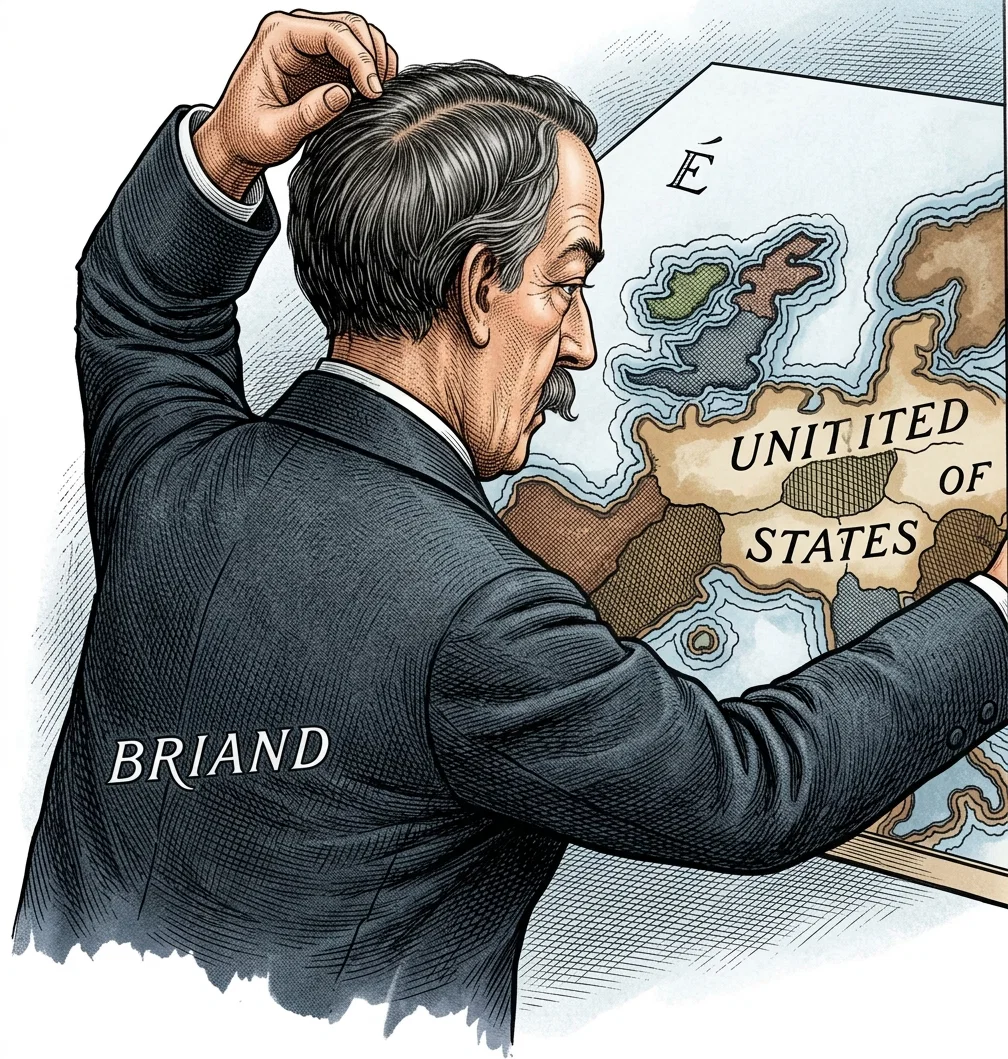
In the closing months of 1929, M. Briand, Foreign Minister of France, with the sanction of the French Government, formulated his now-famous project for the creation of a Pan-Europa, to be christened “The United States of Europe.”
This proposed Pan-Europa is confessedly an image of Pan-Americanism; that is, Briand derived his concept of a federated Europe from our Federal Union of forty-eight states. The friends of Briand’s unique scheme ardently hope that its realization will bring to that war-torn continent the international peace, the political, economic, and commercial coöperation, that prevail between the States of the American Union. The editor of the Manchester Guardian, a British weekly, says apropos of Briand’s project: “Briand’s aim is to divert European states from the barren contemplation of past enmities to constructive coöperation in the tasks of peace, especially in the economic field.” Briand, however, insists that before Europe can be united industrially and economically she must first be united and harmonized politically.
Those who are conversant with present-day Europe are aware that its numerous distinct national units are commercially torn apart by tariff walls so high as to render international trade and industrial coöperation as troublesome and financially unattractive as can be imagined. Between our amalgamated American States commerce is not only absolutely free, but enormously profitable. Accordingly, it is argued that between the federated nations of Europe commerce would become automatically free, and hence vastly more lucrative. Most Democratic newspapers in America and the more radical Republican papers declare that the Briand project is a defensive action against the Hawley-Smoot Tariff recently enacted into law. It should be stated, however, that Briand has declared repeatedly that his proposal is not aimed at anything distinctly American.
MEMORANDUM SENT TO POWERS
It was in May of the present year that Briand formulated his widely discussed “Memorandum,”—a syllabus of his plan for federating the twenty-seven outstanding states of Europe. To each of those powers, except France, he sent a copy of the Memorandum for criticism and suggestion. The time chosen by Briand for disclosing to the powers of Europe his unprecedented scheme for that continent he declared to be most propitious by reason of the fact that the Young Plan had just gone into effect; the Bank of International Settlements, in Geneva, was about to open its doors; and the French troops had almost completed their evacuation of the Rhineland.
Each of the nations addressed by Briand through the medium of his six-thousand-word Memorandum has returned to the French Government a statement of its criticism and suggestions, and also its acceptance of the French Government’s invitation to send one or more representatives to the special European Conference, which will convene in Geneva in September, primarily for the purpose of giving due thought and discussion to the question of the expediency and feasibility of making the Briand scheme an ultimate actuality.
Seventeen of the twenty-six powers receiving the Memorandum have submitted somewhat drastic objections to many of its proposals, declaring their conviction that the ends sought by the Briand project could be more effectively dealt with by the existing machinery of the League of Nations. The British Government declares further that the organs of the League have already begun work on virtually the whole program of practical action that the Memorandum sets forth. It is felt, too, by the British authorities, that an exclusive and independent union in Europe might foster intercontinental rivalries and even hostilities. Nine of the powers included in their suggestions that Russia and Turkey be included in any possible European federation. Only three of the twenty-six powers accepted M. Briand’s proposals without reservations. The Manchester Guardian declares that it would be difficult to find anything new or hopeful in Briand’s proposals. “They have now been criticized from various angles by the leading European powers,” says the Guardian, and adds: “It would be a matter for neither surprise nor regret if the answer of the British Government led to their final abandonment before the next meeting of the League Assembly.”
PITFALLS BLOCK REALIZATION
The analogies that Briand and his sympathizers see between the United States of America and the projected United States of Europe seem to many political experts to be altogether illusory. Each of the European powers, with two or three exceptions, has its own distinctive language, its exclusive traditions; in most cases, its own national religion, its sharply differentiated coinage, its peculiar stamps; and, in most instances, its exclusive national cookery, dress, manners, and customs. Each European political entity is a body in which a unique nation is, and has long been, incarnated.
Such a heterogeneous coterie of political units can assuredly possess no integrating affinity that would permanently unite its members. The exact converse is true in respect to our American States. They have a common language, common modes of dress, common customs, the same monetary coins and symbols. Every state government is an almost exact replica of every other; there is a common national, or federal, government around which they revolve. Our interstate forces are centripetal, and, of course, cling together; while the corresponding European forces are centrifugal, and so they tend to fly and hold apart.11
Will the Premier of France be successful in piecing together into a harmonious and composite whole the puzzle map of Europe?
A dispatch, of August 21, from Geneva to the leading American newspapers, makes this initial statement: “The League of Nations is seeking to sidestep Minister Briand’s proposal for a United States of Europe.” The reason is the fact that the devotees of the League foresee in the Briand project the probability that it would permanently close the door against America’s entrance into the League. They still cherish the faint hope that the United States may yet be induced to join the League. They perceive—so they aver—that as an offset to a federated Europe, anchored to the League, there might be set up in the Western Hemisphere an analogous organization of American powers. The interests of the two would be almost sure to be at variance, and, accordingly, forever widen the gulf between the United States and the League. The distinguished Spanish writer, Madariaga, an ardent friend of the League, declared in the January (1930) Forum that he regarded Briand’s dream of a United Europe as nothing more substantial than a mirage on the political horizon.
FRANCO-ITALIAN TENSION
Since the close of the Great War a bitter controversy has developed between France and Italy, and it is admittedly growing more virulent as time moves on. This Franco-Italian tension springs largely from the fact that France has set her heart upon preserving indefinitely the status quo as established by the Versailles Treaty, which ended the Great War. Italy is equally insistent that the Treaty shall be so amended as would result in conferring upon her certain definite social, diplomatic, and strategic advantages, which she passionately claims to be her just dues.
In a recent interview published in a French journal, Mussolini declared that before Briand’s projected European federation can be actualized, the Versailles Treaty must be radically revised. As all the world knows, Italy insistently protests her right to naval parity with France. France continues to dismiss Italy’s demand with no little contempt. Italy contends that the complete recovery of the Italia Irredenta, begun in the middle of the last century, cannot be accomplished until France shall have ceded back to her Corsica, Nice, and Savoy. Other disputed points enter into their famed controversy, but lack of space precludes our considering any of its further details. We simply call attention to it as a force bound to prove hostile to any attempt to federate the political units that comprise Europe.
Think, too, of the seething rancor that marks the mutual attitude of Prussia and Poland because of the Polish Corridor. And there are now fourteen additional disputed frontiers in Europe. The League, too, is powerless to change any of these boundaries without the consent of the parties to the treaties defining such boundaries. “France and her Allies feel that any relinquishment of territory ceded by the 1919 treaties may be the beginning of a movement to overthrow the whole peace settlement.” Despite the guarantee given by the Versailles Treaty, minorities in many European states are today victims of oppression,—a prolific cause of international ill will.
In the face of the foregoing facts, so prejudicial to a politically united Europe, does it not look as if the prospect of concretely realizing the United States of Europe is exceedingly remote? Even if such a federation should become a reality, could it achieve its fundamental objective, namely, permanent world peace? We shall now look to inspired prediction for the inerrant answer.
OMNISCIENCE SPEAKS
In Jeremiah 25:31 it is clearly stated that the time will come when the Lord will have “a controversy with the nations,” and “will give them that are wicked to the sword.” At the same time He will “utter His voice from His holy habitation; . . . against all the inhabitants of the earth.” Verse 30. Note the term “sword;” it is invariably a symbol of war when employed generically, as it is here. As a consequence, the slain of the Lord will be dispersed over all the earth, as declared in the thirty-third verse. That will be the one time in which the victims of the battlefield will not be buried, but shall be refuse upon the ground. Why not buried? The answer is obvious. All impenitent sinners will have perished, and the righteous will have been taken to their supernal home.
Read thoughtfully Joel 3:9-16, and observe that at the very time when Jehovah, by the power of His voice, shakes the heavens and the earth, He proclaims war among the heathen, or unbelievers. He commands them to “prepare war,” to beat their plowshares into swords, and their pruning hooks into spears. At that time even the weak shall say, “I am strong.” Not many years have passed since the Chinese and the Japanese were hopelessly weak martially. But to-day they say, not in mere words, but in deeds and actions, “I am strong.” It is a matter of common knowledge that all nations are feverishly preparing for that awful experience when “multitudes” shall be drawn into “the valley of decision,” that is, the valley of threshing, of cutting apart or to pieces, as the term “decision” originally meant. In verse 12 the valley is identified as that of Jehoshaphat. The ancient battlefield of Armageddon lies in close proximity to that valley. In Revelation 16:16 this same battle of mass slaughter is named Armageddon, a battle divinely destined to be the culminating event in the history of our world of sin and death. Let us not fail to note that a rainbow of promise arches those black thunderclouds of war,—a promise found in Joel 3:16,—in radiant words of divine assurance, as follows: “The Lord will be the hope of His people.” It is in that darkest hour of this world’s history that the following divinely given assurance will be fulfilled to every living believer: “A thousand shall fall at thy side, and ten thousand at thy right hand; but it shall not come12nigh thee.” Psalm 91:7. In verse 9 is given the reason why each trusting child of God shall be so gloriously delivered in that hour of the world’s supreme tragedy: “Because thou hast made the Lord, which is my refuge, even the Most High, thy habitation.”
In chapter 16 of the Revelation we are told that “spirits of devils” go forth to the rulers of the whole world to draw their armies into the Battle of Armageddon,—the culminating tragedy, the crowning horror, of the reign of sin. War is the supreme curse, and every curse is the spawn of sin. It follows, then, that only the end of sin can bring the end of war. Naturally, then, sin’s long dominion is destined to end in an orgy of war. Neither the United States of Europe nor all other multitudinous peace agencies of these last days can bring into this war-cursed world the beatific gift of endless peace. But when our world shall forever have been brought under the heavenly sway of the Christ of God, the Prince of Peace, then shall her peace be “as a river,” and her “righteousness as the waves of the sea.” Isaiah 48:18. Then “the work of righteousness shall be peace; and the effect of righteousness quietness and assurance forever.” Isaiah 32:17.
REVENGE
By Theo G. Weis
THEO G. WEIS
REVENGE is the deadly fang of a poisoned life. It never pays to “get even.” To cause others to realize an injustice done us by forcing embarrassment or calamity on them is not just retribution. To burn a man’s barn because he burned our hay meadow does not restore the hay. We human beings err easily in our judgment. We have our eyes too near the ground to see the workings of the heart. We judge too harshly because we do not fully understand. It is always best to let God balance life’s ledger pages. He will do right with every account entered in the books of heaven. Revenge shows a spirit of hate and selfishness, which, if persisted in, leads to a tragedy.
A HATEFUL ATTEMPT
About a year ago the Associated Press carried a news item relating to an incident that had all the earmarks of vile vengeance. A certain Swiss commercial traveler of Geneva, after divorcing his wife, married another. His first wife, on learning that her hated rival was about to become a mother, sent her anonymously, by parcel post, a large bouquet of chrysanthemums. Inside the neatly wrapped package and among the pleasing flowers, she hid a live viper.
When the second wife opened the package, the snake fell out dead, having been killed by the cold in transit. The police began their task of finding the sender. They finally traced it to the divorced wife, and arrested her for an attempt to kill.
SATAN USED SERPENT
Hidden in the innocent freshness of flowers, vengeance does its most heinous work. In the Garden of Eden Satan used the guile and the hypnotic beauty of the serpent behind which to hide his evil intentions. He hid death under the guise of life, and misery behind the sparkling promises of happiness. Here vengeance was born. When man swore allegiance to the side of evil and disobedience, Satan won his first subject; what is more, he felt revenged for what he considered were inconsiderations shown him in the court of heaven. As a confederate in a transgression, man, for the first time, became a revengeful being; for the first time he felt the ugliness of measuring out evil for good, and evil for evil.
Satan tried to “get even” with God in that very first step of retaliation. Man has tried to “get even” with God ever since. Pride caused the fall of Lucifer; pride was the sword that cut him out of heaven; pride destroyed paradise on earth; pride plants the spirit of rebellion in every human heart; pride is underneath vengeance.
WAY OF LIFE IS CLEAR
In a fatherly spirit of love God always proclaimed His law to mankind. The way to life is unerringly clear. God’s injunctions are not to be spurned. Something goes wrong; man deliberately turns from the lighted path to loiter in the shadows of requital. God speaks! He sends a Nahum to thunder His reproof: “God is jealous, and the Lord revengeth; the Lord revengeth, and is furious; the Lord will take vengeance on His adversaries, and He reserveth wrath for His enemies. The Lord is slow to anger, and great in power, and will not at all acquit the wicked.” Nahum 1:2, 3. Or God sends His message through an eloquent Paul: “Dearly beloved, avenge not yourselves, but rather give place unto wrath: for it is written, Vengeance is Mine; I will repay, saith the Lord. Therefore, if thine enemy hunger, feed him; if he thirst, give him drink: for in so doing thou shalt heap coals of fire on his head. Be not overcome of evil, but overcome evil with good.” Romans 12:19-21. In such simple words God has made known the safe way in His Book; no one can possibly lose the way.
“Love your enemies,” Jesus said. Love is the only spirit that smothers revenge and dries it up as the sun dries up water. Revenge not; it does not pay.
Every Hour Tests Our Discipleship
By Charles G. Ames
EVERY hour of every day our discipleship is put to the test. The care we take and the uses we make of our bodies, the government of our appetites and passions, the thoughts and feelings we cherish in solitude, the tempers we exhibit to each other, the principles and motives which control us in industry, trade, and politics, surely have more to do with making and marring our character than our theological speculations and our church professions.—Charles G. Ames.
The Mystery of Life
By Alice Enevoldson
Many have attempted to reach a solution by the evolution method, but the answer “just won’t come out right.”
ALICE ENEVOLDSON
With so many proofs to the contrary, on all sides, it seems extremely insensible to try to solve the “mystery of life” from an evolutionary standpoint.
A TOUSLED little head bends intently over a page of scrawly figures, mind and pencil busy. Finally the figuring is done, but soon the look of triumph is clouded with a puzzled expression, and tumbled curls shake slowly. “It doesn’t come out right.”
From these early efforts on through life we are all busy solving problems, many of them more important than those figured with pencil and paper. The big thing in all these problems is the result,—that it come out right. One of the problems that the human race has been trying to solve since time immemorial is the problem of life,—the mystery of its origin and the outcome of it all.
GOD HAS GIVEN SOLUTION
God has already solved the problem for humanity, and left each member of the race to accept or reject the result as his own solution of life. But there have always been those who have been anxious to figure out the problem for themselves. The schemes they have invented may have seemed very possible, the method of figuring may have looked logical to them; but, somehow, the results haven’t come out right.
Men to-day are still busy with the same age-old problem. They believe, however, that facilities for solving the problem are increasing. Thinking is becoming more scientific. There is a feeling that the human mind is expanding so that nothing need any longer remain a mystery. The parts of the Bible that can be understood only by faith are being discarded. In their place men are substituting theories of their own. The Bible tells us that God created man; these thinkers try to explain how he evolved.
THINKING HAS ADVANCED
From the materialistic viewpoint of the evolutionist, these methods mark an advanced step in the thinking of to-day. Man is no longer satisfied with blindly accepting religious dogma. He must seek out for himself a rational explanation of the world about him. Only with an unbiased mind is real progress made possible. Man must be unhampered by religious scruples, so these thinkers say, in order to find real freedom of thought and action. With no feeling of accountability to a personal God, man will need to depend more on his own resources, and thereby gain a larger conception of his own importance. Thus will he advance toward the superman.
The theory sounds good; the reasoning seems quite logical; but, after all,—and this is the really important question,—does this method of solving life come out right? Is the result satisfactory? I remember having a chemistry teacher who used to tell us, when we had difficulty with chemistry problems, to check our work by first noting whether the result was reasonable. Sometimes our answers might be obviously out of proportion, indicating a misplaced decimal point or something else wrong in the figuring somewhere,—wrong because the result was plainly wrong. Perhaps many have never stopped to think just how the evolutionary theory of life really works out. To these it may be merely a convenient hypothesis of the origin of life that has little bearing on the present. What difference does it make now what we believe about how man got here? But it does make a difference, a vital difference.
PHILOSOPHY OF LIFE CHANGED
The theory of evolution changes the whole philosophy of life. Assuming that man has evolved from the lower forms of life, what is the explanation of this unsatisfactory condition in which we find our world,—full of suffering, sickness, and death? The Bible explains it as the result of man’s fall from his original perfect state; but in the evolutionary theory there is no place for a fall. All the disagreeable factors of our environment only constitute necessary elements of the whole scheme of things. Sin is not a phenomenon; it simply belongs to the natural order for which man can in no sense be held responsible. Man’s tendencies to evil are merely the left-overs of his crude animal origin, which he must live and struggle with the best way he can. What can be our conception of the author of such a state of affairs? Unless we conceive of a god that was hampered by the nature of the material with which he had to work, the evil in creation must be an expression of the character of the creator.
MORAL RESPONSIBILITY SHIFTED
Do we want a god like that,—one who will punish his creatures with even the laws of cause and effect for following a course that was deliberately a part of his plan when he started life evolving? Yet such a god is the conclusion to which the theory of evolution inevitably leads. What effect must it have on man’s efforts to overcome evil thus to shift the moral responsibility from man and put it back on god (whoever the god of the evolutionist may be)? Why should man strive to subdue wrong tendencies for which he is not responsible when the scheme of evolution will gradually and automatically eliminate them through the advancement of successive generations? What is there to look forward to?—the advancement of the race? Yes, but no hope is held out to the individual. There is nothing in the evolutionary theory that can help me with my individual life problem. The Bible presents a personal Saviour who will help me out of my difficulty though I can give no excuse for the wrong I have done. But, since there is no place in the theory of evolution for a fall, there can be no place for a Saviour. While men may feel quite elated over their success in solving the problem of life for themselves, when one stops to carry out the solution to its logical conclusions, it just won’t come out right. The answer is out of proportion. (Continued on page 15)12
The Mystery of Life
(Continued from page 11)
What kind of exchange has man made in substituting his own solution for God’s solution of his life? Has he, after all, acquired more of the self-confidence and freedom necessary to real progress. He may have thrown off the unwelcome restraints of his former Christian faith, but, instead, he has tied himself with the cords of his inherited animal crudities for which he is not responsible, and with which he must struggle all alone in a hopelessly losing battle. He may have rid his mind of what he would term the bias of religious dogma, but, instead, he has circumscribed his thinking with theories that bar from all consideration anything outside of his own limited understanding. Instead of a personal God with a loving, restraining influence over His children, he has a vague, impersonal, and, to say the least, unsympathizing god of natural energy. Instead of the Christian hope of a perfect life beyond, he has a vague notion of the slow, painful, and uncertain advance of the race. Is this a wise exchange? Some one has observed in this connection that we are accustomed to calling people heathen who have a form of religion without the God of the Bible and a knowledge of the plan of salvation. Are not these modern theories a form of heathenism,—“Occidental heathenism”? Does not men’s solution of life appear quite unsatisfactory?
And since the problem does not come out right, where is the difficulty? Undoubtedly, there have been many mistakes and false assumptions in the figuring process all along the way. But is the method right in the first place? A child has just learned how to work problems in long division. He is quite conscious of his new ability. With every suggestion of figures that comes to his attention, he inquires in an understanding sort of way, “Wouldn’t you figure that out by long division?” But if he tries long division on problems of multiplication, he is sure to meet with the disappointing result, “It doesn’t come out right.”
Men to-day have made so many discoveries in studying the laws of nature, and have become so conscious of their ability in solving scientific and intellectual problems, that many have forgotten that all problems cannot be solved by the same method. The big problem of life—its whence? where? and whither?—belongs to a different field, and the chief difficulty in dealing with it has been the attempt to solve, by a long process of reasoning, a problem that can be understood only by a simple process of faith. Many have failed to appreciate the fact that discovering mysteries does not mean understanding them. When men have gone their limit in scientific investigations, there still remains the unsolved problem of origins, and that problem is not solved by pushing it back into the dim past and obscuring it with a multitude of details. It is by faith, not speculation, that we understand that “the worlds were framed by the word of God.” Hebrews 11:3. There are problems of life that are only “spiritually discerned,” and that reasoning cannot solve. If we try it, it is sure to come out wrong. In order fully to appreciate his possibilities man must realize his limitations.
GOD’S SOLUTION INFALLIBLE
Man’s attempts at solving life have failed; they do not come out right. Why not accept God’s solution of our lives when our own is unsatisfactory and His meets our need? Why not stop reasoning about that which reasoning cannot solve. Man needs God, and that need is the greatest evidence of His existence. Man needs a Saviour to help him out of the difficulty of sin. There is a void in every life that does not recognize Him. There is an “unknown” left unsolved in every great problem that does not take Him into account. There is a great gap in all human reasoning with God left out. Some try to span the gap with a bridge of words that, after all, does not explain anything. Why continue to grope in the dark when the God of the Bible, the Creator, meets the need, supplies the unknown, and solves all the great problems of life? Why not accept by faith what the Bible tells us of Him and His unlimited power? Reason can take us no further; and as we step out on faith, we are not treading on ground any less sure. Men would find all their needs supplied, all their life problems solved, “if haply they might feel after Him, and find Him, though He be not far from every one of us.” Acts 17:27.