Miscellaneous Facts on Industry, Engineering, and Wealth
Page 2
The Youth’s Instructor
Sep 12, 1916
Review and Herald Publishing Assn. · Takoma Park Station, Washington, D. C. · Sep 12, 1916
Miscellaneous Facts on Industry, Engineering, and Wealth
THE army worm causes a yearly depredation of at least $15,000,000 to the American farmer.
THE last six months saw 1,069 industrial strikes, 268 of them, involving 300,000 workers, in April alone.
THE waters of the Rhone River connect with the sea at Marseilles by means of a five-mile canal run under a towering mountain range.
THE country is spending well toward two hundred million dollars a year on rural roads — perhaps twice what it was spending for that purpose ten years ago.
MR. HYMAN SHAW paid his way through school last year by selling more than 700 newspapers a day. During the past four years he has made upwards of $2,500 in this way.
THE late J. P. Morgan made more than a million dollars for every year of his life. E. H. Harriman during the latter years of his life made more than a million dollars a month.
“It is said of the great French statesman, Richelieu, that he could say No so gracefully and winningly, that a man once became applicant for a position upon which he had not the least claim, just to hear the great cardinal refuse.”
A MAN whose sole business is to remove from the floors of a large department store in Minneapolis quids of chewing gum which careless shoppers have thrown there, says that he removes several hundred dollars’ worth of gum a week from the floors of the store. Be it said to the shame of the worshipers that church janitors are sometimes compelled to do a similar work.
LINSEED oil when freshly made is eager to combine with oxygen from the air, and to decompose, giving forth carbon and hydrogen. This decomposition generates a remarkable amount of heat. When contained in a roll of inflammable material such as waste and rags, spontaneous ignition is almost sure to take place shortly. Many serious fires in large factories are caused in this way. Take care of greasy rags.
CAPT. CHARLES H. THOMPSON captured a 30,000-pound fish off the coast of Florida, after a furious struggle lasting thirty-nine hours. The fish was forty-five feet long, twenty-three feet nine inches in circumference. Its skin, or hide, was three inches thick. The liver alone weighed 1,700 pounds. The creature was a deep-sea fish, not a whale. Five harpoons and one hundred and fifty-one bullets were used in subduing the monster, and it required five days to finally kill it.
ADMIRAL DEWEY, the hero of Manila Bay, is seventy-eight years of age. He is in such vigorous health that one who sees him wants to know the secret of his well-being. Mr. Dewey makes it a principle to stand for health at any price. He regards participation in social affairs by a person of advanced years as an abuse of health. His experience has taught him that a fashionable dinner contains more food than one should eat, of a flagrantly “indigestible sort;” he therefore refuses all dinner invitations and other social affairs, with the one exception of the annual banquet of the Manila Bay Society. He never attends theaters. He retires regularly at nine o’clock.
“Buy a goat” is the slogan of some of the mountainous districts of Kentucky, Tennessee, and Alabama. In the three States sixty per cent of the area is unused in any way to return wealth to the owners, or to the States. In some sections ninety to ninety-five per cent of the area is lying idle. And yet this territory is sufficient to furnish, if properly stocked with goats, leather for the whole United States. Furthermore, goats roaming over the rocky regions of the South will prepare them, after two or three years, for cattle and sheep ranges, by ridding the land of its underbrush, and putting the soil into prime condition for sowing grass seed.
THE widow of a Norwich, Connecticut, man was settling up his estate recently. She remembered that he had spoken of a little bank account ($33) which was opened in his youth with the Norwich Savings Society. She went to the bank and received $1,812.09, almost fifty-five times as much as had been paid in on the account. Magic? Not at all! The increase was due entirely to the normal accumulation of dividends, or interest, while the money was on deposit in a conservative, purely mutual savings bank.
Chinese Proverbs
THINK twice, and do not speak at all.
At seventy a man is a candle in the wind.
A thousand soldiers are easily obtained; one general is hard to find.
Do not lace your shoes in a melon patch.
Easy to open a shop; hard to keep it open.
Of all important things the first is not to cheat conscience.
All pursuits are mean in comparison with learning.
In a united family, happiness springs up of itself.
He bought a dried fish to spare its life.
Win your lawsuit, lose your money.
Better do kindness near home than go far to burn incense.
If you suspect a man, don’t employ him; if you employ him, don’t suspect him.
Unskilful fools quarrel with their tools.
It’s a little thing to starve to death; it’s a serious matter to lose one’s virtue.—World Outlook.
Do It, Say It, Love It, Give It
“If you've any task to do,
Let me whisper, friend, to you,
Do it.
If you've anything to say,
True and needed, yea or nay,
Say it.
If you've anything to love
As a blessing from above,
Love it.
If you've anything to give,
That another's joy may live,
Give it.”
The Religion of the Chinese
By W. S. Chapman
W. S. CHAPMAN
THE ideal basic principle of government in the Chinese nation is that of the ideal home. From the district mandarin upward, each officer in his sphere, to the chief ruler, is the “father and mother of the people.” In this sense both the home and the government are patriarchal.
Then again, the father as head of the home, the mandarin as head of the district or province, and the chief executive as head of the nation, are, respectively, to be reverenced as the “father” of the home, province, or the nation, as the case may be, not only during life, but after death, forever. This, in brief, constitutes the ideal of “filial piety” in the writings of Confucius and in the teachings in the native schools. As an ideal it has some charm, but as incorporated into the lives of the people the “worship of ancestors” is a gripping horror fearful to contemplate.
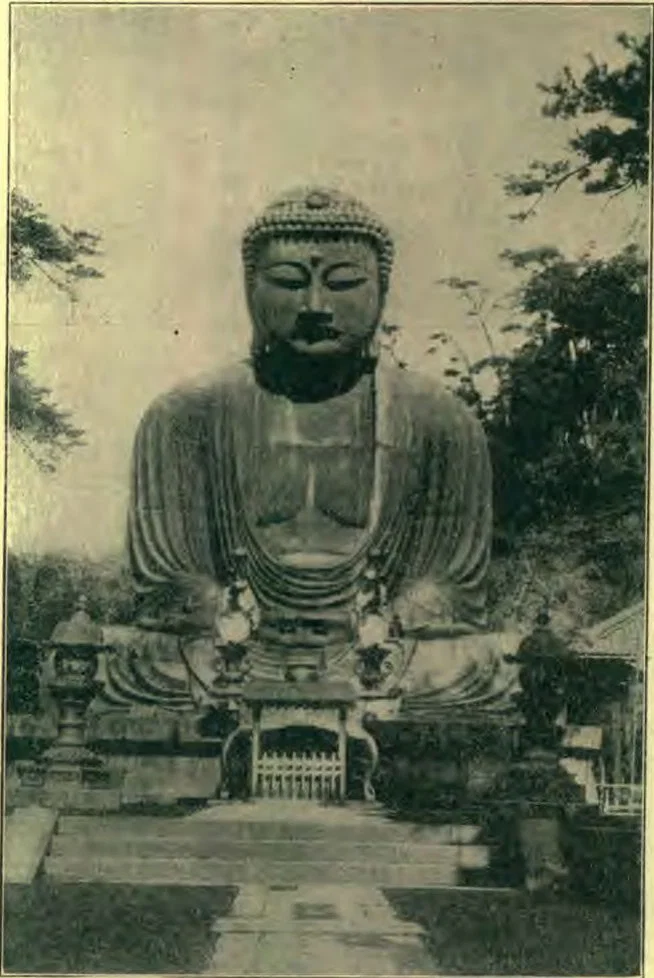
BUDDHA, THE GOD OF THE BUDDHISTS
The principal purpose in life of the living Chinese is the proper care of his dead ancestors. Not that their filial piety is of the pure and elevated character that Confucius wrote about and taught, but because of fear and the influence of avarice. When a male member of the family dies, father or brother, it is believed that he is transformed into a devil. However kind and agreeable he may have been in life, in death he changes into a spirit, with the vindictive mind of a devil, and must be propitiated, or he will bring evil and poverty upon the members of his former family. The surviving relatives, therefore, exercise great care in burying the bodies in pleasant localities, in keeping the graves in good condition, and in furnishing the departed spirit with food and paper money to amply supply their spirit needs. The dead are supposed to possess power to confer riches and prosperity upon their relatives, and all success in life is, therefore, ascribed to them. In this ability of the dead to prosper the living they are supposed to have a power beyond that possessed by either the dragons or idols. The idols are propitiated through fear, the dead from motives of avarice, mainly. The worship of ancestors takes precedence of the propitiation of idols and the dragons because ancestor worship is part of Confucianism, the oldest form of present-day religion, while the idols and dragons are part of Buddhism and Taoism forced upon the Chinese by their conquerors, and so from the beginning took the second place in their estimation.
Each home is supplied with an ancestral tablet. Before it certain religious ceremonies are performed at prescribed regular periods as a propitiation of the dead. Only the male members of the family can take part in these ceremonies, and this is one great reason why the birth of a son is considered an event of such vital importance, and the arrival of a daughter so grievous a calamity. Should the males die out, there would be no one left to worship before the ancestral tablet, or provide for the wants of the ancestors, and the family, as such, would disappear.
The terror to a Chinese is the fear that after his death there will be no filial son to care for his grave and provide for his necessities in his spirit home. Just where the dead reside is as much a mystery to the Chinese as to other nations, but it is believed that they have homes in places which are the exact counterpart of the places in which they resided when alive; that is, in a city or village that is an exact duplicate of the one on earth. If the relatives provide amply for their wants and in paper money, which, after being burned over the grave, is by some unexplained process turned into the actual thing, then the dead occupy exalted positions among their fellow spirits, and, in gratitude, prosper their relatives; but if they are neglected by their heirs, their lot is a miserable one in the spirit world, and in wrath they make their relatives suffer for it.
China has, in reality, no formal state religion. While Confucianism is the avowed imperial religion, it has no temples or formal worship, the whole is but a mental assent to certain sentiments and instructions never followed in the lives of the people. Buddhism has filled the land with idols, for it is idolatry, per se, and both it and Taoism, or necromancy, have built temples by the hundreds at every available location, but no man can tell you to what cult he belongs. Generally, he is a mixture of all three.4
Religion, however, as recognized and practiced in civilized nations, is something unknown in the East. Religion as defined in encyclopedias—“a rite or ceremony as practiced in the worship of God;” “a system of doctrines and worship regarded by its adherents as of divine authority”—has no counterpart in China.
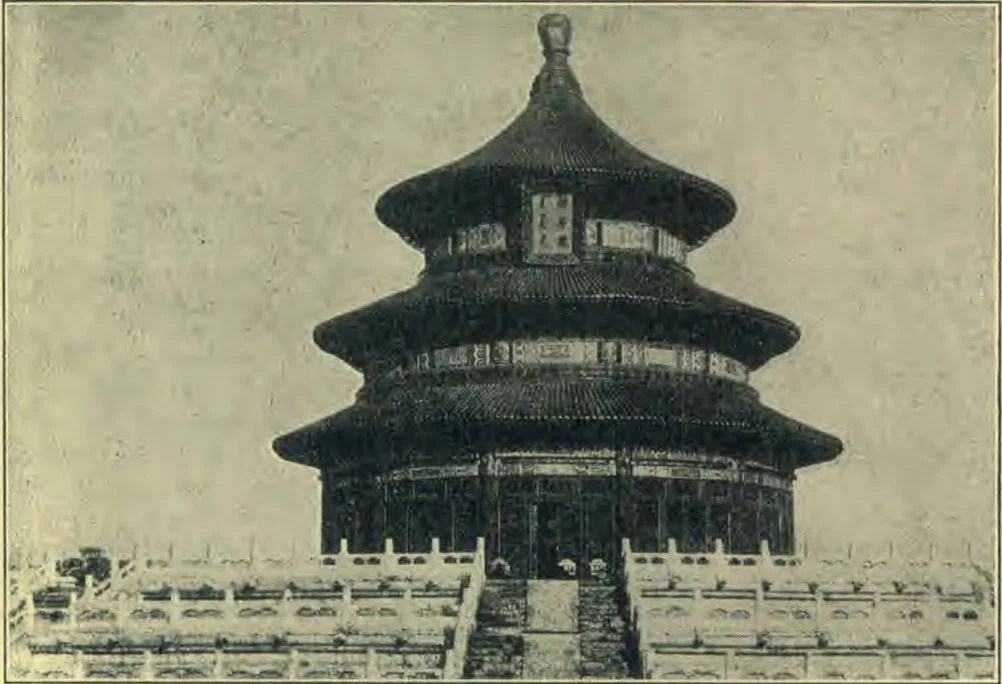
THE TEMPLE OF HEAVEN AT PEKING, CHINA
God is unknown in the sense in which Christians present him. The Chinese worship of idols, of ancestors, and of demons and devils has no connection with morality or reference to reformation of character.
Confucius evidently knew of the true God, and some historians think that in his day the nation worshiped the Creator. It is known, however, that in the three centuries following his death the people gradually turned to the worship of nature. Early in the first century A. D., Buddhism and the worship of idols were introduced from India, followed by Taoism; and the Chinese sunk, morally, to the low level they now occupy.
The memory of the true God is, however, not absolutely lost, being kept alive in a dim, mystic, and unprofitable manner. At certain intervals and in times of great distress, the people go to worship what they call Heaven, and they give it a personality, the Chinese words for the name meaning “The One Great,” having supreme power. Heaven is so mystical and so far away, however, that, in despair, the Chinese have originated idols in their yearning to communicate with the unseen and the unknown world. In emergencies individuals will turn to Heaven for relief, and once each year the ruler, as the great high priest of the people, ascends to the Temple of Heaven, offering gifts to the One Great, while the nation with bowed heads join in his entreaties for help.
Confucianism is not a living issue in China. As a cult it lost its hold upon the people centuries ago. Like “filial piety” it is now only a beautiful theory which in no way affects the lives of the people for good or bad. The sayings of Confucius confront one on all sides in printed streamers and wall decorations, even in the opium dens, but with this kind of outward expression, the recognition of Confucianism ceases, outside of the schools. Few if any ever dream of applying its principles to the betterment of character.
But the people have a deep-seated and absolute belief in the potency for good or evil of all they worship, from the One Great to their dead and their idols, even down to the kitchen god, and bitterly resent any effort to interfere with any of them—not because of any attachment to or veneration for any, but for fear of calamity to follow from their vengeance if disturbed. This is the primal cause for all opposition to republicanism in China.
The test comes, and the insufficiency of idol worship is shown, when seasons of great distress descend upon the nation, or come to individuals. For instance, if a prolonged drought devastates the country, or terrible floods bring ruin and desolation and death to vast areas and to thousands of the people, the Chinese, unitedly, drop all their gods and in terror call on the One Great for relief, acknowledging that it is he alone who can right wrongs and give complete relief.
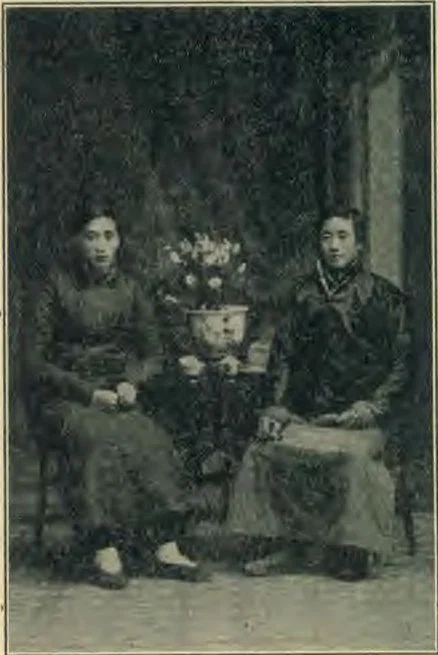
TWO OF OUR CHRISTIAN COLPORTEURS
Occasionally, in the dimness of a fading day, or the darkness of a moonless night, a silent figure can be detected climbing some mountain or high hill. He seeks the very highest attainable elevation, for he is going to talk to the One Great. He bears no gift in his hand as would be the case if he were approaching an idol or some demon, or going to the grave of an ancestor. He does not come with any thought of propitiation, but as though coming to a trusty friend for sympathy. He comes to tell the One Great of his pitiful condition, fully believing that he will be heard, sympathized with, and answered; so he climbs high because he wants to be sure that he is alone when he speaks to his friend and helper. Then, having reached the top, with head humbly bowed, and hands held out beseechingly, he pours out his soul to the One Being who, he has faith to believe, will listen and can and will answer. Who can doubt that the poor wretched creature is reaching out after the Unknown God, as did the Athenians; and that some, at least, of his tears flow because of the gentle and tender and sympathetic touch of an answering angel?3
In this fitful crude worship of the One Great is found the only “religion” the Chinese possess, and it is the answering chord which the missionaries touch when they tell the tale of Jesus and the atonement. The story fits into the crude dream of the poor heathen of a being somewhere with power to help and with no inclination to torture and destroy, and his heart reaches after a knowledge of him with a hunger sometimes that words cannot express. Is it any wonder that Chinese converts are often so faithful?
The World of Waters
By Mrs. C. M. Snow
On the Boundless Deep — No. 8
The World of Waters
ALL the ship’s crew seemed very merry the day we crossed the equator. They appeared as if some mysterious event was about to take place. Even the captain talked to Ivanilla of the wonderful experiences the day would reveal. He said, “Listen closely, and by and by you will hear old Neptune sing out to the mermaids, Get off the line, girls, for the ‘Sierra’ is coming to pass over.” But we went out of our world into a new and strange one very quietly, without even an extra bump or thump to tell us when it was done. No one saw the equator, not even through a spyglass, as the woman thought she did when a hair was stretched across the lens of the instrument through which she was looking.
We had passed from winter to summer. The weather continued beautiful. The ship plowed along upon an even keel. The windows remained open day and night, for there was not a wave to threaten the portholes. That first night in the Southern Hemisphere was brilliantly illuminated by countless stars. Throughout “the infinite meadows of heaven” we sought for the Southern Cross, the starry insignia of the hemisphere in which we now are. Among the several more or less clearly outlined crosses we selected what we thought was the right one, but later learned our mistake. New constellations appear above the horizon. We no longer see Arcturus or the Bear, but Orion the Hunter, appears, standing on his head; and in Orion’s wake is Sirius, his faithful Dog Star, still keeping at the accustomed respectful distance from his master, the Hunter.
No service is held on Sunday. In fact, it is hard to keep track of the days, for each one is so like every other one, except that embroidery and fancy work are laid aside by the passengers on Sunday, and the noisier sports are not indulged in. On Sabbath we read our Bibles and study our Sabbath school lessons more continuously than on other days. But the engines observe no rest, day or night. We speed on at the rate of seventeen knots an hour, or over four hundred and seventy statute miles a day, toward that other line we have to cross when we enter the Eastern Hemisphere.
It is said that a man who was to cross the Atlantic Ocean during the old sailing-ship days, had studied his route on a map formed of the two flat circles representing the two halves of the globe. Because they touched only at a single point, he is said to have been afraid that the captain might miss it, and carry him off into space. But we had no anxiety on this score, and passed from our native land only too quickly.
Time and its tenses are strange things, and at their strangest when one is traveling around the globe. The question is not only, What season is it? but, What day is it, and what hour and minute is it? The officers of the ship seem to have the regulating of the time, and to make the clock say whatever they wish it to. The captain makes it record twelve o’clock when he says it is noon.
He is very liberal with time, and seems to have a supply of it among the ship’s stores, for he gives us long days, whereas when we left Washington our days were fast shortening. But this generosity, like that of many another human, we feel must be repaid in kind.
As we are traveling westward, it takes the sun longer to reach us each morning than to reach the point where we were the previous day. And each night it takes him still longer to seek his bed. Our day is, therefore, longer than the complete period of the globe’s revolution. In fact, old Sol seems hesitant about leaving at all, as if he feared we would outrun him and he lose us altogether.
Long after he has passed from view, the heavens are radiant with the splendor of his going. An indescribable thrill electrifies our being, for the glory is untellable, unbelievable, and our hearts grow big with the wonder of it all. Since these sunsets are so awe-inspiring and filled with grandeur, what will the coming of the Son of man be? and who can stand before his presence? It is not hard to believe that sinful human beings will call for the rocks and mountains to hide them.
As these thoughts loom large in mind, the music of the sea is challenged by other sounds that come, not floating, but bounding out on deck from the social hall. The second-saloon passengers have got up an entertainment which includes Samoan music and dancing in native costume. We remain outside.
Mrs. C. M. Snow.
Be Glad
By Helen Adair
WHEN lightnings flash, and thunders roll,
And darkening clouds hang low,
Be glad it is the darkest cloud
That has the brightest bow.
When twilight finds you weak and worn,
With weariness oppressed,
Be glad that weary ones alone
Can know the joys of rest.
When th’ wolf is prowling round the door,
And threatens to devour,
Be glad for riches over which
Gaunt Famine has no power.
When all the cupboard shelves are bare,
With not a crust in sight,
Be glad and thankful, still, because
You have no appetite!
When trials seem to call on you
More oft than on your brothers,
Be glad because they help make you
“More feelin’er for others.”
When toothache grips you hard and fast,
And wrings out moans and groans,
Be glad you’re not an elephant
With all his aching bones!
Although the world has many a thorn,
Why should that make you sad?
Delicious fruit on thorns are found.
Be glad, then, oh, be glad!
HELEN ADAIR
A Noble Deed Is a Step Toward God
By Holland
I COUNT this thing to be grandly true:
That a noble deed is a step toward God —
Lifting the soul from the common sod
To a purer air and a broader view.
— Holland.
Keeping Good Deeds Fresh in Memory
“The best way to keep good acts in memory is to refresh them with new.”
If You Wish to Succeed, Choose Your Reading with Care
By Lora Clement
LORA CLEMENT
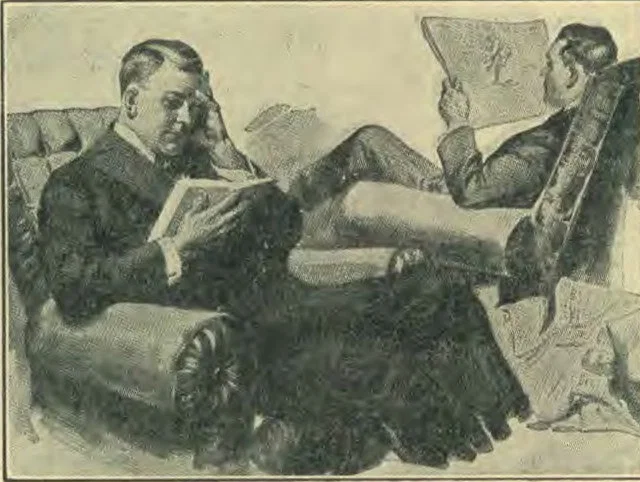
Which will succeed? One spends all his leisure moments with the daily paper; the other spends his leisure time with a few truly great books.
Are the books you read helping you to live a better life? If not, you have no time for them. God has a high ideal for you. If you wish to reach it, you must choose your reading with care, for the trend of many a life for good or ill, for success or failure, has been determined by a single book.
Early in the nineteenth century a boy of fifteen was left at home to spend the day alone. He sauntered into his father’s library in search of something to read, to while away the hours. Carelessly choosing a little tract, he retired to a quiet place intending to read the story at the beginning, and leave the moral at the close for any who might relish it. That one leaflet resulted then and there in his acceptance of Christ as his Saviour. J. Hudson Taylor left his room with new ideals, and these led him to a life of service in China.
The mere reading of a biography sent David Livingstone into the mission field. “Cook’s Voyages” and a constant study of the Bible led William Carey to give himself for India. John Wesley, Allen Gardiner, John G. Paton, and scores of others who lived lives worth while were influenced toward their work by the books they read.
The seed dropped into the mind today will surely yield its fruit somewhere in the afterward, and let us see to it that the harvest is not of inferior quality. Influence never dies. From presses running day and night a great flood of literature rushes into the world, and from this stream waves of influence permeate the most remote corners of the earth. The good and the evil are always with us. Let us choose the good.
Worthy books merit the friendship of every young man and woman. “They are always ready to comfort, to instruct, to refine.” They “elevate the character, purify the life, take the attractiveness out of low pleasures, and lift us upon a higher plane of living and thinking.” For their friends who seek knowledge they crowd into hours the wisdom of years. To those who are struggling for the higher life they bring the experiences of others who have gone before.
There are more worth-while books than any of us can master in a lifetime. History, description, travel, and wholesome narratives are always helpful. Among the best, however, are biographies of noble and true men and women who, in close communion with Christ, have represented him to others. Such reading tends to reproduce the excellence it records. Upon the same plane stand books treating of missions; for they reveal the needs of a sin-sick world, bring us in touch with real things, and impart a longing for some share in the work of the literal fulfilment of the great commission. But above all others towers the Book of books. In this our interest should center, for it is the antidote for all human ills. It is so simple that even a child can understand its precepts; yet so deep are its fountains of wisdom that no human philosopher can fathom them. Its divine Author has marked the course of history “from the beginning until this present time. It is the base of supplies for the Christian soldier, and to cut him off from it means sure defeat in the battles of life.”
Many of the Western mines so flourishing in 1849 are now only barren wastes. Their value was not lasting; but it is not so with good books. Their worth increases as the “pickax of the reader” goes deeper; and to possess a knowledge of the Word of God means eternal riches.
The value of a book depends largely upon the manner in which it is read. No book is so good as to prove profitable to the negligent reader. Gymnastic exercises do not develop the muscles of the mere observer. However, a careful, prayerful, systematic course of reading strengthens the mind and awakens it to greater activity.
The choice of good books is especially important for young people, because before them are great possibilities. Youth is the period of character building. Temptations must be met and overcome; far-reaching decisions must be made; and responsible positions filled. Just now is a time of crisis. “The need of the hour is for men and women who know what Israel ought to do.” “Who knoweth whether thou art come to the kingdom for such a time as this?” As the timber used in the construction of a building determines to a great extent its durability, so the material of which character is formed determines the usefulness of the life. The books we read either help us to grasp life’s opportunities by the forelock, and prepare for prompt, efficient service, or bring us to defeat in the presence of the enemy. In all the activities of life the heaviest responsibilities rest upon young shoulders. It is young blood that flows, and always has flowed, most freely through the arteries of missionary enterprise. Then can we as young people afford to lock the doors of opportunity against the future? the present? Can we afford to read anything that will do ourselves or others an injustice? Consider these questions prayerfully; answer them candidly. The privilege of earning a college degree may be denied you, but by a choice selection of reading for spare moments you may mold a character which will prove a veritable Gibraltar amid the storm and stress of life.
When David Livingstone returned to Scotland, after an absence of sixteen years in Africa, the Glasgow University desired to honor him by conferring the degree of Doctor of Laws. As he appeared upon the platform, the students received him with silent respect. He was gaunt and weary from exposure to African sun and twenty-seven attacks of African fever; one arm, having been injured by the bite of a lion, hung useless by his side. He told them of some of the battles he had fought for humanity, and declared that he was going back again to suppress the slave trade, open new fields for commerce, and prepare7the way for extensive gospel work. He closed his address by saying: “And shall I tell you what supported me through all the years of exile among a people whose language I could not understand, and whose attitude toward me was always uncertain and often hostile? It was the promise, ‘Lo, I am with you alway, even unto the end of the world.’” Just a sentence from the good old Book, but how much it must have meant to the missionary-explorer. Sometimes a single sentence stands out preeminently helpful in the few pages one can snatch time to read during the day. Cling to such key-thoughts. They will help you likewise, sometime when the battle goes hard.
The end of all things is coming, but it is not yet. The Master still “hath need of us,” and he is anxious that we should prepare for service here and a place in his kingdom hereafter. Shall we not pledge ourselves to read only the best, that we may stand before our Maker and King as workmen that need not be ashamed? And may I suggest that you do not pass by the Missionary Volunteer Reading Course books, which are especially selected to help you make this needed preparation?
“Faithful unto Death”
By C. C. Crisler
“A Spanish painter [Vicente Joanes by name], in a picture of Stephen conducted to the place of execution, has represented Saul as walking by the martyr’s side with melancholy calmness. He consents to his death from a sincere though mistaken conviction of duty; and the expression of his countenance is strongly contrasted with the rage of the baffled Jewish doctors and the ferocity of the crowd who flock to the scene of bloodshed. Literally considered, such a representation is scarcely consistent either with Saul’s conduct immediately afterward or with his own expressions concerning himself at the later periods of his life. But the picture, though historically incorrect, is poetically true. The painter has worked according to the true idea of his art in throwing upon the persecutor’s countenance the shadow of his coming repentance. We cannot dissociate the martyrdom of Stephen from the conversion of Paul. The spectacle of so much constancy, so much faith, so much love, could not be lost. It is hardly too much to say with Augustine that ‘the church owes Paul to the prayer of Stephen.’”—Conybeare and Howson, “Life and Epistles of the Apostle Paul,” chap. 2, last par.
Stephen’s death, although “a sore trial to the church,” “resulted in the conviction of Saul, who could not efface from his memory the faith and constancy of the martyr, and the glory that had rested on his countenance.”—“The Acts of the Apostles,” p. 101.
Such is the witness borne by many writers concerning the influence of Stephen’s courageous conduct in the face of bitter persecution. Dr. Robert E. Speer, secretary of the Presbyterian Board of Foreign Missions, says: “The memories of that day . . . haunted him [Saul] unceasingly, the face of the martyr as it had been the face of an angel, his patient suffering, his quiet, composed death. In telling the story of his conversion to the multitude from the stairs of the castle in Jerusalem he recalls it, ‘And I said, Lord, when the blood of Stephen thy witness was shed, I also was standing by and consenting, and keeping the garments of them that slew him.’”—“Studies of the Man Paul,” pp. 27, 28.
Faithful witness for Christ may not always bring results so manifest as those that followed the martyrdom of Stephen; but whatever the apparent results, loyalty to God in time of trial always brings its own award in heart and life, and the promise remains sure, “Be thou faithful unto death, and I will give thee a crown of life.” Rev. 2:10.
C. C. Crisler.
Fear and Health
By Orison Swett Marden
UNDER the heading, “Fear of Lightning Kills,” an item in a metropolitan daily recently reported the sudden death of a woman from fear of lightning. During a severe thunderstorm, which had done considerable damage in the neighborhood of her home, the woman became unconscious from fright, and died. There was no heart trouble, and the lightning had not touched her, but all her life she had felt a nervous fear of thunder and lightning, and that deadly emotion had at length killed her.
It used to be customary for the Weather Bureau at Washington to send out warnings of the advent of tornadoes, but when it was found that such forecasts frightened more people to death than they saved from death, the weather chief decided that it was best to discontinue the warnings.
After the passing of the St. Louis tornado, which the Weather Bureau had predicted, hundreds of letters were received in Washington, telling of people who had died from fright and of others made ill by worry, though they were not near the path of the storm.
Many frightened mothers are now flying from New York with their children, for fear they will contract infantile paralysis, or, to give it its medical name, poliomyelitis, when but for their dread of the disease they would be just as safe in New York as elsewhere.
Fear is a worse disease than any mere physical disorder. It is well known that during epidemics in the past, multitudes of people who had not contracted the disease died of fear. Multitudes today are seriously affected through fear of disease. Their loss of courage more than anything else destroys their disease-resisting power. Whatever depresses, distresses, or worries lowers the vitality and injures the health. Fear is the most terrible of depressants. It tends to close up life’s avenues. It takes away the appetite, checks the circulation of the blood, and seriously impairs the nutrition of the entire system.
Chronic anxiety or fear, from which multitudes of people suffer all their lives, keeps the blood poisoned, and this opens the door to all the enemies of health. In fact everything that affects peace of mind and happiness affects the health. Whatever worries or depresses encourages the development of disease.
Worrying about disease produces disease. Fear and worry are the great wreckers of health ideals. They cause most of the dyspepsia in the world, and develop and spread some of the most dreaded diseases.
Many diseases have their origin in latent fear and anxiety, which work like leaven until the whole nature is affected. This is especially true where the latent fear relates to possible inherited disease tendencies, such as tuberculosis or cancer. The fear, for instance, that cancer may develop in one when he reaches a certain age, because cancer seldom appears before this age, is often an irritating cause which tends to develop cancer germs.8
Now, just as fear and worry invite and promote disease, so courage and faith repel it. The mind has everything to do with the progress or the arresting of disease. More and more, physicians are recognizing the fact that the mental attitude is by far the greatest factor in the practice of medicine. They know that the patient’s mental condition very seriously modifies even the effect of drugs.
The important thing is to keep the physical and mental standards so high that the disease germ, the worry germ, the anxious germ, cannot gain a footing in our brain. Our physical resisting power is dependent largely on our mental power, which ought to be so great that it would be impossible for these enemies to gain access to the body.
Instead of being filled with fear of disease and disease germs from childhood up, every person should be so trained and his life so regulated that he shall be a mighty bulwark of resistance against all mental and physical enemies, all disease germs.—Orison Swett Marden, in the Washington Herald.