GENERAL CALLES — KAH-yes
General Carranza — Kah-RAHN-sah
Consul Andreas Garcia — Ahn-DRAY-ahs Gahr-SEE-ah
General Bertrani — Bayr-TRAH-nee
General Gavira — Gah-VEE-rah
General Villa — VEE-yah
Matamoras — Mah-tah-MOR-rahs
San Ignacio — Sahn Ig-NAH-see-o
Guerrero — Gay-RAY-ro (”r” rolled)
Nuevo Laredo — NWAY-vo Lah-RAY-do
San Vincente — Sahn Veen-SEN-tay
Presidio del Norte — Pray-SEE-dee-o del NOR-tay
San Elesario — Sahn Ay-lay-SAH-ree-o
Espia — Ays-PEE-ah
Fronteras — Fron-TAY-ras
Santa Cruz — SAHN-tah KROOS
Tubitami — Too-bee-TAHM-ee
Sarico — Sah-REE-ko
Tubac — Too-BAK
Mariposas — Mah-ree-PO-sahs
Vallecitas — Vah-yay-SE-tahs
Las Cruces — Lahs KROO-says
Popago — Po-PAH-go
Tenaja — Tay-NA-ha
Tia Juana — Tee-ah-HWAH-na
Sanoito — Sah-no-EE-to
Saltillo — Sahl-TEE-yo
Allende — Ah-YAYN-day
Jimenez — Hee-MAY-nays
Del Rio — Dayl REE-o
Ojo de Auga — O-ho day AH-gwah
Cuchillo Parado — Koo-CHEE-yo Pah-RAH-do
Cuchubeaschi — Koo-choo-bay-AHS-chee
Nogales — No-GAH-lays
Basura — Bah-SOO-rah
Sanoyta — Sah-NO-ee-tah
Quijotas — Kee-HO-tas
Real Castillo — Ray-AHL Kah-STEE-yo
Puerto Isabel — PWAYR-tah I-say-BAYL
Tubutama — Too-boo-TAH-mah
Altar — Ahl-TAHR
Magdalena — Mahg-dah-LAY-nah
Mina San Pedro — Mee-nah Sahn PAY-dro
Santa Maria — SAHN-ta Mah-RE-ah
Carrizal — Kahr-ree-SAL (”r” rolled)
Galeana — Gah-lay-AH-nah
Caboraca — Kah-bo-RAH-kah
San Rafael — Sahn Rah-fay-AYL
Libertad — Lee-bahr-TAD
Opodepe — O-po-DAY-pay
Guasavas — Gwah-SAH-vahs
Carmen — KAHR-mayn
Chihuahua — Chee-WA-wa
Hermosillo — Hayr-mo-SEE-yo
— Washington Post.
For the Finding-Out Club
Every one who sends in a correct list of answers to any set of questions will be entered as a member of the Finding-Out Club, if the list is received within three weeks after the date of the paper containing the list. Membership lists of answers to be accepted must follow the rules given below:—
1. The list must be written neatly.
2. Pen and ink must be used.
3. Writing must appear upon only one side of the sheet of paper.
4. The answers must reach the editor’s desk within three weeks after the date of the paper containing the questions answered.
5. All lists must be folded and not rolled.
6. The questions must not be repeated in the list of answers.
7. Each answer must bear the same number as the question it is intended to answer.
8. Every list must give the date of the INSTRUCTOR containing the list of questions being answered; for example, “Answers to questions in INSTRUCTOR of December 8.”
9. Every list must bear at the bottom the name of the one sending in the list.
Failure to heed any one of these rules is sufficient to bar one from membership in the Finding-Out Club. Let us watch the membership grow.
---
I. WHAT king beat down a city and sowed it with salt?
2. What prophet was himself the subject of prophecy?
3. The legal heir to the throne of Judah was hid by his aunt for six years in the house of God to escape a murderous hand. Who was the woman, and who was the future king?
4. In what cave did David seek refuge when pursued by Saul?
5. Of whom does the Bible say, when frightened, his hair stood on end?
6. What king of Babylon put out the eyes of a captured king of Judah?
7. Who was the last king of Judah?
8. What woman, upon the death of her son, king of Judah, murdered her grandchildren and usurped the kingdom?
9. When was the Feast of Tabernacles celebrated for the first time after the death of Joshua?
10. What prophetess dwelt under a palm tree?
11. Who was the left-handed judge that delivered Israel?
12. Whose life was lengthened fifteen years in answer to prayer?
13. Who wished to “die the death of the righteous”?
14. Name three persons mentioned in the Bible whose names begin with the letter V.
15. What Canaanite king cruelly cut off the thumbs and great toes of seventy conquered kings, and was subsequently captured and made to suffer the same cruelty?
16. What book of the Bible was written without mentioning the name of God?
17. By whom and to whom was it said, “Come thou with us, and we will do thee good”?—J. H. Vincent, D. D.
Breaking “Gas” Prices
A FEW months ago, just prior to the skyrocket advance in retail price that gasoline has made lately, came the announcement from Washington that a synthetic process of gasoline manufacture had been discovered that would at least treble or quadruple the quantity of the fuel that could be extracted from any given volume of crude oil. This new process “cracks” the molecular structures in crude oils, and induces a change allowing the volatile gasoline to be formed and boiled off.
Dr. Rittman, the chemical engineer expert of the government, in a recent address before the Engineers’ Society of Dayton, Ohio, reviews the present fuel situation and the work done already in commercializing the new process, and prophesies definite relief to the consumer from the present purse pressure.
In regard to the critical situation at the wells and extracting plants, he says:
“One thing that has pushed the gasoline market up out of sight is the falling off of Oklahoma crude oil. Less than a year ago, Cushing field in that State produced 300,000 barrels of crude oil, which analyzed from 25 per cent to 30 per cent of gasoline; in other words, 180,000 barrels per day. Now that source of supply has diminished until it is below 60,000 barrels.
“That means that despite the new process, which was brought out eight months ago, and is represented today by expenditures exceeding $8,000,000, with thirty additional plants clamoring for it, we cannot cope with the problem yet; it will be some time before production catches up with demand.
“No two crude oils are the same. As a matter of fact, two wells in the same oil field are different, and one will contain more gasoline than the other. The average gasoline content of petroleums in America is below 12 per cent. By the new breaking processes we can bring that up to 60 per cent, or five times what it was previously.
“The term ‘gasoline’ really means nothing. It is a commercial name which meant originally those constituents of crude oil which in natural distillation boiled off below 150 degrees centigrade. That temperature has been raised successively until it is now about 175, and is going higher progressively. That means that where a Pennsylvania oil ten years ago produced 10 per cent of gasoline, that same grade today is producing 25 per cent.
“The heat-containing oils, exemplified by the Oklahoma oils, are also variable in gasoline production. Some of the oils as found in Texas, in the Humble field which has been opened up recently and is producing 100,000 barrels per day, contain practically no gasoline, but contain kerosene to the extent of 70 per cent. California oils and Mexican oils contain no gasoline. The average contained in California oils for the 100,000,000 gallons produced per annum, is about 2½ per cent. Now we can produce gasoline by the ‘cracking process.’
“Now, how much gasoline can we hope to get by this method? From the Eastern crudes we should get from 70 per cent to 80 per cent; on crude such as the Mexican, we get 40 per cent to 50 per cent. Thus we are going to solve the gasoline problem by various ‘cracking processes.’ I do not wish to limit myself to the Bureau of Mines processes. I am trying to speak broadly. There are hundreds of men working on this problem. I say that synthetic gasoline will catch up with the demand in the next six months. You can look for higher prices before lower prices, but in the course of a year or so, most certainly we will have an available supply of gasoline at the old figure or below it.”—The Illustrated World.
Novel “Attack” of Prairie Dog on a Woodchuck
By Mary B. Thayer
NAPOLEON AND THE WOODCHUCK
WE once had a prairie dog, whom we named Napoleon on account of his extraordinary energy, courage, and acuteness. We had a pair of them, the other being Josephine, but there was nothing remarkable about her. Napoleon was a fat little fellow, but exceedingly strong and brave.
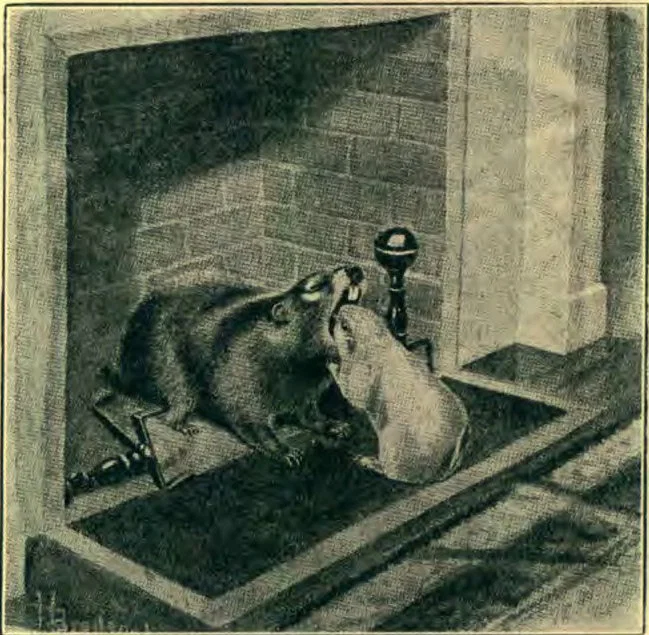
We had caught a young woodchuck. It was old enough to have all the undaunted ferocity of its species; and, indeed, it was already nearly three times the size of Napoleon. The woodchuck had been left in the sitting-room, where it had retreated into the unused fireplace, and sat, glaring furiously at every one who approached, and keeping its mouth wide open, except when, from time to time, it would close it with a fearful snap, loudly grinding its teeth together in the way peculiar to woodchucks. Some one now brought in Napoleon, and, to my horror, set him down on the floor. I was for snatching him up, feeling sure that the woodchuck would make an end of him; but my father said, “Let them be. We can interfere in time.” Napoleon, after investigating other parts of the room, trotted toward the fireplace. The woodchuck drew himself up and opened his mouth as wide as it would go, while his eyes gleamed with fury; and I held my breath in terror for my pet, who walked up to him, seeming greatly interested. Napoleon never paused an instant, but proceeded to examine the woodchuck’s wide-open mouth, thrusting his whole muzzle inside it, and then actually putting out his little pink tongue and sampling the roof of the woodchuck’s mouth! Every moment I thought, “Now—now it will be all up with Napoleon! Those awful jaws will shut and that will be the end.” But nothing of the kind happened: the woodchuck seemed entirely paralyzed; he did not relax a muscle,10but sat immovable, with mouth wide open, as he had done when Napoleon first approached. The latter made a long and leisurely inspection, first of the inside and then of the outside of the woodchuck’s mouth, and at last trotted away again, leaving the poor nonplused animal sitting calmly in the fireplace as before.
Napoleon lived for several years more, and at last died of old age (so we believe), his mate having previously escaped.—Mary B. Thayer, in St. Nicholas.
The Soft Answer That Turneth Away Wrath
I ANSWERED a want advertisement in the paper:— “A young lady to take orders over the telephone in large department grocery store. She must be courteous.”
Three weeks later, after six other girls had failed in quick succession, I was employed.
I never shall forget that first day. I wonder now how I ever kept my nerve with two telephones ringing, ringing, ringing, as if the whole world were starving and groceries were to be had at no other place. I believe it was the fact of my unfailing courtesy that gave me strength. I did not know then, but I know now, that courtesy is its own reward. The quick response to a kind word, gentle tone, or favor is very gratifying. When night came I had a very severe headache, but somehow I knew I was making good.
I soon learned that the average woman, with the burden of housekeeping on her shoulders, is the most irritable and unreasonable creature alive. A delivery ten minutes late can bring on your head a mighty wrath; a wilted lettuce can lose you your best customer. I had to stand between these women and overworked delivery boys, careless shipping clerks, and sometimes inferior goods.
One instance: A woman was to give a dinner party. Her groceries arrived almost at the last minute, with the fish order filled incorrectly. “My dinner is spoiled!” she cried distractedly over the telephone. “I never will spend another cent with you as long as I live!” Woman is built for fortitude, not responsibility. I shouldered the responsibility and persuaded her to bear with me until I could rectify the mistake. It took much soothing; a hint of irritation on my part would have spoiled everything. As it was, fifteen minutes later a messenger boy was delivering the fish at her door. We had kept our customer and made a lasting friend.
This is just one instance out of thousands. Soon I had a small private office next to the senior manager’s, with two telephones all my own, and an individual speaking tube to the shipping department. My customers refused to give their orders to any one else, and I found the readiness with which women responded to courtesy almost pathetic. In a few months my salary of six dollars a week had stretched into eighty-five dollars a month, which was at that time a very generous salary for a woman in the South. So you see, I found courtesy a profitable investment.—The American Magazine.
The Choir of the Daybreak
By Homer P. Branch
I SAT by my window at daybreak,
As the wild birds caroled the hour,
And watched the shades of the nighttime
Droop ’neath the morning’s power;
And as the banners of sunrise
Flung their colors above the trees,
The burst of light charmed the bird-notes
Into sweeter melodies.
The wren, the linnet, and robin,
The oriole, catbird, and jay,
And all the choir of the treetops,
Spirited sang and gay;
And with notes unknown to mortals,
With harmonies as grandly fair
As the soul’s unuttered music,
They piped on the morning air.
The daybreak’s freshness and grandeur,
And the songs of the happy birds,
Commingled a tender beauty
That cannot be told in words;
And a gladness settled o’er me,
That lifted me out of the cares
That yesterday bore upon me
In the burden of affairs.
And my heart communed with angels
On the sacred memories massed
In the stalls of recollection,
Scattered all along the past;
And the future’s brilliant finger
In a beckoning gesture shined,
A strange, glad impulse awaking,
That cannot be defined.
O the glory of the morning,
And the wild birds’ heaven-made song!
O the good that is created
To take the place of wrong!
But the fondest hours of lifetime,
And the gladdest moments e’en,
They do teach us always, sweetheart,
The love of the Great Unseen!
— Homer P. Branch.
A Good Rule
MR. DAVID GIBSON is said to be the original Courtesy Man; that is, he started the era of railroad and other big corporations making special campaigns to educate their employees to show courtesy to their patrons. A resolution that he offers as a guide to employer, employee, and patron alike is the following:—
“Resolved, That we all cease trying to get something for nothing — grafting, in other words; that we all do just a little more than we agree to do, rather than just a little less. That honesty is a question of efficiency here on earth, with its rewards in profits now, here on earth. That fear is the root of all evil; for if our neighbor cheats us in his store it is to fortify himself against some element out of his store. That the basis of all life is business life; that business is the system by which we supply our wants and needs; that we are true to political life, true to social life, as we are true to business life. That we think of others as we would have them think of us; that we do as we think, the thought precedes the act; that coöperation is the real brotherhood of man; that the prosperity of one man does not require the poverty of another man; that both the idle man and the dishonest man, whether they be possessed of little or much, are fools in themselves and abominations to their communities.”
The Holy Spirit
By Arthur L. Manous
To whom has God given the Holy Spirit?
“To them that believe in him.” Acts 5:32, Syriac Translation.
“To those who submit to him.” Emphatic Diaglott New Testament.
“To them that obey him.” The Common Version.
“To those obeying him.” Young’s Translation.
“Unto them who are yielding obedience unto him.” Rotherham’s Translation.
For the Holy Spirit, some have been praying instead of obeying. “Prayer is all right with obedience, but not instead of it,” says one. “Behold, to obey is better than sacrifice.” 1 Sam. 15:22.
ARTHUR L. MANOUS.
The Two Travelers
By Palmer Cox
A Fable
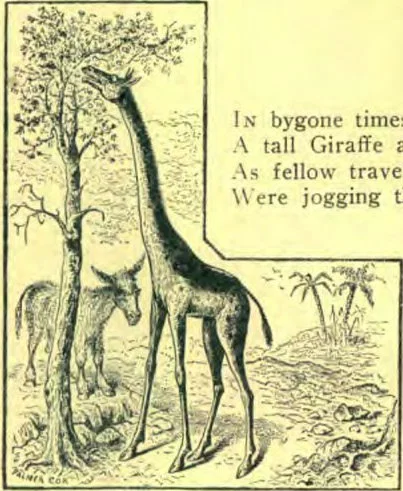
In bygone times it came to pass,
A tall Giraffe and a dwarfish Ass,
As fellow travelers, side and side,
Were jogging through a country wide.
The Ass was much
inclined to smile
At his companion's
awkward style;
His great long legs to
criticize,
And at his neck express surprise;
In short, to spare no
cruel hit
Whereby he might
display his wit.
But as they moved the region through,
The vegetation scarcer grew,
Until upon the sterile ground
But little else than stones were found,
And only on the tallest trees
Grew aught that could their hunger ease.
And there, with famine worn away,
The hungry Ass was forced to stay,
And watch his comrade eat the fruit
A dozen feet above the root.
“Ah me!” he cried, “no more I'll chaff,
Nor at your neck and figure laugh!
In truth, I find now, after all,
I'd give my ears to be as tall!”
— Palmer Cox, in St. Nicholas.
Gordon’s Joke
“BUT the boys and girls laughed at me,” said Gordon, when Uncle Gordon told him not to look as if he had lost his best friend. He had come home from school at noon so cross that Uncle Gordon scarcely knew him. Usually Gordon was the merriest kind of boy, but he could not take a joke very well.
“What did they laugh at you for?” asked Uncle Gordon.
“Because when I was erasing my examples on the blackboard, the old eraser flew out of my hands through the window and scared old Mr. Peter’s big rooster almost to death. He wasn’t hurt a bit, but he squawked as if he were half killed. The boys and girls all laughed at me, and said I ought to be a star pitcher on the team if I could aim as well as that. I’m the best baseball pitcher they have, if I do say it myself!”
“Well! Well!”
Uncle Gordon himself was laughing, and Gordon looked crosser than ever. The next moment Uncle Gordon looked serious.
“Now, Gordon, I am sure if it had happened to another boy, you would have been one of the first to laugh, wouldn’t you?”
“Yes,” said Gordon slowly, looking ashamed.
“If I were you, I would train myself to stand laughter,—kindly laughter you know,—just as you trained yourself to pitch ball. I would try every bit as hard to win out as a joke taker as you try to win out in games.”
“You don’t understand how I feel, Uncle Gordon.”
“Yes, I do. I used to be the same way.”
“You did!”
“Yes, but a little pig cured me.”
“Tell me about it,” begged Gordon. “You take a joke better than any one I know.”
“But I had to learn how first; I used to laugh at other people all the time, and it wasn’t always kindly laughter. But, oh, how I hated to be laughed at myself! I know all about it, Gordon.
“One day my father gave me a pig for my own. I’ve always had a kindly feeling for pigs ever since. Spotty learned many cunning tricks, and soon everybody in town knew him. One Sunday morning I walked up the aisle in church with my father and mother. As we went to our seats, I saw everybody laughing. Then I looked up at the minister, and he was biting his lips to keep from laughing. The choir was laughing. I could not imagine what was wrong till I looked around, and there coming up the aisle was Spotty, following after me as fast as he could! I turned back, grabbed him up, and ran out of the church.
“At first I threw myself down in the grass at home and almost cried. Then I began to think of all the times I had laughed at other people, and I wondered if I had hurt their feelings as much as they had hurt mine. Then I thought of Spotty, and how funny he must have looked. No wonder the people laughed! I began to laugh myself, and I made up my mind right then that I would learn to take a joke. Spotty cured me.”
Uncle Gordon could hardly finish his story for laughter. As for Gordon, he was laughing with all his might.
“Thanks ever so much for telling me about Spotty!” he said, as he started back to school. “He’s going to cure me, too! Just see if he doesn’t!”
And he did, too, for now there isn’t a boy in all the crowd who can take a joke better than Gordon can, and he enjoys a joke on himself as much as he does one on somebody else.—Picture Story Paper.
The Worth of a True Friend
A TRUE friend is distinguished in the crisis of hazard and necessity,—when the gallantry of his aid may show the worth of his soul and the loyalty of his heart. — Ennius.
Self-Praise and the Wisdom of Modest Speech
“Don't praise yourself, lest others doubt and grieve you; Yet don't dispraise yourself — they might believe you.”
Missionary Volunteer Work Summary, North American Division, Quarter Ending March
By M. E. Kern
Summary of Missionary Volunteer Work in the North American Division Conference for Quarter Ending March 31, 1916
Conferences
No. Societies Reporting
Present Membership
Conf. Society Members
Missionary Letters Written
Missionary Letters Received
Missionary Visits
Bible Readings
College Meetings
Subscriptions Taken
Papers Sold
Papers Lent or Given Away
Books Sold
Books Lent or Given Away
Tracts Sold
Tracts Lent or Given Away
Hours of Christian Heartwork
Clothing and Meals Given
Bouquets Given
Scripture Cards Given
Treatments Given
Signers to Temperance Pledge
Offerings for Foreign Missions
Offerings for Home Missions
Conversions
ATLANTIC UNION
E. New York
7
88
19
70
28
134
66
26
469
1010
27
66
56
411
161
225
1
648
27
63
$52.58
$5.10
..
Greater New York
16
264
..
583
414
1853
473
41
1892
3229
701
147
130
1900
557
418
..
..
..
3
91.99
71.50
..
Maine
7
120
33
107
58
195
43
..
327
786
157
81
..
491
386
123
..
12
..
..
27.38
5.20
..
Massachusetts
16
270
5
499
90
455
178
10
4355
2699
138
202
*4082
2470
730
271
10
55
19
..
132.70
105.00
37
N. New England
5
38
7
28
8
52
24
2
126
2272
39
17
..
109
208
21
1
149
13
3
7.18
3.05
..
S. New England
16
159
2
110
68
170
77
26
1659
753
8
39
24
227
88
59
4
32
4
..
41.05
12.01
1
W. New York
12
125
8
283
114
524
233
14
1339
1671
213
147
226
2971
897
158
14
132
16
24
107.03
57.31
..
Bermuda Mission
1
18
..
13
..
4
2
..
45
33
..
12
7
17
3
..
1
..
..
..
5.24
.36
..
CENTRAL UNION
Colorado
18
300
..
268
127
852
109
20
93
3435
58
155
2
5796
1539
334
27
150
49
98
46.46
38.15
3
Kansas
19
450
..
750
453
379
312
14
228
2006
103
115
..
1014
474
330
27
150
..
72
63.35
9.41
16
Missouri
4
72
..
87
28
111
5
..
58
1648
18
22
..
165
61
97
..
..
..
28
..
13.95
..
Nebraska
5
200
..
66
23
264
68
7
18
496
82
15
33
243
106
112
5
..
22
..
8.10
2.00
5
Wyoming
2
62
..
4
..
49
5
..
13
250
1
15
1115
..
29
..
..
..
..
..
1.69
3.23
15
COLUMBIA UNION
Chesapeake
6
100
..
283
37
243
48
8
770
765
173
56
29
227
81
202
8
38
38
..
..
11.76
4
District of Columbia
1
28
..
34
3
16
2
..
245
136
..
1
2
87
66
14
..
..
2
..
..
..
..
E. Pennsylvania
17
236
3
141
58
341
66
99
1015
2474
144
172
138
2591
349
277
18
93
21
62
45.17
23.92
3
New Jersey
20
260
..
178
124
681
213
15
618
5329
199
212
217
6573
779
100
8
32
27
..
63.77
30.99
3
Ohio
20
536
..
189
76
329
153
21
182
461
83
134
1537
5298
745
460
3
..
5
6
204.69
19.31
..
Virginia
5
177
..
99
43
3
2
..
10
100
8
8
2
67
105
36
..
..
..
..
3.01
..
..
W. Pennsylvania
6
113
..
224
227
479
176
28
868
7608
150
110
15
1365
313
307
3
3
6
..
185.63
21.88
5
West Virginia
2
47
..
153
23
258
76
35
1851
4071
101
30
72
1038
206
61
12
..
14
..
15.30
..
1
LAKE UNION
E. Michigan
47
656
1
356
121
2732
130
283
1832
4715
416
319
198
5743
654
526
48
240
78
57
100.09
54.61
9
Indiana
25
385
..
114
56
315
82
221
854
2612
136
374
547
1173
199
163
2
..
54
45
72.41
8.04
11
N. Illinois
29
532
..
869
407
3283
812
1519
808
4820
251
480
427
4481
2737
809
110
242
72
169
148.20
364.42
20
N. Michigan
6
143
..
45
19
49
5
13
311
404
9
62
64
85
73
18
..
..
..
25
54.79
1.49
..
S. Illinois
12
191
15
458
210
494
83
26
233
2107
82
136
278
500
588
377
..
..
35
..
17.47
17.68
..
W. Michigan
40
922
3
473
168
592
131
50
493
5776
23
266
32
3244
1998
822
48
293
121
66
245.32
53.29
3
Wisconsin
25
347
..
228
85
491
206
11
413
3263
27
79
28
1136
555
438
14
405
31
51
146.75
15.06
5
NORTHERN UNION
Iowa
12
159
..
189
103
449
75
13
623
1761
267
76
5
1371
394
203
11
76
208
183
72.94
11.98
..
Minnesota
23
446
74
432
191
398
114
48
985
4001
54
178
2
4761
842
242
10
41
68
43
72.71
46.53
..
North Dakota
9
190
3
285
52
71
21
17
39
1629
581
106
1
298
24
51
..
..
5
5
71.92
27.58
..
South Dakota
19
275
..
753
332
528
208
30
131
3776
51
132
163
2009
1071
480
..
..
..
72
213.69
13.57
..
NORTH PACIFIC UNION
Montana
S. Idaho
13
215
8
158
17
140
24
19
..
1166
5
40
26
320
89
73
13
13
12
..
19.79
2.50
5
S. Oregon
6
94
5
102
53
153
77
1
10
1908
1
31
..
306
214
116
14
..
6
2
5.52
6.33
..
Upper Columbia
14
433
10
385
104
310
110
15
138
4552
20
247
24
1262
603
444
9
175
68
11
42.11
47.94
13
W. Oregon
16
357
..
182
80
321
119
25
487
5448
8
102
..
2413
295
193
13
677
28
11
57.14
54.65
12
W. Washington
16
250
..
48
23
187
32
18
3710
128
3
73
555
199
74
151
923
86
24
..
27.55
..
..
PACIFIC UNION
Arizona
2
42
..
49
19
25
29
2
185
525
6
17
..
24
37
8
12
..
5
..
5.00
24.25
..
California
16
405
..
506
222
158
320
78
560
4242
70
282
636
7476
657
1616
107
222
234
54
134.59
53.47
15
Cen. California
23
400
1
215
79
1009
207
9
3857
4740
131
234
80
3315
325
503
141
482
93
3
137.99
99.46
25
Inter-Mountain
8
69
..
344
170
1336
187
108
122
918
223
73
10
614
483
196
26
68
53
..
72.33
44.39
4
Nevada Mission
N. California
11
225
..
184
50
212
84
2
318
3756
18
168
43
863
331
394
281
131
128
42
74.43
78.30
..
N. W. California
10
..
..
236
187
253
68
62
86
1337
29
128
5
801
471
285
85
100
22
22
72.24
13.52
..
S. California
24
523
..
177
76
269
101
15
145
2556
17
106
9
1835
369
422
175
202
141
193
103.64
78.49
..
S. E. California
7
177
..
182
110
376
72
61
58
1186
37
137
10
810
198
299
..
..
..
14
81.71
34.71
5
SOUTHEASTERN UNION
Cumberland
11
205
9
215
73
377
39
3
1100
1244
18
109
..
208
292
104
19
47
78
2
29.77
18.69
1
Florida
17
241
1
173
75
378
75
16
1294
5202
72
76
191
632
241
143
96
..
15
..
28.83
..
10
Georgia
8
150
2
177
108
757
214
431
231
1839
63
104
37
1294
595
235
6
80
56
6
72.54
43.57
..
North Carolina
7
139
..
34
43
97
62
..
267
282
3
11
4
344
457
119
..
42
9
..
19.24
3.40
..
South Carolina
5
147
..
28
17
406
44
..
90
301
32
34
53
367
187
118
2
14
40
..
24.94
3.17
..
SOUTHERN UNION
Alabama
6
76
..
248
141
713
264
20
875
765
47
72
38
414
1092
359
12
62
90
12
9.65
26.25
15
Kentucky
6
107
13
188
65
220
89
21
890
1205
27
71
268
826
450
196
17
..
..
..
6.80
13.00
1
Louisiana
4
45
..
200
5
150
5
..
500
875
..
3
5
..
160
126
10
..
13
..
25.00
35.78
..
Mississippi
5
24
1
23
19
59
4
18
2
250
18
18
..
2
297
84
..
..
19
..
1.20
1.80
..
Tennessee River
8
230
..
333
127
319
261
2
143
1462
15
146
27
915
725
451
20
17
83
1
..
35.74
3
SOUTHWESTERN UNION
Arkansas
5
87
5
38
15
88
2
1
..
297
..
50
3
71
63
48
8
1
26
..
37.47
14.75
..
New Mexico
3
43
5
265
89
26
6
..
50
1038
..
18
1
170
15
63
..
..
1
..
2.55
.73
5
N. Texas
7
202
..
126
94
159
64
2
17
716
15
53
14
130
29
70
3
..
..
..
55.39
6.04
4
Oklahoma
14
455
12
166
51
107
51
28
49
4040
32
99
3
1260
585
169
7
48
33
51
3.03
15.75
6
S. Texas
2
18
..
24
14
55
35
..
896
397
28
10
6
17
71
31
..
..
..
..
1.35
.05
..
W. Texas
3
48
..
43
40
34
12
1
10
150
13
30
..
60
190
36
..
..
11
8
2.15
.10
..
EASTERN CANADIAN UNION
Maritime
5
56
5
87
46
4
..
..
..
92
..
15
..
172
97
30
..
..
33
..
47.95
..
..
Ontario
7
103
..
75
42
314
119
..
317
1749
85
46
10
5528
160
48
12
..
26
12
37.51
57.50
..
Quebec
3
45
5
88
22
164
16
8
1
609
..
32
..
44
180
15
2
..
1
..
8.70
19.00
..
WESTERN CANADIAN UNION
Alberta
3
125
..
155
26
7
11
8
400
917
6
28
103
101
108
9
1
..
50
89
30.25
8.20
..
British Columbia
10
120
2
42
15
27
6
..
13
1256
16
32
..
141
29
41
15
88
49
..
34.26
8.13
..
Manitoba
3
40
11
68
23
72
7
4
767
650
17
38
258
109
19
3
..
7
1
..
27.45
3.65
..
Saskatchewan
2
28
..
18
7
15
2
5
1
463
..
12
..
161
11
80
..
84
..
..
36.75
5.35
..
Totals
762
13833
268
13920
617
26122
7029
3601
39989
134326
5366
6733
11851
90616
26713
14434
2414
5489
2368
1553
$3708.68
$1903.55
265
Totals for Quarter ending March 31, 1915
684
13618
251
13417
5264
28632
7618
3351
52103
188923
9572
7790
22359
135203
25672
17632
1556
4425
2304
608
$4401.85
$2234.96
377
*Pages.
M. E. Kern, Secretary M. V. Dept. of N. A. D. Conf.