“ALWAYS give of the best that is in you. Feel your responsibility toward yourself and your work. Never be content with a compromise with work. Give your employer the best that you have in you to give.” This advice Belvedere Brooks gives to young people who wish to succeed. “Always give of the best that is in you” to your lessons, to your work at home, in the office, in the Missionary Volunteer Society, in the church, and everywhere.
About a year ago a young man enlisted in the State militia, and attended the evening classes organized for military training. He studied hard, but one evening he came home discouraged. “Mother,” said he, “there is no use in studying as I do. Others get on with much less.” “Yes, there is,” replied the wise mother. “You have joined, and now you owe it to yourself and to the State that you do your very best.” He was persuaded to continue to do his best, although it seemed useless. In June his company was mustered in. A corporal was needed, and the young man who had done his best was called; later an officer higher in rank was needed, and again the young man was promoted.
In the army of Prince Immanuel, there are places of responsibility to be filled, and God will choose from those who are doing their very best just where they are, for they alone are prepared to fill them.
Study also with your text for today this gem by Mrs. E. G. White: “Perfection exists in the least as well as in the greatest of the works of God. The hand that hung the worlds in space is the hand that fashions the flowers of the field. Examine under the microscope the smallest and commonest of wayside blossoms, and note in all its parts the exquisite beauty and completeness. So in the humblest lot true excellence may be found; the commonest tasks, wrought with loving faithfulness, are beautiful in God’s sight. Conscientious attention to the little things will make us workers together with him, and win for us his commendation who seeth and knoweth all.”
A few days ago our train stopped at a certain station. When the signal was given for leaving, there were several sudden starts and equally sudden stops. The engine lacked steam for pulling its load upgrade. Every worker must climb many a grade, and for doing it he needs persevering enthusiasm almost as much as the engine needs steam. It keeps him working faithfully, cheerfully, hopefully, when others about him give up in despair.
“The man who wins is the man who works;
The man who toils while the next man shirks;
The man who stands in his deep distress
With head held high in the deadly press,—
Yes, he is the man who wins.
“The man who wins is the man who knows
The value of pain and the worth of woes;
Who a lesson learns from the man who fails,
And a moral finds in his mournful wails,—
Yes, he is the man who wins.
“The man who wins is the man who stays
In the unsought paths and the rocky ways,
And, perhaps, who lingers, now and then,
To help some failure rise again.
Ah! he is the man who wins!”
The verse today calls for faithfulness in service, and closes with the assurance that our work shall not be in vain. How it should spur us on to high endeavor! “Would that it were possible,” says O. S. Marden, “to convince the struggling youth of today that all that is great and noble and true in the history of the world, is the result of infinite painstaking, perpetual plodding of common everyday industry!” Then let us refuse to become discouraged. If we are trying to serve Him faithfully, he will use our efforts to bless others.
“Do thou thy work; it shall succeed
In thine or in another’s day;
And if denied the victor’s meed,
Thou shalt not miss the toiler’s pay.”
“In the morning sow thy seed, and in the evening withhold not thine hand.” Work faithfully each day, seizing every opportunity for service. When opportunity knocks, when duty beckons to you, do not excuse yourself and say:—
“Some One Else can do it better;
Some One Else is wiser far;
Some One Else is better posted
What the latest methods are.
“Some One Else would be more fitting;
Some One Else would have more time;
Some One Else would please the others;
Some One Else would do it—prime.
“Some One Else has had more training;
Some One Else is not afraid;
Some One Else is used to leading;
Some One Else would give more aid.
“Some One Else—and do you ask me
Who this Some One Else may be?
You can find him without trouble,
For it’s any one—but me.”
Does not the verse for today urge us to do our best in living the life worth while, in “being fruitful in every good work,” and in getting acquainted with God? The standard before every Missionary Volunteer, Senior or Junior, is, Do Your Best. You are not to do your neighbor’s best, but your best.
“Just do your best. It matters not how small,
How little heard of;
Just do your best—that’s all.
Just do your best. God knows it all,
And in his great plan you count as one;
Just do your best until the work is done.
“Just do your best. Though poor, despised, forsaken,
Let not your faith be shaken.
Just do your best; with God and one
The mightiest things are done.
“Just do your best. Who cares if in
The wild, hot rush for wealth and place,
You don’t excel?
Don’t fret. Just do your work,
And do it well.
“Just do your best. Reward will come
To those who stand the test;
God does not forget. Press on,
Nor doubt, nor fear. Just do your best.”
“A number of years ago there lived a chain maker unknown to fame. He was poor, but an excellent workman, and very conscientious in all that he did. He might have shirked his work. He might have done poor, imperfect work. But no. Each link of the great chains he made must be right, and so he labored.14
“Years pass, and on the great ocean there sails a large vessel with many passengers. On the deck is coiled the great chain attached to the sheet anchor. It lies there unnoticed, unthought of. Suddenly a storm arises, and grows in intensity. So fierce does it become that the ship is in danger. She flounders. Anchor after anchor is cast over, but the storm is so severe that the chains snap like cords.
“Then comes the captain’s order, ‘Let go the sheet anchor!’ Now is the moment of suspense. It is the last hope of safety. Will it share the fate of the others? Down into the deep it goes. In a moment the chain is out its length. The vessel quivers from stem to stern between the grasp of the two forces, the storm and the anchor. The old chain maker is battling with the elements. He wins. The anchor holds. The vessel is saved. His work stood in the great moment of trial.”
When our work is unappreciated, will we faithfully do our best? When those we have loved and served turn against us, can we say with Paul: “I will very gladly spend and be spent for you; though the more abundantly I love you, the less I be loved”? We must, if our work is to stand the supreme test; and through His grace we can.
“Let us work—the time is fleeting;
Soon the shades of night will come:
We shall rest, yes, rest forever,
When our work on earth is done.
Let us do the Master’s bidding;
He has said, ‘Work while ’tis day.’
We shall rest where he is reigning,
When earth’s shadows flee away.
“Let us toil, nor heed our trials,
Life is not a flowery way;
Jesus trod the path before us,
He will keep us day by day.
Let us fight the host of Satan,
Let us wage our warfare well;
When we’ve done the work assigned us,
We shall with our Captain dwell.
“When our hearts grow sad and heavy,
Wearied by the constant strife,
Let us think our pathway leadeth
To the pearly gates of life.
Oh, how sweet the rest that waiteth
For the soldiers of the cross!
No more conflicts, no more trials,
Rich reward for every loss!”
MEDITATION.—The texts for this week intensify my desire to be an efficient worker. Sometimes it seems so useless to press on in service, for I am such a poor worker, my services seem unproductive of good; and yet, while God does not discharge me, I am determined to do my very best. I feel so grateful that in his terms faithfulness counts for success. Therefore by his grace I, even I, may succeed.
SPECIAL PRAYER.—Will you not this week pray for the officers in the Missionary Volunteer Department of your conference, of your Union, of the North American Division, and of the General Conference? Think what their duties and responsibilities are, and pray for them as God impresses you.
M. E.
The Quarterly Summary
By M. E. Kern
How eagerly people watch the morning and afternoon papers for reports from the war! How anxiously the people at home look for reports from their soldier boys! Are you interested in the great spiritual warfare now in progress? Doubtless, you read with interest the articles which appear in the INSTRUCTOR about the work of our Missionary Volunteers; but do you read the quarterly summaries? Figures are not dry to those who are intensely interested in what they represent.
Do you realize that the quarterly report of the North American Division Missionary Volunteer Department15published in this issue of the INSTRUCTOR represents the high-water mark in the number of societies and members reporting? The other items are equally interesting. Have you noticed the report from your conference? Is your report in there?
M. E. KERN.
Kept for the Master's Use
By Arthur Fox
KEEP me faithful, O my Father!
Let me never from thee stray;
I would love thee, trust and serve thee,
Faithful be from day to day.
I surrender all to Jesus,
Laborer with him to be;
Or, submissive, I sit quiet
Till the Master calleth me.
ARTHUR FOX.
Dare to Do Right
“DARE to do right, dare to be true!
You have a work that no other can do;
Do it so bravely, so kindly, so well,
Angels will hasten the story to tell.”
Missionary Volunteer Society Programs for Week Ending September 23
THE programs for the Missionary Volunteer Societies, Senior and Junior, for this date, with notes, illustrations, and other helpful material, will be found in the Church Officers' Gazette for September.
For helps and suggestions on this assignment, see the Review for September 14.
1916 Gift Books
To every young person holding three Missionary Volunteer Reading Course certificates the Young People's Missionary Volunteer Department will send, post-paid, one of the following books, selected by the young person himself or by his Missionary Volunteer conference secretary:—
“Steps to Christ,” gilt, Mrs. E. G. White.
“The Great Second Advent Movement,” paper, J. N. Loughborough.
“William of Orange,” George P. Upton.
“The Missionary Idea,” paper, Mrs. A. E. Ellis.
“Our Paradise Home,” gilt, S. H. Lane.
“Passion for Men,” cloth, E. F. Hallenbeck.
“Talks with My Students,” F. Griggs.
“Victory in Christ,” Robert Horton.
“The Second Mile,” H. E. Fasdick.
“Elijah and the Secret of His Power,” F. B. Meyer.
“Abraham, or the Obedience of Faith,” F. B. Meyer.
“The Kingship of Self-Control,” Wm. J. Jordan.
“Out of the Fog,” Chas. K. Ober.
“The Personal Life of David Livingstone,” W. G. Blaikie.
“The King’s Daughter,” J. E. White.
“Tiger and Tom,” J. E. White.
“The House That Rum Built,” J. E. White.
“Christ Our Saviour,” Mrs. E. G. White.
“Letters from the Holy Land,” Henry A. Harper.
“Things Foretold,” W. N. Glenn.
Numbers 15-20 are especially adapted for Juniors.
XIII — Stephen's Address (Concluded); Stephen Stoned
MEMORY VERSE: “Be thou faithful unto death, and I will give thee a crown of life.” Rev. 2:10.
Questions
1. Who built the first temple for God? Acts 7:47. Note .
2. Where does the Most High not dwell? Verse 48.
3. What is the testimony of the prophet which Stephen quoted? Verse 49.
4. Why can men not make a suitable temple for God? Verse 50. Note .
5. How did Stephen then address his hearers? What did he say they were resisting? Whose example were they following? Verse 51.
6. What question did he then ask? What did he say their fathers had done to those who prophesied of Jesus? Of what did Stephen accuse his judges? Verse 52.
7. What did he say of their relation to God’s law? Verse 53.
8. How did the members of the council feel as they heard these words? Verse 54. Note .
9. What is said of Stephen at that moment? Where did he look? Verse 55. Note .
10. What did he say? Verse 56.
11. How did the priests show that they would hear nothing more from Stephen? Verse 57.
12. How did they silence this faithful witness for Jesus? Where did the witnesses lay their clothes? Verse 58.
13. During his sufferings what did Stephen say? Verse 59.
14. How did he show a forgiving spirit? Verse 60.
15. Who consented to Stephen’s death? Acts 8:1. Note .
16. Why was the Jerusalem church scattered? Where did the members go? Who remained in the city? Verse 1. Note .
17. Describe the burial of Stephen. Verse 2.
18. What is said of Saul? Verse 3. Note .
Questions for Diligent Students
1. What do you find in the account of Stephen’s trial that shows his preparation for it?
2. In what respects was the trial and death of Stephen like that of Jesus?
3. What lesson is there for us in Stephen’s experience?
Notes
A Good Committee Meeting
By Matthew Method
It meets on time.
All members are present.
It opens with earnest prayer.
It has a definite program.
It carries it out.
It has a clear-cut purpose in view.
It moves toward the accomplishment of that purpose.
Before it adjourns it gives every member a well-understood task.
It fills every member with new zeal.
It closes with earnest prayer.— Matthew Method.
Ancient Advertising
“CHRIST’S miracles were only the bell tolled to bring the people to hear his words,” says Professor George Jackson, dean of an English theological school. In other words, the miracles were wrought to attract an audience to hear the gospel. Herbert S. Houston, president of the National Advertising Clubs, in a published address, says: “I saw the chains that held the Bible at Strasburg; robber barons ruled the Rhine and Middle-Age ignorance palled all. Then I recalled that the Gutenberg press originated across the street, and when it began printing the Bible for circulation, darkness began to lift from the earth.” Luther nailed his ninety-five theses where the largest public could read them. O. J. Gude aptly reminds us that the church steeple was the first regular and permanent outdoor advertising ever erected.—The Christian Herald.
The Grocer's Cheese and Giving Overweight to God
I RECENTLY watched a grocer weighing a pound of cheese. He had a hard time getting the piece to weigh a pound. Finally he cut off several slivers in order that the buyer should get nothing over his pound. He might as well have let his customer have the benefit of these; they were useless to him. But he never gave overweight. We often treat God in the same way. We are so careful to do just what we think we ought; and to give no overweight. We ask, “How little can I do and still be a Christian?” instead of our hearts asking, “How much can I give?”—James D. Lawson, in the Sunday School Times.
The Story of a Word
By Geneva Anderson
ONE of the most interesting words in our language is the word “shibboleth.” It comes from the Hebrew tongue, where it means an ear of corn, or a stream or flood. The story from which it gets its present meaning is found in the twelfth chapter of Judges.
Jephthah was one of the judges of Israel who conquered the Ammonites by the help of his tribesmen, the Gileadites. But instead of being glad over this victory, the Ephraimites blamed Jephthah for not asking their aid, that they also might have had a share in the glory. Although Jephthah told them that when he had asked their help he had been refused it, still the Ephraimites were not pacified. So the two tribes joined battle.
The Gileadites were the stronger, and succeeded in taking the passages of the Jordan. Then the Ephraimites saw they were beaten, and those who escaped the slaughter fled, only to be stopped at the river by the men of Gilead. Each one who came to the river was asked, “Are you an Ephraimite?” and if he said, “No,” the command came, “Say shibboleth.”
Now, the Ephraimites could not pronounce the “sh,” and would say, “Sibboleth.” So in this manner the victors determined who were enemies and who were friends. “And there fell at that time of the Ephraimites forty and two thousand.”
This word, when it passed into our English language, came to get its meaning from the Bible story rather than from the original meaning of the word itself. It signifies a criterion or a test. For instance, one writer has said the “sh” sound is the shibboleth of foreigners.
In the twentieth century it has come to have a broader meaning—a party cry or watchword, or a pet phrase.—Geneva Anderson.
The Size of Heaven
By Perrin Holmes Lowrey
“GRANDFATHER, how big is heaven?” I asked;
“Is it big as this town? Is it big as the skies?
Is it big as the world?”
His spirit was masked
With the wrinkles of age, but it laughed in his eyes;
His lips were shut tight, but he smiled them apart:
“No, Lad, it’s the size of a little boy’s heart.”
— Perrin Holmes Lowrey, in Ladies’ Home Journal.
Our Slogan
When Wilberforce was trying to get a bill through Parliament to liberate all the slaves under the British flag, there was great excitement. They were anxious to get their liberty. When they were expecting the vessel which would bring the news that the bill had failed or succeeded, thousands of the people went down to the shore to get the first news. The captain of the coming vessel knew how anxious they were to get it. As soon as the vessel was in sight, and he saw the multitude on the shore watching for him, he shouted the words, “Free! free! free!” and they all took up the cry and it spread through the island. Those once slaves to sin and now ransomed by Christ can take up the same cry.—“Evenings with Moody and Sankey.”
Brain Team Work
By Orison Swett Marden
“One for all—all for one—
The boat is the one:
The man is nothing;
The boat is everything.”
THIS is the slogan of the Cornell University boat team. The men repeat it until the words become ingrained in the very structure of their brain.
Trainer Courtney, who in his training of Cornell crews, has given a most remarkable example of the possibilities of team work, insists that every man under him must bury any personal ambition to be stroke oarsman. From the first, each is made to understand that his independent effort, no matter how extraordinary, does not count, and that every position on the crew is just as good, just as dignified, and just as honorable as any other. It must be “all for one,” and that one the boat. The whole aim is to prevent the individualizing of effort and to make every man do his best to help every other man to do his best. “When the boat wins, we win,” is their constant thought.
The human brain may be compared to a boat crew. Its maximum power comes from the combined efforts of all the faculties in team work. To get the best results each faculty must be trained with equal care and thoroughness for the good of all. None must be favored to the neglect or injury of another.—Orison Swett Marden.
Short Rules for Young Christians
By Dr. W. M. Anderson
1. NEVER neglect daily private prayer; and when you pray, remember that God is present, and that he hears your prayers. Heb. 11:6.
2. Never neglect daily private Bible reading; and when you read, remember that God is speaking to you, and that you are to believe and act upon what he says. I believe all backsliding begins with the neglect of these two rules. John 5:39.
3. Never let a day pass without trying to do something for Jesus. Every night reflect on what Jesus has done for you, and then ask yourself, What am I doing for him? Matt. 5:13-16.
4. If ever you are in doubt as to a thing’s being right or wrong, go to your room and kneel down and ask God’s blessing upon it. Col. 3:17. If you cannot do this, it is wrong. Rom. 14:23.
5. Never take your Christianity from Christians, or argue that, because such people do so and so, therefore you may. 2 Cor. 10:12. You are to ask yourself, How would Christ act in my place? and strive to follow him. John 10:27.
6. Never believe what you feel, if it contradicts God’s Word. Ask yourself, Can what I feel be true, if God’s Word is true? and if both cannot be true, believe God, and make your own heart the liar. Rom. 3:4; I John 5:10, 11.—Dr. W. M. Anderson.
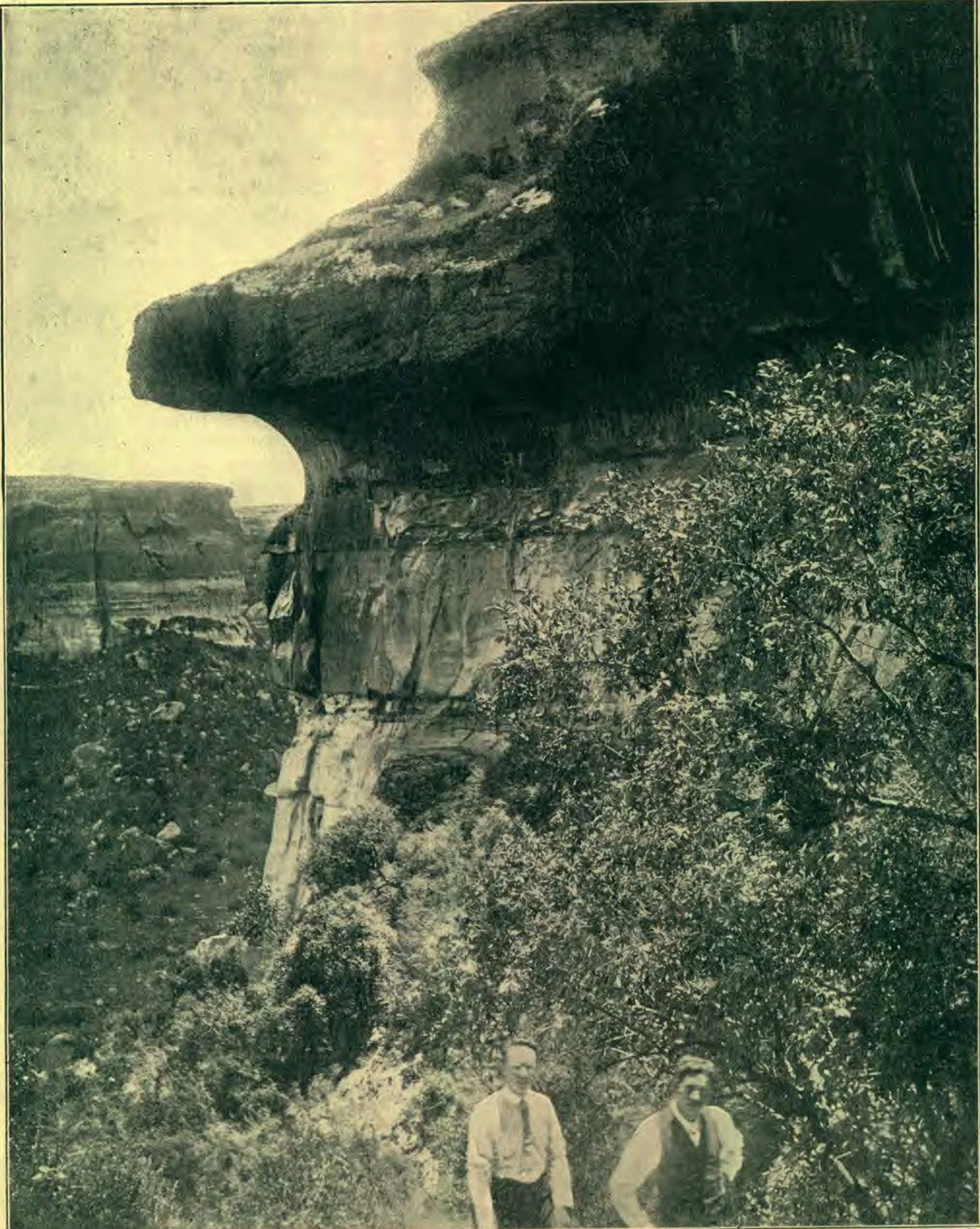
NEAR EMMANUEL MISSION, NORTH BASUTOLAND, AFRICA
THE EARLY MORNING OFTEN FOUND JESUS IN SOME SECLUDED PLACE, MEDITATING, SEARCHING THE SCRIPTURES, OR IN PRAYER.