During the year 1914 we were able to add to our churches through baptism 954 members. This is fairly good, taking everything into consideration. Two of our fields are directly in the war zone, and some of the workers and members have had to flee to other parts of the country. We have to help not only the workers and their families, but also the poor people who have lost all their belongings. There are many of our people who would be glad to earn their bread if they could get work. These have to be cared for. We long for the trouble to stop.
The work in the cities can be carried on fairly well, but the people in country places are left largely to themselves. One of our aged ministers was badly injured by a mob. Another was threatened by a mob of ten men; they wanted to bind him and carry him off, but the police delivered him out of their hands. We have not many pleasant things to report, and yet we are not discouraged, because we know our Father knows best.
I conducted meetings in Riga during the winter. We were not molested in the least. During 1914 we baptized just one hundred persons in Riga. This present quarter (the first of 1915) we have on the list twenty-five or thirty candidates. Before we baptize any one, he12goes through a special course of instruction. In this instruction all points of the truth are taken up in detail, and the candidate is questioned as to whether he understands them or not. God blesses this kind of work. It does my heart good to see dear souls take hold on a living Christ by the hand of faith.
I have just learned that a soldier has found Christ and the truth through a soldier who has fallen on the battle field. They studied the Sabbath school lessons together, and this man became interested in the truth and is now a believer. He was badly wounded, and is now in a hospital in Moscow.
I wish I were a poet, so I could translate a little poem for you which a young brother wrote from his prison in Petrograd. The last stanza runs like this:—
“\nAll the little which I suffer
Is not worth to be recalled,
For the joys which God doth offer
Here as witness to be called.
Naught is fairer and more glorious
Than of self made wholly free.
Only live and trust in Jesus,
Serve him, and by faith I see.”
To me it is full of expression, knowing all the circumstances of the brother. He believes that God will work good out of it all. May God keep him and spare his health.
We thank you all for the interest you take in us here. We appreciate being so kindly remembered.
The Sabbath Test in Singapore
By K. M. Adams
K. M. ADAMS
The great obstacle in this field to the acceptance of the message is the Sabbath question. The native people are beginning to awake to the necessity of an education as a means of worldly advancement, and are preparing themselves and their children so that they can secure positions with the government and get good salaries. A government place means a pleasant job, and a rise in the social scale also.
When the Sabbath truth is presented to them, they are quick to see that it is true, and quick to acknowledge it. But then the possibility comes home to them with startling force, “If I keep the Sabbath, I must resign my position.” One can almost see the gladness at finding the truth die out of their faces as this realization confronts them. It means a loss of money, position, advancement. What will they do? What can they do? The decision is hard for them to make; it is only recently that they have had this work, nor can they resort to manual labor, for the coolie gets only from a fifth to a tenth of what a man in a government office receives.
Monument erected in Rarotonga to the memory of native teachers who were massacred in pioneering with the gospel in New Guinea, with James Chalmers.
But in this matter, as in all other things, the Lord has helped. Not one in our field who has decided to resign rather than work on the Sabbath, has lost his position. They have all been given the Sabbath off. We feel that the Lord has worked mightily in this matter, and all the glory is his.
*Straits Settlements.
The Cook Islands
By GEO. L. STERLING
GEO. L. STERLING
As missionaries in the island fields we are denied many of the everyday conveniences which you enjoy in the homeland. Did you ever stop to consider what blessings the railroad and street car are to you every day that you live? We do not have these conveniences here in the islands. Most of the Cook Islands are small, and do not admit of such things. But we often wish we had such helps at hand when we pass from island to island. We have been waiting here on Rarotonga for nearly three months to get a passage to the island of Aitutaki, only one hundred and twenty miles away; but during all that time, and for six weeks preceding; no way has opened, either by the steamer or by sailing vessel.
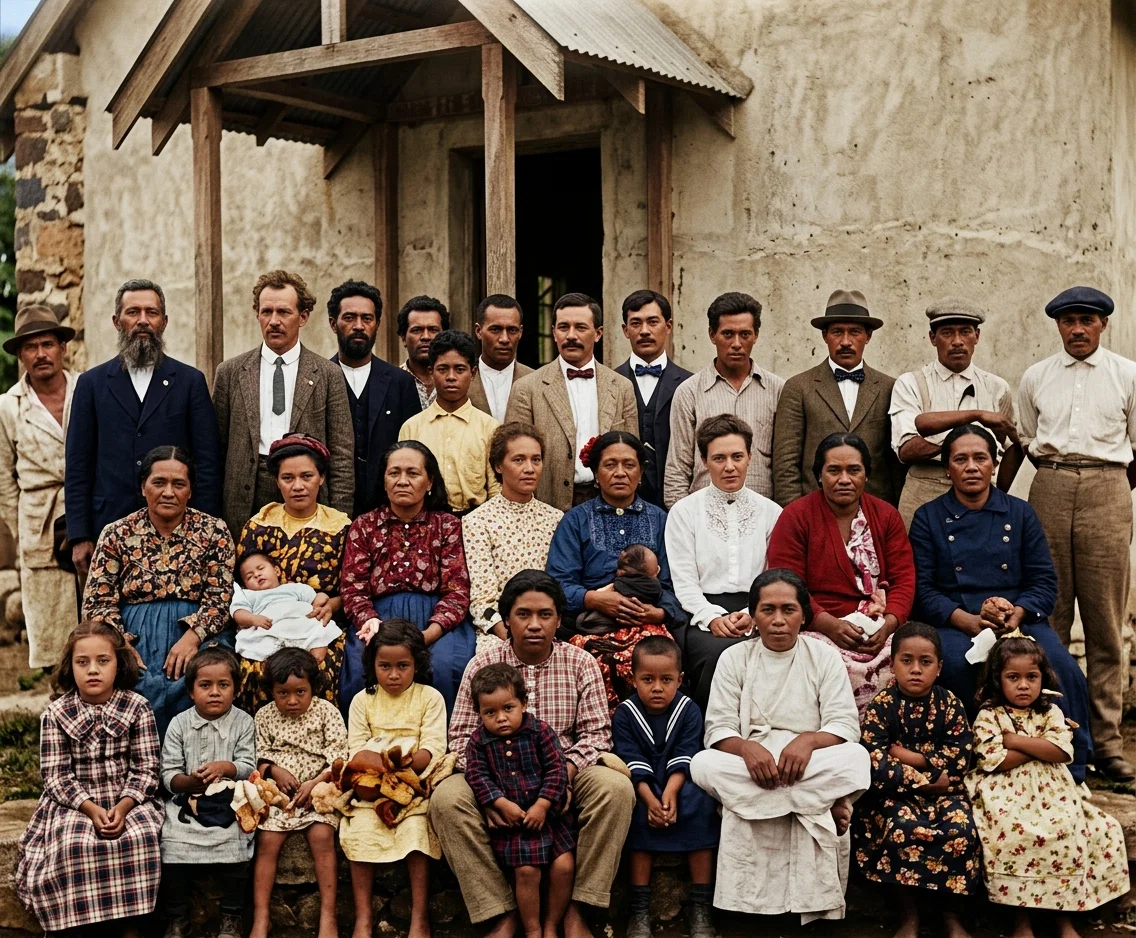
SOME OF THE BELIEVERS IN COOK ISLANDS, AT ENTRANCE TO
THEIR NEW CONCRETE CHURCH BUILDING
We call to mind the experience of the pioneer, John Williams, here at Rarotonga in the early days of missionary endeavor in the Cook Islands. Briefly the story is as follows:
Being at Rarotonga, with no vessel at his command, and desiring to visit islands to the westward for the purpose of planting the gospel seed among the heathen inhabitants, with practically no tools or conveniences whatever, he cut green timber out of the forests of Rarotonga, hewed it by native labor, and in the remarkably short space of fifteen weeks had a good sailing vessel built and equipped—not a toy, but a vessel sixty feet in length and of eighteen feet beam.
Had we set to work three months ago with as much confidence in our ability as had this pioneer missionary, we might have had a ship of our own nearly ready to launch by this time.
Owing to adverse winds and cyclonic conditions that yearly prevail in these islands during February and March, no sailing vessels have been running since last December. And owing partly to there being no cargoes at this time of year, and partly to war conditions (we are affected by the war away out here in the southeastern Pacific), no steamers have been running to Aitutaki. We have a little company of believers there, from whom we have had no opportunity of receiving reports since I left last December. We can only trust them in God's hands. We hope, however, that before this appears in print the Lord will have provided a way by which we shall have reached Aitutaki.
The inability to travel at will from island to island is a hindrance to the giving of the message in this group. Again, we are sometimes at liberty to go to an island for a short time, but do not dare to go, not being sure of a way by which to return in time for other appointments. For the same reasons we find it difficult to get our workers and people together for yearly meetings, such as you enjoy in the homeland in institutes and camp meetings.
Though we have mentioned these hindrances to our work, yet we have many blessings of which we are not unmindful. Where the trials are greatest, “He giveth more grace.” Never have we felt like complaining over our lot; instead, we have great cause to rejoice in the sheaves the dear Lord has enabled us to gather in the few years of our labors in the Cook Islands.
And now, as we shall soon go forth to the labors of another year in the outlying islands, will you not remember our field in your prayers, that God will bless our efforts for him?
The Philippines
By J. E. Fulton
A Missionary Tour in the Far East — No. 1
The Philippines
J. E. FULTON
To describe a world so distant and so strange, and to convey any just conception to the minds of our brethren in the homelands, of the work to be done among a population so vast, with religions and superstitions so forbidding as obtain in the Far East, is most difficult indeed. Yet the story must be told the best we can. Here more than half the world's population have not yet heard of Christ — a great ocean of need and responsibility. Who that has had his heart touched with the love of Christ, will not, like his Master, be moved with compassion for the multitudes? Some way the church of God must take on a deeper burden for the unwarned millions of these Far Eastern lands.
By invitation, the writer accompanied Elder Daniells on his tour though the Philippines, Japan, Korea, and China. The opportunity was great, the associations most pleasant, and now comes the responsibility of assisting in some small way to set before our brethren in the home fields the missionary problems we as a people must face in this vast Eastern field.
There is a population in the Philippines of eight million people, speaking several different dialects. Our work was opened up in this archipelago by the Australasian Union before the Philippines were taken over by the General Conference or by the Asiatic Division. It was the writer's privilege six years ago to join Elder Finster here in counsel when he was beginning his work. It is now a matter of great rejoicing that God has so richly blessed the efforts put forth. Years of earnest toil and seed sowing have brought forth their results. Perhaps in no island field in the world can a more interesting and inspiring work be found. Companies and churches of believers in the message have been raised up until we now have nearly four hundred church members, and two hundred others who are being instructed. One of the most encouraging features of the work is that so many of the converts have become active workers for the Lord, for it can be said that the native brethren in the Philippines are a missionary church. Some bright young men have given themselves to the work of the ministry, and God has blessed their efforts in raising up some good churches. A large number of young people have taken up the canvassing work, with excellent results in setting the truth before many people, and in making the work more than self-supporting.
The outlook is bright and most assuring. Many are inquiring about the message. The Filipino people are intelligent, and make good workers. The change of government, breaking the shackles by which for centuries the people there were bound, and the rift made in the Catholic Church by which two or three million souls were organized into an independent Catholic Church and given the Bible, have no doubt been factors in making the Philippines a more favorable field than in former years.
And then, undoubtedly, the thrill of new life felt throughout Korea and China has reached the natives of these islands as well. But with the kindling of this new life among the Filipinos, so favorable to missionary effort, there has come a spirit of independence which is attended with dangers both to the nation and to the church. Laying aside the obligations of the government to this people, the responsibilities of the church are plain. With a people so aggressive in spirit and at the same time so intelligent and promising, we must establish at once a good training school for workers.
These young people should be trained for evangelistic work at our mission, but our missionaries are already too full of work. We cannot expect them to give the time and attention required. Therefore one of the most crying needs of the Philippines is a good training school for native workers. At a young people's meeting held in Manila, sixty-three young people were present, many of whom desire to receive an education for the work. Under a good government, in a time of peace and quiet in these Eastern lands, with an intelligent and appreciative people, now is the time to act promptly. We cannot tell how soon the way may be made difficult. Certainly it cannot be always so favorable as now.
So let us now remember this field in prayer, study its needs, and give liberally to establish the institutions so imperative to the success and solidity of the work.
Reference has been made to the success achieved in selling our literature. Numerous tracts, a monthly magazine, and some subscription books in one or more of the native languages, have been published and are being widely circulated.
At present our publishing work is being carried on in this hot climate in a small building, formerly a stable, and upon a little job press, run in shifts from 4 or 5 A. M. till 10 P. M. Yet books are printed under these adverse circumstances, and bound by our workers under the mission building in the open basement, where, added to many other difficulties, they must also battle against dampness and dust. But with all their heroic efforts to make books, they cannot supply them fast enough. I feel sure that every Seventh-day Adventist who reads these lines will say, “Give our workers in the Philippines a fair chance. Build them a printing office and give them proper equipment.”
We wish many of our people could see the bright native Seventh-day Adventists, and hear them rejoice in what the truth has done and is doing for them. How it does draw upon one's heart to see their needs, and sense the altogether inadequate facilities provided to give the help needed. Brethren, we must not allow our missionaries there to toil so short-handed. What if our large, populous conferences in the homelands had such meager facilities and so few laborers? Why should these hopeful fields be left unhelped? Has not the time come when more equality should be shown? The Philippines have a population of eight millions. Manila, the capital, is a city of about three hundred thousand people. The door of opportunity is swung wide open. Shall we not enter while we may?
Ominous clouds in the Far East will break some day, and peace will be no more. Shall we wait while souls who now would listen perish? The call is urgent. Who will help?
Making Way for the Bold
WE make way for the man who boldly pushes past us.—Bovee.
Itinerating in China
By Fred Lee
FRED LEE
You may like to know how we visit the twenty-two outstations of Honan, which are scattered three hundred miles to the north of us, one hundred miles to the west, and one hundred and fifty to the southeast. Only a portion of the trip can be made by train. Yet the people must know the truth, and brethren must be visited; so we must go, no matter what the weather or what or how inconvenient the mode of travel.
We have a variety of ways of traveling. I shall mention the various stages in a hundred-mile trip. I first took a chair cart, then I went twenty-five miles by rowboat. My next stage was taken on muleback. (The mules are just high enough so that the rider's feet do not touch the ground.) Later I took a wheelbarrow. This means that I walked most of the time, as it seems to be the habit of the wheelbarrow man to get tired very quickly, and tell how hard he is working for so little money; so of course one takes pity on him.
I might say that the weather changed about as often as the vehicles, the latter part of the journey being made in a hailstorm. Because of this I was obliged to stop at a very small and dirty Chinese inn overnight, when only three miles from my destination, though it would not be dark for three hours.
We travel generally by cart. There are no springs on the cart, the wagon box resting on the axle. These carts are made for Chinese roads, and the best of springs could not stand the jarring and bumping. However, a man's constitution must stand what the springs cannot. A Chinese, whose constitution is very elastic, does not notice it, and can sleep very soundly while traveling. But to one whose nerves are tense it becomes very tiresome. When one has taken the jars and knocks for two or three days in succession, together with the prospect of being tipped over at any moment into the mud, he hardly feels physically fit to do the work he came to do. However, this is the way we must carry the gospel in China, and we are happy to have the privilege.
Miss Susan and Phoebe
A Story for Mothers and Aunts and Others
With four grimy, incriminating lumps of sugar in her outstretched hand, gaunt Miss Susan stood and frowned sternly at Phœbe; Miss Susan’s niece sewed swiftly in the corner by the window.
“I’ll never do it again!” whimpered Phœbe.
“Not in my house,” replied Miss Susan, grimly. “I can put up with a good deal, but I’ll never harbor a thief. Go to bed now, and tomorrow I’ll go to Ellenden and see the matron about taking you back to the orphan asylum.”
With a cry, Phœbe ran to Clarissa, who dropped her work and opened her arms to receive her.
“O, don’t send me back!” sobbed Phœbe, from the shelter of Clarissa’s embrace. “I’ll be awfully good. I won’t ever touch another thing. I’ll pay you for the sugar. I’ve got a nickel. Please don’t send me back.”
“You can’t pay for stolen goods,” answered Miss Susan, shortly. “Go to bed now.”
Without a word, Clarissa let the child go; and Phœbe, sobbing loudly, left the room. Her progress through the hall and up the stairs was marked by the walls that floated back. Clarissa shut her lips tight and sewed harder. Miss Susan sat down by the lamp with her workbasket.
“Clarissa, tell that child to keep quiet!” she commanded.
Clarissa followed Phœbe upstairs, and presently all was quiet above. With flushed cheeks, Clarissa came back to her chair.
“Couldn’t you forgive her this once, Aunt Susan? Won’t you try her just once more?” she begged. “She feels so bad.”
“Anything but a thief and a liar,” said Miss Susan sternly. “That can’t be forgiven.”
“But she’s such a little thing,—such a lonely little thing,—only eleven. She’s never had a real place in the world, and no one has really loved her.”
“Loved her!” said Miss Susan, with a sniff. “You’re as sentimental as if you were fifteen instead of twenty-five. If people want to be loved, let ’em act so as to deserve it.”
“But we’ve got to help her be good.”
“Once a thief, always a thief. If stealing and lying are in that girl’s blood, you’ll never get ’em out, and I don’t propose to waste my time trying to.”
Clarissa rose and folded her work. “You can love people into almost anything,” she murmured. “If you’ll try her once more, Aunt Susan, I’ll watch out for her. I don’t believe she’ll do it again. This is the first time. Just think of her temptation!”
“Temptation is to be resisted,” answered Miss Susan, firmly. “Right is right, and wrong is wrong. We can’t excuse sin. You might as well save your breath, for even if you talk all night you won’t make me believe anything else. I am going to Ellenden tomorrow to see the matron about taking Phœbe back, and I’m going by boat in order to get an early start, for I’ve some trading to do. I won’t get back till the boat at night. I wanted to see Squire Perkins tomorrow to find out what he’s going to do about Jabez Brown, but that will have to wait.”
“I suppose he’ll lock him up,” said Clarissa in a dull voice. Arguing with Aunt Susan or the squire was useless. “You want breakfast at five?”
“Yes. The boat leaves at six. You needn’t get much. I’m never hungry when I’m starting on a journey.”
Miss Susan was up before four the next morning. Breakfast was ready at five, but Miss Susan merely nibbled a little toast. Clarissa waited on her silently. Phœbe did not come downstairs.
“Lock that child in the garret and keep her there all day,” was Miss Susan’s parting injunction as she started for the wharf.
The “Emma Carleton” started daily from one end of the lake, and, with various stops, consumed half the day in running to the other end; then it turned round, and ran home. Miss Susan was to get off at Pottstown, where she could take the train to Ellenden. There was a more direct route to Ellenden by train, but the trip by boat cost less, and that appealed to Miss Susan’s thrifty soul.
It promised to be a hot day, but on the deck of the “Emma Carleton” the breeze over the water and the blue sky overhead made one feel only the freshness of the early morning. Miss Susan enjoyed it in her grim fashion, although daybreak to her spoke usually not so much of poetry as of the exhilaration of a duty to be done—a wash out of the way, or an extra room cleaned before breakfast. Although it was a moral house cleaning that she had risen early to accomplish this time, it had the usual soothing effect upon her. She had no tolerance for sin or a sinner—even in the shape of a trembling little child who had been starved of all the delights of childhood.
For two hours Miss Susan sat on deck, bolt upright on her stool. At eight o’clock she took her best gloves from her shopping bag, and put them on in place of her second-best, which she had been wearing on the boat. Her best gloves were new and stiff; and she hung her bag on a convenient hook while she put them on.
“There!” she said to herself as she fastened the last button, “I never told Clarissa to keep that child on bread and water today. With that shortcake for dinner, and green peas and new potatoes, likely she’ll pamper her to death! And me not there to look after her!”
It was a discouraging thought; and while she pondered it, the boat made the Pottstown wharf. It was behind schedule time, and as there were only two passengers to set ashore, it made short work of its landing. Within three minutes the “Emma Carleton” was steaming down the lake again.
Miss Susan and her fellow passenger—an Italian with a huge basket of bananas—walked up the hot street to the station. Pottstown was a manufacturing town, ugly and dirty, with no excuse for existence except its factories, its wharf, and its railway station.
“How they did hustle us off that boat!” thought Miss Susan as she entered the station. “I like to be prompt, but I’m no hand to hurry. Let’s see! The train doesn’t go for half an hour. I think I’ll buy a glass of cold milk. I’m real hungry already.”
She made a movement toward her shopping bag and stopped short—petrified. There was no shopping bag! Unless some one had stolen it, it was hanging on that convenient hook on the “Emma Carleton,” bound on a trip to the far end of the lake.
“How ever did I come to do it!” groaned Miss Susan. “I knew when I put it there that I had no business to. And then, thinking of this thing and that, and landing so suddenly—I just came off and left it. Think of my doing a thing like that! Why, I never lost even a shoe button in my whole life!”
Stupefied, she sat down on one of the hard station benches. The times were rare in Miss Susan’s well-ordered life when she had blamed herself.
After she had sat for some moments, full of self-reproach, it dawned on her that she could not buy the milk. She must wait until she reached Ellenden. Then to her dismay came the thought that she could not reach Ellenden. She had no money to buy a ticket, and she knew not a soul in Pottstown. She would have to go home. Then with a sudden sinking of her heart, she realized that she could not even go home, at least not until seven o’clock in the evening, when the “Emma Carleton” would return. Whether or not Captain Sanders found her bag, he would remember that she had bought a return ticket in the morning.15
As she sat, dazed, on the hard bench, passengers hurried by, bought tickets for Ellenden, mounted into the waiting train, and finally rolled off out of the station. Vainly Miss Susan tried to find some way out of her difficulty. She had always ruled circumstances, but now they ruled her inexorably.
It was such a foolish predicament for a well-to-do, perfectly ordered spinster to find herself in—to be marooned, penniless, for twelve hours on a hot day in a sordid little town where there was not one friend to whom she could turn! Already she was hungry and thirsty and hot and tired. What would she be before the day was over!
After the bustle of the departing train the station dropped back into silence. The big clock monotonously ticked away the slow minutes. She walked restlessly to the door and looked out, but there was nothing to be seen through the heat dancing above the pavement except her fellow passenger on the “Emma Carleton;” he had transferred his bananas to a pushcart, and was moving slowly down the street. She went back to her bench and sat down, for it was cooler in the dim station. Into her mind came a vision of Phœbe, shut all day in the attic. She wondered whether it would be very hot there. She was parched with thirst herself, but she had always made it an iron rule not to drink from a common fountain. She thought of the well at home, and the cool dripping of the bucket as it came up. Clarissa would certainly see to it that Phœbe had a drink.
What time was it?—Not yet ten. On the tips of her best gloves Miss Susan told off the hours until seven at night,—nine hours before the boat would rescue her from misery.
She no longer worried over her loss nor blamed herself for her carelessness. She thought only of the long hours ahead,—hours of heat and thirst and hunger. Never had she imagined that a person could be as hungry as she was at that minute.
At twelve o’clock a train arrived from Ellenden. Miss Susan eagerly scanned the faces of the descending passengers. Might there not be one among them whom she knew? But they passed through the room indifferently, with only a careless glance at the erect, indomitable figure on the bench.
The heat was almost unendurable. She untied her bonnet strings and took off her best gloves. She almost wished she had not told Clarissa to keep Phœbe in the attic; it would be a stifling place to spend a long, hot day. Clarissa would be setting out dinner about this time. Miss Susan winced as she thought of the delicious shortcake, the new potatoes and green peas, and of the white cloth and the cool dining room. Without doubt, Clarissa would have Phœbe down to eat dinner with her. Clarissa always had been foolish about children.
Then suddenly she felt no longer strong and self-reliant, but only helpless and lonely. She longed to put her head down on Clarissa’s shoulder and cry.
When Clarissa had said that Phœbe was lonely, with no place in the world, did it mean that the child felt always as Miss Susan felt now? For the first time in her busy, capable life, Miss Susan questioned whether there were perhaps more in life than early washes, and notable housekeeping, and the punishing of sinners. Were there also lonely, ignorant, bewildered souls that must be discovered and saved by the gentleness of Clarissas?
Unable to sit still, Miss Susan went out into the street. Courageously she tramped miles through the glare and grime, but nowhere was anything refreshing. She would have given ten dollars, had it been in her power, for one slice of her own bread.
As she turned the last corner back to the station, she came suddenly upon the Italian’s pushcart laden with large yellow bananas. The Italian was nowhere in sight.
Miss Susan stood and looked. Outwardly she saw the dirty street and the pushcart. Inwardly she saw a child before the sugar basin,—a child with outstretched hand and startled eyes. Could it be possible that Phœbe had wanted the sugar as she wanted those bananas? Miss Susan turned and fled.
Almost running, she went back to her hard seat on the bench. “Temptation was to be resisted.” She had not forgotten Mr. Perkins’s sermon. But in her mind she still saw a picture of those tempting bananas. At two o’clock she felt that she never could stand it. She wondered whether the man had come back. Almost without knowing what she did, she left her seat and went out into the street again. The pushcart still stood against the wall; its owner was not in sight. She walked by the cart to the end of the block, turned, and came back. Near the edge of the cart two bananas lay detached from the others. With a sweep of her hand, Miss Susan seized them as she passed, and hid them in her folded arms.
The ticket agent was gone from his booth. She was quite alone in the station. Greedily she devoured the two bananas, and took a long drink from the fountain. Then she carried the banana skins down to the wharf and threw them into the water. She had expected them to sink; but they floated, and seemed to point accusing fingers at her as she fled back to the station.
She had quieted her physical pangs only to waken those of the spirit. She had been tempted and had not resisted; she was a sinner. At any moment she might lift her eyes to see a policeman advancing to lead her away to jail. A glimpse of herself in a mirror startled her; in her eyes was the hunted look she herself had brought to Phœbe’s. She remembered the child’s instinctive rush to Clarissa—from punishment to sympathy and love.
Through five hours of torture Miss Susan sat, dropping her eyes when people came and went at train times, shrinking when the ticket agent addressed a good-natured remark to her, and cowering16when a policeman strolled through the station. Before her eyes danced always the accusing banana peels. There was no comfort anywhere—except in Clarissa. Life seemed one long line; at one end stood the policeman; at the other, Clarissa.
Seven o’clock came finally, after long, lonely hours, and the boat came, too. The policeman was on the wharf, and Miss Susan’s world turned black. He did not accost her, however, and she walked across the gangplank with eyes straight ahead, in order to avoid seeing the convicting banana skins. The Italian crossed before her, with his goods again in his basket. He stood the basket against the rail and went below. Captain Sanders had her bag, and restored it to her with the genial wish that its loss had not caused her any inconvenience. Miss Susan shook her head; she could not speak. When the captain left her, she glanced furtively round. No one seemed to be noticing her. She took a quarter from her purse, and dropped it into the Italian’s basket.
“You can’t pay for stolen goods,” she murmured, and turned almost into the arms of Squire Perkins. For the first time in her life she shrank from him.
He beamed joyfully. “Why, Miss Susan, what a pleasant surprise! Have you been to Ellenden?”
“Yes,” answered Miss Susan, instinctively flying to cover.
“I wish I’d met you. It’s funny I didn’t, for I was in and out of all the shops. I want your advice. Can we sit down here?”
Miss Susan sat down dumbly. She had lied; she had lied and stolen. How could she advise Squire Perkins?
“It is Jabez Brown,” the squire said, stretching out his long, thin legs. “He’s been drinking again, as you know. Miss Clarissa begged him off last time, but clemency has had no effect. The fellow needs punishment.”
Miss Susan had always been Mr. Perkins’s unflagging lieutenant in seeing that sinners were properly punished. The two together had been a strong guard against Clarissa’s gentle pleas for mercy. The squire looked at Miss Susan hopefully, and waited for her reply.
“It’s been some months since he drank, hasn’t it?” she asked.
“Four. But he’s fallen again. For the sake of reputable society we must make an example of him.”
Miss Susan did not answer. She was thinking that she stood side by side with Jabez Brown, and with the poor miserable little sinner whom she had convicted and sentenced so harshly last night.
“It is only punishment that will touch him,” said Mr. Perkins.
“It is only love that will save him,” said Miss Susan, looking straight before her. “It is love he needs, not punishment.”
“Judicious love—” began Mr. Perkins, but Miss Susan interrupted him.
“Any kind of love!” she said, obstinately. “Any kind of love is better than any kind of punishment.”
Mr. Perkins stared at Miss Susan,17and then elaborately changed the subject. On the few occasions when he had differed from her, he had not enjoyed the argument. He could ascribe her present strange attitude only to the sun on the hot streets of Ellenden.
Miss Susan heard few of his platitudes. Perfectly erect, she sat on her stool, reconstructing a universe. At seven in the morning it had been dominated by Miss Susan, vicegerent of strict justice. At seven in the evening it was swayed by Clarissa, from whose eyes there shone the broad love that heals human hearts.
When Miss Susan reached home, supper was set forth; she sat down to it hungrily without even removing her bonnet. She did not speak until the warmed-over peas and potatoes had disappeared. Then she asked in her usual short way, “Where’s Phœbe?”
“She’s in bed,” Clarissa answered.
“Was it hot in the attic today?”
Clarissa turned defiantly. “Aunt Susan, I didn’t put her there. It was her last day in the country, and I had to let her spend it outdoors.”
“I’ll go up and see her,” said Miss Susan.
“O,” cried the girl, “don’t make her feel any worse tonight! She’s been crying ever since she went to bed.”
Without a word Miss Susan went into the hall with her candle, and mounted the stairs to Phœbe’s room, where she set the candle down on the table. Clarissa trailed after her.
For an instant Miss Susan stood looking at the child, while Clarissa held her breath.
“Would you rather stay here, Phœbe, or go back to the asylum?” Miss Susan asked, looking fixedly at the child.
“O,” cried Phœbe, “I’d rather stay here! Miss Clarissa’s here.”
Miss Susan laughed shortly. “Yes, Miss Clarissa’s here. If she thinks she can keep us both in order, I guess the house will cover the three of us.”
Clarissa, with her eyes shining, flung her arms round her aunt and kissed her. Then she turned and gathered into her arms the hot, moist, tear-stained Phœbe.
Miss Susan, half wonderingly, touched the cheek that Clarissa had kissed. She had almost forgotten how a kiss felt. For a moment she feared that she, too, might sit down on the bed and mingle her tears with the others.
“I’m going to be so good!” cried Phœbe.
Miss Susan looked at her gravely. “We mustn’t steal,” she said. “It is a sin.”
“I won’t! I won’t!” the child declared.
Miss Susan went to the door, and then turned and came back into the room. “Phœbe,” she said, “when you want sugar, you show Miss Clarissa what you take. I don’t want you to overeat.”
To the amazement of both, Miss Susan suddenly bent her straight back and kissed first the big girl and then the little one; then, picking up her candle, she went out of the room and left them together.—Selected.
Home Life
By Mrs. I. H. Evans; Miss Lora E. Clement
Conducted by Mrs. I. H. Evans, Takoma Park, Washington, D. C.
Assisted by Miss Lora E. Clement
Through the columns of this department, hints will be given on all matters pertaining to the home life. Short articles and letters are solicited from home makers, telling of their everyday experiences,—their joys and sorrows, their failures and successes.