Your ShelfYour Projects

Signs of the Times, Vol. 24, No. 10.

THE ATONEMENT IN FIGURE

Signs of the Times

Mar 10, 1898

Pacific Press Publishing Company · Oakland, California · Mar 10, 1898

THE ATONEMENT IN FIGURE.
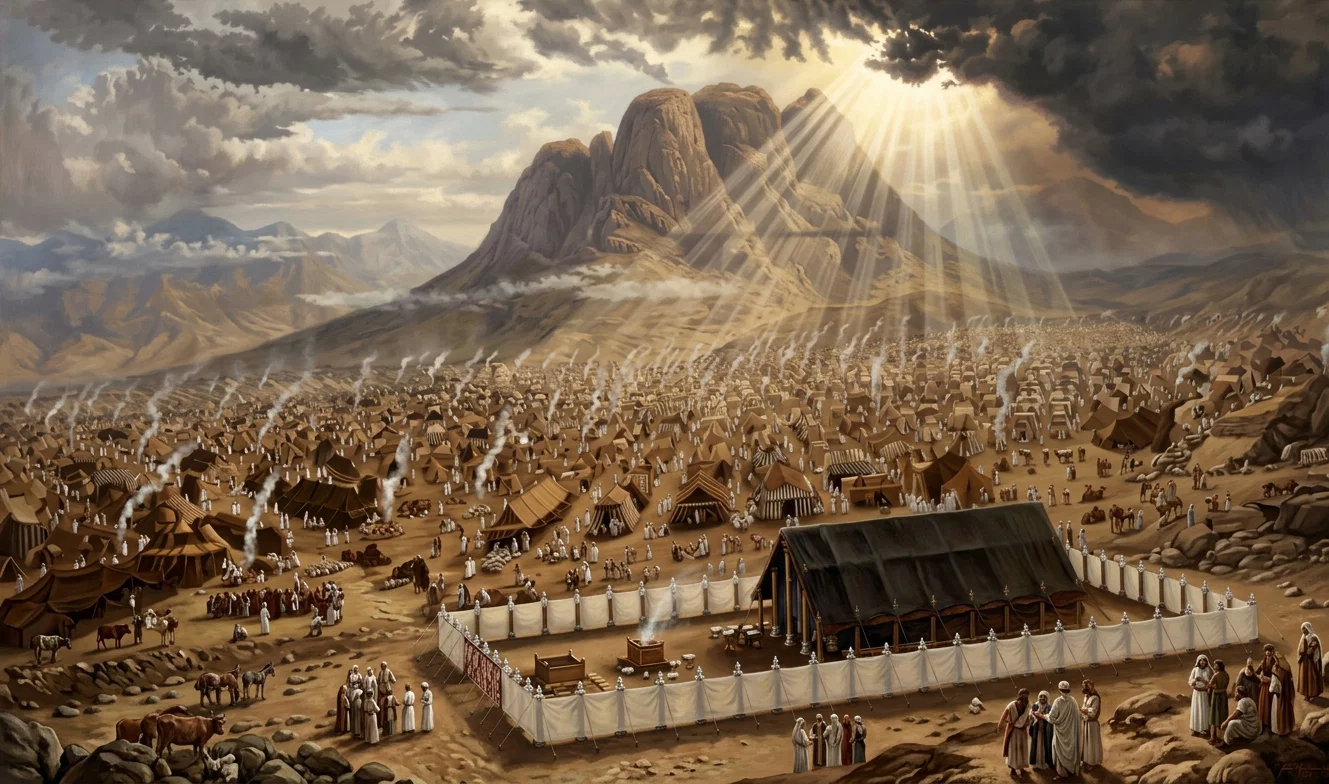
The ceremonies by which the people of Israel were taught to show their faith in the atonement, are dwelt upon to some extent in the book of Hebrews. The sanctuary, in which their regular rounds of service were performed, is introduced, after which the writer says: “Now when these things were thus ordained, the priests went always into the first tabernacle, accomplishing the service of God. But into the second went the high priest alone once every year, not without blood, which he offered for himself, and for the errors of the people.” Heb. 9:6, 7.
By permission of J. W. Kelchner.
MOUNT SINAI, THE CAMP OF ISRAEL, AND THE SANCTUARY.
By permission of J. W. Kelchner. MOUNT SINAI, THE CAMP OF ISRAEL, AND THE SANCTUARY.
Several things are revealed in this scripture. We learn from it: First, that the ceremonies there conducted constituted the “service of God.” Second, that these ceremonies were of two kinds, being conducted by different persons, at different times, and in separate apartments of the tabernacle. Third, that all these ceremonies were in consequence of the errors of the people, hence pointed, in some way, to a remedy for sin. But to learn the exact formula of that work, a somewhat extended description of the sanctuary and its furnishings will be required.
The full description of these is found in the book of Exodus, beginning with chapter 25, and continuing to the end of the book. A careful reading of the explanation there given shows that the sides and one end of the structure were formed of upright boards closely joined together, the lower ends of these being set in silver sockets fixed in the ground. These boards were held in position by crossing them on the outside with bars, which passed through rings placed at uniform distances apart in the boards. The building was roofed with curtains which reached to the ground on both sides, and the east end was closed by hangings of fine-twined linen, which were brushed aside for passage into the building. Another curtain divided the whole into two apartments, giving the first, or outer apartment, twice as much space as the other. Ex. 26:31–33.
The inner walls of the building were overlaid with fine gold, which shone with the greatest brilliancy, thus representing the reflected light of God’s glory in the New Jerusalem. Rev. 21:11, 18. That part of the curtains which formed the ceiling was of the finest and purest linen, having wrought upon its surface in beautiful needlework the forms of many angels, which were designed to represent the angels of heaven in waiting upon the bidding of Jehovah.
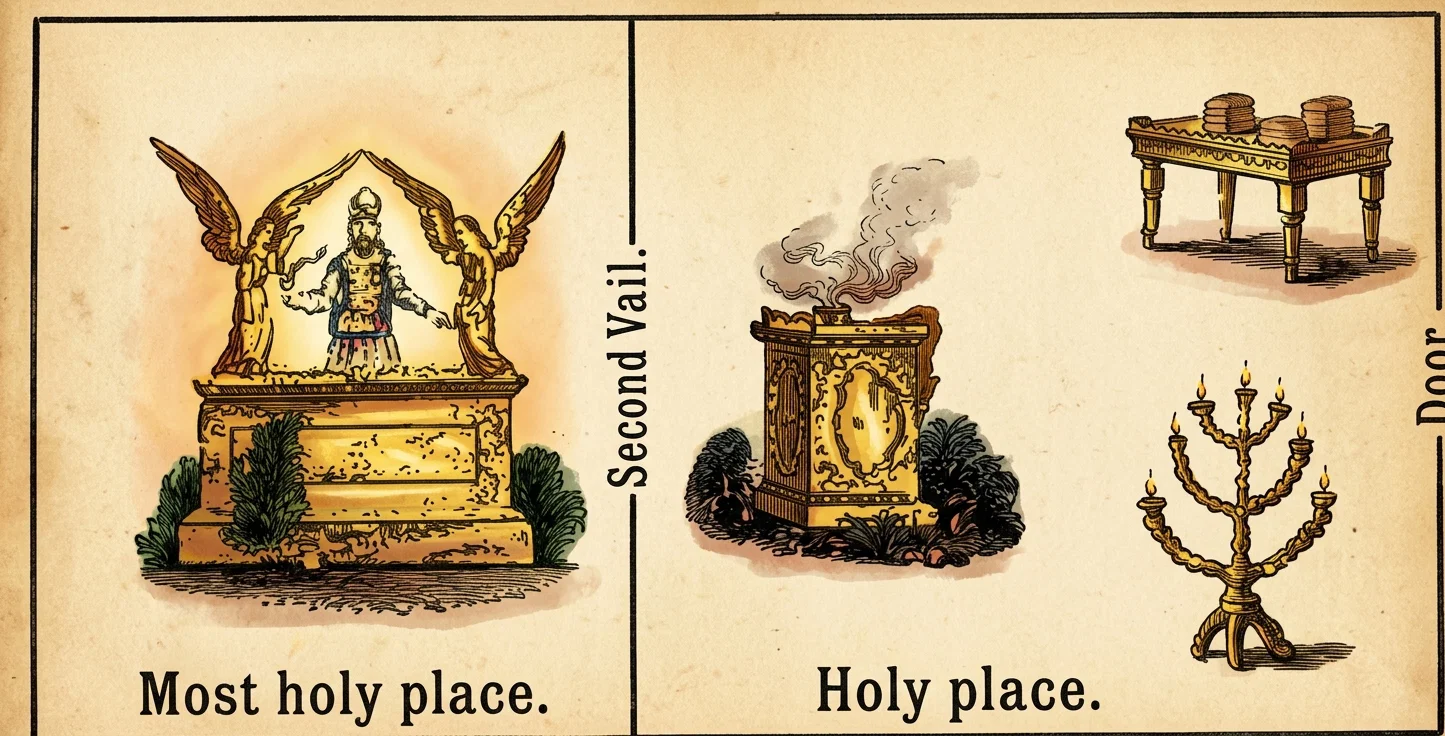
The first apartment contained a table, a seven-branched, golden candlestick, and an altar. Ex. 40:22–27. On this table were placed each Sabbath morning twelve fresh loaves of bread, one for each tribe of Israel, to represent the living Bread of heaven upon which their souls might feed, through faith in Him who was to come down from heaven as their Life-giver. John 6:33–35. The constant light reflected from the seven branches of the candlestick, was to call their minds to the great and true Light who was to light “every man that cometh into the world.” John 1:9. From the altar was sent up incense of sweet-smelling savor, as a reminder of how pleasant to God is the penitent prayer of the reconciled sinner.
Beyond the second curtain, in the most holy apartment, was an ark, or chest, built of wood and overlaid with gold. This held the two tables of stone on which were graven the Ten Commandments. The golden cover of the ark, called the mercy-seat, was crowned with two cherubim, one standing on each end with extended wings, the tips meeting over the center. From under the shadow of these spreading wings shone forth the shekinah, the symbol of God’s presence. This was the “mercy-seat,”—the typical throne of God, from whence His mercy was dispensed to the people of Israel, in the atonement made for them by the high priest. Beneath this throne and mercy-seat were the Ten Commandments, which have ever stood as the ten pillars of his eternal government. The violation of one of these was counted rebellion against the throne of heaven.
As already learned, the priests performed services in the first apartment every day. Into the second apartment, however, the high priest went alone but once each year, where he offered blood for himself and for the errors of his people. On this last point we are particularly interested, because we wish to learn the nature and process of that figurative work which betokened the faith of Israel in the Messiah’s atonement for the world.
The Lord’s instruction to that people reveals the first step of the transgressor toward reconciliation with heaven. “If any of the common people sin through ignorance, while he doeth somewhat against any of the commandments of the Lord concerning things which ought not to be done, and be guilty; or if his sin, which he hath sinned, come to his knowledge; then he shall bring his offering, a kid of the goats, a female without blemish, for his sin which he hath sinned. And he shall lay his hand upon the head of the sin-offering, and slay the sin-offering in the place of the burnt-offering.” Lev. 4:27–29.
The place of the burnt-offering was an altar at the east end, but just outside of the tabernacle. When any person was seen going thither carrying a young goat, it was well known that he was a sinner desirous of being reconciled to God. Having transgressed one or more of the Ten Commandments that were under the typical throne of God, he was a rebel against the government of heaven, and was therefore counted a sinner. 1 John 3:4. The wages of sin, then, as it is now, was death, because it is contrary to the life of God. Rom. 6:23. In order, however, that the sinner might be released from the death penalty of the broken law, he was permitted, by the mercy of God, to bring an innocent substitute, upon whose head he might figuratively transfer his sin by confession, and then kill the victim, so that a stay of the death penalty might be secured for himself. This was an appropriate expression of faith in the work Christ was expected to do for a guilty race. The blood of the goat having been spilt at the base of the altar, his fat was burned upon it, and his body, bearing the sin, was conveyed into the first apartment of the sanctuary, there to be disposed of by the priests. Lev. 27:30, 31; 6:25–27; 10:16–18. Thus the sin of the sinner was brought into the tabernacle of God, there to await the great day of atonement for its final disposition.
At the close of the religious year, when the sins of the people had been confessed and brought into the sanctuary, came the day of atonement. “This shall be a statute forever unto you; that in the seventh month, on the tenth day of the month, ye shall afflict your souls; . . . for on that day shall the priest make an atonement for you, to clean you, that ye may be clean from all your sins before the Lord.” Lev. 16:29, 30.
With all the offerings and services of the year, the people could not be clean from sin until the day of atonement had performed this service for them. The sins of each were forgiven at the time he confessed them outside of the door of the sanctuary upon the head of his voluntary offering, and this act foreshadowed the privilege of every sinner to lay hold on Christ as the sacrifice for each individual sin. As the body of that typical offering bore the sin of the guilty one into the sacred inclosure, there to be atoned for, so Christ not only bore our sins in His body on the cross (1 Peter 2:24), but He also in that body took them into the presence of God, for their atonement. But as in the type a further ceremony was necessary by which to dispose of a nation’s accumulated sins, so in the antitype there must be a time set apart for the final blotting out of the sins previously confessed and forgiven. Acts 3:19–21. The religious year of the Levitical system was therefore typical of the entire history of the atonement, from the time sin entered the world until Christ shall, in the end of His dispensation of grace, complete His work for the accumulated sins of His people.
On that great day of atonement in the type, the high priest cast lots upon two goats at the door of the tabernacle. The one upon which the lot fell to become the sin-offering was slain, and his blood was taken within the most holy place, to be sprinkled upon and before the mercy-seat. Lev. 16:7, 8, 15. This service, it will be noticed, was altogether different from that held daily in the outer apartment by the under-priests; for while the blood of those daily offerings was spilled at the base of the altar of burnt-offerings, and the body bearing the individual sin was carried into the first apartment of the sanctuary, in this service the blood only was used, and the principal part of the ceremony was held in the most holy place.
Following the high priest in that day’s work, we see him take the blood of the slain goat, and, passing through the outer apartment of the sanctuary toward the holy place, he takes upon himself the sins accumulated there, and bears them in before God. By so doing he fulfilled the directions received by which he was to accomplish the work of the day: “He shall make an atonement for the holy place, because of the uncleanness of the children of Israel, and because of their transgressions in all their sins; and so shall he do for the tabernacle of the congregation, that remaineth among them in the midst of their uncleanness.” Verse 16.
Most holy place. Holy place.
By taking the sins upon himself that were in the sanctuary, the priest cleansed it from its moral pollution, and it was, therefore, in a figure, again reconciled, or brought into harmony with the purity of heaven. This being done, he came out to the door of the sanctuary, where the other goat had been kept alive, and there laid his hands upon the head of the goat, confessing over him all the sins of Israel, thus transferring from himself to the goat the sins which he had brought out from before God. This done, the goat was then sent out into the uninhabited wilderness, bearing all the sins which had been recognized in the atonement.
We say recognized in the atonement; for it is clear that in the work of the high priest in cleansing the sanctuary from the sins transferred to it through the confessions made at its door from day to day, no sins were included which were not confessed, since they still rested upon the sinner. As the atonement work was the separating of sin from the people of God, and inasmuch as the scapegoat upon receiving the sins atoned for was sent from the camp, it follows that those who took no steps toward reconciliation with God, but chose instead to retain their sins to the close of that day’s services, received no atonement, and were also banished from the camp and people of Israel. This was virtually a day of judgment,—a time when sin was banished from the entire people of God, thus pointing to the final work of Christ in separating sin from His people, preparatory to His coming to earth to take them into His eternal presence. But this matter will be carried further in the next study of the subject.
JOHN ORR.

OBJECT OF TRIALS.

It almost seems like an incongruity to read in the Scriptures the following connected statement concerning Christ: “And there came a voice from heaven, saying, Thou art My beloved Son, in whom I am well pleased. And immediately the Spirit driveth Him into the wilderness. And He was there in the wilderness forty days, tempted of Satan.” Mark 1:11–13. What! allow His beloved Son, fresh from the baptismal waters, to be driven into the wilderness and exposed to Satan’s temptations! So the record reads. “But,” says one, “if I should get a great blessing, and should receive the assurance that I was a son of God, I would expect an easy time thereafter.” Would you? Then you would be disappointed. Here is the lesson for us. God blesses for service, and service always means temptation, trial, and adversity. God loves His children, and “whom the Lord loveth He chasteneth, and scourgeth every son whom He receiveth. If ye endure chastening, God dealeth with you as with sons; for what son is he whom the father chasteneth not? But if ye be without chastisement, whereof all are partakers, then are ye bastards, and not sons.” Heb. 12:6–8.
The Father chastens all His children, allowing them to go through severe trials, but He will never leave us nor forsake us. And what better time to endure a trial than just after receiving a blessing? It was so of Christ. Having just heard the voice of the Father say, “Thou art my beloved Son,” He was well prepared to resist Satan’s insinuating suggestion, “If Thou be the Son of God.” Strong in the faith which the word of the Father imparted, He was proof against Satan’s wiles, standing firmly against his suggestions, meeting every one of them by the Word of God; and when the tempter was overcome, and fled the field for a season, angels ministered to Him, and He went forth with renewed zeal and a clear accession of power, proclaiming the Gospel, calling His disciples and instructing them, teaching, preaching, and healing everywhere. Peter, at a later day, puts all this experience together in the following manner: “How God anointed Jesus of Nazareth with the Holy Ghost and with power: who went about doing good, and healing all that were oppressed of the devil; for God was with Him.” Acts 10:38. So Christ went through the experiences of blessing, temptation, and helpfulness.
Every son of God must needs pass through similar experiences,—blessings to make one strong to resist temptation: temptation resisted gives increased strength and confidence in God. This enables one to aid others, to be useful sons, thus helping the Father in His work. We should not then be surprised that temptations come, or that they sometimes follow very closely after unusual blessings. It was so with the Master; why may it not be the same with us? He was put to the test; why not we? He knows the exact amount of our strength, and He is faithful and “will not suffer you to be tempted above that ye are able; but will with the temptation also make a way to escape, that ye may be able to bear it.” I Cor. 10:13. Notice carefully how we escape from temptation: not by getting away from it, but by being more able to bear it! Seeing our need, we cry to God for help. He hears our cry, and we are “strengthened with all might, according to His glorious power, unto all patience and long-suffering with joyfulness.” Col. 1:11. So when temptations come, let us remember their object. No temptation comes without the Lord’s permission. He may see that we need a trial, and, like a kind parent, prepares us for it, and then gives us what we need. By the experiences thus gained we may test the divine strength as we never otherwise could; we may feel the foundations and the pillars of our faith and find them secure; we may prove God anew, and, having done so, may rest in Him more securely, experiencing all that an apostle suggests; when writing to some who were in deep trial, he said, “That the trial of your faith, being much more precious than of gold that perisheth, tho it be tried with fire, might be found unto praise and honor and glory at the appearing of Jesus Christ.” 1 Peter 1:7. M. E. K.

God Is Love

“GOD is love;” and, hence, “love is of God.”

TRUE SERVICE.

A LIFE of idleness and self-pleasing is not the life of a Christian, nor has it ever been. Christ was a worker, and He gives to all His followers a law of service, that they may promote the temporal and spiritual interests of their fellow-men. He presents to the world a higher conception of life than they have ever thought of. The true recognition of God’s work is service. A life of obedience and service is not only the true life for man, it is the most distinguished and the noblest. By it man brings himself in connection with the light and life of the world, and in connection with his fellow-men. This makes the law of service the connecting link which binds men to God and to their fellow-men, and constitutes them laborers together with God, living to be good and to do good.
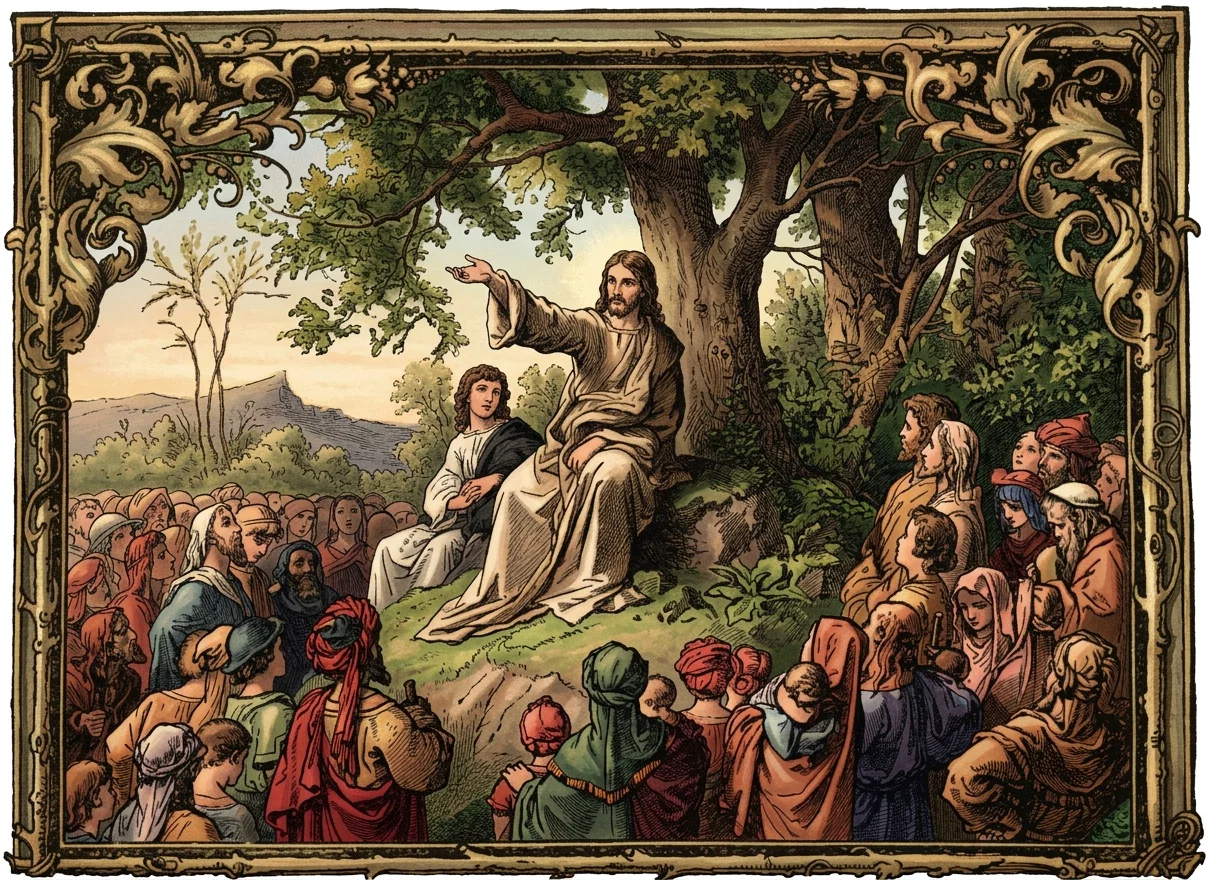
CHRIST TEACHING THE PEOPLE.
Christ was a successful worker with the common people. This was the class that always heard Him gladly. His heart was yearning to make souls happy. “Come unto Me,” He said, “all ye that labor and are heavy-laden, and I will give you rest. Take My yoke upon you, and learn of Me; for I am meek and lowly in heart; and ye shall find rest unto your souls. For My yoke is easy, and My burden is light.” We have the record that on one occasion, after a day of ceaseless toil, our Redeemer lay fast asleep in a fisherman’s boat. His exhausted human nature cried for rest and sleep.
What a lesson is this for the human beings who do nothing to bless others. Behold the Saviour! How pressing were the necessities that sought Him for relief! Teaching in the temple, healing the sick, explaining the Scriptures in the streets, by the wayside, in His retired walks,—the subjects so urgent left Him no time for repose. His sympathies were drawn out for the oppressed; He comforted the mourner; He brought hope to the hopeless; He healed the scars and bruises that sin had made. He “went about doing good.”
It is the prerogative of God to command; it is the duty of man to obey. Yet nothing is forced upon any soul. The honor of duty is conferred upon him as a son of God, an heir of heaven. He is to labor for God in disinterested, true-hearted, honorable service. And in obedience to all His commandments, a spirit of love for God is revealed. It was in this atmosphere that Christ lived and worked.
When those who profess Christ learn that they must put on Christ in words, in spirit, and actions, they will not be led to feebleness and inactivity, to self-love and self-pleasing. It becomes us as Christians to recognize clearly our duty toward God by taking up the responsibilities that bind us to our fellow-men by the strong links that the law of God has defined. We are to love our neighbor as ourselves, all our service merging itself into the life of Jesus Christ. The noble life which Christ has made it possible for us to live,—one of obedience and service,—will make us partakers of the divine nature. When we possess the inner strength of piety, which animated Jesus Christ, the experience of the great apostle will be ours. Then we can say, “I live, yet not I, but Christ liveth in me.” That life will reveal that it is a part of Christ’s life. Its possessor will wear Christ’s yoke and lift His burdens. The transformation of the human character makes the yoke of Christ easy, and His burden light.
Every one may find something to do in saving souls and advancing the truth of God. It is because men are not more than half converted that the church is so lifeless. There are many who are, and have been all their lives, only half Christians. Their names are in the book of life, and if they will turn to the Lord with full purpose of heart, if they will respect the voice that says to them, “Seek ye My face,” and reply, “Thy face, Lord, will I seek,” they will see God with a clear, elevated, spiritual sense. The religious sentiment awakened in the heart will be recognized as the voice of God, and will be obeyed.
The fact that our names are registered in the church books will never make us Christians; it is in doing the Word that we become sons and daughters of God. Judas was chosen as one of Christ’s disciples. Christ did not reject him because he was not perfect. He had power to heal the sick. But, notwithstanding the lessons of Christ, he failed to be converted daily, and to be an instrument sanctified and polished for the Master’s use. He was subject to temptation. Satan found that the hereditary and natural tendencies of Judas could be used to dishonor the Master and imperil his own soul.
These things are not understood as they should be, and the result will be as it was in the case of Judas. Some will depart from the faith. Having a knowledge of the truth, while not sanctified by it, they will constantly work out wrong characters. And these really do more harm because of the knowledge of the truth which they have. They confederate with apostates, and betray sacred trusts.
God calls for the undivided interests of the men whom He has chosen. Only the pure in heart shall see God. This seeing God in a clear spiritual light is salvation to the soul of the believer. As soon as a soul decides to die to self, the new light begins, and grows stronger and stronger until he is able to endure the seeing of Him who is invisible. And as man sees God, he becomes fashioned in character after the divine similitude. his words, his spirit, his attitude, his actions in everything, testify to the clearness of his judgment. In proportion to his views of God will be his spiritual force of character; and the consecration to God of his life, his time, his powers, is the result.
All our powers belong to God. They are His by creation and by redemption. God has given to every one his measure of power, and He expects each to put it forth on the side of truth. The Christian is to stand with undivided interest on the Lord’s side. Our every word and action should be a work for God. Then we shall manifest our faith in God and our confidence in man.
MRS. E. G. WHITE.

BLAMING GOD FOR SIN.

A FAVORITE pretext of sinners is to blame God for the existence and continuation of sin. Satan’s temptation of Eve began with the intimation that God was deceiving her and her husband. So all animosity toward God and His Word is of Satanic origin. When Adam was called to account for his disobedience, he endeavored to throw the responsibility back upon the Lord. “The woman whom Thou gavest to be with me, she gave me of the tree, and I did eat.”
Cain would bring an offering to the Lord, but he wished to have his own way as to what he would offer. But it was not the offering that God had directed, and of course He could not accept it. It did not contain the evidence of faith in the real Offering for sin which God had promised. As God does not change, we may know that He does not yet accept human substitutions for His express commands. Cain was very angry and felt very bitter because the Lord would not acknowledge his profession and accept his offering. His anger was evidence that he blamed God for the result of his own defection (Gen. 4:3–7), and he vented his wrath on his brother Abel (verse 8).
When the Israelites were delivered from Egypt, and were brought into trying places, they doubted God’s Word, murmured, and laid the blame upon the Lord. Ex. 16:7; Num. 14:27. Ezekiel, who prophesied in the days of the Babylonian captivity, mentions this tendency on the part of the people to turn the Lord’s mercies into pretexts for murmuring against Him. After stating that the wicked person who would turn from his wickedness should live, and that the righteous one who would turn from his righteousness should die, he adds, “Yet ye say the way of the Lord is not equal.” Chapter 18:25.
This disposition to shirk responsibility for sin has permeated every generation down to the present day, and with increasing virulence. The latest expression we have seen in print on this point is in a paper printed in a California town. Concerning the proclamation of the Gospel of Christ, which portrays the importance of keeping the commandments of God, the journal in question excuses the sin of disobedience by reflecting on the implied negligence of God. Following is its attempt at sarcasm:—
“For several weeks past two Adventist evangelists have been proclaiming the Gospel of the seventh-day Sabbath in this community, and their meetings have been well attended. Nevertheless, the clang of the anvil is still heard in our blacksmith shops on Saturday, while the silence of the tomb reigns supreme on Sunday. If you ask these people what is to be gained for religion and morality by a substitution of Saturday for Sunday worship, they will evade your question by asserting that it is a sufficient reason for the change that we are violating God’s law by observing Sunday. Then comes a thought that perplexes the understanding. In what mysterious ways doth God move, that He has left this world for centuries to grope in moral darkness, sinfully worshiping Him on the pagan Sunday, until it became His divine pleasure to raise up an Elder Smith or an Elder Kent, and, through them, to reveal the truth!”
The would-be slur at the ministers of the Word is not the point to which we would call attention. That of itself is of minor importance; but the boast that men continue to disregard the claims of God’s law, notwithstanding the fact that it has been plainly brought to their notice, is significant. Again, the Gospel of Jesus Christ calls men to repentance on account of sin (which is “the transgression of the law,” 1 John 3:4); and the law of God shows that Sunday, and not Saturday, is the “substitution.”
But the climax of blasphemy is in the charge that God “has left this world to grope in darkness.” Why has the world groped in darkness for centuries?—Because the people have chosen to do so, despite the plain Word of God, which has always said that “the seventh day is the Sabbath of the Lord.” David says, “Thy Word is a lamp unto my feet, and a light unto my path” (Ps. 119:105); but if men substitute something else in place of the Word, who is to blame if they continue to grope in darkness? The apostle Paul says of such that “they are without excuse.” Rom. 1:20. The people of Israel continued in darkness in the same way. Hear the Word of the Lord concerning them by the prophet Jeremiah:—
“But this thing commanded I them, saying, Obey My voice, and I will be your God, and ye shall be My people; and walk ye in all the ways that I have commanded you, that it may be well unto you. But they hearkened not, nor inclined their ear, but walked in the counsels and in the imagination of their evil heart, and went backward, and not forward. Since the day that your fathers came forth out of the land of Egypt unto this day, I have even sent unto you all My servants the prophets, daily rising up early and sending them; yet they hearkened not unto Me, nor inclined their ear, but hardened their neck; they did worse than their fathers. Therefore thou shalt speak all these words unto them; but they will not hearken to thee; thou shalt also call unto them; but they will not answer thee. But thou shalt say unto them, This is a nation that obeyeth not the voice of the Lord their God, nor receiveth correction: truth is perished, and is cut off from their mouth.” Jer. 7:23–28.
Our Saviour, when on earth, bore a like testimony concerning those who made void the law by their traditions, and the reason for their groping in darkness:—
“And the disciples came, and said unto Him, Why speakest Thou unto them in parables? He answered and said unto them, Because it is given unto you to know the mysteries of the kingdom of heaven, but to them it is not given. For whosoever hath, to him shall be given, and he shall have more abundance; but whosoever hath not, from him shall be taken away even that he hath. Therefore speak I to them in parables; because they seeing see not; and hearing they hear not, neither do they understand. And in them is fulfilled the prophecy of Esaias, which saith, By hearing ye shall hear, and shall not understand; and seeing ye shall see, and shall not perceive; for this people’s heart is waxed gross, and their ears are dull of hearing, and their eyes they have closed; lest at any time they should see with their eyes, and hear with their ears, and should understand with their heart, and should be converted, and I should heal them. But blessed are your eyes, for they see; and your ears, for they hear.” Matt. 13:10–16.
His earnest desire that they should receive light, and the darkness consequent upon their rejection of His teachings, are further emphasized in these words:—
“Verily I say unto you, All these things shall come upon this generation. O Jerusalem, Jerusalem, thou that killest the prophets, and stonest them which are sent unto thee, how often would I have gathered thy children together, even as a hen gathereth her chickens under her wings, and ye would not! Behold, your house is left unto you desolate.” Matt. 23:36–38.
Here were the most highly favored people upon the earth “left for centuries to grope in moral darkness,” and why? Was it God’s fault?—No, it was their own fault; God had given them His Word, sent unto them prophet after prophet to warn them and plead with them; but, like the masses of to-day when the claims of His law are presented, they turned a deaf ear. Were they not religious? Did they not have “a zeal for God”?—Yes, but they taught for doctrine the traditions of men, and persecuted those who would show them their error. However, it always has been God’s “divine pleasure” to raise up men, albeit they may have been of the humbler classes, to call those in darkness to His “marvelous light.” But it ever has been, and will be to the end, that the long-suffering of God is cited as evidence of His responsibility for the continuance of sin. Thus His great mercy to sinners is by them construed as the cause of their sin. Such is the ingratitude of choosing disobedience. W. N. G.

“THE FOUNDATION OF GOD.”

“NEVERTHELESS the foundation of God standeth sure.” 2 Tim. 2:19. This language is a comfort to those who realize the instable character of the things of this present world. We live in an age of distrust—an age when men distrust each other and their God, and are placing confidence more and more in the perishable things of earth. This feeling prevails to such an extent that it is manifest to every careful observer that men’s hearts are failing them for fear, and for looking after those things which are coming on the earth. What a deception! What a mistake, that man should lose sight of his Creator, and put his trust in that which, like himself, was created! By the people of the world this is called wisdom; but the Lord, and every one who yields to the conviction of an enlightened conscience, knows that such a course is the height of folly.
This holds good in the matter of the education of the present time. God, the source of all true knowledge, is ignored, and men and women, like children playing with the mechanic’s tools, seem not to know the purpose for which the things they study were made, and yet they call their work science. We can not see very much science in the work of a child who does not know the proper use of tools; but the principles which underlie the popular education of our time, make that system such as to be compared with child’s play. Education of this character is what causes the unsettled state of affairs in the world to-day, socially, politically, and religiously—because man tries to get along without the Author of all things, and consequently the whole human structure is like a poorly built edifice resting upon an insecure foundation.
The only secure foundation there is for man, the only ground for confidence, yea, the only foundation there is for anything, is the eternal “Word of God, which liveth and abideth forever.” 1 Peter 1:23. That Word made and upholds all things (Heb. 1:1–3), and is the foundation of all things created. It follows, therefore, that the existence and well-being of even those who forget God, depend entirely upon that Word. The Word of God being the foundation of everything created, it must be that those who deny their dependence upon that Word claim the power of self-existence, and thus assume to put themselves in the place of God. All this is true. It is only man’s part of the very work Satan undertook to do when he conceived the plan to dethrone God and take His place. He failed, and all who follow him in working out the same principles, must likewise fail. Then the only things that shall remain are those which are found to be in harmony with, and resting upon, the Word of God.
“But,” says the skeptic, “how do I know that Word to be true?” This expression of doubt is no excuse; for if he will turn to the book of nature, and open his eyes, he will there read God in every plant, leaf, and flower. If he will submit to the Power which produced those things, he will be above all questionings of unbelief. God has given sufficient evidence of His existence, and the power of His love, and all who will, shall know Him, to the joy and rejoicing of their hearts. The Bible, I may say, is an appendix. It utters the same voice as that spoken to us through the works of God, and throws great light upon the present condition of this world, which condition is contrary to the original design and purpose of the Creator.
The Word of God thus considered reveals His wisdom and beneficence. But even with this infallible guide man was fast losing sight of the true character of his Creator, and human wisdom and ways were rapidly taking the place of the divine. To help mankind where and when he most needed help, and “when the fulness of the time was come, God sent forth His Son.” Gal. 4:4. In other words, “When we were yet without strength, in due time Christ died for the ungodly.” Rom. 5:6. This Christ is the living Word of God. John 1:1–3. God was in that Word “reconciling the world unto Himself.” 2 Cor. 5:19. That “Word was made flesh, . . . and we beheld His glory.” John 1:14. Thus God was “manifest in the flesh” (1 Tim. 3:16), that man might have the Word of God, which is His character, lived out before him in the life of a man—“the Man Christ Jesus”—and thereby the Saviour became the source of confidence, “a sure foundation.” They also in whose lives that Word again becomes flesh are made “like Him,” and become a source of confidence to unbelievers. Being made like Christ, we shall endure with Him. This is why the righteous are said to be “an everlasting foundation.” Prov. 10:25.
Since through the work of Christ the victory over sin has been gained, and a live hope kindled in the hearts of His children, He has become the foundation of all that are redeemed, and of all that have been created, in that the result of His mission to earth has placed all the created intelligences beyond the possibility of falling. Therefore we read, “Other foundation can no man lay than that is laid, which is Jesus Christ.” 1 Cor. 3:11. The church of Christ is called the building of God, and its members are “lively stones,” built upon “a living stone,” which is Christ, “the chief Corner-stone.” Notice that the entire building is of one nature. See 1 Peter 2:4, 5; Eph. 2:19–22; Isa. 28:16. “Nevertheless the foundation of God standeth sure, having this seal, the Lord knoweth them that are His. And, Let every one that nameth the name of Christ depart from iniquity.” “He that believeth shall not make haste.”
J. E. EVANS.
New Orleans, La.

“THY REDEMPTION DRAWETH NIGH.”

Could I trace in golden letter All across the azure sky, “Sinner, break the earthly fetter, Thy redemption draweth nigh;”
Could I write it in the sunset, Or the golden morning light; Could I trace it in the wavelet, With its foamy crest so bright,
I should never faint, no, never, Nor give vent to weary sigh, But should write, for aye and ever, “Thy redemption draweth nigh.”
CLARA E. RICHESON.
Lead, S. D.
Continue reading: BIBLE OBJECT LESSONS