If there is a juggernaut sweeping its ruthless way across the country, that juggernaut is inhuman wealth.—Rev. W. G. Clarke.
Coal and Naval Warfare
The art of naval warfare is not confined to armored vessels, huge guns, and destructive ammunition. The common element of coal and peaceful commercial tact sometimes figures conspicuously. Only a short time ago a dark war cloud hovered over the coast of China, when it appeared as if Great Britain was to be left out of the deal which Russia and Germany was endeavoring to make in Chinese territory and commerce. Somehow the excitement suddenly ceased, and now the following explanation appears in the Tribune of this city:—
“The inside history of why the threatened trouble died out so suddenly in Chinese water has just come out. It appears that Great Britain, acting in concert with Japan, obtained control of all the coal at the various Asiatic ports, the result being that the fleets of Russia and Germany were helpless. An idea of the straits they were in is shown by the fact that in order to get her ships away from Port Arthur, Russia had to apply to England for the loan of enough coal to get up steam.”
COMPARATIVE STRENGTH OF THE ARMIES AND NAVIES OF EUROPE BETWEEN 1869 AND 1897.
Country
Total War Strength, 1869: LandF'ce
Navy
Total War Strength at beginning of 1898: LandF'ce
Navy
Increase in 28 Years: LandF'ce
Navy
Germany
977,262
............
5,166,592
58,513
4,189,330
............
France
757,727
67,969
4,849,572
165,270
4,091,845
97,301
Italy
445,509
18,812
2,181,790
41,324
1,736,281
22,512
Austria-Hungary
822,472
............
1,767,087
15,313
944,615
............
Russia
1,135,975
64,021
5,008,284
85,532
3,872,309
21,511
Great Britain
191,892
59,830
637,863
162,947
445,971
103,117
Turkey
459,360
40,000
1,061,862
58,276
602,502
18,276
Spain
151,668
22,117
1,512,197
49,629
1,360,529
27,512
Denmark
49,253
1,018
117,130
5,559
67,883
4,541
Greece
14,716
............
297,964
............
283,248
............
Switzerland
350,020
............
493,175
............
143,155
............
Sweden and Norway
162,313
21,248
255,440
20,779
93,127*
............
Bulgaria
Not indep't in 1869
266,342
............
226,342
............
Serbia
Not indep't in 1869
271,170
............
271,170
............
Roumania
Not indep't in 1869
250,537
............
250,537
............
Totals
5,518,167
295,015
24,097,011
663,142
18,578,844
294,770
The following countries did not rate very high as military and naval powers in 1869, but the statistics presented below show that at the beginning of 1898 they are striving to keep up with the age by equipping strong armies and navies.
Country
Land force
War ships
Japan
349,941
212
China
631,400
107
Mexico
165,427
11
Brazil
98,142
126
Chile
95,714
64
Argentine Republic
66,237
67
Venezuela
257,764
............
Totals
1,664,625
587
STRENGTHENING THE ARMIES.
By T.
The following table gives the comparative strength of the armies and navies of Europe between the years 1869 and the beginning of 1898:—
The much-talked-of war between Spain and the United States has also brought out the fact that men in this country have had a military drill and are ready to take the field at any time as trained soldiers. But the war spirit that has been boiling here for the last week or two leads some to make the enthusiastic and perhaps quite rash statement that 14,000,000 men could be called out in the United States on a few days’ notice.
But leaving these enthusiastic and overdrawn statements to one side, the literal facts are sufficient to show that if the world is entering an era of universal peace, it is going at it in a very peculiar way. The world is not only more fully prepared for war than ever before, but it is also very evident that there is a strained relation between the various nations of earth that betokens something very different from a calm and undisturbed millennium.
And not only are the armies themselves greatly increased, but the weapons with which they are now equipped are incomparably more destructive than they were thirty years ago. So when we compare the size of the armies then and now, we must not only take into account the increase of men, but also the multiplied effectiveness of their weapons and armament.
T.
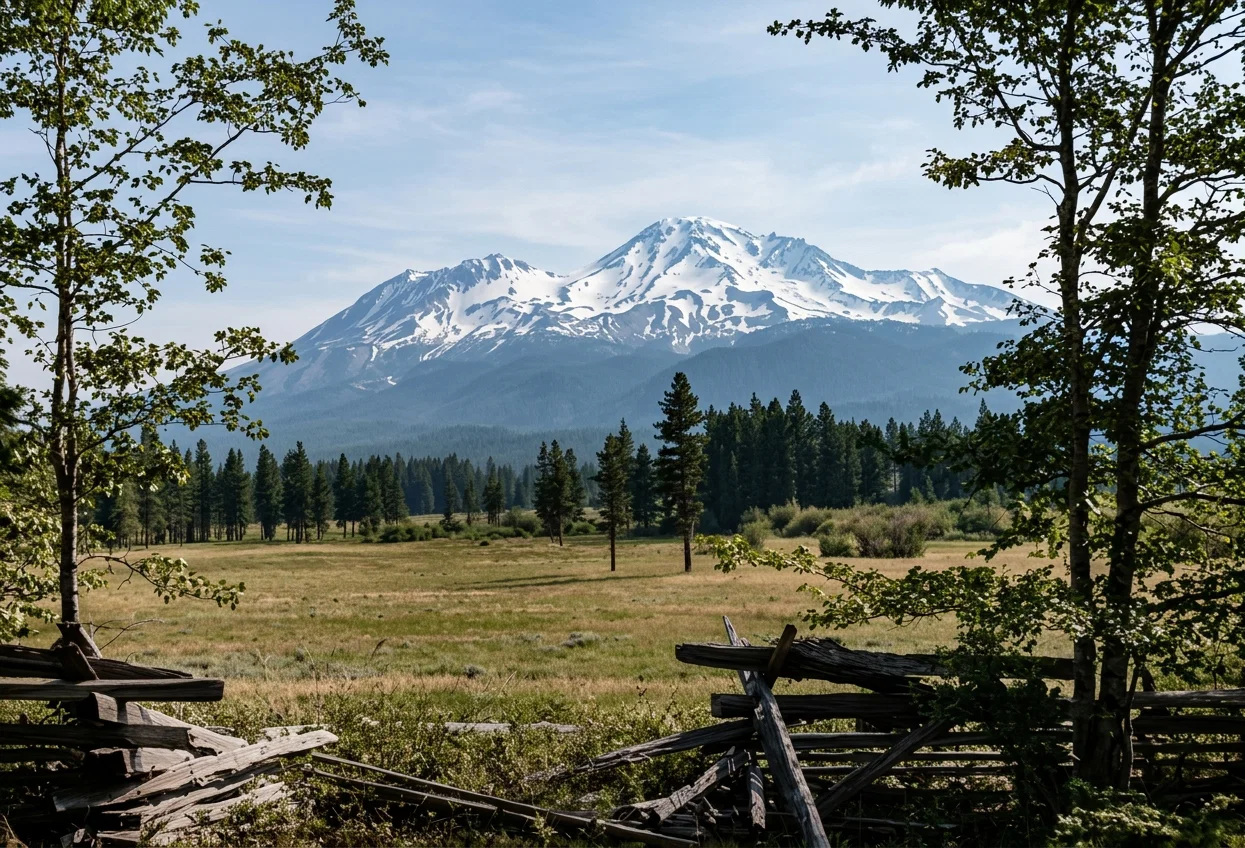
CALIFORNIA SCENERY, NO. 10.—One of the most far-famed peaks of the Sierra Nevada Mountains in California, just where that chain of mountains unites with the Cascade Range of Oregon, is Mount Shasta, lifting his cloud-piercing and snow-capped summit to the height of 14,511 feet. The Indians called the mountain Wyeka, now corrupted into Yreka, meaning “the White One.” The word is preserved in Yreka City, thirty-five miles north of the mountain. Shasta is located 330 miles north of San Francisco, fifteen miles from the Southern Pacific San Francisco and Portland Branch Railway. A good view of the mountain is obtained for miles along the railway, the best perhaps at Sissons. It has been well remarked that Shasta in the north and Whitney in the south were two grim and faithful sentinels, for centuries guarding the gold buried in California soil. The mountain is of volcanic origin, and was once active. A section of 10,000 square miles in Northern California is covered with lava, including Shasta. The two dark-colored peaks are the Black Buttes, probably half a mile high, near Mount Shasta. The region about Shasta must be a delightful one for a summer vacation. One would get plenty of pure air and water, and God seems to come nearer in His created works untouched by man.
WHAT OUGHT SHE TO HAVE DONE?
By Helen A. Steinhauer
(An o’etrue tale.)
Once upon a time there was a dear young girl who married before she was either old or wise enough to be a wife; and, not knowing how to bear and forbear, she sometimes had sharp words with, and angry feelings toward, the man whom she loved even more than the mother who gave her birth. Of course he wasn’t perfect—nobody is, you know—and this only made matters worse.
She had a laudable desire to help her husband and to earn her own bread—altho she had not done so before her marriage; but, unfortunately, the way she had to do it was attended with serious drawbacks. She had, as night operator in a telegraph office, to give up her natural rest; and as a consequence, she grew sickly, and nervous, and sometimes touchy and irritable; and her lawful protector, not understanding woman’s nature, found fault and became exacting, and often overbearing and unkind. At least that is what people said; for, alas! alas! our poor girlie held a somewhat exposed position, and what should have been kept sacredly private became town talk, her nights being of necessity spent in a depot, where prying persons could eavesdrop, and where passers-by overheard much that these two would not have had known to a third party on any account.
Then, too, it being a public office, young men could drop in of an evening; and the civilly-disposed were not slow to make capital of this, and hint and spread rumors which would have made our sweet, innocent girlie’s face crimson, and her bonnie brown eyes flash with righteous indignation, had she dreamed what was going on behind her back.
True-hearted women friends grieved in secret, and sought to persuade her to return to the shelter of her childhood’s home, for she had a fond father and lovely Christian mother, whose heart’s sorrow and life trial it was that she would persist in leading this exposed sort of life.
By and by her lawful protector was called away by circumstances, and forced to leave her in charge of his brother—an honorable and most kind young man. But this made further capital for the impure-minded and they were not slow to trade upon it.
Still our headstrong lassie refused to be counseled; nor would she pay the long-promised visit to her girlhood’s home (a boarding-house was her only other), altho her father offered to do all in his power to smooth her way, and make further toil on her part unnecessary, while her return would have brought gladness and sunshine into the life of her sad-faced mother.
Her lady friends—the motherly ones—deplored the fact that she failed to recognize that their better knowledge of the world fitted them to give her good advice, and were pained that she so positively refused to heed their loving counsel and avoid the appearance of evil.
The mere fact of her husband’s absence should have led her to make a change in her mode of life, while her own failing health formed a cover under which she could have gracefully withdrawn. But our girlie thought she knew best and would not be guided.
What could we do with her? There was nothing that we could do for her but to throw around her the mantle of love and pity.
But alas! and again, alas! altho woven of the strongest strands, its texture is such that it is no shield against the darts of prejudice and slander, which penetrated to wound and destroy our fair girl’s fame. Why will she not be guided, and take the only step which could have saved it and set her right before a censorious and uncharitable world? The daughter who throws herself into the extended arms of her parents, and seeks the shelter of her early home, finds herself in the holiest as well as the safest place this side of heaven, when made such by a Christian mother’s prayers.
God give the dear girls wisdom!
HELEN A. STEINHAUER.
Battle Creek, Mich.
TEDDY’S LOST OPPORTUNITY.
By Luella Watson Kinder
“TEDDY,” and grandma’s tremulous voice was wafted into the lower hall, where Teddy was hurriedly strapping his school-books preparatory to rushing off to school. An ugly frown appeared on his face, and he answered not a word. “Teddy, my boy,” and this time she leaned over the balustrade just above his head. Teddy knew now that his grandmother saw him, so it was useless to pretend he did not hear.
“Ma’-am?” he shouted, very crossly and much louder than there was any necessity for. He would like to have said, “What?” but he knew that that would be going a step too far, for his father had taught him he must speak respectfully to his elders and not say, “What?” “Yes,” and “No,” as some children do.
“Won’t you please stop at Mrs. Bennett’s and leave this package for me? It is early, and you go past their house, don’t you?” she asked timidly, noticing the frown.
“Yes’m, sometimes I go that way. I’m in an awful big hurry to get there this morning. Our football team has to practise before school, an’ I just can’t stop, gran’ma,” and he shouldered his books.
“Here, ’tis all ready wrapped up, so I won’t keep you a moment waitin’ on me,” and the frail little form began hurriedly descending the steps, hoping the boy would change his mind. He evidently would have done so had not his mother bustled into the hall just then.
Mrs. Vane was an energetic woman, and the full, round tones of her voice showed strength of will. “What is it now, ma?” she interrogated somewhat sharply.
“Nothin’, only I just thought maybe Teddy could leave this package at Mrs. Bennett’s for me.”10
The old lady hesitated, with a half-frightened, appealing glance at the child, but he opened the door and passed out.
“O, Teddy hasn’t time to be bothered with your little traps, ma! If Mrs. Bennett is in a hurry for the things, she can send for them.”
“But I promised I’d send them, and she’ll think”—
“I can’t help what she thinks. I s’pose she’ll get her things sometime. I wish you would not borrow things, mother, if they have to be returned at a certain moment of a certain day.” And Mrs. Vane seized the dusting-brush and hurried into the sitting-room, from which her voice rang in— “Let us scatter seeds of kindness,
For our reaping by and by.”
Upstairs, grandma, alone in her room, wiped away a few tears, and opened her Bible to where “even Christ pleased not Himself,” and meditated on it until she almost convinced herself “that Mary was right in speakin’ so. I know I’m an old bother and ought not to expect to have things done to please me.” Then she crept into “Mary’s” room and got the piled-up darning basket, which she carried back and seated herself to darn.
As Teddy carried his lunch he did not return to dinner, and several times through the day a sweet, wrinkled face, surmounted by thin gray hair, brushed smoothly back under a black lace cap, would come between him and the page of his book. He saw again a pitiful, appealing glance and noted the shrinking of a tiny, withered form under his sharply-spoken mother’s words. “Poor little grandma!” he thought. “I might just as well have taken the package for her. It would not have taken a moment, an’ she knits my mittens an’ mends my clothes. Never mind, I’ll take it just as soon as I get home.”
Ah, Teddy, good resolutions sometimes come too late!
When he reached home and was bounding up the front steps, his sister opened the door. Her eyes were red with weeping, and she motioned him to be quiet. “It’s dear grandma,” she said. “She has had a stroke of paralysis. When I went to call her to dinner she was sitting by the window with one of your stockings on her hand. She had been darning it, but could not move when I got to her.”
“But,” gasped the boy, “she—she isn’t dead is she?”
“Yes, she died a few moments ago. Didn’t the messenger boy meet you?”
Teddy never forgot the bitter anguish of that moment. Years after he became a man, the sight of a certain half-darned stocking brought tears to his eyes and pained his heart. As he sat in the darkened room near all that was left of his gentle little grandmother, and listened to his mother and others tell the many virtues of the departed loved one, the uppermost thought in his mind was, “Why, if they loved her so, did they not speak to her more tenderly, and why did they so often refer to her as ‘childish’ or ‘old and cranky’?”
Why, indeed? Ah, children, and those who may read this incident, be kind and considerate to the aged! They may seem queer in their ways and have odd notions. Their ideas are probably behind the times, their prejudices strong, and they may like to lecture you a little. Take it pleasantly. Humor their little ways and notions, and speak kindly to them. Tell them little items of interest. They will not be with you long, and if you could realize how lonely they feel sometimes, as they think of all the friends and loved ones gone on before, you would try to throw more brightness into the clouds which surround the setting of life’s sun, and make them feel that there is still one who loves them, this side “Jordan’s stormy banks.”
—Luella Watson Kinder.
A LIVING YEAR.
By Mary G. Slocum
Why cry so many voices, choked with tears,
“The year is dead?” It rather seems to me
Full of such rich and boundless life to be,
It is a presage of eternal years.
Must it not live in us while we, too, live?
Part of ourselves are now the joys it brought.
Part of ourselves is, too, the good it wrought
In days of darkness. Years to come may give
Less conflict, less of pain, less doubt, dismay,
A larger share of brightness than this last;
But victory won in darkness that is past
Is a possession that will far outweigh
All we have lost. So let us rather cry,
This year of grace still lives: it can not die!
—Mary G. Slocum.
JAPANESE CUSTOMS AND MANNERS.
By W. C. Grainger
However much one may read about Eastern Asia and its people, when he first visits the country he finds many surprises awaiting him. He realizes more than ever the truth of the old saw that says, “One-half the world does not know how the other half lives.” The conditions as well as habits of life differ widely from those of western nations.
The Government of Japan is a monarchy with a titled nobility that rank socially above all other classes. Next to them are those who are the possessors of great wealth, followed by the professional classes, of whom those who have studied abroad take precedence, everything else being equal. Then come the common people in the following order: tradesmen, mechanics, farmers, and coolies. The last two embrace a large majority of the people.
Caste as it exists in India has no footing in Japan, but social distinctions here are probably as marked as they are among the nations of the West.
The nobility and men of great wealth usually live in houses of European style, and partially furnished after western models. They ride in fine carriages and keep liveried servants; wear foreign clothes, and in fact very generally imitate foreign ways. Altho few in number, their influence in governmental affairs predominates. Aside from the popular brands of the Legislature, they constitute the government, for it is from there that the emperor selects his cabinet, governors of provinces, and chief military and naval officers. It must be said to their credit that there are many broad-minded men among them, who, under the direction of a liberal-minded ruler, have done much for the civilization of Japan. A great revolution has taken place within the last thirty years, and that such a thing should occur among a semi-civilized people in so short a time without bloodshed and without any serious social disturbance, is a marvel to the world, and speaks volumes in praise of the natural intelligence and patience of the people.
Thirty years ago Japan was what China is to-day. Robbery and murder were of common occurrence, but now life and property are as secure as in any other country in the world. A new system of government has been adopted. Every department has been reorganized, educational, military, naval, legislative, and judicial. Railroads, telegraphs, and telephones connect all parts of the country, and are well patronized.
The postal system of Japan is excellent.11The service is better than that of our own country. In this city mail is delivered every hour from 6 A.M. to 10 P.M., excepting from 12 to 1 and from 6 to 7 P.M. There is no part of the country in which there is not free delivery at least once a day.
The emperor sent intelligent men abroad to study different features of foreign governments, with a view of selecting the best from all. Some gave special attention to the social life of other nations; others studied their educational systems, etc. The outcome has been that France furnished the model after which the army was organized, England the navy, and America the present system of education.
In adopting the English system of railroad engineering and service, I think they made a mistake, for to my mind the American is superior in many respects.
Excepting the upper classes very little change has taken place in the social customs of the people. Their houses and their dress are distinctly Japanese. Those in government service and those attending government high schools, when on duty are required to wear a uniform made in foreign style. When off duty they generally don their native dress. The only advantage the native costume has over the European, that I can see, is its cheapness—an ordinary suit costing less than half as much as a foreign suit would cost. The people in many things practise close economy, and well they may, for with the masses incomes are very meager when compared with that of Americans. Of late years the cost of living has increased very materially, while the advance in wages has been little or nothing. This has so affected the laboring classes that it is with difficulty that they support themselves and families. It is here as it is in America. Men in striving to become rich do not always consider the rights of those who labor for them. For the last month the papers have been publishing financial reports of manufacturing establishments and other corporate bodies. As far as I have observed, all declared annual dividends of from twenty to forty per cent. Considering the great advance in the cost of living—many things have advanced fifty per cent. within the last year—a part of these large dividends ought to have been distributed among their employes in the form of increased wages.
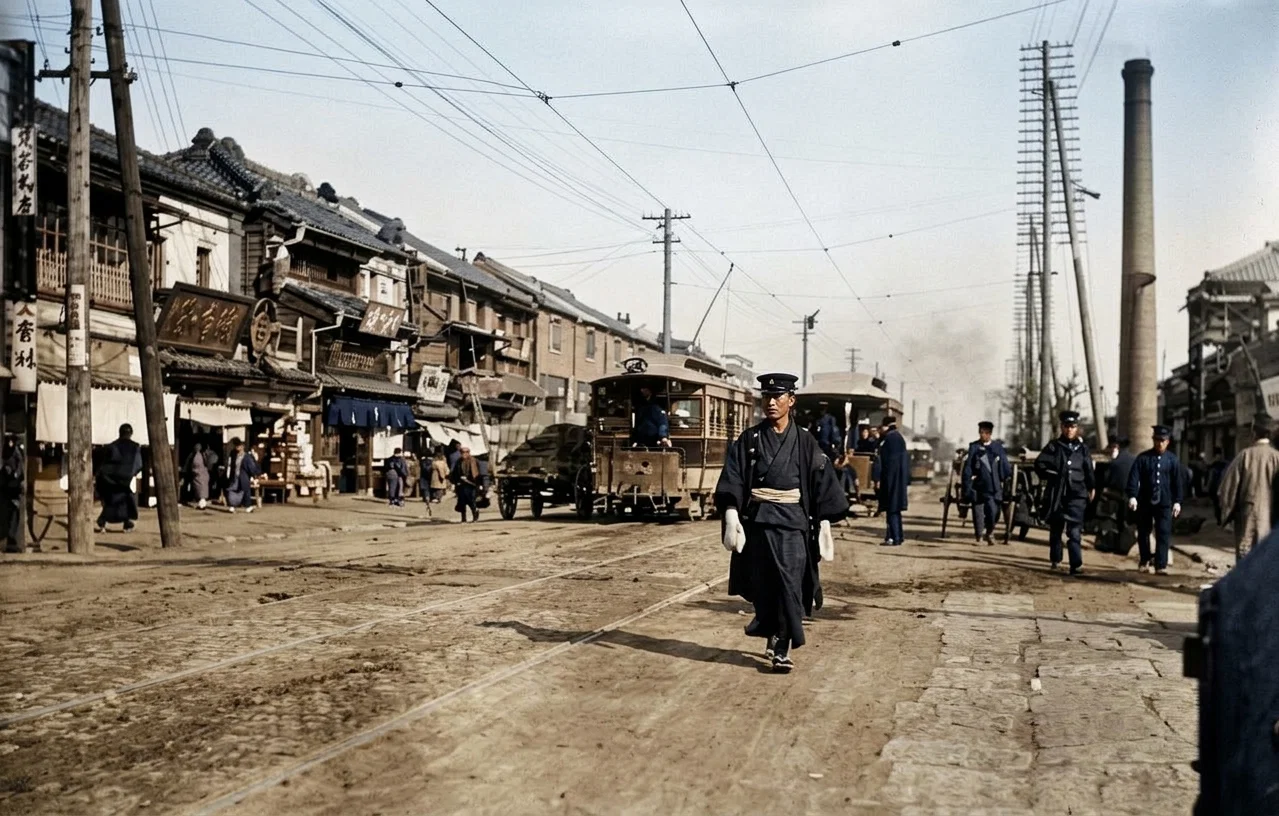
Ginza Street, the best in the city of Tokyo, Japan, from the north end of Shimbashi Bridge, looking northward.
While the number of large establishments increases from year to year, doubtless a majority of those engaged in manufacturing still pursue their work in their own houses very much as our own people did a hundred years ago. Here in this city almost every house that has a street frontage is a shop of some kind, the majority of the houses being two-story structures. The lower front room is commonly occupied by the business of the family. Weaving, carpentering, blacksmithing, manufacturing jinrikishas and articles of bamboo, are the most common lines of work.
The Japanese are not averse to work, but they seem to have a great preference for a kind that they can perform in a sitting posture. They never do anything standing that they can possibly do sitting. They neither use chairs nor stools, but sit on the floor in a position peculiar to themselves. They assume the position by dropping on their knees and sitting backward on their feet. They are trained to this from childhood. To my mind this habit in a measure accounts for their diminutive stature. I have observed that in many of them the lower limbs are proportionately small, which must be due to this restriction. It has become so natural to them that they seldom sit in any other position. Even in the railroad cars, which are provided with seats, I have often seen them sit on the seats with their feet folded under them. At first it seemed very strange to me to see blacksmiths and carpenters hammering away at their trade in a sitting posture. It is astonishing how soon one becomes accustomed to the ways and manners of a strange people. Should I remain away ten years, this land doubtless will seem more like home to me than my own native land. My attachment for this people grows stronger every day.
Excepting the residences of the nobility, and the very wealthy, houses are very small when compared to our American houses. Even business houses on Ginza Street, the best street in the city, are scarcely equal to those of a second-rate American village. Houses are usually constructed of wood and plaster. The framework is put together in a very substantial manner, so as to resist the shock of earthquakes, and the tile roofs are excellent; everything else is of very light material. They are as a rule either painted black or left unpainted, which gives everything a very dingy appearance.
The arrangement of rooms and furnishings is peculiarly Japanese. Floors are all covered with thick mats three feet by six feet, closely fitted together. Partitions made of wooden frames covered with opaque paper separate the different rooms. These slide back and forth in grooves above and below, and can be taken down at any time. To throw the entire floor into one room is but the work of a moment. The outer walls of the rooms consist of wooden frames covered with translucent paper, which serve for windows. These also slide in grooves and can be removed at pleasure. Outside of these is the veranda, with its board floor, which is kept so clean and is polished so smooth as to almost reflect your image. Board screens sliding in grooves constitute the outer walls of the house. At night these are closed and fastened. In the morning they are slidden to one end of the porch, where there is a kind of box or recess to receive them.
Commodious closets are found in connection with every room, in which are stored away the belongings of the family. A low table, about two feet square, or a low writing-desk, a brazier filled with ashes, in the center of which are a few pieces of burning charcoal, and a small teapot, are all the visible furnishings of the house. Everything else is stowed away in the closets, to be brought out only when needed. Their beds are only heavy comforters spread upon the floor-mats, and their pillows cushioned blocks of wood shaped to fit the neck. Their manner of living makes housekeeping very easy. The women are good housekeepers and take great pride in keeping everything scrupulously clean. The woodwork of the interior and the veranda would scarcely soil a pocket-handkerchief at any time. At the first entrance is a small court in which all foot gear is left by those who enter. To enter a Japanese house with shoes on would be a gross act of impoliteness. Instead of counting the hats in the hall, the number of persons in any house may be known by the number of shoes in the court.
W. C. GRAINGER.
Tokyo, Japan.
A SHEPHERD BOY'S PRAYER.
A LITTLE lad was keeping his sheep one Sabbath morning. The bells were ringing for church, and the people were going over the field, when the little fellow began to think that he too would like to pray to God. He had never learned a prayer. So he knelt down and commenced the alphabet—A, B, C, and so on to Z.
A gentleman happened to pass on the other side of the hedge, heard the lad's voice, and looking through the bushes, saw the little fellow kneeling, with folded hands and closed eyes, saying, “A, B, C.”
“What are you doing, my little man?”
The lad looked up, “Please, sir, I was praying.”
“But what are you saying your letters for?”
“Why, I didn't know any prayer, only I felt that I wanted God to take care of me and help me to take care of the sheep; so I thought that if I said all I knew, He would put it together and spell all I want.”
“Bless your heart, my little man; He will, He will, He will. When the heart speaks right, the lips can't say wrong.”—Our Sunday Afternoon.
Bide a Wee, and Dinna Fret
“With toils and cares unending
Art beset?
Bethink thee, how the storms from heaven descending,
Snap the stiff oak, but spare the willow bending,
And bide a wee, and dinna fret.”
IN CONVERSATION.
Be a good listener as well as talker.
Take time and acquire patient attention to the subject matter.
Avoid argument. Study to bring kindred facts to bear upon the theme in hand.
Interruptions can not always be charged to the blame of those who speak out in meeting, and they are pardonable when any one is prolix.
Criticisms are in order except in respect of private, personal, and family affairs.
Egotism and conceit do not always appertain to those who talk a great deal about self. Must we not draw out of our experiences, tastes; temper, and habits of life? Such affairs amount to something and are a gain.
Lead the conversation to something useful and practical, and of general interest, things improving in character, entertaining in matter, and that will be contributing informing knowledge to the parties engaged.—Religious Herald.
THE FIRST OVERSHOES.
The first pair of arctics brought into the United States were imported from Rio Janeiro in 1830. They were a rough pair of India rubber “gunboats,” painted and gilded like a Chinese pagoda, and were sent as curiosities to a New York gentleman by a representative of a wholesale house doing business in what was then the great American empire. Friends of the gentleman, when inspecting his odd rubber shoes, expressed a desire to own a pair of such oddities; and in 1832 twenty-seven pairs were imported by New York and Boston people. The next year the importations numbered 500 pairs, and in each following year the trade increased.—St. Louis Republican.
OUR MASTER.
By Whittier
Who hates, hates Thee; who loves, becomes
Therein to Thee allied;
All sweet accords of hearts and homes
In Thee are multiplied.
Deep strike Thy roots, O heavenly Vine,
Within our earthly sod;
Most human and yet most divine,
The flower of man and God!
So, to our mortal eyes subdued,
Flesh-veiled, but not concealed,
We know in Thee the fatherhood
And heart of God revealed.
—Whittier.
OUR WORK AND WORKERS.
Brother I. D. Van Horn is now permanently located in Indianapolis.
Brother F. M. Roberts reports the baptism of eight persons at Noblesville, Ind.
New churches are soon to be organized at Don Juan, Shelbyville, and Logansport, Ind.
At the last quarterly meeting of the church at Fort Wayne, Ind., five persons were added to the church by baptism.
Sixteen converts are reported as a visible result so far of meetings held at Levi, Texas, under the direction of Brother H. Woodruff.
The brethren of the Indiana Conference have been holding elders' and parents' institutes at various points. An appointment is out for Ligonier, March 10–13.
Special meetings held at Keene, Texas, have been fraught with extraordinary results. There have been four baptismal services, at which fifty-five persons were buried with their Lord in a watery grave. This revival season, under the labors of Brother A. F. Ballenger, has been of great value to the school at that place as well as to the church.12
The board of trustees of the Keene, Texas, Academy have started the manufacture of health foods. There are three objects in view,—revenue for the institution, employment for students, and the supplying of healthful food to the people.
Meetings are being held in the courthouse and city hall at Cheyenne, Wyo., by Brethren O. S. Ferren and C. H. Abbott. In connection with these meetings, daily Bible readings are held in different parts of the city, and a good interest is manifested.
A new journal has been started at Copenhagen, says Present Truth; but we are not informed whether it is a weekly or monthly, nor is the price given. It is published by the Seventh-day Adventist Society of Denmark, and is entitled Trösteranden (The Comforter).
As reported to the Minnesota Worker by Brother L. H. Christian, there are in that State 119,000 Swedes, 107,000 Norwegians, and 16,000 Danes, who were born in Scandinavia, and nearly twice as many more who were born in the State, making a total of some 600,000. To the largest number of these the message we are bearing to the world must be given in the Scandinavian languages.
The International Tract Society has begun the publication of a 16-page monthly journal at Calcutta, India. We have received the first number (January, 1898) and bid it Godspeed as an exponent of Gospel truth that bears a certain sound. Price, 2 annas (5 cents) per copy. From it we learn that Bible addresses were being given in the Corinthian Theater every Sunday evening, which service was to continue during January and February.
We learn from the Missionary Worker that Brother W. A. Spicer, who for several years has been one of the editors of the London Present Truth, is to go to Calcutta to edit the Oriental Watchman, whose début is mentioned in another item. It is also stated that Brother G. C. Tenney, formerly editor of the Bible Echo at Melbourne, and later of the Review and Herald editorial staff, Battle Creek, Mich., will go to London to edit the Present Truth.
At a general meeting held in Portland, Ore., February 10 to 20, for General Conference district No. 6, an advisory council of the district was organized, the work of which is to consider and advise as to the general work within the district. The council is composed of the following: Chairman, A. J. Breed, superintendent of the district; secretary, E. J. Hibbard, College Place, Wash.; the presidents of the various conferences, heads of mission-field boards, and presidents of publishing house, sanitariums, and colleges.
Brother G. W. Angleberger, says of his labor at Cañon City, Colo.: “I had the privilege of speaking to the prisoners in the penitentiary about three weeks ago. I took as my subject, ‘The Love of God,’ emphasizing the thought that all sinners have been purchased by the blood of Christ, and may be saved if they will. As these themes were presented, the faces of those poor fellows would shine with joy, and tears flow. Some are reading the SIGNS in their cells, and the warden says they are becoming interested in them.”
DEPARTURE FOR PITCAIRN.
On the 2d inst. Brother J. R. McCoy sailed from San Francisco for Pitcairn Island on the British ship Orealla, Captain Stewart, bound for Queenstown. Brother McCoy is a native of Pitcairn, was for some time chief magistrate, until he engaged in missionary work with our missionary brigantine Pitcairn. For the past year he has been selling books and doing ship missionary work at San Francisco. Notwithstanding his absence from his island home, he is considered the father of his people, and there seems to be no one there who can fully supply his place. Altho the colony is small, its isolated position throws grave responsibilities upon those who have to lead
the people either in religious or secular matters. While we are sorry to part with Brother McCoy, we are glad for their sakes that he is returning to the island.