Answers to Questions in “Instructor” of December 5, 1916
1. INDIA RUBBER, or caoutchouc, is the chief constituent of the latex furnished by a number of different trees, shrubs, and vines. The latex of the best rubber plants furnishes 20 to 50 per cent of rubber. Latex is chiefly secreted in vessels or small sacs which reside in the cortical tissue between the outer bark and the wood. It is usually obtained from the bark by making an incision reaching almost to the wood, when the milky fluid flows readily from the lacticiferous vessels. The existence of rubber was first observed soon after the discovery of America. It was noticed that certain Indian tribes of South America played with a ball composed of an elastic substance, which afterward was found to possess the power of removing lead-pencil marks from paper, and came into commerce as “Indian rubber.”
2. A ship passing through the Panama Canal from the Atlantic Ocean to the Pacific Ocean sails southeast.
3. The black and white stripes of the zebra seem to be useful in attacking others as well as for defense; they blend together at a little distance, and “their proportion is such as exactly to match the pale tint which arid ground possesses when seen by moonlight.” They are not, therefore, readily seen.
4. An eclipse is an obscuration of one heavenly body by the intervention of another, either between it and the eye, or between it and the source of its illumination. A lunar eclipse is caused by the moon’s entering the earth’s shadow, or penumbra. As the limb of the moon approaches the earth’s shadow, it begins to darken. When only a small portion has entered into the shadow, that portion is completely hidden. But, as the total phase approaches, the part of the moon’s disk immersed in the penumbra becomes visible by a reddish coppery light—that of the sun refracted through the lower parts of the earth’s atmosphere.
5. The direction assumed by the needle of the compass is not generally toward the geographical north, but diverges toward the east and west of it, making a horizontal angle with the true meridian. Among mariners this angle is known as the variation of the compass. The needle points directly to the north magnetic pole.
6. When Robert Cavelier, Sieur de La Salle, came down the Mississippi River, in 1682, from the French possessions to the north, he took possession of the country in the south in the name of France, which hereby gained her first title to the vast drainage basin of the Mississippi. In honor of Louis XIV the new possession was named Louisiana—a name then, and until 1812, applied to a much larger area than that of the present State.
7. The large spikes on the heads of horned toads protect them from being swallowed by snakes. The toads are found in Mexico and from California to Texas. The enlarged spiny scales scattered over the toad’s back cause it to look as if it were sprinkled with the dried husks of seeds. The toads are entirely insectivorous. They bask on the broiling hot sand, and then can run fast enough; otherwise they are sluggish, dig themselves into the sand by a peculiar shuffling motion of the fringed edges of their flattened bodies, and when surprised they feign death.
8. A sponge is a porous mass of interlacing horny fibers which forms the internal skeleton of certain marine animals of low organism. The sponges are a large group, mostly marine, but a few inhabit fresh water. They are generally permanently attached, growing in a plantlike fashion into masses which vary much in size, shape, color, and consistency. During life the interstices of the skeleton are filled with cells and pierced with a system of canals and small cavities opening on the surface by numerous incurrent pores.
9. Chocolate is a paste of the ground kernels of the cocoa bean, deprived of a portion of the fat. It is mixed with sugar, vanilla, or other flavoring, and then made into a cake, which is used for the manufacture of various forms of sweetmeat.
10. St. Patrick was probably born about the year 389, at a place called Bannauenta. The only place now known that bore that name is Daventry, Northamptonshire, England.
11. The United States produces more coal than any other country in the world. In 1905 the production amounted to 350,821,000 tons.
12. Hero of Alexandria, B. C. 130, is probably the first one who knew about the power of steam. In the “Pneumatica” is described the æolipile, which is a primitive steam reaction turbine. From the time of Hero to the seventeenth century there is no progress to record. The next distinct step was the publication in 1601 of a treatise on pneumatics by Giambattista della Porta, in which he shows an apparatus similar to Hero’s fountain. It was in 1763 that James Watt made his experiments with steam.
13. The United States gained more of its territory from France by the Louisiana Purchase, as this territory covers an area of 1,000,000 square miles.
14. Rice is the chief article of food in Japan. Paddy fields are to be seen in every valley or dell where farming is practicable. The fields are generally kept under water to a depth of a few inches while the crops are young, but are drained immediately before harvesting. The fields are then dug up, and again flooded before the second crop is planted out. In 1906 there were 7,246,982 acres devoted to the cultivation of rice in Japan.
15. The date of the first employment of cannon cannot be established with any certainty, but there is good evidence to show that the Germans used guns at the siege of Cividale in Italy, 1331.
16. There are 840 acres in Central Park, New York. It is about two and one-half miles long and one-half mile wide, and was laid out, beginning in 1857, by F. L. Olmstead and Calvert Vaux.
17. Paris is farther north than Boston; Paris is between 48° and 49° north latitude, while Boston is 42° north latitude.
Where did John Wesley preach in America?
How did New York become an English city?
What was the Northwest Territory?
How long were George Washington’s ancestors in America?
Who were the Plymouth Fathers?
Who was “Mad Anthony”?
Where did Aaron Burr propose to found an empire?
Who first discovered North America?
Each Man's Imagination Peoples His World
“EACH man's imagination largely peoples the world for himself. Some live in a world peopled with princes of the royal blood; some in a world of paupers and privation. You have your choice.”
Let My Days Be So Many Degrees of Nearer Approach to Thee
“LET my days be so many degrees of nearer approach to Thee.”
A True Story
By Rev. Frank Hampton Fox
From Tramp to Traffic Manager
A True Story
The World's Columbian Exposition, with its accumulated wonders collected from many countries, closed Oct. 30, 1893.
For more than six months the committees in charge of the State exhibits had been away from home and business. Now that the curtain had been rung down on the Exposition, there was a general rush for cars to ship the collections home. Indignation and approval vied with each other over Transportation Manager Johnson's rule that cars would be supplied to the States in their alphabetical order. People from States with names beginning with A, B, or C were well pleased; but as there were about forty States ahead of South Dakota, the committee from that State faced the gloomy prospect of a long delay. Days of inaction increased their discontent; the November days were slipping by, and flakes of snow filled the air.
The South Dakota committee held an indignation meeting in which Johnson was freely criticized for his alphabetical rule. Finally they determined to send Col. Tom Black, the chairman of the committee, to interview the transportation manager and induce him to relax the rule enough to give South Dakota the needed cars at once. The colonel's military training made him reluctant to attempt to secure the much-desired concession. The committee insisted, and he obeyed their demand under protest.
People anxiously awaiting an opportunity to voice their grievances filled Johnson's outer office. The colonel sent in his card by an office boy, picked up a paper, and settled himself for the long wait until his turn came. To his surprise the boy returned immediately, and said:—
“Mr. Johnson will see Colonel Black at once.”
The score of waiting people who were ahead of him frowned at this manifest display of favoritism. When he entered the inner office, Johnson arose, extended his hand in cordial greeting, and inquired, “What can I do for you, Colonel Black?”
The colonel, somewhat confused by this cordial greeting, answered: “I know that it is not worth while for me to ask you to give us cars to ship our South Dakota exhibits in advance of the alphabetical order, which you have adopted. But winter is coming, and our committee insisted that I should come and see you.”
“How many cars do you need?”
“Seven.”
“When can you begin to load them?”
“Tomorrow morning at seven o'clock.”
“Seven cars will be set in on the sidetrack by your exhibit at seven o'clock tomorrow morning.”
“What do you mean?” exclaimed the colonel in amazement.
“I mean just what I say; the cars will be ready for you to begin loading your exhibit at seven in the morning.”
“Why, Mr. Johnson, you are not fooling me?”
“No, sir; my word is given; the cars will be there, and I'll come myself and see that they're placed just where you want them.”
“Thank you, sir,” said Colonel Black; “this is certainly very kind of you.”
Too dazed by this unexpected success to say more, he hurried back to astonish the committee with the report of his good fortune.
“Colonel Black, you're a wonder,” exclaimed Mrs. Katherine James, who had charge of the women's exhibit. “I don't believe there is another person in Chicago who could have moved that stubborn, unreasonable man to do this. Why, he's the most set creature that I ever tried to do anything with; I—I offered him two twenty-dollar gold pieces if he would give us those cars; and he just smiled, and said he couldn't do it.”
She paused for lack of words properly to express her feelings.
Mrs. James was a fascinating woman of forty, with splendid form, a beautiful face, snapping black eyes and fine, wavy black hair. She was a successful lobbyist, and seldom failed to secure the thing she sought. Her chagrin had been great when she failed to secure any concession from Johnson, but this did not prevent her jubilation over the colonel's success.
Shortly before seven the next morning a switch engine pushing seven cars came puffing up the sidetrack to the South Dakota exhibit. Johnson supervised the placing of the cars so that they would be convenient for the loaders, who were ready to begin their work. Colonel Black was there also with hot coffee for the switching crew and a good word for all of them.
“Come into my office, and drink your coffee with me by the stove,” said the colonel to Johnson.
When they were seated, he said: “Mr. Johnson, you have been very kind to us, and I assure you that we appreciate your courtesy; I wish you would tell me why you have shown us this exceptional kindness.”
There was a brief silence while Johnson sipped his coffee. When he did speak, his answer was more of a surprise than the unexpected favor had been. The hand with which he held the cup shook; his under lip quivered, and tears trickled down his cheeks. Mastering his emotions, he brushed aside the tears with his free hand, and looking up, said:—
“Because of the visits which you used to make to Cell No. 42 in the South Dakota Penitentiary. Don't you remember Frank Johnson?”
“Johnson, Frank Johnson,” exclaimed the colonel; “is it possible that you are Johnson? How did I fail to recognize you?”
He grasped Johnson's hand with such a grip as a man can give another only when his soul goes with the greeting.
“I had been in prison four years when you began to visit me. The prison, along with my leaden mental depression, must have given me a ghostlike appearance. I felt that every door was barred and all of the avenues to success were closed against me, and I never could find work. One day you told me how you broke into the bread line once, and went to work without being hired. In your last visit to Cell No. 42 you advised me to break into the bread line somewhere and go to work. ‘Be sure to make yourself indispensable when you do get a place,’ were your last words to me.”
“I was desperate when I came here a year ago last spring; I had tramped for weeks, asking, yes, begging, for work; but no man would hire me. I was hungry and heartsick; my last hope was the Exposition. I came here when they were just starting the work; there were great piles of material, and here and there a few men were getting ready to build. I tramped10all day from one group to another, begging for work; I offered to do anything, but everywhere there was the same refusal, ‘We've all the men we need at present.’”
“Colonel Black, I was hungry and weak; I hadn't tasted food for three days. That night I gave up, and walked over to the lake front to jump in and drown myself, with all my troubles. Had I plunged in as soon as I reached the water, all would have been over; but I sat down on the shore to think. I remembered your visits while I was in prison, and that gospel of another chance which you said was about all the creed you had.”
“I had penciled a note and pinned it to my coat, which I folded and laid with the note up, so that those who found it would know why I had resorted to the water cure for my troubles. I declared that there was absolutely no hope for an ex-convict; no one would give him a chance to earn an honest living. Then I thought of your words to me and how I was killing hope in the breast of every man who had been in prison. I tore that note to pieces, and determined to make one more supreme effort for the sake of other men in my condition.”
“When morning came, I washed my face and hands in the cold water of the lake; and at seven o'clock I was on the Exposition grounds, determined to go to work. I came to a carload of wheelbarrows in the knockdown piled near one of the sidetracks. Something said, ‘There's your chance.’”
“I went to the office of one of the superintendents, and asked for a monkey wrench. When the clerk asked me what I wanted it for, I told him that I was going to set up wheelbarrows, and he gave it to me without further question. Soon men came asking for wheelbarrows. I said to them all, ‘Go to the office over there, and get a written order on me for the number of barrows that you want; my name is J. F. Johnson; see that my name is on the order.’”
“The orders came, day after day; the barrows were called for as fast as I could set them up. I carefully preserved all of those orders from the superintendent's office.”
“At noon that first day I went to the house of an old lady near the Exposition grounds, and told her that I was working on the Exposition and that I should like to find a place to board. She was very poor, and needed the money; so she took me in. The good woman exhausted her means, and credit as well, during the two weeks that preceded pay day. I never shall forget that first pay day; we had nothing to eat for breakfast that morning, and I had to work without dinner, too.”
“That afternoon the men received their pay; I waited so that I was the last one to step up to the cashier's window. It is difficult for a hungry man to keep his nerve; I trembled in spite of all the courage that I could command. When the cashier asked my name, I was so frightened that I could scarcely speak. He looked over the list, frowned, and said, ‘I fail to find your name on the pay roll, Johnson.’”
“‘That's strange,’ said I; ‘for I've been working here two weeks, setting up wheelbarrows. Here are all these orders signed by the superintendent, ordering me to deliver barrows to the men; my name is on all of these orders.’”
“The question was referred to the office for correction; in a few minutes word came, ‘This is an unfortunate oversight; correct it at once.’”
“That night I felt happy, for my name was on a pay roll, and the old lady declared that I had made good. A job is a life preserver; I was a new man.”
“A carload of wagons arrived, and the foreman placed me in charge of a gang of men to unload and set them up. They gave me one job after another, each time placing a few more men under my direction; my wages were increased; and by the time the buildings were completed I was well established with the men who were in charge of the Exposition. So, when the exhibits began to arrive and general confusion followed, I was placed in charge of one section to relieve the congestion; my men soon had things in good order. I was given more supervision, and finally I was made transportation manager for the whole Exposition. We are doing our very best to satisfy everybody; soon the last exhibit will be shipped.”
“Then what will you do?” the colonel inquired.
“I have the position of traffic manager for the I. C. and W., which you know is one of the great railways running out of Chicago.”
“Yes,” said the colonel with a smile; “I happen to be one of the officers of that road; but I did not know who the new traffic manager was; I only knew that he had made good elsewhere.”
Both men arose; each grasped the other's right hand for a moment of eloquent silence; then Johnson said:—
“Colonel Black, I owe everything to your gospel of another chance.”—Rev. Frank Hampton Fox, in Christian Endeavor World.
Being King
By Louis Glanville Stevens
“Say!” Nelson dug his clenched fists deep into his pockets and shrugged his shoulders. “Everything I do seems to be wrong lately. I don’t chop the kindling thin enough, I make too many tracks on the carpets, my grades are too low, and my shoes are never shined. Father and mother jump me every minute I’m home. I’m sick of it—sick of it all.”
The little group of pals around Nelson exchanged glances. They were surprised, for Nelson had never talked in this fashion before.
“Don’t talk foolish, Nelson,” admonished Bruce Duncan, Nelson’s next-door neighbor. “You know your mother thinks you are just right. And you shouldn’t talk that way. She gives you a piece of pie or cake every day after dinner, and you get ten cents to my one for candy. Then, too,—”
A voice from the direction of Nelson’s home interrupted the youthful peacemaker.
“Nel-son, Nel-son!”
“Hear that!” ejaculated Nelson angrily. “She wants me to wash the dishes, I guess.”
His pals laughed as he doubled up and with his hands to his mouth yelled with all the strength his lungs could endure:—
“Y-e-s, Y-e-s!”
He didn’t shout again, for his face turned pale and he fell at their feet unconscious. He had yelled a little too loud, and produced an internal head injury.
When Nelson opened his eyes to the world again, he saw his mother’s tender face and anxious eyes bending over him. His father’s eyes were red too, and Nelson wondered why. Gradually it all came back to him. Yes; he was sorry. He had been mistaken. He would tell them. Nelson opened his mouth—but he couldn’t utter a sound. His speech had gone; his last words were in anger.11
Senator Nelson Nickerson arose from his office chair and faced his youthful secretary, whose damp eyes and twitching lips betrayed the fact that he was moved and mentally upset. The Senator placed his hand on the younger man’s shoulder.
“That’s my story, Weller, and I have retold it once again for your sake. I was without my speech for two years. A hot temper has never been one of my faults since that time. Now, I presume you expect to be dismissed for your disrespectfulness to me a few minutes ago. You lost your temper because you thought I was totally in the wrong. Being king over this wonderful mind of ours is a big job. The hand which rules it must be strong, careful, and steady. One slight mistake may cause a lifetime injury. Think over my story, Weller, and I’ll forget this little squabble.”
The young secretary clasped the Senator’s extended hand meaningly.
“I’ve thought it over already, sir; I’m king now. Hasty Temper will shine my shoes for the rest of his days.”
LOUIS GLANVILLE STEVENS.
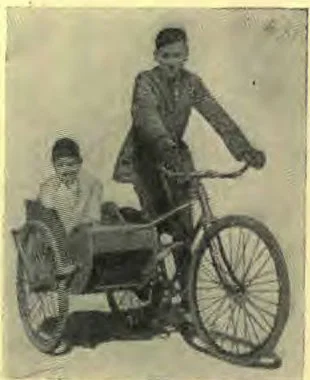
THE SIDE CAR AS IT IS ATTACHED TO A BICYCLE
Constructing a Side Car for a Bicycle or Motor Cycle
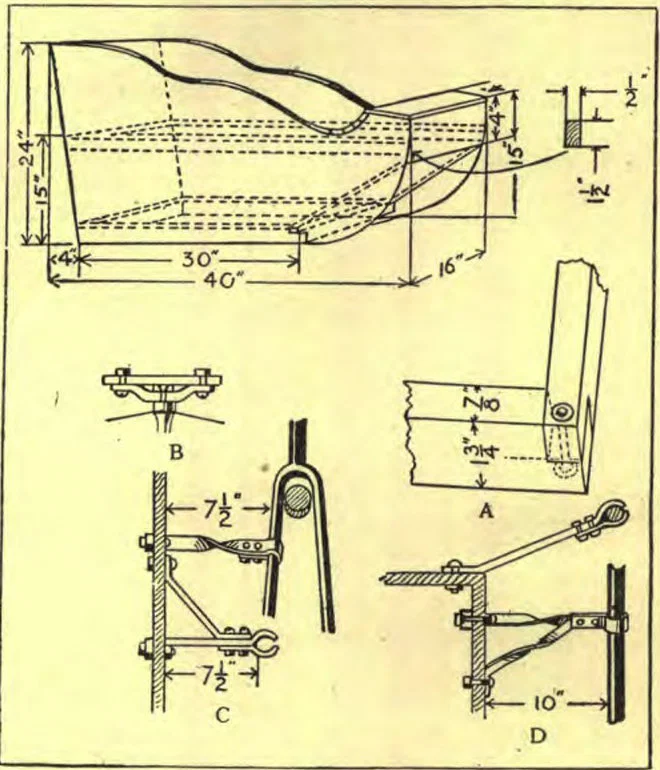
THE accompanying illustration shows the construction of a simple side car for a bicycle, which may be enlarged for motor cycle use. The frame of the side car should be strong, light, and well made. Basswood will be found very durable for a light side car for a bicycle. The joints at the corners are lapped, with a small bolt run through them to hold the parts tightly together as at A. The frame is rectangular, 30 inches long and 16 inches wide, made of pieces 1¾ inches wide and ⅞ inch thick.
The sides of the body are built up of ½-inch boards fastened vertically to the frame, and a side rail placed 15 inches above the frame, which is used for supporting the seat and also as a means of attachment for band-iron braces to the bicycle. Screws should be used throughout for fastening the boards to the frame and rails. First fasten them to the side rails, then draw the curved line at the top and cut both sides out at the same time after clamping them together. Before fastening them permanently to the frame, lay a floor of ¾-inch boards. A single board 16 inches long placed on the side rails makes the seat. The back is put on in the same way as the sides.
The side wheel, which is an ordinary front bicycle wheel, is attached to the body of the side car with braces of band iron 1⅛ inches wide and 3-16 inch thick, the forward one being fastened over the side rail and the other to the upper rear part of the body.
DETAILS OF THE FRAME OF A SIDE CAR AND ITS CONNECTIONS TO A BICYCLE OR MOTOR CYCLE
The inside end of the hub axle is supported by a piece of the same band iron shaped as shown at B, and bolted over the side boards to the frame back of it.
The same sized band iron is used for attaching the side car to the bicycle, one piece connecting the body to the bicycle frame between the large sprocket and the small one, and the other between the side rail of the body, through the boards to the tube connecting the seat and the rear-wheel hub. This is shown in C and D. The bars of the last attachment must be twisted slightly, as the drawing shows, to allow for the slant of the bicycle tube.
—Popular Science Monthly.
Hospitality
By Rosslyn Gallion
“THERE is that scattereth, and yet increaseth; and there is that withholdeth more than is meet, but it tendeth to poverty.”
The following incident was related to me recently. It occurred several years ago, when my brother was but eighteen years old, very inexperienced and very homesick. He was canvassing in a rich farming district in one of the Central States, and was having difficulty in finding a place to spend the night. I give his own words:—
“I had had a very hard day, and as night drew on I tramped for many weary miles hunting a place to stay. As door after door refused me admittance, and dogs barked at me, and human beings looked distrustful, I was feeling lonely and discouraged.
“Between nine and ten o’clock I timidly approached a small, homey-looking cottage nestled among the trees at some distance from the road. In answer to my knock a motherly woman came to the door; animation, energy, and hospitality written in every line of her face. The sight of her put courage in my heart, and I asked if I might stay all night. All the cold looks and curt denials met with earlier in the evening were as nothing when she said, ‘Indeed, you may, my boy. Come right in.’
“She had me hang my hat in the hall, and brush my clothes, while she hurried away, and brought me a glass of water. Then she prepared supper, giving every attention to my comfort.
“After supper I remarked my appreciation of her kindness, which was so different from the rebuffs I had received; and I asked her why she had given me, a total stranger, such a hearty welcome. This is in substance her reply to my question:—
“When she was a little girl her parents lived in an Eastern State. It was in the days when the East was rushing west in the mad search for gold. Her father had enough and to spare, but he decided to go with a party just then leaving his vicinity for the Far West. Leaving his12family well provided for, and bidding them an affectionate farewell, he set out.
“Months passed, perhaps a year or two, and not finding the prospects for accumulating wealth so good as he had anticipated, and hungry, too, for the sight of his loved ones, he longed for the cozy little home. As no company of travelers was starting east just then, he decided to attempt the journey alone.
“It was a perilous undertaking, starting at the time of year that he did, the winter to be reckoned with, and provisions uncertain. But he braved the wilderness full of wild beasts, and wilder, crueler savages; endured storms, exposure, hunger, and cold, in an attempt to reach his family. By the time he came to the border of Eastern civilization his clothes were ragged, his hair and beard unkempt, and altogether his appearance was not prepossessing.
“Day after day, night after night, he had the utmost difficulty in getting anything to eat or anywhere to sleep. He staggered on toward home, reaching there in the spring, sick and emaciated. There was joy in that household when the father was again with them. Tender attentions were showered upon him. Every comfort was his. He rallied for a while, but finally succumbed to the illness brought on by exposure and partial starvation.
“Before he died he called his children to his bedside, and exacted from all of them the promise, that as long as they lived they would never turn from their door any one who might ask for their hospitality and kindness. Furthermore, there were to be no charges.
“‘And,’ the good lady concluded, ‘I have never lost anything, never been disappointed in any one whom it has been my privilege to serve. I have found it a real pleasure to minister to the needs of the unfortunate, the wayfarer, and the destitute.’
“In the morning she gave me the attentions a mother would give her son, and as I left she wished me God-speed.”
Isaiah records a wonderful promise to the hospitable soul: “Is it not to deal thy bread to the hungry, and that thou bring the poor that are cast out to thy house? When thou seest the naked, that thou cover him; and that thou hide not thyself from thine own flesh? Then shall thy light break forth as the morning, and thine health shall spring forth speedily: and thy righteousness shall go before thee; the glory of the Lord shall be thy rereward. Then shalt thou call, and the Lord shall answer; thou shalt cry, and he shall say, Here I am. . . . And if thou draw out thy soul to the hungry, and satisfy the afflicted soul; then shall thy light rise in obscurity, and thy darkness be as the noonday: and the Lord shall guide thee continually, and satisfy thy soul in drouth, and make fat thy bones: and thou shalt be like a watered garden, and like a spring of water, whose waters fail not.”
The text for today promises strength and peace; but we must first be willing to receive these gifts. Then through quiet communion with God and his Word, he will teach us how to let him supply them. If we have his strength, we cannot fail, for he is almighty; if we have his peace, nothing can disturb our hearts, for it is a peace that no trouble on earth can take away.
How important it is that we learn to wait on the Lord. Today when circumstances crush, and it seems impossible to hold out any longer, we are to wait on the Lord. We are not to move till he points the way. So long as he says wait, he will supply the waiting power. We may be conscious of our own weakness, and yet stand firm; for faith knows that God recruits the fainting, trusting warrior with fresh and superior strength.
It is very hard to stand still and wait when it seems that the very ground upon which our feet rest is being swept out from under us; but as surely as Saul failed because he grew weary of waiting for Samuel, so surely the Christian who wearies of waiting on the Lord will fail in his Christian life. To wait on the Lord one must constantly be near enough to the Master to hear the still, small voice; and the heart must be kept in touch with him continuously.
Let us take time to read the entire chapter this morning, for it gives an exceptional background for our verse, and makes it stand out in remarkably strong and emphatic outlines. The chapter is a magnificent description of a thunderstorm. As the reader glides through its verses, he can almost hear the storm rolling down the whole length of Palestine. (The picture in the Revised Version is particularly good.)
It is a violent storm; flames of fire gush out of the black clouds; the trees shiver; and even the mountains that guard the northern border, Lebanon and Sirion (the Sidonian name for Mt. Hermon), seem to quake in the storm. And then when the storm has spent itself, we look upon the disheveled trees of the forest.
But the psalmist does not stop there. The picture is not complete. The storm has rolled away, but God, who sent it, remains, and it is to him the singer points. In fact, he has described the storm only to help us to realize the wonderful strength that may be ours. The strength that spoke in the thunder will fortify our hearts and keep our peace secure. And just as the thunderstorm ministers to the beauty and fruitfulness of the earth, so when the last mutterings of a calamity are hushed (if all through the experience we have heard the same voice that the psalmist heard during the storm), our hearts shall know a deeper peace, our lips a brighter smile.13
What comfort this promise yields! And the trying time at which David probably wrote it makes it doubly precious. Absalom, his son, had proved traitor; Ahithophel, his old and trusted friend, “was among the conspirators,”—he had joined Absalom, who was seeking the life of his father, his king, his friend. Where could David find shelter from his traitor son and his false friend? It was a bitter trial, and must have stricken him almost dumb with grief.
At first David chafes under the baseness that would forget all former companionship, and we hear the voice of wounded love. His kindly feelings are turned to gall by such dastardly treachery. But soon he returns to gentler terms, for he remembers his never-failing Friend, and is lifted above the sea of trouble that seems about to engulf him.
It was the one sorrow of Absalom’s treason that was crushing him at this time; but he had tested the Lord and found his grace sufficient even for this unspeakable sorrow. The sweet peace and quiet rest of those who cast all their burdens on the Lord fills his weary heart and finally overflows in his great confession of God’s sustaining power. And today that same confession and command is pleading with you to cast upon the Lord the burden that just now is threatening to crush your heart, for he will sustain you.
This is a beautiful psalm. It is a two-picture story of the righteous and the wicked. First the chapter begins by telling what the man whom the Lord calls blessed does not do; and this seems a natural course to take. Usually it is what a Christian does not do that the world first notices. The psalmist mentions three kinds of sins; each is a little deeper stain, each a step farther on. All these the righteous man avoids, for there is safety only in nonconformity. If the hem of the dress or the tip of the hair is caught in powerful machinery, the whole body will be drawn in and mangled; and just so the smallest conformity to sin may lead to the greatest disasters.
The second verse shows that the man whom God calls blessed is more than negative. He is decidedly positive; and it is only because of his positive qualities that he can stand out against the world. The negative qualities are the fence around the vineyard; the positive are the vineyard itself. Negative virtues are of little value unless there is a strong positive life behind them. And the secret of a strong positive life is a desire for right-doing—a delight in right-doing. Life follows the current of our desires.
The life of the true Christian is beautiful, for through the heart that truly loves God’s will his power will flow freely and make the once barren life blossom as the rose. Whatsoever the true Christian does prospers, for he endeavors to do all to the glory of God, and to glorify God is a superior kind of prosperity. The true Christian is also like a beautiful, fruitful tree. Standing firm and secure while the winds of opinion howl, he becomes a shelter to others. He has been transplanted from the pool of selfish ambition and become deeply rooted by the stream of living waters, and now the excellent things spoken of in Phil. 4:8 hang in ripening clusters on his life for others to harvest.
Then in a few rapid strokes of the pen, the psalmist delineates the life of the wicked. The righteous he compares to a graceful tree, but the wicked are chaff. That one word “chaff” is all the description that is necessary. It draws in all the details needed to complete the picture. Such a life is empty, useless, harmful, and will utterly disappear in the winnowing wind of the judgment.
MEDITATION.—While my troubles now seem very small compared to those of David, they are real ones just the same, whether it be the unfriendliness of my relatives, the contempt of the world-loving, or my heart’s own clamor for self-indulgence. I want to know how to let the life-giving current from God’s life flow into my life. I want the peace that comes from full surrender and complete confidence in God. I want to be a positive character, and a shelter to others amid the storms of life.
PRAYER.—O Lord, look upon me in my weakness and helplessness and gird me with strength. Hold me by thy right hand, that no waves of trouble, discouragement, or temptation shall overwhelm me. Make me as a tree planted by the river of thy living waters, that I may be a shelter and a shade to any of thy weary, discouraged children. Help me to bear fruit for thee. Amen.
M. E.
Verse on the Health Value of Fruit
“An apple a day
Keeps the doctor away.
A pear, without question,
Helps the digestion.
Much better than meat,
Are grapes, good and sweet.
Oranges, without doubt,
Prevent rheuma and gout.
Lemons, though sour,
Gain favor each hour.
Grapefruit, above all,
Is a breakfast’s best call.
The people out here,
Prefer fruit to beer.
That’s why they consume
So much fruit, we presume.”