The Youth’s Instructor, Vol. 65, No. 16.

The Instructor Literature Series

The Youth’s Instructor

Apr 17, 1917

Review and Herald Publishing Assn. · Takoma Park Station, Washington, D. C. · Apr 17, 1917

The Instructor Literature Series

THIS is a series of booklets comprising the very best of supplementary readers and classics for all grades. They can be obtained for five cents a copy and postage of one cent. It is a remarkable series covering history, biography, literature, nature, industry, geography, and stories of the States. The titles of some of the booklets are:—
  • Buds, Stems, and Fruits, Mayne
  • Story of Flax, Mayne
  • Story of Glass, Hanson
  • Adventures of a Little Water Drop, Mayne
  • Story of De Soto, Hatfield
  • Story of Daniel Boone, Reiter
  • Story of Printing, McCabe
  • Story of David Crockett, Reiter
  • Story of Patrick Henry, Littlefield
  • Famous Artists (III, Millet), Cranston
  • Story of the Cabots, McBride
  • Story of the Norsemen, Hanson
  • Story of Nathan Hale, McCabe
  • Story of Florence Nightingale, McFee
  • Four Little Discoverers in Panama, Bush
  • Life in Colonial Days, Tillinghast
  • Whittier’s Poems, Selected
  • Poems Worth Knowing (Book II, Intermediate), Faxon
  • Four Great Musicians, Bush
  • Later English Heroes (Cromwell, Wellington, Gladstone), Bush
  • Heroes of the Revolution
  • Stories of Courage, Bush
  • Story of Slavery, Booker T. Washington
  • Evangeline, Longfellow
  • Snowbound, Whittier
  • The Great Stone Face; Rill from the Town Pump, Hawthorne
One can obtain besides these, any of the common great poems, biographies of almost all of the great historical characters; stories of battles, flax, glass, water drops, wool, silk, sugar, time, birds, coffee, tea, salt, rice, currants, honey, coal, wheat, and the stars. Order of the F. A. Owen Publishing Co., Dansville, New York.

“Winning Declamations and How to Speak Them”

THIS new book is by Edwin DuBois Shurter, professor of public speaking in the University of Texas. This is not a child's book of declamations. It is designed for student training. Selections are made from the speeches and writings of present-day statesmen as well as of poets and statesmen of the past. President Wilson, William Jennings Bryan, Roger Casement, Henry Grady, Ben B. Lindsey, Joaquin Miller, E. P. Powell, Elihu Root, Morris Sheppard, Alfred Tennyson, Mark Twain, John H. Vincent, Henry van Dyke, Theodore Roosevelt, Wendell Phillips, William E. Borah, and many others of note have made contributions to its pages through their public addresses.
It is the best book of the kind on the market, and will be greatly valued in private and school libraries. Order of your tract society, or of the Review and Herald Publishing Association, Takoma Park, D. C. Price, $1.25.

News Notes: Sculptor, Navy Appointment, Ship Sales, Suicide, Library Gift

Ivan Mestrovic (Mestrovich), a Serbian sculptor of note, is to give an exhibition of his works in this country this spring.
Dr. Cary T. Grayson, personal physician to the President, has been appointed medical director of the navy, with the rank of rear admiral.
Since July 1, 1916, according to a recent report in the Journal of Commerce, one hundred and nine American ships, of about one hundred and thirty-six thousand tons, have been sold to foreign flags — half of them to Norwegians and the remainder to various nationalities.
More than 15,000 people, it is estimated, commit suicide each year in the United States. In the entire civilized world, a million people each year — more than five hundred a day — are guilty of self-destruction. In nine cases out of ten, if not in every case, discouragement is the cause of self-destruction; and this discouragement is mainly due to wrong habits of living.
The Carnegie Corporation of New York recently made a gift of $180,000 for a library building to the Peabody Teachers’ College, Nashville. With this gift, and the provision by the college trustees for a permanent annual expenditure upon the library of $10,000, together with the 50,000 volumes, the property of the college, it is assured that the greatest teachers’ library in the South will be housed at this college.
The Christian Herald, in giving statistics of the progress and present standing of the different denominations, says: “The amount given for foreign missions by the members of all the Protestant bodies in the United States and Canada was, according to last report, an average of eighty-one cents per member, less than one eleventh of the average of members of the Seventh-day Adventist denomination.” Our per capita contributions to home and foreign work was $37.01; and to foreign work, more than ten dollars.
Lawyers of Albert Lea, Minnesota, refuse to defend “blind piggers” (men who conduct illegal drinking places). Albert Lea’s foremost attorney, H. H. Dunn, former speaker of the Minnesota house of representatives and a member of the law firm of Dunn & Carlson, was the first of the Albert Lea lawyers to take this stand. Mr. Dunn said in view of the fact that the edict of the voters of Freeborn County had made Albert Lea and the remainder of the county dry, he could not as a citizen attempt to defend any person who was trying to evade the desire of the people. Mr. Dunn declared that his firm stood on the same ground.
The American people spent $185,000,000 for factory-made confectionery during 1916, or $1.80 for every man, woman, and child in the country, according to figures compiled by the Census Bureau. The liking of Americans for sweetmeats has increased enormously, the bureau says, noting that sixty-five years ago the per capita consumption of factory-made candy was but 13 cents. Sixty-five years ago there were 400 factories in the country, with aggregate capital of $1,000,000 and total production worth $3,000,000. Today there are 2,500 candy factories, with aggregate capital of $110,000,000 and total production worth $185,000,000.

W. S. CHAPMAN

Algeria

W. S. CHAPMAN
ALGERIA, in Northern Africa, lies on the coast of the Mediterranean Sea, with Morocco on the west; on the south, and partly joined to it, is the Great Sahara Desert. The inhabited portion lies between the sea and this desert, an average width of about three hundred kilometers, yet scattered over the Sahara are isolated oases, either where natural wells and consequent growths have made them habitable spots, or where artificial wells have been bored, giving gushing wells and verdure.
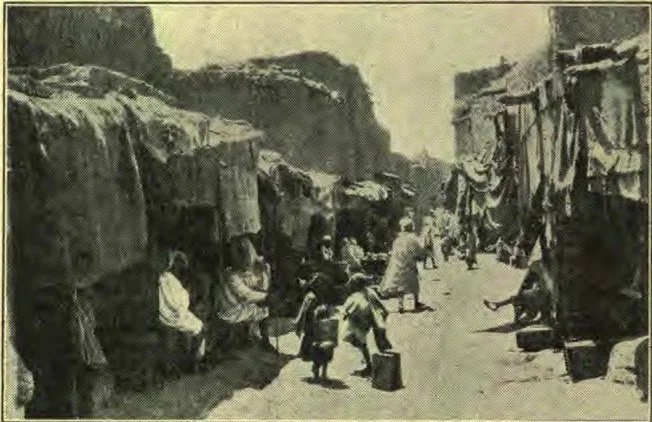
A STREET SCENE IN SIDI OKBA, ALGERIA
Algeria, a dependency of France, being acquired in 1830, is a wonderfully interesting country, teeming with a vast and heterogeneous population, all under French domination. Its principal cities, strung along the coast, are of great interest because of their ancient ruins scattered everywhere, and because of the peculiarities of the inhabitants. One feels continually as though walking among modern people inhabiting a dead world.
Algiers, formerly an Arab city, is the most beautiful of all in a country covered by cities that attract; but, as with all the other “show spots,” the French conquerors have so desecrated its houses and streets, and so much that was of value because of age or associations has been pirated, together with the cutting back of the quaint old Moorish dwellings which almost met overhead in the streets, and the introduction of the wide boulevards of France, well paved and brilliantly illuminated, that the contrasts and innovations are quite a shock to sentimentally inclined tourists. Especially is the damage prominent in the destruction of the sea front, which has lost the ancient aspect it bore in the days of the savage pirate kings.
“In this changeful north Africa, succeeding conquerors have imposed their civilizations and their work upon those of the conquered in a manner that has hardly a parallel in Europe. Carthage destroyed, Rome came in her might and built a hundred cities, conducted water, brought huge areas into cultivation, and made roads after her manner; and in due time overthrew her own ancient altars in zeal for a new faith. . . . All went down in a day before a troop of Arabians who rode as conquerors from Egypt to the Atlantic. Islam followed in their wake. The civilization derived from Europe disappeared; the water courses were broken, the desert resumed its sway, and the stones of Roman temples and basilicas went to build the mosques and villas of the visitors. For twelve centuries the creed of Mohammed held dominion; Europe was busy with its own affairs, and endured the insolent depredations and exactions of the deys with scarcely a serious attempt to suppress them. But at length the cup was full. An English fleet struck the first blow; and a few years afterward France took the subjugation of Algeria seriously in hand; and today European civilization is once more paramount in the ancient provinces of Rome.”—Stanford.
The most numerous and scattered of the peoples to be met with are the Arabs, the Berbers, the Mohammedans, the Jews, the Mzabites, and the border tribe of Biskris. Negroes are found everywhere. They do the heavy work as masons and on railroads. Their happy faces are a relief and contrast to the dignified and solemn demeanor of the Orientals. The Negro women are the servants and masseuses at the baths.
The Arab is a wanderer because his wealth consists of flocks and herds, which compels a change from place to place in search of pasture for his animals. Under the Romans the Berbers were all nominally Christians, but after the Arab invasion they adopted the religion of Islam, but had nothing else in common with their conquerors. The men are not inclined to wander, but dwell in the mountainous region, and are reliable, industrious laborers.
Mohammedans who live in the towns are called Moors. At the present time they have intermarried largely with the Arabs and Berbers. They are the chief merchants of the towns. Their wives go veiled, but the Berber women are unveiled, even living side by side with Moorish women who are veiled and relatives.
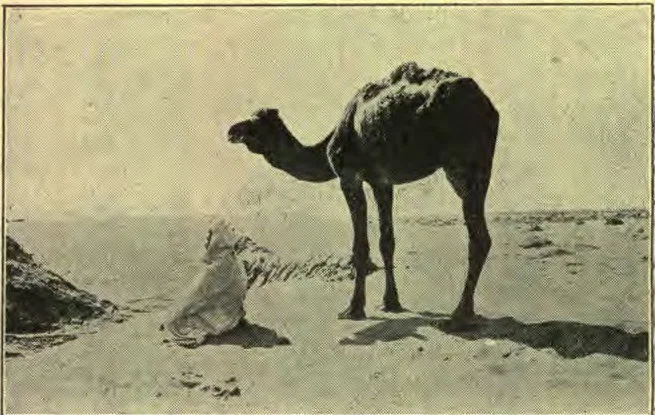
EVENING PRAYER
EVENING PRAYER
Another class of traders who are also skilled bankers, are the Mzabites, frequently seen in the cities, but whose home is far out in the desert, on the very borders of the Sahara, some four hundred miles from Algiers. They are energetic and persevering, and have created a city of their own on the desert sand, dug wells and found water, and have established a system of dams and irrigating canals to distribute the spring rains, so that they have a fertile and beautiful garden of green surrounded by the bare rocks and burning sand of the Sahara.
Another very low class, also from the Berber tribe, are the Biskris, whose home is in the east and far down in the desert at Biskra. They are the water carriers and scavengers of the cities. As they have Negro blood in their veins, they have somewhat of his happy nature and a love for bright-colored clothing, so that when gathered around the public fountain they form not only a pleasing but an amusing sight.
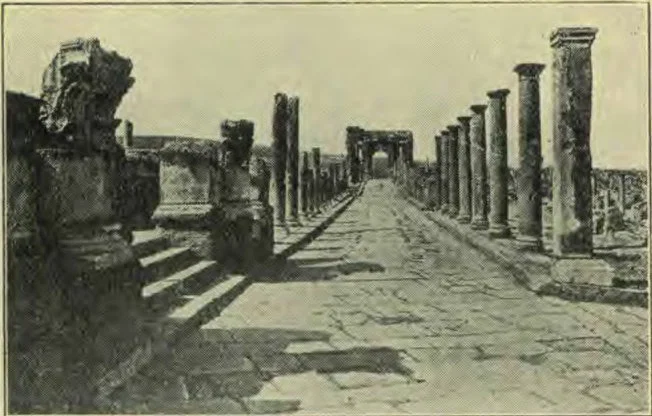
A STREET IN TIMGAD, ALGERIA
Algeria consists of two parallel ranges of mountains, the northern sloping to the sea and the southern toward the Sahara. The sloping sides of the northern range with its vast plains was once the granary of Rome. Between the two ranges lies a lofty plateau of barren sand, almost a desert. Occasionally oases with fresh water are found, and in these places a scanty population reside and earn a precarious living.
Four hundred miles west from Algiers lies the holy city of Tlemcen, of the Mohammedans. In every direction can be seen square whitewashed buildings surmounted by domes. They are called koubbas, the tombs of Marabouts, or saints, and are objects of veneration and the cause of endless pilgrimages. In its prime Tlemcen was once one of the great cities of Algeria, peopled by pure Berbers rather than Arabs. It was supposed to have had a population of 150,000.
Two hundred miles east of Algiers lies the city of Setif, a city 3,573 feet above the sea. It is the center of a vast grain-growing country once the granary of Rome, a great sea of grain without a single tree. East of Setif the mountain slopes down to the valley of the river Roumel, which forms the moat of the rock-girt city of Constantine. The whole hillside is full of the remains of Roman cities and public buildings.
The city of Constantine is built on a plateau formed by surrounding chasms or ravines 1,000 feet deep, the top of this circular peninsula being the city itself. It has no connection with the mountain except in one place. It is said that the city has withstood eighty sieges. Its original name was Cirta, but the Romans renamed it Constantine, after the daughter of the emperor. The Jewish population of the city is very great, and the Jewish women of this city are said to be the most beautiful women in the world.
Two hundred and eighty-eight kilometers from Constantine begins the great Sahara at the oasis of Biskra, and a short distance from this place, at the village of Batna rise the Aures Mountains. They are of no especial interest except for the character of their inhabitants. For centuries this far desert region was an asylum for the fugitives from the armies of the many nations, tribes, and peoples, escaping in the various wars that have desolated Algeria. There is therefore no distinct class or peoples, as intermarriage has obliterated all racial lines, yet there is a noble dignity in their bearing, and their classic faces impress the beholder. Their isolated position has made of them a peculiar people in language, customs, and habits. “Their language is full of Latin words. They observe the twenty-fifth of December as a feast, under the name of Moolid (the birth). They use the solar instead of the Mohammedan lunar month, and the names of the months are the same as our own.”—Stanford.
To the north of Batna lies El Kantara, where the mountain suddenly splits into a deep narrow gorge, which the Arabs call the Mouth of the Sahara. In front is a beautiful oasis having an abundance of olive and palm trees. Continuing to descend until the hills are left behind, the traveler will reach Biskra on the very borders of the desert. Unlike any other city in Algeria, Biskra is distinctively African in all its attributes. It consists of a score or more of native villages ruled over by a French garrison, occupying a large oasis some four or five miles long and with an average width of about a mile. It contains an immense number of palm trees which constitute the wealth of such places. The city is populated by representatives of every tribe in Africa in almost countless numbers, like flies, added to which are a large proportion of Negroes. Two hundred and twelve kilometers farther south is Tuggurt, a desert town containing 200,000 palm trees.
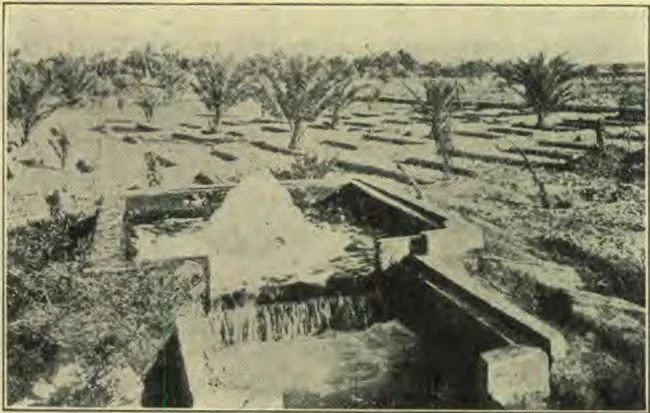
AN ARTESIAN WELL
AN ARTESIAN WELL
The desert of Sahara is commonly regarded as a vast region of arid, bleaching sand, a scene of perpetual desolation. One can travel, however, for days over the rocks of the Sahara and not see sand enough to fill one’s hat. Rain falls everywhere, and the most destructive storms come at points which are the driest. The region has always an abundance of rain, but it leaches through the sand and falls into the underground rivers. Wherever the natives dig wells, or where modern methods are used and wells bored, with the coming of the water vegetation springs up like magic, and a glorious oasis forms, to be soon quickly populated and cultivated. Ninety per cent of the Sahara is composed of rock, however, and there is, therefore, more or less barrenness, as no water can be procured in such places.
The coming of the French well digger in 1856 was a great event. The people at that time were still unfriendly and even hostile, and gave the workers very little encouragement, but when, after twenty-two days of incessant work, the bore threw out a giant stream of a thousand gallons a minute, the people went wild with excitement and enthusiasm. Their feelings toward their conquerors changed at once, and they have ever since remained cordial. The oases so created, however, can never sustain dense populations, because the regions are unhealthy, malignant fevers and chronic diseases always prevailing. Then, too, the changes in the summer climate are trying, the change from 120° F. to freezing often occurring in one and the same day. Only the Arabs and Berbers seem capable of enduring these excessive changes.
The horse and the mule are of little value in the great desert. The employment of the camel is a necessity, but the French had much trouble in learning how to treat and to work them. At first they were treated with contempt, the habits and wants of the creatures being misunderstood. The common idea was that the camel is an animal of great speed and endurance, going without water or food for long periods without serious results. This occasioned much suffering and great loss. The facts are that the camel requires just as much food and care as does a horse, the only difference being that it can stand greater irregularity in its meals. This ability and the fact that it can drink enough water at a time to last it for several days make it of use in desert wastes. The camel can work for half the year and subsist on the scanty vegetation of the Sahara, but his diet for the rest of the twelve months must be rich and abundant, or some morning without a sigh or groan, when apparently well, he will quietly lie down and die.
“For a caravan of camels traversing the desert, the stomach of the beasts is the sovereign lord of marches and halts, the director of the daily program; day and night, the fatigue and hunger and sleep of the men do not enter into the account; everything is subordinated to the single necessity of nourishment for the herd. Whenever a little edible vegetation is found, at whatever point of the itinerary, a halt is made for several hours or several days; in the intervals, even as happens sometimes of two or three kilometers or of five or six days, progress, slow and regular, is made without truce, almost without sleep, beneath sun and stars alike. One can stop only at a pasturage; a voyage in the Sahara is a hunt for a blade of grass.”—Stanford.
Before the present European war, Algeria had a shipping interest of 109 vessels with a total tonnage of 11,290,600. Now, because of the submarine campaign in the Mediterranean, not over fifty vessels are engaged in trade. Aside from these a large number of other vessels have been sunk, so that over fifty per cent of the vessels doing business with Algeria have disappeared.
The main source of wealth in Algeria is in her vintages and in export of garden produce to France, but these industries have suffered severely. The port of Algeria, the capital, has been hit the hardest, more than sixty per cent of its tonnage having been destroyed.
Oran, the next largest port, has suffered sadly. Its exports consisted, mainly, of vegetables, of which large quantities were carried to France, 10,250 tons of artichokes, peas, green beans, tomatoes, and other vegetables, in the course of a year. This explains, in part, the augmented cost of living in France, and the stringency of the money markets in Algeria.

Lest We Forget

“OUT of sight, out of mind,” is a saying quite too true. Porto Rico, though it has many more than one million inhabitants, is so small that some find it difficult to locate on the map.
That more interest may be taken in the work of giving this message to the Porto Ricans who sit in darkness, we wish to do something to keep the thought of it before you.
At this time of year the climate is all that one could desire, but for several months during the summer time the shade is eagerly sought. Jonah could not have taken more pleasure in the shade of his gourd than we have in the shade of a volunteer “moon vine.” This one root produced such a wealth of vine that it practically covered an arbor about 24 x 18 feet and 12 feet high. We could almost see it grow as we enjoyed the shade of its immense leaves. Then came a wilderness of beautiful white blossoms. Now the seeds encased in their curious rattleboxes, are ready to harvest.
We are sure such an arbor or a similar porch at your home would help you to think interestedly of the work being done in Porto Rico, and might help you to see how you can consecrate self and means to the furtherance of the cause of the Master in this beautiful island.
To this end we offer to all who send a two-cent stamp a small package of these seeds, which resemble pressed rose beads. When writing, if you inclose extra postage we shall be glad to use it for placing literature in the hands of the people here.
Those interested may address my mother, Mrs. D. A. Fitch, 12 Cerra St., Santurce, Porto Rico.
D. D. FITCH.

Our Work in Algeria

ALGERIA was entered by our workers in 1905. Elder J. C. Guenin is located at Algiers, Algeria, and Elder W. E. Hancock at Jose Abella. Brother R. T. E. Colthurst is our missionary licentiate in that field. He, with his young daughter, went to Algeria before the European war. They spent some time in Algiers, but last fall moved to Mostaganem. Miss Agnes, in a personal letter, gives us a brief glimpse of her home town and of her work, which will be of special interest after reading the article in this number written by W. S. Chapman on Algeria. Miss Colthurst says:—
“Mostaganem is a small town, but ancient, which is gradually being modernized and extended. It, like Algiers, is on the coast of the Mediterranean Sea. The climate is hot in summer, but we do not feel the heat as we did in Algiers; the winter is much colder.
“The population of this town is chiefly composed of Berbers, Jews, Spaniards, and a few French families. The Jewish women wear a black silk scarf, which covers all the hair, and is gathered together on one side, allowing the ends to hang down on the shoulder. They also wear a shawl, woven by themselves; its color is a red brown. This is to cover their shoulders and backs, and comes down over their dresses about halfway.
“We have a few large buildings here, such as the girls’ high school, the boys’ college, where there are now some Serbian students, the large military hospital, the Arab boy school, and the barracks. The new bank is quite pretty, but is not so large as the one at Algiers. The post office is small, too. The market is served by the Arab and Spanish folk. Fruits and vegetables are plentiful, but just now things are very high here.
“Our house is situated near the sea, and from our large balcony, which is at the rear of the house and overlooks our proprietor’s garden, we have a lovely view of the bay and of the mountains on the other side. In summer time the sunsets are beautiful, with red and orange hues.
“I am busy looking after the house for papa, and trying to keep up certain studies. I am trying also to do my part in the missionary work. I have the children’s French Sabbath school class, and I teach them to sing and memorize Bible verses, and I teach them the Old Testament stories. So far we have been getting along well. On Thursdays we meet for practice and study, and on Friday night we have a children’s prayer meeting, which papa has given over to me, while he takes the adult Spanish folks.”

Sending the Angels

FOR months we had been deeply interested in several girls in our church, and had put forth every effort to lead them to turn from their reckless lives, and serve the Master. At last the victory was won, and for some weeks they had done nobly, attending Sabbath school and church, studying their Bibles, and endeavoring to exert a good influence over others.
One day their teacher came to my office greatly agitated. She said, “The enemy has got hold of our girls, and unless something is done immediately, all our efforts will be in vain. The old crowd of their former associates has persuaded them to go tonight to Coney Island.”
We bowed down and prayed, and I was particularly impressed with the petition in the teacher’s prayer, asking that God would at that very hour send angels to arrest the girls, and save them from going to that wicked place.
The sequel we learned the next day. The girls had started out, intending to join their wild companions at a place agreed upon. They had secured transfers, but on reaching the meeting place, suddenly the leader said to her associates, “Let’s not go to Coney Island, but let us go to church.” Immediately the other party began to urge and insist, and finally to scoff and ridicule; but, in spite of all their effort to dissuade them, our girls took another car, paid their fare, and came to church, and were loyal to their faith. We have always believed that the Lord literally answered the teacher’s prayer, and sent the angels to rescue those girls.
MEADE MACGUIRE.

Springtime Praises

WE offer our praise for the springtime, Which God has commanded each year, For soft, balmy breezes refreshing, For sunshine, with healing and cheer;
For the blooming white dogwood that mingles With manifold shades of the green, Its white, branchy hands ever stretching, Gleam out here and there in the scene;
For birds with their songs ever vying, The mocker, the robin, the wren, With cardinals, bluebirds, and thrushes, Bringing courage and promise again;
For dainty wild blossoms unfolding In woodland and meadow so bright; For clear, purling waters, that babble By day and by night of delight.
The pean of praise is resounding For life the Creator bestows; And we, above all, should be singing While love in our hearts warmly glows.
ELIZABETH McHUGH

Man’s Mortality

[The following beautiful poem is justly considered a literary gem of the highest order. The original is found in an Irish manuscript in Trinity College, Dublin. There is reason to think that the poem was written by one of those primitive Christian bards in the reign of King Diarmid, about the year 554.]
LIKE a damask rose you see, Or like a blossom on a tree, Or like the dainty flower in May, Or like the morning to the day, Or like the sun, or like the shade, Or like the gourd which Jonah had, Even such is man, whose thread is spun, Drawn out and out, and so is done. The rose withers, the blossom blasteth, The flower fades, the morning hasteth, The sun sets, the shadow flies, The gourd consumes, the man—he dies.
Like the grass that’s newly sprung, Or like the tale that’s new begun, Or like the bird that’s here today, Or like the pearled dew in May, Or like an hour, or like a span, Or like the singing of the swan, Even such is man, who lives by breath, Is here, now there, in life and death. The grass withers, the tale is ended, The bird is flown, the dew’s ascended, The hour is short, the span not long, The swan’s near death, man’s life is done.
Like the bubble in the brook, Or in a glass much like a look, Or like the shuttle in a weaver’s hand, Or like the writing on the sand, Or like a thought, or like a dream, Or like the gliding of a stream, Even such is man, who lives by breath, Is here, now there, in life or death. The bubble’s out, the look’s forgot, The shuttle’s flung, the writing’s blot, The thought is past, the dream is gone, The waters glide, man’s life is done.
Like to an arrow from the bow, Or like swift course of water flow, Or like that time ’twixt flood and ebb, Or like the spider’s tender web, Or like a race, or like a goal, Or like the dealing of a dole, Even such is man, whose brittle state Is always subject unto fate. The arrow’s shot, the flood soon spent, The time no time, the web soon rent, The race is run, the goal soon won, The dole soon dealt, man’s life soon done.
Like to the lightning in the sky, Or like a post that quick doth hie, Or like a quaver in a song, Or a journey three days long, Or like snow when summer’s gone, Or like a pear, or like a plum, Even such is man, who heaps up sorrow, Lives but this day, and dies tomorrow. The lightning’s past, the post must go, The song is short, the journey so, The pear doth rot, the plum doth fall, The snow dissolves, and so must all.

Try It

“A BOY was given a beautiful canary bird, which filled the house with its music. Soon after, his mother was taken ill, and the singing of the bird troubled her. So the lad took it to the farthest corner of the house. Even then, the faint notes of the bird were heard by the invalid, and the lad gave it to a friend. When his mother knew of it, she said, ‘But, son, you loved the bird.’ ‘Yes, mother, but I love you more.’ A giving up of that which pains a loved one, ‘in honor preferring one another,’ goes a long, long way toward the consecration of the home life.”

Hugh M. Smith and the Bureau of Fisheries

The man who knows the most about fishes of any one in the country is Mr. Hugh M. Smith, chief of our Bureau of Fisheries. His knowledge brings him a salary of $6,000 a year.
Continue reading: ONE THOUSAND YEARS IN HEAVEN