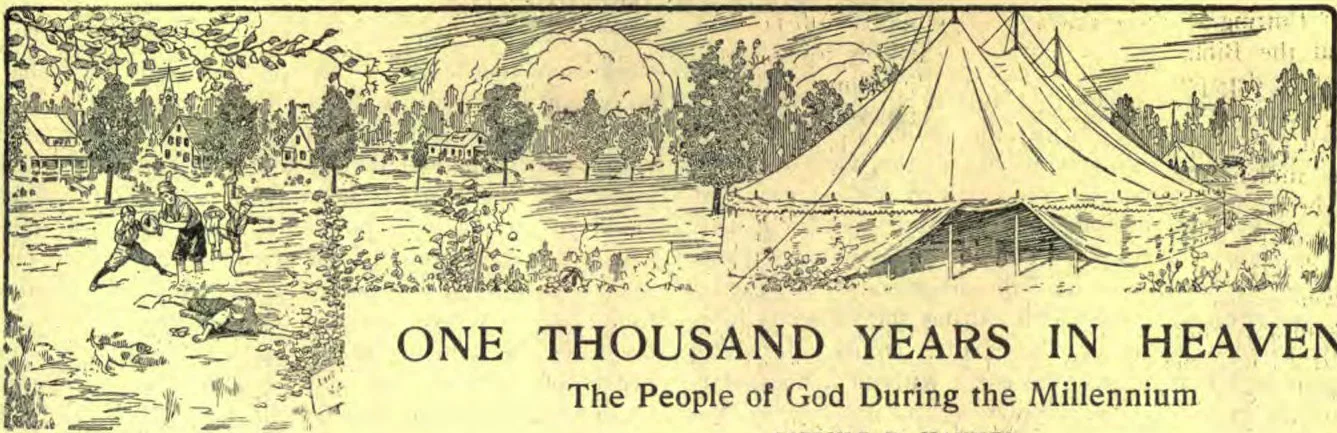
The subject of the sermon on Thursday night at the tent had been announced as “The Millennium.” Donald was very eager to hear this sermon, for, several weeks before, the superintendent of his Sunday school had talked to the children about the time when there was to be no war, and all the world would be converted. Donald wanted to learn more about this glorious time.
Brother Harris began his sermon by speaking of the ideas which men had taught about the millennium. He described the very thing that the Sunday school superintendent had spoken of to the children. Then he said this theory was not taught in the Bible. Donald was so surprised that the superintendent had been wrong that he leaned forward with much interest to catch every word.
“The word ‘millennium,’” continued the speaker, “comes from two Latin words which mean ‘a thousand years.’ This is all the word means, just a period of a thousand years. It does not mean at all what its perverted use has come to convey to many minds—a thousand years of peace, prosperity, and salvation upon this earth.
“The millennium begins with the second coming of Christ. During the thousand years, Satan will be bound in some place called ‘the bottomless pit.’ During the same time, God’s people will ‘live and reign with Christ.’ All this is taught in Rev. 20: 1-5, which is the only passage in the Bible that makes direct reference to this thousand-year period.
“The Bible does not teach that all the nations will be converted before the end of the world. In fact, it teaches just the opposite. The world will grow worse and worse until the end, instead of better and better. You will read this in 2 Tim. 3: 13.
“In the parable of the wheat and the tares, recorded in Matt. 13: 24-30, 36-43, it is made plain that both the righteous and the wicked will ‘grow together’ until the ‘harvest,’ which is ‘the end of the world.’ At the end of the world, therefore, instead of all the wicked’s being converted, they will be cast into a furnace of fire, and be consumed.
“In Luke 17: 26-30, Jesus declares that the condition of the world just before his second coming will be like that before the flood, and also like that of Sodom and Gomorrah in the time of Lot. A description of the time preceding the flood is found in Gen. 6: 5, where it says that ‘the wickedness of man was great.’
“Another picture of the last days is given in 2 Tim. 3: 1-5. Here is a list of nineteen terrible sins that are especially to characterize the last days. The astonishing thing about this passage is that it is a description of the church, and not especially of the world. If the professed church of Christ can be thus described in the last days, the condition of the world at large must be infinitely worse. The world will not be converted to the church, but the church will be converted to the world.
“This very theory of the world’s conversion and a thousand years of peace is in itself a sign of the near coming of Christ, for I read in 1 Thess. 5: 1-3 that ‘when they shall say, Peace and safety; then sudden destruction cometh upon them.’”
Donald was wondering how his Sunday school superintendent had got so mixed up on this matter, and on what he based his opinions, when Brother Harris began to explain.
“There are prophecies in the Bible of a time in the future when all the earth will worship the true God, but it is the earth in its regenerated condition of which the Bible thus teaches, when all things are made new, and not the earth as it is now. It is because these prophecies have been misunderstood, and made to apply to the earth in its present condition, that the truth of the millennium is misunderstood.
“Isaiah speaks of a time when ‘the earth shall be full of the knowledge of the Lord, as the waters cover the sea.’ Isa. 11: 9. He says again that every Sabbath day ‘shall all flesh come to worship’ before the Lord. Isa. 66: 23. This is all in the new earth, as you will see by reading Isa. 65: 17-19 and 2 Peter 3: 10, 13.
“We will now study the order of events in connection with the millennium. It begins at the second coming of Christ. At this time there are four classes of people on the earth. They are the righteous living, the righteous dead, the wicked living, and the wicked dead. Let us see what becomes of each class.
“In 1 Thess. 4: 16 we are told that when Christ comes the second time, all the righteous dead will be raised to life. In the next verse we read that all the righteous living will be caught up together with the righteous dead, who have been raised to life, to ‘meet the Lord in the air.’ They do not remain in the air, but are taken with Christ to heaven to live in those mansions which Jesus has gone to prepare. This is certainly taught in the words of John 14: 1-3. Jesus there said he would come again to receive his people unto himself, ‘that where I am, there ye may be also.’ He takes them all to heaven, where they remain a thousand years. In Rev. 20: 4 we catch a glimpse of them living and reigning with Christ during this period. Thus it is plain that during the millennium all of God’s people are in heaven, and not on this earth.
“Now, the wicked dead are not raised at the coming of Christ, but remain in their graves. ‘The rest of the dead lived not again until the thousand years were finished.’ Rev. 20: 5. This leaves only the living wicked for us to consider. These, we are told, are destroyed by the glory and brightness of his coming. 2 Thess. 2: 8.8
“Putting all these passages together, it will be seen that the Bible teaches that this earth is to be completely depopulated during the millennium. All the righteous will be in heaven, and all the wicked will be dead. A description of the earth at the beginning of the millennium is found in Jer. 25: 33, which says, ‘The slain of the Lord shall be at that day from one end of the earth even unto the other end of the earth.’ A description of the earth during the millennium is given in Isa. 24: 1, 3. The earth is empty. Jeremiah again says that he saw the earth without a man here, and all its cities broken down at the presence of the Lord. Jer. 4: 23-27.
“A waste, a desolate wilderness—this will be the condition of the earth during the millennium. And in this earth Satan will be bound. This earth in its desolate condition is ‘the bottomless pit’ of Satan’s captivity. The chain which binds him is not a real chain of iron and steel, for no such chain would hold him. Rather it is a chain of circumstances, and the circumstances are these: He has no one to tempt, he is unable to do anything. He cannot tempt the wicked, for they are dead. He cannot tempt the righteous, for they are in heaven. He is bound. His angels are also bound here with him.
“At the close of the thousand years the holy city, the New Jerusalem, comes down from heaven and rests upon the earth. Rev. 21: 2. In this city are the people of God who have been in heaven a thousand years. At the end of the thousand years the wicked dead are raised to life. This releases Satan from his bondage, and he goes out to deceive the nations which are now in the earth. Rev. 20: 7. He marshals them into companies and battalions to attack the holy city, which they see before them. In the great confederacy of evil now commanded by Satan are the giants who lived in the earth before the flood. The great generals of the world’s greatest wars are there, just as eager as ever to destroy their opponents. Satan leads them to believe they can overthrow and capture the holy city.
“Led by this delusive hope, they make the attack. You will find the account of this last great battle in Rev. 20: 7-9. Fire comes down from heaven and devours the great host of the wicked. This is the second death, from which there will never be any recovery. This fire also brings Satan and his angels to death. This is the end of the long, long conflict which has raged through the ages between Christ and Satan. It ends in the utter destruction of Satan and all who have allied themselves with him.
“The fire which consumes the wicked will also purify the earth. Great billows of flame will burn the ruined works of men. The last remnants of sin and sinners will be consumed. ‘The elements shall melt with fervent heat, the earth also and the works that are therein shall be burned up.’ 2 Peter 3: 10.
“After the desolation of the millennium and the purifying fires at its close, the earth will blossom again and become the home of the redeemed of the Lord. ‘Blessed are the meek: for they shall inherit the earth.’ Matt. 5: 5. Then shall be fulfilled the prophecy of Isaiah 35. Read the entire chapter, and notice the expressions, such as, ‘The wilderness and the solitary place shall be glad for them [the redeemed]; and the desert shall rejoice, and blossom as the rose. It shall blossom abundantly, and rejoice even with joy and singing: the glory of Lebanon shall be given unto it, the excellency of Carmel and Sharon. . . . In the wilderness shall waters break out, and streams in the desert. And the parched ground shall become a pool, and the thirsty lands springs of water.’
“And now,” said Brother Harris, “hear me as I close. Every person in this audience tonight will be present at the end of the millennium. You will be either in the city of God with Christ, or on the outside in the great host of the wicked. It may depend upon the decision you make, or that you fail to make, tonight as to where you will be. Oh, my friends, do not resist the influence of the Spirit of God upon your hearts, but prepare yourselves, by the grace of Christ, to meet Jesus in peace when he comes! Behold, he cometh, and that very, very soon. Let us be prepared to enter into those glorious mansions which he is now preparing.”
As Brother Harris closed, Donald found himself leaning far forward in his seat, intently listening to each word, and his cheeks were wet with tears. Never before in all his life had he heard anything so wonderful as he had heard this night. The future life seemed real to him now. He felt he understood just what was coming, and the determination in his heart to be ready to meet Christ, and go with him to heaven, was very much strengthened by the sermon.
Stir Me
“Stir me, O stir me, Lord! I care not how.
But stir my heart in passion for the world:
Stir me to give, to go, but most to pray:
Stir, till the blood-red banner be unfurled
O’er lands that still in heathen darkness lie.
O’er desert where no cross is lifted high.
“Stir me, O stir me, Lord! till all my heart
Is filled with strong compassion for these souls:
Till thy compelling ‘must’ drive me to prayer:
Till thy constraining love reach to the poles,
Far north and south, in burning, deep desire;
Till east and west are caught in love’s great fire.
“Stir me, O stir me, Lord! Thy heart was stirred
By love’s intensest fire, till thou didst give
Thine only Son, thy best-beloved One,
E’en to the dreadful cross, that I might live:
Stir me to give myself so back to thee
That thou canst give thyself again through me.
“Stir me, O stir me, Lord! for I can see
Thy glorious triumph-day begin to break;
The dawn already gilds the eastern sky!
O church of Christ, awake! awake!
O stir us, Lord, as heralds of that day!
The night is past, our King is on his way.”
Soul-Winning: A Book by Elder George B. Thompson
“Soul-Winning”
ELDER GEORGE B. THOMPSON is the author of a stirring book which bears the foregoing title. Soul-winning is the most important thought that can engage our attention in this hour. Let us get this book and read and reread it. The poem “Stir Me,” is quoted by Elder Thompson, and surely will become the heart prayer of all who read the book. Order of your tract society or of the Review and Herald Publishing Association, Takoma Park, D. C. Cloth binding; price, 75 cents.
Review of Back to the Bible by George McCready Price
“Back to the Bible” is a book by George McCready Price, author of “The Fundamentals of Geology.” Mr. Price’s books are instructive and entertaining. Every minister, and every young man looking toward the ministry, will find “Back to the Bible” a book of interest. Order of your tract society, or of the Review and Herald Publishing Association. Price, fifty cents.
The Dream That Did Not Come True
By Laura E. Buck
It was a beautiful winter evening. Robert Masters had returned from a party with his young friends, and had thrown himself into his father’s armchair before the grate. The fire burned low. He was the only occupant of the library, and had ample opportunity for reviewing the incidents of the evening. As he gazed into the fire, the evening’s pleasures began to assume a different aspect from that which had at first impressed his mind.
Lower, still lower drooped his head upon his breast. Absolute silence reigned in the room. And now an aged man is sitting there before the fireplace, his brow marred by many a furrow, his gray hair but sparsely covering his once noble head. A twig from the hemlock near by taps upon the window pane. Mournfully he raises his eyes toward the midnight sky, where myriad stars fleck the pure blue of its surface. With a sigh he remembers how that same blue sky had met his gaze forty or more years before, when at the age of twenty he felt the awesome hush which came when his father traced for him the mystery of the Two Roads. The one lying to the right, though at first more stony and wearisome to travel, would by each kindly thought and worthy act become smoother day by day, and would finally lead to the land of pure delight. Then he was told of the other road, smooth, brilliantly lighted, where the people live for the happiness of the day. Instead of ascending the mountain side as does the other, it winds around and around, ever downward, until lost in the gulf of despair. He remembered how at first he had tried to pave his way with kind deeds, but soon grew weary of this, and chose the path which for the time seemed more pleasant, until now he felt that the years that had passed had left behind mere husks instead of ripened grain.
His hands, as they lay on the arms of his chair, trembled with age, and he realized full well that his days were numbered. In agony of mind his eyes sought again the blue sky, and he cried out from the depth of his despair, “O youth, return! O father, let me stand once more at the choosing of life’s ways, that I may take the better part!”
But even as the tones of his own voice fell upon his ear, he realized that the days of his youth were indeed gone, and that his beloved parents had already “crossed the bar.” He could see the wandering lights hovering over the murky morass before him,—then the dark, and the hissing of serpents eager for their prey. Rising unsteadily from his seat, his breath coming in gasps, he raised his hands heavenward and wailed, “Is this death? Oh! is this death?” Then forward he fell upon his face, prone before his Master.
The clock in the high church tower struck. Its tones broke upon the stillness of the night, and Robert Masters awoke with a shudder from his deep dream of woe. As he raised his eyes again to the sky above, his heart was filled with thankfulness for his youth, for the privilege of even yet choosing the true, pure life of service for his Master; and even though he might not hear acclamations of praise for his deeds of great valor, yet in the end he should find ripened sheaves instead of the husks of this life’s pleasures. And to such the Master will say, “Thou hast been faithful over a few things, I will make thee ruler over many things.” LAURA E. BUCK.
A Dream
By J. L. TUNNELL
I LAY in the Valley of Plenty
Surrounded by comfort and love,
And gazed at the fair land around me,
And then at the clear sky above;
And thought to myself, What a fable.
That sorrow could ever exist.
All things are so free and so happy,
All sadness this world must have missed!
I then fell asleep, and an angel
Of light came and stood by my side,
And taking my hand, led me forward
Through a bright, pleasant road; was my guide
Until we came near to a mountain,
When he soon turned around, and explained,
“Over there is the Valley of Sorrow,
The thought of which you have disdained.”
He left, and I kept on a-climbing;
The top was now drawing quite near;
In a minute I’d stand on the threshold
Of poverty, sorrow, and fear.
I had finished my wearisome climbing,
And I stood on the top of the hill
Overlooking the Valley of Sorrow,
Where struggled the weak and the ill;
Some near to the end of the journey,
Still others but barely begun;
They all seemed to struggle with burdens,
And curse at the heat of the sun.
The valley was long, but still longer
The throng that had filled it with woe,
And in anguish I lifted a heart prayer
To my God, for the people below.
J. L. TUNNELL.
Treasure in Heaven
By Lawrence Earl Carr
Why toil I here so earnestly
For all this earthly ware,
For when I go into the grave,
No riches follow there;
And when the doors of life are closed,
And all earth’s toil shall cease,
Then, if my riches are in heaven,
My soul shall rest in peace.
Then I shall waken from death’s sleep
As from a pleasant dream,
Nor find its night so cold and dark
As parting death might seem.
Lord, help me now to work each day,
To place my treasure there,
That other souls for whom Christ died
May reach those mansions fair.
LAWRENCE EARL CARR.
A Tract Experience
By Lyle Shepard
About ten years ago, a woman while waiting at a depot in one of the towns located in the central part of the West Michigan Conference, took a leaflet from a tract rack and read to pass away the time. She was not a Christian, and did not read very much, but what she read impressed itself upon her mind. In substance it was that the New Testament taught that the seventh day, commonly called Saturday, was the Sabbath; that Christ was crucified on the sixth day and rose the first day; that the Sabbath came between the two, therefore it of necessity must be the seventh day. She said to herself that this was so, and if she ever became a Christian she would keep the true Sabbath.
About three years later sorrow came into her home, and as a result she gave her heart to the Lord. She started to keep the Sabbath, and has observed it ever since. Within the past six months seven of her relatives have joined her in the message.
Our tracts are like seeds. If we sow them, God will see that they are properly watered, and give an abundant increase. LYLE SHEPARD.
Life Lived in Running Water
By Dr. C. W. Saleeby
WE know that the water of the earth is continuously moving. “All the rivers run into the sea; yet the sea is not full.” The sun lifts water into the air, whence it falls as rain and replenishes the streams. That is exactly what life requires. Stagnant or standing water will not avail it for long. The water of life must not only be wet, so to say, but it must ever flow. All life is lived in running liquid water. If the flow ceases, the life stagnates and shortly dies.
The rule is absolute. The driest seeds, or spores of microbes, or those most minute objects that no microscope can reveal and no filter retain, may survive, with all their malignant possibilities, for months or even decades of years. But it is only when they get into a stream of water that they can really live and multiply.
Such a stream of water they find in any one of us whom they may attack in order to produce what we call mumps or scarlet fever or measles. For each of us, being alive, is a reservoir, or rather a running river, of water. Nearly three fourths of the weight and substance of each of us is merely water, and this water is ever flowing through us. It is almost as if the living creature were like a turbine or mill wheel, which placed itself in the stream of water that ever circles through land and sea and sky under the compelling force of the sun.—Dr. C. W. Saleeby.
JOSEPHINE VAUGHN
By Josephine Vaughn
Spring
ALL hail to thee, thou fragrant spring!
As nature robes itself in green,
We with the birds a welcome sing
At thy return, O gracious queen!
The hyacinth and tulip grace
The dewy sod, o’er hill and vale;
The violet lifts her lovely face
With perfume sweet and beauty frail.
The dandelions look as bright
As glorious stars upon the grass;
The fruit trees dressed in bridal white
Waft fragrant greeting as we pass.
O nature, sweet with springtime’s mirth,
Thy fruits and flowers shall fade away,
But still thou teachest of that earth
Where there shall be eternal May!
There shall we dwell when, robed in white,
We rise to join the angel throng,
And share with them heaven’s pure delight,
And join with them in Moses’ song.
JOSEPHINE VAUGHN
A Marvelous Memory
ANTONIO MAGLIABECCHI, librarian of the Grand Duke Cosimo III of Florence, is said to have possessed a most extraordinary memory. If a priest wished to compose a panegyric on a saint, the librarian could tell him all the references to the saint in literature, even to the parts of the different works wherein they were to be found.
He could tell not only who had treated a subject fully, but also who had touched on it incidentally in writing upon other subjects.
When Magliabechi visited other libraries, his memory was so remarkable that he needed to see and consult a book only once in its place to fix everything about it permanently in his mind. Once the grand duke asked if he could get him a certain book.
“I am sorry, Your Grace,” replied Magliabechi, “but there is only one copy in the world. That is in the library of the grand seignior at Constantinople. It is the seventh book on the second shelf on the right as you enter.”— Selected.
Notes of Interest
Out of 2,682 persons treated the first year that Pasteur was experimenting with his hydrophobia vaccine, only thirty-one succumbed.
There is being installed on Mt. Wilson, California, the most powerful telescope in existence. It is to be equipped with a one-hundred-inch mirror.
Henry S. Graves, our National Forester, is said to know by their Latin names every species of tree in the United States, besides many outside of this country. Such cyclopedic knowledge is not represented by every $5,000 salary.
On the banks of Lake Titicaca, as well as on the islands of the lake, at an elevation of nearly thirteen thousand feet, a curious variety of corn is raised. The ears vary from one inch to two and one-half inches in length. Last year this type of corn was planted near San Diego, California, and within sixty days a crop of corn, with ears twice the size of the Peruvian variety, was produced.
A fish valued at $1,000 was recently on exhibition in one of the big department stores of St. Louis. The fish, which is a very rare one, is of Japanese extraction and is called Takanawhaskimadojo, but more popularly known as the “Dojo.” It is said to be able by its movements to forecast a storm, and to be able to live twenty-four hours when out of water. It was part of an exhibit of the National Aquarium Society.
The thorny cactus, otherwise known as the prickly pear, hardly seems a pleasing or comfortable diet to any one who has ever encountered its spines; but in the southern portion of the United States which is its native habitat, the thorny cactus has for some years been used as a winter food for stock. The needle-like thorns are singed off with gasoline torches. In an average growth of cactus one man can singe enough cactus in one day to feed several hundred beef cattle.
Dr. Richard Mueller prescribes a diet for people whose hair is thinning and becoming gray and lusterless; for an extra supply of hair-forming material must be taken into the body. As hair contains five per cent of sulphur and ashes, raw milk and oatmeal—which contains twenty-two per cent of sulphur—are prescribed. Rye bread and raw eggs give iron and lime; and for centuries carrots have been a remedy for hair-growing, though nobody knows exactly why.
*A woman’s thimble, according to the Popular Science Monthly,* suggested the first gas burner. William Murdock, the inventor, first burned the gas as it came from the end of a pipe. One day he wished to stop the illumination quickly. Looking round for an extinguisher, he seized his wife’s thimble and thrust it over the light, which immediately went out. There was a strong odor of gas, however, and Murdock, seeing that the end of the thimble was full of tiny holes, touched a light to it. Through all the holes, jets of flame appeared, and the experimenter was surprised to find that the illumination from those tiny jets was greater than that given by the flare from the end of the pipe. Acting on the principle that this chance discovery revealed, Murdock made what was known as the “cockspur burner.”
A Prodigal’s Purpose — A True Story
By Frank Hampton Fox
“PAPA, there’s a man downstairs who wants to see you.”
“I’m preparing for a funeral, and must start in half an hour; I don’t see how I can see any one now.”
“I told him that you’re dreadfully busy; but he looks awfully sad, and says he must see you,” answered eight-year-old Rachel.
I hurried down to the little sitting-room, determined to dispose of the agent, visitor, solicitor, or whatever he might be, as quickly as possible.
“George!” I exclaimed, and could say no more, so great was my amazement.
“Yes, Fox, it’s George.”
“But how do you come to be here? I thought—”
“That I was still in Lansing; no, I’m not there; neither have I broken jail; I’m out on parole. You have a funeral today; there’ll be plenty of time for us to talk matters over later. Just now I’m hungry and broke; I have a job on the Journal, and begin work Monday morning. Can you grubstake me until I draw my first pay?”
“But, George,” I protested, “why did you come back to Kansas City where everybody—”
“Where everybody knows my past,” he said with a shade of bitterness in his tone. “You probably think I’m a fool,” he continued; “but I’ve learned that a man can’t hide himself in this world. That is especially true if a man expects to make something of himself. If I could content myself to sink into oblivion and forever hide my face, it is not likely that any one would ever take the pains to look up my record, and publish to the world the choice bit of scandal that George Rendel had served a prison sentence. But, Fox, I’m going to make a man of myself in spite of past failure and the fact that many good people have conferred on me the degree of N. G.
“I regret—that’s not the word; I deplore, no, I execrate my past. I know that I can’t blot it out; there it is, and there it will remain forever a black page against me. But the future is mine—do you understand me, Fox?—the future is mine, and I’m going to make good. I don’t propose to go where I’m not known, and work my way up to the top, and then have some busybody discover that I’m an ex-lawyer, ex-minister of the gospel, and last of all an ex—O, how I hate that term! I wish they’d blot the hateful word out of the language—ex-convict. No, sir; I’m going to work here in Kansas City where everybody knows me and my failures. Right here I expect to make good.”
“Splendid!” I exclaimed. “George, if your mind is committed to that undertaking, you will win. You have talent: few men possess the gifts that you enjoy. The climb will be difficult; the road is steep, but not so precipitous that you can’t climb it to success.”
“Come into the kitchen and have something to eat. Excuse me, and I’ll see how much change there is in the house; I fear there is not much; it’s too near the end of the month. Mother, how much change have you?”
“Not a cent, except the church offering for tomorrow. Why, what do you want?”
“A little change to lend an old friend. Rachel, dear, have you any money in your bank?”
“Yes, papa; do you want to invest it for me?”
“Yes, dear; lend it to me, and I’ll invest it in the Kingdom.”
“I hope it’ll turn out better than the money you invested in the gold mine.”
Soon she came running with her bank, and poured the contents into my hand.
“Here, husband,” said Mrs. Fox; “we’ll borrow our collection money, and put in double a week from tomorrow. How much have you, nickels, dimes, and quarters?”
“And pennies,” added Rachel.
“Two dollars and sixty-six cents,” I replied. “George, I’m ashamed that I can’t muster any more cash; but it’s all there is in the house.”
“I dislike to take the last cent you have, but it means the beginning of a new life for me. I shall never forget your kindness and cordiality, Fox. You’re the first man to give me a cordial greeting since I came out of prison. Such things help to nerve me for the fight upward which I’m going—no, the fight which I’m now waging.”
“Poor George!” I exclaimed as the door closed behind him, and I hurried into my overcoat to go to the funeral. “How much it does take to bring some men to themselves! George has at last come to himself. What a pity he did not do this years ago! What joy it would have given his dear old mother, who died with a broken heart when her only son was sentenced to the penitentiary.”
“Have you read the articles in the Journal by the new writer?” inquired Deacon Wallace at the close of a Wednesday-evening service a few weeks later.
“Yes,” I said, “he has something worth while to say on the moral and religious issues of the day.”
“The queerest thing to me about his writings,” said Mrs. James, “is that he signs the same name to his articles as did that scapegrace George Rendel, who was sent to the penitentiary two years ago for forgery. He’d been drinking and gambling at some gathering in the home of one of his wealthy parishioners. When he lost and couldn’t pay up, he drew a check on another man’s bank account to pay the winner. My12husband was on the jury that convicted him. Some were in favor of acquitting him; but my husband said, ‘Any man who couldn’t take a glass at a social gathering and stop before he went too far should be shut up for the protection of both himself and his friends.’”
“Suppose,” I said, “that this is George Rendel trying to begin life over again.”
“Well, Mr. James will certainly stop his paper, if they’re employing ex-convicts to write stuff for decent folks to read.”
“I should say,” answered Deacon Wallace, “that we who call ourselves Christians should call up the editor of the Journal, and tell him that we greatly enjoy reading the articles by George Rendel, and hope that they will continue to be a feature of the paper.”
It was agreed to act on this suggestion, and in the next twenty-four hours twenty-one persons who had been present at that Wednesday-evening service, telephoned the editor, commending Rendel’s articles. As a result, the editor increased his wages, and soon the new writer was recognized as a leader of thought.
Years have passed, and the books written by George Rendel are in every public library in the country. In many homes his latest volumes adorn the center table. He has written a score or more, which the best publishers have been glad to handle for him. Mrs. James has two of his latest books, and frankly admits that she enjoys reading them. Mr. James says:—
“I didn’t think that there was any good in that prodigal. But by his scathing denunciation of the social sins of society he has driven drinking and gambling from many an aristocratic circle in this city.”—Rev. Frank Hampton Fox, D. D., in Christian Endeavor World.