A few words will explain what a boomerang is—that wonderful weapon wielded so skilfully by the dusky aborigines of Australia. Used by the natives in war and the chase, it consists merely of a piece of stout wood bent in a curve, and having a length from two and a half to three feet, with a breadth of two to three inches. One side is convex, and the other flat, the curved side possessing a sharp edge.
At some time or another every boy has doubtless wished himself the possessor of a boomerang. Well, here are instructions for both making and correctly throwing a small-sized specimen of this strange and primitive but effective weapon.
First procure a piece of well-seasoned hickory, about one foot long, three inches wide, and one inch thick. Then proceed to scald it thoroughly by pouring several kettlefuls of boiling water over it. The hickory will thus be rendered quite pliable. While in this condition it should be bent to the shape shown in Fig. 1. This may be quickly done with the aid of a vice; but if the reader does not possess one of these extremely useful implements, he can adopt a very simple and equally effective method.
Lay the piece of hickory plank on the table, with half of it projecting over the edge. Then, with one hand firmly hold in position the half resting on the table, and with the other bend down the unsupported half.
When the hickory has assumed the correct curve, two side pieces should be nailed on, as shown in Fig. 1. These are fixed temporarily to hold it in position while the wood dries.
Fig. 1.— Bending the Wood
When thoroughly dry, remove the side pieces, and saw the curved hickory into six strips, each one-half inch wide.
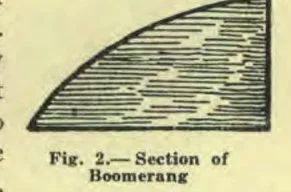
Fig. 2.—Section of Boomerang
The result will be six roughly fashioned boomerangs, and it only remains to trim them into shape with a pocketknife. One side should be left quite flat, while the other must be carefully rounded, the convex or outside curve being brought to a bluntish edge. The correct shape is clearly shown in the sectional diagram, Fig. 2. Lastly, round off the ends, and smooth down the surface of the wood with sandpaper.
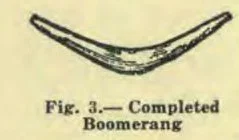
The finished boomerang should have the appearance depicted in Fig. 3.
Now go into an adjacent field or other open space, and try your luck at throwing this curious weapon.
Fig. 3.— Completed Boomerang
Grasp the boomerang at one end, which should possess crosscuts to give a grip, and keep the hollow or concave side away from you. Then throw it as if you wished to hit a spot on the ground about thirty yards distant. If possible, give it a slight downward twist with the wrist as it leaves the hand, thus imparting a spinning motion or “screw-back” to the weapon. Instead of traveling straight forward, and then falling to the ground, the boomerang will gradually ascend in the air, whirling round and round, and, taking a circular course, will sweep back toward you, finally depositing itself a few yards from your feet, the retrograde motion being produced by the bulged side of the weapon.
It is not advisable to throw the boomerang in the vicinity of a crowd, as in the hands of a novice its flight is liable to be a trifle erratic. —“Every Boy’s Book of Hobbies,” Cecil H. Bullivant.
Extravagant Eating and the High Cost of Living
The high cost of living is causing much discussion of our extravagant ways of eating. The Independent says: “What is needed is the individual cultivation of the custom of taking no more food on the plate than one expects to want, and then eating it all unless it prove unpalatable or excessive. If this practice were universal, we should have enough money to put up a palatial post office in every hamlet, make every river navigable to its source, pension all the descendants of all the soldiers, build the biggest navy in the world, or carry out any of the schemes of social improvement urged upon us.”
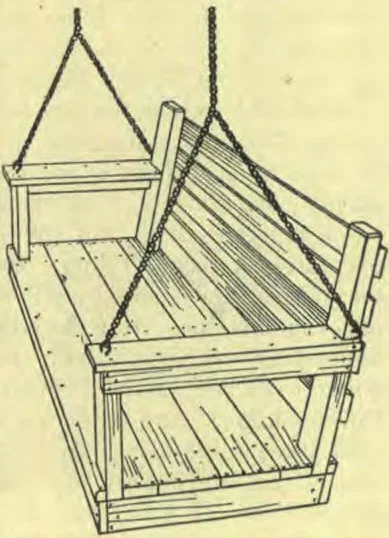
Any Bright Boy Can Make a Porch Swing Like This
World Gold Production for 1916
The world's total production of gold for 1916 is given as $478,625,000.
Comfort and Daily Counsel
By M. E.
(Texts for April 15-28)
This psalm (the thirty-seventh) is full of splendid advice; it also contains warnings that no one can afford to disregard; and the young person who heeds the instruction given in this psalm will find the path of true happiness. Let us study it carefully.
“Fret not thyself because of evil-doers.” God does not want us to worry because certain persons, who are not Christians, enjoy great prosperity, and seem to be carried through life “on flowery beds of ease.” No, he does not want us to worry, nor be envious, nor yet let their prosperity in any way shake our faith in the government of God. In the first place, worry and envy will in no way help us; they never better one’s lot nor improve one’s character; they consume nervous energy and corrode the heart. In the second place, riches may suddenly and unexpectedly take unto themselves wings, or death may snatch them away. At the best they are uncertain blessings.
“Trust in the Lord, and do good.” Let us lift our eyes above all things around us that annoy, and “trust in the Lord.” Let us always remember that he rules even in our personal affairs; all that comes to us receives his permission to enter our lives, and he has definite plans to use it for our good. And, too, let us keep busy doing good. The best way to combat the wickedness in the world is to do good; the best way to keep worry, envy, and distrust out of our own hearts is to do good. Then follows the precious promise which enables God’s children to say: “We’ve always been provided for, and we shall always be.”
“Delight thyself also in the Lord.” Our natural taste for pleasure has been perverted; but those who know how disappointing the pleasures of the world are, long for something better; those who have pressed into the Presence where there is “fulness of joy” have learned that in communion with God lies the only pleasure that fully satisfies the human heart. The more we study his Word and the more time we spend in secret prayer, the sooner we shall get acquainted with the Master; and to know him is to “delight thyself in the Lord.” To become really acquainted with God brings to us the secret of contentment, for then our wishes will be molded by the divine will and we shall have the desires of our hearts.
“Commit thy way unto the Lord.” The little things, the great things, the pleasures, the sorrows, the bright prospects, the bitter disappointments,—yes, all things that concern your life, you are to let the Lord take into his hands. And then again the psalmist admonishes you to trust God, for he will in all things secure happy results. He will take care of your interests; he will not permit you to be permanently wronged. The verse that is coupled with this command (verse 6) is a veritable fortress, a refuge in time of trouble. Is your character assailed? your name slandered? Do you feel unable to disperse the clouds that are darkening your reputation? Leave it all with God. Be true to him, true to your highest ideals, and true to others. Let no grudge or revenge creep into your heart, and rest in the assurance that God will take care of you; for he will.
“Rest in the Lord.” Again comes the quieting admonition to leave all with God. The margin reads, “Be silent to the Lord.” But we cannot rest, we cannot trust, we cannot be silent amid the trials and perplexities of life, unless we know God; if we know him, however, we shall see that the circumstances that annoy and pain us, that perplex our minds and crush our hearts, are only tools in God’s hands for shaping our lives into the ideal that is “higher than the highest human thought can reach;” and in quiet trustfulness we may await his biddings.
“Cease from anger.” “Do not allow your mind to become so excited that you will indulge in harsh or malignant remarks; or to wrong any man, however wicked he may be. See always that you are right, whatever others may be, and do not allow their conduct to be the means of leading you into sin.”
Let each member of the Morning Watch circle take up the verses for week ending April 28, and outline them for himself. Let him notice the commands, the promises, and the admonitions, and try to interpret each to his own heart. Unless we make a personal application of the Morning Watch verses, they can do us but little good.14
MEDITATION.—As I study this psalm, I realize to a greater extent that to trust God is one of the lessons that every Christian must learn. I must learn to trust him at all times no matter how things look. How can I expect God to trust me unless I learn to trust him? How can he trust me with power to win souls if I fail to trust him in the little things that concern me, and fail to trust him to supply me with the strength and wisdom needed for service?
SPECIAL PRAYER.—Teach me, O God, to drop worry out of my life. Do not let me envy those who seem to have an easier time than I do. Thou knowest just what I shall meet; teach me how to be so fully consecrated to thee that I shall not hinder thee from working out all that enters my life to thine own glory and for my good. Help me to obey the instruction given in this psalm, that I may live above worry, irritability, and envy. Help me to live so close to thee that my life may teach others the possibility of keeping sweet and cheerful at all times. M. E.
“Bill Jones”
By D. D. Fitch
ONE of the differences between Spanish and English is the transposition of the adjectives. For instance, we say “white paper,” while the Spanish form is “papel blanco,” or “paper white.” Applying this same rule to the Jones bill that has recently passed Congress, giving at one stroke citizenship to all men native to Porto Rico, it would be and has been here “Bill Jones.”
I believe that all the INSTRUCTOR readers are interested in one phase of this bill. It is this: Unless the newly made citizens of Porto Rico shall at the next election, which is very soon, vote against it, Porto Rico will go dry. Naturally, in a sugar-making country there are interests that will fight this to the bitter end. It is the object of this article to solicit from the readers of this paper all the temperance literature they can find it in their hearts to forward to the writer. This is a Spanish island, but English is taught in the schools, so English literature can be used to good advantage. If any one desires to place such literature in the hands of those who read only Spanish, I am glad to say that this can be procured if the means are at hand.
What a satisfaction it would be to have this island, where nearly every grocery is what one might call a saloon, go dry, and to know that we had a part in it! What is done must be done quickly, as there are only a few weeks in which to work. D. D. FITCH.
Do Great Minds Come in Small Bodies?
Dr. Charles Mercier, of London, in his lectures on heredity, declares that the common belief that small men have more than average brain power is quite correct. Cæsar, Napoleon, Nelson, Wellington, Grant, and Lee were of moderate size or undersized. The greater the mind the smaller the body, is the rule. Charlemagne is a rather notable exception. Seated, Charlemagne was taller than the average individual, but standing he was shorter.
Only a few weeks ago the whole world was startled by the news of a revolution in Russia, the most extensive and one of the most despotic empires in the world. Of course, such a great event could not happen without a long period of preparation. Most people did not know how the people of Russia were being educated to believe in and hope for another kind of government, nor about the events which were leading on to this great change.
Thus it was with the great kingdom concerning which we have been reading. We suddenly pass from the splendor and strength of Solomon’s kingdom to the weakness of the kingdoms of Israel and Judah. But after all, this is what we might have expected because of the sad mistakes which Solomon made; for it is sin that ruins both men and nations.
Forgetting the sacred mission of Israel to teach righteousness to the other nations, Solomon formed political alliances with these nations, which were sealed by marriages with heathen wives. In his efforts to imitate the despotic rulers of his day, he ruled harshly, levied heavy taxes, and was very extravagant. Rehoboam, who was to inherit his kingdom, was the son of one of these heathen wives. Brought up by such a mother amid the luxury of Solomon’s court, Rehoboam was doubtless a very selfish and wilful young man.
What lesson do you learn from Rehoboam’s course in receiving advice? Who were better able to give proper advice, the old men who had had a long experience and had been with King David, or these young fellows who had grown up with Rehoboam and who had had no practical experience? To whom do you go for counsel? Above all, does the Wonderful Counselor have his place in your heart? Rehoboam did not seek wisdom from God. “He did that which was evil, because he set not his heart to seek Jehovah.” 2 Chron. 12:14, A. R. V.
This was not the first time there had been differences between Judah and the northern tribes. Judah received David as king seven years before the other tribes did. Most of the great leaders before David’s time were from the north, such as Joshua, Barak, Gideon, and Saul. These tribes were farthest from the glory and profit that centered in Jerusalem, and doubtless felt jealous of Judah’s leadership. So when Rehoboam contemptuously refused their just request, they revolted under the leadership of Jeroboam.
Jeroboam, we are told, was a mighty man of valor and an industrious young man. He also had the assurance from the prophet Ahijah that he was the chosen leader of the ten tribes. Although he had trouble enough and had to flee for his life, it seems that he never learned the lesson of dependence on God. Prov. 3:5. We have no record that he ever sought the prophet of the Lord for advice until the time of the serious sickness of his child. 1 Kings 14.
He was statesman enough to see that if Jerusalem should still be the religious center, his people would be won back to Judah. So he felt that he must establish a center of worship. The Levites fled to the south, so he had no divinely appointed priests. What should he do? Instead of inquiring and waiting on the Lord, he trusted in his own understanding. The golden calves which he set up for the people to worship show the influence of Egypt upon his mind.
What an awful thing to be a leader in sin! No less than thirteen times it is said of the wicked kings that followed Jeroboam, “He walked in all the way of Jeroboam, . . . and in his sin wherewith he made Israel to sin.”
Jeroboam and Rehoboam—which was which? Can you remember? Well, it was Jeroboam who did not rule in Jerusalem.
Elijah and Elisha
It has been said that Elijah was the Martin Luther of the Hebrew people. He was a great reformer.15And although, as far as we know, he wrote nothing, he was one of the greatest prophets that ever lived. His name is mentioned more times in the New Testament than that of any other prophet.
He appears very suddenly. We do not know anything about his family or home life. He is simply “Elijah the Tishbite, who was of the inhabitants of Gilead.”
It is now half a century since Solomon was king, and the wicked Ahab was on the throne of Israel. Contrary to the Lord’s plain commandment to his people, Ahab had married a heathen wife, Jezebel of Phenicia, where they worshiped Baal. This wicked woman determined to set up Baal worship in Israel and stamp out Jehovah worship. She had great crowds of priests and priestesses, fed at the royal tables, to help her in this work. Idolatry was the great sin of Israel anyway, and it seemed as if the whole nation would forsake the Lord.
At such a time Elijah suddenly appeared to the king, and boldly told him of his sin and the punishment that was coming. Then Ahab had three years and a half of dire famine in which to reflect on his course. How wonderfully Elijah was fed during the famine! And what a wonderful challenge he made to the king at the end of the three and one-half years. What was to be proved by this test? How did it come out? Can you find Mt. Carmel on the map?
But even after all this, Elijah became discouraged. He evidently expected that those who cheered at Carmel would rally around him at Jezreel. But the Lord taught him a wonderful lesson at Sinai. What was it?
The advent message is called the message of Elijah. Why? Are we as jealous for the cause of God, and as anxious to turn the hearts of the people to the Lord, as he was? Are we all learning to pray “earnestly” as Elijah prayed? Every Missionary Volunteer is to be an Elijah in this time. And then those of us who are living when the Lord comes, will be translated without seeing death, as he was.
The story of Elisha is quite as wonderful as that of Elijah. He was a farmer’s boy. And it is said of him that “he cherished the love and fear of God, and in the humble round of daily toil he gained strength of purpose and nobleness of character, growing in divine grace and knowledge. While coöperating with his father in the home duties, he was learning to coöperate with God.” Every one of us can do that, and be ready for the opportunity when it comes, as he was.
Elijah had blazed the way. The whole nation had been stirred, and many were coming back to the Lord. Now they need a careful, patient instructor like Elisha. He was very willing to do what some persons call menial work. He washed the hands of Elijah,—he was his servant. He did not belong to the class who believe that things just happen. He wanted a double portion of the Spirit that was on Elijah, but he did not sit down and wait for it, nor even turn back when told to. He stayed with Elijah to the end. He was persistent, and that is a fine quality. If it is worth anything to be a worker for the Lord, it is worth everything. No sacrifice is too great to win the prize.
Do you suppose if all our Missionary Volunteers were as anxious to have a large portion of the Spirit as Elisha was that there would be more power in our lives and more work done? M. E. K.
Missionary Volunteer Society Programs for Week Ending April 21
THE programs for this date, with notes, illustrations, and other helpful material, will be found in the Church Officers' Gazette for April.
Memory Verse: “God is our refuge and strength, a very present help in trouble.” Ps. 46:1.
Questions
1. Who comforted Paul in his troubles? Acts 23: 11. Note 1.
2. What did some of the Jews do the next day? How many were banded together? Verses 12, 13.
3. What did these men say to the priests and elders? How did they wish them to assist in carrying out their plans? What were they ready to do? Verses 14, 15. Note 2.
4. Who heard what these murderers said? To whom did he reveal the plot? Verse 16. Note 3.
5. By what means was the youth taken to the chief captain? How was he introduced to this officer? Verses 17, 18.
6. What shows the kindness of Lysias? What did the young man say of his uncle’s danger? What request did he make? Why was there need of prompt action? Verses 19-21.
7. What did the captain say to the young man before he left? Verse 22.
8. What did Lysias do to save Paul? To whom did he send him? Verses 23, 24.
9. What message did Lysias send to the governor? Verses 25-30.
10. How did the soldiers carry out their orders? Verse 31. Note 4.
11. What part of the escort returned to Jerusalem from Antipatris? Who went all the way? Verse 32.
12. What did the soldiers do when they came to Cæsarea? Verse 33.
13. What question did Felix ask? What did the governor say to Paul? Where was he kept a prisoner? Verses 34, 35.
Questions for Diligent Students
1. What evidence is found in this lesson that God was a refuge to Paul?
2. How many soldiers started with Paul from Jerusalem?
Notes
1. In prison, Paul questioned whether he had not made a mistake in going to Jerusalem. He thought of the warning given him by the prophet Agabus. He remembered the tears and entreaties of his brethren that he should not expose himself to danger. He thought of the churches left without a helper. He was distressed and discouraged. In that dark hour “the Lord stood by him,” to comfort and cheer.
2. “Instead of rebuking this cruel scheme, the priests and rulers eagerly agreed to it. Paul had spoken the truth when he compared Ananias to a whited sepulcher.”—“The Acts of the Apostles,” p. 414.
3. “Let us not forget to thank God for a boy’s ears. I say his ears saved Paul’s life. I mean the whole of the boy together. Who shall ever make a record of all the deeds of heroism performed by boys? It was a little Chinese boy that bore the most important message from Peking to the foreign soldiers. Over the wall he went by a rope; hiding under bridges; going without food; dodging the barbarous soldiers who patrolled the country; never getting discouraged; never giving up; and at last putting that precious document into the hands of the general! How brave and true a heart was this that beat in the breast of this little Jew! ‘They would kill his dear old Uncle Paul—would they!’ God bless these plucky boys.”—C. Fredrick Goss, in Sunday School Times.
4. Lysias was determined that Paul should travel safely. He sent with him two hundred common soldiers, two hundred spearmen, and seventy men on horses. Forty men could never take Paul from such a guard as that. The company started the third hour of the night, nine o’clock in the evening, our time. Cæsarea was sixty-eight miles northwest of Jerusalem. The soldiers carried a letter from Lysias to Felix. The whole company went about half way, and when they reached Antipatris, which was a fortress in the plain of Sharon, the common soldiers remained behind and returned to Jerusalem. The horsemen went the whole way with Paul, and delivered him to the governor.
Whosoever Will Be Great Among You
“WHOSOEVER will be great among you, let him be your minister.”
Russia’s New Régime
THE new Russian cabinet will base its policy on the following principles:—
First: An immediate general amnesty for all political and religious offenses, including terrorist acts and military and agrarian offenses.
Second: Liberty of speech and of the press; freedom for alliances, unions, and strikes, with the extension of these liberties to military officials within the limits admitted by military requirements.
Third: Abolition of all social, religious, and national restrictions.
Fourth: To proceed forthwith to the preparation and convocation of a constitutional assembly, based on universal suffrage, which will establish a governmental régime.
Fifth: The substitution of the police by a national militia. with chiefs to be elected and responsible to the government.
Sixth: Communal elections to be based on universal suffrage.
Seventh: The troops which participated in the revolutionary movement will not be disarmed, but will remain in Petrograd.
Eighth: While maintaining strict military discipline for troops on active service, it is desirable to abrogate for soldiers all restrictions in the enjoyment of social rights accorded other citizens.
The provisional government desires to add that it has no intention to profit by the circumstances of the war to delay the realization of the measures of reform above mentioned.—The Independent, March 26, 1917.
Love Divine
By L. Myrtle Sours
O Love divine! that through the years of life
Has guided my poor heart through all its strife,
That won my trust in childhood's years to thee,
Thou art my King, thine would I ever be.
O Love divine! to thy warm bosom pressed,
Safe folded in thine arms, may I e'er rest.
L. MYRTLE SOURS.
Self-Sacrifice
By Frederick F. Shannon
CAPTAIN ROSTRON, of the “Carpathia,” tells of a young girl on one of the lifeboats putting out from the doomed “Titanic.” The boat was filled with women. The order was given for some one to get out, as the boat was overloaded. This young heroine got up to leave the boat. Others, seeing her flower-like beauty and tender years, tried to dissuade her. Then she loomed fairer and taller than a Greek goddess as she said to the mothers and wives: “No, I will go back. You are married and have families. I am not; it doesn’t matter about me.” With this valedictory to earth and time, she returned to the reeling, staggering deck of the wounded “Titanic.”
Was she not a true daughter of those fabled Titans who vainly strove to overcome the forces of nature? Indeed, we have a feeling that she conquered the deep, and that old ocean was complimented in being asked to furnish the liquid shroud for a body in which throbbed the last full measure of self-giving heroism.
A soul is rich toward God when it gives itself in sacrificial tides of godlikeness.—Frederick F. Shannon.
Knights and Dragons
By Amos R. Wells
I WANT to tell you about a boy who was very fond of stories of adventure. He liked especially to read about the old knights, and how they fought with giants, and killed dragons, and rescued beautiful ladies. One day he was talking about it with his mother, and he asked whether there were no knights any longer in the world, and if he couldn't be a knight and kill dragons. “Couldn't I, mother?” he asked.
“Wait awhile,” answered his mother, “and I will tell you.”
That very morning our lad, whose name was Sam, went with his mother to market. On the way they saw an old woman, who had let fall a basket of apples in the middle of the muddy street. She was nervously trying to pick them up before any cart should come along. Sam was walking by when his mother said, “Kill your dragon, Sam.”
“What dragon?” asked Sam, startled.
“Why, your pride, which is keeping you from helping that wrinkled old princess out there in the mud.”
So Sam darted off, and helped the old woman pick up her apples.
After dinner, mother was washing the dishes, and little baby Helen was troubling her by pulling on her dress and crying. It was one of Helen's fretful days. “Sam!” called his mother, “come quick. Here's another princess to rescue!”
“Who?” asked Sam, running in.
“Don't you see?” asked his mother. “Here am I, attacked by the giants Worry and Work and Hindrance. Come to my help.” So Sam took little Helen, and played with her while his mother washed the dishes.
“Sam,” said his father when he came home that night,—Sam’s father was a deacon and led the Wednesday evening prayer meeting that week,—“I think you are old enough to say just a word in prayer meeting. It will help some of the other boys and girls to take part; yes, and some of the older folks, too. Won’t you repeat a short verse, if I help you find one?” Sam hesitated, and then he caught his mother’s eye. “Brave for others, be a knight,” that loving glance seemed to say, and Sam took part in the prayer meeting that night.—Amos R. Wells.