The Youth’s Instructor, Vol. 48, No. 12.

HONOLULU'S PLAGUE AND FIRE
Earlier text: HONOLULU'S PLAGUE AND FIRE

MARCH STUDY OF THE FIELD

Part IV: Among the People of Italy
(March 25–31)
1. The Roman Campagna.—The Roman Campagna is a vast prairie surrounding the city of Rome. It is partly level, partly undulating, with swamps, long grass, a few forests, and dense undergrowth. The longest side of this triangular tract of land is on the Mediterranean Sea, the other two sides running up to the Sabine Hills and the Alban Mountains. It contains over a million acres. The largest portion of it has not been plowed for centuries, and is a grazing place for cattle, sheep, and goats. It is almost uninhabited by human beings, except by the few shepherds and drovers, and the laborers who are there for a few days at seedtime and harvest. In the spring the shepherds go to the mountains with their flocks. Milk, butter, and cheese are taken to Rome from the Campagna; also beef and mutton, lambs and goats, the flesh of the latter being a cheap meat. The sheep are a fine breed, and produce excellent wool. There are not many horses or mules raised. Swine abound on the hills. This tract is the abode of hunters, who sell their game in the Roman markets. The land is owned by a few proprietors or corporations. These rent it out to business men. The reason of its remaining principally in pasture is because of the prevalence of malaria, probably due to lack of drainage.
2. The City of Rome.—Rome is not surrounded with suburbs, as are most cities, but with the Campagna, mentioned in the preceding paragraph. The city has a circumference of thirteen miles. There are thirteen gates in actual use, besides several that are closed. At every gate are officers, who examine each package that is brought into the city. The old Roman streets have curious names; such as, “The Cat,” “The Monkey,” “The Baboon,” “The Two Slaughter Houses,” etc. Many new streets are named after the royal families. Nine months of the year Rome is a safe and pleasant place of residence for foreigners. The winter is mild, snow, ice, and frost being almost unknown. When the ground is covered with snow, the people climb to high points to see the strange, lovely sight. The Romans call other Italians “foreigners,” and do not regard them as their equals.
3. A Roman Amphitheater.—An amphitheater was a spacious building used by the Romans for combats between gladiators, fights of wild beasts, and other cruel shows. Criminals were sometimes thrown into the arena to be devoured by wild beasts. Many Christian martyrs perished in this way. The seats were so arranged that spectators viewed the scene from all sides. The amphitheater was generally elliptical in form.
4. The Arena.—The arena was the part of the amphitheater in which the exhibitions took place. Arena is the Latin word for sand, and it was so named from the fact that it was strewn with sand, to absorb the blood, and prevent the place from becoming slippery. It was surrounded with a wall, which was very smooth, to keep the beasts from climbing it. This wall was also surrounded with a metal layer, or network. The dens of the beasts, and the room in which the gladiators met before the show, were connected with the arena. Its shape was usually that of the building.
5. The Coliseum.—The Coliseum was probably the largest amphitheater. It occupies about five acres of ground. Eighty-seven thousand persons could be seated, and fifteen thousand more could be admitted. It was finished 80 A. D. At the time of its dedication five thousand wild beasts were slain in the arena. The games lasted one hundred days.
6. The Gladiators.—The gladiators were usually slaves, whose masters had them instructed in the art of fighting, for the purpose of amusing the public. Sometimes prisoners of war, or criminals, were given this training, and in some cases Roman citizens became gladiators. The gladiator fought for his life in the arena; for he knew that either he or his opponent must die in the contest. When one was disarmed, or had been thrown to the ground, the conqueror looked to the emperor, if he were present, if not, to the people, for the signal of death. The thumbs extended signified a desire to save the life of the vanquished; putting them down indicated that he was to die. The successful one received presents, and sometimes freedom, if he was a slave.
7. The Vatican.—The Vatican is the principal residence of the pope. It is composed of a mass of thousands of buildings, which were erected at different times, according to the convenience and taste of successive popes. In these buildings are treasures of art, gallery after gallery being stored with the curious and beautiful. Here is one of the richest collections of ancient sculpture in the world. The library is of rare and valuable manuscripts. The gates of the Vatican are of brass, the ceilings of gold, the pavements of ancient mosaic.
8. St. Peter’s Cathedral.—This cathedral is the most magnificent temple in the world. It is close to the Vatican. Tradition says that after Paul had suffered martyrdom under the emperor Nero, he was buried in a cave that is now covered by this cathedral. But there is no reason to believe that Paul’s body was ever placed there. His death was three and one-half centuries before the building was finished. It is said that the erection of it was one of the principal causes of the Reformation; for the expenses were so great that the popes were compelled to issue so many indulgences as to bring discredit upon the Catholic Church. Its length is six hundred and nine feet. Like the Vatican, it contains treasures of marble and painting. It took twenty-two months for six hundred workmen, laboring night and day, to complete the dome.

Meadow Larks in Winter

Stormily the morning dawns, Flying clouds and sifting snows; Dark and cold the day begins; Icily the tempest blows: But anon, through breaking skies, Shoots a slender, sunny ray, Greeted by the cheery welcome, Oft repeated, day by day, Spring o' the year! Spring o' the year!
Speckled head and back and wings, And a lemon-colored breast, With a crescent of black velvet In the yellow feathers pressed; On the meadow, brown and sear, Watch him dart, now there, now here, Pausing frequently to lavish Music on the frosty air— Spring o' the year! Spring o' the year!
On a swaying stalk he swings When the sun is in the west, With the golden beams reflecting From his scarce less golden breast; But a sudden whir of wings, And the flock has vanished quite; While the distance echoes, faintly, As a welcome to the night, Spring o' the year! Spring o' the year!
MINNIE ROSILLA STEVENS.

THE BROWN CREEPER

In the midst of a Massachusetts winter, when a man with his eyes open may walk five miles over favorable country roads, and see only ten or twelve kinds of birds, the brown creeper’s faint “zeep” is a truly welcome sound. He is a very little fellow, modestly dressed, without a bright feather on him, his lower parts being white and his upper parts a mottling of brown and white.
The creeper’s life seems as quiet as his colors. You will find him by overhearing his note somewhere on one side of you as you pass. Now watch him. He is traveling rather quickly, with an alert, businesslike air, in a spiral course, up the trunk of a tree, hitching along, inch by inch, hugging the bark, and every little while stopping to probe a crevice of it with his long, curved, sharply pointed bill. He is in search of food,—insects’ eggs, grubs, and what not,—morsels so tiny that it need not surprise us to see him spending the whole day in satisfying his hunger.
How flat and thin he looks, and how perfectly his colors blend with the grays and browns of the mossy bark! No wonder it is easy for us to pass near him without knowing it. We understand now what learned people mean when they talk about the “protective coloration” of animals. A hawk flying overhead, on the lookout for game, must have hard work to see this bit of a bird clinging so closely to the bark as to be almost a part of it.
And if a hawk does pass, you may be pretty sure the creeper will see him, and will flatten himself still more tightly against the tree, and stay as motionless as the bark itself. He needs neither to fight nor to run away. His strength, as the prophet said, is to sit still.
But look! as the creeper comes to the upper part of the tree, where the bark is less furrowed than it is below, and therefore less likely to conceal the scraps of provender that he is in search of, he suddenly lets go his hold and flies down to the foot of another tree, and begins again to creep upward. If you keep track of him, you will see him do this hour after hour. He never walks down. Up, up, he goes; and if you look sharply enough, you will see that whenever he pauses, he makes use of his sharp, stiff tail-feathers as a rest—a kind of camp-stool, as it were, or better still, a bracket. He is built for his work: color, bill, feet, tail-feathers—all were made on purpose for him.
When you come upon a bunch of chickadees flitting through the woods, listen for a quick, lisping note that is something like theirs, but different. It may be the creeper’s; for although he seems an unsocial fellow, seldom flocking with birds of his own kind, he is fond of the chickadee’s cheerful companionship.
To see him and hear his zeep, you would never take him for a songster; but there is no telling by the looks of a bird how well he can sing. In fact, plainly dressed birds are, as a rule, the best musicians. The very handsome ones have no need to charm with the voice. And our modest little creeper has a song, and a fairly good one—one that answers his purpose, at all events, although it may never make him famous. Of course you must go where the birds pair and nest, if you would hear them at their finest; for birds, like people, sing best when they feel happiest.
The brown creeper’s nest used to be something of a mystery. It was sought for in woodpeckers’ holes. Now it is known that as a general thing it is built behind a scale of loose bark on a dead tree, between the bark and the trunk. Ordinarily, if not always, it will be found under a flake that is loose at the bottom instead of at the top. Into such a place the female bird packs tightly a mass of twigs and strips of the soft inner bark of trees, and on the top of this prepares her nest and lays her eggs. Her mate flits to and fro, keeping her company, and once in a while cheering her with a song; but so far as has yet been discovered, he takes no hand in the work itself. It is quite possible that the female, who is to occupy the nest, prefers to have her own way in the construction of it.
But after the young ones are hatched, the father bird “comes to time,” as we say, in the most loyal manner. In and out of the nest he and the mother go, feeding their hungry charges, making their entry and exit always at the same point, through the merest crack of a door, between the overhanging bark and the tree, just above the nest. It is a pretty bit of family life.
It would be hard to imagine a nest better concealed from a bird’s natural enemies, especially when, as is often the case, the tree stands in water on the edge of a stream or lake. And not only is the nest wonderfully well hidden, but it is perfectly sheltered from rain, as it would not be if it were built under a strip of bark that was peeled from above. All in all, we must respect the simple, demure-looking creeper as a very clever architect.—Bradford Torrey, in Youth’s Companion.

SOME QUEER FISHES

I remember hearing a song, one line of which was, “Did you ever see an oyster walk upstairs?” I frankly confess that I have never seen an oyster perform in that manner; but I have been told of fishes that do something almost as wonderful, and that is, climb trees. There is an Indian fish called the “anabas,” or climbing-perch, which is so formed that it can not only remain out of water for a long time, but can also climb into bushes and trees. Then there is a family called “frog-fishes,” which have fins so shaped and placed on the body that they can use them as legs. They can live out of water for two or three days; they take advantage of this fact, and creep about on land like small four-footed creatures. Another fish that goes for a walk on shore is the strange-looking sea-bat.
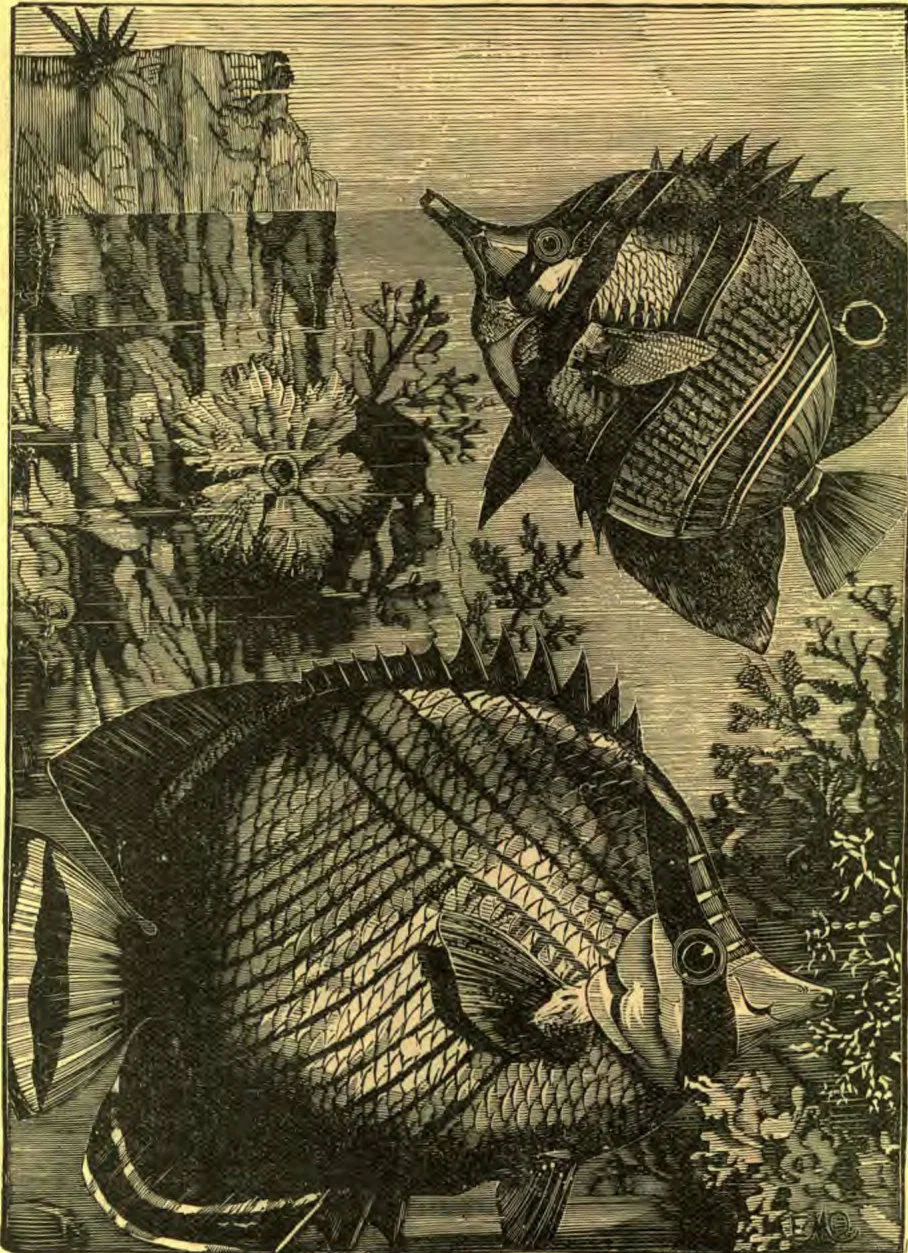
THE BEAKED CHÆTODON.
The skate is an odd-looking fish, which is abundant on some coasts. It attains a large size, a fine specimen having been known to weigh two hundred pounds. When angry, the skate bends its body into a bow-like form, till the tail almost touches the nose; then, with a sudden fling, lashes out with the tail in the direction of the offender.
Some queer fishes are clad in various kinds of armor. The body of the remarkable pipe-fish is so long and slender that he curls it around the seaweed. It is covered with large, bony plates instead of scales, and the skin from its sides laps over to form a long pouch underneath. In this pouch Mr. Pipe-fish carries the eggs deposited by Mrs. Pipe-fish.
Mr. Pipe-fish has a remarkable cousin, known as the sea-horse. His armor-plates are strangely formed, and his large eyes, at the beginning of his long, turned-up nose, give him a very fierce appearance. He curls his tail around a weed, and the upper part of him looks just like the head and neck of a little horse. Another kind of sea-horse is more remarkable still; he looks more like the skeleton of a sea-horse, whose flesh the waves have torn into long ribbons, which float in the water like real ribbons in a breeze.
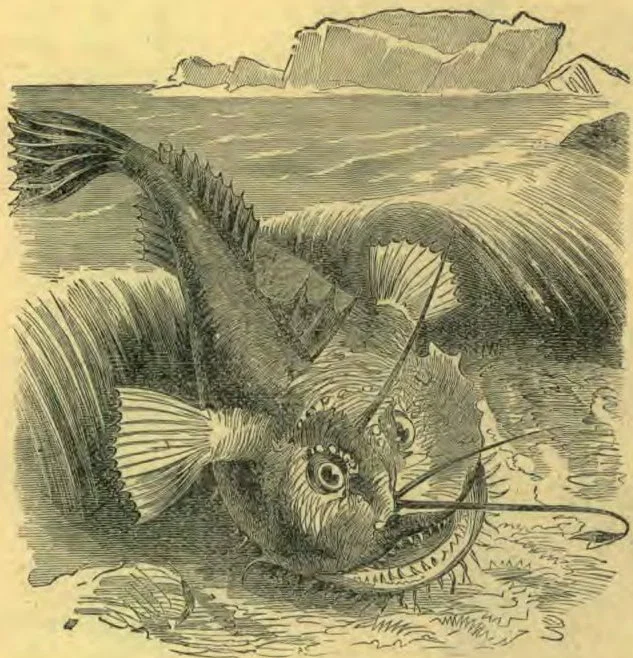
THE FISHING-FROG.
THE FISHING-FROG.
The globe-fish, when among his friends, is gentle-looking; but when he comes across a stranger, he has an odd way of taking a long breath, and swelling out like a balloon. Then his sharp spines stick out, and look very unpleasant; and, oddest thing of all, he turns over and floats on his back. Another peculiar thing about him is that he has no teeth; instead, there is a plate of ivory along his gums.
Still keeping to those fishes that have bony plates upon their bodies, we have the sturgeon. He is an enormous fellow, sometimes attaining a length of twenty feet or more, and weighing several hundredweight. Although sturgeons have no teeth, they catch and eat enormous numbers of fish, such as mackerel and herring. In spring they assemble in great shoals, and ascend large rivers, where they lay their eggs.
The torpedo, or cramp-fish, is so called because it has an arrangement inside something like the cells of a galvanic battery, by means of which it has the power to give electric shocks. These shocks, though not so powerful as those produced by the electric eel, are still strong enough to benumb the arm of a man should he take hold of the fish; it is believed the torpedo uses its power for the purpose of catching its prey.
The Chinese squirt-fish, or archer-fish, shoots its prey. This archer is said to be fond of insects. Its mouth is drawn out into a kind of beak, and by means of this it can shoot out a drop of water at any fly that may be resting on a plant at the water’s edge. The result is that the fly usually drops into the water and becomes a victim. But the archer-fish is outrivaled at this game by the beaked chætodon, which continues its habit of “shooting” flies even in captivity . For this reason it is held in high esteem by the Japanese as a pet. They keep the fish in a large glass bowl, and amuse themselves by holding over it a fly at the end of a slender rod, and seeing the fish try to capture it. This fish is found in the Indian and Polynesian seas.
But this is not nearly so clever as the method adopted by the fishing-frog, a fish about five feet in length. This remarkable creature reminds one of an enormous tadpole, for it seems to be nearly all head. Its mouth extends across the whole width of the head, and the under jaw protrudes beyond the upper. To add to its charming appearance, both jaws are provided with a double row of sharp teeth. What entitles it to special mention, however, is the foremost of three long spines upon the top of its head. This is pliant enough to bend over like a fishing-rod, so that the tip, which is red and fleshy, resembles a worm. Being so big and ungainly, the fishing-frog can not chase the smaller fishes that he feeds upon. He has a better plan; he half buries himself in the mud and weeds, so that he can not be seen clearly; then he sets his fishing-rod gently moving. This, of course, is too much temptation for some silly little fish, which, without stopping to think, rushes at the supposed worm. The great mouth of the fishing-frog opens, and the little fish is seen no more.—Edward Step.
THE SKATE.
THE SKATE.

SOMEBODY ELSE

Who's Somebody Else, I should like to know? Does he live at the North or South? Or is it a lady fair to see, Whose name is in every one's mouth? For Meg says: "Somebody Else will sing," Or, "Somebody Else can play;" And Jack says, "Please let Somebody Else Do some of the errands to-day."
The words of cheer for a stranger lad This Somebody Else will speak; And the poor and helpless who need a friend Good Somebody Else must seek. The cup of cold water in Jesus' name, Oh, Somebody Else will offer; And cords of love for a broken heart Brave Somebody Else will proffer.
There are battles in life we only can fight, And victories, too, to win; And Somebody Else can not take our place When we shall have "entered in." But if Somebody Else has done his work While we for our ease have striven, ’T will be only fair if the blessed reward To Somebody Else is given.
— Union Signal.

CLEANLINESS

I

WE should have a good reason for all our actions; and as we are instructed to present our “bodies a living sacrifice,” and to cleanse ourselves from all filthiness of the flesh, washing our bodies “with pure water,” it will surely be of profit to understand why God has told us to do these things. I hope every young reader (and old, too, for that matter) will study the wonderful science of physiology so earnestly that all will esteem it a delight as well as a duty to care for these marvelous habitations of the Spirit.
It is interesting to know something about the surface of our bodies. We are enveloped in an elastic tissue called the skin, which is composed of “yellow elastic” and “connective” tissues. There are two layers of skin; the outer is called variously the cuticle, the scarf-skin, and the epidermis. It is composed of flattened cells, arranged in several layers. The deepest layers contain cells of colored granules, and it is these that give color to the skin. In the white races, the color granules are few; in the dark races, they are abundant. In the albino, the color cells are lacking; and the skin being transparent, the pink tissues beneath show through. The cuticle has no blood-vessels and few nerves; hence it is not sensitive. Its chief office is to protect the sensitive structures beneath it.
The epidermis is constantly rubbed off by contact with clothing and in other ways. This is especially noticeable after taking a warm bath, as the dead cuticle, or outer skin, can be removed in a considerable quantity by using a flesh-brush or a coarse towel. A neglect to bathe results in an accumulation of dead matter on the skin; and this clogs the pores, and by obstructing the circulation, and producing congestion, is a frequent cause of colds. Good soap softens this matter, and aids in its removal.
The true skin, or “dermis,” has many blood-vessels, nerves, and glands. Deep down in the dermis are sweat-glands and oil-ducts, which lead to the surface of the skin. The number of these tiny ducts and glands in the entire skin is said to be not fewer than two and one-half millions. The skin breathes through these countless little mouths; therefore unobstructed pores are necessary to health. Perspiration is a fluid, carrying off, by way of the glands, the water and various impurities separated from the blood. These glands are more numerous under the arms than elsewhere, and need careful attention. Nothing is more repulsive than the odor from decayed matter that ought to be removed from the person. A plentiful use of soap and water will insure cleanliness and promote health.
Perspiration escapes by evaporation also; this is called “insensible perspiration.” From one and a half to four pints of fluid escapes in this way from the body every day. Care should be taken never suddenly to check this discharge of perspiration, by bathing or sitting in a draft, as to do so often results in serious disorders. When the action of the skin is suddenly checked, extra labor falls upon the lungs, liver, and kidneys. The kidneys are often most seriously affected. Two rules for insuring health of the skin are—proper cleanliness and proper clothing.
MRS. M. D. Mc KEE.

THE BURIAL AND RESURRECTION

  • (March 31, 1900)*
*Memory Verse.—Isa. 53:9.
*Time: A. D. 31. Place: Jerusalem. Persons: Soldiers, Joseph of Arimathea, Nicodemus, women of Galilee, chief priests, Pharisees, Pilate, angels.

QUESTIONS

1. As the day of crucifixion drew toward its close, what request did the Jews make of Pilate? For what reason? John 19:31. In carrying out Pilate’s order, what difference did the soldiers make between Jesus and the thieves? Vs. 32, 33. What was thus fulfilled? V. 36. What was done to Jesus? What word met its fulfillment in this? Vs. 34, 36; note .
2. By whom and in what way was the body of Jesus secured for burial? V. 38; Luke 23:50, 51. Who joined Joseph in the work of laying Jesus in the tomb? What expensive preparation was made by them? John 19:39, 40. In what sepulcher was the body placed? Vs. 41, 42; Matt. 27:60.
3. Upon what day did these things take place? Luke 23:54. Who were associated with Joseph and Nicodemus in the last sad rites? V. 55. Upon leaving the tomb, what did they do? V. 56; note .
4. On the next day—the Sabbath—who came again to Pilate? Matt. 27:62. What did they call to his mind? V. 63. What petition did they make? Why? V. 64. What was Pilate’s answer? What did they do? Vs. 65, 66.
5. At their first opportunity, what did the faithful women of Galilee do? Mark 16:1, 2. While going to the tomb, what question had been troubling them? V. 3. What were they surprised to find? V. 4.
6. By whom had the tomb been opened? Matt. 28:2. What was the appearance of this heavenly being? V. 3. How did his terrible presence affect the guard? V. 4.
7. How did he appear to the women who came to the sepulcher? Mark 16:5. What did he say to them? V. 6; note .

FRIGHTENING THE LIONS

Monsieur Foa, the French explorer, says that lions have a wholesome fear of African wolves, which hunt in packs, and do not scruple to attack even the lion. There are terrible battles, in which the lion succumbs to numbers, and dies fighting. In connection with the lion’s fear of wolves, Monsieur Foa tells a story from his own experience.
It was a very dark night, so black that trees could not be distinguished until the travelers were close upon them. Lions prowled about the party, one of them roaring from a point so close as to have an alarming effect on the nerves. The animals could not be seen, but they could be heard on all sides.
Reaching a tree, the men found one of their comrades with rifle cocked, peering into the darkness, trying to discover the whereabouts of the animals that could be plainly heard walking among the leaves. A second man was trying to relight a half-extinguished torch. Still the lions could be heard coming and going in the darkness.
At this point the native servant whispered the advice to imitate the cry of wolves in the distance. The party at once began barking and shouting, “Hu! hu! hu!” in an undertone, as if the pack were still at a distance, while the man at the camp made the same well-imitated cry.
The effect was instantaneous. There was the sound of a rapid stampede across the dry leaves. The lions decamped in a panic, driven off by the supposed approach of a pack of wolves. For the rest of the night the party was undisturbed.—Selected.

Life and Work of DWIGHT L. MOODY

Official and only authentic edition. Written by his son, WM. R. MOODY, and IRA D. SANKEY, his lifelong associate and friend.
100,000 AGENTS WANTED AT ONCE. Liberal terms. Freight paid. Credit given. A golden opportunity for you. Outfit free. Write to-day.
P. W. ZIEGLER & CO., 324 Dearborn St., Chicago.

Good Until April 15.

$11 for $7.

We will ship to any address for $7, cash, “Guide for Nut Cookery,” Perfect Ball-bearing Nut Butter Mill, Family Blanching Mill, and 50 lbs. extra No. 1 shelled Spanish peanuts. Without the Blanching Mill, 75 cents less.
The mill has been on the market for four years, and has been greatly improved. Nearly 3,000 in use. A child can operate it. It makes fine sterilized nut butter. “Guide for Nut Cookery” tells how. It is a complete recipe book, showing the most healthful ways to prepare nuts, grains, legumes, and all varieties of foods.
Write for descriptive circular, and prices on nuts and health foods.
JOSEPH LAMBERT, Battle Creek, Mich.

To Reach BATTLE CREEK

FROM
CHICAGO, BUFFALO, DETROIT, OR TOLEDO,
Purchase Tickets Reading over the MICHIGAN CENTRAL
“The Niagara Falls Route.”
A First-class Line for First-class Travel between Chicago and New York and Boston. Elegantly equipped through trains pass Battle Creek in each direction daily.
R. N. R. WHEELER, O. W. RUGGLES, Ticket Agent, Battle Creek Gen'l P. and T. Agt., Chicago, Ill.

TAKE THE Canadian Pacific Railway

For . . CHATHAM, OTTAWA, MONTREAL, LONDON, GALT, QUEBEC, WOODSTOCK, TORONTO, BOSTON, PORTLAND, and
All points in New England, the Maritime Provinces, Great Britain, and the Continent.
Illustrated literature, time-tables, and full particulars, upon application to—
J. FRANCIS LEE, GEN. AGENT,
Passenger Dept. 228 SOUTH CLARK ST., CHICAGO
Branch Offices: 76 Ottawa St., Grand Rapids, Mich. Room D, Chamber of Commerce, Cincinnati, Ohio. 315 Chestnut St., St. Louis, Mo.

Cincinnati Northern Railroad Co.

TIME TABLE NO. 3.

IN EFFECT SEPT. 24, 1899.
Trains Pass Battle Creek, as follows:

WEST-BOUND.

No. 21, Mail and Express — 6.58 P. M.
No. 23, Accommodation — 2.07 P. M.
No. 27, Local Freight — 8.25 A. M.

EAST-BOUND.

No. 22, Mail and Express — 8.25 A. M.
No. 24, Accommodation — 1.45 P. M.
No. 28, Local Freight — 5.30 P. M.
Direct connections are made at Toledo with all roads diverging. Close connections for Detroit and Cincinnati.
J. L. READE, Ticket Agt., Battle Creek.
E. R. SMITH, City Pass. Agt., 6 West Main St.

GRAND TRUNK RAILWAY SYSTEM.

Time-Card in Effect November 19, 1899.

C. & G. T. DIVISION.

WEST-BOUND FROM BATTLE CREEK.

No. 9, Mail and Express, to Chicago 12.15 P. M. No. 1, Chicago Express, to Chicago 9.00 A. M. No. 3, Lehigh Valley Express, to Chicago 3.40 P. M. No. 5, Pacific Express, to Chicago, with sleeper 1.10 A. M. No. 75, Mixed, to South Bend 8.20 A. M. Nos. 1 and 75, daily, except Sunday. Nos. 1, 3, and 5, daily.

EAST-BOUND FROM BATTLE CREEK.

No. 8, Mail and Express, to Pt. Huron, East, and Detroit 3.45 P. M. No. 4, Lehigh Express, to Port Huron, and East 8.27 P. M. No. 6, Atlantic Express, to Port Huron, East, and Detroit 2.25 A. M. No. 2, Leh. Exp., to Saginaw, Bay City, Pt. Huron, and East 6.50 A. M. No. 74, Mixed, to Durand (starts at Nichols) 7.15 A. M. Nos. 8 and 74, daily, except Sunday. Nos. 4, 6, and 2, daily.
A. S. PARKER, Ticket Agent, Battle Creek.

THE LESSON FROM THE SPROUTING OF THE SEED

“VERILY, verily, I say unto you, Except a corn of wheat fall into the ground and die, it abideth alone: but if it die, it bringeth forth much fruit. He that loveth his life shall lose it; and he that hateth his life in this world shall keep it unto life eternal.” John 12:24, 25.
There is but one way, since the fall of man, by which we can obtain the precious fruit of the earth. It is that the seed be cast into the ground, and die. If it is not cast into the ground, it abides alone; but if it surrenders its life to the coming plant, it lives. If we love our lives, our ways, our plans, our desires, so much that we can not surrender them for the good of others, we shall never bear fruit in the kingdom of God. Self-denial for others’ good is the grace that carries with it salvation to the soul. It will insure to the person life beyond this vale of tears,—a reward in the kingdom of God. The growing seed teaches the resurrection of the dead.
Some will say, “How are the dead raised up? and with what body do they come?” To a question like this the apostle answers: “Thou fool, that which thou sowest is not quickened, except it die: and that which thou sowest, thou sowest not that body that shall be, but bare grain, it may chance of wheat, or of some other grain: but God giveth it a body as it hath pleased him, and to every seed his own body.” 1 Cor. 15:35-38.
So is the resurrection of the dead. It is sown in corruption, a natural body, and raised in incorruption, an immortal body; but to insure the immortal body, it becomes necessary that we die to sin. The object, therefore, of labor was not to bring upon man penance for his sin; but in the suffering that came to him in the earning of his bread by the sweat of his brow, in the actual labor he had to perform to obtain his food, was an object lesson of how he must obtain the kingdom of God. To lose sight of this truth is to lose the object of life. The mind of God that created the world, that devised the plan of salvation, so overruled the sin of man that if he properly related himself to the circumstances under which he was placed, he would see Christ in all lawful labor.
All good trees and beautiful flowers, and the cultivation of the same, are an object lesson of the work of grace in the heart. The more perfectly we can see the relation between the two, the more perfectly the soil will be cultivated. When we see the spiritual lesson that God designed to teach, we shall cultivate the soil not simply to obtain a livelihood from it, but to see God’s glory in it; the lesson we are to learn is not only how we can live in this life, but how we can best glorify God here, and be fitted for the final harvest at the end of this world.
There are no circumstances in life in which God has not designed to reveal himself; and in all the relations of life the Bible has presented certain spiritual truths, which, if heeded, will reveal Christ in a practical manner. The subject of the providence of God in connection with physical labor is one great lesson that all should learn.
S. N. HASKELL.

THE SOARING OF BIRDS

The soaring of birds is probably the highest form of pleasure derived by living creatures from the use of physical gifts. In it the power of flight reaches its perfect development. To float in air with no effort of the beating wing must be a form of physical beatitude like no other sensation, and birds evidently regard it as such; for, except in the case of birds that soar mainly to watch for prey from vast heights, it is, as a rule, reserved by birds as a form of pleasure, many species soaring only in weather that strikes them as inviting them to soar, much as the owner of a boat finds that certain days are particularly inviting for a sail. Other birds soar only at certain hours in the day.
There are many birds, such as the kite, the condor, and the vulture, with which this wonderful and effortless soaring is the normal way of flight. “When the condors are wheeling in a flock round and round any spot, their flight is very beautiful. Except when rising from the ground, I do not recollect ever seeing one of these birds flap its wings. I watched several for nearly half an hour, without once taking off my eyes. They moved in large curves, sweeping in circles, descending and ascending without giving a single flap.”
Soaring in such perfection is not an accomplishment possessed by many birds; or, rather, it is seldom exercised. But the writer has seen a trained peregrine falcon soar at a vast height exactly like the condors; and so much did the bird enjoy the newly discovered power,—for it was a young one, which had been allowed to fly only occasionally,—that it was long before it would return to the lure. Gulls also “sail” grandly, though not, as a rule, in such wide circles as the birds we have mentioned.—C. J. Cornish, in “Animals at Work and Play.”

FOR EVERY DAY OF THE WEEK

SUNDAY:
It is vanity to desire to live long, and not to care to live well.—Thomas à Kempis.
MONDAY:
“If one poor struggling toiler o'er life's road, Who meets us by the way, Goes on less conscious of his galling load, Then life indeed does pay.”
TUESDAY:
“Are we praying for what will bless others, or only for what will bless ourselves and our own souls? There is selfishness in prayer, as in other things, and we should guard against it by constant watchfulness.”
WEDNESDAY:
“Absence of occupation is not rest; A mind quite vacant is a mind distressed.”
THURSDAY:
Some wait ever for the morrow: present hours slip by. “So little can be done to-day, what's the use to try?” Notice, he who grasps the moments, every one that flies, Is the man in life's sharp contest who obtains the prize. — Selected.
FRIDAY:
“The best way to do a man good is to expect good of him. If we always call on others for their best, we also make it easier to live with them; for we see them through kindly eyes, and are patient with their faults and frailties.”
SABBATH:
“The Lord shall give thee rest from thy sorrow, and from thy fear, and from the hard bondage wherein thou wast made to serve.” Isa. 14:3.
Continue reading: AN OPPORTUNITY FOR YOUNG MEN