The Youth’s Instructor, Vol. 48, No. 12.

HONOLULU'S PLAGUE AND FIRE

The Youth’s Instructor

Mar 22, 1900

Review and Herald Publishing Company · Battle Creek, Mich. · Mar 22, 1900

HONOLULU'S PLAGUE AND FIRE
PERHAPS most of the readers of the INSTRUCTOR have heard before this that the bubonic plague, or something closely allied to it, is present in Honolulu.
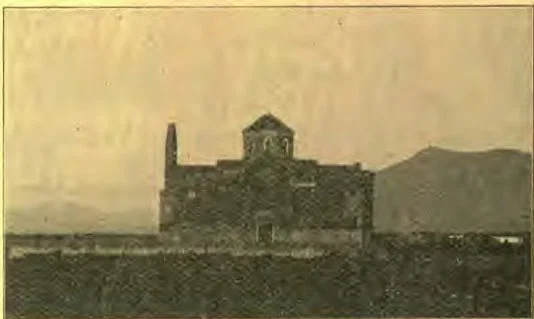
THE CHURCH FOURTEEN-HUNDRED YEARS OLD.
The city has never had a system of sewers; and in the older portions, especially the Chinese quarter, the soil has become so saturated with filth that disease and pestilence are but the natural outcome. This portion of the city has a population of about ten thousand Chinese, Japanese, and Hawaiians; and it was here that the plague started. As most of these persons go barefoot, many think that the plague was contracted by the feet coming in contact with the polluted soil. One of the leading physicians is reported as saying that he would rather sleep in the bed with a plague patient than walk barefoot through the streets of Chinatown.
About forty persons, only two of whom were white, have died of the disease thus far. One of the latter was a girl of thirteen years; it is thought she contracted the disease from eating candy bought at a Chinese store.
Physicians and the board of health have been untiring in their efforts not only to prevent the spread of the plague, but entirely to stamp it out. Inspectors have been appointed; and every house in the city is supposed to be visited twice a day. Every case of sickness is reported to the board of health, and a physician is sent immediately to investigate. All plague patients are at once removed to the pest hospital, and the doubtful cases are taken to the suspect hospital. At these places three of our own people are serving as nurses; and they report several cases as apparently on the road to recovery. Among the latter are two little children, one a Chinese boy, and the other a little Japanese baby. One of the merchants sent some toys to these little folks, and they were received with smiles of great satisfaction.
As one means of doing away with the sources of infection, the authorities have, as new cases have developed, immediately placed the neighborhood under quarantine, and finally burned the home of the victims, and, in Chinatown, all the houses in the vicinity. Many temporary buildings have been erected as places of detention for those who have been exposed to the disease. Here they are provided with clean beds and wholesome food, and kept until all danger of their infecting others is passed.
On Sabbath, January 20, the firemen started to burn a block where there had been several cases of plague. For about an hour all went well; but the rising wind carried the burning embers to the dry roofs of the closely packed houses in the neighborhood, and directly upon the towers of Kaumakapili church. Although the whole force of the fire department was present, and everything possible was done to quench the flames, the men were powerless to stay the onward march of the fire, and so turned their attention to the work of keeping it within prescribed limits. The fire raged in fury, jumping from block to block and from street to street. Reports from explosions of gasoline and kerosene were almost constant. Dynamite was used by the firemen, but all was in vain, and the work of the fire was not done until it had reached the sea on one side and the river on the other. Bucket brigades were formed by the citizens, and the firemen were kept drenched with water. So fierce was the heat, that clouds of white steam enveloped them.
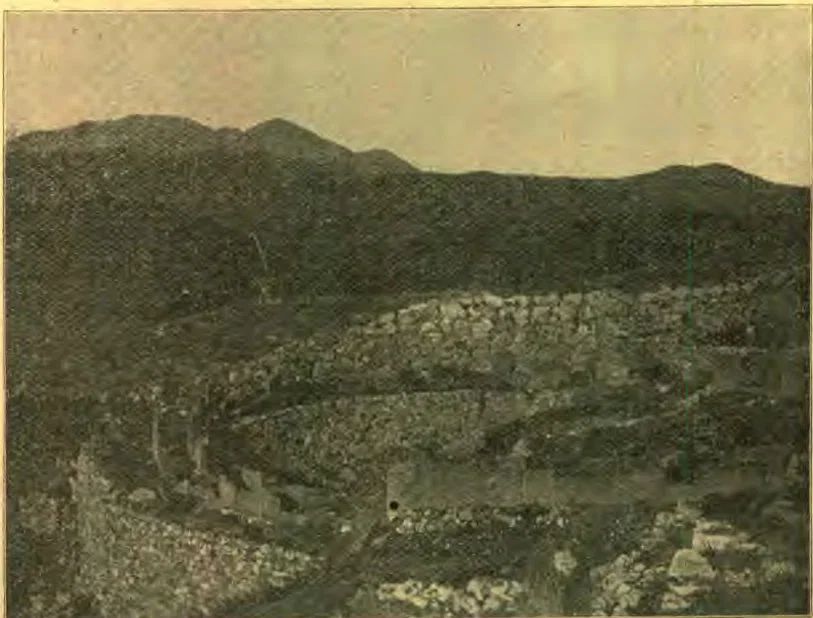
SCENE OF DR. SCHLIEMANN'S EXCAVATIONS.
Those in the quarantined districts ran in terror into the streets and to the guard lines. For a time it seemed as if they might try to break through the lines, and thus spread the contagion through the city, but the guards and citizens acted with coolness and dispatch, and the terrified victims were taken in order to a place of safety. It was indeed a queer-looking crowd that marched down King street—men, women, and children, some carrying sewing-machines, some beds, blankets, trunks, cooking utensils, lamps,—anything on which, in their terror and excitement, they could lay their hands.
Those who were sick, lame, or helpless were brought out of the burning district, some in rude carts, and others upon the backs of their more fortunate friends or relatives. Mothers, as they led their children through the crowded streets, looked back with tear-dimmed eyes to the place where their old homes and all their earthly possessions were turned to ashes. Chinese women with little feet hobbled painfully along, taking, perhaps, the longest walk of their shut-in lives. About four thousand persons were marched to Kawaiahao church. The women and children were sent into the building, where they would be comfortable; while the men swarmed over the grounds, kept in by the guards, who were stationed six feet apart all around the yard.
Despite their great misfortune, most of these poor people tried to be cheerful, and to make the best of a very bad matter. Soon after they arrived at the church, dray-loads of tents, bedding, and provisions began to arrive; at half-past seven in the evening, all those homeless persons had been fed and made comfortable for the night. After supper the Hawaiians spent the time in singing, and playing upon their guitars and other musical instruments, which were about the only things they had saved from the fire.
There is great opportunity for genuine Christian Help work in Honolulu, and nobly do the men and women of the city respond to the call. Money has been contributed, and women all over the city are engaged in making clothing for those who saved only the clothes upon their backs.
We ask those who read this to pray for these poor people, that their eyes may be opened to see Him whom to know aright is life eternal.
LENA E. HOWE.

MYCENAE

IN the angle of two lofty mountains, on the boundary of the Plain of Argos, about ten miles from the seashore, fitly described by Homer as “the innermost corner of Argos,” is found one of the most ancient and interesting ruins in the world.
Perseus is the legendary founder of Mycenæ, and is said to have raised its massive walls with the help of the Cyclops from Lycia. Among the early kings of this mighty city we find the names of Sthenelus, Hercules, Tantalus, and Agamemnon, son of Atreus. Agamemnon appears to have been prince of all the mainland and islands of the Greeks, and to have led the inhabitants against Troy. On his return he was murdered by Ægisthus, the lover of his wife, Clytemnestra.
The might of Mycenæ had dwindled before the dawn of history. However, among those who fell at Thermopylæ, eighty Mycenians are mentioned. The city was destroyed by the Argives, B. C. 463, and since then the ruins have remained very much as we find them to-day.
As we near the Acropolis, we are conducted into the tombs of Agamemnon and his wife. These two conical-shaped tombs are built of stone in the side of the hill, and are exactly alike. They are about fifty feet high, with a floor space about the same. The top of the tomb of Clytemnestra has fallen in, thus giving sufficient light to get a picture of the entrance. At the top of the entrance is a large stone, thirty feet long, sixteen feet broad, and over three feet thick, weighing about one hundred and thirteen tons. The wonder is how these stones were ever placed.
The Acropolis was surrounded with a massive wall, still partially preserved. The foundations of great castles, treasure-houses, and the remains of cisterns and vaults are still to be seen. Our illustration, taken within the walls, shows where Dr. Schliemann excavated in 1876, and found a number of skeletons and many gold ornaments and other valuable relics. These were transferred to the museum at Athens.
Let us pause here on this rocky summit, and view the fertile Plain of Argos, with its many olive groves, orange orchards, and fig-trees. Although it is the thirty-first of December, the fields are green, and the wheat and barley several inches high. Here and there are shepherds, with their goats and sheep; and along the roads we see little donkey caravans, carrying goat-skins full of oil or wine. There are numerous Greek churches, in each of which may be seen pictures of Jesus and some of the saints, with a taper burning before each. In some of the churches, relics may be found; these, with the pictures, are objects of worship. One of these churches, dedicated to the Virgin Mary, is said to be fourteen hundred years old. Far in the distance is the sea, and on each side rise snow-capped mountains. These scenes have remained practically unchanged for at least four thousand years. Only man and his works have crumbled into dust.
H. A. HENDERSON.

KNOWING GOD

WE can not by searching find out God: but he has revealed himself in his Son, who is the brightness of the Father's glory, and the express image of his person. If we desire a knowledge of God, we must be Christlike. When Philip said to Christ, “Show us the Father, and it sufficeth us,” the Saviour answered, “Have I been so long time with you, and yet hast thou not known me, Philip? he that hath seen me hath seen the Father; and how sayest thou then, Show us the Father?”
He who does not seek each day to be more Christlike can not know God. Living a pure life through faith in Christ as a personal Saviour will bring to the believer a clearer, higher conception of God. No man whose character is not Christlike can set forth God in a true light. He may preach Christ, but he does not show his hearers that Christ is an abiding guest in his heart.
“This do, and thou shalt live,” Christ said to the lawyer who had answered his question with the words, “Thou shalt love the Lord thy God with all thy heart, and with all thy soul, and with all thy strength, and with all thy mind; and thy neighbor as thyself.” Eternal life is the reward that will be given to all who obey the two great principles of God’s law,—love to God and love to man. The first four commandments define and enjoin love to God; the last six, love to our fellow men. Obedience to these commands is the only evidence man can give that he possesses a genuine, saving knowledge of God. Love for God is demonstrated by love for those for whom Christ has died.
While enshrouded in the pillar of cloud, Christ gave directions regarding this love. Distinctly and clearly he laid down the principles of heaven as rules that his chosen people were to observe in their dealings one with another. These principles Christ lived out in his life of humanity. In his teaching he presented the motives that should govern the lives of his followers. “All ye are brethren,” he said. Treat the purchase of my blood as I have given you an example.
God has manifested the most wonderful love for fallen man. He “so loved the world, that he gave his only begotten Son, that whosoever believeth in him should not perish, but have everlasting life.” Those who partake of God’s love through a reception of the truth will give evidence of this by making earnest, self-sacrificing efforts to give the message of God’s love to others. Thus they become laborers together with Christ. Love for God and for one another unites them to Christ by golden links. Their life is bound up with his life in sanctified, elevated union. True sanctification unites believers to Christ and to one another in bonds of tender sympathy. This union causes rich currents of Christ’s love to flow continually into the heart, and then flow forth again in love for others.
The qualities that it is essential for all to possess in order to know God are those that mark the completeness of Christ’s character,—his love, his patience, his unselfishness. These attributes are cultivated by doing kind actions with a kindly heart. But Christ’s requirements are not met by his people to-day. A strange deception is upon the people of God. Selfishness prevents the unity that should exist. True Christian love is rare in our churches. This shows that the members do not love God as they claim to. They give evidence that they need to be sanctified. It is the most fatal deception to suppose that a man can have faith unto life eternal without possessing Christlike love for his brethren.
He who loves God and his neighbor is filled with light and love. God is in him and all around him. There is no such thing as a loveless Christian; for “God is love,” and “hereby we do know that we know him, if we keep his commandments. He that saith, I know him, and keepeth not his commandments, is a liar, and the truth is not in him. But whoso keepeth his word, in him verily is the love of God perfected: hereby know we that we are in him. . . . A new commandment I write unto you, which thing is true in him and in you: because the darkness is past, and the true light now shineth. He that saith he is in the light, and hateth his brother, is in darkness even until now. He that loveth his brother abideth in the light, and there is none occasion of stumbling in him. But he that hateth his brother is in darkness, and walketh in darkness, and knoweth not whither he goeth, because that darkness hath blinded his eyes.”
Christ declared: “A new commandment I give unto you, That ye love one another; as I have loved you, that ye also love one another. By this shall all men know that ye are my disciples, if ye have love one to another.” Christians will love those around them as precious souls for whom Christ died.
MRS. E. G. WHITE.

Leave Tomorrow With God: Luther's Robin Sermon

“Would it not be better to leave to morrow with God? That is what is troubling men—to-morrow’s temptations, to-morrow’s difficulties, to-morrow’s burdens, to-morrow’s duties. Martin Luther, in his autobiography, says: ‘I have one preacher that I love better than any other upon earth: it is my little tame robin, which preaches to me daily. I put his crumbs upon my window-sill, especially at night. He hops on the sill when he wants his supply, and takes as much as he desires to satisfy his need. Thence he always hops upon a little tree close by, lifts up his voice to God, sings his carol of praise and gratitude, tucks his little head under his wing, and goes fast asleep, leaving to-morrow to look after itself. He is the best preacher that I have on earth.’”

The Higher a Man Is in Grace

“THE higher a man is in grace, the lower he will be in his own esteem.”

THE GENIUS FOR HELPING

“There is a man,” said a neighbor, pointing to a village carpenter, “who, I really believe, has done more good in this community than any other person who ever lived in it. He can not talk very much in public, and he doesn’t try. He is not worth two thousand dollars, and it is very little he can put down on subscription papers. But a new family never moves into the village that he does not give them a neighborly welcome. He is on the lookout to give strangers a seat in his pew at church. He is always ready to watch with a sick neighbor. He finds time for a pleasant word for every child he meets, and you’ll always see them climbing into his one-horse wagon when he has no other load. He has a genius for helping folks, and it does one good to meet him in the streets.”—Michigan Christian Advocate.

HOW SHALL WE KNOW

How shall we know that what we say Or what we sing Brings peace to souls who go their way In suffering? We know because the gentle word And grateful song Have soothed us when, with hope deferred, The way seemed long.
How shall we know that kindly thought Or breathed prayer Is balm to souls whose paths are fraught With ceaseless care? We know because our darkest ways Unbidden shine With cheering gleams—reflected rays Of light divine.
Go thou, then, forth with song, with cheer, Go forth with prayer; For souls bowed low with woe and fear Are everywhere; And not one thought nor act of love Or tenderness, But will return, a homing dove, Your soul to bless.
—H. W. Greene.

MAKING TRAYS AND WASHING-BOXES

DEVELOPING-TRAYS are made of many different materials. Paper, wood fiber, glass, porcelain, and hard rubber trays are usually kept on hand by dealers in photographic stock. If you prefer to buy your trays, those made of hard rubber will be found the most serviceable, though they are rather expensive and very fragile. Common granite-ware baking-pans will serve almost as well. This ware is both cheap and strong; and while the enamel remains intact, chemicals have no effect on it. But it must not be used after the enamel becomes broken, and the iron is exposed.
There are almost as many different ways of making homemade trays as there are persons who make them. The most simple is to dip a shallow pasteboard box of appropriate size into melted paraffin, to make it impervious to water. Such trays answer the purpose in an emergency, but they do not last long. The kind most commonly used is made by lining a suitable wooden tray with common oilcloth. The oilcloth is not cut at the corners, but is simply folded. It may be glued to the inside of the tray, or overlapped at the edges, and fastened to the outside with tacks.
The best trays I ever used were made of wood coated with paraffin. The cost of such trays is almost nothing, and they are not difficult to make. I have used trays made of almost every available material, but I never used one that did not have some drawbacks. Those I am about to describe are heavy, and can not be used for hot water; but unless one is moving often, the weight is hardly a drawback, and the amateur will seldom, if ever, have occasion to use hot solutions in his trays. The dimensions of trays will depend on the size of plates used.
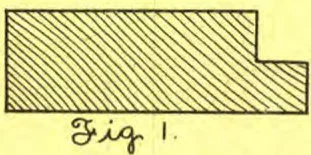
Fig. 1.
Fig. 1.
Three should be made large enough to hold two plates, with half an inch to spare each way. If you have a five-by-seven-inch camera, the inside measurement of your trays should be seven and a half by ten and a half inches. They should be labeled, respectively, “Developing,” “Toning,” and “Miscellaneous.” The developing and toning trays should never be used for any other purpose. Another tray, large enough to hold four plates, and labeled “hypo.,” should be made. I will give instruction for making a tray of the size first mentioned; and if the reader decides to make another size, the dimensions may be proportionately changed.
Procure a one-by-three-inch board of some light, soft wood, and plane both sides and edges perfectly smooth and straight. Along one edge of the board make a half-inch rabbet, or groove. Figure 1 shows an end section of this board, reduced to half-size. From this board cut two pieces twelve and a half inches long and two eight and a half inches wide. Make a half-inch rabbet across each end of all these pieces. Now with one-and-a-half-inch finishing nails fasten these four pieces into a frame. Fit the short pieces on the inside, so as to make the dimensions of the tray come out right. If the long pieces are fitted on the inside, the inside measurement of the frame will be six and a half by eleven and a half inches. This frame makes the sides of the tray. For the bottom use a half-inch board eleven and a half inches long by eight and a half inches wide. This, you will observe, is one inch larger each way than the inside of the tray; but as half an inch has been removed from each side and end by the rabbeting plane, it will be found a perfect fit. A board from the side of some dry-goods box will serve for this bottom piece. It should be planed smooth on both sides; and if there are any nail holes in it, they should be filled with small wooden pegs.
If the tray has been carefully made, it will be water-tight; but if it should leak a little, it will not matter, so nothing will be gained by trying it. There are many methods of making wooden trays impervious to chemical solutions; but the best is also the cheapest and most simple, so I will give only that one.
Place the tray near a gentle heat until it is warm to the touch; then give it a generous coat, inside and out, of melted paraffin. The paraffin may be applied with a paint-brush, or with a swab made by wrapping a clean cotton cloth around the end of a stick. If the tray was not sufficiently heated to take up the wax readily, it may be “burned” in with a moderately hot smoothing-iron.
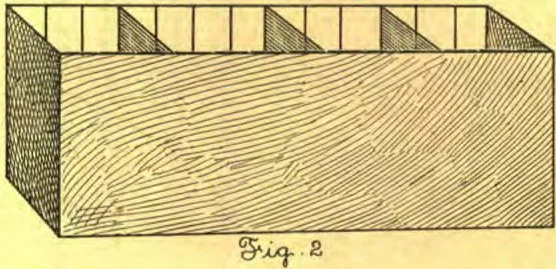
Fig. 2
Fig. 2
Trays may be made on this plan by simply nailing smooth pieces of board together, just as a dry-goods box is made; but they will not look as neat, nor are they as substantial, as when the pieces are neatly rabbeted and fitted together.
Besides the four trays already mentioned, it would be well to make a washing-box. This is not absolutely essential, as the plates may be washed in the “miscellaneous” tray, or in any other available vessel.
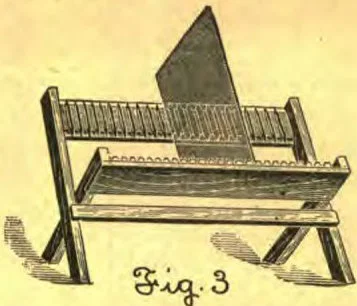
The washing-box should be made on the same plan as the trays; but for five-by-seven inch plates, the inside dimensions should be as follows: length, eight and three-fourths inches; width, five and three-sixteenths inches; depth, eight inches. Before the box is nailed together, strips of wood eight inches long, half an inch wide, and one fourth of an inch thick, should be tacked to the inside of both side-pieces, exactly three sixteenths of an inch apart. A lath “ripped” to the proper width, and planed, is just the thing for the strips. Thirteen will be required for each side; and when the box is finished, they will make twelve grooves along each side, into which the plates may be slid lengthwise, to be washed in an upright position. It will be impossible to use a smoothing-iron to coat the washing-box, so it must be heated to a temperature above the melting-point of paraffin before the wax is applied. Figure 2 shows a washing-box containing sixteen grooves. A simple drying-rack, which may be made without other description than the illustration gives, is shown in Figure 3. It will be found a convenient addition to the outfit. J. EDGAR ROSS.
Fig. 3
Fig. 3

BEREAN LIBRARY STUDY

Dan. 11:20-27; “Thoughts on Daniel,” pages 239-250

NOTES ON LESSON 17

(March 25-31)
1. An Agent in Fulfilling God’s Plan.—The lesson opens with the prophecy referring to Cæsar Augustus, “a raiser of taxes.” During his reign the Messiah was born in Bethlehem of Judea, and the haughty Roman monarch acted his part in the fulfillment of God’s plan. “The decree of Imperial Rome for the enrollment of the peoples of her vast dominion, has extended to the dwellers among the hills of Galilee. As in old time Cyrus was called to the throne of the world’s empire that he might set free the captives of the Lord, so Cæsar Augustus is made the agent for the fulfillment of God’s purpose in bringing the mother of Jesus to Bethlehem. She is of the lineage of David, and the Son of David must be born in David’s city.”—“The Desire of Ages,” page 44.
2. One Man Was the State.—When Rome became an empire, all the various offices of trust, which had formerly been distributed among different persons, were centered in the emperor. As consul, he became chief magistrate; as censor, he decided who were to be senators; as tribune, he heard appeals, and his person was sacred; as imperator, he commanded the army; and as pontifex maximus, chief priest, he was the head of the national religion.
3. A New Title.—When one man had become all this, much anxious thought was given to the selection of some title that would properly define all this dignity. At last “Augustus” was chosen, a name which had not before been given to man, but which was applied to things considered most venerable and sacred. “The rites of the gods were called august; their temples were august. The word itself was derived from the holy auguries.” So Octavius, bearing by inheritance the greatest name then known,—Cæsar,—became Cæsar Augustus.
4. A Son of the Gods.—Gradually the insinuations of courtiers that the emperor was the “divine son of the gods” came to be accepted; and altars, statues, and images representing this divinity were erected. The slightest indifference or carelessness, intentional or otherwise, toward any of these was high treason. Throwing a stone at an image of the emperor was sufficient excuse for beheading the offender. Of all the Roman emperors none were more zealous than Tiberius in putting out of the way those whom he deemed guilty of any disrespect. In those days, deeds and words were not all that were taken into account, but even “a gesture, an involuntary forgetfulness, an indiscreet curiosity,” caused the sacrifice of many lives.
5. A Warning to Pilate.—Remembering all these things helps us to understand the situation of Pilate, the Roman procurator of Judea, when the priests and Pharisees of Jerusalem brought in their accusations against Christ. Although Pilate repeatedly declared, “I find no fault in him,” he yielded to the threat, “If thou let this man go, thou art not Cæsar’s friend: whosoever maketh himself a king speaketh against Cæsar.” Pilate understood full well the furious jealousy of Tiberius, and knew that a release of one to whom the title “King of the Jews” had been given, would mean for him a call to Rome and his head upon the block.
6. A Fearful Record.—The turbulent character of the world’s history during the time covered by the week’s lesson is indicated by the uncertainty attending the lives of the various rulers. During the three hundred years elapsing between the death of Cæsar Augustus and the time of Constantine, Rome had sixty-two emperors. Of these, forty-two were murdered, three committed suicide, two were forced to abdicate the throne, one was killed in a rebellion, one was drowned, one died in war, the manner of the death of one is uncertain, and no more than eleven died a natural death.
7. Roman Amusements.—The Roman people, from the emperor to the lowest citizen, were devoted to games, contests of strength and skill. “Bread and the circus!” was the motto of the half million idlers who thronged the streets of Rome. Beginning with the contests of wild beasts, which were turned loose in the arena to destroy one another, the appetite for sport was whetted to demand the blood of men. Then men fought with beasts, and finally it was a combat of man with man. But aside from the notoriously cruel arena combats, the skill of the Romans in the management and training of wild beasts was something marvelous. Ferocious animals imported from the wilds of Asia and Africa were not only subdued, but trained. Mark Antony had a span of lions that drew his chariot through the streets of Rome. Cæsar’s elephants, carrying torches, escorted their master home at night. Tigers and lions were tamed until they seemed only cats of a larger growth. Stags were harnessed to vehicles, and worked as patiently as horses.

HOW MISSIONARIES TRAVEL IN PERSIA

In Persia almost all traveling is on horseback. Many natives use donkeys, which they abuse dreadfully, and on which they often look very ludicrous. The little donkeys go along so steadily that their riders often fall asleep, or, if they do not, and wish to go fast, they swing their legs, which reach nearly to the ground, in and out under the donkey’s body. Some missionaries ride donkeys, too. It is most comfortable to travel with one’s own horses, going a moderate distance, twenty miles or so, each day. That may seem a short distance, but, as a matter of fact, a man can walk both farther and faster than a horse on a long journey.
When one wishes to travel very fast in Persia, he goes chappar, or post. On the mail roads there are posthouses, with horses, about twenty-five miles apart; and the mail carrier gets fresh horses at each posthouse. More horses are kept than the postman needs, however; and as he does not pass every day, other travelers use the post-horses. A good rider, whose body is tough, or “baked,” as the Persians say of a well-seasoned horse, can ride eighty or a hundred miles a day in this way. It is very wearing, though; for you must travel without much bedding for night or food for day; and some of the horses are very bad, with sore, evil backs.
The takht-ravan is the stately mode of travel. It is a moving couch, or inclosed litter,—a sort of giant palanquin,—borne between camels or mules, one supporting the front shafts, and the other supporting the rear. Takht-ravans and kajavas are for women, and they are very precarious contrivances. The missionary children have often to ride in kajavas,—pairs of cages balanced over a mule or a horse. The passengers get very cramped; and sometimes the horses stumble or slip on a steep path, and there is a spill. Even the caboose of a freight train is a luxury compared with kajavas.
There are no real railroads in Persia. There was one on the shore of the Caspian Sea, but its only engine blew up; and there is a poor little one a few miles long at Teheran, where trains run one way by gravity.—Well-Spring.
Continue reading: MARCH STUDY OF THE FIELD