OUR voyage from Calcutta to Singapore took us across the Bay of Bengal and down the Malacca Strait, a distance of 1,630 miles. All the features of this voyage—the weather, sea, steadiness of the ship, passengers, food, and general service—combined to make this one of the most enjoyable sea trips I have ever had. As I was very anxious to write my reports on India and to catch up with my correspondence, I greatly appreciated these excellent conditions for hard work. Our steamer, “Kut Sang,” left Calcutta the tenth of February and arrived at Singapore the nineteenth.
On arriving at Singapore we found our people, with the rest of the citizens, in a rather serious condition. On the fifteenth a regiment of 800 Indian soldiers mutinied. Without the slightest warning they left their barracks about three o’clock in the afternoon and began shooting the Europeans in the streets. In a short time the whole city was filled with consternation. The loyal soldiers in the city were few, but they were joined by the men in the business houses, and by very prompt, heroic efforts they saved a general massacre of the European population. The women were quickly removed from their homes to steamers lying at anchor in the harbor, and the men who did not join the fighting forces were gathered into a well-protected area. Our sisters were taken to the steamer “Nile,” and our brethren were safely housed in our church building, which was located in the safe area.
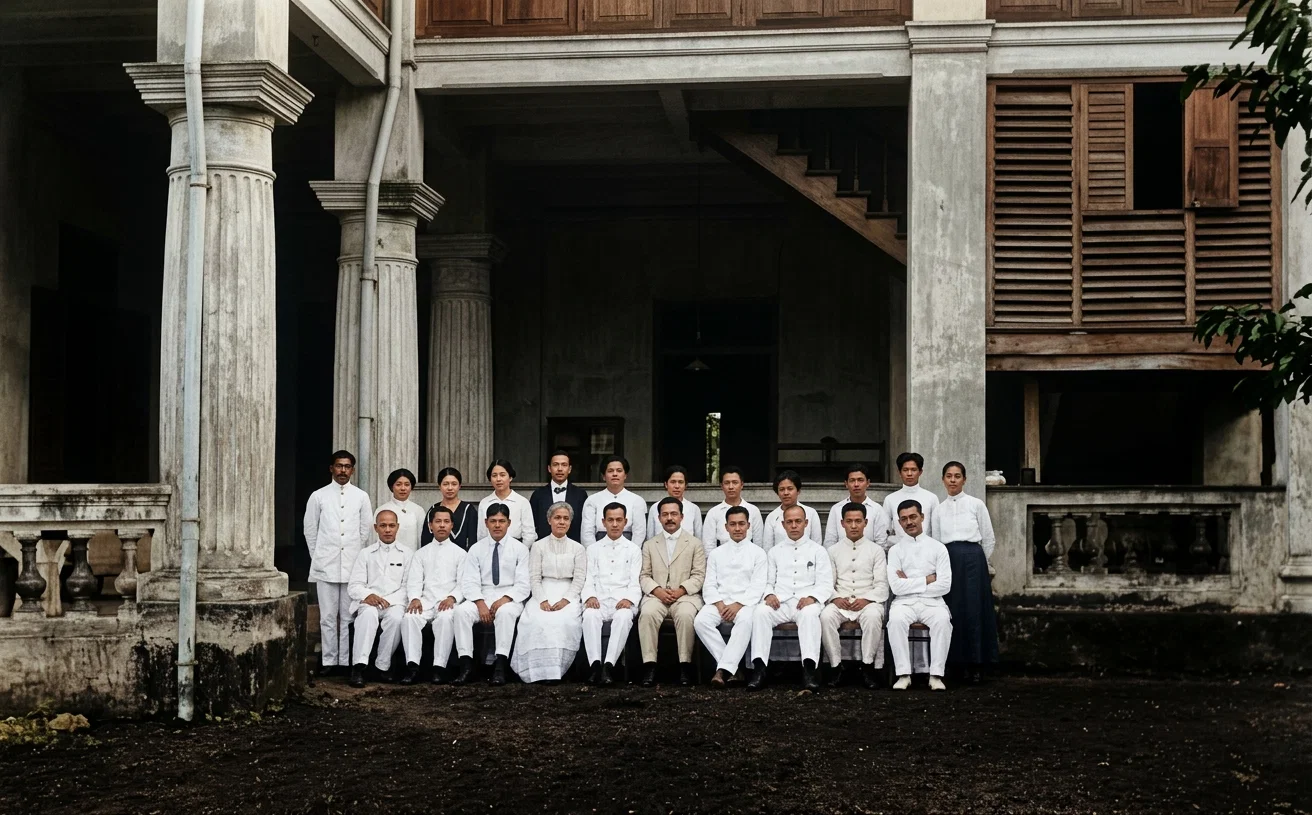
The outlook for a general meeting of our workers in the Malaysian field was not very encouraging, but we decided to make the best of the situation. The mutineers that had not been shot or captured were in hiding, and it looked as if it was a matter of only a few days when they would all be captured. After advising with the military authorities we decided to go on with our meeting, and by sundown we were nicely located in our large, well-ventilated mission building. There were twenty of us, making a large, happy family. We had no thought of danger, although for three or four nights we could hear shooting in different directions around our building. We had all looked forward with great expectation to this gathering, and we felt that the Lord would care for us as we prayed and planned for the advancement of his cause in this part of the great harvest field. This was the biennial council of the Malaysian Mission field.
Owing to the general disarrangement of the shipping schedules caused by the war, it had been impossible to plan definitely just when we could meet and how long we could remain together, but after a great deal of uncertainty and delay, we had all succeeded in reaching Singapore about the same time.
SEVENTH-DAY ADVENTIST CHURCH BUILDING, SINGAPORE
Our meeting continued one week. Elder R. C. Porter, president of the Asiatic Division, was with us to aid in shaping the work of the council, while the burden of carrying out the daily program rested upon Elder F. A. Detamore, the superintendent of the Malaysian Mission field.
Malaysian Mission Territory
The territory of this field embraces the Malay Peninsula, Dutch East Indies (except Dutch New Guinea), and British North Borneo. The Malay Peninsula is a long, narrow strip of land lying between the China Sea and the Malacca Strait. Only a small portion of the peninsula is British territory. The British territory is called the Straits Settlements because it is made up of detached blocks of land along the Straits of Malacca. In the early days these were the principal European settlements on the peninsula. These settlements are composed of,—
a. The island of Singapore, at the extreme south end of the peninsula.
b. Malacca, a strip of land on the west coast of the peninsula about one hundred miles north of Singapore.
c. The Dindings, a piece of the mainland, and a number of islands 350 miles north of Singapore.
d. The island of Penang and Province Wellesley, a strip of territory opposite11Penang on the mainland, 480 miles north of Singapore.
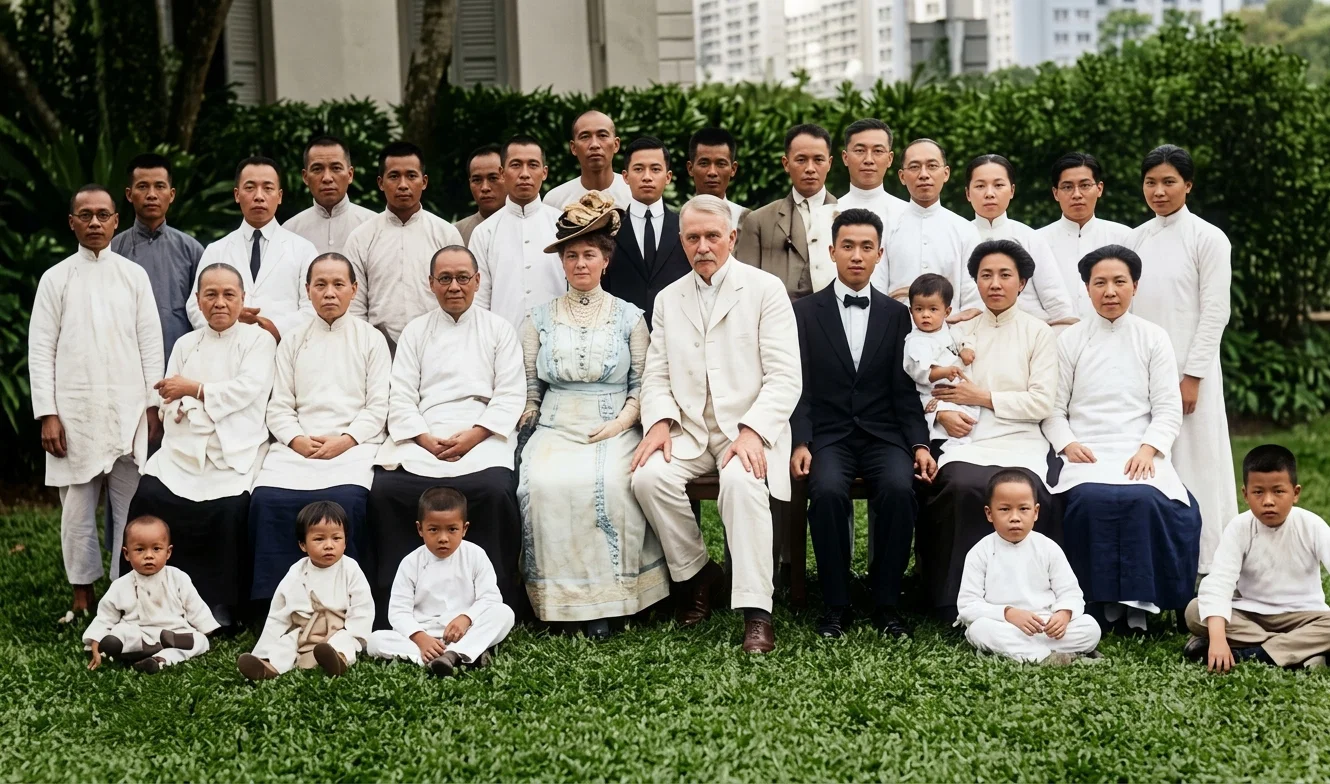
ELDER AND MRS. A. G. DANIELLS, WITH THE MEMBERS OF THE CHINESE CHURCH, SINGAPORE
The remaining territory of the Malay Peninsula is divided into nine states, all under British protection. Four of these states have united under a federation by which they are known as the Federated Malay States. By special arrangement Great Britain administers the governmental affairs of these federated states. The other five states are separate and independent. They have placed themselves under British protection, but each administers its state affairs under the advice of British counselors.
In the organization of the Malaysian Mission field our brethren have created six division missions—the Straits Settlements, the Federated Malay States, Sumatra, West Java, East Java, and British North Borneo. The remainder of the territory in the Malay Peninsula and the Dutch East Indies is practically unentered, and is under the watch care of the Malaysian general committee. This mission field is beset with many difficulties. It extends over a vast sea area, and lies along both sides of the equator, making it rather warm, with but little change of temperature throughout the year. Yet the climate is not nearly so trying as the plains of India or parts of China farther north.
The population of this mission field is at least 50,000,000, representing many races, languages, and religions, and a great variety of conditions, from the highest degree of culture and civilization among the British and Dutch, to the wild tribes of Borneo, whose greatest achievement is reckoned by the number of heads one can gather during a lifetime. While these conditions make the task of the missionary exceedingly difficult, yet our workers are all of good courage and are greatly attached to their fields.
Borneo Mission
All our regular laborers in the Malaysian field were present at this meeting.
Brother and Sister R. P. Montgomery were over from Borneo to tell us about the progress of the cause there. Their report was of thrilling interest to me. I wish it all might be given fully to our people in the homeland. They went to Borneo nearly two years ago and settled at Sandakan, a town on the northeast coast of the island. They now have a church of twenty-two members. Brother and Sister Montgomery are the only Europeans in the church; all the rest are Chinese, and eighteen of the membership embraced the truth in Borneo, and were baptized there. Four of these new converts are now giving their entire time to evangelistic work. Brother Montgomery has the language so that he preaches in the Chinese.
Of course they put in a plea for more workers. Borneo is seven hundred miles wide and eight hundred miles long, about the size of Texas, and has a population of 2,000,000 or more. It is the third largest island in the world. It has vast forests, great mineral resources, and large rivers navigable for long distances. They know of no good reason why many churches like the one they now have cannot be raised up in Borneo. But they need help. Brother Montgomery has been overworking and must have a furlough as soon as some one can be secured to take care of the field in his absence. We cautioned him most earnestly, but he wanted to know how one could keep from overdoing with so much to be done and no one to assist. Surely Borneo ought to have at least two ministers to work for its two millions. Some State in America can share with Borneo and still get along all right, and this sort of thing must be done to a far greater extent than it has yet been done if we do our duty by these lost millions in these mission fields.
East Java
Brother and Sister Wood came over from East Java. They are from Australia and have been working in Java for a number of years. They are located in Surabaya, the principal town in the eastern part of the island. Here we have a church of some twenty-five members who are active in missionary work and faithful in supporting the work with their funds. The Sabbath school offerings for the biennial period were $430, Mex.; week of prayer offerings, $182, Mex.; the tithes, $1,360, Mex. This church disposed of 300 copies of the last number of the Harvest Ingathering Review, receiving for them $122.80. When the war broke out, they printed 5,000 copies of a tract entitled “War in the East.” Nearly all these have been sold at four cents each. These items assure us of earnest fellow believers in the East Java Mission.
West Java
Sister Tunheim is our superintendent of the West Java Mission. For eight months she has had a hard struggle with malarial fever. But she was at our meeting, and is full of courage. The one church in the West Java Mission is at Batavia, and numbers between forty and12fifty. Here are a few items from her most interesting report: Number of baptisms in 1913, fourteen; in 1914, nine. The missionary work has greatly increased during the last two years, there being 2,000 tracts and 20,000 papers sold, and 128 subscriptions obtained; Harvest Ingathering Reviews distributed, 570; cash received, $352 gold, a little more than sixty cents for each paper. This church is in need of a building, and its members are working very earnestly to raise enough money to pay for one. They now have on hand $1,293.60 gold. This is the result of hard work and real sacrifice.
MALAYSIAN MISSION BUILDING AND WORKERS
Sister Tunheim reported the following to show how believers are being raised up in different places where the living messenger has not yet gone:—
A short time ago three of our sisters went to the southern part of Sumatra to sell tracts and take subscriptions. They had very good success, and found one of their relatives who had heard the truth in Java and had worked against it, but the Spirit of God had since worked upon his heart and made it tender and teachable. He has fully decided to obey all the commandments, and has written a very pleading letter for me to come and teach him and several others who are anxious to hear more about the message. From several other parts I often get letters entreating me to come or send some one to teach them the good old way. Thus we often hear the Macedonian cry, “Come over . . . and help us.”
A man who is working in the resident’s office in Mabon, recently received one of our tracts with our mission address on it. He then wrote to us, ordering a whole case of books, which we sent to him. These have been sold by him and others to whom he has sent them in different adjacent islands. He has ordered many more tracts and books since, amounting to another case in all. The most of these he has paid for. He believes firmly in the soon coming of the Lord, and confesses that the seventh day is the Sabbath of the fourth commandment. He also gathers some of his neighbors to a meeting on Sabbath afternoon.
There is a man in Timor who has sold more than $20 gold worth of books and tracts, and has paid for them. A man from a near-by island has written me that he has read some of these tracts and books, and feels convinced that the seventh day is the Sabbath, and wants to keep it. Thus we see the way is opening up faster than we can follow.
Unless the Lord raises Sister Tunheim up to health and strength very soon, she must leave the field on an extended furlough. The workers here are anxiously awaiting the arrival of a laborer who has been selected to work in West Java.
It was a pleasure to meet at our council Brother Richard Sisley, who is doing self-supporting work in Java. Brother Sisley is a member of the Sisley family so well known in the earlier days of our cause. He is a brother of W. C. Sisley, manager of our printing house in England, and of Sisters G. B. Starr and Maud S. Boyd, who engaged in the work in Boston several years, and have but recently been located in California. He is teaching school in Java. While doing this he acts as elder of the church in Batavia, and leader in a company in another place. From his income he supports three native workers in China. His Christian life tells for good in the community where he lives. He is now sixty-seven years old, but is in good health and is full of vigor. He is taking two or three studies in correspondence schools and gets high marks on all his papers. Our brethren in Malaysia greatly appreciate the service Brother Sisley is rendering to the cause, in his quiet, consecrated way, and would regret exceedingly to have him leave the field. And what he is doing, thousands of others, with the same devotion to the message, could do.
Sumatra Mission
I was glad that Brother and Sister Yates could get over from Sumatra. It is not far from Singapore to Padang, Sumatra, as the crow flies, but it is a long way by boat. They were nearly two weeks making the journey each way. It has been less than a year since they began work in Sumatra. Although Sumatra has a population of 5,000,000, and has seemed a promising field ever since we began work there in 1900, yet the permanent results up to the present time are very small. It is possible that the continual changes in the working staff of this mission are in some measure responsible for the seeming failure. Brother and Sister Yates are bent on pushing forward in Sumatra. They have a nice school in Padang, and are planning on doing more along evangelistic lines and in the distribution of literature.
Federated Malay States Mission
Brother and Sister Thompson, who have recently come from Oregon, are in charge of the work in the Federated Malay States, with headquarters at Kwala Lumpur, the capital. They have been assisted in their work by Brother and Sister Duckworth, who embraced the message some years ago in Singapore, and who have a good knowledge of the Malay language. From the results already seen they believe that a permanent substantial foundation has been laid, and that the cause will make headway there. They have an organized church, which is faithful in the payment of tithes and offerings, and in the home missionary work.
Straits Settlements Mission
The headquarters of this mission are at Singapore. This is the only place in the Settlements that we have as yet entered. Brother Roy Mershon, the secretary-treasurer of the Malaysian field, is also superintendent of this mission. The work is well established in Singapore. The members of the church here are mostly Chinese of a good quality. Brother Mershon is planning on a vigorous effort in behalf of the many thousands in Singapore. Brother Lee, a Chinese evangelist, and Sister Chan, a Bible worker, are laboring in the city for the Chinese; and a Tamil brother is working for his people.
Brother Adams, assisted by Sister Yarnell and Brother Fox, is conducting a school in the mission building. The great object of the school is to educate our young native believers to become efficient workers in the cause.
General
The report of the general superintendent showed that during the last two years 113 persons had been baptized, that $5,436 in tithes had been received, and $2,627 in offerings, making a total of $8,063 received from the members for the support of the work. This is a large amount for poor people scattered over such a large area. The tithe is an average of $18 a member, and the offerings of nearly $9 a member, or 17 cents a week for each member. In view of this splendid support, the brethren are encouraged to look and work to the point of making this mission self-supporting in the near future.
Altogether our meeting was most encouraging. It was impossible to close the proceedings without laying plans for advanced work, and that means asking for more help. We must surely send laborers enough to place two in each of these large missions. With only one in a field we run the risk of great loss in case that one fails in health. I am convinced that we have already sustained a greater loss on this account than the cost would have been for keeping a double force in the fields. No one could visit this field and mingle with these workers without having his interest in their work greatly stimulated, and earnestly praying for the fullest success to attend their labors.
A. G. DANIELLS.
News From German East Africa
By L. R. Conradi
SEVEN long months passed ere the first direct news reached us from German East Africa, and then only short notices written on post cards, dated in October. Missionary B. Ohme, the director of the German Victoria Nyanza field, wrote October 20:—
DEAR BROTHER: I am sending news to you, being assured that it will reach you. Thus far we have lacked nothing. Luke 22:35. We have been able to continue our mission work. We did not receive, however, the last shipment of goods. Our last money, 4,500 rupees, we received July 11. At present we are all quite well, healthwise. During August and September I suffered considerably from sickness, but at present I am much improved. We hope that soon we shall be able to communicate with you again. Letters you sent before the war began13have not reached us. Hoping you are all well, we send best regards.
Another card contains simply the following short notice: “In stormy and troublous times everything is still well with us, and we send you the best greetings.”
Another writes, “The best of health, and free to labor, we send you this brief news.” The last news is dated September 10, and reads as follows:—
I sent a registered letter inclosing the accounts, but it was returned by the censor. We hope, however, that this letter may reach you. We are all well, and we greet our brethren and sisters cordially. We still have provisions, but kerosene is scarce.
As to our oldest field, the South Pare Mission, where Brother E. Kotz is in charge, we are quite assured that their work is going on unmolested. He wrote, August 2:—
The work is onward. We expect to have, by the end of the quarter, quite a large baptism. At present the Mohammedans are celebrating Ramadan, their month of fasting. It is the great month for Mohammedan propaganda, when large numbers are being baptized.
The adjoining German Lutheran mission to the north sent good reports as late as October.
Our Victoria Nyanza field has really become the battle ground between contending forces, and we may expect great losses in mission property, to say nothing of the terrible effects it may have upon the progress of our mission operations.
We received the following news from Brother A. A. Carscallen, dated December 13:—
As far as I know, the brethren in German East Africa are still alive. I am not allowed to communicate with them. Brother and Sister B. Ohme were still in Majita, and Brother and Sister V. Toppenberg at Busegwe.
January 30 the following letter, written by Brother Bornath, was forwarded to us from Nairobi, the capital of British East Africa, where Brother and Sister Bornath are prisoners of war:—
DEAR BROTHER: First of all I want to tell you that when we left, the mission work was going well in most places. In some, however, everything was stopped. Until the end of November all our missionaries were well (that is the latest I have had any news from them), with the exception of Brother Palm, who had been killed on his station, November 28. He rests now from his labors until we shall meet him in the first resurrection. My wife and I were taken prisoners December 8, on our station. Since December 14, we have been in the prisoners' camp, Nairobi. We shall soon be sent to India. Healthwise we have every reason to thank God. It is well with us. The missionaries' wives might return to Europe, but on account of Mrs. Bornath's condition, I prefer to take her with me to India. We had to leave the station empty-handed. We commit ourselves to God's hand, and we are willing to endure whatever may come. We met Brother Carscallen. Brother and Sister Matter are already in India. We receive no papers of any sort. Please remember us in your prayers.
The effects of the war upon the great mission work conducted in Africa cannot be estimated at present. Two of our mission families are already prisoners of war, and by this time probably removed to India. Another faithful worker has fallen. His aged mother and his sister mourn his death. A number of our mission stations hardly erected, are left without any one to look after the work there. The property has been looted by the natives, and the fields are left untilled. The native boys who have recently stepped out from heathenism and have been baptized are left without shepherds. Promising schools have been closed. Our mission territory where thus far white men have successfully preached the gospel of peace has become the fighting-grounds between contending forces. Only eternity can tell how much damage has been done. Our missionaries still remaining are undoubtedly constantly in danger of losing their lives, threatened by hostile forces. We have been without news since November. From us they have no news, as they have not heard from us for nearly a year. They have no money. They receive no goods. All we can do is to pray for them, and ask the Lord that this terrible war may stop soon, and that soon the way may be opened for us to come into touch with our brethren, and that the work may soon be finished.
L. R. CONRADI.
Note and Comment
An Unwelcome Spring
[This editorial from the Nashville (Tenn.) Banner of April 5, is a good commentary on Luke 21:26: “Men’s hearts failing them for fear, and for looking after those things which are coming on the earth.”]
In a letter printed a few days ago in the New York Tribune, but written a month ago, when the first crocuses were just breaking through the turf in Kensington Park Gardens in London, Will Irwin says he supposes “spring was never before unwelcome in this world.”
For all the world knows that Lord Kitchener said a little while back that he did not know how soon the war would be over, but he knew when it would begin, and set the date on the first of May.
All England knows that her people are approaching a series of dreadful months. Before the wheat is ripe, a million fine fellows will be under ground; before the wheat is garnered, the material accumulations of centuries will be dust and ashes. With the approach of spring all Europe had begun preparation for the monumental wreckage of war.
The war went on in its ghastliness, through the cold and freezing winter months, while ice filled the trenches and mud was deep on the highways. With the moderation of the weather came the terrific onslaught of the Russians on Przemysl, the scaling of the icy heights, ready to sweep across the plains of Hungary and an offensive along the whole of their front from the Baltic Sea to the Roumanian border and in the Caucasus.
The coming of spring means a half million casualties on the Allied side alone—a hundred thousand of them dead; as many more wrecks for life. It means the death grapple in the fiercest combat the world ever has seen.
“That is why,” continues Mr. Irwin, “the sound of the pattering spring rain on the roof is like the steps of the priest and the hangman in the corridors of the death house.”
Before the sprouting leaves of Kensington Park Gardens turn brown in the autumn wind, there will be thousands of tragedies in suspense and in certainty. No wonder spring is unwelcome!
Drawing Together
The movement for the confederation of the religious forces of the world goes on steadily toward complete consummation. Each year there is some new development toward that end, some new yielding of bodies that had held aloof. The progress is not so rapid as some have wished, but it is always progress, not retrogression. The Greek Church has always held aloof from conferences or conventions of evangelical bodies; but there are indications of a breaking away, on the part of that body, from its historic attitude of exclusiveness. The American Bible Society is to hold a World's Bible Congress at the Panama Exposition, San Francisco, August 1-4. Says the United Presbyterian of April 15:—
A unique feature of the meeting will be the presence of representatives of the Greek Church. In no previous conferences have they ever taken part. It is expected that the congress will surpass any previously held in the number and varying character of the representatives who will be present. Incidentally it may be mentioned that the one hundredth anniversary of the founding of the American Bible Society will occur in May of next year.
While in and of itself this might not be considered a striking development, it is one of the many straws which indicate the direction of the wind. It is striking in this, that the Greek Church has never encouraged the circulation of the Bible among the common people. In fact, the Greek Church in Greece has caused the government to penalize the printing, the circulation, and the reading of the Bible in the modern tongue. If this congress should cause the Greek Church to alter its attitude toward the circulation of the Bible, all Christians would have occasion to rejoice over that feature of this development at least.
The Hunan General Meeting
By James E. Shultz
JAMES E. SHULTZ
THE meeting for the province of Hunan was appointed for February 3-13, and at the request of the committee I left Shanghai January 25 by a river boat, arriving in Hankow, the Chicago of China, five days later, where I joined Elder R. F. Cottrell and Brother H. M. Blunden, who preceded me to Changsha, the headquarters of our work in the province. Generally the trip can be made in six days, but at the time of our meeting the water in the river was very low, and it was with difficulty that the large boats proceeded as far as Hankow. Once we ran aground, where we remained fast for twenty-eight hours, while the passengers shivered with the cold.
Changsha, the place of Hudson Taylor’s death, is one of the literary centers of China. The province of which it is the capital has produced some of China’s brightest men, among them being ten prime ministers. But the city is distinctly Oriental, with streets not usually more than ten feet wide, while some are narrower, which makes carriage traffic impossible. The only conveyances to be seen are sedan chairs and wheelbarrows having two wheels, one behind the other, to enable the operator to climb stairs with his load. Yet one is impressed with the fact that Western custom is exerting an influence, for the white man’s tobacco is considered a luxury, even though it is enjoyed in very small quantities, being procured from the street hawker, who gives the user a “refreshing smoke” from his long-stemmed but small-bowled public pipe, which he rents for a few minutes, everything furnished, for a few cash.
With all its boasted culture, I am persuaded that were the apostle Paul to visit Changsha (Long Sand) today, he would say, “I perceive that in all things ye are too superstitious.” When we made our first trip through the city, while passing through one gate we noticed that all traffic and pedestrians crossed to the opposite side of the street. Inquiring the reason for this troublesome practice, we were told that a man had been killed in the place, when or how no one could tell, but they assured us that to fail to cross to the opposite side of the street, it mattered not how inconvenient nor against how many people one jostled, would assuredly anger the gods, who would visit the offender with their wrath. So the custom prevails.
Our two foreign houses are situated on an island in the river, away from the filth and noise of the city. Not until we had visited the former home of Elder Cottrell, in the heart of the city, could we really appreciate the advantage our brethren now have over those who opened the work in the province. The former location is one of the worst I have seen anywhere in the East, too unsightly to be called a home, but in the early days of our work it was the best that could be had. Now that our loyal people have provided our workers with comfortable homes, they can prosecute their work without incurring unwarranted dangers.
Arriving the day before the time for opening the meeting, we were glad to join the brethren who had arrived early, in earnest prayer that the Lord would bless all the deliberations of our council. A spirit of earnestness characterized our Chinese workers, and from the first it was evident that their purpose in coming to the meeting was to seek a better spiritual preparation for their work.
Much time was given to spiritual instruction, each of our foreign brethren contributing his share. Brother Cottrell dwelt upon the importance of the call to the gospel ministry. Brother Blunden presented the qualifications of the consecrated colporteur, and my efforts were along the line of practical Christian living. Each day time was given for prayer and personal examination, in addition to the consideration of practical problems of missionary propaganda. Each evening a service was conducted by our Chinese evangelists for interested ones from the city.
It was pleasant to meet with our Chinese brethren in committee work, and to study with them the problems they are meeting from day to day. The Christian integrity they showed convinced me that these men are being given wisdom proportionate to their needs. In a field that has as many churches as many of our large conferences at home, and where the work has gone with leaps and bounds, careful planning is required if serious mistakes are to be avoided; but there is no disposition to temporize with questions, no inclination to lower our denominational standard, but rather an earnest endeavor so to plan as to accomplish the greatest results with the least delay.
During the last two days of the meeting, calls were considered from various parts of the field to open up new outstations. While the work in the stations already established showed a substantial growth, there were calls from thirty other places for the efforts of the living preacher. All this is the result of the efforts of our colporteurs. From one place came an earnest call for a worker which was signed by one hundred inquirers who are already keeping the Sabbath. Another city sent an earnest appeal signed by several of the leading merchants of the place, who sent a promissory note for the sum of $150 to help defray the expense of sending a worker to them, and promising an additional $850 as soon as the worker arrived. Other places sent equally urgent calls,—places where men had been keeping the Sabbath for two or three years as the result of reading our magazine.
Nor was this all. From outside the province, calls were received. For several years our canvassers have been going into the province of Kiang-si, and for four years calls have been coming for a regular worker to be stationed in that large province. At this meeting the believers in that province were represented by an earnest young man, who pleaded that their call should not go longer unheeded. But what could be done? Certainly there was no foreigner available for such work. The Chinese brethren, seeing this, finally voted that Brother Hwang, one of their most experienced and successful workers, should be sent to answer this call. They said that when the call first came they thought they could not spare him, but as he stood ready to go, the Lord put it into the hearts of all to release him for the work. The thirty calls for immediate help in their own province caused them to consider their own needs, but they could not deny the right of another province to have at least one messenger of truth in its midst, so, like the church of Antioch, they sent forth one of their own number as a witness to Kiang-si, while we united with them in praying that his mission might be blessed of God.
Before the meeting closed, those in attendance, together with the members of the Changsha church, united in the celebration of the ordinances of the Lord’s house. Confessions were made and sins of a definite nature put away.
Owing to ill health, upon the doctor’s urgent suggestion, Elder Lillie, the director of the field, was advised to seek a more healthful climate. This leaves Brother S. G. White as the only foreign worker in a field having a population of 23,000,000. Let us not forget to pray that God may give him wisdom in planning for the future of the work.
New Hebrides
By C. H. PARKER
C. H. PARKER
ATCHIN.— Two months have come and gone since our return to this field. They have been busy days, though it is the hottest time of the year and the most dangerous for fever. The Lord has especially blessed us as workers, and our health and strength have been kept in even balance. For this we thank our dear Heavenly Father.
We began our school work again on January 25. The attendance has been small, but has increased, and we trust to see it increase from week to week. For this we need your most earnest prayers. The attendance on the Sabbath and at other weekly services has been good. A number of women have begun to come,15and Mrs. Parker has a meeting for them each Sabbath.
Almost every afternoon we visit among the villages, and treat all the sick that we can find. The number of treatments for February is about one thousand. We have some bad cases of cuts, tears, and crushes. The Red Cross outfit, which our Victoria-Tasmania young people donated to the work here, has been a great help. Thus hands from the homeland are being stretched across the rolling expanse of waters, and applying the healing balm to the sicknesses of this people.
We have many evidences that the Lord is working upon the hearts of this people, but the devil is not standing idly by while the work of the Lord is gaining power in these lives. Just three weeks ago three towns were facing each other’s muskets. Early in the morning we heard the war beat of the tom-toms of two villages. The Lord prevented actual bloodshed, but it caused a very bad spirit to exist. The trouble arose over the long spell of dry weather which we have been having. One of the towns had claimed they had a medicine man who had power over the winds, the rain, and the sun. This man was dead, but the other towns thought some man of this town had inherited the power from the medicine man, and that he was keeping the rain from falling. So they thought they would make a finish of it.
We got most of the people of the three towns to come to the mission and talk their troubles over together in a friendly spirit. I had the privilege of putting before them the only true God and his prerogative alone to give and withhold rain. I told them the story of Elijah, Ahab, and the Baal prophets, and that when the hearts of the people turned back to the true God, the Lord gave them rain in abundance.
Their talk was quite excited and dramatic at first, but finally they were all sitting down with one another and shaking hands, and then they were friends again. They said esu koatsin (finished forever), and went back to their homes laughing.
The Lord knows what is best for his work here, and it takes the cloud as well as the sunshine to make the rising grain appear. With Paul we can say, “I have learned, in whatsoever state I am, therewith to be content. I know both how to be abased, and I know how to abound: everywhere and in all things I am instructed both to be full and to be hungry, both to abound and to suffer need. I can do all things through Christ which strengtheneth me.”
We need your continual prayers, brethren and sisters, that the Victory of Israel shall be an abiding presence in our work here.