Your ShelfYour Projects

Review and Herald, Vol. 92, No. 27.

Sounding His Praise
Earlier text: Our Malaysian Mission Field

Mental Food for the Young Child

MRS. VINA SHERWOOD-ADAMS
WHY is it, when a little child comes bounding to us, his face all abeam with dawning intelligence, that we seem duty bound to meet these indications of his intellectual growth with dead forms, such as the letters of the alphabet, the meaningless numerical symbols, the written form of letters, etc.? We think that if he can spell a few words, count to ten, or write a little, we have given him a long push toward knowledge. Have we? Sometimes we parade this mechanical knowledge before others until the child gains the impression that he is a very learned little man.
From our own childhood we have received a wrong impression of what constitutes true knowledge, which is to know God and the things that he has created. Many volumes have been written about God, and still more on his created works; but there are only two books in which we may obtain this true knowledge firsthand, the Word and nature. The little child cannot read and comprehend the first, the Word; so he must make free use of the second, nature. That is why we observe in all normal children this early interest in things alive. They will chatter like little magpies over even a few ants crawling on the ground. As parents and teachers we are responsible for encouraging and assisting them in the study of their book.
I am becoming convinced that the hereditary traits given children by their parents are the smaller factors in forming the general character we find in the adult. Of course there are certain strong traits running through a family that predominate through life; but it is what a child learns from his parents, his brothers, his sisters, his neighbors, the things he studies, his surroundings in general, that make or mar his character. I believe every little one has a pretty clean slate when he comes into this world, and that we are more responsible than we realize as to what is written on that slate. We can wash a child’s school slate clean again, but how difficult it is to remove even the earliest impressions made on a baby’s mind!
What a high privilege we have of molding our children’s minds while the heart, “not yet hardened by contact with evil, is quick to recognize the presence that pervades all created things. The ear as yet undulled by the world’s clamor is attentive to the voice that speaks through nature’s utterances,” Shall we excuse ourselves, and give this privilege to others?—No. “Do not send your little ones away to school too early. The mother should be careful how she trusts the molding of the infant mind to other hands. Parents ought to be the best teachers of their children until they have reached eight or ten years of age. Their schoolroom should be the open air, amid the flowers and birds, and their textbook the treasure of nature. As fast as their minds can comprehend it, the parents should open before them God’s great book of nature. These lessons, given amid such surroundings, will not soon be forgotten.” “The mother should have less love for the artificial in her house, and in the preparation of her dress for display, and should find time to cultivate in herself and her children a love for the beautiful buds and opening flowers. By calling the attention of her children to their different colors and variety of forms, she can make them acquainted with God, who made all the beautiful things which attract and delight them. She can lead their minds up to their Creator, and awaken in their young hearts a love for their Heavenly Father, who has manifested so great love for them.”—“Christian Education.”
Battle Creek, Mich.

June Hints

WITH the coming of fresh fruits and vegetables, June is the time to look after the cellar. All the bins should be cleaned out, the walls and ceilings brushed, and the floor thoroughly swept. The useless rubbish that is so apt to accumulate in the cellar should be looked over and disposed of.
Where the cellar is old, or dark, or musty, one or two coats of whitewash should be applied. The following formula for whitewash for interior use is recommended by the United States Government:—
“Slake a peck of quicklime with boiling water, and cover the instant the water is added. Strain after slaking, and put in a gallon of salt dissolved in hot water, a quarter of a pound of Spanish whiting, two pounds of rice paste, and a half pound of glue dissolved in warm water. Mix these thoroughly, cover, and set aside a few days to ripen.”
By making this mixture thin enough, it may be applied with a spray pump, in which case two or three applications will be needed. It is also excellent for henhouses, hencoops, nests, etc. Not only will a liberal use of whitewash destroy germs and neutralize odors, but it will also effectually prevent lice, mice, and other vermin.

Whitewash for Outside Use

To make a practically waterproof whitewash, such as is used on lighthouses, life-saving stations, etc., “mix a half bucket of unslaked lime with two handfuls of common salt. Add soft soap in the proportion of a pound to every fifteen gallons of whitewash. This makes a very sticky and effective wash.”

Fruit Closets and Shelves.

This is the time when the fruit closets and shelves should receive attention. If possible take all the cans off the shelves and set them on a table or box; look them over carefully to see if all the fruit is keeping; and wipe each can with a cloth wrung out of hot, soapy water. Give the shelves a thorough washing and airing, clean away all cobwebs and dust from the corners, and set the left-over fruit in an accessible place, so it will be used first.
All empty cans, bottles, jelly glasses, etc., should be looked over and so arranged that they will be easy to get at when the busy fruit-canning days begin. If new covers and rubbers are needed, they should be bought, that all may be in readiness. MRS. I. H. E.

The Excellence of Love

NOTHING is sweeter than love, nothing stronger, nothing higher, nothing broader, nothing tenderer, nothing better, either in heaven or in earth, because love is born of God, and, rising above all created things, can find its rest in him alone.—Thomas a Kempis.

Conducted by Mrs. I. H. Evans, Takoma Park, Washington D. C

Assisted by Miss Lora E. Clement
Through the columns of this department, hints will be given on all matters pertaining to the home life. Short articles and letters are solicited from home makers, telling of their everyday experiences,— their joys and sorrows, their failures and successes.

MRS. C. L. STONE

Training in Habits of Order and Helpfulness — No. 3

MRS. C. L. STONE

In the interesting discussion in the previous article, the question left open was how to release the energy of childhood along lines of desirable activity. The natural habits of children offer us the safest guide in our methods of dealing with them.
Writing of the place of industries in elementary education, Katharine Elizabeth Dopp says: “Later infancy is pre-eminently the period of play. . . . To lay hold of this interest, to direct it so that it will lead to useful ends, . . . is the part of parents and teachers.”
As soon as a little child is able to run about, sometimes even before he can begin to talk, he begins to play at doing the things he sees his elders doing. He is anxious to attempt, anxious to do. When a little older, he will constantly follow mother about, demanding the privilege to “help mother wash dishy, help mother f’eep f’oor, help mother carry wawa.”
When he finds himself unable to accomplish the desired feat, he gladly welcomes a slight assistance from mother. Let her take the trouble just then to show him how to do right the little task he is trying to accomplish. A baby is so much the creature of imitation and habit that he can be taught before he is two years old always to do certain little tasks and to do them right. The sense of having achieved something, with mother’s smile and word of approval, is ample reward to him. His ecstatic exclamation, “Father, I helping mother,” is sweetest music. Little hands are not skillful, and baby fingers usually make more work in the end for mother; but it certainly pays to take the time and trouble to show baby how to do the thing right at the time he is so anxious to do it, else the time will come when, discouraged at mother’s lack of interest and his own clumsy failures, he will cease to desire to help her.
As the little girl grows older, she can have in miniature almost all the utensils and furnishings with which mother carries on her daily round of housekeeping. These need not be expensive, for many of them can be homemade. The little table should have a tablecloth, if only a square of muslin, and dishes with which to be set. With keenest delight the little one invites mother to tea, and here is mother’s opportunity to teach her how to set a table properly.
The dolly’s bed should have its proper furnishings of mattress, pad, sheets, pillows, pillow slips, coverlet, and spread, that the little one may learn from the first, the right method of making a bed. Later as a special privilege she may be allowed to help mother make her larger bed.
Little washtubs and boards may be had; and when the family wash is in progress, nothing more delights the little one than to be allowed some real water in a real little tub in which she may wash her dolly’s clothes. This is the time for mother to teach even the small girl all the different steps of doing this work properly.
Keep in mind that in all the table setting, sweeping, bed making, and washing, the child manifests the same keen interest and delight that is seen in the game of hide and seek. Thus the mother, in taking advantage of the play instinct, is teaching valuable lessons, while to the child it is merely play.
By giving this type of toy to our children, we avoid the use of the mechanical toy which is so severely condemned by present-day psychologists. The mechanical toy calls out no activity from the child. His is a passive enjoyment. He simply winds up the toy and observes, but has no active part in the game. For this reason he soon tires of it, and almost invariably takes it apart to see how it is made. After this he wants something new. Not so with the little wagon, or hoe, or spade. These are useful tools to him. They serve him when he wishes to do something, and he does not tire of them. Given a pile of sand, building blocks, spools, a doll, a tiny flatiron, a little broom, anything which calls for activity on his part, and he will play for hours day after day with the same playthings.
Let us not be afraid to enter into the spirit of play with our children, nor to cultivate in them this play instinct. A little child should not be expected to live the life of an adult nor to do his tasks in an adult fashion. “There is no doubt that the little child gets greater satisfaction, more normal development, in activities that are normal to his state of development than in those for which he is not ready.”

Revolving Stand for Sewing

A NOVEL use I have found for an old piano stool is to utilize it in making a sewing stand. This stand has the advantage of revolving, which is very convenient, for with a twist of the wrist any portion of the sewing outfit can be brought immediately to one's side. The height of the stand can be adjusted, which is an unusual feature.
I took a piece of cretonne thirteen inches deep and cut it the size of the circumference of an old piano stool. I then hemmed the bottom edge, turned down two and one-half inches of the top edge, right side out, and turned up the bottom so it lapped half an inch over this, and stitched it across at intervals of about three inches so as to make a row of pockets. This strip I fastened around the stool with brass-headed tacks, easing it on so as not to draw the pockets tight. I put tape, china or pearl buttons, dress fasteners, black or white hooks, collar supports, etc., in the pockets, stitching a sample of the contents first, to the outside of each. On top of the stool I set a round workbasket, and fastened it firmly by means of a carpet needle threaded with cord, run through the plush top of the stool. I keep my scissors, spools, needlecase, pincushion, etc., in the basket, and as I sit at my machine, I give the stool beside me a twirl to bring any pocket to hand.—Woman's Home Companion.

The Doorway of the Old Home

THE doorway of the old home Is stained with age, and small; And in the early twilight, When purple shadows fall Across the little doorstep, My half-shut eyes can see A row of clear-cut visions, That stand and smile at me.
The doorway of the old home Has often opened wide For schoolgirl and for student, For mother and for bride; And soldier feet have traveled, While eyes were dim with pain, Across the narrow threshold, That ne'er came back again.
The doorway of the old home Has heard love's stories told; Has seen the splendid autumn Of people growing old. And baby hands have fumbled At lock and heavy key; And feeble arms stretched from it To children out at sea.
The doorway of the old home Is stained with age, and small; And yet in glowing summer, In winter, and in fall, It gives a cheery welcome, And knowing eyes may see The row of clear-cut visions That stand and smile at me.
— Margaret E. Sangster, Jr., in the Christian Herald.

The West Indian Union

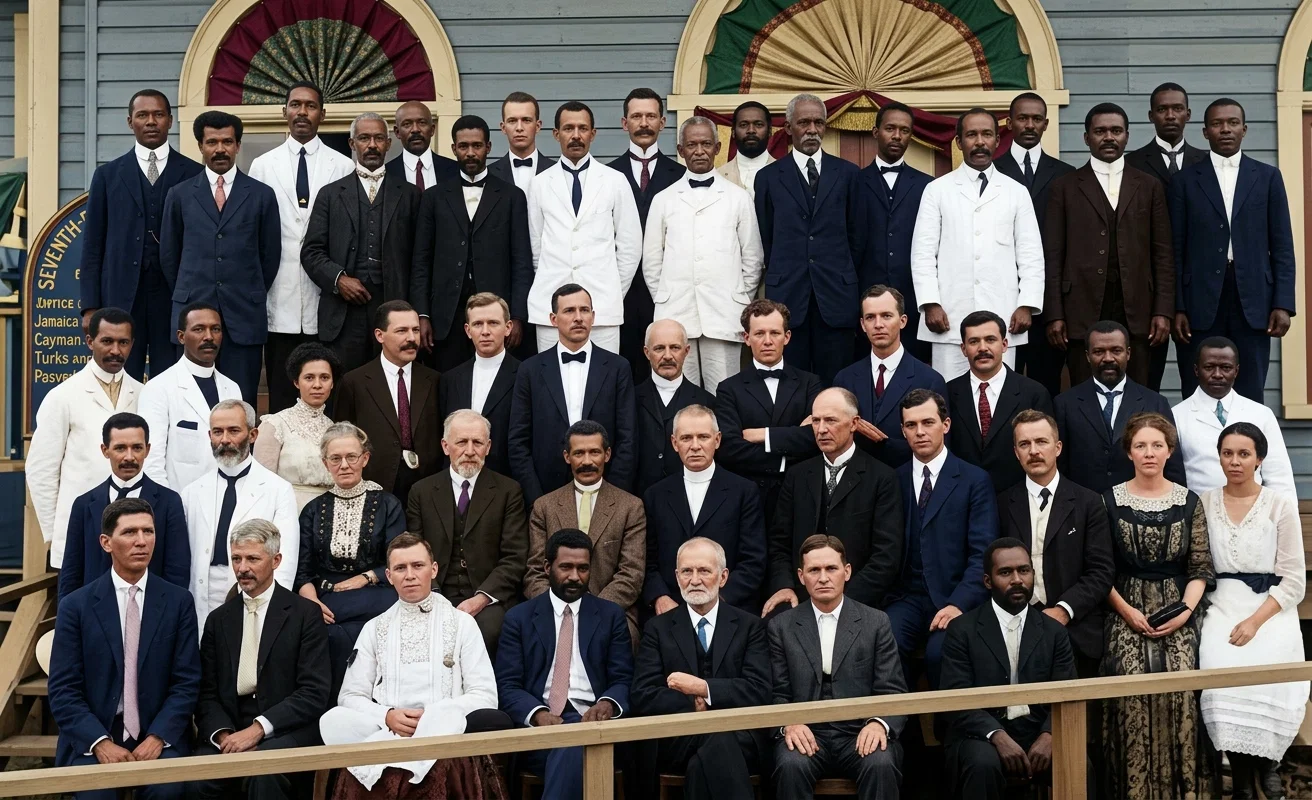
MARCH 24 Prof. M. E. Kern and the writer sailed from New York on the steamship “Alimarante,” to hold a ministerial institute and attend meetings in the West Indian Union. After a pleasant sail of five days we reached Kingston, Jamaica. Here we found the Jamaican Conference in session, and received a most hearty welcome from all. Delegates were present from nearly all the churches. These, with the Kingston church, which has a membership of about five hundred, made a large attendance. The large church was crowded at all the evening services, many interested ones attending. A ready response was given to the instruction, and all entered heartily into the study of plans for the advancement of the work on the island.
Harmony prevailed in the deliberations of the conference. Elder E. C. Boger was unanimously reelected president of the conference, and C. B. Degering secretary and treasurer. Plans have been laid by the committee to carry forward several efforts in new fields, and to hold a number of conventions among the churches, and in this way carry forward a strong, aggressive movement for the ingathering of souls. The reports rendered during the conference indicated progress, and the outlook for the advancement of the work in this island seemed to be encouraging.
April 5 we sailed for Colon, to hold a ministerial institute and attend the sessions of the West Indian Union and West Caribbean Conferences. We reached the Canal Zone the seventh, and were soon comfortably located in rooms in our mission building in Cristobal. The days from April 9 to 27 were indeed busy ones. The institute covered the first ten days of the meeting. Though the territory is widely scattered, and much time and expense were necessary to reach the place of meeting, nearly all the workers in the field were in attendance. More than fifty workers were present, and these, with a number of others from the Colon and other churches, made quite a large institute.
The institute was conducted on the same general plans as those held in the United States. The most of the instruction was given by Professor Kern and the writer, covering the work of the ministry, the Holy Spirit, prayer, work in the field, work among the churches, etc. This was the first institute of the kind ever held in this field, and all entered most heartily and earnestly into the studies, desiring to obtain all the help possible.
DELEGATES TO THE WEST INDIAN UNION MISSION CONFERENCE
From the beginning, the blessing of the Lord was present in a very special manner. In no institute held have we witnessed more of the working of the Spirit of God than in this meeting. The revival spirit was present; confessions were made, misunderstandings cleared up, and sins put out of the life. The Holy Spirit gave all a new vision of the work and of their responsibility to labor for lost souls, and stronger resolutions were formed to be more faithful and efficient in the work.
The deep spiritual influence of the institute pervaded all the business deliberations of the conference which followed, and we feel assured that this meeting worked a new and better experience in the lives of the laborers in this field, who have to meet many obstacles in the progress of the message.
Unity marked the proceedings of the conference. Elder A. J. Haysmer was reelected president of the union, and F. H. Raley secretary, treasurer, and auditor. Earnest study was given to the question of how best to carry forward the work in the union harmoniously and effectively. Difficulties in administration are caused by the scattered condition of much of the territory, making it impossible to visit portions of the field as often as desirable. Delays are experienced in mail facilities, especially since the removal of some of the mail ships on account of the war. Then there is a very large and unworked Spanish territory containing millions of souls, the majority of whom are darkened by ignorance and superstition. One of the greatest problems before us in the meeting was how to plan the work so that the message can be quickly carried to these people. The circulation of literature must be a prominent factor in this work, and requests were made for some efficient laborers for this branch for the West and South Caribbean Conferences. The problem of how to reach the large Spanish-speaking population in this union is indeed great, but it must be solved.
On account of the difficulties of finding available office room in the Canal Zone, it was thought best to locate the union headquarters in Jamaica for the present.
Steps were taken looking toward increasing the circulation of the West Indian Watchman, and other literature produced by the printing office at Riversdale. The brethren connected with the office are laboring hard to make the printing office self-supporting.
Departmental work was given consideration at the meeting, and plans were adopted to strengthen these lines, especially in the local conferences. Professor Kern, in addition to the regular work of the institute, was able to give special attention to the work of the youth in this field. This was appreciated, and will doubtless result in great good. The problem of the education and training of the young people in this field is a serious and perplexing one.
In connection with the union conference, the West Caribbean Conference held its regular session. The utmost unity was manifested in the business of the conference.
Elder W. G. Kneeland has the confidence of all, and was reelected president. Requests were made for a capable man who can act as secretary and treasurer, and promote field work as well. A request was also made for a strong leader in the circulation of literature, especially among the Spanish-speaking people.
Personally, we enjoyed meeting with the believers in this union, and becoming more conversant with their problems. The help sent to the meeting was appreciated, and all possible was done for our comfort. Earnest efforts were made to cooperate in all the plans proposed for the unification and advancement of the work. The Canal Zone, on account of the construction and completion of the Panama Canal, the greatest engineering achievement in the annals of the human race, is under the eye of the world, and if times of peace and prosperity should continue, would doubtless be one of the greatest routes of commerce in the world.
We feel hopeful for the work in this field. Let this portion of the vineyard be remembered in the prayers of God’s people, that the health of our workers may be continued, and many more gathered into the message and prepared for the coming of the Lord.
G. B. THOMPSON.

Colorado

DENVER.— We are glad to report that the work is moving onward here. Since last September I have had the privilege of baptizing sixty-eight new believers. Our churches have been blessed with many additions to their membership. A deeper interest than ever before is being manifested in both our regular church services and the Sunday evening meetings, and many are taking their stand for the truth as the result of these efforts. From all parts of the city, calls are coming in for Bible readings, and we are more than busy. The outlook was never brighter. G. W. ANGLEBARGER.

THE FIELD WORK

“GO YE INTO ALL THE WORLD”
GO YE INTO ALL THE WORLD

Medical Convention Notes

WE have already spoken of the three medical conventions recently held, and have given the agenda paper which served as a program. Leading thoughts from various speakers may be sufficient to indicate the ground covered and the tone of the discussions. The recommendations adopted will be given in connection with outlines of discussions. The first one follows:—
Resolved, That it is the sense of this convention that our denominational medical work should be regarded as a distinctive factor for the advancement of the truths and work of Seventh-day Adventists, including the following:—
a. The care of the sick among our own people and others.
b. Education in principles of health and physical reform.
c. The training of medical missionary workers.
d. To assist by influence and careful, direct effort to give the Bible truths for this time.
We believe that while we should seek for the highest possible scientific efficiency, we should not seek to be competitors of scientific or professional institutions; that while we must use every means possible to make our sanitarium work properly self-supporting, we do not regard our sanitariums as enterprises of financial gain, either to conferences, companies, or individuals.
Dr. H. W. Miller: “The medical work of the world, as far as equipment, men, and methods are concerned, is doing all that needs to be done in strictly medical lines. We are not competing with institutions of the world. Our work must be distinctly different, to the extent that we are doing what they are not doing and cannot do. One of the distinctive features of our work is in the field of reform, bringing persons to a recognition of the laws of health and urging obedience to them.”
“Some of the first purposes of our establishing sanitariums were to provide a means of caring for our own sick people; to make provision for the care of others who would come to us; to provide training centers for medical workers; and to do a health educational work for the general public. The success of an institution should be judged from the manner in which it meets these needs, and not alone from the standpoint of its balance sheet or the standard of its professional work. Our sanitariums should stand as memorials for our great principles, or else we have no good reason for operating them.”
W. T. KNOX: “While we are inclined to look on sanitariums primarily as curative institutions, we must bear in mind that, as in all other lines of our work, the real object should be to bring to people eternal life. We should not only cure persons of their ills, but should teach them how to live in obedience to all of God's laws. Our health food factories, for example, should consider it more important to help persons to live right and obtain health, than to sell their products. Our medical institutions should be great factors in turning men to God. Where a sanitarium does not do this we can write failure against its work.”
“One reason for disappointment in our realizations, to my mind, is the financial phase of the work. Too often have we allowed indebtedness to increase until it has brought discouragement. The financial question then becomes the important one, and almost everything has to be decided in its relation to how it will affect the finances. We try to make the institution pay, and unless we are guarded, the commercial spirit enters. Every line of energy is utilized to make money. Its effect is seen on all.”
“The important lesson of this should be to us that it is wrong to go into debt. The remedy for this is to do all we possibly can to get out of debt. If we ask, How can we be more evangelistic? we can answer, One way is to get right financially.”
“Spiritual work cannot be done by proxy. It must be a personal matter. One must not say, Let somebody else give Bible readings, or pray, or labor for souls. Every one must do his part, and each must have a personal experience in soul saving to insure the success of the institution as a whole in this direction. I have seen persons who were not gifted as speakers or as public workers, but, with a personal, godly experience, were very successful in bringing men to Jesus. The secret of success in this lies in the earnestness of our efforts.”
G. B. Thompson: “In order to do evangelistic work we must be evangelistic at heart. We must believe in prayer and in the power of prayer. We must be definite in our purpose. If we find we are not meeting our purpose, we must ask, Wherein have we departed? We must seek to know what is the matter.”
“It is not enough to have a Bible in a room. There are those who supply Bibles to all guest rooms in hotels. That is good as far as it goes; but for us and our work that does not go far enough.”
“We must have the power of personal Christian experience in our work. Every worker in the institution must have a right experience. Everything in the institution from top to bottom must be done on a missionary basis. If we are not carrying on our sanitarium work in this way, we are making failures. We must find the seat of difficulty and correct it. We must reform.”

Discussion Gleanings

The Lord does not want his people to run his work on borrowed money. The wealth of the world is his. We will do better financially to keep in mind that our service is for God.
Doing God's service in the way he wants it done will enable us to endure sacrifice and suffering, and to work harder. This will help to keep the work out of debt, and it will let us sleep better and give us greater satisfaction.
While we may reach the rich and influential class, our work must also reach the poor and needy.
We believe the secret of making our sanitariums evangelistic is in the godliness of the head physician. He is the man that molds and shapes in a large measure the policies of the work. Our hope lies in strong spiritual doctors.
The early instruction concerning our health work was that it is to fit and prepare a people for translation. This is an important object that we should not forget.
Among some of the things that can be done to strengthen the spiritual influence of a sanitarium is to hold weekly meetings for the workers, for the consideration of the details of spiritual needs, keeping before them its object, talking over individual cases, presenting problems of evangelistic work, discussing how to reach various cases, hearing reports of personal work, having prayer for special cases, and praying for increased patronage where this is needed.
We cannot attain our true purpose until we get a clear vision of what our work should be. Boards of management, superintendents, heads of departments, and all, must see clearly the principles of this work in order to make it succeed.
If we were doing our fullest duty in training to be real soul winners the young people that come to us, we would be a power in carrying forward the work of God.
We cannot make sanitariums merely centers for performing expert surgery for the money that is in it, and expect the approval of God. We must do what we can to relieve those coming to us, and at the same time make the occasion one of helping them find the way of obedience to God's law.
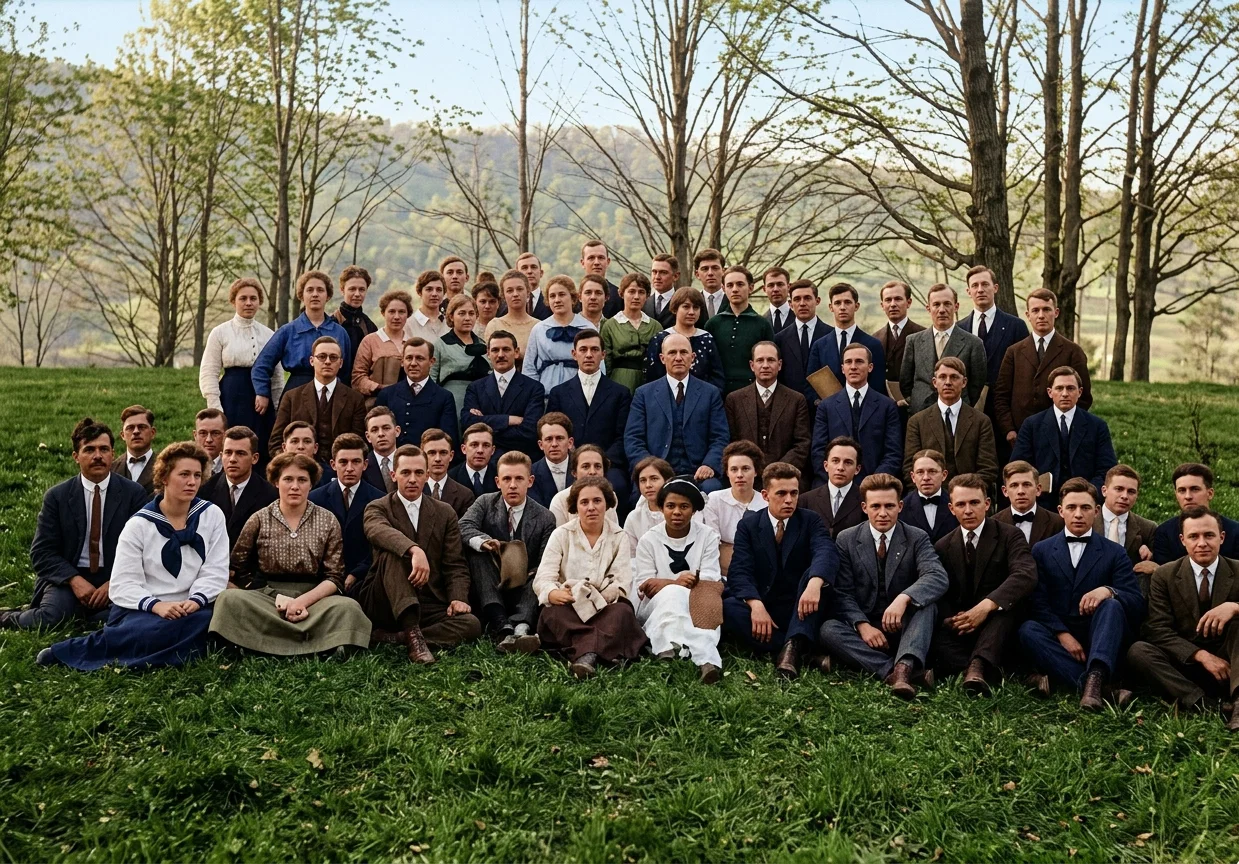
EMMANUEL, MISSIONARY COLLEGE CANVASSERS’ CLASS ’15
We must hold the highest standard of purity and right living in our sanitariums for every member, from the superintendent and business manager down to the humblest worker.
In one of our institutions in one year thirty-two persons came to a knowledge of the truth. We should have persons everywhere speaking a good word for us on account of the spiritual blessings they have received from us.
L. A. HANSEN.
Continue reading: Temperance Work of the Emmanuel Missionary College Young People’s Society