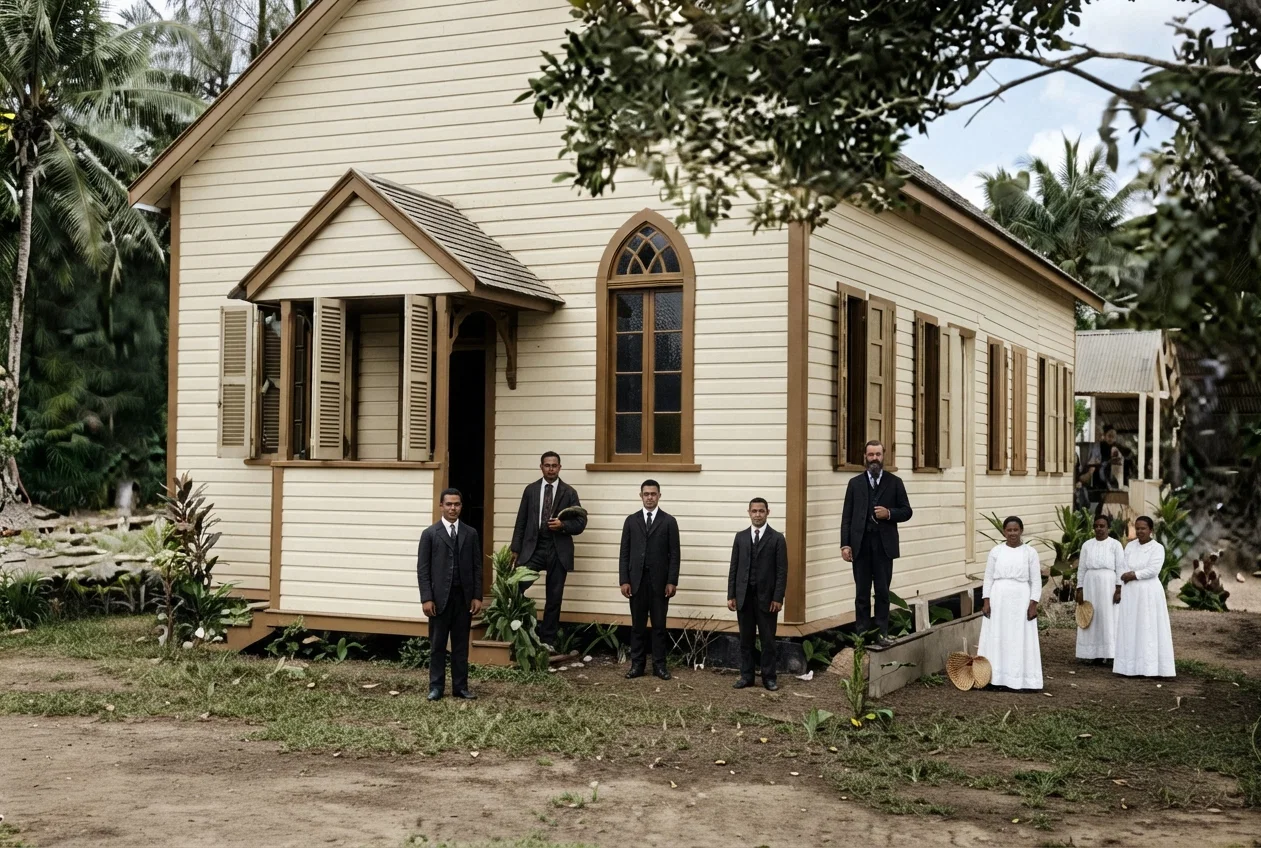
THE islands and groups of islands of Polynesia have long been the home of a people of dark brown skins and stalwart forms. These people lived on in ignorance of the existence of other men, until the early explorers chanced to sight the mountain-tops of unknown land, and, drawing nearer, in wonder beheld their brethren whom centuries of time and vast distance had separated from the rest of mankind. As the Lord had said, "This Gospel of the kingdom shall be preached in all the world for a witness unto all nations," evidently a divine hand was guiding the explorer, and bringing to light the nations that sat in darkness, that some from every "kindred, nation, tongue, and people" might be ready to meet their soon-coming King in peace.
Seventh-day Adventist Church of Arue, Tahiti. Showing Elder A. J. Read and Native Deacons and their wives in front.
The Society Islands, the most important part of the French possessions in Polynesia, comprise Tahiti, Moorea, Raiatea and Tahaa, Huahine, Boroboro, Matea, Maupiti, and Tubuai Manu, besides several smaller islands. These islands are mountainous, and are inhabited by a race of people who in tastes and appearance are brothers and sisters. When discovered, these people were one of the finest races physically on the face of the globe, and, tho since much debased through the effects of rum and kindred evils, there is still a good deal of vigor manifested in the brawny frames and muscular appearance of many of the natives. They much resemble in language, physique, and habits the natives of New Zealand and of the other Polynesian groups.
As there are no finer islands of their size anywhere within the tropics than the Society group, it is not surprising that all the fruits and food-bearing trees that grow within the torrid zone should be found here. The products which are considered especially paying to the producer are coffee, copra, and the vanilla bean. Cotton has in the past been raised to quite an extent for exportation. A considerable quantity of oranges are shipped monthly to New Zealand. The orange trees receive no care whatever, but yield abundantly. Most of the land lies idle from year to year, or raises only weeds and trees.
In early days the Society Islands were ruled by native chieftains, who spent much of their time in planning campaigns and executing crusades against rival factions. At one time the warriors of Raiatea, under their daring leaders, brought beneath their sway the natives of surrounding islands. Their conquests extended as far as Tahiti, which lay 130 miles to the east.
During the years of early mission work, and up to the year 1844, the principal foreign influence in the group was British, and most of the foreign residents were from England. Through difficulties in which the native government became implicated with French priests, the islands came under foreign rule. "The Society Islands, together with the Marquesas, Tuamotu, Gambier, Tubuai, the island of Rapa, the Wallis or Wea, and Howe Islands, form what is called the French Establishment in Oceania, under the control of a Commandant-General, who resides in Tahiti. Tahiti was taken possession of in 1844, and the various other islands were gradually encroached upon by the French, until in 1880 they became French possessions."—Encyclopedia of Missions.
The present population of all these islands of the French possessions, and those of the Austral group, which are under the protection of the flag, is about 28,000, as shown by the government year book.
It was in the year 1797 that the London Missionary Society entered upon active operations in Polynesia, and despatched its first mission ship, the Duff, with a company of workers, to the island field. Several of these located in Tahiti. After nineteen years of trials and hardships, great results were manifested. In 1839 the following testimony as to the condition of society in Tahiti was borne by the captain of a whaler:
A Glimpse at Tahiti.—Population about 10,000.
"This is the most civilized place I have been in in the South Seas. It is governed by a dignified young lady of about twenty-five years of age. They have a good code of laws, and no liquors are allowed to be landed upon the island."
Five years later there was a change in the administration of affairs, concerning which the Encyclopedia of Missions bears the following testimony: "With the institution of the French Protectorate, the flood-gates of iniquity were opened. The people were corrupted by the influence of the rumsellers and other foreigners. The London Missionary Society mission was embarrassed and broken up, and withdrew from Tahiti and Moorea in 1852."
Whatever these people may or may not have been in the past, we know them to be needy of the bread of life to-day. Centuries of heathenism have bound many a poor native with evil habits as with chains of iron, that the power of the Gospel alone can break. The many pages of literature that our press on the island of Tahiti has turned out have found interested inquirers after truth, and thus our few laborers are given an abundance of work. Our brethren are endeavoring to instil right habits into the youth by taking several under their personal watchcare within their family circle. Any one who has ever tried the experiment knows that this line of work, along with other duties, requires eternal vigilance, and gives little time for rest or recreation. How our brethren are going to reach the 28,000 people who are scattered over a hundred or more islands, is puzzling to contemplate, unless they have more help. All of the above-mentioned islanders, speak the same language, and most of those who have reached years of maturity have learned to read.
The climate of these islands over which France exercises jurisdiction is healthful, tho of course debilitating to persons of weak constitutions and unaccustomed to the tropics. The malarial conditions of the New Hebrides and Santa Cruz Islands are not encountered here. Elephantiasis is the most common ailment met with aside from alcoholism.
THE PENITENT'S CRY.
By Emma L. Pardon
JESUS, Thou glorious Lord of all,
Low down before Thy feet I fall,
And on Thy holy name I call:
O Lord, be merciful to me!
Far from the right I oft did stray,
And oft forsook the narrow way;
Now hear me as, with tears, I pray:
O Lord, be merciful to me!
Thou who didst shed Thy precious blood,
And sorrow's path on earth hast trod,
That Thou might'st bring us back to God,
O Lord, be merciful to me!
I long to hail Thee as my King;
I long Thy glorious praise to sing;
My heart I as an offering bring:
O Lord, be merciful to me!
A holy life I now begin,
If Thou wilt dwell my heart within,
Expelling by Thy grace each sin:
O Lord, be merciful to me!
The things I loved I now do hate;
Upon Thy holy Word I wait;
Accept me now, if not too late:
O Lord, be merciful to me!
O, now I trust Thy promise clear,
I claim Thee as my Saviour dear,
Thy gracious words of love I hear:
"I will be merciful to thee."
EMMA L. PARDON.
Albany, N. Y.
HOW THE BIBLE WAS SPREAD IN RUSSIA.
MANY of the ups and downs in the story of Bible circulation in Russia read like a romance. The ending details of this story we find in the Kirchenzeitung of Leipzig (No. 51), from which we select and translate the following data:—
In the first decade of the present century the Bible was practically unknown in Russia. It was indeed possible to secure German and Slavonic texts (the latter being the church language of the establishment, but not at all understood by the great majority of the people), and occasionally a copy in the Finnish, Polish, Lithuanian, or Estonian languages could be met with; but in the Russian language there were no copies of the Scriptures to be had. In 1812 Napoleon invaded Russia, and the Russians, defeated in all the battles, were compelled to retreat. The Czar Alexander I. and his advisers were in despair. Only one man among those with whom the emperor associated remained calm and hopeful, and that was Prince Galitzyn. Finally the czar asked him the cause of his good spirits, and the prince drew out of his pocket a small copy of the New Testament, and informed his ruler that this Book was the source of his comfort and joy. The czar wanted to see the Book, but it happened to fall to the ground, and, in falling, opened at the ninety-first psalm, and the czar's eyes fell on the opening words of this psalm. Deeply moved, he asked for the Book, and became a warm lover of the Scriptures.
Soon afterward John Paterson, a representative of the British Bible Society, arrived in St. Petersburg and asked for permission to establish a branch in Finland. The czar not only granted the request, but also contributed 5,000 rubles toward the project, and further issued the order that in Russia proper, even while the French were yet in Moscow, a Bible Society on a large scale should be established, so that all Russian subjects could have a Bible in their own tongue.
In this way the St. Petersburg Bible Society received governmental approval December 6, 1812, and the czar himself became a member. The first meeting was held in January, 1813, when Prince Galitzyn was chosen president. The members were not only adherents of the state or orthodox church, but also Protestants and Roman Catholics. Especially were the Protestants active in the propaganda. In the same year a Bible Society—yet in existence—was established for the German Baltic provinces. In Moscow, too, a similar organization was effected, headed by the archbishop of that metropolis. As early as 1814 the various local societies were united into a general body, the Russian Bible Society, and among the new members were a number of Russian grand dukes. The outspoken object was to have every Russian family in the empire the possessor of a Bible. In order to secure a good translation into the Russian, the czar contributed 30,000 rubles and a stone building in St. Petersburg. In the year 1823 the Bible had already been translated into sixteen dialects of Russia, and 49,000 copies had been imported from abroad in addition to the 805,000 copies issued by the Russian society. There was no lack of funds. In the first ten years of its activity this society expended the sum of 3,687,000 rubles, and yet, as Prince Galitzyn himself declared, the supply was not equal to the demand among the people.
An unexpected change came after the death of Alexander I. in 1825, when Nicholas I. ascended the throne. In the following year the new czar issued an edict dissolving all Bible societies in Russia, and refused to permit private printing concerns to circulate the Scriptures, and ordered that all the copies on hand in the depots should be sent to St. Petersburg, where their fate was to be decided by the Holy Synod, which body alone was to have the right of circulating the Scriptures. This body did practically little or nothing in this direction, and soon the matter rested altogether. In 1845 an English wholesale merchant in St. Petersburg, when requested to furnish a copy of the Russian New Testament, reported that it had been impossible for him to secure a single copy of either the Slavonic or the Russian Scriptures in that city, altho he had offered the highest price for such a Book, and that in Moscow too the supply was nearly exhausted. After a great deal of agitation, the Holy Synod decided that it would print 3,600 copies of the New Testament in the Slavonic language, as it was thought this would supply the actual needs. Nor was more done at that time.
Moorea, Society Islands, one of the most picturesque islands of the South Pacific. Population, 1,400. The Pitcairn visited Moorea upon its first cruise. We have never had a missionary on the island for any length of time. The people have received considerable of our literature, and have asked for help. A coffee planter from New York, whom I met upon the slopes of those mountains, told me that his best help were the confirmed drunkards, as they would work well part of the week in order to have means with which to get drunk the balance of the time. How much they need to be taught habits of temperance and industry, the Lord only knows. E. C. C.
In the reign of Alexander II., Bible societies were again permitted to do their work in Russia, and in 1869 "The Society for the Spread of the Scriptures in Russia" was organized, and this association has in the twenty years of its existence spread more than a million and a half copies of the Bible or parts of the Bible throughout the empire. Headquarters and depots are at St. Petersburg and Moscow, and a network of colporters has been established in all the leading cities. In the year 1898 a Miss Hörschelmann, the daughter of a high officer, devoted herself entirely to the work of distributing the Bible among the prisoners, and has in this way disposed of 60,000 copies. —Literary Digest.
Mission Work in Persia.
By Editor
From an article in the Missionary Review on "Educational Missionary Work in Persia," we cull this item:—
"The missionaries have not ventured to open any schools for Mohammedans. In Tabriz and Oroomiah the fanaticism of the people is so great that no Mohammedans attend the schools opened there for Armenians and Nestorians. In Teheran and Hamadan, however, many Moslem children attend. The missionaries in the capital hesitated at first to take them, but the president of the late shah's council, the Amin-i-dowleh, requested it in writing, and now two-fifths of the boys and one-sixth of the girls in attendance are Mohammedans. Nasr-i-din Shah himself visited the schools several years before his death, to show the favor in which he held them. The girls' school especially interested him. After going over it thoroughly he was taken to the dining-room and kitchen. He had made no comment as yet, but then he looked about him admiringly, and simply exclaimed, 'Clean, clean!' In Persia at last he had seen two un-Persian things,—a just conception of woman, and cleanliness. It was only of the latter he spoke. Perhaps he not did see the former at all."
Hopeful Outlook for Cuba.
By Archibald McLean
Is there reason to believe that the Cubans will accept the Gospel? The history of Dr. Diaz (Baptist) furnishes the answer. In eleven years he baptized 3,000 people with his own hands. He planted seven missions and put fourteen men to work. In that period he was in jail six times. The authorities did what they could to annoy and hinder him in his work. The people listened to his message. In the war his missions were scattered; his helpers have been put to the sword. At the present time there are about 1,500 of his converts left. What he did while under the ban shows what can be done in propitious circumstances. Hereafter it will be possible to build churches with steeples, and to preach the Gospel boldly and everywhere. The day for the Inquisition has passed; the Cubans will hear and believe and obey.—Archibald McLean.
Antichristian Education
S. H. Kellogg, D.D., LL.D., of Landour, North India, says that "in India the need for educational institutions as a necessary part of the missionary propaganda, is the more emphasized by the fact that in a high and increasing degree the influential classes are coming more and more under the influence of the English language and literature, and in particular with all that is most antichristian in our modern scientific and philosophical literature.
Such names as Huxley, Spencer, and others are as familiar to the educated classes in India as in America; and probably the greater number of those who have become more or less acquainted with English, have come to believe that these men have finally settled the question against Christianity and the supernatural, and they share the opinion of too many superficial skeptics at home that modern science is essentially and inevitably antichristian."
The Need for Medical Missionaries
The London Lancet concludes that "there is no career more lofty or honorable than that of a well-informed, capable, and courageous medical missionary. A few hundred of such individuals would powerfully affect the history of China, India, and Africa." Another authority says: "To illustrate the comparative need of medical missions in China, the Inland Mission publishes a black chart containing 4,000 white spots, to represent the number of qualified and registered medical men to every 2,500,000 of the population of the British Isles. In order to represent the proportion in China we should have to blacken all the spots except one. As one is to 4,000, so is the supply of surgical and medical skill in China to the supply in Great Britain."
18 "AND walking by the Sea of Galilee, He saw two brethren, Simon who is called Peter, and Andrew his brother, casting a 19 net into the sea; for they were fishers. And He saith unto them, Come ye after Me, and I will make you fishers of men. 20 And they straightway left the nets, and followed Him. And 21 going on from thence He saw other two brethren, James the son of Zebedee, and John his brother, in the boat with Zebedee 22 their father, mending their nets; and He called them. And 23 they straightway left the boat and their father, and followed Him."
16 "And passing along by the Sea of Galilee, He saw Simon and Andrew his brother of Simon casting a net in the sea; for they 17 were fishers. And Jesus said unto them, Come ye after Me, 18 and I will make you to become fishers of men. And straight- 19 way they left the nets, and followed Him. And going on a 20 little further, He saw James the son of Zebedee, and John his brother, who also were in the boat mending the nets. And 21 straightway He called them; and they left their father Zebedee 22 in the boat with the hired servants, and went after Him. 23 And they go into Capernaum; and straightway on the 24 Sabbath day He entered into the synagog and taught. And they were astonished at His teaching: for He taught them as 25 having authority, and not as the scribes. And straightway 26 there was in their synagog a man with an unclean spirit; 27 and He cried out, saying, What have we to do with Thee, 28 Thou Jesus of Nazareth? art Thou come to destroy us? I know Thee who Thou art, the Holy One of God. And Jesus rebuked him, saying, Hold thy peace, and come out of him. And the unclean spirit, tearing him and crying with a loud voice, came out of him. And they were all amazed, insomuch that they questioned among themselves, saying, What is this? a new teaching! with authority He commandeth even the unclean spirits, and they obey Him. And the report of Him went out straightway everywhere into all the region of Galilee round about."
1 "Now it came to pass, while the multitude pressed upon Him and heard the Word of God, that He was standing by the 2 Lake of Gennesaret; and He saw two boats standing by the lake; but the fishermen had gone out of them, and were wash- 3 ing their nets. And He entered into one of the boats, which was Simon's, and asked him to put out a little from the land. 4 And He sat down and taught the multitudes out of the boat. And when He had left speaking, He said unto Simon, Put out 5 into the deep, and let down your nets for a draught. And Simon answered and said, Master, we toiled all night, and 6 took nothing; but at Thy word I will let down the nets. And 7 when they had done this, they inclosed a great multitude of fishes; and their nets were breaking; and they beckoned unto 8 their partners in the other boat, that they should come and help them. And they came, and filled both the boats, so that 9 they began to sink. But Simon Peter, when he saw it, fell down at Jesus' knees, saying, Depart from me; for I am a sin- 10 ful man, O Lord. For he was amazed, and all that were with 11 him, at the draught of the fishes which they had taken; and so were also James and John, sons of Zebedee, which were partners with Simon. And Jesus said unto Simon, Fear not; from henceforth thou shalt catch men. And when they had brought their boats to land, they left all, and followed Him."
NOTE.—The texts inclosed in marks of parentheses, while not essential to the lesson study, will be found to throw much light upon the lesson, and are suggested for those who wish to study further.
SUGGESTIVE QUESTIONS.
As Jesus walked by the seashore near Capernaum, whom did He see? Matt. 4:18. See note 1. (Luke 5:1.)
What were these men doing? See note 2.
For what reason did the Lord address one of these fishermen? Luke 5:1, 3.
After His discourse, what did the Saviour ask Simon to do? Verse 4. (John 21:6.)
What objection did Simon interpose? Verse 5. See note 3.
Tell what resulted from obeying Christ's command. Verses 6, 7.
Recognizing that a most wonderful miracle had been wrought, what did Peter do? Verse 8. See note 4. (Isa. 6:5, 7; Dan. 10:8.)
What assuring and comforting words were then spoken to Peter? Verse 10. (Matt. 4:19; Jer. 16:16.)
How did Christ's words on that occasion affect the people? Verse 22. (Matt. 7:28, 29.)
What interruption occurred while Jesus was speaking? Verses 23, 24. (Luke 4:33, 34.)
With what words did Jesus rebuke this acknowledgment of His Messiahship? Verse 25. See note 5. (Acts 16:18.)
What then took place at the command of Jesus? Verse 26. (Mark 9:26.)
How was the scene regarded by those present? Verse 27.
How far did the knowledge of this affair extend? Verse 28.
Side Lights.—Luke 4:31-37; "Desire of Ages," pp. 244-259.
NOTES.
1. "Sea of Galilee;" so called because of the province of that name which formed its western shore. It was also known as Lake Gennesaret, because of a most beautiful and fertile plain by that name, which bordered on one of its northwestern indentures; it was called the Sea of Tiberias, from the city of Tiberias, which was located on its western shore; and, in ancient times, it was called the Sea of Chinnereth, from a town of that name near it. See Num. 34:11; Josh. 12:3; 19:35.
2. Some months before this, these men had voluntarily, but temporarily, it seems, joined themselves to Christ, as related in John 1:35-42. No one had, as yet, fully united as colaborer with Christ. These men had listened to His teaching and witnessed His miracles; but, having also seen the combination of religious leaders against Christ, they had found relief in assuming their former occupation.
3. These were words only of discouragement. All night Peter had toiled in vain. "During the lonely hours he had thought of the fate of John the Baptist, who was languishing alone in his dungeon. He had thought of the prospect before Jesus and His followers, of the ill success of the mission to Judea, and the malice of the priests and rabbis. Even his own occupation had failed him, and as he watched by the empty nets, the future had seemed dark with discouragement."—Desire of Ages, p. 245.
4. Conflicting emotions overcame the erring disciple. He had, in great measure, lost sight of Christ's calling, of which he had been convinced a few months before. His was now the cry of self-loathing, as his true self of unbelief and unholiness was clearly revealed by the flash of supernatural illumination.
5. A strong expression, literally, "be thou muzzled." The Lord would not recognize this satanic testimony to His office and work. See "Desire of Ages," pp. 255, 256.
1 "Now BEFORE the feast of the Passover, Jesus knowing that His hour was come that He should depart out of this world unto the Father, having loved His own which were in 2 the world, He loved them unto the end. And during supper, 3 the devil having already put into the heart of Judas Iscariot, Simon's son, to betray Him, Jesus, knowing that the Father 4 had given all things into His hands, and that He came forth from God, and goeth unto God, riseth from supper, and layeth 5 aside His garments; and He took a towel, and girded Himself. Then He poureth water into the basin, and began to 6 wash the disciples' feet, and to wipe them with the towel 7 wherewith He was girded. So He cometh to Simon Peter. 8 He saith unto Him, Lord, dost Thou wash my feet? Jesus answered and said unto him, What I do thou knowest not 9 now; but thou shalt understand hereafter. Peter saith unto 10 Him, Thou shalt never wash my feet. Jesus answered him, If I wash thee not, thou hast no part with Me. Simon Peter saith unto Him, Lord, not my feet only, but also my 11 hands and my head. Jesus saith to him, He that is bathed needeth not save to wash his feet, but is clean every whit; and ye are 12 clean, but not all. For He knew him that should betray Him; 13 therefore said He, Ye are not all clean. "So when He had washed their feet, and taken His garments, and sat down again, 14 He said unto them, Know ye what I have done to you? Ye call Me, Master, and, Lord; and ye say 15 well; for so I am. If I then, the Lord and the Master, have 16 washed your feet, ye also ought to wash one another's feet. For I have given you an example, that ye also should do as I 17 have done to you. Verily, verily, I say unto you, A servant is not greater than his lord; neither one that is sent greater than he that sent him. If ye know these things, blessed are ye if ye do them."
Golden Text: "I have given you an example." Verse 15.
SUGGESTIVE QUESTIONS.
(1) To what time of the earthly ministry of Christ does this lesson refer? (2) What did Jesus know at this time? What was His regard for His disciples? V. 1. Note 1. (3) What is said of Judas Iscariot at this time? What supper is here referred to? V. 2. Note 2. (4) What else did Jesus know? V. 3. (5) After He had sat down to supper, what did He do? Vs. 4, 5. Note 3. (6) When He came to Simon Peter, what did that disciple say? V. 6. (7) What did Jesus answer? V. 7. Note 4. (8) What then did Peter say? What was Jesus' reply to this? V. 8. Note 5. (9) Then how did Peter show a change of mind? V. 9. (10) What explanation did Jesus make? V. 10. Note 6. (11) Why did Jesus say, 'Ye are not all clean'? V. 11. (12) After this what did Jesus do? Then what question did He ask the disciples? V. 12. (13) In what did they 'say well'? Why? V. 13. (14) What obligation was laid upon them by His washing their feet? V. 14. Note 7. (15) How was this obligation emphasized? V. 15. Note 8. (16) How did Jesus show that this was a reasonable service? V. 16. Note 9. (17) Wherein lies the blessing of knowing these things? V. 17. Note 10.
NOTES.
1. "He loved them unto the end."—Nothing could quench the love of Jesus. He had "come forth from God," and "God is love." It was love that had actuated His mission to the earth, knowing all the consequences; hence a failure of His love would have meant a failure of His mission. Even at this critical moment, when He knew that before morning one disciple would betray Him, another would deny Him, and all would forsake Him, "He loved them unto the end."
2. "And during supper."—That is, the Passover supper having been begun, or having been prepared.
3. "He riseth from supper."—This action indicates some unusual occurrence not mentioned here, but Luke supplies the cause. He says, "There arose also a contention among them, which of them is accounted to be greatest." Luke 22:24, R.V. This was an old contention, and the time was deemed opportune to settle the question by securing the place of honor at table, that is, the place next to the Master, or Host. The Lord, knowing that the ambition to be considered great was innate in the human heart, saw fit to establish by example a permanent lesson on the subject for the church: "Whosoever would be first among you shall be your servant." Matt. 20:27, R.V.
4. "Shall understand hereafter."—If this service had been simply that of a common custom, as some contend, Peter would have known then what it meant; but he did not. There was no such custom as the host washing the feet of servants or of guests. It was a custom to give strangers water to wash their own feet. See Gen. 18:1-4; Luke 7:44.
5. "Thou shalt never wash my feet."—Peter's idea was that one in an exalted position should not stoop to serve inferiors. Peter was not yet converted (Luke 22:31-34), and had not yet learned that "he that humbleth himself shall be exalted" (chap. 18:14; Phil. 2:5-9). Without such a lesson Peter might have made a pope; but after the experience of that night such an assumption would have been impossible to him.
6. "He that is bathed."—"Bathed all over. A different word from 'to wash,' that follows, which means to wash a part, as the hands or feet. A man who has bathed does not need to bathe again when he reaches home, but only to wash the dust off his feet; then he is wholly clean. So also in the spiritual life, a man whose moral nature has once been thoroughly purified need not think that this has been all undone if in the walk through life he contracts some stains; these must be washed away, and then he is once more wholly clean."—Cambridge Bible. We might illustrate in this way: The bathing illustrates the new birth; the washing of the feet, the cleansing from daily imperfections.
7. The obligation to continue this ordinance is established in that they (the church) ought (owe it) to wash one another's feet. The Lord emphatically laid this debt upon all, both by precept and example.
8. The example.—By the example the obligation is emphasized. "Ye should do as I have done;" in other words, "Follow Me." An example is always something to be imitated. An outward action is not imitated by a mere mental or verbal assent to its propriety.
9. A reasonable service.—Reasonable because the servant can not consistently be too proud to do anything that his master has done. On the contrary, the privilege of doing as his master has done should be esteemed a great honor. The final honor attached to Christian service will come of being like Christ (1 John 3:1, 2), and we can not be like Him unless we follow His example.
10. "If ye do them."—The blessing comes not of knowing this ordinance, nor of professing to believe that it is all right,—it comes of the doing, of doing it by faith in the Word of the Lord. Failure to do is failure to believe, for the act is the only proof of the faith. So also of the knowledge; the man who knows God, will do whatever is commanded in His Word. If the Word says, "Ye ought to do this," he will do it. If the Lord says, "I have given you an example, that ye should do," he will do it without hesitation.
HIS LOVE.
By Asa Smith
O PRAISE the Lord, my Saviour;
He's very dear to me!
And would you know the reason?—
His love has purchased me.
And in His love I'm basking
Through all the livelong day.
I gladly wait His coming,
And watch and work and pray.
O, He is far more precious
Than any earthly friend;
So unto Him my praises
Do constantly ascend!
His service is far sweeter
Than any flowery field;
So unto Him my "members"
Most willingly I yield.
Then come, my blessed Jesus,
O Saviour, "quickly come,"
That I may be forever
With Thee at rest, at home!
Asa Smith.
Deadwood, S. D.