Review and Herald Publishing Company · Battle Creek, Mich. · Jan 3, 1901
A VISIT TO YELLOWSTONE NATIONAL PARK
By Daniel Nettleton
Did you ever visit the Yellowstone Park? If not, you may be interested in some thoughts that have been suggested by my trip through this Wonderland of the world.
In company with Elder W. B. White, president of the Montana Conference; Elder W. T. Knox, of Oakland, Cal.; Dr. Wollekar, of Butte, Mont.; and “our boy,” Ray Beggs, of Livingston, Mont., I started, July 19, up the Yellowstone River for the park, sixty miles to the south of Livingston. Our company had a team of horses, a wagon, and a camping outfit, all furnished by the kindness of our Montana brethren. We spent ten interesting and profitable days in the park, receiving not only physical rest, but spiritual refreshing as well.
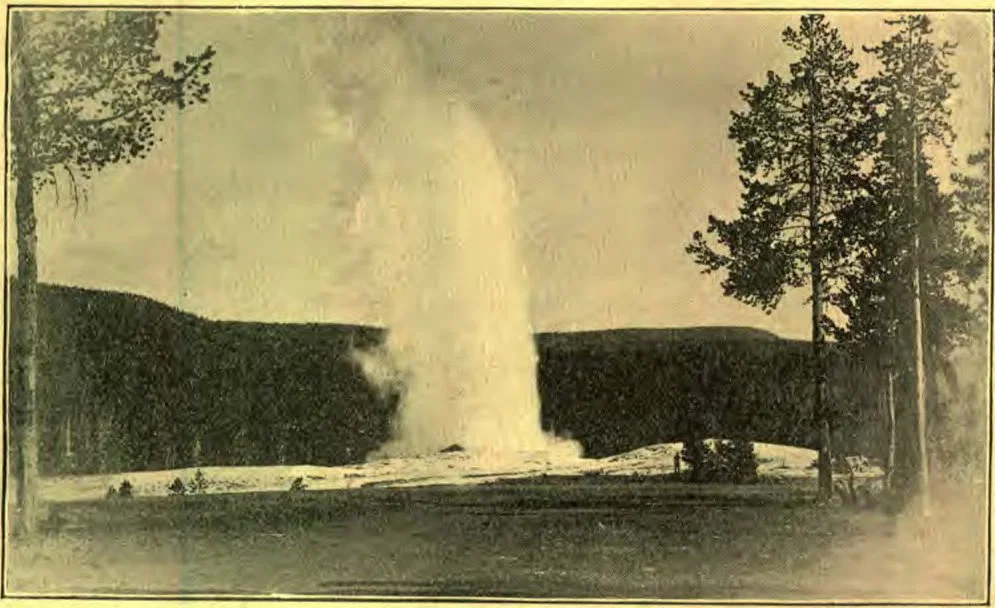
OLD FAITHFUL
Yellowstone National Park lies in the north-western corner of Wyoming, and extends a few miles into Montana and Idaho. The reservation is about fifty-three miles east and west, and sixty-one miles north and south. No valley within its limits has an elevation of fewer than six thousand feet, while many of the mountain peaks within, and adjacent to, the park rise from ten to fourteen thousand feet above sea-level.
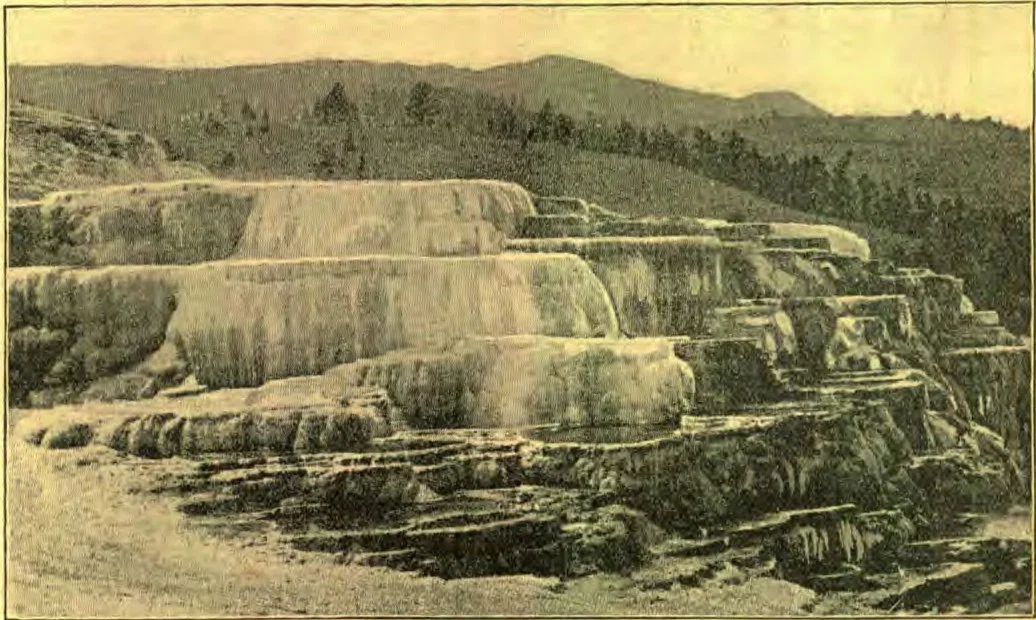
MINERVA TERRACE — MAMMOTH HOT SPRINGS
Yellowstone Lake, one hundred and fifty square miles in area, is the largest body of water at that altitude, eight thousand feet, in North America. Three of the largest rivers in the United States — the Missouri, the Yellowstone, and the Columbia — have their source in Yellowstone Park.
This is the land where the geysers gush, and the cataracts roar; where hot springs boil, and cool fountains flow,—the land where the mountain lion, the wolf, bear, buffalo, elk, and deer hold protected and unmolested right; where the nimble squirrel rejoices, the happy chipmunks skip, and all nature smiles. The eagle finds many a craggy peak on which to build her nest, and the fox can dig his hole in safety. There are also many beautiful birds and flowers. Everything is in its natural state. All the government has done is to build good roads, and to station soldiers here and there for the protection of the animals, and to enforce obedience to the rules of the park.
The animals seem to have lost their natural ferocity and timidity, and are remarkably tame, for the simple reason that no one is allowed to hunt or kill them. The deer and their beautiful fawns would come close to us, apparently saying, “We are not afraid; for here nothing is allowed to hurt or destroy us.” I am sure we had no desire either to kill or eat them.
The bears are an interesting feature of the park. They have learned, among other things, that there is no danger to be feared; but they have not learned the command, “Thou shalt not steal,” or at least they do not obey it; for one night after we had lain down to sleep, Bruin came and helped himself to the beans and prunes that we had left outside our tent, and walked away with an air of saying, “I am a vegetarian; I believe, with you, that beans and prunes are good for man and beast — especially for beast.”
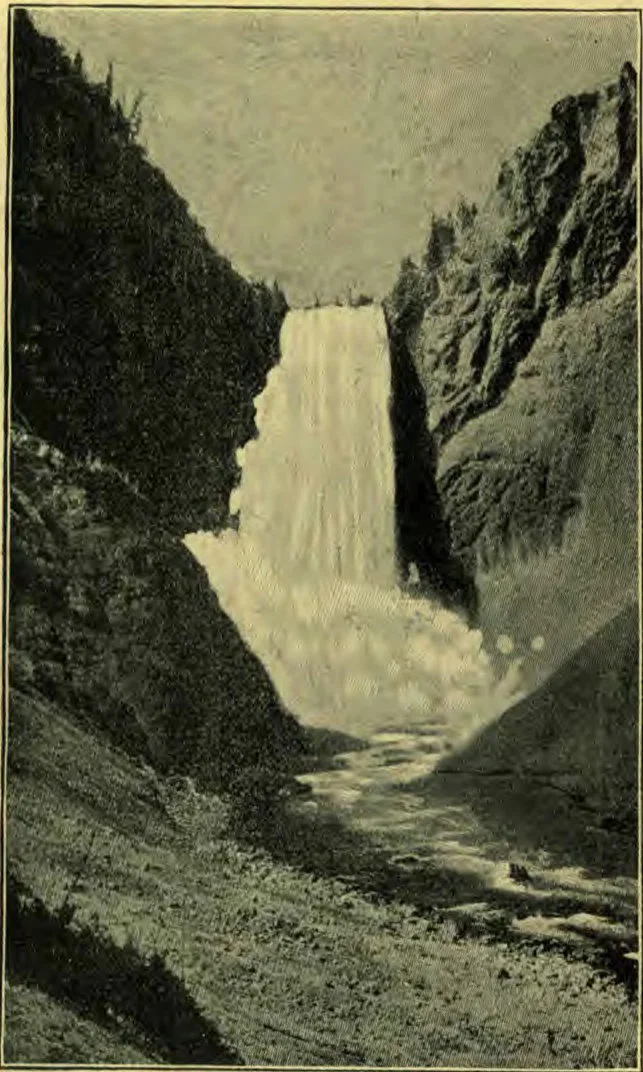
No pen can tell of the wonder and beauty of this most interesting place. I can not express my feelings as I looked on the lofty mountains lifting up their hoary heads into the regions of eternal snow; the dark, silent forests of evergreens; the charming valleys, with sparkling fountains and laughing brooks; the beautiful rivers, with dashing cascades and lovely waterfalls; the wonderful hot springs and gushing geysers, throwing boiling water from thirty to one hundred and fifty feet into the sunlight, and then falling back to earth like a shower of diamonds; and the deep and awful canons, whose rock-riven sides speak of Him who can plow a passage through the solid mountains for his streams to flow on their clear, winding way to the sea. As2I looked, for the first time, on the lower falls of the Yellowstone, I was so overcome by their magnificence and overpowering grandeur that I turned away, sat down upon the rocks, and wept. When I turned my head again, and watched the river make its awful leap of three hundred feet, and the beautiful blue water turn to white foam and sparkling crystal as it fell on the rugged rocks below, and then, recovering itself, wind away like a green ribbon at the bottom of the Grand Cañon, I shouted, “Glory!”
The Grand Cañon of the Yellowstone, twenty-four miles long, with a depth of from six hundred to twelve hundred feet, is the most brilliantly colored landscape in the world. Words can not give an idea of the surpassing loveliness of this romantic place. It looked as if a dozen of the most beautiful sunsets had been thrown together into that deep, awful abyss, and had caught on rock, and crag, and peak, and cranny, until the sides of the cañon were one mass of glory. Clinging to the rocks, I crept to the edge, and looked down. Where shall I begin, or how, in anywise to describe this tremendous sight,—its overpowering grandeur, and at the same time its inexpressible beauty? I thought of the sea of glass mingled with fire, and exclaimed, “Great and marvelous are thy works, Lord God Almighty.”
We are surrounded every day by the great and marvelous; but we do not seem to be so aroused and impressed as when we stand in the presence of the uncommon, and, like Moses at the burning bush, say, “I will now turn aside, and see this great sight.” A visit to the National Park affords a rare opportunity to see the strange and wonderful side of nature.
During the ten days we were there, and in our circuit of over a hundred miles, we had abundant opportunity to see nearly all the great sights of the park. There is nothing more startling or impressive than the hot springs and geysers. There are three thousand hot springs, there being over four hundred in one basin alone. These vary in size and shape from those the size of a common water-pail, to giants that measure from thirty to forty feet in diameter. Morning Glory spring, as its name suggests, is a glory indeed. It is a silent pool about twenty feet across, its funnel-shaped and delicately-colored walls giving it the appearance of a morning glory.
GREAT FALLS OF THE YELLOWSTONE
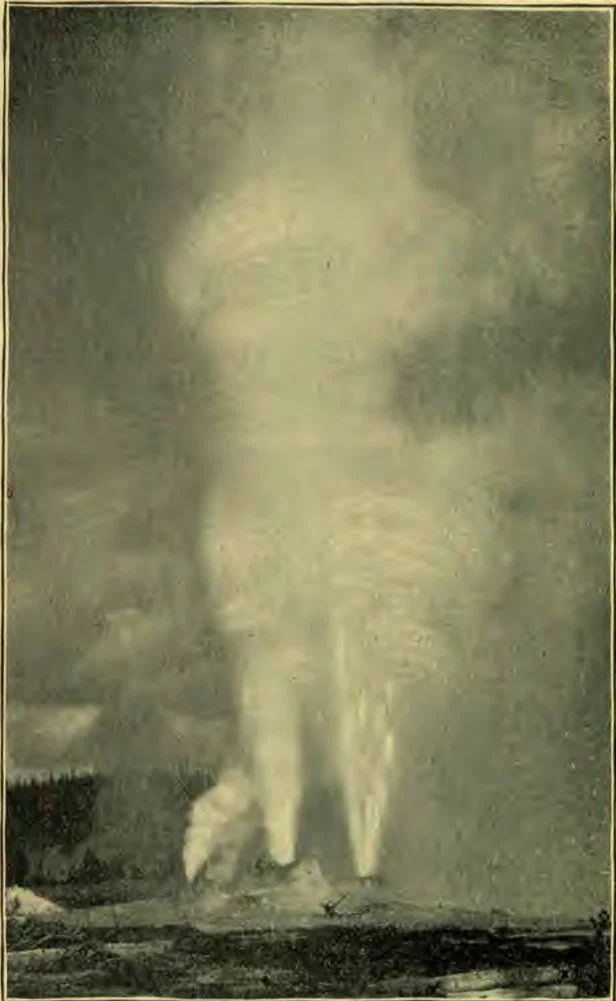
The geysers of this region rival anything of the kind in the known world. There are over fifty that throw a column of hot water from thirty to two hundred feet into the air, at intervals of six minutes to fourteen days. There are several geyser basins. These are large tracts of land, some containing three or four square miles, which can be fitly described as a “desert land,—a waste, howling wilderness.”
If you would picture to yourself a geyser, imagine yourself standing on the brink of a hot-water pool, which is constantly bubbling and boiling. All at once, with a rushing, seething, hissing sound, the water leaps into the air, thirty, fifty, seventy-five, one hundred or two hundred and fifty feet, and continues this for several minutes, and sometimes for over two hours; then suddenly it resumes its ordinary bubbling and boiling. These geysers really seem to go mad. Approach their crater, and look down into their deep, blue, hot waters; and if it is their time to play, they will leap forth with a rush and roar like a wild beast from his den. Each one seems to have an individuality of its own; and, like men, each must be studied to be appreciated. They have all been named, their names being suggested by their habits and surroundings. Here are a few: Bee Hive, Saw Mill, Surprise, Spasmodic, Grand, Giant, Riverside, Splendid, Comet, and Old Faithful. A new one has lately appeared, and must of necessity be named “Dewey.”
Away up on the eastern slope of Terrace mountain, in a rough, ragged place, occupying one hundred and seventy acres, sparkling and glittering in the morning sunlight with a pearly whiteness that almost blinds the eye, are the Mammoth Hot Springs — a world of wonder in themselves. They are fifty in number, with craters varying from six to thirty feet in diameter. The water is blue, green, deep. As it boils up, and flows over the side of the mountain, it forms terraces, which, for beauty of form and delicacy of coloring, are incomparable. As they stood out in the golden sunlight of that July morning, they appeared indeed like “angel terraces,” or pearly steps, which could be fitly used to ascend to the palace of the Lord of hosts. They differ from the others in holding carbonate of lime in solution.
O the mysteries that cluster around these boiling springs and gushing geysers! How far beneath our feet are the fires that make them boil and hiss? Whence the force that throws them hundreds of feet into the air? and where the supply of water that keeps them constantly flowing? For instance, there is “Old Faithful,” which for centuries, no doubt, has continued regularly, at intervals of about an hour, to throw his sparkling waters to a height of one hundred and fifty feet. Think of it—before you and I were born, before Columbus sighted this land, or Napoleon marched his conquering host through Europe; yes, before St. John saw his vision of the new earth and the jeweled city, Old Faithful, surrounded by the grand old mountains, was throwing up his pearls and diamonds as freely as when you and I stand in his presence, and are lost in admiration of his beauty.
LION, LIONESS, AND CUB
As I turned from these scenes in the National Park, I think I had a better idea of the experience through which our earth is yet to pass when “the sea shall boil like a pot,” the mountains be moved out of their places, and when the “Lord shall make the earth empty, and turn it upside down;” also of that time when the “wilderness and the solitary place shall be glad; . . . and the desert shall rejoice, and blossom as the rose.” Then as we go forth to view the glory of our Father’s house, we shall see that this earth, which seems so great to us in our earthly pilgrimage, is but a single room in the palace of our King.
DANIEL NETTLETON.
MYSTERIES
By Minnie Rosella Stevens
I WONDER what could the marble shaft,
By the old church wall with its ivy gray,
Tell of a heart that lies buried there,
With its joy and grief in the far away.
I wonder what, in the wild bird’s heart,
Could attune his voice to such melody,
Waking response in its depths so keen
That the soul could weep in its sympathy.
I wonder what’s in the baby’s mind,
As it laughs and croons in its cot alone.
And what would the unseen records tell,
Were they read, as writ, on each ruined stone?
In simplest minds there are thoughts of which
E’en the wisest sage does not even dream.
Daily we listen to nature’s tongue,
But can seldom catch what one word may mean.
Thus whispers faint of the wisdom hid
In other spheres, far beyond our own,
Come to our earth, like a promise sweet
Of the great beyond, that will yet be known.
MINNIE ROSELLA STEVENS.
Looking Toward the Light
I ASKED the roses, as they grew
Richer and lovelier in their hue,
What made their tints so rich and bright.
They answered, “Looking toward the light.”
Ah, secret dear, said heart of mine,
God meant my life to be like thine,—
Radiant with heavenly beauty bright,
By simply looking toward the light.
—Selected.
HOW SHALL WE REGARD UNFAVORABLE SURROUNDINGS?
By David Paulson, M. D.
The consecrated worker will discern roses and lilies where the unconsecrated worker will see nothing but dry places. To the former the promise is verified that “the parched ground shall become a pool.” It is a gift from God to be able to recognize opportunities, and it is another talent to have the capacity and ability properly to utilize them. Some persons possess one of these gifts and not the other. In that case those who have a special gift to recognize openings where good may be accomplished should do all in their power to inspire others, who possess a willingness to do, but have no gift to see when and where to do, to step into them. It is a fortunate combination when there is a happy blending of both these gifts in the same individual. These qualities are both susceptible of cultivation.
Those who are always worrying because they seem to have no opportunities are frequently the very ones who are daily ignoring great opportunities. Every day God furnishes us with all the opportunities that we have capacity to use, and that he, in his infinite wisdom, sees that it is safe to trust us with.
DAVID PAULSON, M. D.
A GLANCE AT THE PAST
By Mrs. L. D. Avery-Stuttle
When we look over our country, dotted with villages and cities, and listen to the shrill whistle of the iron horse, the noisy whir of machinery, the puffing of engines, and the thousand and one other tokens of our busy, restless civilization, it is hard to realize that there was ever a time when, instead of the whistling train and the belching chimneys of our active industry, the scream of the prowling panther rang through the forests, and the curling smoke of the red man's wigwam was the only sign of human habitation. Yet this state of things existed in many parts of the United States only a comparatively short time ago.
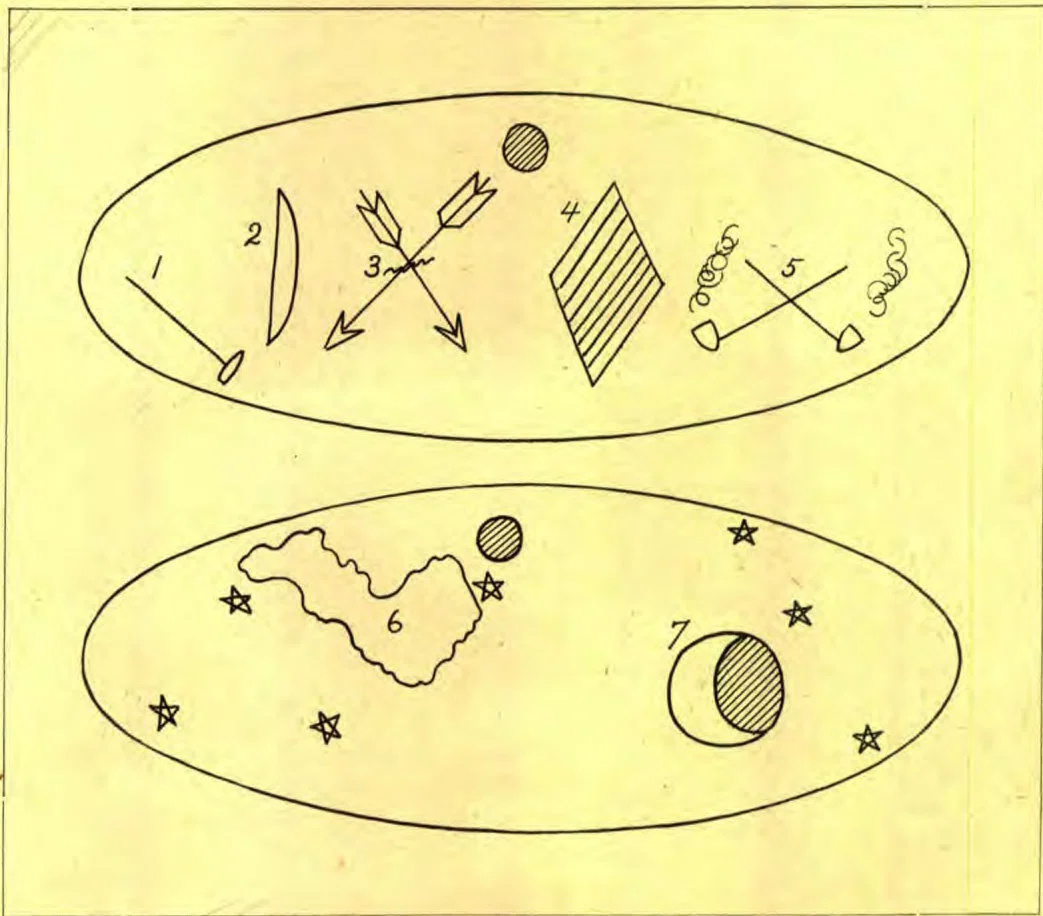
The accompanying pictures are exact representations of the two sides of a stone found on the farm of J. V. Avery, in Conway, Livingston County, Mich., in 1898. The rude pictures seem to have been carved upon it as a record of some important public event. As Fig. 1 represents a weapon as it is being thrown to the ground, and Figs. 2 and 3, a bow with tied arrows pointing downward, while Fig. 5 is a plain representation of the calumet, or pipe of peace, with ascending smoke, it is reasonable to suppose that the whole is intended as a record of a contract of peace between two contending tribes. Fig. 4 is an emblem commonly engraved upon the calumet. The owner of this remarkable stone has also a piece of an ancient calumet, with the same figure upon its bowl. The representation of the moon in eclipse (7) and the stars, together with the cloud (6), engraved on the opposite side of the stone, is probably intended to represent the date when this important war ceased.
Many other interesting relics have been found upon this farm. The owner one day plowed up the bleached and crumbling skull and whitened bones of some dusky inhabitant of the country, who paid the debt of nature many, many years ago.
I remember gazing with a sort of awe upon the dried and withered mummy of a South American woman, which had been unearthed by relic-hunters. She was in a squatting position, and had buried herself alive—so read the paper pinned upon the glass case where she sat in state. The attendant said this was customary among a certain tribe. The dry, grizzly hair was still braided in tiny braids, and hung—or rather, was plastered—close to the cheeks, which resembled dry, baked clay.
As I looked upon this sad and almost repulsive sight, it was hard for me to realize that this poor form of clay had once been a living, breathing, perhaps beautiful woman; that she, too, had known hope and fear, joy and sorrow; and I said: “Oh, how fleeting are the joys and sorrows, the sweet and the bitter, the sunshine and the shadows, of earth!”
Think of the time when the wonderful prophecy of Isa. 26:19 shall be fulfilled: “Thy dead men shall live, together with my dead body shall they arise. Awake and sing, ye that dwell in dust: for thy dew is as the dew of herbs, and the earth shall cast out the dead.”
MRS. L. D. AVERY-STUTTLE.
A PARABLE
THERE was once a child who lived in a narrow glen, hemmed in with high hills. He was not yet old enough or strong enough to climb their steep sides, and get a view of what lay beyond. To him there was no “beyond.” That little glen was his world. Morning after morning he watched the sun rise over the hill. It seemed to him to rest upon the summit before it mounted. As he looked up into the blue summer sky, it appeared to him like a beautiful arch whose sides touched the hilltops. And the stars that looked down upon him by night seemed so near as to be almost within reach. In his childish fancy he thought that if he could climb the hillside, and reach the summit, he might touch the sun, and cover it with his hand. He would put his cheek close to the cool, sweet surface of the sky. He would lay hold of one of those little lanterns, and use it to light his way. One day he made the journey, and gained the hilltop. The pretty dreams and fancies of his childhood vanished. The sun had climbed very high. The summer sky was very far away. There came to him the surprise of larger vision and new thoughts. The world was never the same to him again. His thought of it had widened. The narrow glen, which had hitherto been his world, became a very little place. He had learned a lesson. God’s world was larger than his,—Selected.
TOADSTOOLS
By Aunt Betty
Every old stump in our far Western forests is adorned with them, tier above tier: in the damp, shady woods they are growing all the year, but in the clearings they dry up in summer, only to start afresh with the fall rains. What colors!—the old-fashioned tints and shades our grandmothers used to call “mouse-color,” “dove,” and “laylock” are here; delicate grays; browns, tinged with gold; olive alternating with “Quaker-color;” green and slate; orange-yellow, followed by gray, bordered with olive, and a tiny rim of cream outside of all.
The combinations are endless, and the texture is as soft as velvet. Here is a beauty,—gray next to the stump, a narrow rim of cream, a wider one of light-brown, then a rich, dark-brown, plush-like border outside. See this one,—it measures just an inch across, and has twenty-three distinct rows of color. They look like the delicately tinted wings of moths. There are few brilliant colors, though one sometimes sees bright-green toadstools, and last summer I found some most gorgeous ones on an old fir stump that had rotted in great ridges. In the grooves, which were vertical, were the toadstools, one above another, scores of them, ranging in size from tiny bits the size of a silver five-cent-piece to giants as large as half a dinner-plate. They were of a bright orange-yellow, bordered with a still brighter orange-red, with rich, cream-colored linings. But in spite of their beauty, I liked the modest-colored ones better.
AUNT BETTY.
STOVES
By W. S. Chapman
The open hearth was, of course, the primitive fireplace; then came the brazier used by the Egyptians, Greeks, and Romans. This was an open vessel of metal, in which charcoal was consumed. In Continental countries, the brazier is still in common use in the industries and for cooking and domestic uses.
The Romans invented the hypocaust, when the public baths, or balneæ, were built in Rome, after Claudius brought in the supply of water from Palestrina. The hypocaust was a chamber under the floor of the apartment or bath, to be heated with flues, which carried the heat, smoke, etc., to the floors of other apartments or baths.
In the fourteenth century, chimneys were introduced into houses, and paved the way for the invention of fireplaces, and finally of metal stoves. The discovery of gas has given a more cleanly article of combustion than coal. With gas- and oil-stoves it is possible to cook in and heat apartments that have no chimneys. Electricity has also been brought into use as a heating agency; but, so far, it is not extensively applied, owing no doubt to its expense. W. S. CHAPMAN.
TWO CROPS
By Elizabeth Rosser
Somebody’s garden gate stood wide,
A bad little seed-sower stepped inside;
From his mischievous hand, with crafty look,
A host of bad little seeds he shook.
Little cared they for rake or hoe,
All they asked for was room to grow;
And, when I looked at the garden-ground,
A crop of bad little tares I found.
Somebody watched his garden gate
At early morn and evening late;
The seed sown on his well-tilled soil
Called for care and honest toil;
So with willing heart and cheery song
He labored all the summer long;
And, after weeks of sun and rain,
He reaped a crop of golden grain.
ELIZABETH ROSSER.
TEMPTED IN ALL POINTS
By Ellen G. White
CHRIST offered himself as a willing sacrifice in our behalf. He stooped from his high place in heaven to rescue human beings from the slavery of sin. The Son of God gave up his honor and glory, and tasted the bitterness of death, that men might become partakers of the divine nature. He died that all might have an opportunity to choose God as their leader.
“When the fullness of the time was come, God sent forth his Son, . . . to redeem them that were under the law, that we might receive the adoption of sons.” The star of hope arose upon our world, and its brightness increased as our Saviour increased in wisdom and stature, and in favor with God and man.
In the wilderness Christ endured temptations that no human being can comprehend. Here he was brought face to face with Satan, the fallen angel, who tempted him with all his subtle power. The enemy began by disputing Christ’s divinity. If you are the Son of God, he said, give me evidence that you are. Here you are in the wilderness, hungry, starving for food. You do not look like a sovereign. Give me evidence that you are what you claim to be. Command that these stones be made bread.
But the One whom Satan was trying to overcome was the Lord of heaven, and all the tempter’s efforts were without avail. Though Jesus was physically weak from his long fast, he would not yield one inch to the wily foe. His will was anchored in the will of his Father. “It is written,” came from his pale and quivering lips, as Satan told him to turn the stones into bread, “Man shall not live by bread alone, but by every word that proceedeth out of the mouth of God.”
Satan then took Christ to the pinnacle of the temple, and challenged him to cast himself down, saying: “If thou be the Son of God, cast thyself down: for it is written, He shall give his angels charge concerning thee: and in their hands they shall bear thee up, lest at any time thou dash thy foot against a stone.” Thus Satan tried to lead Christ to commit the sin of presumption. He reminded him that God had promised to protect him by angel ministration. But no temptation could induce the Saviour to accept the challenge. “It is written again,” he said, “Thou shalt not tempt the Lord thy God.” Christ’s time to show his divine power had not yet come. He was fully aware of the glory he had with the Father before the world was. But then he willingly submitted to the divine will, and he was unchanged now. This was his time of trial and temptation; he must endure the test, however cruel it might be. But he knew that by suffering and sorrow and a cruel death he was to bruise the serpent’s head. The giving of his life was to be the price of the world’s redemption.
Satan next took Christ to the top of a high mountain, and there presented before him all the kingdoms of the world and the glory of them, saying: “All this power will I give thee, . . . for that is delivered unto me; and to whomsoever I will I give it. If thou therefore wilt worship me, all shall be thine.” Then it was that divinity flashed through humanity, and the fallen angels saw Christ glorified as he said, “Get thee behind me, Satan: for it is written, Thou shalt worship the Lord thy God, and him only shalt thou serve.”
The victory was gained. Christ had redeemed Adam’s disgraceful failure and fall, and had placed man on vantage-ground.
“Then the devil leaveth him, and, behold, angels came and ministered unto him.” The angels had been watching the contest, but they could do nothing to relieve the Saviour until the last temptation had been resisted. The commander of heaven, Christ was accustomed to receive the attendance and adoration of angels; and at any time during his life on this earth he could have called to his Father for the help of angels. But no bribe, no temptation, could induce him to deviate from the path of God’s appointment. Great cunning was shown by the tactics that Satan followed. He assailed Christ on the point of appetite. He appealed to his trust in God. He presented to him earth’s most captivating scenes. But Christ failed not. He saw a world perishing in sin, and steadfastly and firmly he moved forward in the path of resistance. He had a world to rescue. He had come to seek and save that which was lost.
Christ passed over the ground where Adam fell, and overcame in our behalf. He endured every test that man will ever be called upon to endure. He met all the temptations that man will have to meet. He traveled over the path in which he calls us to walk. Every step Christ took was taken in dependence upon God, and upon not a single point did the enemy overcome him.
When God gave Jesus to our world, he gave all heaven. This gift has secured for us our adoption into God’s family. The Father’s promise is Yea and Amen in Christ Jesus. Never will he falsify. Never will he alter the thing that has gone out of his mouth. The clouds of uncertainty and unbelief rolled back as the Saviour cried out upon the cross, “It is finished.” And to-day he who overcame the world, stands in the heavenly courts as our Advocate. He is touched with the feeling of our infirmities; for he was “in all points tempted like as we are, yet without sin.”
MRS. E. G. WHITE.
IF WE KNEW
By H. Isabel Graham
If we knew the heavy burdens borne by pilgrims passing by, Would we lend a hand to help them, Christlike pity in our eye? Would we pause amid our pleasure, just to speak a kindly word That would make the cross grow lighter to the heart with sorrow stirred? “Bear ye one another’s burdens.” Would we hear these accents still? Bend to soothe the weary traveler, and the royal law fulfill?
If we knew how fires of passion change the life and sear the soul, How the floodgates break in pieces when the angry billows roll, Would we sail along serenely close beside the sheltering shore, Heeding not the wrecks that signal, ere they sink to rise no more? Would we scorn the one who stumbles, with the Pharisee’s disdain— Proudly draw our mantle closer, lest our virtue catch the stain?
If we knew!—we can not fathom life’s strange pain and mystery; Here we see but dark and dimly: let us then walk reverently. With a smile of love and pity let us stretch a friendly hand, Even though each other’s motives we may fail to understand. “Mizpah” be our watchword ever, till all strife and discord cease; Some day we shall meet with gladness, when we reach His plains of peace.
—H. Isabel Graham.
To-Day: Verses on Earnest Duty
To-day,
Unsullied, comes to thee—new born;
To-morrow is not thine:
The sun may cease to shine
For thee ere earth shall greet its morn.
Be earnest, then, in thought and deed,
Nor fear approaching night;
Calm comes with evening light,
And hope and peace. Thy duty heed
To-day.
—Selected.
SHUT UP WITH A BIBLE
WHEN Nicholas I became emperor of Russia, his first task was to put down a formidable sedition among the aristocracy of his realm. Many nobles, detected in guilt, and many who were simply suspected, were thrown into prison. One, who was innocent, was by nature a man of fiery temper; his wrongful arrest infuriated him, and he raved like a wild animal. Day after day, brooding over his treatment, he would stamp shrieking through his cell, and curse the emperor and curse God. Why did he not prevent this injustice?
No quiet came to him save in the intervals of exhaustion that followed his fits of rage. A visit from a venerable clergyman on the ninth day of his confinement, produced no softening effect. The good man's prayer was heard with sullen contempt. The divine words, “Come unto me, all ye that labor and are heavy laden, and I will give you rest,” sounded like mockery to the embittered prisoner. The aged minister went away, leaving a Bible in the cell, which he begged the prisoner to read.
As soon as his visitor was gone, the angry nobleman threw the Bible into a corner. What to him was the word of a God who let tyrants abuse him?
But when the terrible loneliness of succeeding days had nearly crazed him, he caught up the volume, and opened it, and his first glance fell on the middle of the fiftieth psalm: “Call upon me in the day of trouble: I will deliver thee.” The text surprised and touched him, but his pride resented the feeling, and he dropped the book.
The next day, desperation drove him again to the only companion of his solitude, and from that time he read the Bible constantly. Then he began to study it, and commit whole chapters to memory. The story of the Saviour's life and death totally changed him. He saw himself a fellow sufferer with the Christ who was unjustly accused and slain.
Revengeful rage gave way, and the spirit of a martyr took its place. Like the persecuted Christians shut up in the Roman catacombs, he forgave his enemies. An unworldly joy took up the time he had once spent in harsh thoughts and words. The shadows of wrong and death vanished in the new light that shone upon him from beyond.
The company of a book—the one Book in all the world that could have done it—had given the proud noble another heart.
Madame Dubois, once a beloved prison missionary in New York, from whose writings this story is taken, was in Russia when the condemned man's aunt and sister, with whom she was visiting, received a letter, which was believed to be his last. It was the outpouring of an exalted soul superior to fate.
He had undergone his trial; and, unable to prove his innocence, had been sentenced to death. On the day set for his execution, while the ladies of his mansion walked in tears through the crape-hung parlors, suddenly the sight of their doomed kinsman himself astonished them at the door!
It was an unhoped-for deliverance at the last moment. When the jailer's key unlocked the prisoner's cell, instead of the messenger of death, the czar of Russia stood before him. A conspirator's intercepted letter had placed the innocence of the suspected nobleman beyond question, and the czar made what amends he could by bestowing on him a splendid castle and a general's commission.
Seventy-five years have passed since then, and with them the life of the almost-martyred Russian; but the fruits of his devout fidelity and kindness among his fellow men, the hospital he built for the sick and friendless, and the very Bible he was shut up with in his own distress, still bear witness to a consecration that was worth all personal cost, and infinitely more.—The Youth's Companion.
WHAT MAMA TOLD SUE
By Viola E. Smith
I used to be afraid at night,
And cover up my head,
When mama had put out the light,
And left me there in bed.
But then that was before I'd heard
What I know now is true;
My mama told me every word,
And I believe it, too.
She said our Father in the sky
Sends angels pure and white
To watch beside me while I lie
In my dark room at night.
They are so beautiful and dear,
And strong as they can be!
What is it that should make me fear,
When such friends care for me?
And now when I hear any sound
Like those that scare me so,
I smile, and think the angels 'round
Are passing to and fro.
I do not tremble fearfully,
But wide as anything,
I strain my eyes to try to see
The shining of a wing.
What would God think, I'd like to know,
If those he sent should say,
"Your Sue's afraid of us, and so
We had to come away"?