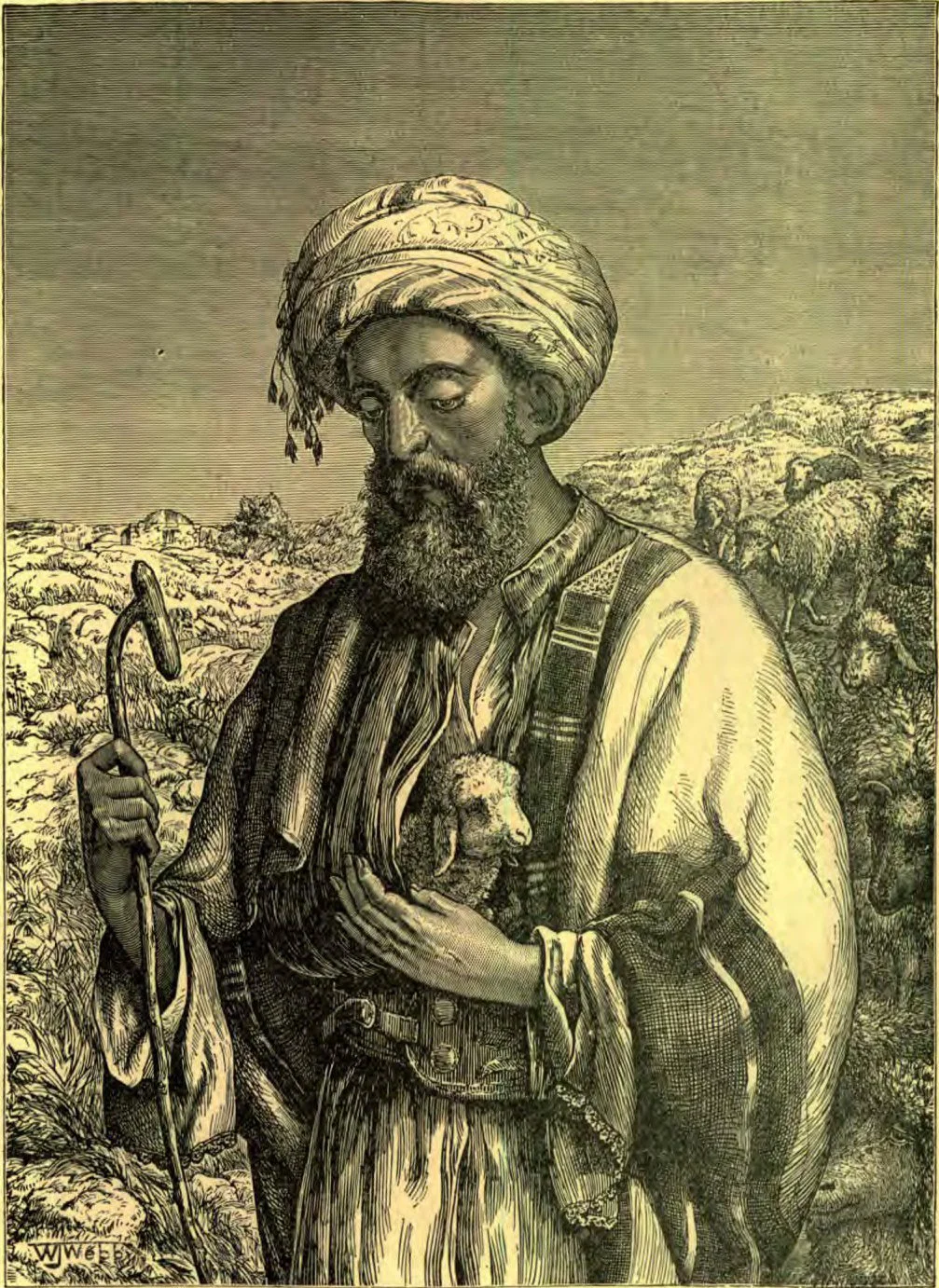
What a safe, warm, happy shelter the dear little lamb in our picture has found, has it not? Gathered close to the heart of the kind shepherd, carried tenderly in his loving arms, what can it want or fear? So long as it is in his bosom, nothing can harm it. If the storm should beat, it is safely sheltered; if the wolf should come, it is hidden where he can not get it, and the shepherd is strong to protect it. It will neither hunger nor thirst; for food and drink are sure to be provided for it. All it has to do is to rest, and be happy, and love the good shepherd, who cares for it so tenderly.
Look well at the picture, and then we will see what the Lord Jesus wants us to learn from it. For he uses the way in which the shepherd cares for his sheep, and carries the lambs in his bosom, to show how he cares for his own “little flock.”
He calls himself “the Good Shepherd,” and he is called the “Chief Shepherd,” also the “Great Shepherd of the sheep.” But who are his flock? We will let his own word answer this question for us: “We are . . . the sheep of his pasture.” And again: “Ye my flock, the flock of my pasture, are men, and I am your God, saith the Lord.”
So all that he says about his flock—his sheep—is for us, and this is what his word says: “He shall feed his flock like a shepherd; he shall gather the lambs with his arm, and carry them in his bosom.”
SAFELY SHELTERED
Did you know that you are being carried in the Lord’s bosom? Think what a difference it would make to the little lamb in the shepherd’s arms if it did not know where it was. Suppose it should think that it was in the clutches of the hungry, cruel wolf, or about to be devoured by the roaring lion! How frightened it would be, and how it would struggle to get free. The good shepherd’s arms would be no resting-place to it then. Or suppose it should know that the shepherd was holding it, and yet should not know the shepherd,—his kind, loving heart,—how gently he would care for it himself, and give his own life rather than let any hurt come to it. Even then it might be anxious and troubled, and wonder what was going to happen to it. It would not lie down peacefully, and rest in his bosom.
Even so, although it is true that you—God’s little ones, the Good Shepherd’s lambs—are carried in his bosom, because his own word says so, if you do not know it, and know him, you are missing the sweet rest and peace and joy that he wants you to have.
You can not get away out of his bosom, for he “fills heaven and earth,” and “in him we live, and move, and have our being.” So the only way that we can get out of his bosom is by getting out of existence, by ceasing to be.
His arm is much too strong to let you go; for he upholds the heavens and the earth and all that are in them. Nothing can escape, or get away, out of his strong arm, which gathers the lambs, and carries them in his bosom.
Neither can any one snatch you away from him; for he says that no one shall pluck his sheep out of his hand, because his Father, who gave them to him, is greater than all, and has given him all power in heaven and in earth.
And this will make you so happy as you learn more and more to know the Good Shepherd, and all that he has done and is doing for his sheep. He says: “I am come that they might have life. . . . The Good Shepherd giveth his life for the sheep. . . . I lay down my life for the sheep.”
Do you not already love your tender Shepherd, and will you not rest in his arms, and nestle close to his loving heart, and trust him always for all things? Are you not glad that you are so close to him?
He is your dwelling-place, all round about you, wherever you are. His breath is breathed every moment into your nostrils, so that you “may have life.” His gentle voice is speaking in your ear sweet words of love and instruction and comfort, through all the things that he has made. All the food that nourishes and gives you life comes from his own being; for he is “the fountain of life.”
Learn all you can of the Good Shepherd; for the better you know him,—his power, his love, his tenderness, his watchfulness,—the more sweetly you will rest “in his bosom.”
EDITH E. ADAMS.
WHAT IS LEFT
SOMETIMES we forget how much we owe, of the blessings we enjoy every day, to Him who taught men to love others better than themselves, and to minister to all who were sick and in trouble. The following little story will impress6on our minds some of the blessings that Christianity brings to the world:—
“Norah had been given a model village for a birthday gift. There was a big square, painted with streets and grass plots, and on this were set up tiny houses, people, and trees, of pasteboard. It was a most fascinating plaything; and Norah never tired of setting up her village, and sending the pasteboard people to school, or church, or along the streets. She was sending all the little ones to school one day, when her father, who had come in, and was looking at the little village, asked, with an interested face: ‘What kind of town is that, Norah?’ And then, as she looked up inquiringly, ‘I mean is it a Christian or a heathen town? a town where people know and love God, or one where they do not?’
“ ‘Oh, a Christian town!’ Norah answered, quickly. ‘See the church?’
“ ‘Suppose we make it a heathen town,’ her father suggested. ‘What must we take out?’
“ ‘The church,’ answered Norah, setting it one side.
“ ‘Is that all?’
“ ‘I suppose so.’
“ ‘No, indeed,’ her father said. ‘The public school must go. There are no public schools in heathen lands.’
“ ‘Norah set the school aside. ‘Then the children ought not to have books in their hands,’ she said.
“ ‘Certainly not the girls,’ her father said. ‘Nor ought they to be in the streets with the boys. Take them out.’
“ ‘Norah looked very grave as she set the happy-faced little girls aside.
“ ‘Take the public library, too,’ her father directed.
“ ‘Anything else?’ she asked, sadly.
“ ‘Isn’t that a hospital over there on Elmwood Avenue?’
“ ‘But, papa, don’t they have hospitals?’
“ ‘Not in heathen countries. It was Christ who taught us to care for the sick and the old.’
“ ‘Then I must take out the Old Ladies’ Home,’ said Norah very soberly.
“ ‘Yes, and that Orphans’ Home at the other end of town.’
“ ‘Why, papa!’ Norah exclaimed, ‘there is not a good thing left! I wouldn’t live in such a town for anything! Does knowing about Jesus make all that difference?’”
Yes, knowing about Jesus makes all the difference between the most heathen and the most enlightened land. And knowing Jesus,—each for himself,—his beauty, his goodness, his mercy,—will do more than that—it will make little bits of heaven right in the darkest place on earth.
January Field Study
By Editor
January 6-12
Introduction.— The Missionary Magazine articles for special study this month are: “The Ethnology of Malaysia,” “Among the Russians,” “Buenos Ayres and Our Churches in Argentine.” The life of Henry Lyman, the martyr of Sumatra, is so full of inspiration to the young persons who are seeking to know what their life-work should be, that we devote the entire space to a brief sketch of it, rather than to other notes on the lesson. The death of this man and his colleague is incidentally mentioned in the study. Such lives breathe forth a heaven-born enthusiasm that we who are giving the last message of mercy shall do well to seek.
Boyhood and Youth.— This young man was born in Northampton, Mass., Nov. 23, 1809, and consecrated from birth to the work of the ministry. His boyhood and youth were far from promising in a religious aspect. At Amherst College, which he entered in 1825, he led for a while a wild life. The Spirit of God, however, arrested him in his sophomore year, and in a college revival he was powerfully converted. April 25, 1827, is the date he sets down as that of the great change.
Call to Missionary Work.— All the force and energy of his strong character were now turned in the right direction, and he not only promptly accepted the ministry as his vocation, but soon began to think of the foreign missionary field. It is very interesting to trace in his letters and private journals the development of his call to this work. Hints of it began to appear in less than a year after his conversion. In a year and a half he writes to his sister: “My feelings have this term taken a stronger turn toward this subject than ever before. It makes my soul bleed to hear the cry from Europe, Asia, Africa, and South America. Millions bow to Juggernaut, millions to Mohammed, millions to the pope, and millions more to idols of their own making. Few are willing to go. But by the leave and assistance of divine Providence, I will go.” This was written Nov. 2, 1828, and in five years from that time he was in Java. He was exceedingly deliberate and painstaking in making up his mind on this momentous matter. He examined himself, his motives, his qualifications and capabilities, with great care, and sought the best advice. He investigated mission work, read missionary biographies, and attended all kinds of missionary meetings. Under date of Dec. 14, 1828, he wrote: “Can I leave my country and engage in this work? I want to do it. No, I do not. I want to do just what God would have me do, whether to go there or to stay here.” In February, having read much about the Sandwich Islands Mission, his heart was drawn out toward it; but he said: “I do not know that I would prefer going there to labor. It is too nearly a paradise for a missionary to go there now. I would rather begin from the beginning than build on another man’s foundation.” To his sister, August 14, he wrote: “If there are any parts of the Bible which rejoice my heart, they are those which speak of the heathen receiving the gospel. If there is any pleasure in prayer, it is in praying for benighted pagans. If anything for which my heart is drawn out to God, it is for the missionary.” His feelings strengthened in this direction every day until a final decision was reached, after spending a week, during December, 1829, in fasting, prayer, and studying every phase of this momentous question. He then wrote: “The greatest trial that I could be called upon to endure would be to settle over a New England congregation. If my own board will not send me, my last resource will be to work my passage out, and then labor for the heathen in some dark corner.” With such a feeling and such a spirit there could be no question of his call. He announced his decision to his parents, who did not oppose; and during the remainder of his seminary course he gave himself yet more thoroughly to the fullest preparation.
Departure.— He was appointed to the East India Archipelago, for exploration and missionary work, in February, 1833. In May of that year he was married; and one month later, with his classmate, Samuel Munson, as colleague, the party set sail from Boston for Batavia. It took the ship one hundred days to reach her destination. The missionaries were soon comfortably settled, and began the study of the language, and to do such other work as they could carry on. Every letter breathed forth a spirit of thankfulness for the privilege of working for those who were without God and without hope.
Beginning Their Work.— As the Dutch government was not particularly favorable to missionary exploration, being jealous of any interference by outsiders with the native population, the missionaries did not obtain permission to begin their work of exploration until April, 1834, when they set out for Sumatra. It was no small trial for these brethren to leave their families at Batavia, and plunge still deeper into the depths of heathenism, fully conscious of the risks to be run and of the doubt as to a return. But with the strong courage that he had hitherto manifested, Henry Lyman did not falter nor lose heart, but rather rejoiced that the long task of preparation was fully at an end, and stern, rugged work confronted him. He wrote to his sister at this time: “Truly now I can say that in all I have experienced of missionary life I have ever found a something within so consoling, so comforting, and such a firm support, yea, repaying with such manifold increase, that were I at liberty to choose between what I have passed through and a comfortable situation at home, I should prefer the former.” And to a cousin he wrote: “The separation from home, and recently from my wife, was bitter, but I would go through the same again if it could be attended with the same consolation from on high. I was never more happy. God fulfills his promise: he gives a hundred-fold.”
First and Last Work.— The missionaries reached Padang after a nineteen-days’ voyage, and proceeded to examine the Batta group. They were prevented, because of wars, from carrying this exploration as far as they desired, but strongly recommended their board to establish a mission among the Nyas people at once. They arrived on the west coast of Sumatra, June 17, and on the 23d set out for the interior with a few coolies and other native servants, expecting to be gone one month. All went well for a few days; but on June 28 they came suddenly upon a log fort occupied by a number of armed men. They were almost instantly surrounded by two hundred of these in a state of great excitement, and were slain before their peaceful errand was understood, or there was sufficient opportunity for explanation. When the sad news reached her in far New England, Mrs. Lyman, the mother of the missionary, said: “I bless God, who gave me such a son to go to the heathen; and I never felt7so strongly as I do at this moment the desire that some other of my children may become missionaries also, and may go and teach the truths of the Bible to those savage men who have slain Henry.” In no part of Sumatra has the gospel worked more marvelous changes than among these very people.—Condensed from “Gospel in all Lands.”
CYCLONE PRANKS
By C. T. Brady
Of all the manifestations of power I ever witnessed, from an earthquake down, a cyclone is the most appalling. The midnight blackness of the funnel, the lightning darting from it in inconceivable fierceness, the strange crackling sound from its bosom, the suddenness of its irresistible attack, its incredibly swift motion, its wild leaping and bounding, like a gigantic beast of prey, the awful roar which follows,—all this but feebly characterizes that strange ravener of the plains.
The cyclone plays odd pranks. I have seen two horses lifted in air, and carefully deposited, unharmed, in a field about an eighth of a mile away. I have seen chickens and geese picked clean of feathers, and yet feebly alive.
One house, I remember, had a hole ten feet in diameter cut out of its roof, as if by a circular saw. I have seen the black, whirling cloud lift a building, and shake it to pieces, as one shakes a pepper-box. One of the worst cyclones I ever knew threw a heavy iron safe about as a child might toss a wooden alphabet-block in play.— C. T. Brady.
9. In another place, what is said of this food? Ps. 78: 25.
10. How did the children of Israel regard the good food so graciously given? Num. 11: 6; 21: 5; note 4.
11. Instead of appreciating God’s goodness, what did they lust after? Num. 11: 4.
12. Of what were they thinking while thus complaining? V. 5; note 5.
13. What did the Lord tell Moses to say unto the murmuring people? V. 18.
14. How fully were their lusts to be satisfied? Vs. 19, 20.
15. What did Moses say to the Lord concerning this promise? Vs. 21, 22.
16. What answer did the Lord give? V. 23.
17. In what way was the Lord’s word fulfilled? V. 31.
18. How abundantly did the people supply themselves? V. 32; note 6.
19. What came upon the people as a result of their lusting? V. 33; note 7.
NOTES
1. Without doubt Nadab and Abihu would never have done the wrong they did, had they been free from intoxication. Had they been sober, they would have been afraid to disobey the Lord’s plain command. But God held them responsible just the same, and punished them as he would if they had been wholly free from the effect of wine. They knew it was wrong to use strong drink, and in taking it, they were simply placing themselves where they could not do right. So when the time came that they blindly did the last great wrong, the Lord simply went back to the time when they did know better, and held them accountable for the whole. The same plan holds good now.
2. Sometimes the punishment for sin is inflicted at once. Nadab and Abihu were immediately put to death, as were also Ananias and Sapphira. But usually the execution of the penalty is put off until the day of the Lord. “The wages of sin is death.” Death will surely come to all who persist in wrong-doing. “But because sentence against an evil work is not executed speedily, therefore the heart of the sons of men is fully set in them to do evil.” Let us daily remember the truth of Eccl. 11: 9, 10.
3. No one who uses strong drink can serve God acceptably; for in taking strong drink he is taking that which destroys the powers of both mind and body. The liquor drinker can not know God, and can not understand his goodness. His senses are so blunted that he can not tell the difference between truth and error, between right and wrong. His brain becomes paralyzed. He becomes, through his wrong habits, lower than the dumb brutes. Only one way, therefore, is right; and that is never to taste strong drink of any kind. No drunkard can inherit the kingdom of God, neither will any one who continues to use strong drink to the slightest extent. A drink now and then means to fail at last of entering in through the gates of the city of God. Touch not, taste not, handle not.
4. The Israelites found fault with the best food ever given to men. And because they cherished a complaining, fault-finding spirit, the blessing of the Lord could not even go with the manna. They ate it, but it became so distasteful to them that they loathed it. And, really, it appears that they did not feel well after eating it, and they felt that their strength was wasting away. But what was the trouble?—It was because they did not believe and trust in God. The very best food on earth will not prove good to one of the Lord’s children who is unbelieving and complaining; while with others, poor food will be blessed of God and be made nourishing. The lesson for us is that we should eat by faith, ever cherishing a thankful, contented spirit.
5. They were almost constantly looking back to Egypt, and lusting for things that God had not seen fit to give them. They had come up out of Egypt, but the spirit of Egypt was still in their hearts and lives. They were looking backward, something that people should never allow themselves to do, unless it be to call to mind the goodness of our Father. God wants us always to live in the NOW. Yesterday is not ours, neither is to-morrow. The mind should never be allowed to look back to the things of the world, lest discontent and discouragement arise, and crush out our hopes. Let us love God now, speak of God now, and constantly live in God now and ever.
6. The people gathered the quails in enormous quantities. The spirit of gluttony and greed was to be seen everywhere among them. When one takes himself out of God’s hands, by murmuring and complaining, he will, if opportunity comes, do very foolish things.
7. The plague came, not alone because they were gluttonous, but because they had separated themselves from God, their protector. God could not shield them while sinning as they were, and Satan sought to destroy them. The door had been opened, and he began his work. The fault-finders were destroyed by the leader they had really chosen. God desires us to walk so close to him that sin shall find no place in our lives; and thus the destroyer, Satan, will never be able to harm us.
Whittier's Verses on Faith and Freedom's Temple
By Whittier
What is it that the crowd requite
Thy love with hate, thy truth with lies?
And but to faith and not to sight
The walls of Freedom’s temple rise?
Yet do thy work; it shall succeed
In thine or in another’s day;
And if denied the martyr’s meed,
Thou shalt not lack the toiler’s pay.
Truth shares the future promise: Love’s
Self-suffering is a triumph won;
And each good thought and action moves
The dark world nearer to the Sun.
—Whittier.
THE PARABLE OF THE BENCH
By Well Spring
On the campus of a certain university, upon a bluff where there is a wonderful outlook across to the sunset hills, is a stone bench upon the back of which is carved this legend:—
TO THOSE WHO SHALL SIT HERE
REJOICING,
TO THOSE WHO SHALL SIT HERE
MOURNING,
GREETING AND SYMPATHY:
SO HAVE WE DONE IN OUR TIME.
That is all, except down in one corner, the date of the class which sent the cheerful word of welcome down through the years.
It was a beautiful thought, surely. Was it not also, however unconsciously, a parable? Experiences, glad and sorrowful, crowd our life; what are we doing with them? It is not enough to win from them strength or happiness or wisdom for ourselves; there yet remains one lesson that they should teach us — sympathy for others to whom like experiences shall come. We suffer from misinterpretation; are we, with this suffering fresh in our memory, to pass careless judgment upon others? Once a great joy irradiated our life; it scarcely seemed as if anything could deepen it, but a friend, rejoicing with us, blessed even that. Shall we remember, when the sunlight falls upon another, and we stand in the shadows, to hasten to offer him the gift of perfect sympathy?
“Thou shalt remember all the way which the Lord thy God led thee.” God commanded the Israelites to remember. Is our duty less?—Well Spring.
Obedience Is the Best Success
OBEDIENCE is the best success. Christ did not tell us to win the world to him, but to preach the gospel to every creature.
GRAND TRUNK R’Y. SYSTEM.
By W. C. Cunliffe
Taking Effect Dec. 16, 1900.
Trains leave Battle Creek.
WEST-BOUND.
No. 9, Mail and Express, to Chicago. 12.15 P. M.
No. 1, Chicago Express, to Chicago. 8.30 A. M.
No. 3, Lehigh Valley Express, to Chicago. 5.30 P. M.
No. 5, International Express. 2.17 A. M.
No. 75, Mixed, to South Bend. 8.30 A. M.
Nos. 9 and 75, daily, except Sunday.
Nos. 1, 3, and 5, daily.
EAST-BOUND.
No. 8, Mail and Express, East and Detroit. 3.45 P. M.
No. 4, Lehigh Express, East and Canada. 8.22 P. M.
No. 6, Atlantic Express, East and Detroit. 2.10 A. M.
No. 2, Express, East and Detroit. 6.50 A. M.
No. 74, Mixed starts from Nichols yard. 7.15 A. M.
Nos. 8 and 74, daily, except Sunday.
Nos. 4, 6, and 2, daily.
W. C. CUNLIFFE, Agent,
BATTLE CREEK.
SELF-PRONOUNCING S.S. Teachers' Reference Bible
By Editor
Contains the Celebrated Teachers' Helps,
Comprising nearly 400 pages. Also a complete series of fifteen new maps.
DESCRIPTION
Imperial Seal Binding, Tuck Edges, known as “Divinity Circuit.” Rounded Corners, Full Red Under Gilt Edges.
We offer this Bible, postpaid, for only six new yearly subscriptions at 75 cents; or twelve new six months' subscriptions at 40 cents.
We will also send it, postpaid, with the INSTRUCTOR one year for $2.25. For 20 cents extra we will stamp your name in gold upon the cover. Address—
THE YOUTH'S INSTRUCTOR, Battle Creek, Mich.
OPEN THE DOOR
How very simple are the conditions for our becoming acquainted with the Saviour—just to hear his voice, and open the door! Is it because they are so easy, that we so often neglect them? We do not have to make a great effort to engage his attention; it is not necessary to plot and plan to win his favor, as is often the case with the so-called great ones of earth; we do not have to do anything to bring him to the door of our hearts. He comes himself—and that is not all: he stays. He calls to us, and in the gentlest, most tender voice “counsels” us what to do — he calls, and knocks. He will not force his way, unbidden, into the heart,—he has left us perfectly free to choose who shall be the guests in that secret place,— but he wants to come, because he knows that he can bring us happiness. And so he still stands, calling, knocking. There is no more touching picture of his love in all the Bible. It is that of a friend, who waits to enter.
Suppose that outside the door of our homes, some one who had suffered much for our happiness stood knocking for admittance, and we turned coldly away? Would he not be hurt by our indifference, our lack of appreciation of his sacrifice and love? Would we not rather gladly hasten to the door, open it wide, and urge the dear one in? Why, then, are we less hospitable to this Friend? Shall he who in his earthly life often had no place to lay his head, find no place now to enter?
It is the most intimate relation of friendship that he desires to share with us,—to come in, and sup with us. How often we think of the privilege of the two disciples, who walked to the little village of Emmaus, talking, as they went, of “all the things which had happened.” And as they journeyed, they were joined by the risen Saviour, who, when they came to the “village, whither they went,” went into the house, and “sat at meat” with them. He longs to do, in a spiritual sense, the same thing with us. Shall we not welcome this heavenly Guest, heed his counsel, and at last be among those who are counted worthy to sit with him in his throne?
FOR EVERY DAY OF THE WEEK
Sunday:
If you would please men, please God.—John Wesley.
Monday:
Hurry not only spoils work, but it spoils life also.—Lubbock.
Tuesday:
The work of the world is done mostly by ordinary ability, while geniuses are waiting for splendid opportunities.—The Presbyterian.
Wednesday:
The times that make us weakest, and that force our weakness most upon us, and make us know how weak we are,—those are our coronation days.—Phillips Brooks.
Thursday:
Better is it to have a small portion of good sense, with humility and a slender understanding, than great treasures of science with vain self-complacency.—Thomas & Kempis.
Friday:
We listen best when we listen with our whole mind. When we are hearing aught worth heeding, we should shut out from our interest everything but those words. Concentrated hearing counts.—Well Spring.
Sabbath:
“He that overcometh, the same shall be clothed in white raiment; and I will not blot out his name out of the book of life, but I will confess his name before my Father, and before his angels.” Rev. 3: 5.
NOTICE your address label, and if it indicates that your subscription is about to expire, see to the matter of renewing as soon as possible. The INSTRUCTOR will be better than ever during 1901, and you should not miss a number.
A FAMILIAR CALENDAR
The 1901 edition of the Columbia desk calendar is being distributed by the American Bicycle Co., Columbia Sales Department, Hartford, Conn. It will be sent to any address upon receipt of five two-cent stamps. This unique and useful compilation has been issued annually for the last sixteen years, and it has come to be regarded as an indispensable article in many business offices and homes.
The Little Foxes That Spoil the Vines
By Editor
JANUARY 17, 1901
Is the date with which a timely series of articles will be begun in the YOUTH'S INSTRUCTOR, under the general head, “The Little Foxes That Spoil the Vines.” These articles are every one of the most practical and helpful nature; they do not deal with generalities or theories, but with actual experience. Each one is the record of some case in which a “little fox” got in its insidious work—and of the result in a life. Some tell of victory; others of the sad result of a failure to drive these “little” enemies out of the heart.
There are hundreds of young persons in our churches who are fast becoming cold and indifferent, and who will eventually be lost to God’s work unless something is done to help them. For such, as well as for those who are enjoying a bright experience, these articles were written. And they should be placed in the hands of thousands of young persons everywhere. Have you not some young friend who would be helped by reading such a series? If so, why not see that the numbers of the INSTRUCTOR containing these articles are sent to him? It is not necessary to send a full year’s subscription. For only TWENTY-FIVE CENTS the paper will be sent for one third of a year, or seventeen weeks, covering the time in which these articles are to appear, and six extra numbers. Remember the date—Jan. 17, 1901.
“SHUTTING THE EYE ON THAT SIDE”
A PRETTY story is told by the editor of the Young People's Weekly concerning a little boy whose treasured library had fallen into the delighted hands of a baby brother for an unmolested fifteen minutes. And while there were, as Tommy bravely declared, “lots of pictures left,” the occasion seemed, to one of Tommy’s friends, sufficient to demand at least a crumb of comfort. So, after the rather unwise manner of many comforters, she said, “See the book in your hand! One side of the picture there is gone.”
“Yes, but I shut the eye on that side,” was the brave reply.
Dear little philosopher—how much happier people would be if, when things happen to vex and try them, they would, like him, “shut the eye on that side”! There are so many pleasant things to look at, it would be impossible to see them all, even if one never saw a disagreeable thing in his life. Then when something unpleasant happens, or some plan you have set your heart on carrying out is spoiled, will you not “shut the eye on that side,” and keep a brave outlook on the side of the pleasant and beautiful?
Subscription Renewal Notice for January 1901
JANUARY, 1901
If the yellow address-label on first page of this paper, or on the wrapper, bears this month and year (John Brown 1 1901), it indicates that the following blank should be filled out by you now, and mailed to the Review and Herald, Battle Creek, Mich., before the end of this month:—
Name,........................................Post-office,..................................Street,.......................................County,........................................State,.........................................Inclosed find $...... (money-order, express order, registered letter, or bank draft), for which please send....copies of the YOUTH'S INSTRUCTOR....months to above address.
P. S.—If you object to clipping this out of your paper, or wish to forward other subscriptions, please write names and full addresses on a separate sheet, stating amount inclosed for that purpose.