The Youth’s Instructor, Vol. 66, No. 8.

Short-Term Ambition
Earlier text: Enemies of the Submarine

Our Flag

Our flag now has a special meaning to every man, woman, and child. To a mother it brings pain, for it has taken or will soon take a dear one from her side. To a father it arouses his pride as he thinks of the strong young men who have answered its call. To the child it stands for beauty and heroism.
We may wonder how a mother, as she thinks of her country's emblem, can force a smile through the tears. We also wonder how a person who has spent his life preparing to go to a country where no one can talk to him in his mother tongue, where heathenism prevails, can stand up and make his “good-by” talk to loved ones, companions, and home with a smile on his lips, though there are tears in his eyes. Ah, it's a smile of peace radiating from his heart over the sacrifice he is making, that eternal joy may come into other lives. So with the mother. Of all the sacrifices that are made for this war, there is no sacrifice more heroic, more unselfish, more terrible than the sacrifice of the mother who sends her son, in his strong, clean young manhood, from the protecting influence of his home, to live, to fight, to die, if need be, with no one near to guide or advise him. Only a mother's heart can understand why she so completely leaves him with the invisible Comrade.
The father is looking forward to the close of the war when the Government will say, “We return your son, made strong by suffering, made wise by discipline, no longer a boy but a man, tried in the fierce flame of war.”
Will parents be disappointed; will their boy come back to them demoralized, or will he redeem all the heartaches and anxious months they have spent?
In doing honor to the flag of our country we each have a nobler duty to perform. There is another flag of lily white that should float above the flag of every nation. This beautiful flag of the Captain of salvation will not only protect the flag waving beneath it, but it will uplift the one who carries it and be as white as he is pure and white.
Oh, that every young man and woman would rally to this flag and keep it from blot or stain, and in keeping it out of the filth of the earth, keep the purity of our own national flag.
Christianity is not in danger anywhere unless its followers play the coward, and fail to fly aloft the flag of their Captain.
One day after a great Spartan victory, Daimonides of Greece went into the market place, and standing with his friends, read the names of three hundred whom the state was honoring for gallant and conspicuous service. His name was not on the list. He walked away with a smile on his lips. One of his friends asked, “Why are you so happy? your name was not there.” “No,” answered the Greek patriot, “and that is what makes me so happy; I know what I have done and it makes me proud of my country to know that there are three hundred who have done more.”
That is the spirit of patriotism! It will take this same modest, unenvious, self-forgetting, true spirit to give every young man or young woman courage to unfurl to a watching world the pure white flag of Jesus Christ. MARIAN BROOKE,

The Ant and the Cricket

A SILLY young cricket, accustomed to sing Through the warm, sunny months of gay summer and spring, Began to complain, when he found that at home His cupboard was empty and winter was come. Not a crumb to be found On the snow-covered ground; Not a flower could he see, Not a leaf on a tree.
“Oh, what will become,” says the cricket, “of me?” At last by starvation and famine made bold, All dripping with wet and all trembling with cold. Away he set off to a miserly ant To see if, to keep him alive, he would grant Him shelter from rain. A mouthful of grain He wished only to borrow, He’d repay it tomorrow; If not helped, he must die of starvation and sorrow.
Says the ant to the cricket: “I’m your servant and friend, But we ants never borrow, we ants never lend. Pray tell me, dear sir, did you lay nothing by When the weather was warm?” Said the cricket. “Not I. My heart was so light That I sang day and night, For all nature looked gay.” “You sang, sir, you say? Go, then,” said the ant, “and sing winter away.”
Thus ending, he hastily lifted the wicket, And out of the door turned the poor little cricket. Though this is a fable, the moral is good— If you live without work, you must live without food.
— Theodore Tilton.

A Boy with a Future

I WAS once in conference with a New York banker," says a writer on business success, “when a newsboy entered the room to deliver a paper. After the boy left, the banker said to me:
“‘For two years that boy has been bringing me papers every week day. He comes at exactly the time I have told him to come—three o’clock. He sells me a paper for just one cent, and neither asks nor expects more. Now a boy who will attend to his business in that fashion has the right kind of stuff in him. He doesn’t know it yet, but some day I’m going to put him in my bank, and you may be sure he will be heard from.’”
Perhaps that may seem a very small series of actions by which to judge a boy’s business abilities, but after all, details of character tell a great deal. A boy who, year in and year out, is always on time, is a boy who has self-control and accuracy enough to make a schedule and to hold to it through all weathers, all occurrences, and all distractions. That isn’t a small thing in character. A boy who every day for two years sells a penny paper to a rich customer, and never tries to get more than just that one cent, is a boy of sturdy independence and thorough honesty. The banker had learned in his business to be a shrewd judge of men, and he saw in this newsboy the stuff from which strong men are made.—King’s Treasures.

Winter Jewels

A MILLION little diamonds Twinkled on the trees; And all the little children cried, “A jewel, if you please!”
But while they held their hands outstretched To catch the diamonds gay, A million little sunbeams came And stole them all away.
— Mrs. Mary F. Butts.

Creed, Deeds, and the Essence of Goodness

It is not in a man's creed but in his deeds, not in his knowledge but in his wisdom, not in his power but in his sympathy, that there lies the essence of what is good and what will last in human life.— F. Yorke Powell.

They Won’t Report

THE secretary’s face was the picture of discouragement as she sat down to make out her quarterly summary. “What shall I do?” she murmured disconsolately; “they just won’t report. I am ashamed to send in such a tiny summary of work done, when we have such a large society.”
If you have ever been a secretary, you know something about how she felt. Fifty supposedly active members in the society, and only ten who had reported regularly. What was the cause of this delinquency? The secretary determined to find out. At the next meeting of the executive committee she handed to each officer a list of five members who were not reporting, requesting that these individuals be visited during the week, for the purpose of ascertaining the cause of their failure to report.
The results of the investigation showed that four fifths of these nonreporting members were doing no missionary work whatever, and of course they could not report work which they had not done. The other eight members gave one of the following excuses for not reporting:
  1. I do so little that it isn’t worth reporting.
  2. It seems like bragging to report the work I do.
  3. I always forget to make out my report.
This society is very much like other societies; the causes that lay at the heart of its trouble are very much the same in every society. The greatest reason for the difficulty in securing reports and for the oft-repeated complaint, “They won’t report,” is that the members are not working. Before the reporting problem can be solved, this condition must be changed. The matter should be brought before the executive committee with the earnest request that plans be laid and carried out whereby every member will be enlisted in service. All society members have promised in signing the membership pledge, “to take an active part in the work of the Missionary Volunteer Society;” and surely no one will refuse to do his share, if work is outlined, and he is assigned a definite part. Then when an enthusiastic interest has been awakened among the young people, and the society is actually at work and experiencing the joy of service for others, most of the difficulty in securing reports will vanish. If you don’t think so, try the plan.
And what about those who gave excuses for not reporting the work they were already doing? They need educating; it will take time and patience, but do not be discouraged. To the individual who says, “I do so little that it isn’t worth reporting,” call attention to the fact that if every one followed his example, our whole system of reporting would be broken up. It takes the littles to make the grand total. Two cents isn’t much, yet if every Christian gave that amount weekly to missions, it would equal $160,000,000 in a year. So with our small reports; though not much in themselves, when added together, they make up the splendid figures which are such a source of encouragement to us all.
To the one who feels that it is boasting to report, the secretary might suggest that the report blank be filled out, and handed in without a signature, if preferred. However, if one has a good report, he is rarely backward about signing his name to it.
To the careless individual, who says he always forgets to report, may be handed a blank each week with the request that he fill it out while the secretary waits for it. If the secretary perseveres, the reporting habit will soon be established.
Frequent oral reports from different members of the society will sometimes inspire others to faithfulness. Comparative reports placed upon the board from time to time, and referred to in a tactful way, will also help. Illustrations of the good accomplished through reporting may be given by the leader occasionally as an encouragement to the society to do its best. Cheerfully, tactfully, persistently, train your members to report. It will be a blessing to the individual, it will encourage the society, it will help the conference, it will swell the statistical reports of the union, it will even affect the General Conference reports; but best of all, it will glorify God. E. I.

How They Used It

SOME time ago I visited at the home of one of our conference presidents. When the time came for morning worship, our brother stepped over to the mantel shelf, took down the Bible and the Morning Watch Calendar, found the proper text and read it, in connection with the context. The family consisted of father, mother, daughter, and grandmother. Time after time the text itself was read, until each one in the circle was able to repeat it. The daughter was the first one to memorize it, and the dear old grandmother came in last. But she was not the least appreciative of this privilege of still storing her memory with the precious gems of truth. The whole service seemed beautiful to me, and I think with this example set by the president of the conference, surely its influence will be felt throughout the entire field. One can never measure the inspiration that will come through the regular observance of the Morning Watch.
C. A. RUSSELL.

Missionary Volunteer Work in Haiti

OFTEN we have been encouraged by the heroic efforts of our young people in Haiti to keep up their work, even in the midst of revolutions and other hindrances. Some may remember about the young girl who walked fifty miles to bring her quarterly report to the mission office.
Brother A. G. Roth recently sent in a good report of the Missionary Volunteer work in this little French republic in the West Indies, and tells us of the plans on foot to build up this branch of the work.
It is planned to encourage the observance of the Morning Watch, and a plea is made for a French Morning Watch Calendar. We hope the time will soon come when this language will be added to the growing list of languages in which the Morning Watch Calendar is published.
It is also planned to have definite Missionary Volunteer programs during the year 1918. Brother Roth says: “We have to write or modify the articles, then translate and write them on the typewriter, and duplicate them for the societies. It will take much work, but we are going to make a desperate effort.”
A Reading Course has been started, consisting of the one volume of the Testimonies which is published in the French language.
I am sure our Missionary Volunteers who are favored with many books, leaflets, and periodicals filled with the message, and with good instruction in their work, will pray for the Missionary Volunteers in Haiti, who have so few facilities, but are anxious to make advancement, and to help carry the advent message to all the world in this generation. M. E. K.

Tied Down at Home

I AM tied down at home, with duties which make it impossible for me to attend school. What am I to do to gain the education which I know I must have if I am ever to enter the work of God? T. A. H.
You are facing a problem which many other young people have had to meet, and many have met successfully. It may be necessary for you to plan your work very carefully, in order to get any time for home study. But this careful planning gives a training in efficiency which will always be useful. Try to have a little time every day for study, and to have it regularly. Our Correspondence School offers instruction in a number of branches, for which some degree of credit is given in our regular schools. Where you cannot arrange for personal instruction from a competent teacher, work in a good correspondence school is to be recommended. A great deal of general information may be obtained by careful reading. Do not waste time on reading what has no permanent value, but put your time on the best books, and on one or two good magazines which will extend your knowledge of world events and current history. Read carefully, and form the habit of giving an outline of what you have read. A. B. E.

Overcoming

It has now been four years since I accepted the message; yet I have the same old habit of criticizing and gossiping, though I have tried repeatedly to overcome this. Can you suggest a remedy? I. E.
You have probably been trying in your own strength. If you have learned the lesson that such efforts are certain to meet with failure, you are now prepared to accept the only possible means of overcoming the sinful habit of criticizing and faultfinding, or any other evil habit, for that matter. Your only ground for victory is found in such passages as 2 Corinthians 3:5 and Hebrews 13:20, 21. We are not sufficient of ourselves to control our thoughts which lead to criticism. Our sufficiency is of God. He has promised that Christ by his blessed Spirit shall take up his abode in our hearts and in our bodies, and shall live in us and work in us that which is well pleasing in his sight. You are convinced that these habits are not well pleasing to him. Confess your sin to him and to those whom you have injured by your gossiping and faultfinding. Tell him you cannot overcome the habit; you have tried and miserably failed. Remind him that he has promised to take possession of your mind, and work out his pleasure through you. Ask him to do it, and believe that he does. Pay no attention to your feelings, just believe that Jesus lives in you. Give up the evil habit to him, and tell him he must overcome it in you, for you cannot. Go forward moment by moment, hour by hour, day by day, in this faith, and victory is assured. “This is the victory that overcometh the world, even our faith.” 1 John 5:4. C. C. L.

That Steam Inside You

A BOY sat beside the fire one day, thinking. He was in his grandmother’s great old-fashioned kitchen. On the stove was a fat iron teakettle, which hummed and sputtered gayly as the steam puffed from its spout in a big white cloud. The lid of the kettle was making such a racket, clattering up and down almost as if it were alive. As the boy watched it, he thought a great deal. Surely the steam must be very powerful to make the kettle cover move like that; he wondered if some day he could not make a machine that would use the power which was in that steam. And did he ever carry out that boyish hope?—Yes, he planned and experimented until finally he made the first steam engine ever known.
James Watt saw that there was power in the steam, and that it was going to waste. Not only that, but he determined to make use of this power. And think what wonderful things are done today by the use of steam! that powerful giant that used to spend itself in making a great deal of noise, but accomplishing nothing.
Our Juniors are like the kettle, full of energy that is going to waste. While it is right to play and have fun, still at the same time there is much for boys and girls to do besides that. We like to hear the kettle hum, and watch the steam as it curls up to the ceiling, but there is a far greater work for steam to do in accomplishing useful things. So with boys and girls, they must find out how to use the “steam” inside them, so that it will do strong, kind, helpful deeds for others.
Every true Junior Missionary Volunteer will be planning ways of doing good. The very first place to begin is in your own home. When you bring in coal and wood, when you keep the walks clean, or wash dishes, or help care for the younger children, you are using the steam inside you to good advantage.
In the Junior society there are always things to do. One of the reasons we have Junior societies is to teach us to work for the Lord. Here is what some of the boys and girls in New England are planning for 1918: Each Junior will give away, each week, at least four Bible Fact cards to passers-by on the street, and will also select four houses where they will leave copies of the Signs (weekly), keeping strict account of the street, the number of the house, and the number of papers given out. Besides this each boy and girl will sell one magazine a week, giving the money into the Junior society toward the goal for missions. Every Junior will read at least one set of Reading Course books during the year, and study the Morning Watch.
Now don’t you think this is a fine plan? Unless you are already busy with something else, will you try it, too? Let us resolve to harness our surplus energy, and make it accomplish something that is really worth while. E. I.

Are You Reading the Testimonies?

YEARS ago, when a young girl in one of our schools, I talked with one of the teachers about reading the Testimonies. To me they seemed dry and uninteresting, and I could not see why they were necessary.
“Suppose we do not argue about it,” the older woman said; “but I should like to have you notice one thing, and think about it. Those who read the Testimonies most, and try most faithfully to carry out their instruction, are those who enjoy the happiest and brightest Christian experience; while those who talk against them and neglect them, soon lose their hold on this truth, and finally drift away into the world.”
Many times since then I have thought of that conversation, and have had occasion to verify its truth. The desirability of reading the Testimonies is not a question that can be decided by argument; it is shown by the fruit that it bears in the life. Do you desire to enjoy a deeper Christian experience during the year to come? One of the helps provided for you is very likely in your home library—perhaps unused and unprized. Take down the Testimonies, read them carefully, and mark the sentences and paragraphs that are especially helpful; you will be surprised, as you read, to see how much there is that seems especially fitted to your special need. A. B. E.

We Will Try Without Delay

“WHEN we are asked to do some work, We're not the kind to say, 'Let some one else, we cannot,' But, 'We'll try without delay.' And if at first we don't succeed, We'll try another plan; For we're organized to do things, And when we will, we can.”

IX — The Battle of the Kings; God’s Promise to Abram

(March 2)
LESSON SCRIPTURE: Gen. 14: 1-4, 10-24; 15: 1-7.
MEMORY VERSE: “Look now toward heaven, and tell the stars, if thou be able to number them: and he said unto him, So shall thy seed be.” Gen. 15: 5.
STUDY HELPS: “Patriarchs and Prophets,” pp. 134-137; “Bible Lessons,” McKibbin, Book One, pp. 73-77.
“Some things that are we cannot count— The stars, the sands upon the shore, The grain that makes the golden sheaves, The leaves upon the forest floor.”

Questions

1. How many kings are mentioned in Gen. 14: 1?
2. Against how many kings did these make war? Verse 2.
3. Where was the battle fought? Verse 3.
4. What caused the war? Verse 4. Note .
5. What is said of the condition of the battle field? What kings were overcome there? What did the others do? Verse 10.
6. What goods did the king of Elam and his allies secure? What notable man was taken prisoner? Verses 11, 12.
7. Where was Abram dwelling at that time? How did news of the battle reach him? Verse 13.
8. What did Abram at once undertake to do? What was his plan of action? What success did he achieve? Verses 14-16.
9. Who went to meet Abram as he was returning after the battle? What offer did the king of Sodom make? Verses 17, 21.
10. What did Abram say? Verses 22-24. Note .
11. What did the king of Salem do? Who was the king of Salem? Verse 18.
12. What words of blessing did he speak? How did Abram recognize God’s ownership? Verses 19, 20.
13. After these things what words of encouragement were given to Abram? Gen. 15: 1.
14. What fears had entered Abram’s mind? Note .
15. For what purpose did the Lord take him out of his tent? In what words was the precious promise of God renewed to Abram? Verse 5.
16. What was counted to Abram for righteousness? Verse 6.

Things to Look Up

What are slime pits? See Bible Dictionary.
Where in the New Testament is the priesthood of the order of Melchizedek referred to?
How is a priest different from a king?
How many times is God’s promise that Abram should be the father of many nations referred to in Genesis, chapters 12, 13, and 15?

Notes

Little Self-Denials and Silent Victories

LITTLE self-denials, little honesties, little passing words of sympathy, little nameless acts of kindness, little silent victories over favorite temptation—these are the silent threads of gold which, when woven together, gleam out so brightly in the pattern of life that God approves.—Canon Farrar.

Bringing Sunshine to Others

THOSE who bring sunshine into the lives of others, cannot keep it from themselves.—J. M. Barrie.

Junior Reading Courses and Carrie Stray's Progress

Carrie Stray, a Junior in southern New England, has recently finished three Reading Courses. Wouldn't it be a splendid thing for our Juniors to keep at it until they have finished all the Missionary Volunteer Reading Courses for Juniors? There have been ten courses so far.

Junior Society Report from Edgewater Park, New Jersey

THIS week a fine report for 1917 came from the Junior society in Edgewater Park, N. J. This is a small society, with only eleven members. Although some of these are quite small, they believe in doing things. Two members gave their hearts to Jesus. The society did 509 hours of Christian help work, and gave away 503 Scripture cards and 779 papers. They also gave $39.05 to missions. These are just a few of the items reported.

Handling the Word

That there should be more care in handling the literal Bible, one must acknowledge. To see that precious book exposed to dust or flies, or allowed as a toy for the children is teaching irreverence for it and its teachings. In the mind of the owner it may not mean that the newspaper supersedes the Bible when he throws it on the sacred volume, but that view of it might be taken by others.
Have you ever seen a minister literally slam his Bible onto his desk for the purpose of emphasizing a point he was making? If so, how did it impress you? Some make it a point not to allow any other book to be placed on a Bible, no matter what the location.
These things may seem insignificant, but no mother has ever sorrowed for having trained her children too well in manifesting reverence for the things of God.
Mrs. D. A. Fitch.

Using the Opportunities

AFTER Harriet Beecher Stowe in her old age had so lost her memory that she did not recognize “Uncle Tom’s Cabin” as a product of her own mind and heart, she found great comfort in reciting from memory the many beautiful poems she had learned in childhood and youth.
If all children could realize how much the entire adult life is dependent upon what is wrought into the life during the first fifteen years, how anxious would they be to fill these years as full of good things as possible. Mature people work laboriously to provide money and comforts for old age. This is worthy; but how much more worthy is it for the boy and girl to fill every treasure box in brain and heart with something good and helpful, with something sweet and beautiful, with something strong and ennobling, knowing that their own lives and the lives of others will be enriched thereby during all the years to come.
A man said to another recently, “Do you know one way I made a fool of myself when I was quite young? I failed to learn how to make a decent talk in public. I had the chance to learn—the chance to practice in college. But I never dreamed that I should ever be in a place where I could use the ability to speak. Now the time has come when I could use it if I had it—but I haven’t it.” The one to whom this remark was made moralized thus: “Apparently a young man can use in later life almost any genuine accomplishment that he can acquire. You just can’t acquire too much. Grab every opportunity—that seems to be the lesson.”
This is sound advice. Grab every opportunity to store away beautiful and helpful thoughts; for these affect action. In connection with the present series of Sabbath school lessons there appears each week a stanza of poetry appropriate to the lesson scripture studied. These are meant to be memorized by the pupils. How is it? Are you doing it, young people? These are grains of golden thought that, tucked away in the brain, may later keep out some unholy thought that may seek to find a nest there. Why not give them a place together with the memory verse of each lesson?
Very, very often when one is in special temptation or trial the Lord speaks to the person through some text of Scripture previously memorized. How can the Lord speak if we have not learned the scriptures?
It requires only a slight effort to memorize one short scripture and one brief stanza of poetry on a Sabbath afternoon. Will you not determine to do it, and then do it? You will never regret having fulfilled such a pledge.

Words Recently Mispronounced

Ally, āl-lī, not āl’ley
Allies, āl-līz, not al’leys
Coma, kō’mā, not kom’mā
Contiguous, kon-tig’u-us, not kon-tij’u-us
Eczema, ec’ze-mā, not ec-zē’mā
Vaudeville, vōd’vil, not vau’de-vil
Submarines, sub-mā-rēnz, not sub-mār’i-nēz

Overcoming Bashfulness Through Enthusiasm and Study

Bashfulness

ARE you timid, too timid for comfort or for effective service? Then perhaps the following thoughts may be helpful to you:
“Bashfulness is but self-consciousness, a lack of self-confidence, and one of the best ways to overcome it is to learn to listen when one has nothing special to say, and to know how to express one’s ideas clearly when one has something to say.
“Enthusiasm is one of the best cures for bashfulness, for when enthusiastic, thought of self is lost entirely.
“Great readers and well-informed folk are rarely afflicted with self-consciousness, for they are so well aware that it is the thought under discussion that is important, not the personality, that they lose themselves in their interest.
“As the Bible is the greatest word painting of humanity in all its phases, one who knows it well is never at a loss for a quotation or an inspirational central idea about which to formulate his arguments or conversation. He is ready to meet all comers in the mental lists, and will rarely be routed. He at least wins a hearing, and is never ignored when important matters come up for consideration.
“Prepare yourself by following this beneficial and delightful pastime, so that you will be able to hold your own and lose your consciousness of self when you are drawn into a contest of minds.”

Thoughts on Personal Work

SOMEBODY has said, ‘Every adult convert is a monument of somebody’s neglect.’ Every one should be led to Christ in youth. Whom are we neglecting? What will be the consequences of our neglect?”
“PERSONAL interest and the personal word win more souls than preaching. Edward Kimball was Moody’s Sunday school teacher in Boston when Moody was a boy. Kimball went one day to the shoe store where Moody was packing boots, and pleaded with him to give his heart to Christ. Moody yielded there and then. What if Kimball had not spoken?”
“THERE is not nearly so much opposition to Christ as we imagine. The very people whom we think hard and impossible may be hungry for God, waiting an invitation. There is something in man’s heart that God appeals to. The worker has an ally in the sinner’s soul.”

A Laugh Is Like Sunshine

A LAUGH is just like sunshine, It freshens all the day, It tips the peak of life with light And drives the clouds away. The soul grows glad that hears it, And feels its courage strong: A laugh is just like sunshine For cheering folks along.
— The Calendar of Sunshine.
Press Illustrating Service, Inc.
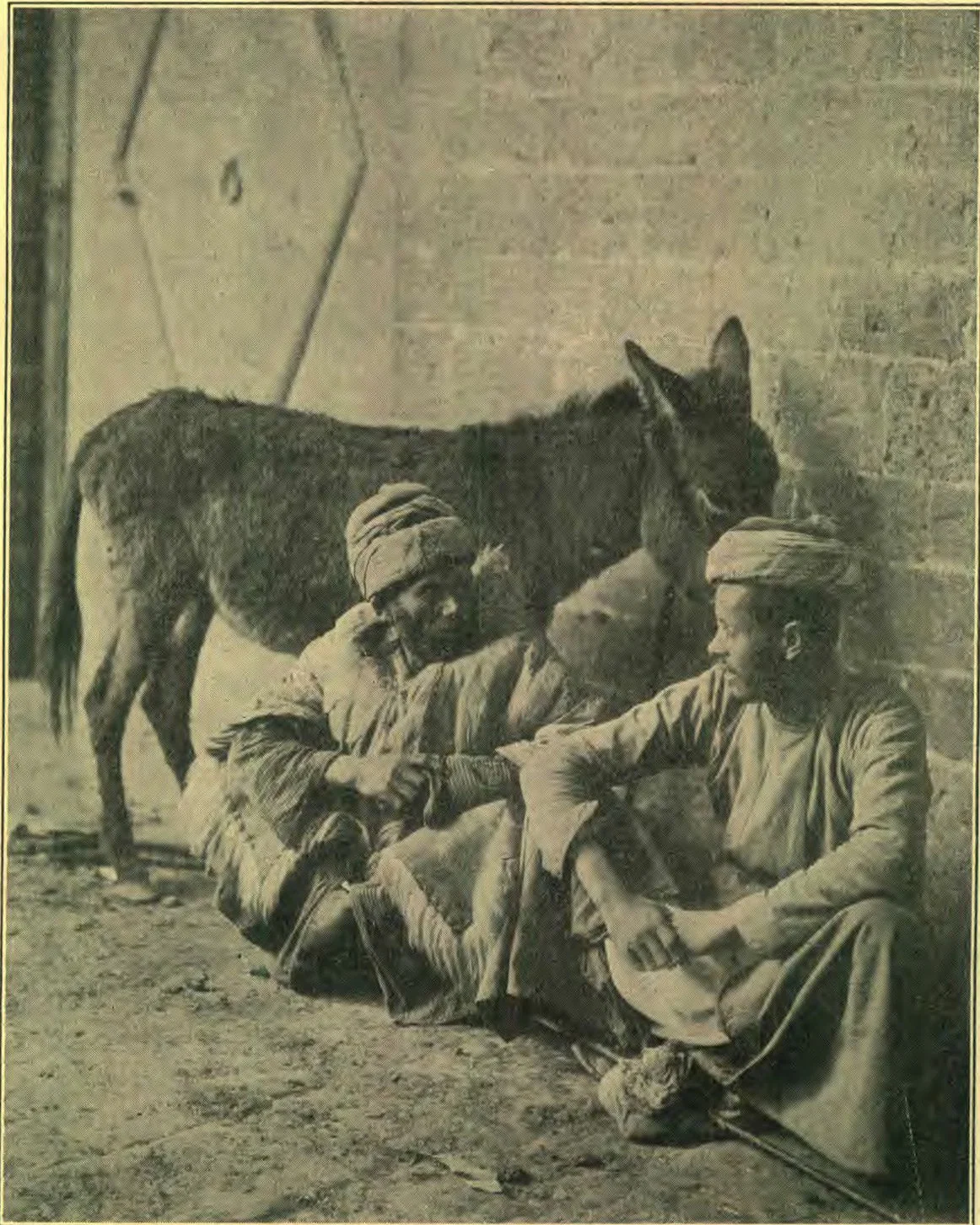
NATIVES OF THE HOLY LAND DISCUSSING THE WAR
Press Illustrating Service, Inc. NATIVES OF THE HOLY LAND DISCUSSING THE WAR

You have reached the end of this edition.

The Youth’s Instructor · Feb 19, 1918