A FEW weeks ago one of our missionaries with his wife was compelled by ill health to leave the African mission field for England. When but three hours out from Liverpool a submarine sighted their boat, and in a few moments the sick man and his wife, with many others, were in lifeboats, drifting upon the surging sea, while their ship with their belongings went to the ocean’s bottom. Three of the lifeboats, with their occupants, soon followed the vessel to the depths, and in those that were saved the people sat in cold water up to their waists for three long hours before they were rescued.
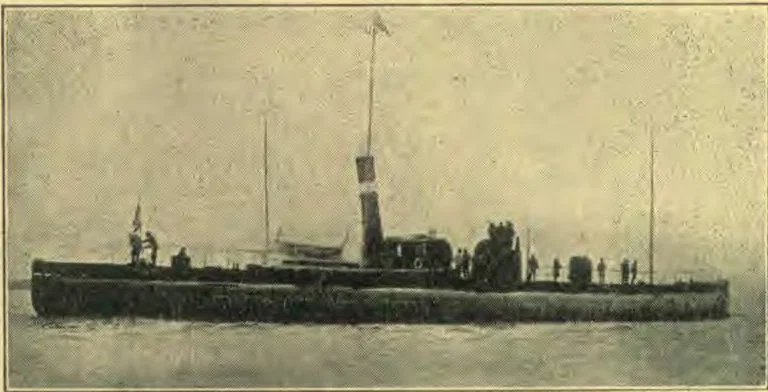
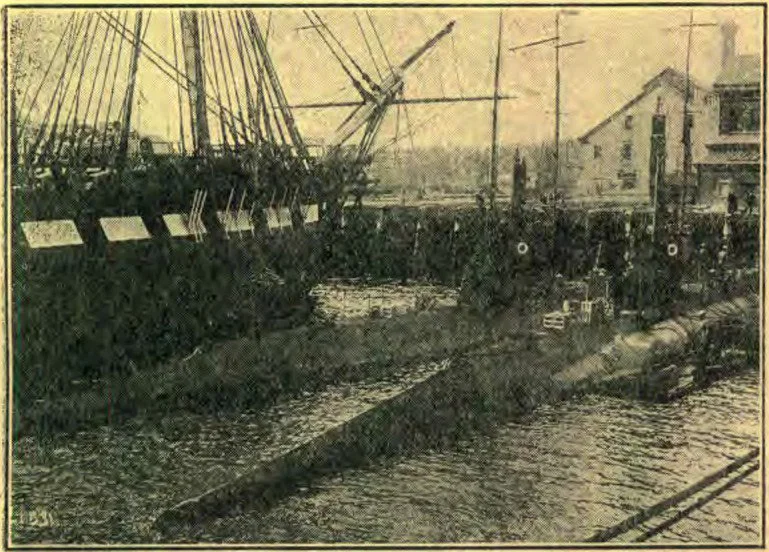
A thousand similar ocean tragedies have taken place since our gallant “Lusitania” with its hundreds of men and women was sent to the bottom of the sea. Of course men everywhere would be alert to find ways of overcoming the sea menace. Mr. Russell Bond, in St. Nicholas, describes the main devices now in use in combating the submarine. He says: “There are7just three ways of dealing with the situation: the submarines may be penned in, so that they cannot get out of their bases into the high seas; they can be hunted down after they have got out to sea; or ships can be so carefully guarded and protected that the submarines will have no chance of injuring them.”
“Of course, if the first of these propositions could be carried out, it would settle the whole problem very nicely. Early in the war heavy steel nets were stretched across the English Channel, and although it has been very difficult to keep them in place on account of storms and tides and the sweep of floating seaweed, yet they have kept the enemy out of the channel, and the British have been able to send troops and provisions over to France with no interruptions. Now, if a similar net could be stretched across the North Sea from Scotland to Norway, a distance of two hundred fifty miles, the U-boat would be completely bottled in and would no longer give Atlantic shipping any anxiety. It may seem like a fantastic idea, but such a net has been designed and has been given serious consideration. It must hang down to a depth of at least two hundred feet, so that a submarine could not dive under it; and as it would be impossible to patrol the submerged part of the net, it must be built so that a submarine would not dare to touch it. By placing a bomb every twenty feet along the length and breadth of the net, there would be no chance for a submarine to cut its way through without exploding one of the bombs. A single bomb would be powerful enough to sink a submarine, but delayed-action fuses would be used, so that when one exploded, it would not set off any of the others about it. The cost of this net and the bombs on it is estimated at fifty million dollars. A truly enormous sum, but it is no more than the cost of a single week of U-boat warfare in ships and cargoes destroyed.
“Hunting Submarines
“In the early days of the war it was found that a small, fast motor boat was the submarine’s most dreaded enemy. Now a torpedo is usually set to run at a depth of at least eight or nine feet, so that the waves will not disturb the valve that controls its horizontal rudder. But these motor boats, or chasers, as they are called, are of such a shallow draft that a torpedo would pass harmlessly under them, and then they are so speedy that a submarine would have little chance of hitting them, anyway. It used to be that they carried a gun as powerful as that with which the submarine was equipped, and they were only too anxious to fight the U-boat if it came to the surface. Because a U-boat is blind under water it would have to come up now and then to get its bearings, particularly when operating in a harbor or near the coast, where it might run into a rock or a shoal.
“At that time submarines were rather fragile boats, and their skin was liable to be punctured by a shell from the chaser, when, of course, they would not dare to dive under the sheltering waves. But now submarines are equipped with heavy guns of much greater range than any that can be carried on the deck of a chaser, and they are armored so that their hull cannot easily be punctured. Then, too, they are larger and can operate out in the ocean, too far from land for the chasers to follow them in safety.
“The chaser has seen its day, and its place is now being taken by the destroyer, which is just as fast and yet is armed with guns that equal, if they do not outrange, those of the most powerful submarines.
“A Lesson from the Fish Hawk
“Probably the greatest danger to the submarine lies in the sky. From a considerable height above the water it is possible to see the dark outline of a submarine, as a fish hawk sees its prey, even when it is lurking far under the surface. And so the sea is now patrolled by aeroplanes, which can swoop down upon the submerged boat and put it out of commission by dropping a bomb on it. Unfortunately, it is very hard to drop a bomb from a rapidly moving plane with any degree of accuracy, and so a new type of aircraft has been invented, known as a Blimp. This is a cross between an aeroplane and a cigar-shaped balloon. This queer craft can cruise around leisurely; it does not have to travel at a rate of fifty to a hundred miles per hour just to keep up in the air. When it discovers a submarine it can stop and hover over the spot, taking careful aim before dropping its bomb. It can stay up in the air much longer than an aeroplane, for it does not depend upon the engine to lift it; and with its engine running slowly it can run longer on the same fuel.
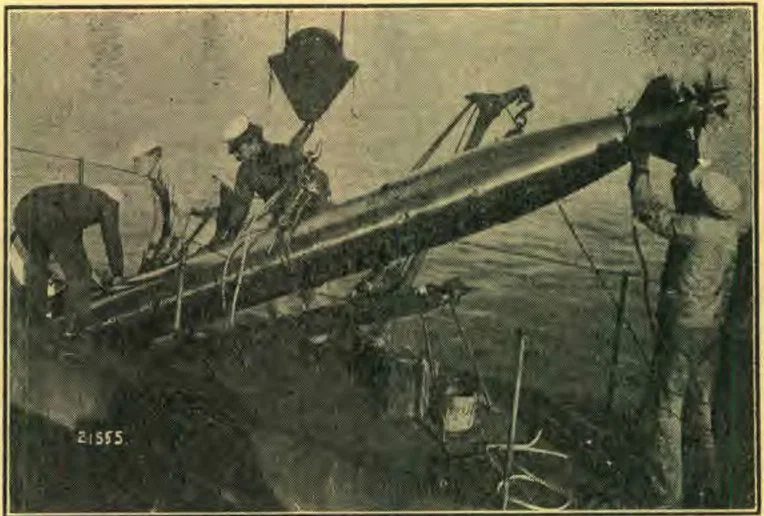
“But there is another scheme that is now being8used which makes the aeroplane more efficient. Sometimes fish are killed in large numbers by exploding dynamite under water. The fish do not have to be actually hit by the dynamite; they may be at a considerable distance from it, and yet they will be either killed outright or stunned by the pressure-wave that travels through the water. This very scheme is used in fighting submarines. A bomb has been invented which will explode when it has sunk to a certain depth in the sea. It carries enough explosive to crush in the side of a submarine that is within a hundred feet of it. If the hull of the boat is not actually smashed, its seams will be sprung so badly that it cannot keep afloat. This blunderbuss type of shooting makes it much easier for the aeroplane to destroy its prey. ‘Depth bombs,’ as they are called, are also used by destroyers and other war vessels, which drop them where they suspect a U-boat may be lurking.
“Why Torpedo Nets Are Not Used
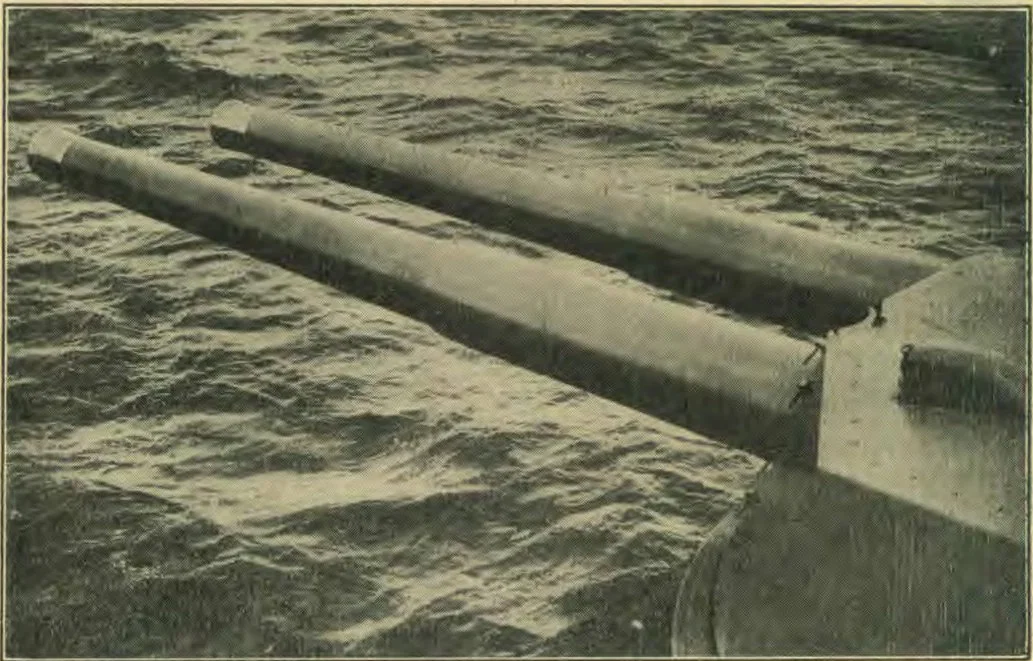
BRITISH DREADNAUGHT GUNS
“When submarines were first invented they were intended for use against battleships and cruisers. They were feared mainly at night when a fleet lay at anchor; for then a submarine might creep up and let fly its deadly missile. Hence, war vessels were provided with nets which they could hang over the side of the ship to catch the torpedo and keep it from striking. But the modern torpedo will go off even when stopped by a net, and to save a ship from the destructive pressure-wave set up in the water, it must be netted at something like twenty feet from the boat. Now, if a merchant ship could protect itself with a petticoat of steel netting twenty feet from its hull, it would be safe from underwater attack. But to keep the netting there calls for cumbersome rigging that would be smashed in the first heavy sea. Besides, the drag of the net would slow down the vessel until it could only crawl along, and then there would be the difficulty, at the same time, of keeping the net from riding up to the surface.
“Lessons from Nature
“There are better means of protection; many of them we have learned from Mother Nature. The world is full of animals that live in constant fear of their lives because they have fierce, powerful enemies, but they manage to exist despite their enemies, some because they can run faster, some because they can dodge better, and some because they look so much like their surroundings that their enemies can scarcely see them. All the tricks by which nature protects its weaker children have been tried out by merchant vessels.
“Speed is one of the best protections. Most of the U-boat sinkings, so far, have been among the slower boats, those making under fifteen knots. A torpedo is an expensive missile and a bulky one too. Not many torpedoes can be carried by a submarine, and so, unless there is a very good chance of making a hit, the U-boat commander is not likely to shoot out such valuable ammunition, but will prefer to come to the surface and fight with his guns. The best submarine can make only eighteen knots on the surface, and if the merchant ship can do as well or better, its chances of escape are excellent, and besides it can return shot for shot from its own guns.
“Zigzagging
“One of the best tricks of the merchant ships is to keep dodging, not merely when it spies the wake of a torpedo, but all through the submarine zone. Instead of sailing a straight course, it proceeds first in one direction and then in another like a sailboat tacking against the wind, but constantly varying the angle and length of each tack. When a submarine sights a vessel it tries to get as near to its intended victim as possible without betraying its own presence. It notes the direction taken by the ship, and then proceeds at top speed under water to a point that will head off the vessel. It has to proceed blindly, by dead reckoning. only occasionally sticking up its periscope for a look. But it is rather disconcerting for Herr Commander to find that the ship which he saw sailing northeast five minutes ago has now turned southeast and is actually farther from him than it was before. The irregular dodging of the boat is really very baffling, and about all the submarine can do is to show itself and fight in the open.
“Hiding in Broad Daylight
“A great advantage of the submarine lies in the fact that it is very inconspicuous. Even when running on the surface it projects but a few feet above water level, while the ships it hunts have masts that tower high above them, and moreover, they usually pour out dense columns of smoke that blacken the sky to a great height. This smoke gives the U-boat commander his first hint that there is a ship about. He can see the smudge above the horizon when the boat that produces it is thirty miles or more away, down behind the curve of the earth. He can head for this smoke at top speed without fear of being seen. Presently he will see masts of the vessel projecting above the horizon, and then even the smokestack, while he himself will be absolutely invisible to the man on the bridge of the9ship, because he will be below that man’s horizon. So the U-boat commander will have plenty of time to size up the speed and general direction of the ship’s course and make his plans to intercept the vessel, before the captain of that boat has the least inkling that there is a submarine about.
“However, our merchantmen are now beginning to take precautions. They are beginning to use hard coal in the submarine-infected regions, so that a submarine must be within fifteen miles to see them. Some boats are even cutting down their masts and doing away with their funnels, to cut down still further their range of visibility.
“Artists to the Rescue
“There is another trick that merchant vessels are now working, known as “camouflage.” It is a scheme for fooling the U-boat by means of paint. It used to be that war vessels were painted a dark gray, so that they would be inconspicuous. We know now that such war paint makes a vessel more conspicuous than ever. Under the direction of artists, vessels are now painted so that there are no sharp outlines, and from a distance it is hard to tell their shape or where they start or end. The parts usually in shadow are painted light, and the lighter parts, dark. Peculiar colors are used that will blend with the surroundings. Waves are painted on the hull of the vessel, and queer stripes and spots are put on. An object painted a solid color is more easily seen at a distance than one whose surface is broken up by a lot of different shades. The leopard has been given its spots and the zebra its stripes for this very reason, and it is this trick of nature that our ships are making good use of.”
Should You Eat Sugar?
By Albert W. McCann
OLD men and women consume little sugar. Babies that live consume very little sugar. Sugar-eating infants do not survive. Men who drink alcoholic beverages rarely eat sugar. The victims of diabetes are compelled to avoid sugar.
Thus we see that a very large element of our population consumes sugar sparingly. In spite of this fact the Department of Commerce has compiled figures showing that the average consumption of cane sugar in the United States during the year ending June 30, 1917, was eighty-one pounds for every man, woman, and child.
The Department figures covered cane sugar only, on top of which is piled up another sugar debauch in the form of glucose candies, corn sirup, and table sirup made of glucose and refiners’ sirup.
All this means that combining the various forms of refined sugar and eliminating infants, the aged, whisky drinkers, and invalids, the average annual consumption of refined sugars in the United States is at least one hundred fifty pounds per person.
The figures of the Department of Commerce show that in Germany the consumption is sixteen pounds, in France twenty-eight pounds, and in Great Britain thirty pounds. Without realizing it we have become a nation of refined sugar gluttons.—Albert W. McCann, in Physical Culture.
Prayer for Deliverance from Fear and Favor
DELIVER us from fear and favor, from mean hopes and cheap pleasures. Have mercy on each in his deficiency, let him not be cast down, support the stumbling on the way, and give at last, rest to the weary.—Stevenson.
For the Finding-Out Club
By Grace Hoover
(Concluded from last week)
33. Jane Austin. American. Wrote stories of early colonial days.
34. Samuel Francis Smith. American Baptist divine, born in Boston. Author of “America.”
35. Joaquin Miller (1841-1913). “Poet of the Sierras.”
36. James Fenimore Cooper. American novelist. Wrote “The Last of the Mohicans.”
37. Henry Blake Fuller. Born in Chicago. A novelist. Wrote “The Cliff Dwellers.”
38. Sir Walter Scott. Scottish novelist and poet. Author of “The Lady of the Lake.”
39. Bayard Taylor. American traveler, writer, and poet, born in Pennsylvania.
40. Oliver Wendell Holmes. American author, wit, and poet. Author of “The Autocrat of the Breakfast Table.”
41. Sir Thomas North. English writer. Made first translation of Plutarch’s “Lives” into English.
42. Robert Southey. English poet and biographer.
43. Paul L. Ford. American writer of historical fiction.
44. James Whitcomb Riley. American poet. Best known by his dialect poems.
45. John Hay. American writer and diplomat.
46. Roger Ascham. English classical scholar and author.
47. George Ade. American humorist and dramatist.
48. Thomas Babington Macaulay. English historian and essayist.
49. James H. L. Hunt. English poet and essayist.
50. Mrs. Humphry Ward. English novelist. Wrote “The Marriage of William Ashe.”
51. Andrew Marvell. English poet and satirist.
52. Robert Bridges. English poet. Author of “Bramble Brae.”
53. Jack London. American novelist. Author of “The Call of the Wild.”
54. Robert Greene. English dramatist, novelist, and poet.
55. Henry Cabot Lodge. American author. Wrote “A Short History of the English Colonies in America.”
56. John Burroughs. American author and naturalist.
57. William Cowper. English poet.
58. Charles Lamb. English critic, essayist, and humorist.
59. Hamilton Wright Mabie. American journalist and essayist. Editor of the Outlook for years.
60. George W. Cable. American novelist. Author of “Old Creole Days.”
61. Tobias George Smollett. British novelist and historian.
62. Walter Savage Landor. English poet and prose writer.
63. Charles Dudley Warner. American author. Wrote “Backlog Studies.”
64. Alfred Tennyson. Noted English poet.
65. Edward Everett Hale. New England prose writer. Author of “The Man Without a Country.”
66. Alfred Noyes. English poet.
67. Stephen C. Foster. American musical composer and writer of songs. Author of “My Old Kentucky Home.”
68. Bret Harte. American humorous poet and novelist. Author of “The Luck of Roaring Camp.”
69. Sir Richard Steele. English essayist and dramatist.
70. Henry David Thoreau. American author and naturalist.
71. Harriet Beecher Stowe. American author. Wrote “Uncle Tom’s Cabin.”
72. Edward Tyas Cook. English journalist.
73. Robert Browning. Noted English poet.
74. Francis Bacon. English writer, philosopher, and statesman.
75. Robert Burns. Celebrated Scottish poet.
76. Anon.
77. Shakespeare. Great English dramatist.
78. Thomas Nelson Page. American author. Wrote “In Ole Virginia.”
79. Edward Everett. American orator, scholar, and statesman.
80. Henry W. Longfellow. American poet. Author of “Evangeline.”
MRS. GRACE HOOVER.
Devotion Through Awareness of God's Presence
By William Law
HE that dares not say an ill-natured word or do an unreasonable thing because he considers God as everywhere present, performs a better devotion than he that dares not miss the church.—William Law.
Give: A Litany of Kindness and Good Example
GIVE to your enemy forgiveness.
Give to your opponent tolerance.
Give to your friend your heart.
Give to your child a good example.
Give to your parents deference.
Give to everybody sunshine.
— The Calendar of Sunshine.
The Angel of the Prisons
By Mary Hazelton Wade
Long ago, in the year 1780, a little girl was born in Norwich, England. As “my dovelike Betty” her mother sometimes spoke of her, but her real name was Elizabeth. She had clear, loving eyes and a quantity of soft, flaxen hair, and she was not only pretty, but winning in her ways.
Elizabeth’s father, Mr. John Gurney, was a rich London merchant, and the home where “little Betsy Gurney” was brought up with her ten brothers and sisters was grand and beautiful. It was called Earlham Hall, and spread over many acres on the banks of a lovely river.
The big house stood in the center of a park, where trees, hundreds of years old, shaded gardens in which beds of lovely wild flowers were carefully tended. Here Elizabeth used to walk with her mother. When she listened to stories of the Garden of Eden, she thought, “It must be like this,” because she could not imagine anything lovelier than what she saw around her at Earlham Hall.
There were other stories, however, that brought fear to the timid Elizabeth. One of these was about the deluge. “Suppose,” she perhaps thought, “there should be another deluge.” This was, no doubt, the reason that, the first time she saw the ocean, she burst into tears. For years afterward she dreaded to bathe in its waters. Her mother, however, would not give way to what she thought were a silly girl’s notions. So Elizabeth was obliged to take sea baths that made her tremble with fear.
She also had to go to bed in the dark. “If only I could have a light in the room!” she pleaded. But her mother was firm, and Elizabeth was left alone in the darkness, to imagine all sorts of dreadful things before she finally went off to dreamland.
Still other ways in that beautiful home were not pleasant to Elizabeth. The day was divided up into exact periods for study, Bible reading, walking, and playing. “I’m not free to do anything when I please,” thought Elizabeth, and she lost interest in everything, so that, though she was really bright, she got the name of being stupid and stubborn.
When she was twelve years old, a great change came in the home life—the dear mother died. Elizabeth was very sad at losing her. Now, however, she was freer than she had ever been before. Her father was a Quaker, as her mother had been, but he was “easy-going,” and did not hold very strongly to the ways of his people. Elizabeth, therefore, was allowed to dress in as bright colors as she wished, instead of the sober gray garments usually worn by the Friends. She also learned to ride horseback and to sing and dance, and many a merry party was held in the grand parlors of Earlham Hall. Now, strict Quakers believed both music and dancing to be wrong, as well as giving thought to fine dress. So, when the pretty young girl sometimes appeared in the meeting-house in “smart purple boots laced with scarlet,” many eyes looked severely at her. She loved music so dearly that she would run “almost beside herself,” as she afterward said, to listen to the band playing in the square. She went to the opera and was greatly delighted when the prince, who was also present, looked at her.
Five merry years went by, in which the young girl thought little of her mother’s teachings. But at last they began to trouble her.
“I am not unselfish,” she said to herself. “I care for my own pleasure. I speak crossly to my brothers and sisters. I think too much about pretty clothes. I am often idle.”
Though such thoughts made her feel uncomfortable, she kept on with what she called “storms of pleasure,” till one night she had a dream that filled her with terror. It seemed to her that she was standing on a beach, and that the tide was rising about her and would soon sweep her out into the ocean.
The next night she had the same dream, and the next, and the next. Elizabeth dreaded to go to sleep, thinking of what she was sure to suffer in her dreams.
Then came a new and beautiful experience—she went to hear the preaching of William Savery, an American preacher. Elizabeth sat on the front seat, with her “smart boots” and all her finery.
She afterward wrote that what the preacher said “was like a refreshing shower falling upon earth that had been dried up for ages.”
When Elizabeth slept that night, she dreamed of the ocean waters rushing in upon the beach, but she was beyond their reach.
She awoke with a light heart, believing the dream had been sent by heaven.
“I will live to do good to others,” she decided. “That is the only way to be truly happy.”
The Influence of Dancing and Dressing
But Elizabeth still loved music and dancing and pretty clothes. “Can I keep on in the old way, and still help others as I should?” she asked herself.
After a while she answered the question with, “No, the pleasures I enjoy so much take my mind away from serving God.”
From that day the young girl gave up the wearing of gay colors and dressed in sober drab, with a close cap about her pretty flaxen hair, and a snowy kerchief crossed upon her breast.
“My plain garments will protect my thoughts,” she said to herself.
What were those thoughts?—That God, who is wise and loving, is close at hand, and that nobody in the world is wholly bad, because there is something to love in every one.
But Elizabeth did not stop at thinking.
“I must show my love for others, no matter how poor or ignorant they are,” she decided. So she went about among sick and needy people, bringing them many comforts and talking with them about God’s love for all.
She also invited poor children to her beautiful home on Sunday evenings, and read stories in the New Testament to them. The children enjoyed these evenings so much that she said to herself, “I will have a day school for them.”
So she started a free school, which kept on growing till there were eighty boys and girls in it. How they loved their kind teacher!
When Elizabeth was nineteen years old, Joseph Fry, a young London merchant, asked her to marry him. Soon afterward she became his wife and went to live in the big city.
Before long she had boys and girls of her own to care for.
“I will teach them by love and not by force, to do right,” she thought.
Busy years went by, in which Mrs. Fry cared for11her children wisely and tenderly. She also gave much time to making her many guests happy. Yet even now she found time to visit poor and sick people in the city and give them aid.
Ministers to the Poor
She had lived eleven years in London when her husband bought a beautiful home in the country at Plashet, with gardens and wide fields where the Fry children could have joyous times.
“They must also learn the happiness of giving joy to others,” the wise mother said to herself. So, when she went out to do loving deeds among the poor, she took her two older daughters with her. Making their way through dirty yards where pigs were running about, they would climb broken staircases and grope along dark, narrow passages. At last, perhaps, they would reach a room where a sick woman was lying helpless, with ragged, hungry children about her. Then how tenderly the beautiful Quakeress would talk to them, as she gave them the food and clothing they needed!
Opposite Mrs. Fry’s home was a broken-down house in which an old man lived with his sister. The only money they earned was by selling rabbits. Though the woman was shy and sad, Mrs. Fry quickly won her friendship.
“How would you like to have a girls’ school in the empty room next your building?” she asked the old couple. They readily agreed, and soon seventy girls were being taught under Mrs. Fry’s watchful care. Her gentle, loving ways, her sweet voice, and her kind eyes quickly won the hearts of her pupils.
She also set up a station where needy people could get flannel and calico. One room was filled with medicines for the sick, and in another, soup was made for the hungry through the long, cold winter.
When Mrs. Fry was thirty-three years old, she went to London to spend the winter. She had already been made a preacher of the Quaker faith, and had often spoken and prayed at public meetings.
One day, soon after she went up to London, a Quaker friend came to her saying, “I have been to Newgate Prison. I wish you could see the pitiful sights I have just seen.”
At that time prisons were far worse than they are today. Although we still have much to do and more to learn about prisons, people are now beginning to see that wrongdoers are sick in mind, and must be healed of their badness, if possible, as those ill in body are cured in hospitals. But in those days men and women who were imprisoned were treated cruelly. They were often put to death for the smallest sins. They were even hanged for stealing food to keep them from starving, and were sometimes imprisoned for years for getting into debt, even through no fault of their own.
Visits Newgate Prison
The prison at Newgate was one of the worst of its kind. In the cells within, people of all ages, those who had done great crimes and those who had broken the laws only in some small way, were huddled together in dirt and rags and darkness. It was to this dreadful place that a friend of Mrs. Fry’s said, “Come, and see for yourself.”
She needed no urging. What she soon looked upon made her heart ache. When she visited a ward filled with women, she found three hundred of them together, with their innocent children about them, without even beds to lie on at night. They were screaming, swearing, and pulling each other’s hair. On the walls hung chains and fetters with which they were often bound.
“Poor, poor women!” thought the gentle Quakeress. “They must be helped at once.”
Soon she made a second visit to the prison. “Leave me alone with these women,” she asked, for she had no fear with God to help her.
When she was alone among the prisoners, she took out her Bible and read some of the words of the dear Lord who had come to save sinners, and went on to explain why he had come.
Before she went away, she offered to set up a school, where the poor, half-naked, half-starved children should be taught. Bad as many of these women were, they wept for joy at their visitor’s words.
The school was soon started, and women as well as children came crowding into it.
Mrs. Fry did not stop here. “These people must have work,” she decided. “They will be far better if they are not idle.”
Many people laughed at the idea. They said the women would steal or destroy any work given them. Mrs. Fry did not heed their words, but as soon as possible, formed a company of twelve persons who were to improve the condition of the women’s quarter of the prison. A room was made ready, matrons were put in charge, and the prisoners who had seemed almost like savages were soon sewing busily and learning to be neat and orderly. They also gladly listened to daily reading from the Good Book. Prizes were given them for neat work, and they received a part of their earnings to use for themselves and their children.
No one was ever punished by Mrs. Fry. The women agreed, “It would be more terrible to be brought up before her than before the judge.”
By this time Newgate had become so noted for its good order that letters from other parts of the country came pouring into Mrs. Fry’s lap, all bearing the same request: “Tell us how we may better the lives of those in our prisons.”
Invitation from Queen Victoria
Queen Victoria invited the lovely Quakeress to her court, and newspapers sounded her praises. Wherever she went, people crowded forward to look upon her. Yet she felt no pride in herself. “It is the Lord’s doing,” she wrote in her diary.
As time went by, Mrs. Fry visited other countries, everywhere giving wise help in the management of prisons. The greatest rulers in Europe entertained her in their palaces.
This noble woman worked not only to help the unfortunate people while in prison, but to make it easier for them to earn a living when they were set free. She also tried her best to make others see the wrong of putting people to death, no matter what sins they had committed. She said, “It hardens the hearts of men,” and gave good reasons why it brought more harm than good to the rest of the world.
Thus busy years went by, during which Mrs. Fry had many troubles of her own. Her husband and two of her children died.
At last she herself was called to lay down her life. In her going, as in all her busy life, she was happy in the thought of the loving Father and his nearness. How could the dear ones left behind her grieve, when they thought of the one who had ever been such a wise friend, who had never been known to speak a cross or unkind word? One of her sons said afterward, “Her word was law, but always the law of love.”—Mary Hazelton Wade, in Everyland.