“BLESS the poor little children who haven’t got any beds to-night,” prayed a little boy, just before he lay down on his nice warm cot, on a cold, windy night.
His mother said: “You have just asked God to bless the poor children; what will you do to help them?”
The boy thought a moment: “Why, if I had a hundred cakes, enough for all the family, I would give them some.”
“But you have no cakes; what then are you willing to do?”
“I’ll give them some bread.”
“You have no bread—the bread is mine.”
The boy thought again. “I’ll give them half of my money. I have seven pennies. I’ll give them four. Wouldn’t that be right?”—Our Little Ones.
Schoolboy Life in China
By A. C. Selmon
In countries where there are free public schools, every boy and girl has a chance to secure an education. Our Chinese boys and girls are not so fortunate in this respect, for the majority of them never learn to read or write.
In this section there are few, if any, free public schools for boys. The boy whose parents are poor has little opportunity to secure an education. He is kept busy helping to keep the family supplied with food and clothing. This is no easy task, for the mass of people of this land have a hand-to-hand struggle for their daily bread. It is all they can do, and more than many can do, to get the necessities of life. If the people own a few acres of land and are in fair circumstances, several families will unite and together hire a teacher for their boys.
I have not spoken of the schoolgirls, because there are none. Some of the missionary societies have schools for girls, but outside of these the girls do not learn to read or write. This is partly because they are regarded as not worth educating; and it is thought that if they were educated, they would not make so good wives.
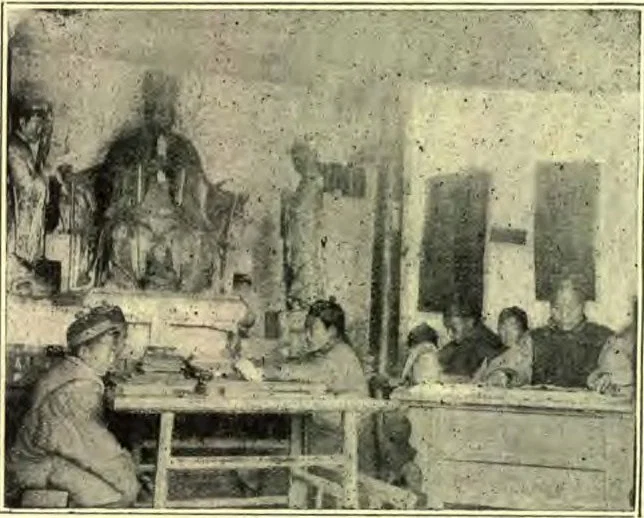
The teacher is hired for a year; and counting out the vacations, about nine months of this time is spent in the schoolroom. Sometimes the schoolroom is a spare room in the home of one of the boys. The floor is simply the beaten earth, the walls are plastered with mud, and the ceiling is coated with soot. There may be one or two small windows having a latticework, over which is pasted thin white paper. Sometimes one of the numerous temples is used for a schoolroom, and such rooms serve the purpose handsomely; for they are large, well built, and well lighted.
A CHINESE SCHOOLBOY
The interior of a temple schoolroom is shown in the picture. The desks are plain tables, and the seats are wooden benches with no backs. A little boy's head hardly comes up to the top of the table, and his feet swing several inches from the floor. Our little student does not murmur much about such inconveniences. He is spurred on to hard study by the feats of some of the ancient worthies. He is told of one poor boy, who, being without books, copied lessons on strips of bamboo; another boy, having no lamp, read by the glowworm's light; and another very restless boy tied his books to the cow's horns, and studied while he tilled the soil.
At the base of the platform on which the large idol sits will be seen a small wooden tablet. This is the Confucian tablet, and is found in every schoolroom, for Confucius is the god of learning. Several sticks of incense are kept burning before it. Three times a day every pupil makes his bow before this tablet, and on the first and fifteenth of every month the teacher also makes a ko-tow to it.
SCHOOLROOM IN AN IDOL TEMPLE
The beginners' primer is a little book called “The Three Character Classic.” It has over five hundred different characters in it, and the boys must learn to correctly recognize and pronounce each one. The first sentence reads as follows, “Men at their birth are by nature radically good.” Others are like the following: “If men do not learn, they are not equal to the brutes;” “To educate without severity shows a teacher's indolence.” His second book is the “List of Family Names.” This is a list of over four hundred characters which are in common use as names. His third book is “The Thousand Character Classic.” This is made up of exactly one thousand characters, no two of which are alike. It treats of some of the early kings, of the virtues of man, social virtues, and kindred topics.
The fourth book is “Odes for Children.” It is a book of easy poetry. The fifth book is the “Canon of Filial Duty;” and the sixth book to be mastered is “The Juvenile Instructor.” It treats of education and social intercourse. All these books were written hundreds of years ago, and one of them was written over two thousand years ago.
After finishing these books the young aspirant next takes up what are known as the “classics.” These are composed of four books, and contain the teachings of Confucius, and of a disciple of Confucius, named Mencius. Confucius lived 551-478 B. C. Mencius lived 371-288 B. C. There is nothing in any of these books about geography, arithmetic, or any of the natural sciences, which are studied by every schoolboy in Western lands.
The task of writing these characters must also be mastered. The teacher first writes a copy, and the pupil places a thin piece of white paper over this; and with a brush-like pencil, made of camel's hair or goat's hair, dipped in thick black ink, he traces the characters until his hand has acquired the skill to write them without a copy.
The boy must improve his time and get ready to take the examinations that will lead to his getting a degree. He puts in long hours in the schoolroom. He goes to school at daybreak, and comes home for breakfast; after breakfast he is in school until noon, and after noon he remains in school until sundown. In some cases he is even made to study at home after dark.
In the schoolroom every boy is repeating his lesson in a loud voice, and when there are twenty or thirty pupils, it makes a very noisy place. The teacher's ear is trained so that when any boy makes a mistake in pronunciation, he is at once corrected.
When the lesson is learned, he must recite, or “back the book” as they express it. He comes up to the desk, and turning his back to the teacher, repeats the lesson. If he makes a mistake, he may receive any one of several kinds of punishment. One form is to beat the hand with a wooden paddle, another is to whip with the rod, another is to pull the ear or the eyebrows, and the most common is to be berated with words, and called a dunce, simpleton, or some such expression. As a rule, the teachers are very strict, but are highly respected by the pupils. The saying of the common people is that the better the teacher is paid, the more he will whip the pupils. A. C. SELMON.
My Master Is Always In
“JOHNNY,” said a man, looking at a boy who was taking care of a shop while his master was out, “you must give me an extra measure; your master is not in.”
Johnny looked up into the man’s face very seriously, and said, “My Master is always in.”
Johnny’s Master was the all-seeing God. Let us all, when tempted to do wrong, adopt Johnny’s motto: “My Master is always in.” It will save us from many a sin and much sorrow.—Selected.
My Father Waits
It was a hot, dusty, uninteresting day for travelers. A little fellow sat patiently watching the fields and fences hurrying by. An old lady wondered at the patience of the child, so said to him, sympathetically, “Aren’t you tired, dear, of the long ride and the dust and the heat?”
The boy looked up brightly and replied: “Yes, ma’am, a little. But I don’t mind it much, because my father is going to meet me when I get to the end of the journey.”
Our Father waits to meet us at the end of the journey of life. Are we sweetly resting in the thought? Does it give us patience in bearing the trials and perplexities of life?
Emerson's Sparrow: Song and Sky Lines
By Ralph Waldo Emerson
I THOUGHT the sparrow's note from heaven,
Singing at dawn on the elder bough;
I brought him home, in his nest, at even;
He sings the song, but it pleases not now,
For I did not bring home the river and the sky;
He sang to my ear,— they sang to my eye.
—Ralph Waldo Emerson.
My Place
*“Take my life, and let it be consecrated
Lord, to thee.”*
I do not ask, dear Lord, there be
A place made small enough for me,
But I be made by thee to fill
The place appointed by thy will.
Naught can I give, I come to claim
The promises that bear thy name.
My poverty I leave, to feel
The riches that thy words reveal.
The weakness I have learned at length
Exchange I for thy power and strength.
My pride, so foolish had I known
That which thou asked was but thine own,
Is crumbled in the dust to be
Sweet blossoms of humility.
My will, forgive the struggle past,
My will, dear Lord, is thine at last.
Emptied and broken here I lie
Too near for thee to pass me by.
But fill me with thy Spirit so
Through me the stream of life will flow.
If where the lofty cedars grow
On mountains crowned with endless snow,
Or in the meadow-land below,
Where lilies of the valley grow,
Through this poor vessel, mean and small,
Let blessings on thy children fall;
Thus I, who dare not lift mine eyes
To places shining near the skies,
And am afraid my skill to trust
In lifting blossoms from the dust,
I, who did even dare refuse
To follow thee in rough ways, choose
Wherever thou canst use me best;
That is my place, my joy, my rest.
—Selected.
MISSIONARIES
A YOUNG MAN SEVENTEEN years of age who began canvassing the last of April was ready for a $550 delivery by the middle of July.
IN one hundred years 300,000,000 copies of the Scriptures have gone into circulation. Two societies during last year distributed 7,667,566 Bibles.
AT the beginning of the nineteenth century, the Bible, or portions of it, were obtainable in forty living languages. Now at the beginning of the twentieth century, it may be read in four hundred and fifty languages and dialects.
THREE fourths of the canvassers in one of our States are said to have come from some of our schools. The value of these institutions to the propagation of this message can not be estimated. May their work be doubly blessed the coming year.
THE door-bell rang at a certain home, and the lady of the house opened the door to one of our canvassers. As he began to show her “Thoughts on Daniel and the Revelation” she said, earnestly, “When you rang the bell, I was on my knees praying that God would send me light on those two books.”
“A BROTHER called at a house the other day, and the lady said, ‘I do not want your book; if you had a book which I dreamed about last night, I would gladly take it.’ The canvasser then asked her if she could tell him of the book. She said, ‘I can remember only one thing; that was a picture of a great and terrible earthquake.’ ‘That is in this book,’ said the man, and then turning to the latter part of Great Controversy, showed it to her. She said, ‘That is precisely the thing I dreamed about. I want that book, and want it right away.’ He did not give her any further canvass; but showed her the bindings, and she took a leather copy. He delivered it the next day.
“Such experiences convince one anew that this work is of the Lord.”
MANY instances might be related which illustrate the truthfulness of the psalmist’s words, “Surely the wrath of man shall praise thee: the remainder of wrath shalt thou restrain.” A general canvassing agent recently told of a man who became angry because he had purchased one of our books. He therefore offered to sell it for anything he could get. A young man gave him an old revolver for it, and ten persons in his immediate neighborhood, himself included, embraced the truth as the result of reading the book, “Surely the wrath of man shall praise thee.”
In another instance a man received the Signs of the Times, and feeling incensed, determined to put it where he nor any other person would ever see it again. He therefore took special care to drop it into a mud puddle that he was driving past. It, however, fell so that most of the paper projected above the mud. A passer-by, observing its peculiar position, was interested to see what it was. He found the title attractive, and also the reading-matter. He later subscribed for the paper, and finally embraced the truth. “Surely the wrath of man shall praise thee.”
The Canvassers’ Work
By F. E. Painter
Most of the young people who read the INSTRUCTOR, doubtless, are accustomed to think of themselves as separate and distinct from other young people, as belonging to the people who have a message from God for the world; and probably many of them are expecting to have part in the work of giving that message. This ought to be the ambition of every Seventh-day Adventist. We can have no higher honor than to be workers for God; for then we are ambassadors for a greater kingdom than any this world has ever known—the kingdom of our Lord and of his Christ.
Our young people can engage in no work which will give them a better experience, or by which they will accomplish more real good, than that of placing our publications in the homes.
Think of the number of sermons on present truth contained in a book like “Great Controversy,”7“Daniel and the Revelation,” “Desire of Ages,” or even some of the smaller books, such as “Coming King,” “Heralds of the Morning,” “Marvel of Nations,” “Story of Daniel,” and a host of others; and then think of the number of sermons our faithful canvassers are putting into the hands of the people each week. As a sample, thirty-eight agents in the Atlantic Union Conference last week sold 425 of our large books, valued at $610.75, besides $188.51 worth of smaller publications, making a total value of $799.26.
This report is not above the average for this union, and frequently a higher record is made. I do not have the actual figures at hand showing the total sales for the past year, but using the week’s work given above as a basis of reckoning, the year’s work would result in the sale of about 22,000 books, valued at $41,500. On a low estimate, each of these books would probably contain twenty good sermons; this would make a total of 440,000 sermons delivered by our canvassers in this union in one year. If each minister spoke three hundred times in a year, it would require 1,466 preachers to equal that number of sermons.
From this standpoint the work of our canvassers is seen to be more important than it is sometimes regarded. True, many of these sermons have never yet reached the intellect of those for whom they were intended, for the reason that many of the books sold have not yet been read: but they will be read some day, and thousands will be convinced of the truth; and when the Spirit of God comes in power in the “latter rain,” the scenes of Pentecost will be repeated, and “a nation will be born in a day.”
The fruits of the seed sown by our faithful canvassers will be seen in the kingdom of God. Then it will be seen that it was worth while to have part in such a work as this. How many of those who read these words will think so now?
F. E. Painter.
A Missionary’s Experience
By Willis R. Hotchkiss
(Concluded from page 2)
wheat. I put into the cultivation of that wheat all the energy born of fourteen months’ abstinence from bread, and I assure you it was not a little. I hoed it myself to make every grain tell. I saw it grow up and head out and turn golden under the sunlight. It was a beautiful sight to me. It was reaped a handful at a time, and beaten out with stones. I had nine or ten bushels of beautiful grain worth its weight in gold to me. Visions of bread in plenty rose before my eyes. But another vision came,—a vision of a great need that staggers imagination. For months I had been stumbling over the dead bodies of famine victims that lay in my path, and the wretched relics came crawling to my station. They did not need to utter a word. Every look from those eyes, every sight of those emaciated forms, was eloquent with the eloquence of suffering; and, as in a flash of the Spirit of God, the connection was made between the wheat pile of mine and those starving people, and a voice seemed to say, “Here is a need, and here is a supply.” “But,” I said, “here is a great big desire. Which shall it be? Shall it be my desire or their need, my luxury or their necessity?” And while I debated, I seemed to see something else, and that settled the question forever with me, and the wheat went. I could afford to do without bread a few months longer, but I could not afford to look into those eyes that closed in death for me; I could not afford to look into those scars that were the price of my redemption, and hear Him say, “I was hungry, and ye gave me no meat; I was thirsty, and ye gave me no drink.” But, Master, when? Then would he say, “Inasmuch as ye did it not unto one of the least of these, ye did it not unto me.”
O my friends, I would to God we could get rid of the notion of missions and missionary organizations and every human agency, and get one clear vision of Jesus Christ. If we did, the whole problem of missionary finance and missionary workers would be settled. I do not ask you to pity the heathen. Pity is a weak thing that spends itself in tears, and then forgets the object of it. But I do ask you with all the strength of my heart that you simply treat Jesus Christ right. Is it right? I submit to you that it is not right to receive eternal life at those scarred hands, and then give him the spare change we happen to have left after we have supplied our luxuries. I submit that it is not right to receive heaven at the price he paid for it, and then give him the odds and ends, the convenient service, the things that cost us nothing. My friends, the crumbs that fall from your laden table are not enough, and they will not do to meet the need of the world that gropes in its ignorance, in its blindness, without God. You have no right to crucify the Lord Jesus Christ afresh upon the cross of your convenience.—Willis R. Hotchkiss.
Word from Africa
By Estella Houser
NDABAMBI is a native young man with Brother Chaney at the Basuto Mission, Africa. Brother Chaney sent him to Harrismith to sell some native literature. Ndabambi wrote a report of his experiences, and we give herewith an English translation of this report:—
Here is a report of my first attempt to sell books. I began to go among the people with the books, and some bought, but others laughed, and said, “What sort of books are these that are coming around to be sold?” Then I began to show what the book was like inside, and when they saw what the book was, one man bought a book. Some who at first made sport of me became interested in the book, and later on they asked the price, and when I told them three shillings sixpence, they began to buy.
There was a man (Zulu) at the house where we stayed, with whom I slept. He soon noticed that I kept the Sabbath, and said, “Why do you not work to-day?” I replied, “This is God’s Sabbath, and he tells us not to work on the Sabbath day.” He inquired, “Is not Sunday the Sabbath?” I said, “It is not,” and showed him the law of God in Exodus 20, and also told him to read Matt. 28:1. At first he could not understand, but later he said, “I see! the Sabbath is the day before the first day of the week.” Then he went to his minister, who could not deny that the seventh day was the Sabbath.
Then he began to tell his friends about the Sabbath, and said he was going home soon, and would tell all the people of his kraal what he had learned.
God blessed me in selling Zulu and Sesuto books, and I thank him who taught me, and gave me strength for the work, and kept me from fearing the people. When the people spoke in an insulting manner to me, I kept silent. I thank God for his blessing which was with me in this my first attempt to sell books, and trust he will bless in future attempts. I hope God will bless those who bought the books, and that in studying them they may find light and the love of Jesus in the books, and that they may know Jesus as their Saviour from sin.
I sold about thirty-eight copies of the Zulu “Christ Our Saviour,” and about twenty of the Sesuto books and tracts. ESTELLA HOUSER.
13. Through whom was Mordecai able to save the life of the king? Esther 2: 21-23.
14. In whose name did Esther bring the message to the king? Verse 22; note 4.
Notes
1. Mordecai was the great grandson of Kish, the Benjaminite who had been carried away into captivity by Nebuchadnezzar. From Mordecai’s living in a palace, we might infer that he occupied some place of trust at this time. The “gate” was an official seat, a court where decisions were rendered, as shown by the following quotations: “Execute the judgment of truth and peace in your gates.” Zech. 8: 16. “They hate him that rebuketh in the gate. . . . They take a bribe, and they turn aside the poor in the gate from their right.” Amos 5: 10-12.
2. Mordecai realized his obligation as a father to care for Esther. He did not throw off responsibility when Esther was taken to the palace, but for one whole year every day he went to the palace to inquire “how Esther did, and what should become of her.”
3. In this, Esther revealed her home training: her wants were simple; she was content with what was given her. O, that all maidens could only realize that there is no ornament to compare with youthful beauty when combined with grace of character! Esther’s beauty was consecrated. Beauty of the face and person is a valuable ornament, and aids in one’s usefulness when it is consecrated to God. Consecrated beauty never makes the possessor vain.
4. Esther did not take the honor to herself, but reported this circumstance in Mordecai’s name. A record was made of it, and as we shall see in our later studies, it was this very fact that saved the Jewish people from death.
MEMORY VERSE: “Where your treasure is, there will your heart be also.” Luke 12: 34.
“And as he said these things unto them, the scribes and the Pharisees began to urge him vehemently, and to provoke him to speak of many things: laying wait for him, and seeking to catch something out of his mouth, that they might accuse him. And one of the company said unto him, Master, speak to my brother, that he divide the inheritance with me. And he said unto him, Man, who made me a judge or a divider over you? And he said unto them, Take heed, and beware of covetousness: for a man’s life consisteth not in the abundance of the things which he possesseth.”
“And he spake a parable unto them, saying, The ground of a certain rich man brought forth plentifully: and he thought within himself, saying, What shall I do, because I have no room where to bestow my fruits? And he said, This will I do: I will pull down my barns, and build greater; and there will I bestow all my fruits and my goods. And I will say to my soul, Soul, thou hast much goods laid up for many years; take thine ease, eat, drink, and be merry. But God said unto him, Thou fool, this night thy soul shall be required of thee: then whose shall those things be, which thou hast provided? So is he that layeth up treasure for himself, and is not rich toward God. . . . ”
“Sell that ye have, and give alms; provide yourselves bags which wax not old, a treasure in the heavens that faileth not, where no thief approacheth, neither moth corrupteth. For where your treasure is, there will your heart be also. Let your loins be girded about, and your lights burning; and ye yourselves like unto men that wait for their lord when he will return from the wedding; that when he cometh and knocketh, they may open unto him immediately. Blessed are those servants, whom the lord when he cometh shall find watching: verily I say unto you, that he shall gird himself, and make them to sit down to meat, and will come forth and serve them. And if he shall come in the second watch, or come in the third watch, and find them so, blessed are those servants. And this know, that if the goodman of the house had known what hour the thief would come, he would have watched, and not have suffered his house to be broken through. Be ye therefore ready also: for the Son of man cometh at an hour when ye think not.”
“Then Peter said unto him, Lord, speakest thou this parable unto us, or even to all? And the Lord said, Who then is that faithful and wise steward, whom his lord shall make ruler over his household, to give them their portion of meat in due season? Blessed is that servant, whom his lord when he cometh shall find so doing. Of a truth I say unto you, that he will make him ruler over all that he hath. But and if that servant say in his heart, My lord delayeth his coming; and shall begin to beat the menservants and maidens, and to eat and drink, and to be drunken; the lord of that servant will come in a day when he looketh not for him, and at an hour when he is not aware, and will cut him in sunder, and will appoint him his portion with the unbelievers.”
“And that servant, which knew his lord’s will, and prepared not himself, neither did according to his will, shall be beaten with many stripes. But he that knew not, and did commit things worthy of stripes, shall be beaten with few stripes.”
Questions
1. As Jesus reproved the Pharisees and lawyers, for what did they watch his words? What selfish request was made by one who stood by? What trouble had evidently come up between this man and his brother? In order to receive earthly gain, what was this man willing to miss?
2. How did Jesus answer this man? What work had he come to do on the earth? See Luke 4: 18, 19. Of what did he warn the people to beware? Why is covetousness a thing to be shunned? In what does a man’s life not consist? What parable did Jesus speak to show the folly of trusting in riches?
3. What had made a certain man rich? From whom had his increase come? As his riches increased, what did he think within himself? What did he decide to do? How long did he think his wealth would last? How did he plan to spend his time? What does all this show?
4. What hindered the rich man from carrying out his selfish plans? What did God call this man? What question did he ask him? To whom is his sad end a warning?
5. What course does Jesus commend to his disciples? Where will their treasure then be laid up? Memory verse. Why will it be safe there? What other reason is given for laying up treasure in heaven?
6. How are we to live day by day? Why? What will be the condition of those whom the Lord shall find waiting when he comes? What will he do for them? Are the day and hour of his coming known? See Matt. 25: 13. What, therefore, are we admonished to do?
7. What question was asked by Peter? How did Jesus answer this question?—By the parable of the faithful steward. What will a faithful steward do in the absence of his master? What will his employer do on his return if he finds him faithful?
8. If the servant is unfaithful, what will he begin to say in his heart? What will he do? What will be his condition when his master shall return? Explain meaning of entire parable.
“Be Ye Kind One to Another”
EVERYWHERE are wounded hearts. Old men, young men, women, and children feel the hurt that comes from the bitter word, the unkind word, the word of unjust criticism. Employers are harsh and unforgiving toward employees, and employees are unmindful of the interests of their employers; teachers are unkind in their demands and judgment of pupils, and pupils are inconsiderate of the wishes of instructors; parents deal harshly and narrowly with their own children, and children are disrespectful, disobedient, and unthankful to parents; husbands and wives thrust the cruel blow of unkindness at each other; friends are disloyal; and Christian laborers are critically unkind to their fellow workers.
I am not thinking of the great crimes of earth, but simply of daily unkindnesses that keep hearts sore all the while, the unkindnesses among those who have a generous feeling for and confidence in one another, but, who, from lack of self-control through the gentle spirit of Christ, daily hurt and embitter hearts.
The heavenly verdict is that “all who profess godliness are under the most sacred obligation to guard the spirit and to exercise self-control under the greatest provocation.”
These unkindnesses of which I have spoken are usually borne in silence, and the hurt seems more keen because of this. It was one’s “own familiar friend” that caused the grief, so one can not speak; but the heart bleeds and bleeds.
Unkindness to those about us makes us unkind to heaven. Hear our Father’s pathetic complaint: “Woe is me for my hurt! My wound is grievous: but I said, Truly this is a grief, and I must bear it.”
Let us be more kind, every one of us. Let us pray for the gentleness of Christ, that gentleness which makes one great.
“God Be with You Till We Meet Again”
By Amos R. Wells
THIS beautiful benediction hymn is known all around the world, having been translated into many tongues. The hymn was written in 1882 by Jeremiah Eames Rankin, who was at that time pastor of the First Congregational church of Washington, D. C. It was written to interpret the familiar words, “good-by,” which are merely a contraction of the sentence, “God be with you,” and it was composed as a Christian benediction hymn, without being intended for any special occasion. The first, second, fourth, and seventh stanzas are all that are commonly sung:—
“God be with you till we meet again,
By his counsels guide, uphold you;
With his sheep securely fold you;
God be with you till we meet again.
“God be with you till we meet again,
’Neath his wings protecting hide you;
Daily manna still divide you;
God be with you till we meet again.
“God be with you till we meet again,
With the oil of joy anoint you;
Sacred ministries appoint you;
God be with you till we meet again.
“God be with you till we meet again,
When life’s perils thick confound you,
Put his arms unfailing round you;
God be with you till we meet again.
“God be with you till we meet again,
Of his promises remind you;
For life’s upper garner bind you;
God be with you till we meet again.
“God be with you till we meet again,
Sicknesses and sorrows taking,
Never leaving nor forsaking;
God be with you till we meet again.
“God be with you till we meet again,
Keep love’s banner floating o’er you;
Smite death’s threat’ning wave before you;
God be with you till we meet again.
Chorus
“Till we meet at Jesus’ feet,
God be with you till we meet again.”
I copy the poem from Dr. Rankin’s own book, giving the form he preferred. He objected very strongly, and quite properly, to the changes introduced by the hymn-tinkers, such as, “Put His loving arms around you,” “Daily manna still provide you,” and the repetition in the chorus, “Till we meet again.” These changes transformed the thought, and are certainly the reverse of an improvement.
The music for this famous hymn was composed, at Dr. Rankin’s request, by William Gould Tomer, at that time a school-teacher in Carpentersville, New Jersey. Mr. Tomer’s music was slightly revised by Dr. J. W. Bischoff, the blind organist of Dr. Rankin’s church. It was sung in that church for the first time. It is an interesting fact that Mr. Tomer was a Methodist, and that the Methodists at Ocean Grove first made the hymn popular.
Dr. Rankin was descended from the Scotch Covenanters. He was the cousin of Melinda Rankin, the stout-hearted pioneer missionary to Mexico. He was born at Thornton, New Hampshire, Jan. 2, 1828, and died at Cleveland, Ohio, Nov. 28, 1904, aged nearly seventy-seven years. His long and useful life included about thirty-five years as a pastor, and about seven years as professor and president at Howard University, that noble institution for colored people, situated in Washington.
Dr. Rankin wrote many poems, and published a volume of hymns. Among his hymns that have become especially famous is—
“Out of my darkness into thy light,
Out of my weakness into thy might,
Jesus, I come; Jesus, I come.”
Dr. Rankin once said concerning his famous benediction hymn: “It has had no sweeter recognition than that given it by its adoption by the Young People’s Society of Christian Endeavor.”
— Amos R. Wells.
Missionary Number of the Instructor
THIS number of the INSTRUCTOR is distinctly a missionary number. The address of Mr. Hotchkiss is long, but none can afford to miss reading it.
The Reason Was Clear
A BROTHER who for a time had lost his “first love” for the truth, related in a meeting his experience. When he first embraced the truth, he used regularly, morning and evening, to go to the grove near his home, and commune with the Lord. In time he made a beaten path from the house to the wood; but after a few years he grew indifferent to the claims of the truth.
A short time before telling of this experience, he revisited the grove, and found the path overgrown with weeds. These weeds, he said, told the cause of his backsliding. Angels with sadness have watched the weeds claim myriads of prayer paths.