WO unto him that buildeth his house by unrighteousness, and his chambers by wrong; . . . that saith, I will build me a wide house and large chambers, and cutteth him out windows; and it is ceiled with cedar, and painted with vermilion. Shalt thou reign, because thou closest thyself in cedar? . . . Thine eyes and thine heart are not but for covetousness, and for to shed innocent blood, and for oppression, and for violence, to do it.”
This scripture pictures the work of those who manufacture and who sell intoxicating liquor. Their business means robbery. For the money they receive, no useful equivalent is returned. Every dollar they add to their gains has brought a curse to the spender.
Every year millions upon millions of gallons of intoxicating liquors are consumed. Millions upon millions of dollars are spent in buying wretchedness, poverty, disease, degradation, lust, crime, and death. For the sake of gain, the liquor-dealer deals out to his victims that which corrupts and destroys mind and body. He entails on the drunkard's family poverty and wretchedness.
Houses of prostitution, dens of vice, criminal courts, prisons, almshouses, insane asylums, hospitals, all are, to a great degree, filled as a result of the liquor-seller's work. Like the mystic Babylon of the Apocalypse, he is dealing in "slaves and souls of men." Behind the liquor-seller stands the mighty destroyer of souls, and every art which earth or hell can devise is employed to draw human beings under his power. In the city and the country, on the railway trains, on the great steamers, in places of business, in the halls of pleasure, in the medical dispensary, even in the church, on the sacred communion-table, his traps are set. Nothing is left undone to create and to foster the desire for intoxicants. On almost every corner stands the public house with its brilliant lights, its welcome and good cheer, inviting the working man, the wealthy idler, and the unsuspecting youth.
Day by day, month by month, year by year, the work goes on. Fathers and husbands and brothers, the stay and hope and pride of the nation, are steadily passing into the liquor-dealer's haunt to be sent back wrecked and ruined.
More terrible still, the curse is striking the very heart of the home. More and more, women are forming the liquor habit. In many a household, little children, even in the innocence and helplessness of babyhood, are in daily peril thru the neglect, the abuse, the vileness of drunken mothers. Sons and daughters are growing up under the shadow of this terrible evil. What outlook for their future but that they will sink even lower than their parents?
License Laws.
The licensing of the liquor traffic is advocated by many as tending to restrict the drink evil. But the licensing of the traffic places it under the protection of law. The government sanctions its existence, and thus fosters the evil which it professes to restrict. Under the protection of license laws, breweries, distilleries, and wineries are planted all over the land, and the liquor-seller plies his work beside our very doors.
Often he is forbidden to sell intoxicants to one who is drunk, or who is known to be a confirmed drunkard; but the work of making drunkards of the youth goes steadily forward. Upon the creating of the liquor appetite in the youth, the very life of the traffic depends. The youth are led on, step by step, until the liquor habit is established, and the thirst is created that at any cost demands satisfaction. Less harmful would it be to grant liquor to the confirmed drunkard, whose ruin in most cases is already determined, than to permit the flower of our youth to be lured to destruction thru this terrible habit.
By the licensing of the liquor traffic, temptation is kept constantly before those who are trying to reform. Institutions have been established where the victims of intemperance may be helped to overcome their appetite. This is a noble work; but so long as the sale of liquor is sanctioned by law, the intemperate receive but little benefit from inebriate asylums. They can not remain there always. They must again take their place in society. The appetite for intoxicating drink, tho subdued, is not wholly destroyed; and when temptation assails them, as it does on every hand, they too often fall an easy prey.
A Solemn Warning.
Concerning those who practise various forms of wickedness that are to-day so prevalent in many of our cities, the Lord has spoken plainly. He says:
"Wo unto them that join house to house, that lay field to field, till there be no place, that they may be placed alone in the midst of the earth! In mine ears said the Lord of hosts, Of a truth many houses shall be desolate, even great and fair, without inhabitant. Yea, ten acres of vineyard shall yield one bath, and the seed of an homer shall yield an ephah.
"Wo unto them that rise up early in the morning, that they may follow strong drink; that continue until night, till wine inflame them! And the harp and the viol, the tabret, and pipe, and wine, are in their feasts: but they regard not the work of the Lord, neither consider the operation of His hands.
"Therefore [for the reasons above given] My people are gone into captivity, because they have no knowledge; and their honorable men are famished, and the multitude7dried up with thirst. Therefore hell hath enlarged herself, and opened her mouth without measure; and their glory, and their multitude, and their pomp, and he that rejoiceth, shall descend into it. And the mean man shall be brought down, and the mighty man shall be humbled, and the eyes of the lofty shall be humbled; but the Lord of hosts shall be exalted in judgment, and God that is holy shall be sanctified in righteousness. . . .
"Wo unto them that draw iniquity with cords of vanity, and sin as it were with a cart rope: that say, Let Him make speed, and hasten His work, that we may see it: and let the counsel of the Holy One of Israel draw nigh and come, that we may know it!
"Wo unto them that call evil good, and good evil; that put darkness for light, and light for darkness; that put bitter for sweet, and sweet for bitter!
"Wo unto them that are wise in their own eyes, and prudent in their own sight!
"Wo unto them that are mighty to drink wine, and men of strength to mingle strong drink: which justify the wicked for reward, and take away the righteousness of the righteous from him!
"Therefore as the fire devoureth the stubble, and the flame consumeth the chaff, so their root shall be as rottenness, and their blossom shall go up as dust: because they have cast away the law of the Lord of hosts, and despised the word of the Holy One of Israel.
"Therefore is the anger of the Lord kindled against His people, and He hath stretched forth His hand against them, and hath smitten them: and the hills did tremble, and their carcasses were torn in the midst of the streets. For all this His anger is not turned away, but His hand is stretched out still."
Has not this prediction been fulfilled in San Francisco, in Valparaiso, and in Kingston? Yet how few recognize the hand of God in these judgments!
Well could it be said of the cities of our world to-day, as the Saviour declared of the cities wherein most of His mighty works were done, "Wo unto thee!" "The men of Nineveh shall rise up in judgment with this generation, and shall condemn it; because they repented at the preaching of Jonah." When the Lord sees men whom He has spared as He spared the inhabitants of Nineveh, continue to legalize and carry on the liquor traffic, the next stroke of the Infinite will be to destroy life. God has given men an opportunity to repent, to prepare to meet death with Christ's armor on, if death must come; and yet they continue in the wicked works that brought the cities under the rebuke and the chastening hand of God, and caused the devastation of that in which they took so much pride.
In recent disasters human lives have been wonderfully spared. Should there not be an acknowledgement of the Lord's mercy? Should there not be heartfelt repentance? Should not the liquor-saloons that have wrought so much evil be entirely abolished?
The honor of God, the stability of the nation, the well-being of the community, of the home, and of the individual, demand that every possible effort be made in arousing the people to the evil of intemperance. Soon we shall see the result of this terrible evil as we do not see it now. Who will put forth a determined effort to stay the work of destruction? As yet the contest has hardly begun. Let an army be formed to stop the sale of the drugged liquors that are making men mad. Let the danger from the liquor traffic be made plain, and a public sentiment be created that shall demand its prohibition. Let the drink-maddened men be given an opportunity to escape from their thraldom. Let the voice of the nation demand of its lawmakers that a stop be put to this infamous traffic.
"If thou forbear to deliver them that are drawn unto death,
And those that are ready to be slain;
If thou sayest, Behold, we knew it not:
Doth not He that pondereth the heart consider it?
And He that keepeth thy soul, doth not He know it?"
And "what wilt thou say when He shall punish thee?"
(Concluded Next Week.)
Sowing and Reaping.
"ONE soweth and another reapeth." Are you reaping where some one else sowed? Then do not assume that the sower failed and you have succeeded. In all works of true reform, pioneers have labored with little apparent success, and those who came after entered into their labors. It is quite satisfactory to enjoy the results of pioneer labor in a good cause. In doing so, however, we should remember our indebtedness to those who toiled when toil was apparently their chief reward.
All Heaven Is Interested in You.
THE word of God says of the angels, "Are they not all ministering spirits, sent forth to minister for them who shall be heirs of salvation?" Who will be heirs of salvation? —You will be one of them, if you so choose. By choosing to be an heir of salvation, you enlist all the angels of heaven as helpers in every trial, in every temptation, in every vicissitude of life. Can you afford to lose all this help by neglecting "the commandments of God and the faith of Jesus"?
Righteousness.
By H. W. Reed
RIGHTEOUSNESS is found in Jesus Christ, as the following quotation will prove: "But of Him are ye in Christ Jesus, who of God is made unto us wisdom and righteousness." This scripture plainly teaches that Christ is made unto us righteousness as well as wisdom. Since Christ is the wisdom of God, and in Him dwelleth all the fulness of the Godhead bodily, it is evident that the righteousness which He is made unto us is the righteousness of God.
Let us see what this righteousness is. The psalmist addresses the Lord in the following language, "My tongue shall speak of Thy word; for all Thy commandments are righteousness." Thus it is so clearly stated that no man need be mistaken as to what the righteousness of God is, for the commandments of God are the righteousness of God, as is thus declared. Then to do away with the commandments of God, as some try to do, is but to do away with the righteousness of God. May God pity those who attempt to do so.
For further proof that the commandments of God are the righteousness of God, read the following quotation from the prophet Isaiah: "My salvation shall be forever, and My righteousness shall not be abolished. Harken unto Me, ye that know righteousness, the people in whose heart is My law." It is readily seen from this scripture that they who know the righteousness of God are those in whose heart is His law, and, therefore, the law of God is the righteousness of God. This is the truth whether men believe it or not.
It is evident from the Scriptures quoted that obedience to the law of God is righteousness, and it is also evident that disobedience to God's law is unrighteousness, or sin. The law of Ten Commandments is the measure of the righteousness of God. Each of our characters must be measured by it, therefore it is all-important that we, day by day, live by faith in Christ, in perfect harmony with the measure of God's righteousness—the law of the Most High.
H. W. REED.
What for the Bible?
By Mrs. S. E. Miller
MANY persons in these days are saying and writing much against the Bible as our fathers knew it, on which their souls were fed, and which strengthened and encouraged them in the trials which fall to the lot of all. Let me ask these souls one question.
Take from us the belief in the Bible, the Saviour from sin which it reveals, the Friend and Helper in all days of trial and darkness, the hope of seeing Him when He comes, and of greeting our loved ones who have entered the dark river of death—take all this from us, and what have you to give us in its place?
We who have for fourscore years trusted that word ask the question.
Of the blessed home beyond, that Book says: "Eye hath not seen, nor ear heard, neither have entered into the heart of man, the things which God hath prepared for them that love Him."
What can the Bible critics give us in exchange for this hope?
Portland, Ore.MRS. S. E. MILLER.
Words of Inspiration.
By I. E. L.
The Prophets.
1. What led the prophets of old to speak?
'For the prophecy came not in old time by the will of man; but holy men of God spake as they were moved by the Holy Ghost.' 2 Peter 1:21.
2. How did the Lord promise to reveal Himself to, and speak thru, the prophets?
'Hear now My words: If there be a prophet among you, I the Lord will make Myself known unto him in a vision, and will speak unto him in a dream.' Num. 12:6.
3. Did they understand that the words they spoke were not their own?
'David, . . . the sweet psalmist of Israel, said: The Spirit of the Lord spake by me, and His word was in my tongue.' 2 Sam. 23:1, 2.
'And the Lord said unto me, Behold, I have put My words in thy mouth.' Jer. 1:9.
The Disciples.
4. Did the disciples speak only their own words?
'It is not ye that speak, but the Spirit of your Father which speaketh in you.' Matt. 10:20.
5. How, indeed, were all the Holy Scriptures given?
'All scripture is given by inspiration of God.' 2 Tim. 3:16.
6. For what is it profitable?
'For doctrine [the grounds of our faith], for reproof [when we are going wrong], for correction [to turn us about, set us right], for instruction in [the way of] righteousness.' 2 Tim. 3:16.
7. How thoroly will he be equipped who makes a diligent study of the Scriptures?
'That the man of God may be perfect, thoroly furnished unto all good works.' 2 Tim. 3:17.
8. But in order to work effectually in us, how must the word of God be received?
'For this cause also thank we God without ceasing, because, when ye received the word of God which ye heard of us, ye received it not as the word of men, but as it is in truth, the word of God, which effectually worketh also in you that believe.' 1 Thess. 2:13.
I. E. L.
The Coming of the Just One
His Coming Is Personal.
1. Did the disciples, with their natural eyes, see the Saviour when He ascended to heaven from earth at the close of His work in His first advent?
"And when He had spoken these things, while they beheld, He was taken up; and a cloud received Him out of their sight." Acts 1:19.
2. How intently were they beholding the scene of the Lord's ascension?
"And while they looked steadfastly toward heaven as He went up, behold, two men stood by them in white apparel; which also said, Ye men of Galilee, why stand ye gazing up into heaven? this same Jesus, which is taken up from you into heaven, shall so come in like manner as ye have seen Him go into heaven." Acts 1:10, 11.
NOTE.—The disciples were not only looking at Christ when He ascended, but they "looked steadfastly"—they had their attention and their eyes fixed upon Him. In their literal, mortal bodies with their natural eyes they saw Him go.
3. What promise was made to the disciples while they were thus looking so steadfastly at their ascending Lord?
"This same Jesus, which is taken up from you into heaven, shall so come in like manner as ye have seen Him go into heaven." Acts 1:11.
NOTE.—The One who is promised to return is "this same Jesus" that they knew and had been associating with in person. He was a personal, literal Saviour when He was here in His first advent, and when the foregoing promise is fulfilled He will return, the same personal, literal Christ that He was then. This is the plain, obvious teaching of the text.
His Coming Is Literal.
4. What promise had Christ made to His disciples while He was yet with them in His earthly ministry?
"Let not your heart be troubled: ye believe in God, believe also in Me. In My Father's house are many mansions: if it were not so, I would have told you. I go to prepare a place for you. And if I go and prepare a place for you, I will come again, and receive you unto Myself; that where I am, there ye may be also." John 14:1-3.
5. What statement does the apostle Paul make concerning the second coming of Christ?
"So Christ was once offered to bear the sins of many; and unto them that look for Him shall He appear the second time without sin unto salvation." Heb. 9:28.
6. Who will attend the Lord Jesus when He comes?
"For the Son of Man shall come in the glory of His Father with His angels; and then He shall reward every man according to his works." Matt. 16:27.
7. How many of the angels will attend the Lord when He returns?
"When the Son of Man shall come in His glory, and all the holy angels with Him, then shall He sit upon the throne of His glory: and before Him shall be gathered all nations: and He shall separate them one from another, as a shepherd divideth his sheep from the goats." Matt. 25:31.
8. In what emphatic language does the apostle Paul speak of the second coming of Christ in his letter to the Thessalonians?
"For the Lord Himself shall descend from heaven with a shout, with the voice of the archangel, and with the trump of God: and the dead in Christ shall rise first." 1 Thess. 4:16.
NOTE.—The Lord HIMSELF is the one that is coming. Language could not be made more emphatic and clearer. And not only is the Lord HIMSELF coming, but He will bring with Him all the holy angels. The foregoing scriptures tell this story in simple, plain, direct language. It could not be made clearer than the language of Scripture puts it. The Lord HIMSELF could be none other than the Christ of God, and the Lord HIMSELF could not come without His coming being both PERSONAL and LITERAL.
His Coming Will Be Visible.
9. How manifestly plain and visible will the coming of Christ be?
"For as the lightning cometh out of the east, and shineth even unto the west; so shall also the coming of the Son of Man be." Matt. 24:27.
10. How many will see Him when He comes?
"Behold, He cometh with clouds; and every eye shall see Him, and they also which pierced Him: and all kindreds of the earth shall wail because of Him." Rev. 1:7.
NOTE.—"Every eye shall see Him." And "they also which pierced Him" shall see Him, showing that the resurrection takes place at His second coming, and those who so cruelly put Him to death on the cross will be required to see the enormity of their awful deed. As the lightnings shine from east to west, illuminating with intense brightness the whole earth and sky, even so shall the coming of our Lord, in all His glory and with all the glory of His Father and with all the glory of His holy angels, illumine this old earth with a glory that has never before appeared upon it.
11. What warning does the Master give concerning those who will teach that His coming is secret or private?
"Behold, I have told you before. Wherefore if they shall say unto you, Behold, He is in the desert; go not forth: Behold, He is in the secret chambers; believe it not." Matt. 24:25, 26.
12. What further warning emphasizes the fact that we must not look for the second coming of Christ in some private or local manner?
"Then if any man shall say unto you, Lo, here is Christ, or there; believe it not. For there shall arise false Christs, and false prophets, and shall show great signs and wonders; insomuch that, if it were possible, they shall deceive the very elect." Matt. 24:23, 24.
NOTE.—These warnings against "false Christs, and false prophets" are also prophecies that such characters will arise. And it should be plain to any one that they will be most abundant and deceptive in the time just preceding the second coming of the true Christ. Satan would especially exert himself to this end. But we have the comfort from the Scriptures that while these great deceptions are aimed especially against the "elect" of God, yet they will not be able to lead them astray. They are studying and heeding the warnings that the Master has given concerning the work of the arch-deceiver. "If any man willeth to do His will, he shall know of the teaching, whether it is of God, or whether I speak from Myself. He that speaketh from himself seeketh his own glory: but he that seeketh the glory of Him that sent him, the same is true, and no unrighteousness is in him." John 7:17, 18. A.B.V.
Man May Know when His Coming Is Near.
13. What statement does the Master make in regard to the definite knowledge that we may have in regard to His second coming?
"Now learn a parable of the fig-tree: When his branch is yet tender, and putteth forth leaves, ye know that summer is nigh: so likewise ye, when ye shall see all these things, know that it is near, even at the doors." Matt. 24:32, 33.
NOTE.—There are certain things that the Lord has given us in His teaching that are to betoken the approaching day of His coming. And we are told to know that His coming is so near that it is even at the doors when we see "all these things." Observe that His instruction is that we are not to say that we know His coming is so imminent until we see "ALL" the things that He tells us in His word to look for.
14. What clear instruction does the apostle Paul give us concerning the definite knowledge we may have concerning the time when the great day of the Lord is near?
"But of the times and the seasons, brethren, ye have no need that I write unto you. For yourselves know perfectly that the day of the Lord so cometh as a thief in the night. For when they shall say, Peace and safety; then sudden destruction cometh upon them, as travail upon a woman with child; and they shall not escape. But ye, brethren, are not in darkness, that that day should overtake you as a thief. For ye are all the children of light, and the children of the day; we are not of the night, nor of darkness." 1 Thess. 5:1-5.9NOTE.—There are those whom the apostle speaks of in the third person as "they" who are in darkness, and so the day of the Lord steals in upon them as a "thief;" it will come to them as a great surprise and shock. But those whom Paul claims as his "brethren"—those who are with him the followers of Christ—are not in darkness, and hence that great day does not come upon them as a thief. They have studied the prophetic word that reveals the "times and the seasons" when His coming is near, and so they are looking for Him and are ready for Him when He comes.
There Shall Be Signs.
15. What plain statement does Christ make concerning the tokens that should mark the approach of the day of His coming?
"And there shall be signs in the sun, and in the moon, and in the stars; and upon the earth distress of nations, with perplexity; the sea and the waves roaring; men's hearts failing them for fear, and for looking after those things which are coming on the earth; for the powers of heaven shall be shaken. And then shall they see the Son of Man coming in a cloud with power and great glory. And when these things begin to come to pass, then look up, and lift up your heads; for your redemption draweth nigh." Luke 21:25-28.
16. What other statement does the Teacher make on the same subject?
"And great earthquakes shall be in divers places, and famines and pestilences; and fearful sights and great signs shall there be from heaven." Luke 21:11.
17. What is the character of the prophecies that foretell the coming of the Lord?
"For we have not followed cunningly devised fables, when we made known unto you the power and coming of our Lord Jesus Christ, but were eye-witnesses of His majesty. For He received from God the Father honor and glory, when there came such a voice to Him from the excellent glory, This is My beloved Son, in whom I am well pleased. And this voice which came from heaven we heard, when we were with him in the holy mount. We have also a more sure word of prophecy; whereunto ye do well that ye take heed, as unto a light that shineth in a dark place, until the day dawn, and the day-star arise in your hearts: knowing this first, that no prophecy of the Scripture is of any private interpretation. For the prophecy came not in old time by the will of man: but holy men of God spake as they were moved by the Holy Ghost." 1 Peter 1:16-21.
NOTE.—The one who reverently, devotedly, and unselfishly follows the teaching of the word of the Lord concerning the second coming of Christ can not be led astray. For there will be signs so numerous and so completely out of the sphere of man's power that the intelligent Christian will make no mistake. The mighty earthquake, the "fearful sights and great signs from heaven" and all the rest of the mighty signs that we are to be guided by are clear beyond the power of man. They are wholly under the control of Him who guides the universe. And then we have the "more sure word of prophecy" that can be depended on even beyond our natural senses, because no prophecy of God's word ever came by the will of man; but men spake from God, being moved by the Holy Spirit. The Lord has fixed things so plainly in His word that there is no chance for the sophistries and delusions of the last days to reach His children. They stand firmly and securely on the impregnable and eternal foundation of God's word.
The Coming of Christ.
“It must, therefore, be a matter of absorbing interest to every man, how, and when, and with what antecedents and results, the Son of Man shall come. ‘This,’ says Charles Beecher, ‘is the question now in the providence of God first claiming the solemn attention of the churches.’ What can be more momentous than the closing up of this whole present scene of things—the passing away of the world’s present fashion and administration? What revolutions in government—what subversions of present social arrangements—what destruction of empires, thrones, principalities, and powers—and what shakings of the heavens and of the earth—are involved! What new and strange experiences shall pass over men when once the glorious King and Judge of quick and dead shall blaze forth His startling presence in the clouds, and summon the earth to answer for all its deeds! And shall we not seek to understand the revelation of God concerning these amazing scenes? Shall we not awake from our dreams of peace, and open our eyes to the startling things that are crowding thick around us, and our ears to what God has said about them? Have we not been allegorizing, and spiritualizing, and Jerusalemizing the prophetic word until we hardly know where we are, or whether there is anything more to be expected or not? Let us, then, rouse up upon this momentous subject. We have mighty interests staked upon it. There is more said about it in the Scriptures than upon any other single theme. And yet Christians now hardly cast a thought forward to the mighty occurrences which it involves. We say the prayer, ‘Thy kingdom come!’ but so cold and lifeless is the petition on our lips that we scarcely know what we are asking. Jesus says, ‘Behold I come quickly!’ but we fold our arms and answer, No, no; it will yet be a thousand years or more. He says, ‘Watch!’ but we say, There’s no danger that He will come in our day. . . . Alas, whose heart now thrills to the startling announcement, ‘The Lord cometh!’ Who looks, and sighs, and prays now, for the return of our Saviour to our world? Who is waiting for, as he is hastening unto, the coming of the day of God? Who is keeping himself in readiness for its solemn revelations?’—Joseph A. Seiss, D.D.
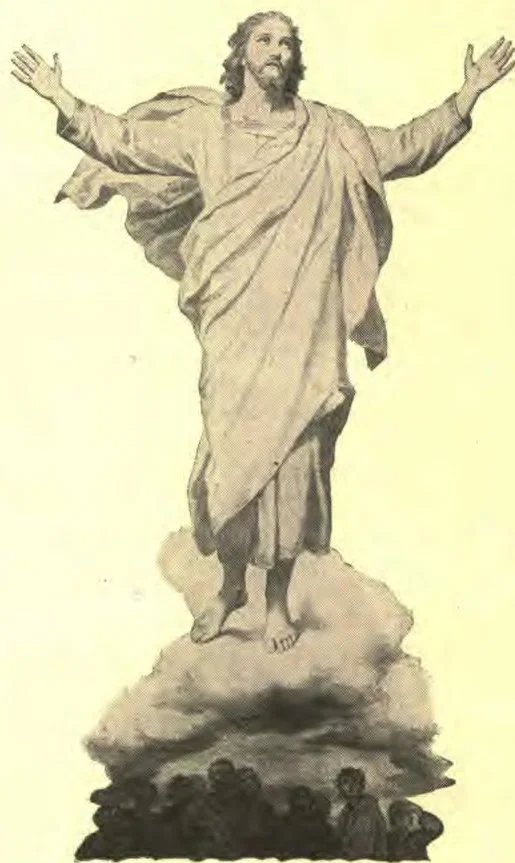
Hofmann. The Ascension.
His Work and Cause.
IN the language of Doddridge, “let us with the apostles look up after an ascending Saviour, and send our wishes and our souls to heaven where He now is, and where He must remain till that important day in which He shall descend to the final judgment. In the meantime, may His cause and service be ever dear to us! And while He is attending to our concerns in the world above, may we, with grateful and joyful alacrity, pursue that which He graciously condescends to own as His interest here upon earth.”—Henry J. Ripley, Notes on Acts 1:11.
The Coming Judge.
THE person by whom God will judge the world, is Jesus Christ, God-man. The second person in the Trinity, that same person of whom we read in our Bibles, who was born of the Virgin Mary, lived in Galilee and Judea, and was at last crucified without the gates of Jerusalem, will come to judge the world both in His divine and human nature, in the same human body that was crucified, and rose again, and ascended up into heaven. Acts 1: 11: "This same Jesus which is taken up from you into heaven, shall so come in like manner as ye have seen Him go into heaven."—Jonathan Edwards.
Temperance in All Things
By Mrs. E. G. White.
In order to preserve health, temperance in all things is necessary—temperance in labor, temperance in eating and drinking.
—Mrs. E. G. White.
For Winter Evenings
The Twentieth Century or the Fourteenth?
By Editor
THE Springfield Republican of September 9 has the following:
"What is this the Roman pontiff commands in regard to ‘modernism’ in the holy church? One reads:
"‘Modernists are to be removed from professorships and the direction of educational institutions.
"‘The clergy and faithful are not to be allowed to read modernist publications.
“‘A committee of censorship is to be established in every diocese to pass upon the publications which the clergy and faithful shall be permitted to read.’
“‘Is this the 20th century or the 14th? It is a pity that the good Pius X should associate his name with such a policy and attempt to crush out the really vivifying thought and forces which ‘modernism’ in the church represents.’”
But that is the only consistent course the pope could take.