CALIFORNIA enjoys the distinction of being the only state in the union without a Sunday law. Repeated efforts to secure the enactment of restrictive legislation have failed, owing to the liberal sentiments of the foremost legislators and the unceasing watchfulness of some devoted Christians whose logical remonstrance thus far has proved an effective bar to such enactment.
Foiled as often as they have appeared at the State capitol, the Sunday agitators have been obliged to content themselves with local issues upon which they have been concentrating their energies of late. Los Angeles, having now a population of 300,000, has been the scene of the most recent crusade.
Court-House, Los Angeles, Cal.
Rev. W. F. Ireland, a cousin of Archbishop Ireland of the Catholic Church, tho himself a minister of the Baptist denomination, has been taking the lead in this movement. In early life Mr. Ireland was an actor. Without going to the theatrical people in this city to ascertain their views regarding the proposed crusade to be undertaken ostensibly in their interest, he seized upon the pretext that they would be benefited by a day of rest, to press the Sunday issue to the attention of the city council. This championship of their cause and its palpable insincerity was resented by the theatrical people, who were not long in finding out that petitions demanding the desired legislation had been distributed by Mr. Ireland at a meeting of the ministers of the city, the associated clergy assuming the sponsorship for his act.
They secured the cooperation of one of the daily newspapers and proceeded to canvass the churches for signatures, heralding from day to day their success, and it was reported that "thousands" were signing the petitions. Published interviews from leading citizens disclosed a lamentable ignorance of the principles of religious liberty and the silence of the five other daily newspapers regarding the Sunday-closing proposition afforded no defense.
The time was opportune for presenting the truth. Communications were addressed to the various newspapers, outlining the fact that the campaign in the assumed behalf of the actors and employees of theaters and playhouses was a poorly masked effort to commit the city council to religious legislation that might be made more drastic after a precedent had been established. Several of these letters were published by the other papers and elicited hearty personal responses from those not of the same faith, but whose appreciation of religious liberty was sincere.
A counter petition was filed with the council even before the much-vaunted demand for legislation reached that body. The theatrical people supplemented this with petitions from actors, stage hands, bill-posters, musicians, and from about a dozen trade unions, such as the teamster's union, the shirt-waist workers, the painters, the plumbers, and various other gilds, who vehemently demanded that the council should not attempt to dictate what day, if any, should be observed by them as a day of rest, and attorneys were employed by the theatrical managers' union to plead their cause if matters should come to a pass where such defense should be required. Literature covering the principal issues from a religious standpoint was placed in the hands of every councilman, the mayor, the city attorney, and the newspaper reporters being supplied, as well as the editors of the newspapers, with material facts regarding Sunday legislation elsewhere and the Scriptural and constitutional objections to interference with matters of religion by the civil power.
The commercial bodies were on the alert, and the secretary of one of the most influen11tial of those organizations stated that should there be any likelihood of the enactment of such legislation the matter would be taken up vigorously by the merchants and manufacturers who would not tolerate any such dictation on the part of any body of religionists. Back of the outward seeming indifference there was a strong determination to protect the personal, civil, and religious liberty of every citizen in Los Angeles without respect to the dogmas of any sect or the clamor of any people however respectable or influential in the community.
In response to a letter sent to him, Mr. Ireland replied: "I want it distinctly understood that we are not making a religious issue of this matter. We are circulating the petition entirely on moral grounds, for it is undeniable that mankind requires one day of rest in seven, and we are determined that he shall have it."
A Political Guillotine.
In the course of the conversation it developed that he had been advised to leave the matter to the Federation of Churches, now organized in Los Angeles, but he declared he would not consider that plan, "for," said he, "the Federation is controlled by four or five persons who are running it for their own personal advancement. I am going back to Washington to confer with Rev. W. F. Crafts. We purpose to organize a Sunday-Rest League and to erect a guillotine in the United States in view of which every politician will recognize the fact that he is destined to political beheadal if he does not give to us the legislation we demand for the protection of the moral welfare of the people."
Incidentally, he said the petition asking for the adoption of a Sunday-rest ordinance in Los Angeles would be presented to the council Monday afternoon, October 7, and in accordance with such plan he presented himself with about twenty or twenty-five clergymen and others at the afternoon session of the council on that day. But it was noticeable that not one of the prominent ministers of the city was in the company. They had nothing to gain and much to lose.
Mr. Ireland contented himself merely with reading the petition and making an appeal for legislation that would enable the actors and others employed at the theaters and playhouses to have a day of rest in each week. Mr. McVey, the secretary of the Y. M. C. A., read certain resolutions that had been adopted by that body. Prof. E. S. Ballenger made a short but effective address in the interest of religious liberty. "This petition reminds me of the action taken many years ago in Rome," said Mr. Ballenger. "There the theaters were the first to feel the demand for religious legislation, and a law was passed closing them on Sunday, but then the people would not go to church and more stringent legislation followed, leading up, as you well know, to the centuries of persecution of the Dark Ages and to the horrors of the great Inquisition. I would favor any plan that promised to benefit mankind, for I am interested in the advancement of religious work and I am interested in young men, but I am opposed to the restriction of religious liberty by the civil power, and I trust your honorable body will take no action in the interest of any religious institution." Attention had been directed to the fact that six or seven thousand Jews reside in Los Angeles, as well as about six hundred Seventh-day Adventists, all of whom denied the sanctity of the first day of the week.
Repeated efforts were made by the solitary councilman known to be favorable to Sunday closing to induce some of the other ministers to speak to the issue, but not one responded. Some of the councilmen began to oppose the desired legislation, and the theatrical representatives came in while the debate was at its height to add their protest. They repudiated the movement as not of their seeking, and they expressed resentment that any one should have presumed to ask legislation in their assumed behalf without having shown them even the courtesy to inform them of the intended championship. As for being overworked, they declared that Sunday would be devoted to rehearsals if the theaters were to be closed by city ordinance, and the actors and others employed at the playhouses would find that legislation secured in their alleged interest actually would be an injury to them by compelling them to perform more labor than if left to meet their accustomed engagements. Then, too, they said, the stock companies, which alone would be specially affected by the proposed enactment, were not overworked at the present time, instances being of frequent occurrence in which actors were left off the bills for weeks at a time, and held only subject to call should their services be required at any time, they receiving their salaries right along, just the same as when appearing on the stage in parts assigned to them. The protection sought by the clergy in their behalf they did not want, but rather they esteemed their professed solicitude as an impertinence.
The owners, managers, actors, and friends of theaters, all were heard in opposition to the petition, and finally the attorney for the theatrical managers' union appeared and made a forcible plea for freedom to perform on Sunday acts that were regarded as legitimate on the other days of the week, and one of the councilmen clinched the argument by declaring if the theaters were guilty of presenting attractions that were injurious to public morals on Sunday, the same attractions could not be otherwise than injurious to public morals on days other than Sunday, and the playhouses tolerating them ought to be closed every day in the week as a measure of public safety. But he evinced a dislike to have nine men—the number composing the city council—decide a matter affecting the interests of the entire community, and he suggested that the demand for Sunday-closing of the theaters be submitted to a vote of the people at the next general election. Subsequently it was explained that this was a device to prevent the Sunday advocates from resorting to the initiative, and by the filing of subsequent petitions forcing the calling of a special election to determine the issue.
While the issue would be deferred in the manner indicated, the constitutional objection to submitting to popular decision an issue that clearly could not be determined even by Congress, the highest lawmaking body in the land, was pressed to the notice of the council. Assurances were given by the president of the council, however, that the matter would not be made the subject of determination by popular vote if it should appear that the constitution prohibits the passage of an ordinance regulating the time that the theaters may be open, and with this assurance the council voted to defer the question to the next general election, which is due to be held in December, 1909, more than two years hence, thus affording the petitioners opportunity to withdraw with less embarrassment than if denied outright. It is not expected that the matter will be presented for a vote of the people, but the opportunity afforded for educating the public in principles of religious liberty will not be disregarded. Should the vote be taken, it is evident that the proposition would be defeated by a large majority.
JOHN F. BLUNT.
Sunday-Law Agitation
FROM various parts of the United States comes news of agitation for Sunday laws—state, district, and municipal. The article in this department concerning the recent attempt in Los Angeles is typical of many others.
Mr. K. C. Russell, at the head of the Religious Liberty Bureau of Washington, D. C., has been waging a vigorous warfare in Kansas City, Mo., against Sunday laws, and the reports of his lectures on the subject, printed in the Kansas City papers, show clearly that he has conducted a logical, consistent, straightforward, manly warfare against all union of church and state in whatever form manifest. Mr. Russell opposed Sunday laws on the broad ground of American liberty and the still broader one of Christianity. A masterly address was presented to Judge Wallace, reported in the Kansas City "Post" of October 10, and three lectures were given by Mr. Russell in the New Casino in which the question was thoroly discussed before large audiences.
In Oregon the question is agitated by the National Reformers in favor of a Sunday law.
The same is true in Wisconsin, and the latest is from New Jersey. In Tennessee men are going to jail for quietly working and resting on the same days that Jesus did.
These agitations are world-wide. What do they mean?
1. They mean the fulfilment of prophecy. The Sabbath agitation can not be stopped by public opinion, by legislation, by court decisions. All the present proponents and opponents of all sides of the question might be silenced or die to-morrow; but the agitation would not cease. Why?—Because it is of God. For centuries—since the early apostasy in the Christian church—God's law has been trampled underfoot, and His Sabbath—the sign of His creative, regenerating, sanctifying power in Christ—has been hidden from men. It is the "fulness of time" for it to be restored; hence the world-wide agitation.
2. It is God's desire that men should decide for Him, and so turn from age-long tradition, hoary error, or modern hypothesis. Yet many are turning from the law of God and the example of Christ Jesus to the human substitute, the Sunday, which has no authority or support from God's word. Listen to His call, applicable to all times and ages when moral questions are in the balance and human character and destiny are at stake (Jer. 6:16-19):
"Thus saith the Lord, Stand ye in the ways, and see, and ask for the old paths, where is the good way, and walk therein, and ye shall find rest for your souls. But they said, We will not walk therein. Also I set watchmen over you, saying, Harken to the sound of the trumpet. But they said, We will not harken.
"Therefore hear, ye nations, and know, O congregation, what is among them. Hear, O earth: behold, I will bring evil upon this people, even the fruit of their thoughts, because they have not harkened unto My words, nor to My law, but rejected it."
Note first that it is the duty of man to put himself in the way of ascertaining the truth. He should seek it not in human theories or expedients, but in the ways of God. (2) He should ask for "the old paths," in which "the good way" is found. In the Sabbath agitation such an inquiry would inevitably lead to the paths of God's commandments and the example of Jesus Christ confirming the seventh-day Sabbath. In that way is rest—rest in God, true Sabbath rest in His creative, redeeming power and love. (3) As ever, many refuse so to do; they declare, We will not walk in "the good way" of "the old paths." (4) Then God sends His prophetic warnings, declares His time has come for reform, and portrays the sure result of rejection. But they will not hear. (5) Then God declares the result and reveals the core of every decision: evil will come upon them, because they have rejected HIS LAW.
It is plainly writ in God's law that "the seventh day is the Sabbath of the Lord thy God." We can not change it. No man or men can change it. No loyal citizen of Heaven will desire to change that which is good and only good. Neither God nor His government needs adjusting. Our hearts and lives need to be adjusted to His law.
3. The great sad feature of this whole Sabbath agitation is that men want their own way, not God's. They will take the time-honored counterfeit instead of the vital, God-honored Sabbath. They will clothe that counterfeit with the sanctions of human law, because they have no divine law. They will thus reject the day set apart by God, honored of God, observed by our Example and Saviour, and eternally established in His immutable law.
This is a time of decision. Will you decide for men or for God? "All flesh is grass; . . . the word of our God shall stand forever."
Jackson County Court-House, Kansas City, Mo.
The Latest War Instrument.
A GOOD deal of space is being given just now in the newspapers to reports of the successes of modern balloons, equipped with power so that they can navigate the air. These "airships" can be guided about in the heavens over our heads very much the same as a ship at sea. Their use in a commercial way has not received very much consideration. The principal thought seems to center in the use they can be in case of war. One of these balloons was recently sailed about over the harbors of New York and a lieutenant from the navy, who was one of the company, was so deeply impressed by what could be done to destroy forts by dropping dynamite into them that he will make a report suggesting that all possible speed be exercised in equipping the fighting force with a squadron of war-balloons.
It has been but a few years since experiments began to be successful in the development of the submarine torpedo boat. But now every navy in the world is being equipped with this late form of fighting-craft. And to the destructive war-ship that can be used under water to destroy the unsuspecting enemy is now added the ship that navigates the air, loaded with the terrible explosives that have been developed in this generation.
The eagerness with which every new invention and discovery is scrutinized to see if it can be made useful in war shows that there is a strong spirit working to fill the minds of men with the emotions that drive them to the strifes of the battlefield. The agitations of all who are lovers of peace are doing something to hold this spirit in check. God's word also tells us that He has commissioned His angels to hold the winds of strife and war until He has finished His work of sending the Gospel of His kingdom to "the whole world for a testimony unto all the nations." And when that work is finished, peace-loving men and women and the angels that cooperate with them will cease their humane efforts, and Armageddon's "war of the great day of God, the Almighty," that war so clearly announced in prophecy, will quickly follow. And then comes the glorious consummation, the second coming of Christ in all His glory and the glory of His Father and the angels.
That soul-inspiring and soul-rejoicing day is right at hand! And how is all the sadness and gloom of this time dispelled by the hopes that it awakens in the breast of every one who is preparing to meet his Lord in peace!
Methodist Episcopal Church Annual Increase
The Methodist Episcopal Church reports its annual increase for 1906 at 42,747, and the present membership at 3,277,271. A considerable part of this increase was in foreign fields, especially in Korea.
A Plea for the Inca Indians of Peru
By Ed. F. Forga
THE condition of the Inca Indians of Peru is worse than that of the Negroes in the South and is comparable only to that of the Kongo natives.
The Inca Indians are descended from the inhabitants of the great Inca empire which the Spaniards found when they discovered Peru in the sixteenth century. They numbered at that time twenty million, settled over the territory now occupied by the republics of Peru, Bolivia, Ecuador, Colombia, Chile, and Argentina. The Incas, with the Aztecs of Mexico, were the most civilized people of America at the time Columbus discovered the continent, and they realized such a degree of civilization as to be a wonder to students of archeology and the history of past civilizations.
With the Spanish conquest came the downfall of the Incas. The Roman Church combined with the government of the new colonies to compel the people to accept the Roman Catholic faith. Since then the Indians, under the system of forced labor in the mines, etc., have been the objects of most unjust treatment.
Markham, in his "History of Peru," says:
"Within two hundred years, nine-tenths of the Indians were destroyed, and the survivors were ground down by pitiless slavery and oppression, which became unendurable.
"Many districts which originally contained one thousand adult male Indians and yielded 8,000 dollars of tribute, were reduced to a hundred within a century; YET THE ORIGINAL TRIBUTE WAS DEMANDED FROM THE SURVIVORS, and payment being impossible, they were carried off into slavery. Vast tracts were thrown out of cultivation, and the country was rapidly depopulated."
The result of this system of rapacity and oppression was that of the ten million Indians of Peru in 1580, only one and one-fourth million survived in 1795. Since the political Spanish yoke was broken in 1821, the condition of the Indian has somewhat improved, but not to any great extent, as a much worse form of tyranny—the Roman slavery—has not been banished from the country.
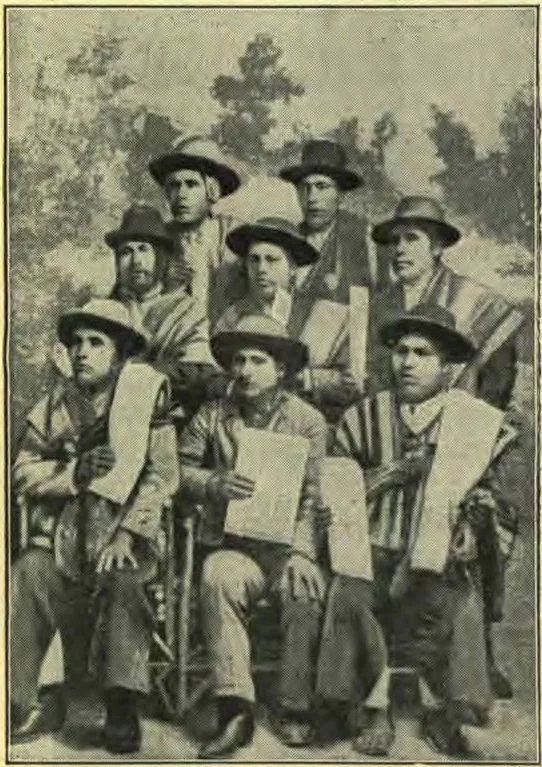
An Indian Deputation to Lima.
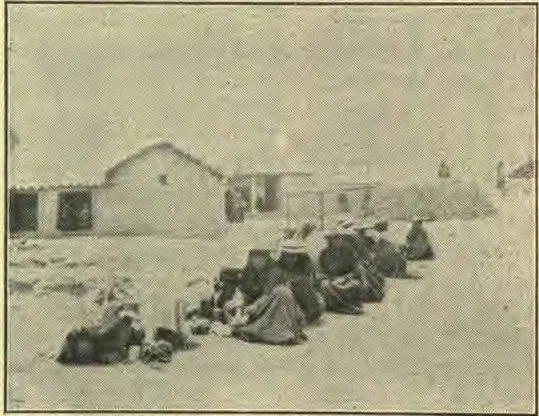
An Indian Village in the Sierra.
But how sad is their present condition! To the descendents of his conquerors, the Indian is in most cases but a beast of burden. These people, after four hundred years of Spanish tyranny and Romish rule, are for the most part "servile, filthy, and drunken, the victims of every vice," says Mr. D. F. Watkins, who has spent the greater part of thirty-six years in missionary labors in behalf of the Indians of Mexico, and who has recently traveled among the Indians of Peru.
As soon as the Indian is born, he becomes the prey of both priests and local authorities. When he is twelve months old, his parents must pay $8.50, and the same amount again when he is three and seven years old. In addition, baptism and other ceremonies cost a considerable amount, and if these taxes are not promptly paid, the priest will take the Indian's property by force, and sometimes imprison him.
An Inca Family Group.
An Inca Indian.
When the Indian, like other men, falls in love with one whom he hopes to make his wife, both he and his intended must serve the governor gratuitously for one month, and the second month they must serve the priest under the same condition. If any utensils are broken, the woman has to pay more than three times their value. If neither she nor her future husband has sufficient means to do this, the man is put in prison until he can pay. Meanwhile his fiancée is subjected to all kinds of ill treatment. For the marriage ceremony the priest sometimes demands as much as $40.00 or $50.00.
Religious feasts, or rather bacchanalian revelries, where vice is rampant, are greatly encouraged by the priests. These feasts, according to the confession of some of the best priests of Peru, the tales of foreign travelers, and from what we have personally seen, are hotbeds of fetishism and gross idolatry.
When one is held in a village or town, a certain Indian is made responsible for the expenses,—perhaps three hundred soles
(about $150),—while a dozen others have to pay ten or twelve soles (about $5.00 or $6.00) each for a solemn mass. Many Indians are compelled to sell and spend all they have, leaving themselves without a cent; but they are proud to have been at the head of their religious feast. If they can not pay, their property is sold; and if they possess nothing, they are imprisoned.
It is a common saying among the Indians that they work both day and night and forever remain poor. No wonder, since the priests and the governors regard the Indians' produce as their greatest source of wealth.
The encouragement they receive to indulge in drunkenness is fearful. Vendors of liquor carry the poisonous stuff all over the country, and it is their practise to leave a certain quantity near the door of the Indian, generally against his will, and a few months later return with authority to collect by force goods equal to three times its value. If need be, everything that he has is sold without his consent, to pay the unjust debt. In this way many an Indian has lost all his property. If he takes his case into court,
nothing is done for him, on account of the influence of the governors, priests, and rich merchants, and the injustice of the judges.
The priests and the local authorities employ an Indian to collect the debts of his fellow Indians, and in case the real debtor fails to pay, the collector himself must do so. Of course many of these things are quite contrary to the laws of the land, but there is no redress. The judicial treatment of
the Indian is cruel and unjust beyond description.
13The life of the Indian is of little value. He has been known to be shot down for his debts; but even when he dies, his widow is frequently the victim of the priests' rapacity. She must pay about $60.00 for his interment in consecrated ground; and to secure this money she is often shamefully abused, beaten, and insulted in her own house, or put into prison. Finally, if nothing else can be done, the children are disposed of by the priest, that he may make sure of his money.
Again and again deputations of Indians have gone to Lima, the capital of Peru, to ask help from the central government. Recently the government appointed a dispassionate lawyer as delegate to investigate conditions among the Indians and make an independent report. The report confirms absolutely the statements of the Indian deputation, but only part of it was published, probably because it contained accounts of such terrible procedure perpetrated by the priests, etc., that it could not be brought to light. All these things happen in spite of the good laws of the country, which are written, but remain a dead letter.
The efforts of the central government to help the Indians are unsuccessful because it has no power to reach the innermost lives and consciences of individuals. The Roman Catholic Church, which is the church of the state, has power over them and controls them, even as she controlled souls in the past. But, thank the Lord, the power of that church is becoming weakened. We have in Peru now a strong anti-Catholic feeling, and the hope of that country, as well as of the Indian, lies in the growing influence of true Christianity.
With the object of bringing the Gospel of Christ to the Indians, an Inca Evangelical Society was formed in Arequipa, in connection with the Evangelical Independent Church there. In order to secure means, that society appointed Mr. D. F. Watkins delegate to foreign countries, and there was given him the following petition signed by more than seven hundred and sixty gentlemen from many cities and towns of Peru, some being lawyers and doctors and men in prominent positions, and others plain working men:
Considering:
"1. That it is a fact that the Peruvian Indians are in a most lamentable condition from the intellectual, moral, and social standpoint;
"2. That it is a sacred duty of patriotism and humanity to save the Indians from so abject and sad a state;
"3. That Romanism, after four centuries of labor, has proved its impotence to elevate the Peruvian Indians;
"4. That the means employed by the government up to the present time, with the object of civilizing the two millions of Indians in Peru, have resulted in barrenness;
"5. That the propagation of the Gospel among them, together with the benefits of general instruction necessary to render their lives happy, is the best means within human reach tending toward their emancipation;
"6. That in order to give so great an undertaking its needed impulse, it becomes necessary to make an appeal to the great philanthropists of evangelical lands;
"Agreed,
"To appoint Mr. David Watkins, an honorable apostle of the Gospel, as representative of the Arequipa branch of the Inca Evangelical Society in foreign countries, principally in the United States and in England, especially in London; authorizing him to raise financial
assistance and solicit moral support wherever he may think it most convenient, to the end of carrying to the Quechua Indians the Gospel in its simplicity, and employing teachers and schoolmasters who will take the initiative in a new era of civilization about to dawn among the unhappy descendants of this historic empire.
"EDUARDO F. FORGA, President,
"EUSEBIO S. CABELLO, Secretary.
"Arequipa, Peru, July 25, 1905."
In March, 1906, as president of that society, I went with Mr. Watkins to London. There Dr. H. Grattan Guinness, acting director of the Regions Beyond Missionary Union, profoundly interested in what he called "a Macedonian cry," took the matter in hand, and published articles and pamphlets, circulated by the hundreds of thousands, spoke publicly in England, Canada, and the United States, and succeeded in raising approximately ten thousand dollars, with the purpose of buying a large farm, which would serve as a center of protection and Christian education for the Indians. Lately he went to Peru with his daughter, Mr. Watkins, and a special worker to carry out this plan.
Regarding myself: A few months after my arrival in London, I was providentially led to the British Union camp-meeting of the Seventh-day Adventists, where I accepted the truth. From that time I could no longer work with other Protestant denominations.
Now I understand that the many marvelous ways which the Lord has opened during these last few years to strengthen the spirit of reform and to carry the light of reform, are providential openings that the people of God may soon powerfully carry the last great message for the nations to that downtrodden people.
Perhaps no other people in the world so enslaved in the awful darkness of Roman Catholicism are in their despair more earnestly looking and longing for the coming of a Redeemer. How much would they appreciate the message of the third angel!
In the name of my country, and in the name of six million unhappy Quechua Indians who live scattered along the Andes chain of South America, I make an appeal that they be helped, and that most speedily.
ED. F. FORGA.
Our Work and Workers.
BROTHER H. A. AUFDERHAR baptized five young people, three of them German, at Niwot, Colo., recently.
THERE are twenty-one Seventh-day Adventist churches in Greater New York. Five have been added the last year.
AT Florence, Colo., a church has been organized with twelve members, five of whom were baptized by Brother M. Mackintosh.
FOUR obeying, and twenty-five or thirty deeply interested, is the word from Brethren V. L. Piepmeier and H. C. Tarr, at Belle, Mo.
FORTY-THREE new recruits in West Philadelphia is the report that Brother O. O. Bernstein gives in an October number of the Atlantic Union Gleaner.
WITH a new church building and a newly-organized church of twenty-eight members, the brethren in Snohomish, Wash., are full of courage in the truth. Brother William Boynton reports their progress.