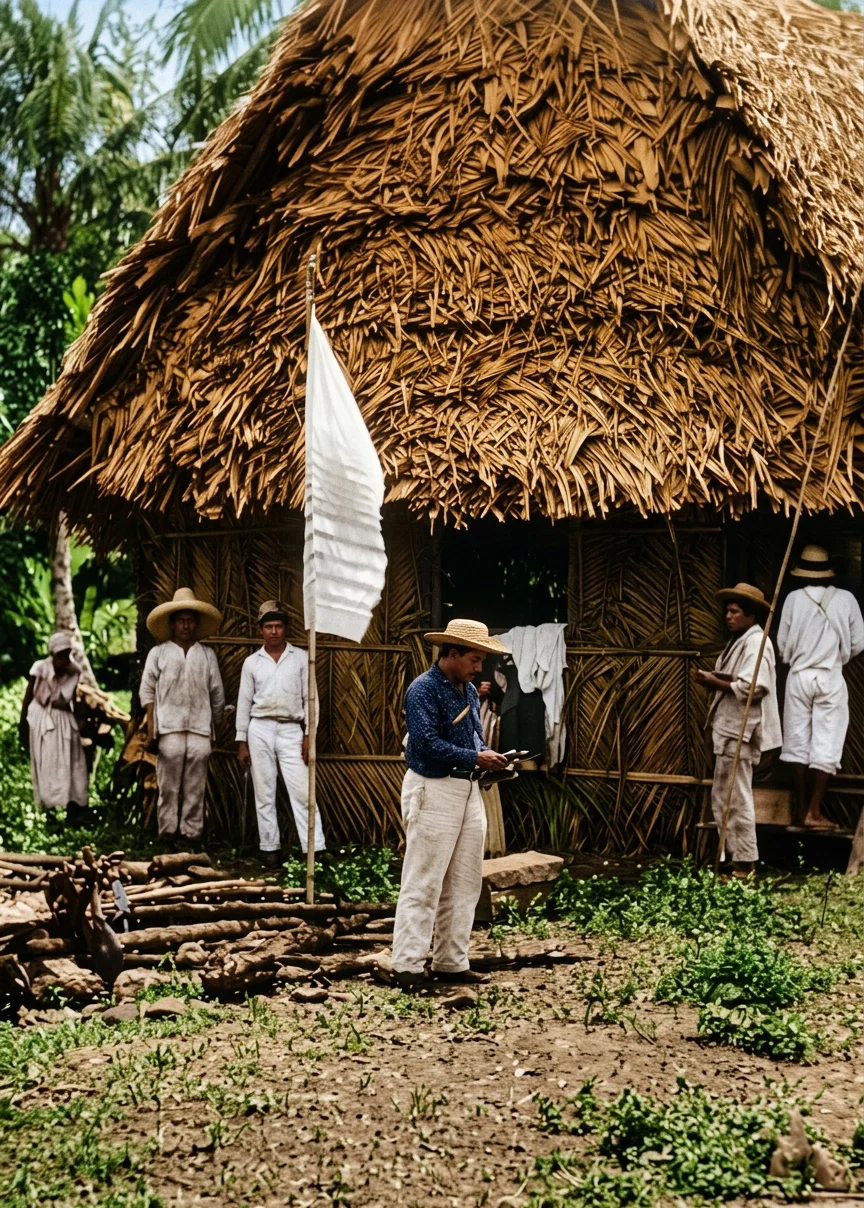
Just about a year ago Elder Conradi was returning from his missionary tour to German East Africa. Since that time we have now and then sent in short reports of the work there, but we have just received quite interesting letters from our laborers, and perhaps it would be of general interest to read what they say. Brother J. Ehlers writes as follows:—
“The buildings in Friedensthal and Kihuiro are steadily progressing. The fever has hindered our work very much. From the middle of October to the beginning of this year, the rain poured down in great torrents day and night without intermission. This caused three mountain torrents to come rushing down the hillsides into the valley, and within a few hours the valley presented the appearance of a small inland sea. The greater part of the water spread out, and disappeared from our valley, but in the lowlands farther down, the water remained for a long time, furnishing a splendid breeding-ground for the fatal malaria germs. We could not get rid of the water around our place, because there was no one who could and who was willing to ditch the land. The Wapare had nothing to eat, and one can do his utmost to teach them that by earning pennies they may purchase bread to stay their hunger; it is to no purpose, for they would rather lay themselves comfortably before their firesides, and sleep themselves into the land beyond the grave, where they think there is neither hungering nor thirsting, and where no one will have to work. Cases of this sort are not frequent, but they have been met with here. Since our new corn and potatoes have appeared, we have more laborers offering themselves than we know how to use. As many as one hundred and twenty have come in a day. So I am doing my best now to get these ditches made to lead off this standing water.
“Our fields of corn were threatened with the water, and much more by the grasshoppers. For three days at a stretch I tried to save whatever could be saved, the boys taking hold to help me in this effort. As a result of this extraordinary exertion, I was again taken ill with black water fever, and had to keep my bed for fourteen days, for the third time. I have lost much blood in this sickness, and am very weak, but I am glad to say that notwithstanding this, I have been able to work some during the past fourteen days. The workmen were there, and I took the mule and rode where I had usually gone by foot, through the swamp, and out of the valley, as far as our second station at Kihuiro. We have made a good road from our chief station (Friedensthal) around the stable to the garden and orchard, and have so arranged that our land can be watered from three sides. About thirty banana plants have begun to bear. We have written to other places, and expect to have about two hundred more plants to set out shortly. Otherwise, our fruit is all set out; none, however, but the bananas is yet bearing.
“With reference to our missionary work here, I have become more confident. We have here quite a number of nominal Christians. But I believe the Spirit of God is quietly working, unknown to them, upon their hearts. There is a sensible, modest man, with good manners, eager to learn, and very diligent. He always says, when we request them to pray at home, ‘I pray to God every day.’ His prayer is childlike. He says: ‘Lord God, my Father, give me food to-day. Give me a new heart. Give me good thoughts and eternal life. I love you, and give you all my heart.’ This is very sincere, and gives us a good example of the childlike faith we ought to manifest in prayer to our Heavenly Father. There are also one or two of the boys who do not seem to be indifferent toward God and his word. Not long ago I held worship with them, and read the parable of the lost son in the Ri-Chambaa language, and explained it to them in the Ki-Pare language, and asked whether the son was good. ‘No,’ they said. ‘Is the father good?’ ‘Yes, beyond all measure.’ ‘Do you know who the bad son is?’ ‘No,’ they answered. ‘Then, do you know the good Father?’ ‘No,’ they replied. Then I told from my own experience how I also went forth with evil thoughts, and fell into hardship, and turned back to God, and was received so friendly by him. I felt the love of God, which I had undeservingly received, and was moved to speak to them from the depths of my heart, earnestly and eloquently. As I invited one of the boys to pray, he was so affected that his words came very slowly, and he prayed from a sincere heart, as I have never heard a native pray before. I will not put too much stress upon these things, but God has given me a hint that all the promises are also meant for the black people here. In all the surrounding darkness the promises of God are sure and steadfast, so that we never need become discouraged. We have often had discouraging times, but I am able to say, to the honor of God, his promises were my rock, which did not move in the midst of the most violent storm. I had nothing but his word, and I will continue to rest upon it.
“We stand on good footing with our fellow missionaries. In Wuga, where I spent about a month with Mrs. Ehlers, we were very kindly received. At this station there are about one hundred Christians, twenty-five of whom attend Sunday service. They have the same troubles with their boys that we have. They run away, and after a time return. On being questioned by the pastor whether our boys were being truly converted at heart, I could reply that our Moses and Jacob are being so transformed, but as for the others, it is more a matter of subjection to authority.
“The natives are bringing us eggs, milk, and chickens, which we always pay for. They call our little girl ‘Moana Jetu,’ which means, ‘Our Child.’ They have also made her presents of eggs.
“The natives have been compelled by the government to build villages. This will facilitate our missionary work here very much, and will also raise our station to more importance. I am informed that three of these villages are to be built in our vicinity.”
We desire to ask our friends everywhere to think of this new station in Africa, and of the three laborers who have just lately sailed to re-enforce the band of pioneers in this hard field, that God shall bless and help them in the great and important task before them.
Hamburg, Germany.
Mission Notes
The Society of Friends in Great Britain now has a larger number of missionaries in the foreign field, in proportion to the number of its members, than any other religious body in England.
The king of Siam has been led by the American missionaries to decide to abolish gambling in his domains. Gambling is a scourge of the Siamese people, and a source of revenue to the government.
The British South Africa Company, looking about for articles which will bear taxation in Barotseland, has finally decided to tax wives. Every polygamist must pay each year five dollars per head for all his wives except the first.
Rev. G. W. Rawlings, of the C. M. S., has been asked to take charge of the moral instruction in the great government Technical School in Osaka, Japan, both masters and boys welcoming his lectures, although thoroughly Christian in tone.
Malay women, says an English Bible woman, are often afraid to let their Mohammedan husbands know of the Christian instruction they receive. They hide the Malay Gospels which they buy, often behind the picture of Mecca which hangs on the wall in most Mohammedan homes.
In the C. M. S. training-school at Oyo, Southern Nigeria, is a young man from Katsina, Northern Nigeria. He came to the school after being assured that he would not be pressed to become a Christian. But after a time he voluntarily asked to be baptized. This young man's father was a Mohammedan doctor of canon law at Katsina, near the southern edge of the Sahara. The young man visited Mecca, and, like Luther at Rome, was disgusted with what he saw of the lives of the great men of his religion. Now he is studying to preach to the Hausa-speaking Mohammedans of western Africa.
Arkansas
By H. Clay Griffin
FRISCO AND WINFREY.—Since my last report I have baptized five more at Frisco, and there are several others about ready for baptism. The church and Sabbath-school are in a prosperous condition. There are twenty-three members in the church, and over forty in the Sabbath-school.
April 22 I began meetings at Winfrey, and the interest has been all that one could expect, considering the busy season of the year and the inclement weather. A few began to obey soon after the meetings were begun, and last Sabbath there were ten keeping the Sabbath, and quite a number are convinced.
H. CLAY GRIFFIN.
Colombia
By J. B. Stuyvesant
ST. ANDREWS ISLAND.—In the short seven months' work we have been permitted to do in this field, I have had more satisfaction than in all the previous six years I was endeavoring to help others see this blessed truth in the United States. It seemed as if we had to force the truth upon nearly everybody there. And while it is far from easy to reach the majority here, yet it does us much good to see and hear the joy of those who do take hold and see the light.
We were in Old Providence Island nearly four weeks, and I helped Elder Knight in the meetings, preaching every other night, and sometimes in the afternoon, which I much enjoyed. I also canvassed the island, and sold quite a number of books, though not so many as I might have sold if the people had really possessed the money to buy. We had the joy of seeing four good strong soldiers enlisted in the cause and baptized, and I have had word from them since that they are prospering, holding their regular meetings, and having a few others meet with them. I hope to be able to visit them again soon, and see some others who were almost persuaded take a stand.
FINISHING A HOUSE, COLOMBIA
It gives us great joy to have a fully organized little church of nineteen members here, besides the four over in Old Providence, who also meet with us here. It made a great commotion in the churches both here and in the other island, to have some of their old members unite with us and be rebaptized, and both preachers denounced us in their meetings as “false prophets.” But the Lord is on our side, and he is helping us. We had a good congregation again last evening, in spite of the denunciation of two weeks ago. The dear Lord has been very gracious, indeed, to us, and has given us splendid health thus far, for which we truly thank him.
As there is but little call for good carpenters here, and a surplus of poor ones, my trade has been a poor source of revenue since coming here. But there was no blacksmith on the island, and there are frequent needs for one in the repairing of the numerous small sailing vessels, etc., about here, so several who learned that I was a good all-round “tinker” and “handy man,” urged me to get a set of blacksmith's tools, and assured me I would do well at it. So I have made a start since my return from Old Providence, and you will be glad to know that the Lord is helping me in the new undertaking, giving me quite a little work already, although I have not yet built my shop or put out a sign. Many are glad that they can get plain work done without a two-hundred-mile trip to the mainland, and a long delay. We may try tanning soon, and a broom shop in the fall, if the Lord so directs and gives us a crop of corn to work up.
Soon after my arrival here, I experimented, and proved that broom-corn can be grown. And as I have recently received from the United States what is the only, and possibly the first, plow on the island, I had the pleasure of turning the first few furrows ever turned here, a few days ago, with several much-interested onlookers, in a little two-acre lot which I have rented and am clearing for a garden. Several say that if my plow is a success, they will have one also. It is a small one-horse affair, but I believe it will be a success.
Mrs. Stuyvesant is very fond of her students, and they also are of her. We are so glad and thankful for our blessed privileges and opportunities here to work for the Master. We trust that you have just had a blessed and profitable conference, and that the work may be expedited greatly in all parts of the field, as a result.
J. B. STUYVESANT.
Northern Illinois
By Wm. Covert.
We have been planning to run six tents in the Northern Illinois Conference this summer. Some of these are already in operation. One tent-meeting is to be conducted at Kewanee, another at Aledo, and four tent-meetings are to be held in the city of Chicago. One of these will be in the English language, one in the Swedish, one in the Danish, and one in the German language. Almost all our available help will be connected with these meetings. The one conducted in the English language in Chicago is the continuation of an interest14that began with the camp-meeting that was held in June. Elder Luther Warren has been in charge of this work. Already a number of persons have embraced the truth. Several are expecting baptism soon. We trust that all these interests will bear fruit, and that companies may be raised up in every place where the tents will operate this season.
Our people seem to be of good courage throughout the conference, and we trust that they will make the cause of the Lord a matter of the first consequence throughout our borders.
Wm. COVERT.
Tent Work in Wisconsin
By Wm. Covert.
A TENT-MEETING is in progress in the city of Wausau. This was planned at the camp-meeting which was held there June 9-19. We hear good news from the tent work there. Another tent-meeting is in progress in the city of Oshkosh. This is for the most part conducted in the German language. The report comes to us that the attendance is from one hundred and fifty to four hundred, and that the interest is quite good. Another tent-meeting is beginning in the city of Ashland, another at Ladysmith, and still another at Rice Lake. The whole season is now before the workers conducting these meetings. We hope that in every place there will be raised up witnesses for the truth.
Wm. Covert.
Brazil
By A. L. Gregory
TAQUARY.—Mrs. Gregory is now five days' distant from here, beginning the first all-Portuguese school we have in Brazil. I have had no word from her for more than a month. The mail service is poor. Some of my dental journals come six months late, and now for three months they have not appeared. The REVIEW comes regularly. We have a great deal of trouble in sending our native paper through the mails.
Our school here is making progress. We have it nearly all paid for, yet the greater part of the money is borrowed from our people.
We are grateful for the printing-press which has been given us, and we want to make it preach the third angel's message in Portuguese.
A. L. GREGORY.
Chile
By Frank H. Westphal
GALVARINO.— Brother Krieghoff and I are holding some meetings among Swiss Germans. There are not many Germans here, but they are well-to-do generally. It may be that we can do them good. They come to the meetings each evening. But we have been here only a short time, and can not tell whether or not they will take their stand for the truth. The Lord is giving us liberty in presenting the message.
I was thinking of going south among the Indians, to start the work there. But the brother who was to take up the school work there did not write, so I came here, for I had promised to come in March. It was well that I came. Three days after my arrival two Baptist ministers came but we had our meetings already started.
The field work is the important feature here. To push out into new territory will bring more results than to travel over the old beaten track all the time.
F. H. WESTPHAL.
Needed Improvements at Huntsville School
By GEO. I. BUTLER
as many more students in the Huntsville school than there have been in the past. She stated that at least one hundred pupils should have been accommodated last year, and that provision ought to be made for two hundred or more in the future. She said: “The facilities necessary for the success of the school must be provided. At present the facilities are very meager. A small building should be put up in which the students can be taught how to care for one another in times of sickness,” etc.
Laundry facilities are very unsatisfactory, and little provision has been made for bathing. A building combining laundry and bathing conveniences is an absolute necessity.
Repairs must be made in the old mansion, the large dwelling built many years ago. It is said that Andrew Jackson, the famous president of the United States, attended parties at this old Southern home many years ago. But such historic structures will decay. The foundation sadly needs repairs. It is already settling, and must receive attention, or it will be too late for repairs.
This main dwelling has been so crowded up to the present time that it has been impossible to make the repairs without endangering the inmates. Two dwelling-houses have been in process of erection the past few months, which would partially relieve the congested state of things in the old mansion if they were finished, but money is greatly needed to pay for a portion of the lumber used in their erection.
In view of what Sister White said, that one hundred pupils should have been in attendance last year, great efforts were made by the management to secure such an attendance. But the present facilities were taxed to the utmost to accommodate eighty persons, teachers and pupils. The premises were literally packed full. The reader can see from this how inadequate the premises must be for the future, although it was said two hundred or more should be provided for.
Then there is the orphanage for the children left motherless, fatherless, or both, by God-fearing parents, whose last words were deeply expressive of longing desires that their children should be trained up in God’s truth, rather than be turned over to worldly relatives or friends who were indifferent or opposed to the truth we all believe so important. How can we as a people be indifferent to such a matter as that, and call ourselves Seventh-day Adventists, expecting our Master’s soon return? If he should inquire of us, “What have you done to save these lambs of the flock?” should we have to say, “Nothing”?
Dear brethren and sisters, we must not be neglectful of such important matters as these. There will have to be provision made for a greater water-supply, as the Huntsville enterprise increases. Wells will have to be dug, and cisterns made, and these cost money. Last year, during a dry time, they had to drive their stock three miles for water.
Perhaps, in view of these facts, and many more that might be mentioned, the reader will not wonder that we expressed great gratitude that the General Conference Committee, with all the heavy burdens pressing upon it, had taken under consideration the needs of the
The Needs of the Huntsville (Ala.) Training-School
SINCE the close of the recent General Conference at Washington, the General Conference Committee, after carefully considering the various needs of the whole field, has published a list of recommendations, some of them for the South, among which is the following, relating to the Huntsville training-school:—
“That we encourage the friends of the Huntsville school to raise a fund of five thousand dollars for the enlargement of the buildings and the improvement of the facilities of the school.”
From our hearts we thank the committee for this recommendation. We say, from personal knowledge, that this money is greatly needed there. Improvements are certainly demanded, and must be made, or the usefulness of the school will be greatly impaired.
Last fall money and pledges for the Huntsville school were taken to the amount of about two thousand five hundred dollars. Those in charge of the school expected a large proportion of this amount would be paid within six or eight months; so buildings and other improvements were begun, but for the lack of funds the work had to stop. This has caused considerable embarrassment. But even had the amount all been received, there would still have been other changes and improvements greatly needed to equip the school as it should be equipped to do the work it ought to do.
The writer has a statement recently sent from the sub-committee at the school, entrusted with the management, from which a few extracts will be presented. In it are some of Sister White’s statements made while at Huntsville last summer, which may be of interest to the readers of the REVIEW. She said: “If true zeal and energy are manifested, this school may become a large educational institution for the colored people in the South. There should be15
this important institution, and recommended the raising of five thousand dollars for its upbuilding.
Let every Seventh-day Adventist remember that this Huntsville Training-school is the only institution in existence in this denomination for the training of ministers, teachers, Bible workers, canvassers, etc., for this race. How can we neglect such an important branch of our work? We ought to have several such schools to-day. But why talk of others when we have only fairly begun to equip one? May God move upon the heart of every faithful believer in present truth to help in this time of need.
Funds for the training-school at Huntsville should be sent to the treasurer of the Southern Union Conference, 1025 Jefferson St., Nashville, Tenn.
GEO. I. BUTLER,
President S. U. Conference.
China
By W. C. HANKINS.
CANTON.—At last we are in China. We reached Hongkong May 3, after a cold, but otherwise very good trip across the Pacific. We had only two or three days of rough weather, and suffered but little from seasickness. We went ashore at Yokohama, Kobe, and Nagasaki, and saw something of Japan and the way the Japanese live.
When people in America read of how the Japanese soldiers are whipping the Russians, they naturally think of Japan as a country fast becoming modernized. This is quite an error, however. Even in the seacoast towns, where the people have come in contact with Europeans for years, the native part of the city is as far from being modern and up to date as it was years ago. And I am told by people acquainted with the interior, that the people there are far behind the dwellers in the coast cities, in civilization.
We reached Yokohama in time to see the celebrated double cherry blossoms. They are very beautiful. The flowers in Japan are fine, and some of them very rare.
At Kobe we found time to visit the Drs. Lockwood, and spent a very agreeable evening with them. We also paid a brief visit to the Japanese sanitarium in that place, which is doing a good business now, and is the medium through which our workers at Kobe can reach many of the Japanese people with the truths of the third angel's message. There is a church there of about sixty members, I believe. The work is moving onward.
After leaving Kobe we sailed through the Inland Sea. The scenery of this sea is said to be very beautiful. We had very cool weather until within a day's journey of Hongkong, when it became very warm.
Our boat arrived at Hongkong May 3, early in the morning. We were just packing our things, getting ready to go ashore, when Brother Wilbur and his wife appeared. We were very glad to see them. We started for Canton that evening, reaching here the next morning. It is quite hot, and we feel the heat all the more severely as it was quite cold most of the time while on our way. But I think we shall soon become accustomed to it. It will take some time to become acclimated, I know, but we will be careful, and hope to be well and strong. We expect to start for Amoy in about a week. We look for Brother Keh some time this week.
We are of good courage, and hope that the Lord will help us to carry the “true doctrine,” to many souls in this benighted land. May God bless the work and workers of Washington, as well as in China, is our prayer.
W. C. HANKINS.
Forest Home (Wash.) Industrial Academy
By L. I. STILES.
THE first year’s existence of the Forest Home Industrial Academy came to a close June 16, and the closing exercises were held Sunday afternoon, June 18.
This school opened last September. It is situated in the northern part of the Western Washington Conference, about seven miles from the shores of Puget Sound, and four miles from Mt. Vernon.
The school was dedicated without any encumbrances, and it is the purpose of the management to keep clear from debt. Thirty-seven have been enrolled during the year, and the school has been a little more than self-supporting.
Eight of the students were baptized at the last quarterly meeting, and some others are expecting to go forward in this ordinance at the camp-meeting.
The school is small, but God is with us. His Spirit has been working, and we trust the results will be large.
L. I. STILES.
Kansas Sanitarium
By L. C. CHRISTOFFERSON
The starting of a progressive work, resulting in the erection and completion of the Kansas Sanitarium, which was dedicated and declared open to its many friends June 14, was made a little more than three years ago, when Mrs. Christofferson and I came to Wichita by recommendation of the Nebraska Sanitarium. We at once secured good rooms in a prominent five-story business block, and during our four months' stay in this place we were actively engaged in treating the sick in their homes, making use of health literature and health foods, by means of which we readily obtained work, and gained access to many of the influential homes of the city. About this time the chamber of commerce manifested their desire to secure a sanitarium in this place, which must be admitted to be a central location for the great Southwest. They invited Dr. J. H. Kellogg to come here, and he addressed an attentive audience in the First Presbyterian church of the city. The daily papers often presented the possibility of a health institution here, and we received many inquiries in regard to healthful living, and the nature of our work. The work steadily grew until we were employing several nurses to meet demands. During the summer of 1902 Elder C. McReynolds, president of the conference, often visited us, saw our needs, and heard the demands of citizens of Wichita for treatment rooms and a place where hygienic food might be served. At this time the Kansas Conference undertook the responsibility of promoting the work, and soon raised a few hundred dollars to equip a small place in which we might be able to meet the most urgent demands of our patrons. Our city friends added to this amount about four hundred dollars. A location was carefully sought, and one was found near the business center of the city, where a food store and health-food restaurant were operated on the first floor, and a physician's office, bath-rooms, and living-rooms were equipped on the second floor. September 16 of the same year, we served an opening dinner to a large number of the influential citizens of the city, and shortly afterward we were obliged to secure additional rooms for patients, who came from the various parts of the State. At this time we were grateful for occasional visits from Dr. W. A. George, of the Nebraska Sanitarium.
THE WICHITA (KAN.) SANITARIUM
The organization of the Kansas Medical Missionary and Benevolent Association was effected March 19, 1903, in the Seventh-day Adventist church. The Kansas Conference Committee, Drs. S. P. S. and Maria Edwards, Dr. Lydia E. Parmele, and a corps of nurses met with the company of believers here, and after careful deliberation, unanimously voted to form a corporation.
In June, 1903, we secured the valuable services of Dr. G. A. Droll. Since the fall of that year we have conducted a nurses' training-school, the present two classes numbering thirteen. We have been blessed with a good class of intelligent and devoted young people, who have taken hold of the work in a very earnest way.
The interest in health principles on the part of several prominent men of influence, who have formed an acquaintance with our health institutions, either through their friends or through relatives, or have been patrons themselves, became very enthusiastic, and they were determined that Wichita "must secure an institution which will be the means of educating the people in right lines of living, for I know," said one of them, "that this institution will not only be a blessing to the city of Wichita, but to the whole State." Thus they set to work to do something substantial in behalf of the sanitarium work, and this found expression in a meeting with the chamber of commerce the eighth of June, 1904, when they agreed to furnish ten thousand dollars to the Kansas Medical Missionary and Benevolent Association. On this same date they turned over to the Association a warranty deed for twenty acres of fine soil, lying two and one-half miles west of the heart of the city, just outside the corporation. A little later they furnished us eighteen hundred dollars in cash. The Kansas Conference by this time had ten thousand dollars in cash and good pledges, and with this, operations were actively begun.
On the twenty-ninth of August the new building was under roof, and the corner-stone was laid. Very appropriate services were participated in by prominent statesmen and citizens, as well as by executive men of the Central Union and State Conferences. As this gathering was during the State camp-meeting here, almost the entire camp of fully a thousand people was present; these, in addition to our city friends, made the attendance large. Many interesting remarks were made by the speakers, recorded in the Wichita daily papers, showing a hearty welcome and support to both our work and workers.
Mr. J. M. Knapp, chairman of the sanitarium committee of the chamber of commerce said, in part: 'Three years ago about this time I was in Manitou, Colo., and a member of my family was with me, who was in very poor health. The doctors had said that they had done all they could do, so I was looking around. I met a friend there, a physician who lived in Texas, and he said he had a friend in Boulder who had taken his wife there for her health, and he would write to him and see if she was getting any benefit. This friend of his was a judge, and in reply the doctor got a nine-page letter, because he had asked for a detailed statement of what he thought of the institution. He said that his wife was getting along splendidly at the sanitarium. I told my wife that we would pack up and go to Boulder. She was so ill that it was hard to get to Boulder, and when we got there, we had to stay in the hotel for three days, they were so full at the sanitarium. Finally we succeeded in getting a room at that institution. My wife was there about six weeks, and her health gradually returned. And that is the reason I said, "A sanitarium will be built in Wichita," and you can see a portion of the structure, for it is going up.
'There must be a reason always for a forward move, and I suppose that the great Master of the universe puts it in16the hearts of men to do some things. We gave of our means to help start a small institution on Market Street, and a United States senator, who had broken down his health in the campaign, visited that place, and regained his health. He was enthusiastic that an institution should be built here, and promised his support.
"We have already paid for these twenty acres of excellent soil, and have turned over eighteen hundred dollars in cash besides. We want $5,200 more, and we are going to get it. I learned of a gentleman who was at the Boulder Sanitarium, and went to him and asked him if he had been benefited there, and he said he had. I said, 'I want you to give me two hundred dollars.' He said, 'I will do it,' and drawing a hundred-dollar bill out of his pocket, he subscribed his name for two hundred. He did it cheerfully, because he had been going down and down, and now the bloom of health is on his cheeks.
"I stepped into the office of a lawyer a few days ago, and said, 'I have come to see you about this sanitarium;' he said, 'Don't say another word;' he then wrote a check and handed it to me, and went to his partner and spoke to him in regard to the matter, and he wrote a check for the same amount. That is the kind of reception we are receiving from our citizens whom these worthy men have shown what the institution means.
"Every morning the first thing we would hear in Boulder, when we would rise from our slumbers, would be the songs of Zion, and the prayer going up for the blessings of the day, that the sick in the rooms of the institution might be brought back to health; and the great God listened and heard those prayers, and then just before the eight o'clock breakfast, the patients would assemble, and Elder Wilcox would lead them in worship, reading a suitable portion of Scripture, and joining in prayer for their restoration to health. I say, God heard and answered their prayers. I saw people who had been carried in there on cots, go home after a brief stay, having been brought back to perfect health."
Elder C. McReynolds also briefly addressed the assembly on this occasion. Holding up a copy of the Bible, upon the principles of which he said the institution was founded, he stepped forward and deposited the same in the corner-stone, as a token of that faith, after which the stone was placed.
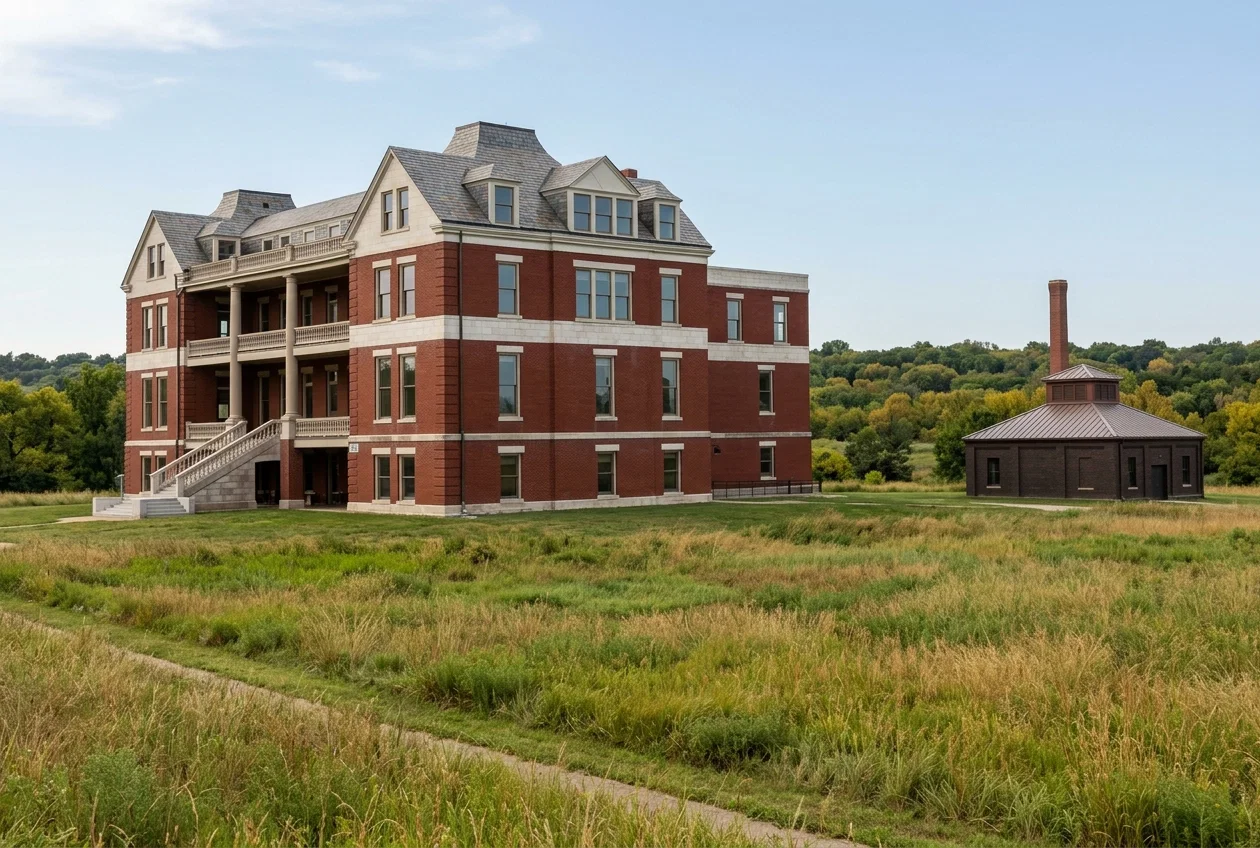
The sanitarium building is erected upon an elevation commanding a beautiful view in every direction. It is veneered with brick, fronts the east, has a capacity of about thirty-five patients. The measurements are forty-four by eighty-eight feet, four stories, and the wing to the west is thirty by thirty-two feet, three stories high. The sanitarium has its own water, heat, and electric-light plant. A lawn of four acres surrounds the building, covered by three hundred young shade-trees. The rest of the twenty acres is largely used for garden purposes. Several acres has already been set to fruit of various kinds. The ground is considered valuable. The cost of the land, and the building with its splendid equipment, is nearly thirty thousand dollars.
Several weeks ago the Board was glad to announce to friends and waiting patients that June 14 would be set apart as the formal opening of the Kansas Sanitarium. The building was crowded with a desirable class of guests, who listened attentively to a suitable program of speeches and music. Dr. David Paulson delivered the opening address, "Need of Our Sanitariums, and Work Accomplished by Them." The sentiments he expressed met a hearty response from our visitors. Following the program our visitors inspected the building and equipment, before partaking of refreshments. City friends furnished large palms for the rooms and corridors, hanging baskets for verandas, and three hundred parlor chairs, for the occasion. For months the confusion incident to our building work could not keep away a number of those about us seeking physical relief, hence we enjoyed considerable patronage before the place was ready for inspection.
During the past year Dr. B. E. Fullmer has been connected with the institution as medical superintendent. Success has attended the work from the start, the income meeting all running expenses. Some have found relief from physical maladies which to all human judgment, seemed hopeless; by careful treatment, with God's blessing, they have been restored to health. We are meeting a class of people here that we would probably never be able to meet in any other way,—doctors, lawyers, merchants, business men of all classes,—with many opportunities to teach them how to live, and especially that these truths are of heavenly origin. We realize that the Lord has worked for us, and that this building is his planting. He has sent his angels before us to prepare the way, and to speak to the hearts of the people to send help for the upbuilding of his cause, that souls may not only be healed of their physical suffering, but may be pointed to "the Lamb of God, which taketh away the sin of the world."