The Rev. J. S. Hughes, writing to the New York Voice recently, thus defines the theocracy of the future:—
“Yet the state should and will become a theocracy, but with none of the present or past ecclesiasticism in it. Doctrines, opinions, and even Christian rites, as baptism, etc., will be purely personal property, with no intervention of either ecclesiastical or secular authority of any kind; but commerce and government must and will be governed by the moral and humanitarian principles taught by Jesus Christ, and he will break in pieces the present governments as a potter’s vessel is broken, and will rule the world in righteousness.”
But this is just what political reformers have promised themselves in every age. Mr. Hughes thus speaks of the present condition of the churches, and what is expected of the Prohibition party:—
“This weak and nearly worn-out church is not as good an exponent of Christian morality as the Prohibition party. The Prohibition party to many of us, to myself certainly, had in it the promise of leading our nation into the channel where the church would find its way into a purer Christian morality. . . . My faith and interest in the usefulness of the Prohibition party have risen and fallen with that single hope that the Prohibitionist believers in Christ would stand firm, and so open a new channel where the church could find a higher expression of Christian conduct and personal liberty of conscience as to doctrines and ordinances, and so hasten the day when Christ shall rule. Christian statehood is at this hour the high-water mark of Christian reformers.”
This puts the political party above the church, the body of human policy above the ordained body of Jesus Christ! Legislation is to lead the church in the way of righteousness, and Christ is to rule through the plan proposed by men! But this is not Christ’s way as set forth in the Gospel. “There is a way that seemeth right unto a man; but the end thereof are the ways of death.” Prov. 6: 25. The way of the Gospel is not that of politics, however holy may be the party of the politics.
THE SPIRIT OF WAR.
In Joel 3: 9-12 is a prediction of the war spirit which will possess the world in the last days. Have we not its fulfilment now? Read the following excerpts from an editorial in the New York Nation of December 12:—
“We pointed out very recently that we were the only nominally Christian people, and in fact the only civilized people, that produced public men who were not ashamed to call for war as a means of educating the young or making trade brisk, or as a means of gratifying the national pride; and not for war, either, with any particular power or in any particular quarrel, but for war generally with anybody who could be fastened on as an enemy—in fact, war for fun. This shocking spectacle has been reserved for our country in the 107th year of the republic of Washington and Franklin.
“In fact, we have an increasing body of politicians among us who talk of it, and teach our children to talk of it, as if it were a game of football, with a large list of casualties; and yet when we think of the floods of misery which pour over the length and breadth of a country from even one battle field, the savage contempt for humanity with which every victor gazes on his dead and wounded, one can hardly help feeling that the prayer for the coming of God’s kingdom which rises every day from millions of lips, is the most frightful mockery of which the Christian world is guilty. Among even the most military of European states, war is treated to-day as a deplorable but inevitable mode of settling disputes. It has been reserved for American statesmen to treat it as a useful national tonic, to be sought after, and not simply accepted. The great national advantage of being out of the way of fighting and slaughter, in which the founders of the republic rejoiced, we treat as a calamity, and reach for quarrels or seeds of quarrels as eagerly as a toper seeks his bottle. . . .”
“We have made much fun of the southerners for the readiness to stab and shoot which this quickness to resent insults has produced among them. We have shown them a thousand times that readiness to take offense is the mark of either an uncivilized man or a fool; that the more eager you are to resent insults, the more insults you are sure to receive. But real Jingoes pass most of their time looking out for them and calling attention to them. In their eyes the whole world is constantly trying to insult or ‘put upon’ the United States, and it is mainly to chastise these people that they want a large navy.
“No wonder, therefore, that Chaplain Condon took it into his head to pray for an increase of the swashbuckler spirit, for Congress to be made more quarrelsome, more vindictive, more ready to make widows and orphans, to blow human bodies into small pieces, to burn towns, and lay waste farms, and ruin trade, and issue greenbacks, and cheat creditors, and turn the thoughts of young men away from industry and charity, and to fill their hearts with hatred of their fellow men and joy over their misery, and generally to roll back the tide of civilization.”
“SUCH AS I HAVE.”
By Hope Ledyard
BY HOPE LEDYARD.
WE parents often needlessly fret over our failures. If we would remember that we are only required to give what we have—that God assumes the responsibility of the withholding—our lives would be much more peaceful. This lesson was taught me afresh the other day by my own boy. I was trying to impress upon him his utter freedom from all responsibility if he would do his best. “Do what you can, then mama will do the rest,” I said, and added, half to myself, “I wish I were a child and could live that way.” “Why, aren’t you God’s child?” said my boy, quick to find comfort for his mother. God, too, only requires of his children such as they have.
But the words have a warning sound, too. Why is it that we parents and teachers fail so often? We try to teach obedience, patience, faith—and the children do not get anything from us. Let us look into our daily lives and see if we have what we are seeking to impart. A gentle, sunny spirit is caught by a child. Have you that sunny spirit? I am finding out more and more as the children grow up that they lack because of the lack in one or the other of their parents, and, though I do not think that it is well to confess this to them, I do think that almost every sin your child commits will lead you, if you examine yourself, to confession and repentance. Again and again every mother can take these words on her lips:—
For they were the failings
That I would not see
When they were my failings,
When they dwelt in me—
Little faults unheeded,
That I now despise,
For my baby took them
With my hair and eyes.
And I chide him often,
For I know I must;
Yet I do it always
Bowed down to the dust,
With a face all crimson
With a burning blush,
And an inward whisper
That I can not hush.
But then, again, do we give what we have? Impulses come to us again and again. Are we careful to obey them? What we have now may not be ours to-morrow. You heard to-day, it may be, of a friend who is in sorrow, and as your heart ached for her, your impulse was to write her a few words. But you “hate writing,” or on second thoughts were shy of intruding, or you simply “put it off,” and now, even before the day is done, your heart is no longer so keenly alive to her pain, and the note is never written. You had something to give and never gave it.
At certain seasons of the year every woman turns over her store of clothing. There are half-worn shoes and undergarments; there is a dress that Mary has outgrown, and it has lain by for two years. You shake it out. O, dear, it is all riddled by moths! And some child shivered all last winter, or endured the hardship of looking shabby, who might have had that dress. You simply did not give what you had.
O, how this one aspect of these words grows upon me as I write! We are not apt to be careless as to great deeds, but how much oftener we should turn over our possessions, actual and spiritual, and send here and there, if we truly believed what our Lord has said: “Inasmuch as ye have done it unto one of the least of these my brethren, ye have done it unto me.”—Christian Work.
Tobacco Bondage, and Freedom.
“If the Son therefore shall make you free, ye shall be free indeed.” “And the truth shall make you free.” John 8:36, 32.
But are tobacco smokers and chewers free?—Alas, there are but very few forms of bondage so galling as that of the tobacco consumer. How many of them often make the sad confession, “I would give up the habit if I could”! Is this gospel freedom? Is this liberty from enslaving habits?—Verily not. An old man, who had borne an irreproachable character up to the age of seventy-two, was lately brought before one of the tribunals of Paris for stealing a piece of lead worth eight cents. He admitted that he was wholly without means, and for the first time in his life knew not where to find a single sous; but it was not hunger that drove him to steal. After considerable questioning on the part of the judge as to what could be stronger than hunger, he confessed it was tobacco for his pipe. “Tobacco, monsieur judge!” said he, growing violent. “I have the misery to be a hopeless smoker! I smoke at waking; I smoke while eating; I can not sleep without smoking till the pipe falls from my mouth. Tobacco costs me six cents a day. When I have none, I am frantic. I can not work, nor sleep, nor eat. I go from place to place raging like a mad dog. The day I stole the lead, I had been without tobacco twelve hours. I searched the day through for an acquaintance of whom I could beg a pipeful. I could not, and resorted to crime as a less evil than I was enduring. The need was stronger than I.”
Said a young man, “I believe my pipe does me harm; I feel it is injuring me; but were I certain that it would curtail my life by fifteen years, I could not give it up.” How distressing to hear such a statement from a free-born son of Britain! “I am a slave to tobacco,” says a lawyer, “and I will give a hundred dollars to be told how to get rid of it without killing me.” “I have resolved to be free a thousand times,” says another, “but I am still a slave, a hopeless slave.” A deacon on his death-bed made the following painful statement: “I thank God that, as my last sickness has now come, I shall get rid of my hankerings for tobacco.” The Rev. George Trask writes:—
“I have known men to dream and rage about tobacco as madmen, when deprived of it. I have known men so enslaved that use it they would in parlors, in churches, in temperance meetings, in defiance of all remonstrance, in defiance of all decency. And one lodge of the Sons of Temperance(?), as I certainly know, passed a resolution that they would not lay aside their tobacco even during the hour they were convened for temperance purposes. I have known a temperance lecturer of great distinction positively refuse to lecture until he had been furnished with a pipe of tobacco to screw his nerves up to the point of eloquence. I know an excellent clergyman who assured me that he had sometimes wept like a child when putting a quid of tobacco in his mouth, under a sense of his degradation and bondage to this filthy habit. I saw a man who told me that tobacco was the dearest thing he had on earth, dearer than wife, child, church, or state.”—Rev. Albert Sims.
THE SECRET.
I once heard of a poor colored woman who earned a precarious living by daily labor, but who was a joyous, triumphant Christian. “Ah, Nancy,” said a gloomy Christian lady to her one day, who almost disapproved of her constant cheerfulness, and yet envied it, “Ah, Nancy, it is all well enough to be happy now, but I should think the thoughts of your future would sober you! Only suppose, for instance, that you should have a spell of sickness and be unable to work; or suppose your present employers should move away, and no one else should give you anything to do; or suppose?”—“Stop!” cried Nancy, “I never supposes.10De Lord is my Shepherd, and I knows I shall not want. And, honey,” she added to her gloomy friend, “it's all dem supposes as is makin' you so mis'able. You'd better give dem all up, and just trust de Lord.”
Nothing else but this seeing God in everything will make us loving and patient with those who annoy and trouble us. They will be to us then only the instruments for accomplishing his tender and wise purposes toward us, and we shall even find ourselves at last inwardly thanking them for the blessings they bring us.
Nothing else will completely put an end to all murmuring or rebellious thoughts. Christians often feel at liberty to murmur against man, when they would not dare to murmur against God. But this way of receiving things would make it impossible even to murmur. If our Father permits a trial to come, it must be because that trial is the sweetest and best thing that could happen to us, and we must accept it with thanks from his dear hand. This does not mean that we must like or enjoy the trial, but that we must like God's will in the trial, and his will is always sweet.—Selected.
SOMETIME, SOMEWHERE.
By Robert Browning
UNANSWERED yet? The prayer your lips have pleaded
In agony of heart, these many years?
Does faith begin to fail; is hope departing,
And think you all in vain those falling tears?
Say not the Father hath not heard your prayer;
You shall have your desire, sometime, somewhere.
Unanswered yet? Nay, do not say ungranted?
Perhaps your part is not yet wholly done.
The work began when first your prayer was uttered,
And God will finish what he has begun.
If you will keep the incense burning there,
His glory you shall see, sometime, somewhere.
Unanswered yet? Faith can not be unanswered;
Her feet were firmly planted on the Rock;
Amid the wildest storms she stands undaunted,
Nor quails before the loudest thunder shock.
She knows Omnipotence has heard her prayer,
And cries, “It shall be done,” sometime, somewhere.
—Robert Browning.
NO BENEFIT TO THE FARMER.
Liquor Manufacture Robs Him of His Markets Instead of Increasing Them.
“THE farmer who consults his own interests, wants no teetotalism. The manufacture of liquor is the main factor in giving him a grain market.”—Beer Organ.
The amount of corn used in the United States in the manufacture of whisky in 1889 was 15,319,862 bushels. One county in a corn state like Illinois would grow it all. The entire amount of grain used, corn, barley, rye, oats, and wheat, was 81,472,911 bushels, which, at its market value in Cincinnati at quoted prices for April 23, would amount to $35,835,592, 2½ per cent of the entire crop.
Now what is spent for beer can not be spent for anything else. It won’t buy both beer and bread. The man who takes his living from a jug has so much less to put into the necessaries of life for himself and family, and as for the comfort and luxuries of this life he knows little or nothing of them.
While the farmer gets the thirty-five millions of dollars for his farm products, he must take into calculation in balancing accounts the whole of the business transaction, which shows as follows on the summing up:
The year 1889 showed manufactured liquor from this $35,535,592 worth of grain, 91,135,550 gallons of distilled and 866,848,993 gallons of fermented product. A gallon of whisky contains about sixty-four ten-cent drinks, which amounts to $6.40. A glass of beer is about one-half pint, and retails at five cents, amounting to 80 cents per gallon. Summing up, we have $583,257,720, the retail price of the whisky product of 1889, and $695,819,194 for the beer; total, $1,597,133,914.
Here is the liquor traffic, destroying the purchasing power of the people for other products to this extent. The money would go into other channels of trade, would buy bread, boots, houses, farms—everything that would conduce to happiness and comfort for mankind. As it is, it is worse than utterly wasted. It entails an equal expenditure of money, according to estimates of statisticians, for the prosecution and care of criminals and paupers, insane and idiots; but the direct loss is thirty-seven dollars for every single dollar received by the farmer for grain sold.—Selected.
TREADING WATER.
THE easiest position that a man, a woman, or a child can assume in water is to float perpendicularly. Any person, without any previous practice, can tread water, and so keep afloat for a long time. He should keep his hands below the surface of the water, his lungs inflated, and his feet moving up and down as in walking. Let the “man overboard” throw his hands and arms out of the water, let him raise an outcry whereby all the air is expelled from his lungs, and he will sink to the bottom. The trouble is that nine persons out of ten lose their presence of mind when they are in water out of their depth for the first time. If, instead of struggling and floundering about, they would do a little walking, there would not be the slightest danger of drowning right away.
Anyone can tread water in the first attempt. No preliminary teaching is necessary. Treading water is simply walking into the water out of one’s depth, with or without the aid of one’s hands. The operation is not unlike running upstairs, and, if anything, easier. Truly, any man, any woman, any child, who can walk upstairs, can walk in the water, and, remember, on the first attempt, without any previous instruction or practice.
Hence I say that persons really ignorant of the art of swimming are perfectly safe in water out of their depth. Very often you hear people exclaim: “Ugh, if this boat were to upset, I’d drown, of course! I can’t swim, you know.”
Yes, but you can tread water. Most of us attach a strong significance to the word “swim.” Why should we mean one thing when a man swims, and another or different thing when a dog swims? The dog can not “swim” as a man swims, but any man can swim “dog fashion” instantly and for the first time. The animal has no advantage in any way in water over man, and yet the man drowns, while the animal swims. The dog, the horse, the cow, and even the cat, all take to the water, and are able to walk as they do when out of water. Throw a dog into the stream, and at once he begins to walk, just as he does when on dry land. Why should a man, woman, or child act differently under like circumstances?
It seems strange that people have to be told to do what the animals do instinctively and instantly. Men’s ignorance of so simple a thing as treading water is remarkable; it is without reason or excuse. There is a popular notion afloat that in some way the dog and the animals have an advantage over man in the water. Nothing could be further from the truth. The advantage lies with man, who is provided with a paddle-formed hand, and knows enough to float when tired—something the animal rarely or never does.
Next to treading water, floating on the back is the easiest thing to do in water. This consists in lying flat on the back, head thrown well back, the lungs inflated, the limbs extended, but flexible, the arms held close to the ears, the hands over the head. The majority of people able to sustain themselves in water prefer to float in a horizontal position rather than in a perpendicular manner. Both positions are much better, in fact much safer, than the attitude that we assume in swimming. I have found it so. One day, in a rough surf, I was nearly strangled with a sudden swallow of water; had I not been able to float, the result might have been disastrous.—Harper’s Young People.
POLYNESIA AND THOSE WESTERN ISLES.
By Elliott C. Chapman
BY ELLIOTT C. CHAPMAN.
Solomon Island Warrior with Totem.
Following the bugle call to “arise, shine; for thy light is come, and the glory of the Lord is risen upon thee,” inspiration clearly outlines the condition of mankind during the closing scenes of probation in the words, “For, behold, the darkness shall cover the earth, and gross darkness the people; but the Lord shall arise upon thee, and his glory shall be seen upon thee.” Isa. 60:1, 2. Spiritual darkness like a cloud has long enshrouded11the western islands of the Pacific, whose inhabitants have for centuries been wallowing in the mire of heathenism, without God, and without hope in the world.
Among the groups of the Pacific which are generally classified as Polynesia, considerable progress has been made within the past century by many of the natives, who, receiving help from devoted missionaries, have deserted the ranks of Satan and enlisted in the service of Christ. The Fiji, Society, Tonga, Cook, and Samoan groups are sometimes described by writers of to-day as Christian lands, and, though such a classification is far too good to be true, there is a vast difference between the civilized Polynesian and the head hunters of the Solomon Islands.
The great islands which lie to the north of Australia, and the lesser groups that are scattered throughout Melanesia, are thickly settled regions, and form one of the most stubborn haunts of heathenism upon the face of the earth. The great island of New Guinea, with its unnumbered but dense population, stretches out over 1,200 miles from east to west, and incloses within its but partially explored plains a vast number of poor heathen who are sadly in need of the Gospel. Some mission work is being conducted by the London Missionary Society and by the Wesleyan Methodists upon the southern peninsula and upon the neighboring islands, but as yet the greater part of Papua, as the island is called by the natives, is absolutely destitute of Christian missionaries, while Satan has the natives so completely enslaved that there is not a commandment in the Decalogue which they do not make bold to transgress.
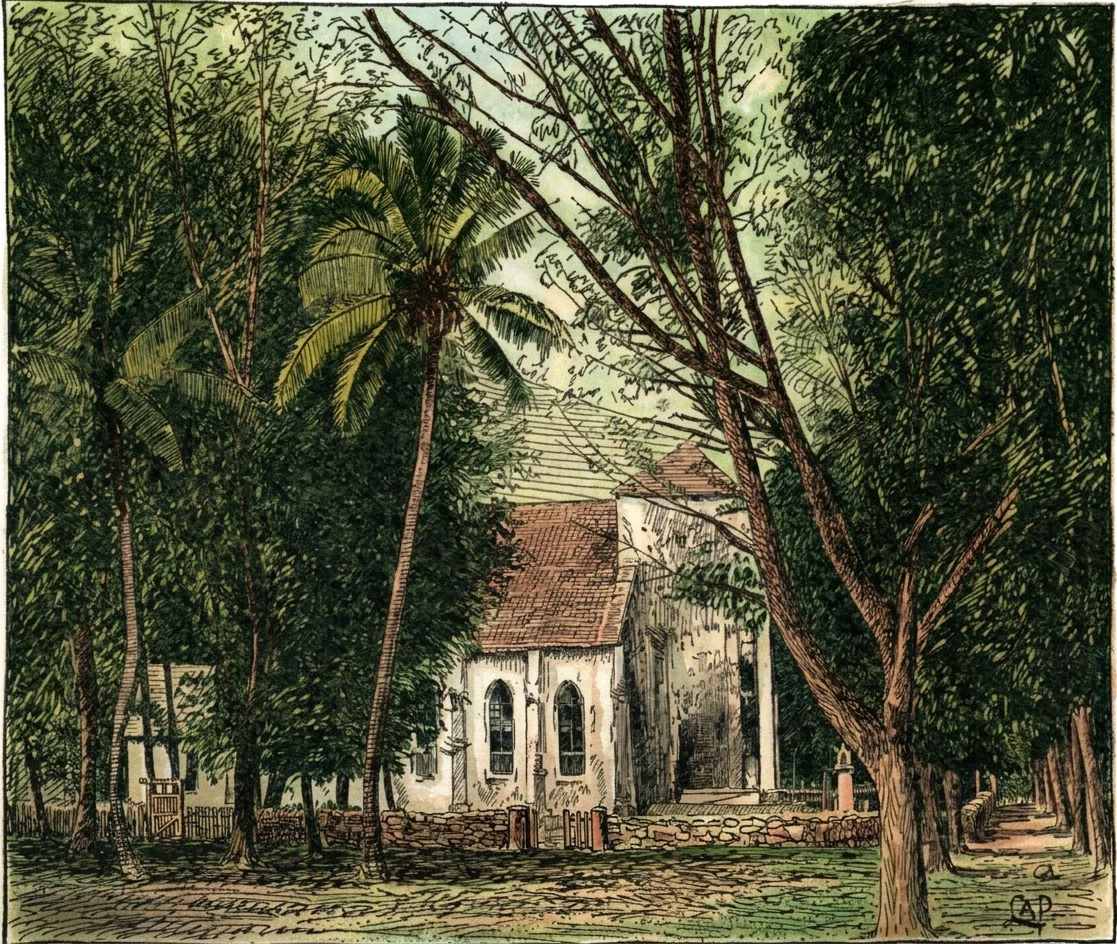
(From a forthcoming work on "Picturesque Polynesia.") The above cut is from a photograph of the church building of the London Missionary Society, on Raratonga, Cook Islands. It may be interesting to many of our readers to know that in this churchyard lie the remains of Sister Sarah Owen, who died July 9, 1895.
The Solomon Islands, which occupy a prominent position in the western Pacific, were discovered over 300 years ago by Spanish navigators, and while ten generations of their people have since successively roamed over the densely wooded isles and feasted upon their fellows, the light of Christianity has scarcely penetrated the gloom and heathenism of these lands.
In 1895 there was not a single professed Christian upon the large island of Guadalcanar, which has an estimated population of 30,000 people. Other islands of the Solomon group are in a similar condition of cannibal heathenism.
The Santa Cruz Islands, whose population is unknown, but is probably about 40,000, is a field where native degradation and Satanic rule have long been unbroken. Though, like the Solomon Islands, the group has long been known to the civilized world, the wretched people have been to a great extent left to the cruel mercies of wicked traders, brutal slavers, and destroying devils. The Melanesian Mission of the Church of England is at present operating in the group, and some precious blood of heroic missionaries has already been shed.
Time, space, and deficient information forbid mention of the thousands of destitute souls in those southern seas. Even in the Marquesas group, which is one of our nearest neighbors in the Pacific, there exists little but gross heathenism. A Catholic priest, who has long labored in the group, has written that he did not believe that there was a converted native in the Marquesas group. Surely the Spirit and the power of the Lord are needed to reach these destitute and sin-cursed natives. The solemn responsibility that rests upon the church of Christ is clearly shown by the words of Prov. 24:11, 12: “If thou forbear to deliver them that are drawn unto death, and those that are ready to be slain; if thou sayest, Behold, we knew it not; doth not he that pondereth the heart consider it? and he that keepeth thy soul, doth not he know it? and shall not he render to every man according to his works?”
CONDEMNING IN OTHERS WHAT WE OURSELVES DO.
It is so much easier to see other people's faults than our own that the habit of finding fault and picking out the faults in other people's character is soon formed, and, although very strange that it should be so, we are almost certain to overlook the fact that our weaknesses and sins are the same that we are condemning in others.
A young man said not long since: “I think that man [naming a friend of his] has a most unfortunate way of carrying his head on one side; he looks so awkward. I should think he would know it.” The speaker did not realize for a moment that he carried his head very much more awkwardly than the party to whom he referred, and in this criticism called emphatic attention to his own appearance.
We sometimes bitterly condemn practices that others have in the way of carelessness and in the way of lack of judgment, when our lives are full of careless actions, of mistakes and faults of every kind. The best way for each of us to do is to pray most earnestly and humbly for strength and direction for ourselves, and when we see in others weaknesses and sins, let us pray earnestly for them and for ourselves that there be not a beam in our own eye while we are pulling out the mote from our brother's eye.
If we can see weaknesses in others, others can see our weaknesses. If I want others to be sympathetic with my weakness, I must be the same with theirs.
“Judge not, that ye be not judged. For with what judgment ye judge, ye shall be judged; and with what measure ye mete, it shall measured to you again.”—Union Gospel News.
HE LEADETH ME.
In pastures green?—Not always; sometimes He Who knoweth best, in kindness leadeth me In weary ways where heavy shadows be,
Out of the sunshine, warm and soft and bright, Out of the sunshine into darkest night; I oft would faint with sorrow and affright, Only for this: I know he holds my hand! So, whether in green or desert land, I trust, although I may not understand.
And by still waters?—No, not always so; Oftimes the heavy tempests round me blow, And o’er my soul the waves and billows go.
But when the storm beats loudest, and I cry Aloud for help, the Master standeth by, And whispers to my soul, “Lo, it is I.” Above the tempest wild I hear him say, “Beyond this darkness lies the perfect day; In every path of thine I lead the way.”
So whether on the hill tops high and fair I dwell, or in the sunless valleys where The shadows lie—what matter? He is there. And more than this: where’er the pathway lead, He gives to me no helpless, broken reed, But his own hand, sufficient for my need.
So where he leads me I can safely go; And in the blest hereafter I shall know Why in his wisdom he hath led me so.
—Selected.
The Rights of the People
Or Civil Government and Religion
BY ALONZO T. JONES
An Up-to-Date Pamphlet on the Principles of Religious Liberty.
This book can not fail to be of great value to all in the study of the series of S. S. Lessons on Religious Liberty for the last three months of 1895. It was not written to go with these lessons, but it is fortunate and timely that it should be published at this time.
“THE RIGHTS OF THE PEOPLE” contains fifteen chapters, the following being a portion of the chapter headings:—
Christianity and the Roman Empire—What Is Due to God and What to Caesar—The Powers That Be—How the United States Became a Christian Nation—What Is the Nation?—Who Made the Nation?—Religious Right Invaded—The People’s Right of Appeal—National Precedent on Right of Appeal—Sunday-law Movement in the Fourth Century and Its Parallel in the Nineteenth—Will the People Assert and Maintain Their Rights?—Religious Rights in the States.
In the four appendixes to the book are given the Declaration of Independence—The Constitution of the United States—The Dred Scott Decision, and the “Christian Nation” Decision.
This is a book of permanent value for reference and study and one that all should possess. It contains 384 pages, with several illustrations, is issued as No. 32 of the Religious Liberty Library, and is bound in paper covers. Price 40 Cents.
A FINER EDITION on laid paper is also ready. It is neatly bound in cloth. Price One Dollar.
MR. AMENT writes from Pekin under date of May 11:—
“As to China, people may talk of great internal reform and a general renovation of the government; but there is no evidence of any change at present.
“Personally, I expect no reforms except under compulsion. Things will go on as they have in the past, and the only hope is from a development from within. No sledge-hammer blows from without will break the hold of this empire on the past; but the little plant, truth, working from within, will do this some day. There is a faithful body of people who are working and praying for this end. If there is any growth in China, I am afraid it will be more in the line of military enlargement and a desire to get even with Japan. The war has utterly failed to arouse the nation; in fact, the nation, as a nation, knows nothing about the war, and no lessons can be taught the officials before the people are instructed. The growth must be from the lower strata upwards, as it has been in all lands. Hence I look for a patient continuance in the usual lines of work, being assured that our first duty is to sow the Gospel broadcast and let the truth do its own perfect work. Our great need now is a body of trained native Christians who are alive to the situation.”
Mr. Ament speaks of the loss of several promising young men preparing for the ministry, who have from ill health or other reasons been disabled, but he adds:—
“We are encouraged at the solidity of our Christian constituency in the city. At both North and South Chapels there are men, all Manchus, who voluntarily help in the preaching work and are regular in their work. The native church, which has supported the native pastor for some years, now takes on a day school, and their contributions were never so large as at present.”—Missionary Herald.
Malay-Language Mission Seminary at Depok, Java
The late J. L. Phillips, M.D., writes to the Sunday School Times of a visit to a seminary for the Dutch and German missions of Malaysia, at Depok, south of Batavia, island of Java. Here forty bright young fellows from Borneo, Sumatra, Java, Celebes, and New Guinea are eagerly studying the Scriptures in the Malay language, under the tutorship of a German scholar and his native coadjutors. Looking into the faces of those two men from Dutch New Guinea, of those converted Bataks from Sumatra, how his heart was moved by the thought that the Gospel had brought together here in this Christian seminary the descendants of cannibals, east and west, and of savages of all this Asiatic archipelago! The Bataks on the west coast of Sumatra have furnished 100 missionaries.
Missionary College Takes Shape in New Guinea
NEW GUINEA has a missionary college well started with buildings, students, etc. W. G. Lawes writes of it: “In all the work that has been done we have had the ready help of a number of natives from the surrounding villages. Every piece of timber used in our buildings has been carried up from the coast (two miles) on men’s shoulders. We can not always get help when we want it; but the people have been very good and willing. Of course we have had to pay them for their services, but the rate of wages is not high, and,12as waistcloths and shirts are most in demand, we thus help the people in their efforts to get the externals of civilization. I ought, perhaps, to explain more fully our purpose in establishing the college. The name may appear misleading, and yet it is the best for the object we have in view—viz., to train and fit young men to be teachers of Christ to their countrymen. Before we receive a candidate, we must have evidence that he is a sincere Christian, and then he must be able to read in his own language. That is all. The minds of the most advanced are only just opening, and the time has not yet come when any, except a very select few, will acquire knowledge from books.”—Missionary Review.
AT YOUR OWN DOOR.
SOPHIA had been praying for twelve years to become a foreign missionary. One day she had so prayed, and the heavenly Father seemed to say:— “Sophia, stop; where were you born?” “In Germany, Father.” “Where are you now?” “In America, Father.” “Well, are you not a foreign missionary already?”
Then the Father said, “Who lives on the floor above you?” “A family of Swedes.” “And who above them?” “Why, some Switzers.” “Who in the rear?” “Italians.” “And a block away?” “Some Chinese.” “And you have never said a word to these people about my Son! Do you think I will send you thousands of miles to the foreigner and heathen when you never care enough about them at your own door to speak with them about their souls?”—Selected.
Methodist Mission Progress in Singapore
THE Methodists have been at work in Singapore for ten years, and are able to report substantial progress. Rev. W. F. Oldman has a school, with an average attendance of over 500. In 1880 only ten natives were connected with the mission, and these were Tamils from South India; but by the end of the next year 31 adult Chinese were members of the church, and now the number has increased to more than 200, with the addition of 80 Tamils and 30 Malays and Malay-speaking Chinese.—Missionary Review.