In all the mission fields of China a beginning has been made in the work for the women and children. But it is only a beginning! For seven years Sister B. Miller has worked for and with the women who come to the little chapels in Shanghai and its vicinity.
In cold and heat, in sickness and health, often with sorrow of heart, and always with earnest prayer, she has gone about this neglected work. Many have been led out of darkest heathenism into the gospel light through the blessing of God on her labors. A recent report from Sister Miller says:—
“Our work at Nansiang is very encouraging. We have there the poor, the blind, the maimed, as well as the educated, preparing to meet the Saviour. We have a Bible class twice a week. This class studies the prophecies, and it is wonderful how honest ones quickly get an understanding of the Word. A little crippled girl who suffers much is a bright and shining light. She can read, and explains some quite difficult passages of Scripture. These people seem to have a burden for souls. Every one works for others, teaching them of the Saviour. A woman between sixty and seventy years of age walks miles to learn of Jesus. God’s Spirit moves on the hearts of this people.”
“I will relate an instance of a woman who was an opium fiend as well as a great lover of cigarettes. Such a slave had she become to these poisons that it took one hundred cigarettes and fifty cents’ worth of opium a day to satisfy her. But God’s Spirit has touched her heart, and when last I saw her she told me that she had had the victory for over three weeks. She is ignorant, and her body is very weak. Let us pray that God may give her strength to continue the victory.”
“At Gading we have a large class of women studying the Bible and learning how to read. I find, as we go to the country, that God has many precious souls there to be gathered in for him. This is our time to work in China.”
A Woman of Rank Studying the Message
In Central China results have been seen in the work for the women. Sister Myrtie B. Cottrell says:—
“Last spring, through the influence of one of our Chinese brethren, we were brought in touch with a Chinese woman of rank. Her husband had formerly been the governmental treasurer for the province of Kan-su, but he died about twenty years ago. This T’ai T’ai (wife of an official) now lives in her old family home, with her son and his wife, here in Changsha, Hunan.”
“Although this woman seems to have plenty of money, she was prevailed upon to rent two rooms in her compound to Brother Ih, our language teacher, and it was through him that she first became interested in the gospel. She began attending our Sabbath services in the chapel very soon after, although she lives quite a distance away, and always comes in a chair or ricksha. Sister Lillie White and I were glad to take advantage of the invitation to visit her, and she returned our call a few weeks later.”
“In July, her only grandson sickened and died. This was a very severe loss to her, as the great hope of the family was bound up in him. Of course, Satan made the most of the opportunity to suggest through Hwang T’ai T’ai’s friends that this trouble had come upon her because she was giving up the worship of idols, ‘and eating the foreign doctrine;’ but we are praying for and working with her, presenting the precious promises written for those in sorrow, and we believe that she is coming through the test only the stronger for the experience.”
“Every year, when the universal custom is observed of burning paper to be offered up as money to their dead ancestors in the spirit world, it is quite a trial of faith to all the Chinese brethren and sisters not fully grounded in the gospel.”
“Last year, Hwang T’ai T’ai had to hire twenty men to carry the paper she burned outside the city, and when her husband was living, they used to spend as much as one hundred strings of cash in that way; but this year when her son came and asked her for money to buy paper for burning, she refused to give him any, telling him plainly that she is now a Christian and does not believe in it. As he is still a heathen and spends a great deal of time and money in drinking wine, he urged his mother to give him the money, but the Lord helped her to be firm and stand by her decision.”
“Mrs. Hwang is very anxious to see her son converted, and desires to place her daughter-in-law in our girls’ school. This also will involve a cross, on account of her rank, as, of course, the young woman is not supposed to associate with those of the common class.”
Progress of a Chinese Four-Year-Old
Sister Cottrell also gives this pleasing picture of one of Central China’s “little ones:”—
“One, two, three, four,—only four years of age was the little Chinese maiden who quietly entered the room where Mrs. Djang and I were talking. Mrs. Djang, our Bible woman, is a real ‘mother in Israel,’ and beloved by all.”
“Calling the little girl to her, she said, ‘Come and repeat the commandments for Mrs. Cottrell.’ Immediately, in very clear Mandarin, the child repeated, without prompting, the ten commandments. Then Mrs. Djang asked, ‘Now will you sing for us, “Jesus Loves Me”?’ whereupon the little girl sang, from memory, the four verses of that beautiful, impressive gospel song, and then sang quite accurately, from the songbook, several other hymns.”
“This little girl is attending one of our church schools, and, though so young, studies very diligently. Her attainments are but a sample of the good work done for the youth and children in that place. Their leaders seem to believe firmly that ‘the fear of the Lord is the beginning of wisdom.’”
Removing Her Idols
Workers in South China also find some women among the millions of that populous field ready to follow the gospel light. Brother J. P. Anderson tells of one such:—
“Not long ago, a woman who has been attending services here in Swatow asked us to go to her home and ‘steal’ her idols, as she did not dare to dispose of them herself.”
“Accompanied by several brethren, we went. After offering prayer for her and the other members of her family, we began to remove the idols, some of which had been worshiped for several generations. Some occupied prominent places in her living room, others9‘lived’ in small niches in the kitchen wall, while others upstairs were only sheets of paper with characters or pictures on them. The paper idols were pasted on the walls. The incense urns were suspended from the ceiling in front of the idols.”
“The removal also included what is very dear to the heathen, the ancestral tablets. These are small slabs of wood, each with the name of a deceased ancestor written upon it. At certain times of the year these are worshiped. This woman showed us about the house where all the gods were kept. In all, we gathered up about two bushel basketsful. This woman attends all the services, and gives every promise of becoming an earnest follower of the true God.”
What the Blind Woman Saw
Another encouraging incident is related by a South China worker:—
“We baptized a blind woman who was sixty-two years of age. As she stood for about twenty minutes answering the questions we asked her as to why she wanted to be a Christian, God’s Spirit came in and melted hearts. Tears dampened every eye, I think, before she sat down. Any one of God’s servants would have been proud to bury her with her Lord in baptism. Not one question did she fail to answer, and intelligently, too.”
“She said she could not see us, and had never seen the Bible, could not read a word of it even if she had her eyesight, but was happy that she could see as far into the kingdom by the eye of faith as any one of us. She said that some day she should be able to see Jesus, and that when he gave her eyes to see, she wanted him to be the first one upon whom they should look, then next she wanted to see the man who had spent so many hours in teaching her the way to heaven.”
“About four hundred persons saw her buried in her watery grave. As she came up from the water, she stopped to tell the people why she had decided to go into the back street, into the little room, to worship with the few Christians, instead of with the multitude as she had always done before.” A. B. E.
A Hindu English School
By M. E. Kern
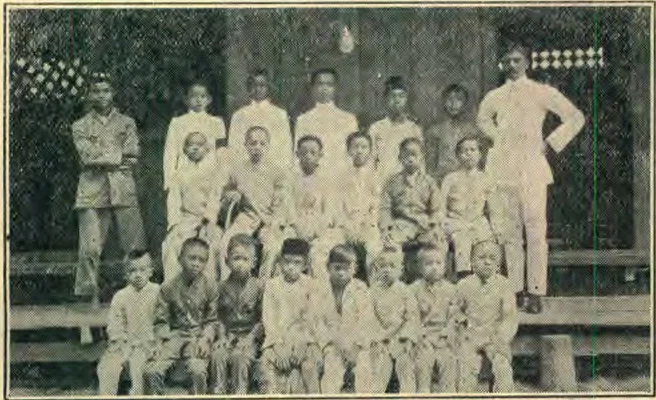
Some months ago Pastor F. A. Detamore, who has charge of our Malaysian Mission and lives at Singapore, made a trip of several hundred miles up the east coast of the Malay Peninsula, to Kota Bharu, where he baptized a young man and his mother. One incident of the visit which Brother Detamore mentions in his letter will, I am sure, interest our young people.
PUPILS AND TEACHER OF MALAYSIAN ENGLISH SCHOOL
Brother Detamore writes:—
“While in Kota Bharu I visited an English school taught by a Hindu. Both Chinese and Malays attend. It would hardly seem like a school to our young people in America. All the pupils study and talk out loud. Some read in one book while others read in other books, but each tries to make his voice a little higher than his neighbor’s. The regular school is held from 8:30 or 9 A. M. till 4 P. M., but the teacher goes to the school-house at night, and those who wish to do so come there to study. I visited them at the study period, and the teacher allowed me to hear some of the boys read. They were much embarrassed, but still they did very well, considering their opportunities. I asked for the privilege of taking a picture of the school, and the students were to come early for this. Some of them were there an hour or more before the appointed time. They learned that I had an interest in them, and when I would meet one on the street, he would gracefully bow to show respect.”
Are not they bright-looking boys? How sad that their teacher is a heathen! Notice how quickly they responded to Brother Detamore’s interest in them. I wonder if noble Christian young men could not find many opportunities to teach English schools in Malaysia. M. E. Kern.
Ant Raiders
By William A. Spicer
I was glad that Brother Laurie Sparrow and I walked in from the Glendale Mission to Ft. Victoria. It was very easy to keep ahead of the ox team, and every now and then we sat down during the eleven-mile jaunt, waiting until we could hear the crack of the driver's whip, or the jolting of the wheels as the wagon came near. Riding on the wagon, we should have missed one sight for which I had looked in vain during all my visit to the stations.
I had heard of the raids the big black ants often make upon the white ant hills; and here, streaming along the footpath and through the grass was a raiding party of ants, hurrying home with the spoils. It was a moving sight. It really looked like an army on the march, or rather in flight. In formation the column was several inches in breadth, and strung out eight or ten feet in length, though we did not wait to see if the last we saw were really the rear guard.
Every soldier carried one or two white ants, or ant eggs. In front were a number of ants as vanguard, carrying no burden, and here and there along the sides were similarly unencumbered scouts, thrown out, evidently, to warn of danger or to keep the formation. There was an air of excitement and hurry about it all that plainly said that a deed of daring had been accomplished, and no time was to be lost in getting back with the spoils. W. A. SPICER.
The Value of Common Things
A NOBLEMAN was once showing a friend a collection of precious stones which he had gathered at great expense. “And yet,” he said, “they yield me no income.”
His friend replied, “Come with me, and I will show you two stones which cost me only $25 each, yet they yield me a considerable income.”
He took the nobleman to his gristmill, and pointed to the two gray millstones which were grinding out meal.
It is not always the sparkling gem that has real value, but the common stone. It is well enough to be brilliant, but it is better to be useful.— Junior Christian Endeavor World.
The Old Folks at Home
By Della Thompson Lutes
ONE day I had occasion to eat dinner at a small country hotel. At the table with me were two old gentlemen. One of them spoke of the situation in Mexico.
“I don’t know as much about that as I’d like to,” said the other, raising his voice considerably, as his friend was deaf. “Doctor says I can’t use my eyes, so I haven’t seen a paper for over a week. I hear it talked about, but it isn’t the same as reading it for yourself.”
“Lucky to be able to hear,” replied the other. “I often wish I could hear what the rest are saying about it. Reading it, you get just facts, providing they are facts, but hearing it, you get different opinions.”
“Aren’t you staying with your daughter now?” Again the speaker raised his voice.
“No,” the deaf one hesitated over the word, his voice of that monotonous level with which the deaf are wont to speak. “Not for the present. She’s got a houseful of company—young folks. Makes it too lonesome. Thought I’d come over to the hotel, where there are others. How is it you aren’t over to Ed’s?”
“Well,” the raised voice also hesitated, “Ed’s folks are out a good deal, and—and—when they’re home there’s generally something going on—bridge clubs or dinners or—something pretty nearly all the time. I have a lot of fun with Ed’s children—but—it’s just as you say—kind o’ lonesome.”
They nodded their old heads in mutual understanding, and then ate for a few moments in silence, and furtively I watched them. They were both close upon seventy. Their faces were seamed with the care and burden of years, their hair white, their eyes heavy and sad. Their hands shook, and it was not impossible that a bit of soup should be spilled upon a clean tablecloth. Old age was a burden, and none there seemed to be to help them bear it. Their life companions had passed away. Their children were grown and married, had cares, anxieties, joys, and sorrows of their own.
“Not that Milly isn’t good to me, understand, or her friends, either.” The old man who had to raise his voice had evidently been questioning the loyalty of his own remarks. “It isn’t that; but they never have time. They’re always in a hurry to go here—go there. They never have time to sit down and read the papers to an old man—O, no! I wouldn’t ask it. Sometimes I meet them on the stairs or in the hall, and it’s always, ‘Good morning, gran’pa, how’re you today?’ chipper as a sparrow; but I notice they never have time to listen while I tell them. I used to think they wanted to know, and I’d set out to tell them, but—” The other old man nodded his head. He understood.
“And so,” the speaker rambled on between soup and meat, “I got pretty lonesome. I used to sit at the table with them. Milly wanted me to. She’s a good girl. I used to enjoy their chatter. There’s always some company around. Tom’s sister stays there a good deal. I used to enjoy them. Sometimes they’d start talking about something I was real interested in, and I’d join. But seems as if I was too slow for them—behind the times—didn’t see things the way they did—or something. I don’t just seem to know what, unless it’s because—I’m old. Anyway I stopped talking—and—seemed sort of—oh—I don’t know—I just fell out of it.”
The other old man, the deaf old man, kept nodding his head. It was an open book to him, an old story, his own story. He read his own name in as the other went along.
“So, finally, I told Milly I guessed I’d come over here and board. There’s always some other old back number hanging around for a game of pinochle, or a chat. Back numbers can all talk about the same things, anyway.”
Again the other old man nodded his head, and now he spoke.
“You can make them be civil to you here,” he said, “by paying them.” His gentle old face grew hard, and one was surprised at the bitterness in his dull-toned voice. “They dare not tell you you’d better go to bed at seven o’clock when there’s going to be company, and they dare not tell you not to come poking around the kitchen before breakfast in the morning. Not that they’d let you, but you don’t have to be told. Home, you’d like to do as you’ve a mind to.”
He jabbed a fork venomously into a bit of meat, and the other old man looked at him in mild astonishment.
“Ed’s all right,” the old man went on sharply. “He’s always civil enough—kind, too—and he doesn’t know nothing about her ways. I don’t tell. I just get out.”
Again they ate in silence.
“Too bad,” said the first old man, “too bad that when one of us has to go, we can’t both go. There isn’t any place for the one that’s left, seems, unless it’s at the old folks’ home. I’ve thought of that.”
“So’ve I,” responded the other, still vigorously. “I’ve thought of everything. But it’s my home they’re living in. I turned it over to them gladly. All Viny’s things are there. I want to stay among them.” The old man’s chin quivered childishly. A maid came and took their order for dessert. They gave it with little thought.
“Tom’s good enough to me,” the old man raised his voice, “Milly’s got a good husband. It isn’t that they aren’t good. They just haven’t time to think about it.”
They finished their dessert, and went off to play their game of pinochle and listen to hotel gossip. And I—I found my own dessert untasted. I was thinking, and I was seeing pictures.
Evidently these two old men had money enough of their own to pay their board where they chose and11where they could buy comparatively congenial companionship. But what of all the old men and old women who have to live with their relatives because they can’t afford to live anywhere else?
I got up slowly from the table, went slowly out of the hotel doors, and walked slowly up the street. And the thought that went with me—the thought that dragged at my feet and clutched at my throat and tore at my heart—was, How many old hearts are there all about us, hungering for a word, thirsting for love, aching with loneliness? Why do we hurry past them on the stair and in hall with a brief and meaningless, “How are you?” without caring how they are, without waiting to hear how they are? How many old cheeks are wet with tears tonight because son or daughter is in too great haste for a little chat, a little dip into the past, a little entering into detail of family affairs or asking for the aged one’s counsel and advice?
What are we hurrying after that we have no time to give to these who have given so much of their youth to us? What better gift can we ask than the pleased smile of an aged parent because of a little consideration and loving thought?
The pictures I saw were varied and not always happy. I saw an old lady sitting by herself in a comfortably padded rocker on the shady end of a pleasant piazza. I had seen her every afternoon for many weeks of a summer in a year gone by, and finally I had come to giving her daily greeting. I had “asked her how she was,” and then stood by impatiently, I fear, while she told me at length. Often, too, I had seen her, myself unobserved, wiping a tear from her lonely, wrinkled old cheek.
Oh, these tears of the aged—weary, sorrowful, hopeless tears! The child cries, and his wants are supplied, or his hurt is soothed, and his tears are dried. The youth weeps, but hope is an abounding fountain in his heart, and his grief is soon assuaged. Even the eyes of the mature are not so long in drying, because of the manifold interests at every hand.
But the tears of the aged are of all, fullest of pathos. They fall because a heart that has spent a lifetime in beating for others, is left to pulse away its weary hours alone; because the hands, once so full of loving service, so active in deed, so besought in companionable work, must needs lie idle now while younger hands perform their deeds with greater expediency. They fall because those over whom they have watched in sickness and with whom they have rejoiced in health, are too busy to sit for a few hours each day in cheerful and cheering companionship.
I read the other day in some magazine of a unique club, the Borrowed Time Club. It was a club of old men, all over seventy, all living on “borrowed time,” organized by a young man who had loved his own old father, and consequently had thought for all old men. He saw lonely old men sitting apart and cheerless on park benches, and the thought came to him that perhaps he could make life a little happier for them. So they organized a club, and he met with them and talked to them cheeringly. They have music and speakers and good times generally. It gives them—what no life is useful or happy without—interest, something to think of, to talk about, to do.
And others, hearing of that young man’s good deed, have organized Borrowed Time Clubs elsewhere.
We may not all, though some of us may, organize clubs of pleasure for the aged within our ken, but there are few of us who have not some aged friend or relative or acquaintance whose last days we could brighten with small expense. A few hours of chatting, a little gift now and then, a letter, or even a picture postal card,—these are small things surely, and yet they mean much to those whose days hang heavily and whose hearts are often sore from neglect and lovelessness.
Let us pause for a few moments each day in our mad haste for heaven knows what, and look about us for those who have run the race. Perhaps, after all, they may have something to give us out of their experience which may help us in our futile search for happiness and satisfaction. Perhaps words of wisdom worth more than the silver which we seek, may fall from their quivering lips.
They have run the race; they have almost reached the goal. Suppose we ask them what they saw along the way. Let us ask them what, out of all their lives, seems best to them at the end, and profit thereby.
And let us take them into our lives, become an active part in it, feel a share of the responsibilities.
“I’d so love to go into the kitchen once in a while,” said an old lady to me once, “and make a batch of biscuits just as I used to. I know Tom’d like them. Molly thinks, just because I’m getting old, that I oughtn’t to be allowed to do a turn. I wouldn’t be so old if I had something to do.”
Many an old man and old woman are growing older by the minute because their children, in all intended kindness, have taken their work out of their hands and left them nothing to do but grow old.
Keep them active, as active as they desire. Give them a part of the home to look after, and let them have interest in all of it. Don’t dump the children on them to be taken care of every time you want to go out, and then shut up like a clam when they want to know where you’ve been and what you’ve done. Grandparents love the babies, but babies can become tiresome even to grandparents.
Invite their company once in a while. Give them birthday parties. Take them to drive. See that they meet your company. Read the paper to them and an occasional book. Play a game with them. Make little surprises for them.
To be sure, all this takes time. But what’s time for? If you’re not doing something with it that’s worth while, you’re wasting it. And this is worth while, because you’re helping to make some one happy who hasn’t many chances.
Never mind the other side. They may be deaf or cranky or selfish or disagreeable or ill-tempered. To be sure, in the case of the latter they don’t deserve as much, but nevertheless you can do your share. And God pity you if you let any of your loved ones pass on without having made every last day a happy one; for if you don’t, you’ll live in sorrow and regret to the day you die.—Della Thompson Lutes, in American Motherhood.
Beauty of the Inner Soul
By Dawes
'Tis not the fairest form that holds
The mildest, purest soul within;
'Tis not the richest plant that holds
The sweetest fragrance in.
— Dawes.
A Pearl Within the Oyster's Shell
By Mrs. Osgood
Within the oyster's shell uncouth
The purest pearl may hide;
Trust me you'll find a heart of truth
Within that rough outside.
—Mrs. Osgood.
The War of Nations—An Algerian Episode of Aug. 4, 1915
By R. T. E. Colthurst
R. T. E. COLTHURST
RUSHING along, a pile of affiches under one arm and a paste can in the other hand, comes the billsticker. At each point at which he puts up one of his bills, every one rushes to it. Barefooted Arab boys, in their voluminously seated cotton trousers, with the legs cut off halfway up the calf and the ends bordered with braid, and wearing their red caps, like upturned red flower pots, of extremely brilliant hue, ran along with bundles of newspapers, each to his allotted selling post. One stops where I am trying to read what the bill says. In an instant his bundle of dailies is gone. The people tear them out of his grasp, give him their cents, and are all reading intensely. The Arab tries to collect from some whom he thinks did not pay. Some pay up; some say he has already his due. He cannot make good his account, and “howls.” I suppose he fears his progenitor will whip him. No one heeds him but me.
Why all this excitement? It is the call of the nation, “To arms! To arms! Men of the navy, men of the army, defend your soil and your homes!” This is what the bill says.
What say the papers? Two German cruisers, the “Dresden” and the “Breslau,” have bombarded a small undefended port at Philippeville and a market town called Brone. Ammunition which was being hastily stacked for shipment to Algiers, is set on fire and crackles off in every direction, killing many of the patrol on guard, and setting fire to the police barracks. One reads: “An unwarranted attack on two unfortified towns (details are suppressed)—a dastardly outrage.” One by one the readers curse or chatter according to the temperament of each; the crowd swells, the talk becomes furious; a passing foreigner, innocent, bewildered, is set upon, knocked down, kicked, disappears. From everywhere stories arrive of Germans seized and made to satisfy the lust for revenge now blazing up in all breasts.
In the heart of the city there is great excitement. The police are powerless, but are quickly reenforced, and not a moment too soon. The Apaches, rowdies of the worst sections, are banded; it is their chance; they smell loot, and like a pack of wolves, waving little tricolors aloft, together they roll up the chief thoroughfare like the waters from a burst river dam. Beware, the blond head they espy! Even some French folk were cruelly handled by these ruffians. They then turned their attention on a big German hotel, smashed the fine-stained glass front and plate glass windows, and sacked the dining hall and restaurant, making a bonfire on the square in front. That night no one was safe. On the next day martial law was enforced and peace outwardly imposed.
Considering myself well enough known, I went canvassing again, but had omitted to reckon on another factor. Men were pouring in from the surrounding towns, and soon I was to find myself in an awkward situation. Canvassing along from building to building, picking up two cents here and two cents there, by the sale of my Signes des Temps, I entered a house I had not yet worked, and finding no one at the lower door where the concierge is often located, I began to canvass the flats. I began upstairs, and was successful in obtaining a few sales at about the middle story. I saw some trunks being carried into one of the rooms, and simultaneously heard a lot of talk about robbery the night before. However, loud talk in Algerian houses is but a daily way of greeting one another. So I paid no attention. A few minutes later I knocked at the door of the newcomers, and offered my paper, and was curtly refused. In houses with so many doors I have to keep a check of my reception, in order to know how to act on my return the following month; so I was noting the door numbers and remarks as I went toward the next flat, when I heard the man I had just accosted ask me what I was writing, while his little boy flew down the stairs past me. I politely showed the man my notes. He took my book, and asked me if I wrote German. “No,” I said, “it is English.” I saw he thought I was an enemy, but I took polite leave of him. His answer was, “Oh, yes, go down, go down!” but in such a tone that I wondered what he meant. So I remained silently by his side, asking God to show me what to do and how, for I began to see he must have sent to have me arrested, and the thought had scarcely come to my mind when I saw an “agent” in khaki coming up the stairs, the little boy directing him, and some womenfolk following behind. He saluted as if on parade, but proceeded to take me into his care. I told him he was committing an error, but I was handcuffed, searched, and marched off.
Thus I was at least protected from the angry populace. But God helped me still further. Finding I went so willingly, and seeing I was no ruffian, the agent removed the irons and left me free to walk at his side. I chatted with him, and so we passed quite unnoticed to the station. Here all I had was removed from my pockets, my sous were counted, and my papers scrutinized. These were all in perfect order, and supported my verbal statement that a mistake had been made. I was told to sit down, and was left from ten in the morning until three in the afternoon without food or water. Here also I did well enough, for the policeman sent a boy to buy me a two-cent loaf of bread. He gave me a glass of water at my request. Finally, at three o’clock in came the commissaire, and to my surprise and pleasure I remembered I had sold him a paper only the month before. He nodded and went to his office, no doubt thinking I had come to have some little business transacted.
A little later in came my accuser, blazing hatred in his eyes and grim satisfaction in his manner. He had his twelve-year-old boy with him, no doubt to show him how to do the trick of nabbing a German! But when he entered the office of the chief of police and had sent for my papers, he had to eat his rage and swallow his disappointment. Presently I was requested to appear, expecting to be confronted by an irate person or possibly by a courteous gentleman expressing his regret for his hastiness and unwarranted action. But no, there was no accuser. He had fled out at the back door, too ashamed of himself to look me in the face.
The chief politely returned to me my things, and said he saw by my address and language that I was a man of education. He said it was this fact that had led the procurator from Oran to imagine I must be an important catch, probably an aid-de-camp on special spy duty. I thanked him for his flattering suppositions13and told him I had accompanied the agent without protest so as not to cause a disturbance at such a critical moment, but another time should claim my right of protection from my consul general.
He is still glad to accept now and again one of our Signes des Temps. This awkward incident turned out to be a protection to me during the next month or two of suspicion, for I had henceforth a police pass, and was able, under this protection, to continue the Lord’s work. God’s ways are often strange, but are for the strengthening of his laborers.
Ninga’s Gift
By Nettie Carlisle
SHE was only a little African girl ten years old, but she had learned to love Jesus, and her heart was so overflowing with joy and happiness that she longed to share her blessings with every one she knew. Her life had been a very sad one, for she was a little slave girl. Her father had sold her in payment of a debt to a wicked young man, who bought her for his wife. He treated her cruelly, and finding that she was too young for the hard work in the fields, he brought her to one of the schools of the Africa Inland Mission.
“I have heard that you train the boys and girls to be good workers,” he said to the teacher in charge. “This is my wife, and I want you to train her so that she can do good work in my fields by and by.”
Poor little Ninga! She was so shy and frightened that for some days Miss Emily could hardly get a word from her, but her big black eyes seemed to be pleading, “Don’t beat me; I will do the best I can.” Soon her fears vanished in the atmosphere of love and kindness which surrounded her. She learned to laugh and shout as the children played their merry games, and no voice was sweeter than hers in song and hymn. She was bright and quick in her classes, and soon learned to read and write.
Her husband visited her occasionally, and after one of these visits Miss Emily found her sobbing bitterly.
“What is the matter, Ninga?” asked her teacher.
“He says he is coming soon to take me away. Don’t let him take me, teacher. He will beat me again, and I want to stay in the school with you.”
Now Miss Emily had been talking with the government officials, for this was in British East Africa, and she knew that she could save the child by paying her father’s debt, so she answered kindly, “Don’t cry, Ninga, I will try to keep you at the school.”
She paid the money to the husband from her own small salary, and Ninga was free.
Oh, how happy the poor child was! “Dear teacher, how I love you,” she said. “I wish I could be your slave forever.”
“Be a good girl, Ninga,” said her teacher kindly. “That is all I ask of you.”
As the days went by, Ninga, sitting in the mission chapel, heard often the story of the wonderful love of Jesus, who died to save her, and her young heart took in the message gladly.
One day she lingered in the schoolroom till all the others had gone out, and then said, timidly: “Teacher, I love Jesus, and I am going to be his child always. I did not know till I came here that it was wrong to lie and steal and say bad words, but I have given them all up. I pray to our Father every night, and oh, how he helps me!”
A few weeks after this Ninga came running in one day, much excited. “Teacher,” she cried, “there is a little slave girl down in the village, and her master treats her dreadfully. She is nearly starved, and he beats her every day because she can’t do the heavy work in the fields. Please take her into the school, or she will die.”
“I should like to take her, Ninga,” answered Miss Emily sorrowfully, “but I have not the money. I might spare enough to pay the debt, but there is only mission money enough to feed and clothe the children who are here now.”
Ninga turned sadly away, but the next day she came back, crying: “O Miss Emily, please, please take that poor little girl in! He has beaten her till she can scarcely move, and her back and arms are full of bruises.”
“How can I take her, Ninga, when I have no food for her to eat, or clothes to wear?”
“I will give her half of mine,” said Ninga eagerly, “and she can sleep with me in my bed.”
Ninga was so proud of this little bed, for she had never known such a luxury till she came to the school. It consisted of four upright posts, with a bottom of woven ropes. On this were laid two blankets to serve as mattress, and two more for covers, as nights are often cold in this part of Africa. “I don’t mind if I am a little crowded,” she added anxiously. “Please take her in, and let her sleep with me.”
“Will you give her one of your dresses, Ninga?” asked the teacher.
(Concluded on last page)14
Ninga’s Gift
(Concluded from page thirteen)
Now Ninga’s sole earthly possessions consisted of three little cotton dresses. One, a red calico, sent by a kind friend in America, was Ninga’s special delight, and carefully kept for best.
“Yes, I’ll give her a dress, and half of my food every day.”
Each child at the mission received a daily allowance of a quart of dried peas or beans, which they were taught to prepare and cook for themselves, or else a very small basket of potatoes. Small as this allowance may seem, it was more than they had lived on in their own wretched homes, and they grew and thrived upon it.
“Very well, Ninga,” said Miss Emily, “I will go to the village, and see what I can do.”
Again she paid the ransom price out of her own purse, and after about an hour’s absence, returned with the little stranger.
Ninga, who had been watching by the gate, gave a shout of joy.
“May I give her a bath, teacher?” she asked; and receiving permission, she obtained a cake of soap, and started with her charge for the river.
The poor child sadly needed a bath, for she had never had one before. When at length the two little girls returned, Miss Emily’s eyes filled with tears, as she saw that the stranger was wearing the little red dress, Ninga’s most precious treasure.—Nettie Carlisle, in Kind Words.