Your ShelfYour Projects

Review and Herald, Vol. 82, No. 37.

The Fate of Tyre
Earlier text: Effective Use of Literature at Tent and Hall Meetings***

The Work at Plumstead

GEO. W. THOMASON, M. D.
THROUGH the Lord’s manifest blessing resting upon our institution at Plumstead, we can come with an encouraging report. Especially as we look back upon the work of the past six weeks we can but feel grateful to God for his special guiding presence and blessing. He has wonderfully verified his promise to do “exceeding abundantly above all that we ask or think.”
It seemed quite reasonable to expect that with the beginning of the rainy season the patronage would materially lessen, but thus far every room has been occupied practically all the time. At the present writing every room is occupied by patients. This coming week we shall begin occupying a nice cottage adjoining the sanitarium property; a patient who is to spend several months with us, having secured this cottage, has placed several rooms at our disposal. The next few days will bring to us several new patients from different parts of the colony, two of whom are surgical cases.
From various inquiries at hand it is evident that a knowledge of the work is spreading, and others are contemplating a visit to the institution, where they may place themselves in contact with these life-saving principles.
Recently we have been able to make a number of improvements which add greatly to the appearance of the sanitarium, of which we mention papering the halls throughout and all the rooms, with the exception of two or three. This feature alone has greatly aided in making the building more homelike, and has contributed much to the satisfaction of the patients. We have also installed some new electrical apparatus in the bath-room by which we can give a variety of electric baths. This will supply a long-felt need in our list of treatments. We have been able to make these and other improvements because of the contributions made to the “Equipment Fund,” and the friends who have accepted the privilege of giving to this fund can feel that they have an active part in this good work. There is other electrical apparatus which we greatly need for special office treatments, and which we shall now be able to secure through the assistance of Brother Honey and Brother John Wessels.
We recently completed our first year of work in this country. Reference to our records shows that we have been consulted by more than two hundred patients personally, to say nothing of the many who have made medical inquiry by mail.
The Lord has greatly blessed us in our medical work outside the sanitarium. Two cases have recently recovered from most severe attacks of typhoid fever, which, to all human appearances, must have succumbed to the disease had it not been for the triumph of rational principles of treatment.
During the past nine months we have performed more than thirty surgical operations of major and minor character. We feel specially to thank the Lord for his guidance in these experiences, and we have realized anew the sweet assurance which comes with the promise: “For I the Lord thy God will hold thy right hand, saying unto thee, Fear not; I will help thee.”
We are anxious that as soon as possible the benefit of these principles shall be extended to other classes in this country. The sphere of vision must be enlarged to see the need of suffering humanity of whatever color or station. Our plans in this respect have not been crystallized into definite shape, but in trying to peep into the future we have seemed to see a little building located on one corner of our grounds, devoted to the care and treatment of the colored people. Such a work could be undertaken with comparatively little outlay, and, as an entering wedge to this class of people, would mean results reaching into eternity. Such work would also be a valuable addition to our facilities as a training-school for workers. It might become apparent in time that a few carefully selected natives from the mission stations could be received, and given a careful training, after which they could return to their country as medical missionaries to their own people. Recently in talking with a patient in my office of the hope of soon starting such a work, from his interest in missionary and philanthropic work he voluntarily offered substantial assistance toward a building for such a purpose as soon as we are ready to begin operations.
The work in our nurses’ training-school is progressing favorably. At present the class numbers six. At the very outset of their training they are gaining a practical medical and surgical experience that is rarely afforded beginning nurses.
We are endeavoring to always make prominent the spiritual side of our work, and many of our patients, we believe, have had their faith in God strengthened and their religious experience deepened by their stay at the sanitarium. Our workers have embraced many opportunities for Bible reading and prayer with the patients to their mutual strength and upbuilding. We are conscious in our work that many prayers are daily offered for our success, and we earnestly urge a continuation of the same.
Plumstead, Cape Colony, South Africa.

The Worship of Ancestors—How Shall We Deal With It?

A. C. SELMON
The above is the title of an article which appeared in a recent issue of the Chinese Recorder and Missionary Journal. It is of interest because it shows a trend that can be noticed in the missionary work in China at the present time.
The writer cites the fact that it has now been a century since the first Protestant missionaries entered China, and as yet less than one per cent of the people have been gathered in, and not one of the rulers. He gives as one reason for the lack of success, the suspicion on the part of the rulers as to the purposes of the churches, and the blunders of the missionaries in the methods used. As illustrating the blunders on the part of missionaries, the author mentions how firmly ancestral worship is woven into the life of China. And then he puts the pertinent question, “How shall we deal with the worship of ancestors in receiving and instructing converts?” The hope is expressed that no convert will be expected to give up his ancestral tablet before being baptized. And, citing as a parallel case, he asks what we would think if, on applying for admission to some church, we were required to give up the pictures of our parents?
He could also excuse these converts if in their ancestral worship they chose to make offerings to the tablet, stating that this would be no more reprehensible than the setting of a plate for a deceased friend, of which we sometimes hear; better let the young convert take part with the rest of his clan in the temple feasts and the ceremonies connected with these feasts, than to forbid ancestral worship, and so lessen his chances of winning other converts from the clan. The writer would excuse the worship of the emperor’s tablet as being simply a civil ceremony; the worship of Confucius, although it might be accompanied with an offering of meat, ought not in any way to affect the Christian conscience.
In order to get into the state schools, and eventually to secure government positions, these forms of worship must be indulged in; and they are excusable on the ground that when the students of the Christian schools secure government positions, they can exert a wide influence in favor of the church.
In closing he asks, “Is it essential to the purity of Christian faith that every trace of the old ritual be abolished?” He answers this question in the negative, and states that even if it were deemed best to do away with these old forms held by the people, still the readiest way to do it would be by a temporary conformity to them.
This article shows the growing tendency to compromise the truth. If Christianity is to adopt all the vices of Chinese idolatry, why spend further effort in trying to evangelize this nation? The second commandment of the decalogue very clearly shows that ancestral worship and the worship of Confucius is idolatry. If the truth is thus knowingly to be mixed with error, it ceases to be truth.
To those who hold the orthodox view of the natural immortality of the soul, this is not so great a compromise as might at first appear. There is a striking similarity in many points of the Chinese belief as to the state of the dead and the belief of those who hold that the soul is naturally immortal.

Mission Notes

AT the Wesleyan Missionary Society Girls’ School at Galle, Ceylon, ninety per cent of the pupils are Buddhists when they enter. But conversions are taking place among them. Very few of them stay three years or more at the school without becoming true Christians. Little by little such leaven is sure to work in the whole community.
A STUDENT in the Presbyterian mission in the French Kongo, Africa, tells how he does it. “I have a little bag,” he says, “and into this I put the Lord’s money as soon as I receive it. When the Sabbath comes, my bag never fails me.” The two essential points of this African’s practise are: (1) A part of all money gained must be given to God; (2) the Lord’s money must be put by itself as soon as received.
IN the American Board’s Foochow mission is a native worker of ability who could instantly double his salary if he would leave the mission and accept a place in the custom-house. His classmates went into government service, and get almost twice as much as he does. One day lately, this Chinese worker helped an English evangelist by translating his address, and did it so well that a gentleman in the audience gave the translator ten dollars as a token of his pleasure. The Chinaman took the money, but gave it to the evangelist. “He needs it,” he told a friend, “more than I do.” This incident contradicts the statement sometimes made that converts in China are all “rice Christians.”
WHY the work is so ineffective in Arabia, is the question among missionary societies at work there. The experience of a missionary physician laboring there partly solves the problem. He required help in his work, and being unable to secure a Christian from the home land, he tried a Mohammedan. Later he found that the Mohammedan watched and secretly threatened any inquirers who seemed to be really moved by the gospel, so that almost all his efforts were lost. Another difficulty is the danger of travel. None can travel except in a caravan, escorted by troops. A missionary recently making a tour through the country attached himself to a caravan which had a guard of two hundred soldiers, yet the first night twelve camels with their loads were carried off from camp by brigands.

Wyoming

SUNDANCE.—Brother R. T. Baer and I have been holding meetings at this place for five weeks. Two have begun to obey the truth, and there are others in the valley of decision. As this week is a week of festivals, we shall discontinue our public effort for a few days, and work what we can from house to house. Pray for us and the work here, as it is a very critical time now. I will try to have every family that comes into the truth subscribe for the REVIEW. I am truly glad to see the general work on the advance, but I can also see that Satan is not behind with his work, as he is heralding the Sunday closing principle everywhere. E. L. Cook.

Canal Zone, Panama

When I last reported, we had just moved from Bocas del Toro to Colon, where we expected to make our home while in this field, and where we enjoyed very good health. Since coming here we have been experiencing some of the unpleasantness of the tropical fever. Part of the time the whole family are down at once, and have to depend upon the neighbors for care. Fortunately, some of the good sisters do not make bad nurses, needing only a little experience added to their willingness. We are just now in the midst of the malarial season; and when it is past, we hope to be able to do more work in this needy field.
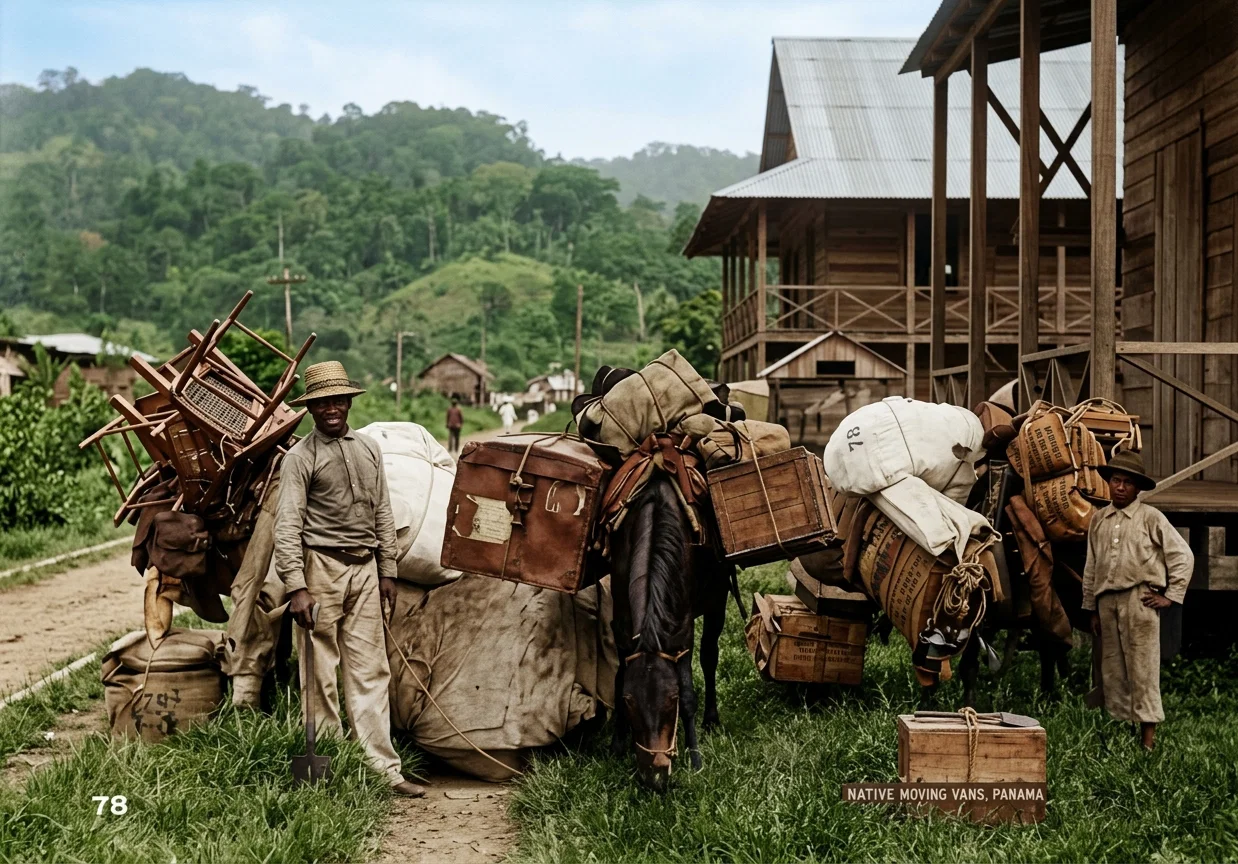
NATIVE MOVING VANS, PANAMA
There is so much to be done, and so few laborers, that we scarcely know where to begin. The population here is largely a moving one, except the native Spaniards and a few Jamaicans, who have lived in the country since the French canal time, and have become permanently located. The majority are people who have been drawn here through the opening of work again on the canal. Some are natural rovers.
Among the English-speaking people we find a good sale for our books and papers. Last week I visited one of our workers, a young native, who is laboring at Empire, close to the Pacific side. Here I found a good work being done. One young man is rejoicing in the truth, through the efforts of this native laborer, and others are interested, and seeking after the truth. From there I went to Panama City, the Pacific terminal of the Panama Railway. Here is a crowded city of several thousand people, mostly Spaniards. In this place we need a worker who can speak Spanish as well as English; also Spanish literature.
Panama is an old-fashioned Spanish Catholic town. As one walks through the streets, on the various corners he comes in sight of altars, with their little crosses and banners and lighted taper, each altar in honor of some departed saint. As I witness these relics of superstition and error, my heart yearns to see the banner of the third angel erected in this stronghold of the enemy.
Formerly Panama was a very unhealthful place. But since the Americans have taken control of the sanitation of the isthmus, the city has been much improved and cleaned, so that now it is in a fair condition. Much is being done to make the canal zone a healthful place; but as long as it continues to rain, and swamps remain, the fever will also remain. Just now it is raging everywhere, and nearly every house has one or two sick persons. In the midst of the sickness we are doing what we can to advance the truth among this people, and are making some progress. Just before my second run of fever, I baptized three, among these a lady eighty-two years of age, and unable to walk. Others are awaiting the rite. While there are difficulties, we are privileged to see encouragement, for which we are thankful.
C. E. PECKOVER.

Sweden

LAST winter I labored in Karlshamn for about four months. The interest was good. Brother O. Nelson joined me the last two months. As a result of this effort five are now keeping the Sabbath, and many are deeply interested in present truth. I intend to move there with my family this fall, and carry on the work during the winter.
During the summer Brother O. Nelson and I have had a tent in Solvesborg, with very good interest. Eight are now keeping the Sabbath, and many others are fully convinced of the truth. A man who has been an officer in the Salvation Army for more than fifteen years, has joined us in keeping all of God's commandments. It has created quite a stir among his former associates.
We can see that the cloud is rising, and that better days are coming for the Lord's work in this country. We trust that the Lord in his goodness and mercy may give us power and wisdom to walk humbly before him. A good spirit exists among the laborers, and we are all of good courage in the Lord.
We have one other tent in the field this summer, and it is reported that the attendance is good. The canvassing work is in a healthy condition, and our books and literature are finding their way into the homes of the people. We occasionally meet persons who have come to the knowledge of the truth by reading. So we thank the Lord for all the means he has given us whereby we can give the blessed truths for our time to the people. J. M. ERIKSON.

Mississippi

AMORY.—We arrived here from Vicksburg August 18. Amory was quarantined on the nineteenth. Vicksburg was quarantined a week after we arrived here. Three cases of fever were reported. After laboring from house to house, and speaking three times in the churches, we found a ripe field in which to labor. Our tent arrived, but we were not allowed to pitch it on account of the quarantine. Four have promised to keep the Sabbath.
The believers at Logtown, Magnolia, and McComb are of good courage.
We ask the brethren and sisters to pray for us in this field.
Thomas Murphy, W. H. Sebastian.

East Michigan

East Michigan
SANILAC CENTER AND ELMER CITY.—June 15 we pitched our tent at Sanilac Center, where we remained six weeks; as a result, twelve took their stand for the truth, in spite of much opposition from a minister of the place.
We then went to Elmer City, five miles distant, remaining there a little more than three weeks. The attendance was large, and four began the observance of the Sabbath. One of these was the steward of the Methodist church. The same minister who opposed us at the former place, began his opposition here. Lacking argument in favor of Sunday, he made a regular tirade against us as a people. This made for us many friends, and after we reviewed him, the interest was greater than at any time before. On account of the near approach of our camp-meeting, we were obliged to take down our tent and leave the interest undeveloped; but we are sure that if some one could go there, others would yet take their stand for the truth.
We now have a Sabbath-school at Sanilac Center of thirty-five members. To the Lord be all the praise. B. F. STUREMAN, E. R. LAUDA.

Orange River Colony

DURING the quarter just ended I have traveled considerably. I held meetings near Frankfort, including a baptismal service. Sister Rensbury was baptized, and her mother-in-law, who had been a Baptist, took her stand for the truth, and asked for membership in the Heisterbach church. This step the good sister took in the face of much painful opposition from her household.
From Frankfort I returned to Heisterbach, and, accompanied by Brother T. Louwrens, visited some interested persons in the Harrismith District. We also spent a few days with the company at Mooihœk. I was glad to find the members there of good courage.
After returning to Heisterbach Farm, I at once started for Wilge Hoek, Lindly District, and spent Sabbath with Brother Venter and his family. They are a united family of Sabbath-keepers. The five adult members—the father, mother, and three very pleasant and intelligent sons, ranging from eighteen to twenty-four years of age—have all joined our church. The other children are younger, but very promising. I organized a Sabbath-school in their home. After spending a blessed time with this dear family, I proceeded to the districts of Senekal and Winburg. For the first time I visited Brother Bornman. I was glad to meet this brother, whom I had longed to see since his return from Bermuda. I found him steadfast in the truth, though he has much to contend with, as he lives alone, far away from any of like faith. There is a possibility that this brother will become a colporteur. From there I passed on to Bloemfontein, and received a kind welcome from our dear Sister Wocke, whose health was anything but good. While there I visited and labored with some who became interested through her efforts, and with others for whom I had worked.
I was obliged to return to the Heisterbach church for quarterly meeting. I arrived June 30, and found a goodly company gathered from various places, among them a Brother Kriek, from Kroonstad District. This brother withdrew from the Dutch Reformed Church several years ago when he was converted, and has been associated with the Baptists. He was an office-bearer. Though a farmer, he has been more or less actively working for the Lord. He is a man of faith, and relates many instances of answers to his prayers for the sick. Some six or eight weeks ago, he fully decided to keep the Sabbath. His wife is with him, and others, he reports, are much interested, and will follow his example. I knew this brother eighteen years ago. It was a joy to meet again, and especially through the influence of the light which had in the meanwhile come to both of us. The truth separates often, but truly it is a uniting power as well.
I also found the Venter family present, and through their light and work others have decided to obey the Lord.
We had a blessed time from Friday evening until we closed with the church business meeting Sunday evening. The various meetings were full of life, and much freedom prevailed. Besides myself, Brethren de Lange, Kriek, Venter, Louwrens, and Moolman took part in the services. Sister Victoria Sutherland had a very interesting Bible study for young people. I estimated the gain to our membership the last quarter to be thirteen.
I had the misfortune to lose by death my valuable horse a few months ago, which was a very serious loss to me. I have bought another, with which I am now traveling. After a few days of rest for my animal I intend leaving for Kronstad.
J. M. FREEMAN.
Heisterbach, Bethlehem.

Burma

INSEIN.—Since coming to Burma, we have met some hard conditions; but, on the whole, the work has been most encouraging. Insein is a quiet suburb, away from noise and dirt. We could sleep but half as soundly as we needed to sleep in Rangoon, because of the distracting sounds caused by natives singing in their mournful, minor key, all night long. Their songs are always pitched about two octaves higher than the natural voice will reach, necessitating a change to a falsetto; and the full opening of the “tremulo,” added to this, gives a hideous combination of sounds. It can not be imagined; it must be heard to be understood; yet nothing has given me more desire to help these poor souls. With no more real hope than they possess, how could their music be different? I long to tell the love of Jesus with such power that they will be able to join speedily in the glad songs of Zion.
Brother Myers had always held meeting in the house in which he lived, and when we left that house, we were without a place to hold services. Rents are so high in Rangoon as to be almost prohibitive. After about a month, we secured a hall formerly occupied by the English Baptists. The providential manner by which we came into possession of this place removed all doubt in regard to what we should do.
Brother Hansen and I called upon the landlord, a very prominent barrister, left our card, but received no encouragement. He said that the Baptists had not given notice of vacating yet. Immediately after we left, government officials came to secure the place for a branch post-office. The manager of the Y. M. C. A. and four others also applied. But, notwithstanding the fact that the gentleman had lost our card, and knew no way of locating us, he reserved the room for us. He has very kindly deducted five rupees a month from the rent.
Since coming into the new hall, we have had a marked increase in Burmese attendance, as well as an encouraging gain in English. Brother Maung Maung occupies half the place as a residence, and I believe this makes the natives feel more at home with us.
Recently Brother Maung Maung was suffering most severely with an ulcerated tooth. He was in bed, and had hot applications to the jaw, but was suffering intensely. During the day some Burmese inquirers came, and the chance to talk present truth appealed so strongly to him, that, regardless of pain, he dressed, and began to teach them. God answered his love by healing the tooth himself, as soon as he began to talk. He has not been afflicted since. He has translated a number of tracts, and printed them. A large portion of the money used for printing has been raised among native friends. Brother Maung Maung is anxious to make the work self-supporting. He seeks to avoid taking anything from the mission funds for printing.
We find a liberal spirit among the people here. Although the rent upon our church is about twenty dollars a month, we have been enabled to raise a large part of it by subscription, and we believe that it will all be met in a short time.
Mrs. Votaw is teaching one of our servants English. He has gone through the primer, and is just ready for the second book. He attends her native Sabbath-school, and has quit painting his forehead, since she told him God was not thus honored. This man is decidedly a superior native. He is clean and neat in appearance. He has learned to pray, and says that as soon as he can read the Bible, he wishes to go and tell his people about the true God. He shows most encouraging evidences of a real work going on in his heart.
H. H. VOTAW.

West Coast Mission Field

AUTOFAGASTA.—We have reached Autofagasta, and have spent several days here. Brother Cespedes and his wife have been living in this place a year and nine months. They were baptized last fall, and have been faithful in witnessing for the truth. A few souls have accepted the truth through their work, and yesterday we organized a church of five members. Others are interested, and we believe some will take their stand with the little church, and be a strength and help to the work here.
One thing that pleased us in our visit here was the missionary spirit that came into the meetings. One brother began selling books the day before he was baptized. God blessed his efforts, and he sold five books. Since he has been baptized, he has offered himself as a worker, dedicating his time and strength to the work. We accepted his proposition, and have sent him into the field. He has sold a number of books since his baptism.
Brother Cespedes and his wife have offered themselves to go to Bolivia. They will enter the work in a few weeks. They will spend a few months working in cities between here and Bolivia, but in October they expect to enter Bolivia. This will be the first effort in this country.
Bolivia is a field that no one likes very well, on account of the heavy rains. But the Lord is preparing laborers for every field. Let us be of good cheer; for the work will soon be done, and Jesus will gather his children home to a better land.
Brother Thomann and I shall go to Iquique next Sunday. Our steamer left us here at Autofagasta, but it will return next Friday or Sabbath. While here we are holding meetings, and selling papers and books.
F. H. WESTPHAL.

The Colorado Camp-Meeting

THIS meeting was held August 17-27 in a beautiful park connected with Rocky Mountain Lake in North Denver. A line of street-cars running every few minutes connected the grounds with all parts of the city, making it very convenient for the city people who wished to attend the meeting. Elder E. T. Russell, president of the Central Union Conference, and Professors Kunze and Kellogg, of Union College, were present from the beginning. Prof. J. L. Shaw and his wife, Elder K. C. Russell, and the writer came after the meeting had been in progress four days. The next day after our arrival, Elder E. T. Russell left for Hutchinson, Kan., to be present at the opening of the Kansas camp-meeting. Before he left, however, much of the conference business was over, so most of the time thereafter was devoted to preaching, Bible study, and the consideration of the different phases of the general work. There were one hundred and eighteen family tents pitched on the grounds, containing over five hundred people. The number living in the city, who remained at home, going back and forth to the meetings, would in all probability swell this number to six hundred. While there was no excitement at any time, there was a steady and marked sinking out of self and into the Lord as the principles from the Bible and the Testimonies were presented. Some plain and timely instruction was received from Sister White relative to the relation the ministers and the brethren in general throughout the conference should sustain to the Boulder Sanitarium. Until the indebtedness is paid off on that institution, and the sanitariums at Washington and Nashville are built and equipped to do their work in an acceptable and creditable manner, the brethren were counseled not to build other sanitariums in Colorado, or engage in other local enterprises, aside from regular evangelical work, that would draw means from our people. While this instruction cut directly across the cherished plans of some of our brethren, they expressed a cheering willingness to forego their plans and throw their influence and support toward the enterprise indicated by the servant of the Lord. The conference officers as well as other interested brethren took a noble stand on this question, and it brought peace into their souls, and a unity and harmony with one another and the various branches of the Lord’s work that bespeak better days and greater success in the work of the conference.
The report of the work of the Boulder Sanitarium, as rendered by Elder Wilcox and Dr. Kerr, was quite encouraging. Thus far this year four thousand dollars from the earnings of the institution has been applied on the indebtedness. All current bills are paid up to date, leaving over five hundred dollars in the bank, and bills due from the patients amount to nine hundred dollars. The patronage is larger now than at any previous time in the history of the institution, and the spiritual interest among both helpers and patients is reported good. The plan of the relief bureau for the sale of the book “Ministry of Healing” for the benefit of the institution met with hearty support. Eight hundred books were subscribed for as a starter, two hundred of which were taken by the sanitarium workers.
Seven hundred dollars was raised during the meeting to augment the fund already on hand for building and equipping an intermediate school for the eastern slope. Twenty-six dollars was raised for local work in religious liberty lines, and one hundred and twenty-five dollars to replenish our foreign mission treasury. This amount was increased to one hundred and eighty dollars by the addition of two Sabbath offerings.
Four new churches were added by vote to the conference at this meeting. The treasurer’s report showed a small surplus in the treasury after the payment of all accounts, among which was the allowance of two missionaries in Africa and one in Holland. In the revival meetings held each Sabbath a large number were reclaimed from their back-slidden condition, and several gave themselves to the Lord for the first time. About twenty persons were baptized at the close of the meeting.
The newly elected officers stand as follows: President, Elder G. F. Watson; Vice-President, Elder Watson Ziegler; Secretary, Meade MacGuire; Secretary and Treasurer of the Tract Society and Treasurer of the conference, Mrs. Bertie L. Herrell; Secretary of the Sabbath-school Department, Mrs. Minnie MacGuire; Superintendent of the Educational Department, E. E. Farnsworth; State Canvassing Agent, A. G. Bodwell.
In an address by the president at the close of the conference, he called upon the ministry to unite with him in a new and entire consecration to the Lord, that they might receive a fresh baptism of the Holy Spirit for service. Plans were perfected for an aggressive campaign this fall, both by the ministry and by the laity, and we shall expect to hear good reports from the work in Colorado as the autumn advances.
G. A. IRWIN.

The Keene (Tex.) Sanitarium

This institution, which has been open a number of years under different managements, was, about one year ago, taken in charge by the Texas Conference. Soon after the close of the General Conference, Dr. D. C. Ross and his wife accepted an invitation to take the management, and during the last two months there has been a general renovation of the building, which is a substantial three-story structure, with broad verandas along the whole front of the first and second floors. The grounds are broad and pleasant, separating the sanitarium from close contact with other buildings.
There is one remarkable feature about this part of Texas: it is the cool, refreshing wind that blows softly during the heat of the day. It reminds me of the coast winds of southern California. This is certainly a blessing to patients who come to this place, and adds much to the natural advantages for rapid recovery.
We believe that we have a competent, God-fearing physician. His wife also has had many years' experience as a nurse, having conducted treatment rooms with her brother, at Santa Barbara, Cal. The nurses have an experience in the truth, which brings the blessing of God upon their labors. We can recommend this as a place to regain health. A good work is being done.
If all our people would recommend these institutions to those in need of medical aid, they would soon be filling the place God designed them to occupy. Some would also be delivered from unprincipled men, who, by the use of opiates in some form to deaden pain and deceive the patient as to his real condition, create an appetite that has enslaved many, and at the same time weakened the mental power to resist.
CLARENCE SANTEE.

Changes in Union College Workers

SEVERAL changes have taken place in the ranks of Union College workers since the annual calendar was issued. Elder L. A. Hoopes has gone to Australia, in harmony with the recommendation of the last General Conference. Miss Carrie Segebart is on her way to South America to act as matron of the school at Diamante, Argentina. Prof. M. W. Newton has been called to Battle Creek, to take charge of the sale of Dr. Kellogg's books. We are sorry to lose these faithful and tried laborers, but are glad Union College is privileged to send forth to the mission fields able men and women, not only from its students, but from the ranks of the teachers as well.
No doubt many are interested to learn what provision has been made for supplying the places thus made vacant. Hence it is with undisguised pleasure that we make the following announcements:—
Elder M. D. Mattson has been engaged to conduct the classes in Bible doctrines, ministers' training, and other subjects carried by Elder Hoopes. It was for a time expected that Elder E. W. Farnsworth would occupy this position, but authoritative word came that he must not be tied to any institution, but be left free to respond to important calls for labor in the gospel ministry. Elder Mattson has been Bible teacher in South Lancaster Academy for eight or ten years. He comes highly recommended by Elder G. A. Irwin, Elders E. T. and K. C. Russell, Professor Griggs, and others. Elder S. N. Haskell and his wife have promised to be with us during the winter term. An announcement of a special course for Christian workers will be made in due time. Prof. H. A. Morrison will take the place made vacant by the resignation of Professor Newton. To fill the offices of business manager and matron, Brother N. B. Emerson and his wife, of Topeka, Kan., have been engaged. Brother Emerson has been for some time the financial agent of the Kansas Conference. Sister Emerson has for years been connected with the Sabbath-school and young people's work. They are both well qualified to discharge the duties of these offices.
Thus, while laborers from Union College have gone forth to other needy fields, their places have been filled with able workmen, and all will be ready for the opening of school, September 12.
C. C. LEWIS.
Continue reading: The Crisis at the Southern Training-School