RIGHTEOUS Abel had fallen in sudden and cruel death by the hand of his brother Cain. His eternal life and happiness in the restored garden of paradise, from which his parents had been so recently driven, were assured; yet God calls to a solemn and terrible account Cain, the elder brother, who had arisen in madness and slain his younger brother. The life-blood of Abel, trickling out upon the earth already groaning under the curse, appealed to God. Cain had taken from his brother his temporal life only.
How much more does the loss of the life eternal of any of our brethren by our neglect cry out to God against us who have the light and fail to give it to those in darkness! We see our brother going down to death in sin, and knowing nothing of the message which God has sent us to bear to him. We are all messengers. We are not doing the work God has given us to do, whatever our occupation may be, unless we are by voice, or pen, or by our means proclaiming the word of life of which God has made us the bearers. We are debtors to all men. Not simply because we commit6aggressive and open sin, but because we neglect to do our work and to give our message, do we come under the curse; and the lost soul, yea, the fallen life wasted eternally, lost forever because of our neglect, cries to God with an exceedingly bitter cry against us. O my brother, my sister, to whom God has given means, are you sending with your means the light of truth to those sitting in darkness and the shadow of death?
In the early days of the history of this country, cruel white men brought by force from their African homes their colored brethren, and sold them in this country to be beasts of burden, to be bought, and sold, and whipped as cattle. In this land where it was boasted that all men were free, there was traffic in the bodies and souls of men, there was the sale of wife from the husband, of loved children from their parents, the violation of all that was sacred and holy. The strong oppressed the weak, and many were the habitations of cruelty, and, as Israel cried unto God in their sore bondage and oppression, so in unutterable pathos the cry of the oppressed in the “land of liberty” went up to the God of heaven, to the ears of the Lord of Sabaoth.
The seed of oppression had been sown, and there came a terrible harvest. In a civil war almost unequaled in history, the harvest was reaped. The bondmen, set free, were turned out of their old homes—away from the kind and provident master who had provided for his bondmen and women even as for his own family, as well as from the hard and cruel master who had driven them under the lash. Without education or experience in providing for themselves, they were expected to make bricks without straw, to sink or swim, survive or perish. With a few true friends, but generally under the gaze of the cold and indifferent or those absolutely unfriendly, they have struggled upward, and there have been many noble evidences of the God-given talent of those who have suffered so cruelly.
Shall we as bearers of God’s last great message to the world, to every nation, kindred, tongue, and people, neglect at our very doors those who need the message and can be blessed by it? Surely, the eternal loss of their souls will appeal unto God against us with an infinitely greater and more terrible cry than that with which the life-blood of righteous Abel called to the God of love and of justice against his brother Cain.
The moving to Washington of the headquarters of the third angel’s message was a move to the South. From this, the capital city of the United States, the light is to shine gloriously through all the Southern States, to the warm-hearted, hospitable white man, and to the colored people also, light-hearted and joyous even in poverty and distress, whose souls are vocal with wondrous music, who love religion, and who seek all that is beautiful, yea, to our colored brethren.
One third of the population of Washington is colored. It has been stated, and I believe on good authority, that it has the largest population of colored people of any city in this country. Many of them here are in government employ. Some of the very brightest and most highly educated people of the African race are in Washington. That this was one of the reasons for the establishment of our headquarters here there can be no doubt. Already a most excellent class has been reached by Elder Sheafe and other laborers. Some of these in government employ have brought the truth before leading officers of the government. A short time ago in a brief personal talk with the United States Secretary of the Treasury, reference was made to one of our colored brethren who had stood nobly on the principle of the Sabbath, had fought a good fight, and had won a glorious victory. Who shall doubt that from this center a great work is to be done for the Southern colored people?
A collection is to be taken up for the special work among the colored people on the first Sabbath in October. The tide of liberality, the flow of means, has been coming in a strong flood to Washington. It has now turned to the South. Shall there not be a generous donation for this purpose far beyond that of any previous time, that the work for the colored people may be placed on a strong basis? Our colored brethren everywhere show in the payment of tithes and the giving of offerings that they are willing, as far as their means will permit, to return into the treasury the means that has been given to bring the truth to them.
From a Testimony published in the REVIEW of Dec. 3, 1895, I quote the following:—
No one is to be looked upon with indifference, or to be regarded as unimportant; for every soul has been purchased with an infinite price. Therefore, in the name of Jesus Christ of Nazareth, let not the colored race be longer neglected by those who claim to believe in Christ as the Saviour of men. Let not one who claims to have heard the gracious words, “Thy sins be forgiven thee,” hold himself aloof from those whose lives have been dark and shadowed. . . .
They have been strangely neglected. Poverty and want are common among them, and very little has been done to relieve their distress. We can not be surprised that such neglect should result in hardness of heart and in the practise of vice, but God cares for this neglected class. The colored people have souls to save, and we must enter into the work, and become colaborers with Jesus Christ. We can not leave them as we have left them in the past. We can not be justified in expending money so lavishly in providing conveniences for ourselves, and in furnishing facilities for those who have been more fortunate, and are already abundantly supplied with every facility, and do nothing for those who know not God and Jesus Christ whom he hath sent. . . .
Many of the colored people are among the lowly who will receive the Word of God, and shall not this long-neglected work of enlightening the colored people be entered into perseveringly, and be carried forward all the more diligently because it has been so long neglected? We must do a work for the colored race that has not yet been done. “God so loved the world, that he gave his only begotten Son, that whosoever believeth in him might not perish, but have everlasting life.” The Son of God, the Creator of the world, sacrificed his own life, in order that he might become the Redeemer of fallen humanity. He made an infinite sacrifice that he might become man’s surety and substitute, and shall we remain indifferent to a downtrodden, abused race?
God cares for the colored people, and if we would co-operate with him for the salvation of their souls, we must care for them, too, and become laborers together with him. We need to repent before God, because we have neglected missionary work in the most abandoned part of God’s moral vineyard. . . .
We can not heap advantages upon ourselves and upon those who are not in need, and pass by those who are in utter want, and be approved of God. This neglect is charged against those who have had great light, who have had marvelous opportunities, and who yet leave so large a portion of God’s moral vineyard unworked. For years Satan has been sowing his tares among the colored people, and the field can not be worked as easily now as it could have been worked years ago. But there should be no delay now. Reproach is brought upon Jesus Christ when those who profess to be carrying the last message of mercy to the world pass this field by. Christ did not pass by the needy and suffering. He united works of mercy with the message of salvation he came to bear to men. He engaged in a constant, untiring ministry, and worked for the perishing and sorrowful. He prefaced his message of love by deeds of ministry and beneficence, leaving us an example that we should follow in his steps. J. S. WASHBURN.
A Decade of War
By L. A. S.
“THE peace agreement at Portsmouth,” remarks the New York Mail, “closes a decade of almost continuous warfare. In the last ten years,” says the Mail, “there have been five great conflicts. The empires of China, Great Britain, Japan, Russia, and Turkey, the kingdom of Spain, and the American republic have all tried the arbitrament of the sword. Out of a total population of about 1,400,000,000 war has been the portion of perhaps 1,130,000,000. Nearly 3,000,000 men have seen service in the field.”
L. A. S.
Encouragement
By P. F. Gay
We have our days of darkest gloom,
Our hours of grief and sadness,
With nothing bright to cheer our life,
And give us joy and gladness.
But then we know the darkest time
Is just before the dawning;
There may be “weeping for a night,
But joy comes in the morning.”
Thank God for this most blessed truth,
That cheers us in our sorrow;
For hearts that mourn and weep to-day
Shall thrill with joy to-morrow.
We pray and labor for the right,
And often get discouraged,
For wrong holds sway and rules the day,
And we’re cast down and worried;
But we should never once lose heart,
Though burdened, sad, and weeping,
For if we “sow” the “precious seed,”
With “joy” we’ll do the “reaping.”
Lord, help us, then, to labor on,
And trouble never borrow;
The wrong, ’tis true, may rule to-day,
But right shall win to-morrow.
But long we’ve suffered, toiled, and
prayed,
And for the right have striven;
And we’ve received no recompense
For time and labors given.
O brothers, let us not forget
Our deeds are all recorded;
And soon God’s faithful ones shall be
Abundantly rewarded.
O, then we’ll trust and love him still,
And where he leads we’ll follow;
The toil and strife we’ll have to-day,
The crown of stars to-morrow.
—P. F. Gay, in The New Voice.
MRS. E. G. WHITE
By Ellen G. White
Lessons From the Life of Solomon—No. 3
MRS. E. G. WHITE
The Responsibilities of Burden-Bearers
AFTER King David, in the presence of the men in positions of responsibility in his kingdom, had outlined his plans regarding the building of the temple, he appealed to them to co-operate with Solomon in carrying forward this work. “Who,” he asked of the assembled multitude, “is willing to consecrate his service this day unto the Lord?”
Willing Service
The response came not only in liberal offerings of treasures to meet the expense of the building, but also in willing service in the various lines of God’s work. Hearts were filled with a desire to return to the Lord his own, by consecrating to his service all the energies of mind and body. Those upon whom had been placed burdens of state, determined to labor heartily and unselfishly, using that for God the skill and ability he had given them. David’s exhortation to Solomon, and his appeal to the burden-bearers of the nation, should be kept in mind by those who are in positions of trust in the Lord’s cause to-day. In this our day God’s people will prosper only so long as they keep his precepts; and those who bear responsibilities are called upon to consecrate their service to the Lord. Conference officers, church officers, managers and heads of departments in our institutions, laborers in the field at home and abroad,—all are to render faithful service by using their talents wholly for God. The Lord is not pleased with half-hearted service. To him we owe all that we have and are.
Implicit Obedience
To all engaged in his service, the Lord gives wisdom. The tabernacle to be borne from place to place in the wilderness, and the temple at Jerusalem, were built in accordance with special directions from God. Throughout the ages, God has been particular as to the design and the accomplishment of his work. In this age, he has given his people much light and instruction in regard to how his work is to be carried forward,—in an elevated, refined, conscientious manner; and he is pleased with those who in their service carry out his design. Only those who, feeling their own inefficiency, obey implicitly the Lord’s commands, can be retained in his service.
Uzzah meddled with the ark, notwithstanding the plain command of the Lord to regard it with fear and trembling, and to keep it sacred. He had to be removed from the Lord’s work. God changes not. To-day he is just as desirous as in the days of Uzzah that men shall know his ways, and that they shall reverence the methods he has outlined for their guidance. They are to carry out the plans he has devised. When men feel that it is unimportant to obey a “Thus saith the Lord” in carrying forward his work, but that their own plans should be followed, they thereby evidence unfitness for any position of trust in his cause. In every effort to advance the interests of his work, we must lose sight of self, and keep in view God’s glory.
Satan’s propositions appear to present great advantages, but they end in ruin. Over and over again men have found out by experience the result of choosing to follow the plans of men rather than the plans that God has made for us. Will not others gain wisdom from their experience? Let us be afraid of any plans that are not heaven-born.
Often the professed followers of Christ are found with hearts hardened and eyes blinded, because they do not obey the truth. Selfish motives and purposes take possession of the mind. In their self-confidence they suppose that their way is the way of wisdom. They are not particular to follow exactly the path that God has marked out. They declare that circumstances alter cases, and when Satan tempts them to follow worldly principles, they yield, and, making crooked paths for their feet, they lead others astray. The inexperienced follow where they go, supposing that the judgment of Christians so experienced must be wise.
Those in positions of responsibility who follow their own way are held responsible for the mistakes of those who are led astray by their example. “Shall I not judge for these things?” God asks.
There are those who think that they can improve upon the plan that the Lord has given; that they can mark out for themselves a course better than the course he has marked out for them. To such ones, choosing the things that be of men, harden their hearts against God’s leading, and follow their own way. Unless they repent, the time will come when they will look upon the utter failure of their life-work. Man’s wisdom, exercised without Christ’s guidance, is a dangerous element.
Any recognition or exaltation gained apart from God is worthless; for it is not honored in heaven. To have the approval of men does not win God’s approval. Those who would be acknowledged by God in the day of judgment, must here listen to his counsels and be governed by his will. Only thus can they receive the rich blessings that will fit them to receive his commendation. They must hold fast to the truth until the end, refusing to be drawn from their allegiance by any ambitious projects.
Stemming the Tide of Evil
We have not realized fully the importance of studying the counsel given by the Lord, through David, to Solomon, regarding those who are unworthy of confidence. Those who prove untrue are to be dealt with in accordance with the wisdom that God will impart. Never are God’s servants to look upon disaffection, scheming, and deception as virtues; those in responsibility are to manifest their decided disapproval of all unfaithfulness in business and spiritual matters. And they are to choose as counselors in every line of work, only those men in whom they can repose the utmost confidence.
In the sixteenth chapter of First Corinthians we read: “Watch ye, stand fast in the faith, quit you like men, be strong.” Those who are elevated to official positions in the Lord’s work are ever to guard against incurring the guilt of rash speech, of unfaithfulness, of betrayal of sacred trusts. And only so long as they discharge aright their responsibilities, are they to be retained in office.
Those who bear responsibilities must be wide-awake. It is not the man who drifts with circumstances, and who in an emergency indorses questionable moves, who wins the respect of his fellow men and the approval of heaven. It is the man who, like a rock meeting the tide, stands firm against evil who commands respect. In a crisis, when many are not fully decided as to the right course, the one who moves steadfastly in the path that God has marked out, with unshaken determination carrying out God’s plans,8is the one who wins confidence as a man fit to command. Those who occupy positions of responsibility should know what saith the Lord, and they should then stand unflinchingly for the right, stemming the tide of evil.
Babylon and Assyria (Continued)
By M. E. KERN
M. E. KERN
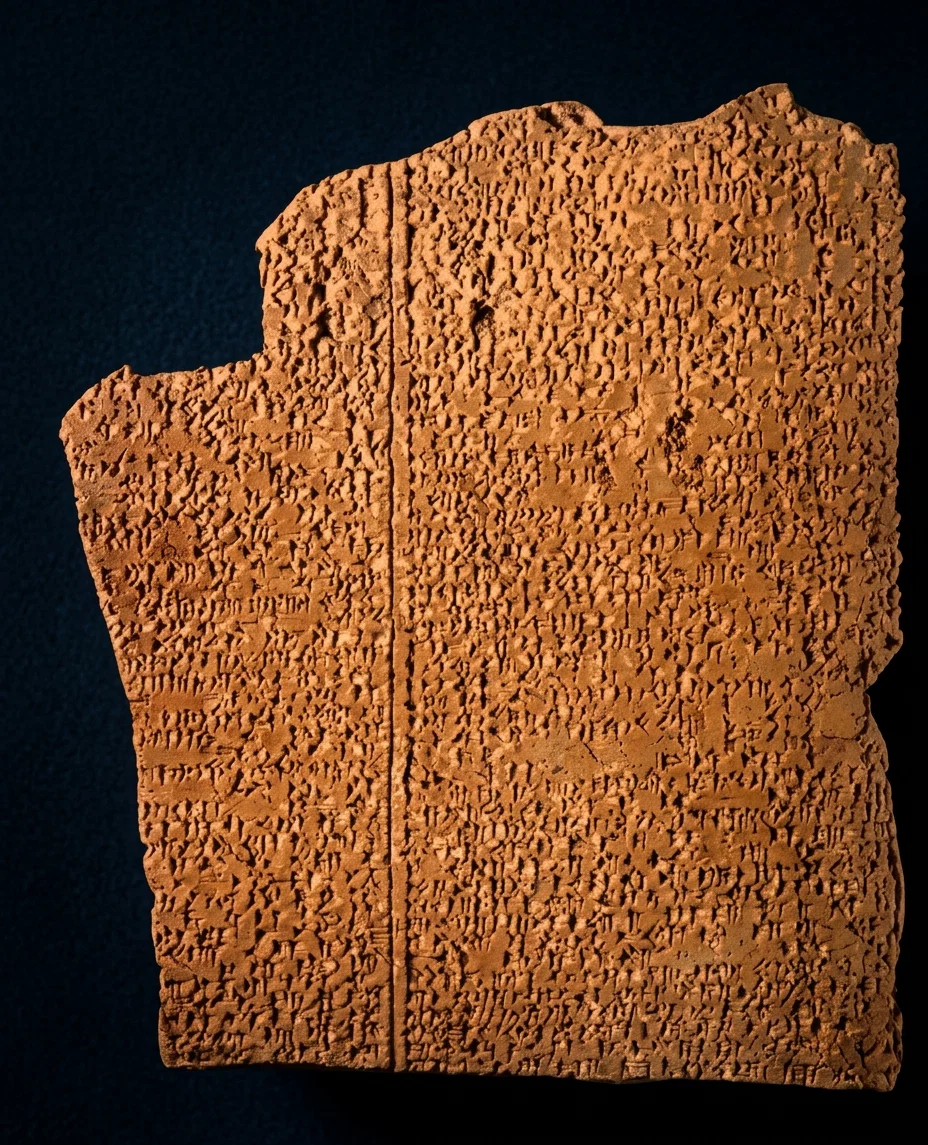
A LITTLE over thirty years ago George Smith found in the ruins of old Nineveh a great library of over thirty thousand clay books, the library of Assurbanipal king of Assyria, 668 to 626 B. C. There was evidence to show that they had been once arranged in order according to subjects. Among them he found an account of the flood in many respects like the Bible account. The deluge tablets tell how Bel commanded that a boat be built in which to preserve life. It tells of the storm, the landing of the ark on a mountain, the sending out of birds, and the offering of sacrifices on landing. But the Babylonian account shows plainly that the story has been handed down through minds that had chosen to forget God and corrupt themselves. The story is polytheistic. It says at the close that when the sacrifice was offered to the gods, they smelled the sweet savor, and swarmed around like flies.
A DELUGE TABLET
Present Excavations in the East
There has been quite a revival of Oriental study in the last few years. With much difficulty the work is carried on, because of the conservatism of the Turkish government, lack of funds to properly conduct the explorations, and because of danger from an unfriendly climate, and often hostile tribes. Wild beasts are sometimes also a menace, for the prophecy of Babylon has been literally fulfilled that the wild beasts should make their home there. Work is being carried on in Persia at Susa, or Shushan, by the French. The German Oriental Society is excavating in the ruins of old Babylon, on the tower-temple supposed to be the original “tower of Babel.” The French are excavating at Tello, a city that flourished before the birth of Abraham; and a new society organized by the University of Chicago has lately received a firman, or permit, to excavate at Bismya, in central Babylonia. The University of Pennsylvania has been excavating at Nippur, about fifty miles from Babylon, and has brought to this country probably the most remarkable relics in existence. Nippur is supposed to be the Biblical Calneh, and is the oldest city yet investigated. The illustration shows the appearance of Nippur before the arrival of the expedition. The miniature mountains cover an area three fourths of a mile wide by one mile long. The highest mound is one hundred and ten feet, and the average height of the mounds is sixty feet. The ruins are about equally divided by the dry bed of an old navigable canal, of which I shall have more to say later. The earliest stratum found is thirty feet beneath the plain, the surrounding country having filled in by inundations and other causes to that amount.
THE NIPPUR MOUND
Results of Excavations
The history of early Babylon is being largely reconstructed as a result of the excavations at Nippur. Dr. Clay, of Philadelphia, says:—
“The antiquities of the earliest known period, instead of being rude, primitive, or aboriginal, are found to be very highly developed. The earliest known inscriptions show that the characters, instead of being pictorial outlines as they once were, have gone through a long development.”
“The skill of the gem cutter and sculptor,” he says, “surpass later periods.” “In many respects,” he further says, “The culture is not surpassed even at the present day.”
These are remarkable statements, and these discoveries are revolutionizing men's ideas of antiquity. Here, too, lies the danger. Still wedded to their evolutionary theories, scholars take the unearthing of these advanced civilizations to mean that the world is thousands of years older than it was formerly believed to be. Thus the author just quoted says: “Several thousands of years at least must have passed before a people was advanced far enough to produce such masterpieces.”
We do not know just how old the world is, and the Bible does not reveal it; but I believe that in history as well as in science there are wild speculations to be avoided. And one not to be led astray must study with the Bible in hand and the heart in touch with the Infinite One. We may sometimes have wrong ideas of what the Bible says, but the Bible is never wrong. And in all the efforts that have been made against it, not one demonstrated scientific truth nor one proven historical fact has ever contradicted the Bible. But in history as well as in science, men take the very witnesses that God has left to show the truthfulness of his Word and try to make them prove their preconceived ideas of evolution. These evidences of very early remarkable civilizations, comparable even with our own, do not prove that there were millenniums before that in which these people developed from savagery to civilization, but they prove, on the other hand, that there was no such long development, but that man made in the image of God possessed a powerful intellect and remarkable genius. And it stands us in hand to know these things, and to be able to combat infidelity hidden under the cloak of science and history.
The Wicked Watcheth the Righteous
By T. E. BOWEN
T. E. BOWEN
That man, whoever he may be, who has a spirit of watching some one else to discover some mistake, some fault, some misstep, God calls a wicked man. Mark carefully what he says of him: “The wicked watcheth the righteous, and seeketh to slay him.” Ps. 37: 32.
This watching here mentioned is a far different watching than that about which the Lord instructs us. He commands us to watch, but it is not the other man, our neighbor, our brother, our sister, but it is our own hearts, our own identical selves the Master tells us to look out for, to watch.
How comfortable it is to be in the presence of noble-hearted brethren and sisters who you know will not pick up every little error or omission and comment upon it to others. It is restful. Well, why not be this way? Why let in this wicked spirit of watching for something to report? God calls the thing wickedness. The wicked watch; the righteous are watched. In which company are we? What a world of iniquity might be avoided in the church if the unholy watchers would go out of business forever.
Rome, N. Y.
Prophetic References to the Event
By J. O. CORLISS
The Final Adjustment of Human Awards—No. 5
Prophetic References to the Event
J. O. CORLISS
Having learned how the work of the judgment is adjusted in the cases of those whose names are found in the book of life, we shall be content to leave the cases of those whose names are not recorded in that mysterious volume, until after we locate the time of that work already considered in previous studies.
When exhorting the Athenians to seek a purer worship than that which he found among them, the great apostle gave as an incentive to that end, that God had “appointed a day” in which he would judge the world in righteousness. Acts 17:31. An “appointed” day in God’s economy is a set time which can not be permitted to pass unheeded, and so must usher in the event or events for which it was appointed. To have it otherwise would be to destroy the certainty of God’s word, and so make his statements unreliable. We are therefore justified in believing it possible to locate the “appointed day” when the judgment session begins.
The revelator points out the definite time of this event. He says that when the seventh angel sounds, the kingdoms of this world become the kingdoms of our Lord and of his Christ. At that time, too, the nations become angry, and God’s wrath is visited upon them. This is also the time, he says, when the dead are to be judged, and the reward given to the saints, and to them who fear the name of the Lord. Rev. 11:15-18.
To learn when the sounding of the seventh angel is due, we must necessarily locate the sounding of those which preceded it. This may be done by a study of chapters 8-11 of this wonderful prophecy. It is not necessary to enter into all the details of these chapters; it is enough to state that nearly all students of prophecy are agreed that these trumpet voices, seven in number, symbolize the great wars of the Christian era by which the great empires of the world have been disintegrated. Thus the first four of these refer to the dissolution of the old Roman empire by the incursions of northern barbarians, which was fully accomplished near the close of the fifth century.
The last three of these are called woe trumpets, because the wars they symbolize were religious, engendering persecution for conscience’s sake. This is set forth in chapter nine by the introduction of the Mohammedan power, which arose in the latter part of the sixth and early part of the seventh centuries. Following the death of its symbol founder,—Mohammed,—Abu-Bekr, his father-in-law, assumed charge in the year A. D. 635. But having comparatively little influence, the work he undertook soon came to a standstill; and although making almost continually murderous attacks upon Christianity for hundreds of years, the Mohammedan tribes remained in a somewhat unorganized condition until near the close of the thirteenth century. In that period Othman organized a monarchy of the principal tribes, and thus fulfilled the prophecy which says that “they had a king over them.” Rev. 9:11. Having thus assumed the place of king, or sultan, Othman became the high priest of the nation, and so was pre-eminently the angel, or messenger, of the “bottomless pit,” whence the Mohammedan religion arose. His name, as given in both Hebrew and Greek, means the “destroyer.” To this name he was loyal, as testified by Gibbon, who says: “The great blood of one hundred and thirty thousand Christians was a grateful sacrifice to the Arabian prophet.”—Gibbon’s Rome, chap. 57.
Regarding the exact time when Othman began his work, Gibbon further says: “It was on the twenty-seventh day of July, 1299 of the Christian era, that Othman first invaded the territory of Nicomedia.”—Chap. 64, par. 14. The power of this organization was to “hurt men five months.” The one hundred and fifty days included in this specification must be considered more than ordinary literal time, in order to have the importance given it by the prophecy.
From Eze. 4:1-6 we learn that God’s method of reckoning symbolic time is to make a “day” stand for a year. Beginning, then, with the time given when the Ottoman empire began its work of destruction upon Rome’s eastern empire, an added one hundred and fifty years would reach to July 27, 1449. During this time the Mohammedans were permitted only to “hurt” men. But when this woe ended in 1449, a remarkable change came about, for then the sixth angel sounded, which was the introduction of the sixth woe.
Under this woe, power was given to “slay” men for the period of an hour, a day, a month, and a year. Rev. 9:15. According to the uniform method of reckoning symbolic time, this would extend over a period of 391 years and 15 days. This will be clear when we consider the following: The Hebrews reckoned thirty days to the month, and twelve months to the year, in all, 360 days. But to prevent a disarrangement of the seasons, every third year a thirteenth month, called an intercalary month, was added, which was composed of the days of that year and the two preceding ones not reckoned in the regular rotation. But the regular year was made up of three hundred and sixty days. In the computation of this prophecy, therefore, we make the one symbolic year stand for three hundred and sixty years; the month, thirty years; the day, one year; and the hour (one twenty-fourth part of a year), fifteen days. Adding these together, we have 391 years and 15 days, which would extend from July 27, 1449, to Aug. 11, 1840. This gives the date of the close of the second woe.
This was, therefore, the time when the power of the Ottoman empire to “slay” at will was to cease; in other words, its independent reign was then to end. Elder Josiah Litch, of Boston, Mass., reached this conclusion as early as 1838, and so published his convictions to the world. The outcome of his calculations was watched with the deepest interest, and when the year 1840 arrived, the sultan of Turkey found himself wasted beyond the hope of recovery in a war with Mehemet Ali, pasha of Egypt, and on Aug. 11, 1840, he actually submitted to the dictation of the four great powers of Europe,—England, Russia, Austria, and Prussia,—since which time the Turkish empire has existed only by their sufferance.
Following this date the prophecy points out a great world-wide movement in which the proclamation of the end of the world would come at a definite time. Revelation 10. This was evidently fulfilled between the years 1840 and 1844, when the great advent demonstration stirred the entire world. That prophecy also pointed out beforehand the great disappointment which was to follow that movement, and closes with the assertion that the people must prophesy again “before many peoples, and nations, and tongues, and kings.”
After giving some additional ideas in chapter eleven of what would take place under the sounding of the sixth angel, the prophet exclaims: “The second woe is past; and behold the third woe cometh quickly.” Chap. 11:14. Then is announced that with the sounding of the seventh angel, the time has come for the dead to be judged. Following as this does the prophecy of chapter 10, we may be sure that the time of the judgment began in 1844. This position seems fully established from the fact that the next angel to make an announcement, declares that the hour of God’s judgment has really come. In our next it will be necessary to our purpose to show what connection this hour of judgment has with the atonement work of Christ for mankind.
Mountain View, Cal.
Spiritual Irrigation
A MAN bought a strip of arid land in California, on which nothing could be made to grow. But it had this advantage, it lay near enough a mountain stream, so that by much labor he led it through his plot. Behold the miracle of irrigation! All growth is luxurious and abundant. The geraniums are like trees. The roses smother the fences with bloom. The orange tree, as Dr. Hillis puts it, “with its feet in the water, its head in fire, distills into orbs of gold.” “Without me,” says the mountain stream, “ye can do nothing.”
Thus, though “barren and unfruitful” of ourselves, by faith that brings to us the indwelling spirit of Christ, we know with Paul, “I can do all things through Christ which strengtheneth me.”—Selected.