The influence of nicotine and of alcohol on growing life should occupy a prominent place, both in the mind of the teacher and of the parent.
Smoking and the use of intoxicating liquors are today two of the most ominous dangers that threaten society, and this danger can be controlled only by carefully educating our youth as to the moral and physical effects of these poisons. Fortunately, the civilized world is awakening to the pernicious effect of alcohol on growing life, and to the fact that the effect of nicotine is nearly if not quite as bad as alcohol.
The effect of tobacco upon growing tissue is to retard its growth. The boy who smokes before he has8his growth, say before the age of fourteen years, will be a smaller man than if he had not used tobacco until manhood. This result is produced in the following way:
When taken into the system, the products contained in the tobacco smoke lessen the disintegration of tissue, thus retaining in the system that which is worn out as the result of wear and tear, and which should be gotten rid of. Instead of eliminating this worn-out tissue and allowing new and healthy tissue from his food to take its place, the tobacco boy has his tissue early clogged by this once-used material, and normal growth is arrested. You may see the principle illustrated by your furnace: throw fresh coal into the furnace already clogged with burnt-out coal and the ashes, and the fire burns but poorly; but shake the grate and get rid of the burnt-out material, and then the fresh food for the fire is oxidized, and heat is the result. In the growing boy, therefore, the more perfectly we can get rid of the burnt-out and useless material in the tissues, the more rapid will be the growth of body and the more vigorous the brain, the heart, and all the vital organs.
Every American boy wants a strong body, a steady hand, and a clear brain as he enters upon his life work. There never was a time in the history of the world when so much is required of men as today, and the man who, having had competent training, has the largest amount of reserve physical strength, is the man who is sure to win over his competitors. Young men, therefore, cannot afford to weaken their bodies and handicap themselves in the work of life by smoking in boyhood.
A very interesting experiment bearing upon this took place at the United States Naval Academy at Annapolis some years ago. A new superintendent of the academy found, in entering upon the duties of his office, that there was a rule against smoking, which rule, however, was openly and constantly violated by the students. Feeling that a law not enforced was demoralizing, he asked our Government for a commission of scientific men to examine into the subject and decide whether the rule had adequate ground for its existence. These students, you know, are picked men and fine specimens of young manhood. Several of these men, smokers, were taken and put through the following tests; viz., for muscle strength, heart strength, and capacity for study; and the same number of nonsmokers were subjected to the same tests. The average of the results was greatly in favor of the nonsmokers. Tobacco was then withheld from the smokers for a time and they were tested again, when it was found that the muscle strength, the heart strength, and the capacity for study were all increased. The result was that the rule against smoking among the lower-class men (the younger men of the school) was enforced and remains in force today. It is certainly important that every parent, every teacher in our schools, and all who have to do with boys, should know these facts relative to the action of tobacco, and, by precept and by example, teach them.
D. H. Kress.
God's Goodness Hath Been Great to Thee
God’s goodness hath been great to thee.
Let never day or night unhallowed pass,
But still remember what the Lord hath done.
— Shakespeare.
Correct Sitting Posture
YOU can be more efficient if, by sheer will-power, you train your body to sit or stand correctly.
Square your shoulders.
Make yourself as tall as you can and slightly sway-backed.
Keep the lower ribs expanded at the sides.
Expanding the lowest ribs at the sides expands the lungs; they should be kept expanded except in so far as may be necessary to let them fall slightly inward during each expiration. The effect of this is that in breathing, the lungs will expand and contract from maximum to medium instead of from medium to slight expansion, as is usual.
The More Graceful Position is the More Efficient One
“The results of this are soon realized in the shape of better physical welfare and endurance along with their spiritual counterparts of greater buoyancy and will-power.”—Dr. S. W. Geis, in Medical Record.
O Will of God, the Loveliest!
By B. F. M. Sours
O Will of God, the loveliest.
I craved so many things;
They flitted from my eager grasp
Like birds on frightened wings.
I longed for earth-loves, and for boons
The like that others seek,
But Love withheld, and gave instead
The bliss of which I speak.
The precious things sped far away,
The nights seemed cold and chill,
But from the blazing firmament
There burst a wondrous Will:
It laved me in its floods of light,
Till in Love's warm embrace
I nestle, 'neath His shadowing smile,
His weak one, saved by grace.
And so I tread the victor path
Without the things I craved,
Saved from the snare of gold, and gleam,
From siren-singers saved:
And ever toward the heights of life
I gaze, till love fulfil —
O Will of God, the loveliest —
The glory of thy will.
O Will of God, the loveliest,
Although the winds were wild,
Thou didst embrace in arms divine,
And kiss thy weeping child.
And as the glory of thy clasp
Dissolves the mists away,
The conquering splendor of the dawn
Breaks — the eternal day.
B. F. M. SOURS.
Men Ought Always to Pray
“MEN ought always to pray, and not to faint.”
Jesus, Our Best Friend
By Matilda Erickson
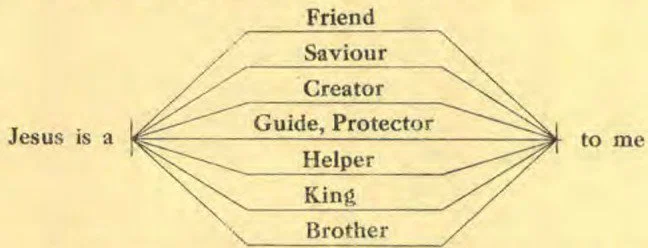
What Jesus Is to Me
MATILDA ERICKSON
Friend.— Jesus is my best Friend. His wonderful love is my only hope. Because he loved me, he left heaven and its glory, and came down to this dark speck of a world to save me. Because he loved me, he wrested my hope of eternal life from the enemy, and came forth from the grave to give it to me. Because he loved me, he went to heaven to plead his blood in my behalf. Because he still loves me, he implores me to let him guide me through life, protect me from dangers of all kinds, and help me bear all the cares that oppress my heart. Because he loves me, he desires to become the King of my heart, the Captain of my soul, that he may sail my barge safely to the haven of eternal happiness. Because he loves me, he wishes to be my Brother, that I may share with him all the riches of heaven. Isn’t he a wonderful Friend?
“Which of all our friends, to save us,
Could or would have shed his blood?
But our Jesus died to have us
Reconciled, in him, to God;
This was boundless love indeed;
Jesus is a friend in need.”
Saviour.— “Dr. Franz Müller, of Vienna, died of bubonic fever. When his friend, Dr. Borisch, fell a victim to that disease, he nursed him until death came, exposing with generous self-renunciation his own life in so doing; then, attacked by the fever himself, he devoted the short time that remained to him to recording for the benefit of others the result of his scientific observations. ‘I am suffering from the plague,’ was the message he posted on the windowpane. ‘Please do not send a doctor to me, as, in any event, my end will come in four or five days.’ A sacrifice for his colleague.”
This helps me to sense more deeply what Christ has done for me.
Creator.— “Lord Kelvin, better known as Sir William Thomson, said: ‘Forty years ago, walking somewhere in the country, I asked Liebig if he believed that the grass and the flowers which he saw around us grew by mere chemical forces. He answered: “No! no more than I would believe that a book of botany, describing them, could grow by mere chemical forces.”’”
By Christ were all things made, and “without him was not anything made.” Nature points to the Creator of all things, and ever sings of his wonderful love. What is my testimony? Does the song of my daily life harmonize with nature’s music? Is it continuous praise of my wonderful Creator and Friend?
Guide and Protector.— “Some years ago,” says the Baptist Commonwealth, “when Captain Dutton was commander of the ‘Sarmian,’ the vessel had entered the St. Lawrence River on its homeward voyage, when suddenly a heavy fog arose, which completely hid the shore and all objects from view. The ship, which was going at full speed, continued on her course without relaxing the least. The passengers became frightened, considering it extremely reckless on the part of the captain. Finally, one of them remonstrated with the mate, telling him of the fears of the passengers. He listened, then replied with a smile: ‘O, don’t be frightened! The passengers need not be the least uneasy; the fog extends only a certain height above the water, and the captain is at the masthead, and is up above the fog, and it is he who is directing the vessel.’”
Just so, as long as Jesus Christ has full control of my life, I need have no fears. The terrible confusion of today does not confuse him. He stands above the fog. He knows how to avoid every treacherous rock. His wisdom can keep me, and his love will keep me. He is the one Friend I cannot get along without.
Helper.— There are burdens which no human friend can help me bear; but Jesus always understands our troubles.
“He knows the bitter, weary way;
The endless striving day by day;
The souls that weep, the souls that pray,
He knows.
“He knows how hard the way has been,
The clouds that come our lives between,
The wounds the world has never seen,
He knows.”
And best of all, he cares. All my troubles he makes his own. It costs much to sympathize with our friends, to put our shoulders under their burdens. Most of us fail at times; but Christ never fails; his “love counteth not the cost.”
King.— “The heart is the real throne of Christ. ‘The kingdom of heaven is within you,’ said the Master. But the important thing to notice is that if Christ is in the heart, the center of our life, he will rule that life to its circumference. He will cleanse it from all evil thoughts. He will make it kind and gentle. He will make us eager to serve others. Some time ago a London paper said that a missionary in China had been speaking about the custom of foot binding, and that some of the Chinese had formed a ‘heavenly foot society’ to do away with the custom. Christ in the heart makes the feet heavenly, ready to run his errands and execute his will. To what extent Christ is actually in the heart may be seen from the purity of the thought, the life, and the service.”
Brother.— Jesus is my Brother. Is not this the supreme test of his love? There are philanthropists who give large sums of money to help the poor. But where is the philanthropist who will go out to seek sinners, reprobates, criminals, that he may make these unfortunate ones members of his own home circle, and joint heirs with him in his father’s estate?
Yet this is just what Jesus has done for me. He risked all to save me; then he made “whosoever will” joint heirs with him of all things. How very much he must love me! Fifteen times in the Sermon on the Mount, he speaks of his Father as our Father. These words, echoing down through the ages, remind me down here in the twentieth century, that Christ is my Elder Brother. And I know he is coming soon, very soon, to receive those who will be joint heirs with him. I hope then to go home to my Elder Brother, to my best Friend.
My Decision.—Yes, Jesus is all this to me, if I will allow him to be. I determine for myself what Christ shall be to me. My decision settles the matter. He has proved his love for me; he has shed his blood for me; he has walked all the way to the grave; learned all the dangers of the journey, that he might guide and protect me in my journey; he has borne every burden that human hearts can know, that he might be my helper; he has vanquished our common foe, that he might be my King; he has become my Brother, that he might make me a joint heir with himself, of his eternal wealth. All now hangs on my decision. Eternal loss? Eternal gain? My decision will determine which shall be my lot.10
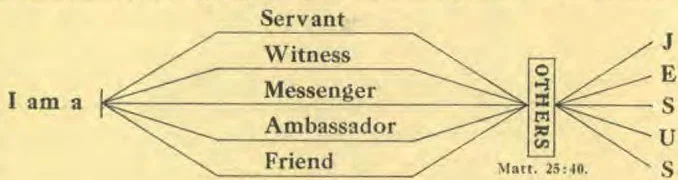
What I Am to Jesus
Servant.— “Before the Civil War a traveler passing through the South had his pity awakened for a young slave. He purchased her from her master, and gave her her liberty. She exclaimed: ‘Oh, he has set me free! I can never thank him enough! I will serve him all my life!’ She thought not of pleasing herself, but her friend; and when any one would speak of her loving service to her benefactor, she would reply, ‘He redeemed me! He redeemed me! I will serve him all my life.’”
Jesus has done infinitely more for me. I am his servant, but how do I show my gratitude?
Witness.— “When Frontenac died, he bequeathed his heart in a golden casket to his wife. ‘I never had it living,’ she said; ‘I will not take it dead.’ Too many, while living, armor-plate their hearts with the love of the world, thus resisting the sweetness of divine love; but when dying, they wish to bequeath their hearts to God. No greater evidence can there be of lack of genuine heart-love; for ‘if any man love the world, the love of the Father is not in him.’” Am I in this class? or am I one of his true witnesses? Does my life prove that I love him supremely? In the Missionary Volunteer Society, in my home, among my friends, do my life and my words witness for him? If I do not in word and deed confess him before others, he cannot consistently confess me before the Father.
Messenger.— I am God’s messenger to my community. Can he count on me?
“At the Battle of Waterloo a regiment sent word to Wellington, saying they soon must yield. His orders were: ‘Stand firm.’ ‘But we shall all perish,’ they said. ‘Stand firm,’ he repeated. ‘You will find us there,’ they replied. All the men fell, each fighting at his post.”
“When we give ourselves wholly to God, and in our work follow his directions, he makes himself responsible for its accomplishment. Christ will increase the talent of every faithful worker.”
Ambassador.— “When I was in college,” says a Christian worker, “two men were sent to West Africa to fill a vacancy. Before they had been gone three months, there came a cable telling us that one was dead. In less than another month a second cable came, saying the second was dead. At once, the matter was announced to the students, and the question asked: ‘Who will take their places?’ Six men at once . . . offered to go, and two were sent. In less than six months these two men were dead, and a cable came again, and the question was again asked, ‘Who will go?’ That occasion, I shall never forget; it stands out as one of the thrilling moments of my life; when the question was asked, ‘Who will go?’ every man in that college stood up, and said: ‘Send me.’”
Am I as willing as these to be God’s ambassador, wherever he calls me to serve?
Friend.— Jesus counts me his friend if I do “whatsoever” he commands me. At first sight this seems a hard test of friendship; but when I know my Saviour as he is, I shall love him supremely and desire above all else to please him. Then I, too, shall be able to say: “To me religion means just one thing: Jesus and I are friends.” There is no better way of proving my love for Jesus than in making his will my own in living and serving. If my highest ambition is to live for him, I shall be ready for whatsoever may come to test my personal friendship for Jesus. And I shall be able to say:
“O Christ, Redeemer, Master! I, who stand
Beneath the pressure of thy gracious hand,
What is the service thou wouldst have from me?
What is the burden to be borne for thee?
I, too, would say, though care and fear exhaust,
‘What matters it? Love counteth not the cost!’”
My Decision.—As effect follows cause, so what Jesus is to me decides what I am to Jesus. These are only different sides of the one supreme question. The place I give Christ in my life, will determine the place he can give me in his service. But what I decide to be to Jesus I must try to be to those about me, for he says, “Inasmuch as ye have done it unto one of the least of these my brethren, ye have done it unto me.” If one hand goes up in faith to Jesus, the other is bound to go out in service for others. If one hand lays hold on Christ for strength, the other will be outstretched with blessings for others. That is the way the Christian keeps his balance.
A Great Sacrifice
By D. W. Castle
THE story is told that a strange disease once fell upon the inhabitants of a certain city in France. Its origin was unknown, but the havoc it wrought was tremendous. For a time it baffled the efforts of the most skilled physicians. Meanwhile the plague was spreading and exacting its ghastly toll. The discovery of a remedy required the sacrifice of a human life, and a man just in the midst of a successful career volunteered. The remedy was discovered and the plague stayed, and hundreds of lives were spared through the noble sacrifice of Dr. Lyon.
Today a terrible plague is sweeping over the whole earth, and no mortal power can stop it. That plague is sin. Its ravages are frightful, and its result horrible to contemplate. God foresaw that nothing short of a supreme sacrifice could check its advance, so he sent his only begotten Son, Jesus Christ, down to earth to taste death for our sakes. Through his incomparable sacrifice the world was released from this dreadful malady. Shall we fail to appreciate that unselfish sacrifice made for our sakes? D. W. CASTLE.
Culled from the Bible
It will be found that the Bible is responsible for several of the common comparisons that we use freely in our conversation, says the Boston Globe:
Meek as Moses; wise as Solomon; old as Methuselah; hairy as Esau; strong as Samson; cruel as Herod; virtuous as Joseph; wise as a serpent; sweet as honey; high as Haman; true as gospel; false as Judas; harmless as a dove; swift as an eagle; bright as the sun; big as Goliath; clear as crystal; fair as a lily; wicked as Jezebel; white as snow; red as scarlet; patient as Job. — Selected.
Fannie Foster's Precipitates
By Mary A. Miller
MISS NELSON met her Sunday school class for the first time after an absence of two months; and as her girls gathered about her, their bright, eager faces showed the pleasure they felt at having her with them again. At the close of the lesson she said:
“Girls, I’ve been wondering if you would not like to join a class in advanced chemistry. I have become quite interested in it myself, since I’ve been away, and it seemed to be just the sort of work you would enjoy.”
“Chemistry!” exclaimed Fannie Foster. “O Miss Nelson, don’t, please! We’ve begun to study that in school. It’s all about H₂O and sulphates and chlorides and things, and I just hate it!”
“Why, Fan,” replied May Kittredge, “I think it’s beautiful to see how the alkalies counteract the acids, and how the different chemicals act upon each other. I think it’s the most interesting study we have. But, Miss Nelson, how could we work in ‘advanced’ chemistry before we have thoroughly mastered the principles?”
“I think,” said Miss Nelson, “my plan of study is a little different from yours, and perhaps I would better explain it. While in Boston, Cousin John took me through the Harvard laboratory, where the summer students in chemistry were so busy working. They were very earnest and seemed so interested I wanted very much to know just what they were doing, and why they did it. Presently one of them, in answer to my question, explained his work to me. A little box of powder before him was his ‘unknown,’ and by means of chemical tests he was to find out of what it was composed. He would dissolve some powder, and then add an acid to his solution; if by that means he obtained a precipitate, he would determine by further tests what metal he had obtained. If no precipitate was deposited, he must proceed further with his work until the metal ‘came down,’ as he put it. I watched him as he worked, until the clear liquid in his hand suddenly became milky, and gently deposited a white precipitate on the bottom of the flask. I could not wonder then at the absorbed, eager workers; and I feel sure that even Fannie, when she has studied further, will find it most interesting.”
“But, Miss Nelson,” questioned a sweet-faced girl, “how can we study such things—we who are not in school? Though I think it would be beautiful if one had the chemicals and the means for work.”
“The way I want you to study, girls,” replied Miss Nelson, “requires no chemicals and no apparatus. I will tell you just what I mean. You have each been given a complex box of ‘unknowns,’ and on that are daily and hourly acting the salts and acids of life. I want you to watch your ‘precipitates;’ you may find some things ‘come down’ you did not suspect. As we grow more experienced in the work, we may, if we will, learn to do what the laboratory students cannot do—we may govern our precipitates so that neither the acids nor the alkalies will have the power to bring down anything but ‘precious metals.’ Suppose you keep a close watch this week, girls, and next week be able to make some report as to the result of your observations.”
The following Sunday all the girls were present except Fannie Foster, and after all the others had told of success or failure, Miss Nelson said, taking a letter from her Bible:
“Fannie is unable to come today, but has sent her report, which I am sure you will all be interested in hearing, as she has granted me permission to read it to you:”
“DEAR MISS NELSON:
“I am sorry not to hear the reports of the other girls, but I am rather glad I cannot give mine in person, for I’m sure none of the rest will have had such horrid precipitates as I have. I felt so lovely after our little talk last Sunday, and was in such a hurry for my tests to begin, for I felt sure the precipitates would be just beautiful. I did not for a minute think I should have this sort of report to make; but I hope the worst metals have precipitated themselves, and something better will begin to ‘come down’ soon.”
“When I came home from Sunday school, before I took off my hat and gloves, I sat right down in the sitting-room and told mother all about it. She thought it was a very wise plan indeed, but said, with her quiet little smile, that she thought I would make some chemical discoveries in the course of the week. I had not noticed Jack, for he sat in the corner of the bay window, reading; but when mother left the room, and started to go upstairs, he leaned forward and said:
“‘A pious idea, Fan! You may rely upon me to furnish an unlimited supply of acids, and help you classify your precipitates.’”
“Oh, the horrid boy! He had simply sat there and listened to every word, and I knew I should not hear the last of it all week. Furnish the acids indeed! Well I just told him I thought if anybody was capable of making things unpleasant and horrid, he was; when he suddenly held up his thumb and finger to the light and squinted up one eye while he pretended to look at something, and said:
“‘Hm! growing cloudy—a little precipitate forming already!’”
“Well, I just bit my lips and hurried upstairs for fear I should say something more; but my beautiful plans seemed all spoiled, and I wasn’t half so sure of the results as I had been. However, the rest of the day passed off all right, much to my relief.”
“On Monday morning I always help get breakfast while Mary is washing. I rang the breakfast bell and everybody was ready but Jack. So I ran up to his room, and there he was, fast asleep, and breakfast all on the table. I shook him and shook him, but he would only say, stupidly:
“‘What you want?’ until I finally got so indignant I gave him a final shake, and started away, saying:
“‘Jack Foster, you are the most provoking boy! I think if folks are good enough to get your breakfast, you might at least eat it when it’s ready!’”
“With that Jack was wide-awake in a minute, and up went his finger and thumb, as he screwed up his face and said:
“‘Ah, another precipitate, I declare!’”
“I felt my cheeks burn as I turned and ran downstairs; but I determined to improve on that test, and when Jack finally did come down, he found his breakfast nice and hot, with a fresh plate of cakes baked purposely for him. He looked at them a minute comically, and then very soberly said:
“‘Fan, I suppose that’s what they call “chemical reaction,” isn’t it?’ which was real good of Jack, I think, for it showed he knew and appreciated.”
“Well, that’s about the way things went all week, though I tried hard to be more careful. But Thursday afternoon Jack rushed into the house, and flew around hunting for something. Finally he called to me:12
“‘Fan, have you seen that price list of bicycles I had the other evening? Fred West wants it.’”
“Of course, I helped him hunt, for a boy isn’t worth much at finding things for himself, when he remembered suddenly that it was in the pocket of his light coat. Taking out a handful of letters and papers, he began to run them through, but stopped suddenly as he came to one, and gave a long, low whistle. I knew that sign of distress, and said,
“‘What’s up now, Jack? Something gone wrong?’”
“With a funny twist of his face he tossed a letter into my lap, saying,
“‘Fan, I’m dreadfully sorry! There’s a note I was asked to give you a week ago, and I declare I haven’t thought of it since!’”
“‘Well of course I ‘took fire,’ as Jack says, and ‘blazed away,’ and am ashamed to remember the quick, angry words I said as I tore open the envelope. Jack sat waiting anxiously until I had read it, and meekly said,
“‘Well, Fan, what’s the damage?’”
“‘Damage! Jack Foster, that’s all you care! I’ve lost the most beautiful time, but it doesn’t matter to you, of course! It was a note from Mrs. Grey, saying if I would like to attend a private recital by Giovanni, she had tickets for us both, and five of the loveliest tea roses waiting to be cut for me. Of course it doesn’t affect you any, but I’ve been just perishing for a bit of something nice, and now to miss that lovely music and the roses and all!—Jack Foster, it’s too bad!’ and with that I rushed off to my room for a good cry. But I heard Jack say as I passed him, ‘Copious precipitate with salt and water solution,’ and then he ran downstairs, slammed the front door after him, and was off with Fred for the bicycle meet at Clinton. Nobody to interfere with his good times!”
“That was what made it all the harder, and I thought if he had only cared a little more I shouldn’t have minded it so much, and then the bitter precipitates began to ‘come down’ thick and fast, and I felt as if nobody else had so unkind a brother, or so many hard times generally—until I was very forlorn indeed!”
“A half hour later I heard a tap at my door, and to my surprise Jack stuck his head in, saying rapidly as he mopped his forehead with a most discouraged-looking handkerchief:
“‘Fan, there’s something down on the hall table for you. Thought I’d tell you as you mightn’t find it. Can’t stop. I’m late now!’ and with that he was off downstairs, three steps at a time, and soon around the corner wheeling for dear life to overtake the boys already some distance in advance.”
“Of course I went downstairs to see what was there, and how surprised I was to find a box of the most beautiful hothouse roses you ever saw. Scrawled on the top of the box I read,
“‘Allow me to precipitate these upon you, Fan. I’m awfully sorry about that last acid. JACK.’”
“Wasn’t that just lovely of Jack? and there he was saving every cent he could raise toward his new bicycle, too!”
“Well, maybe he didn’t find a nice, hot little supper waiting for him when he got home at ten o’clock that night, tired and hungry; and didn’t he appreciate it, too! Someway Jack and I seemed to care more for each other that night than ever before, and after supper, out in the dining-room all by ourselves, we had the nicest, coziest little talk, and Jack declares the advanced class in chemistry is a pretty good thing; but he says he will withdraw from his contract to furnish my acids, and turn his attention to his own precipitates awhile. So the prospect is more encouraging for this poor student in advanced chemistry.”—Mary A. Miller.
Luck and Joan
“I NEVER saw anything like Joan Moore’s luck!” Ellette exclaimed. “Mr. Peyton has made her his private secretary at a hundred a month — just think of it! And she isn’t nearly so rapid a stenographer as I. Of course I’m awfully glad for Joan, for she nearly supports her family, and she’s a perfectly splendid girl; but employers don’t take such things into consideration as a general thing.
“And it’s the same way in other things; Joan plays a little — just accompaniments; yet she’s asked out all the time — a good deal oftener than she will go. And she was a delegate to the convention last fall, and all sorts of wonderful things happened to her there. It isn’t as if she were especially pretty or brilliant or charming; she is just nice and quiet and inconspicuous. That’s what makes it so inexplicable. You can’t tell me there’s no luck about it.”
“I wonder,” Uncle Richard said, with a smile that was keen and quizzical and friendly all at once.
“Why, but, Uncle Richard, I’ve just told you.” Ellette always grew emphatic in her excitement.
“Suppose we work at it a bit. I’ve found that if you really go down into a situation and study it all out, the element of luck vanishes into thin air. About Joan at the office, first. You say she isn’t so rapid a stenographer as you, but she is an accurate one, isn’t she?”
“Oh, surely,” Ellette was both honest and loyal.
“Does she stop with the special thing she is told to do, or go beyond it?”
“Why,” Ellette considered, “she is always studying the files. If Mr. Peyton wants the number of a contract, she can generally give it from memory.”
“Which saves his time and shows interest in her work.”
“And she is always studying up technical building terms — we tease her about it. And she knows how every bit of the work is going, too, even if it isn’t her especial business. I suppose that’s why she’s called on in emergencies so often.”
“Good!” Uncle Richard exclaimed. “You are working it out very cleverly, little girl.”
“And,” Ellette went on, “I guess it’s the way in everything. She keeps in practice because she says people so often want an accompanist, and although she never can be a musician, she can help that way. And she studies the mission work just as carefully as she does her business. I just know how she found a hundred ways to help other delegates at that convention. I remember now that one of her loveliest treats there was given her by a girl she had helped.”
“Altogether?” Uncle Richard prompted.
“Altogether it isn’t luck — it is Joan herself. She makes her own opportunities, just as any girl might do if she had eyes to see. Q. E. D.,” Ellette finished saucily, running out of the room.
But she opened the door for a final shot. “Anyway, I always said she deserved her luck!”—Youth’s Companion.
Pessimists Never Lead the March of Progress
By Bishop Samuel Fellows
PESSIMISTS are always in the rear, and never in the van in the march of progress. Your successful men and women are never chronic grumblers.—Bishop Samuel Fellows.
Our Counsel Corner
“Better Late Than Never”
SINCE all should begin the observance of the Morning Watch with the beginning of the new year, do you think we should try to distribute copies of the Morning Watch Calendar after January? J. H.
This is another case where it is “better late than never.” Let the good work go on. It is better to begin to observe the Morning Watch late in the year than not to begin at all. Remember it is never too late to give or to sell a Morning Watch Calendar to a friend who has none. Then, too, the calendar is very acceptable for use in all kinds of missionary work. You can use it in your bands. You can use it in your Pocket League. You can use it all through the year. Why not obtain a few dozen calendars for your society to use in band work? Why not have a few copies for your own personal use? Let the little daily reminder help you to persuade others to observe the Morning Watch. M. E.
Morning Watch Calendar Appreciated
It seems to me that our Morning Watch Calendar is only for Seventh-day Adventists. Do you really think others would care for it? R. L.
We have reached a time when we do not have to think that others will like it. We know that they like it. Australia one year printed an edition of twenty thousand, a large per cent of which was sold to persons who were not Seventh-day Adventists. Last Christmas, a Missionary Volunteer sent a calendar to a Methodist friend. Soon a letter came from this friend, saying she was not at home when the calendar arrived. Her cousin, however, had been using it, and had become much attached to it. “So,” continued her letter, “will you please send me another, if it does not cost more than fifty cents?” Doubtless many Missionary Volunteers who have introduced the Morning Watch Calendar to persons who are not members of our church, have learned that the calendar makes friends everywhere. M. E.
Just what should our members report as missionary letters? Some leaders say “any letters written to help others spiritually;” others say “those written to persons not of our faith.” F. B.
“Any letters written to help others spiritually” is the correct answer. It is just as much missionary work to encourage and upbuild spiritually one who has already professed Christ, but who needs help, as it is to seek to win an outside soul to the Saviour. Count as missionary letters all those which are written for the purpose of helping others to know Jesus more fully. E. I.
Some of us feel that the older church people should not be regular members of the Missionary Volunteer Society, holding society offices, and the like. We are glad to have them with us for advice and counsel, but the question is, Should they monopolize the society? K. F.
We have tried to encourage our churches to remember that the Missionary Volunteer Society is an organization for young people, not that the older members of the church are not welcome to attend the meetings; they are encouraged to come, and there is something wrong with a young people’s society that does not want the older members to attend. But it is the young people’s society, and they should be given a chance to develop their initiative in leading out in the work.14This does not mean, however, that there should never be an older person in charge. There are circumstances which might make this necessary to the best interests of the society. M. E. K.
Volunteers are Wanted
By M. E.
FOR the Morning Watch circle.
For the Bible Year.
For the Missionary Volunteer Reading Courses.
To be soul-winners.
To help raise $40,000 for foreign missions.
M. E.
Take Time Each Day
By M. E.
“My Promise:
“From today —
“I promise, by God’s help, to pray and read my Bible every day, and to do all I can to bring others to Christ.”
“Name — ____________________”
This pledge was circulated in the New South Wales Conference. It is worth while for every young person to make good promises. This pledge is passed on with the hope that you too will try to do these supremely good things.