Your ShelfYour Projects

The Youth’s Instructor, Vol. 28, No. 50.

A SLEIGH WITHOUT RUNNERS
Earlier text: THE GREAT NEED

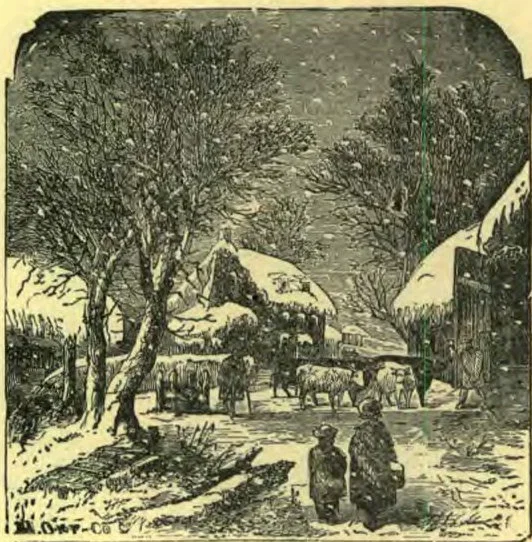
THE SNOW-STORM.

The white snow is coming, hurrah, boys! The keen air is full of its flakes; Don’t you hear its light touch at the window? What a musical rustle it makes!
Hurrah, boys! Get up in the morning! Dress warm, for the air will be chill; Bring out the gay sled from its shelter, And away to the sport on the hill.

HOW WALTER ENTERTAINED THE BOYS.

A HEARTY laugh burst from the group of boys clustered around the lamp-post at the corner. The smallest of them, Alfred Lester, exclaimed a little contemptuously, “The idea of a fellow thirteen years old not knowing how to make a snow-ball! Why, I’m only ten, and I can make splendid ones, hard as anything!”
“I should think you’d have got used to the cold by this time, Walter,” added Alfred’s brother Will.
Walter Perry shivered, wrapped up as he was in overcoat, comforter, overshoes, mittens, and seal-skin cap with ear-lappets, as he replied good-naturedly, “They say an eel can get used to skinning, but I don’t believe I’ll ever get used to snow and ice! If I hadn’t promised Aunt Delia that I would stay out-of-doors one whole hour to-day, you wouldn’t catch me here! Ugh!”
“I believe you haven’t got much courage! You are afraid of the cold!” sneered Joe Brainard.
“May be I am! I am not afraid of a gun that is not loaded, as you were yesterday. I know how to handle a gun, too, if I don’t know how to make a snow-ball.”
The day before this exchange of banter these same boys and one or two others were in Mr. Lester’s house examining a new gun, but Brainard could not be persuaded to touch even the stock, while Harry Greenough was senseless enough to hold it with the muzzle toward him.
“I am accustomed to guns,” said Walter; “brother Arthur and I have often gone shooting.”
“Did you?” exclaimed Will. “What did you shoot?”
“Oh, parrots and”—
“Parrots!” exclaimed three or four. “How could you kill them?”
“Easy enough,—horrid nuisances!”
“Why Walter Perry! Parrots nuisances? They cost lots of money. My cousin Mary has one she wouldn’t sell for a hundred dollars!” cried Alfred Lester.
“You must remember that with us—in the West Indies, I mean, where my father lives—gray parrots are as common and as troublesome as crows are in your corn-fields. Your cousin ought just to hear a flock of them go screaming over the house-tops in the morning on their way to the coffee-fields. Oh, don’t they make a noise!”
“Something like our crows?”
“Only more so. Alfred, does your cousin’s parrot ever scream?”
“Yes, indeed! Sometimes she has to keep Polly covered up for two or three hours to quiet her.”
“Then just fancy twenty or thirty all yelling at once up in the air, where you can’t cover them! Then think of the mischief they do to the coffee!”
“That’s so; they always love coffee.”
“Does coffee grow like corn, Walter?” asked Harry.
“Oh, no; it is a bush with a pretty blossom.”
“What color?”
“White and pale lavender.”
“Oranges grow there, don’t they?” Alfred inquired.
“Yes; oranges, lemons, bananas, guavas”—
“Guava jelly?” suggested Alfred.
“The fruit of which the jelly is made.”
“Does it grow on a tree or a vine?” asked Will.
“On a shrub; it has a pretty flower,—white and pale yellow.”
“Bananas grow on trees, I know; for I saw some growing in the Botanical Gardens in Washington, when papa took me there last year,” said Joe Brainard. “There was only one bunch on that tree, though.”
“That’s the way they grow with us. A young tree comes up and flowers out, bears only once, and then dies; but from the same root there will be young shoots coming up all the time, so that a man who owns a banana walk always has fruit at hand.”
“A banana walk, what’s that?”
“Well, each root sending up so many shoots makes a sort of grove where it is always cool and damp and unhealthy.”
“The people there are fond of bananas, are they not?” suggested Will.
“Fond of them? They live on them,—eat them raw, baked, or fried, for breakfast, dinner, and supper. Bananas are a necessary of life.”
“Which do you like best, red or yellow ones?”
“The yellow ones. The red ones that grow with us are given to the pigs; even the negroes won’t eat them.”
Little Alfred Lester listened in admiration. “What lots of things you know, Walter! A heap more than any of us.”
“Oh, no! I don’t know how to make snow-balls, and you do,” replied Walter, merrily.
“Let’s cry quits, Walter! You may get used to the cold and the snow just when you like. We will not tease you any more. You teach us all you know about the West India Islands, and we’ll make all your snow-balls.”
“Agreed!” cried all the boys, including Walter.
“They have everything nice there, don’t they?” said Will, who was very fond of oranges and bananas.
“Not quite! No such schools as they have here in Boston, or papa would not have sent me here to be educated,” answered Walter. “No one country can have everything. We have beautiful birds, lovely flowers, delicious fruits all the year round,—also earthquakes and tornadoes; but oh! so much ignorance and superstition, even among well-informed people! Give me the intelligence I find here, even among school-boys, if I do half freeze six months in a year! Ha! my hour is up, and nearly another one gone. You’ve entertained me”—
“No! no! You were the entertainer. Tell us some more sometime, won’t you?” cried Joe Brainard.
“May be I will. Good-by. Ho! for the warm parlor,” answered Walter, scampering away.—Church Register.

LETTER BUDGET.

Eveline Bandy, of San Pasqual, California, writes: “My little brother takes the INSTRUCTOR, and we like it the best of any child’s paper of which we know. There is but one other family, Bro. Judson’s, in this valley which keep the Sabbath. We go to their house one Sabbath, and then they come to our house the next Sabbath, to hold meetings. I was baptized last July by Bro. J. L. Wood. I read in my Bible every Sabbath, and some during the week. Pray for me. Yours in love.”
Mattie M. Grace, of Delta, Kansas, writes a nice little letter in which she tells us how much she thinks of the INSTRUCTOR. She says that she loves to read the nice stories, and eagerly looks the Budget through to see if there are letters from her former little class-mates in Wisconsin. She is a little Sabbath-keeper, and is trying to so live as to meet the INSTRUCTOR family in the kingdom.

Never Speak Unkindly to Mother

Never speak unkindly to mother.

You have reached the end of this edition.

The Youth’s Instructor · Dec 8, 1880