Your ShelfYour Projects

The Youth’s Instructor, Vol. 28, No. 50.

A SLEIGH WITHOUT RUNNERS

The Youth’s Instructor

Dec 8, 1880

S. D. A. Publishing Association · Battle Creek, Mich. · Dec 8, 1880
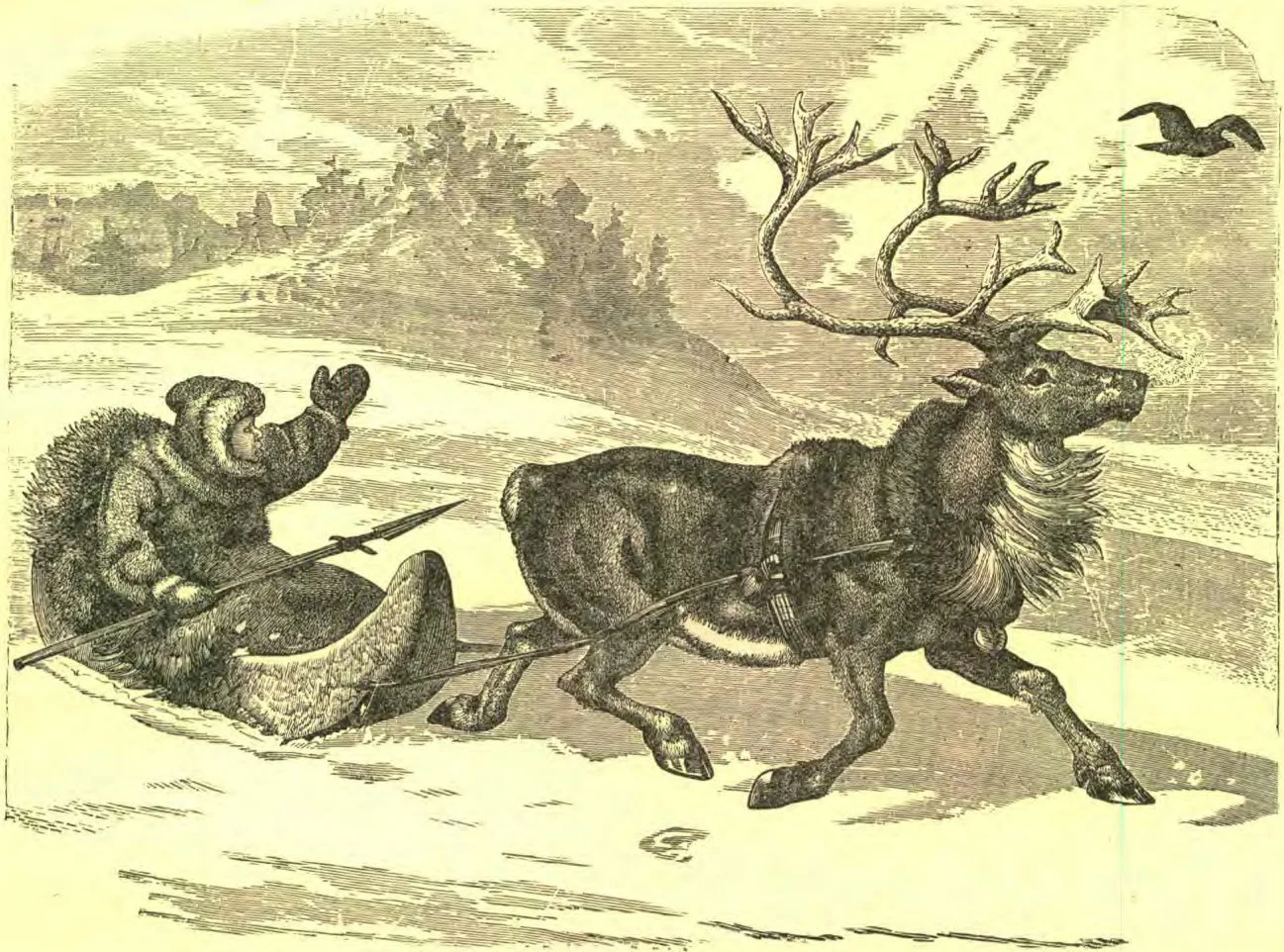
A SLEIGH WITHOUT RUNNERS.

THE accompanying turn-out would, we think, create a great sensation in any of the cities or towns where the INSTRUCTOR is a visitor. How would you like to be its owner, reader?
This picture represents the mode of traveling in the cold and dreary regions of the North, where snow and ice never cease, and where the wind never fails to blow. The traveler stops at night, he cuts out large blocks of snow, and builds two little snow-cots,—one for himself and the other for his dogs to remain in over night.
These sleds are shaped very much like a canoe, and are either constructed of wood or of bone. Water is poured over the bottom, which congeals in the act of application. These sleds travel more lightly than those shod with iron.
Although you and I would get capsized before we had driven a mile, the Esquimaux never does, unless he happens to drive into a snow-drift. Dressed in warm skins, he does not fear the cold, but merrily and safely guides his reindeer over the snow.
V. A. M.

TOADS

Toads are pronounced by Shakespeare to be both “ugly” and “venomous,” but natural history assures us that, as far as mankind is concerned, they are harmless and exceedingly useful. As to their being “ugly,” if “handsome is that handsome does,” then they should be considered most comely. They are certainly well-behaved; are quiet and unobtrusive; given to no turmoils; and quite refined in their tastes, choosing cultivated grounds for their rambles, which they endeavor to free from insects and bugs that would otherwise injure or destroy much of the gardener’s labors. It is said that “in one night a single toad, taking his position by a vine-hill, would destroy more bugs than thirty active men in twice the number of hours.” They are provided by nature with a membranous stomach, capable of great distention, and rapid digestive organs which encourage them to active labor to satisfy their never-failing appetites.
The toad catches his prey with his tongue, which, on prying open the mouth, appears like a little fleshy eminence situated on the under jaw, with the point directed toward the gullet. The tongue is very elastic, and may be projected at pleasure from one to six or eight inches, and perhaps farther, as quickly as a flash of light. It never goes by the object, or falls short of it, as the visual axis or point where both eyes meet on the object is exactly at the distant extremity of the extended tongue. If one eye should be destroyed, it would be unable to procure food and would die of starvation. The eyes of the toad have a peculiar prominence, the globes being almost entirely outside the skull. This enables them to see their prey from all directions at the same instant.
The tongue exudes a tenacious excretion, so sticky that the slightest touch of the object at which it is thrust holds it fast, and the instant contraction of the muscles conveys the unfortunate victim to the mouth of its enemy.
Water must be introduced into the system to dilute their food, and as they cannot drink by the mouth, it is imbibed by absorption through openings in the skin. The wart-like cells, so prominent upon the back, are many little cups capable of holding water to meet the demands of the system should drouths occur. The reason that toads are seen in such great numbers after showers is because they go out to be refreshed with pure water, which, pattering on their backs, may be quickly absorbed. This cutaneous absorption is indeed a curious provision of nature.
There are many species or varieties of toads, one of which I must mention before closing this article. It is called the pipa, and is a native of Surinam. It is a foot or more broad. The warts on the back are large cells, or nests we might call them, into which, by the assistance of the male, the eggs are deposited after extrusion. Here they are hatched, and the young ones carried about by the mother with their heads out, enjoying the prospects, as she hops over field and moor.
The field of nature is ever open before us for study, admiration, and wonder; and however ugly or insignificant a thing may appear to the eye unskilled, when strengthened by rays of knowledge, it discovers beauties and wonders before hidden, and the mind is led to think with reverence and awe upon the Creator of all things.
Mrs. A. C. PAPWORTH.

Respect and Honor Due to Aged Parents

RESPECT to aged persons is one of the virtues. There is no period in life when our parents do not claim our love and warmest affection. It should be our constant study how to best promote their happiness and welfare.

THE FIRST AMERICAN NEWSPAPER.

IN these days when American newspapers are numbered by thousands, when every little village has its weekly issue, and when we can take up our city dailies and read the world’s doings of yesterday, how little can we realize of the times when newspapers were scarce, and news traveled slowly.
The story of the first American newspaper, though brief, is full of interest; brief it is, because the paper’s life was brief: Seventy years after the landing of the Pilgrims, and two hundred and fifty years after the invention of printing, a newspaper was issued in Boston. Only one copy of this paper is known to have been preserved; and it was discovered only a few years ago by Rev. J. B. Felt, who, while preparing a history of the town of Salem, visited the Colonial State-paper office in London, for the purpose of gathering some information from the old records kept there. Among other curiosities, this old pioneer of American newspapers was found and examined with interest; it bore the antique name of “Publick Occurrences,” and was published by Benjamin Harris at the London Coffee-house, Boston, and printed for him by Richard Pierce, on Thursday, September 25, 1690, nearly two hundred years ago. The paper was printed on three pages of a folded sheet, one being left blank; each of these pages was eleven inches long by seven inches wide, and had two columns on a page. Imagine a newspaper, the size of an old-fashioned sheet of letter-paper, and this, as the editor proposed, to be issued once a month, or oftener, if at any time there should chance to be a “glut of occurrences.”
Its columns were filled with bits of home and foreign news, without a word of editorial comment. But the paper just here expired; and why was it? Why did not Mr. Harris carry out his proposal, and so furnish the people of Boston and vicinity, “once a month,” an interesting parcel of news? Simply because it happened to contain one or two business and military locals, which greatly displeased some of the official busybodies, and in their indignation, they appealed to the authorities, who forthwith solemnly determined that the paper came out contrary to law and contained “reflections of a very high nature.” (Right here, we can but wonder what would have been the fate of our modern newspapers.) And to prevent a second issue of the paper, they forbade “anything in print without license first obtained from those authorized by the government to grant the same.”
In this way the first American newspaper came to grief; and had it not been for the accidental preservation of this one copy in London, it would have been forever forgotten. This was the first of a great and numerous family, and though like others that made their appearance in after years, long intervals apart, it was nothing but a dry chronicle of news and history, with not much regard to system. It and they, however, as sure forerunners, were preparing the way for the free expression of thought and opinion through our ever-progressing system of journalism, which, with the blessing of God, has made our land a land of liberty.
J. S. LAMSON.

GOOD RESOLVES.

1. THAT God should be the first one spoken to each morning, and the last one spoken to each night.
2. That I will read God’s word daily before reading any other book.
3. That I will every morning ask my Saviour to give me something to do for him that day, and that I will then watch for work and do it.
4. That I will nightly ask myself how far I have succeeded in keeping these resolves, and wherein I might have done better.

PRETTY THINGS FOR WINTER.

A VERY pretty thing to grow in our homes during the winter is the sponge pyramid. For this have four sponges of graded size, rather small than otherwise; tie them separately with gay satin ribbons, sow thickly with timothy and canary seed, and suspend in a sunny window, one above the other, in the order which makes good their name. Keep them thoroughly wet, and in a fortnight nothing is visible save a swinging pyramid of slender grasses, with here and there a gleam of the brilliant ribbons.
The following forms a dainty ornament for either mantel or bracket, and is easily made: Three or four inches above a little bric-a-brac cup or vase (so that they merely touch the water it contains), hang half a dozen large acorns by silken cords of a tint in harmony with the vase. Be careful to replenish the water daily, and soon miniature oaks will begin to grow.

PAPA, WHAT ARE NEWSPAPERS?

Organs that gentlemen play, my boy, To answer to the taste of the day, my boy, Whatever it be, They hit on the key, And pipe in full concert away, my boy.
News from all countries and climes, my boy, Advertisements, essays, and rhymes, my boy, Mixed up with all sorts Of flying reports, And published at regular times, my boy.
Articles able and wise, my boy, At least in the editor’s eyes, my boy; And logic so grand That few understand To what in the world it applies, my boy.
Statistics, reflections, reviews, my boy; Little scraps to instruct and amuse, my boy; And lengthy debate On matters of State, For wise-headed folk to peruse, my boy.
The funds as they were and are, my boy; The quibbles and quirks of the bar, my boy; And every week A clever critique On some theatrical star, my boy.
The age of Jupiter’s moons, my boy; The stealing of somebody’s spoons, my boy; The state of the crops, The style of the fops, And the wit of the public buffoons, my boy.
Last of all, physical ills, my boy, Banished by somebody’s pills, my boy, Till you ask with surprise Why any one dies, Or what’s the disorder that kills, my boy.
Who has got married, and to whom, my boy; Who were cut off in their bloom, my boy; Who has had birth On this sorrow-stained earth, And who totters past to the tomb, my boy.
The price of cattle and grain, my boy; Directions to dig and to drain, my boy; But ’t would take me too long To tell you in song A quarter of all they contain, my boy.—Sel.

LESSONS FOR CHILDREN.

LESSON CII.—RECAPITULATION.

Before Joshua died, he gathered all the tribes of Israel to Shechem. Beginning back before the time of Abraham, he gave a brief account of what God had done for his people. He told them how the Lord had called Abraham and given him all the land of Canaan; how he multiplied the seed of Abraham; and how, when they had become bond-men in Egypt, the Lord plagued the Egyptians, and delivered his people by the hand of Moses, making a way for them to escape through the Red Sea; how he brought them through the wilderness, and drove out the Canaanites before them, giving them cities that they had not builded, and vineyards that they had not planted.
When he had talked to them in this way, he asked them to choose the God whom they would serve, whether it should be the Lord, or the gods of the heathen nations around them. “And the people said unto Joshua, The Lord our God will we serve, and his voice will we obey.” So Joshua made a covenant with the people, and wrote it in a book. After this, Joshua died, and was buried on the north side of a hill in the mountains of Ephraim.
“And Israel served the Lord all the days of Joshua, and all the days of the elders that overlived Joshua, and which had known all the works of the Lord, that he had done for Israel.”
Then there arose another generation after them, which knew not the Lord nor the works which he had done for Israel; but worshiped Baal and Ashtaroth, the gods of the nations round about them.
Then the Lord gave them into the hand of spoilers; and wherever they went, the hand of the Lord was against them for evil; and they were greatly distressed. But whenever the people turned to the Lord, and cried to him, then he heard them, and raised up judges, who delivered them from the hand of those that spoiled them; for “When the Lord raised them up judges, then the Lord was with the judge, and delivered them out of the hand of their enemies all the days of the judge.” “And it came to pass, when the judge was dead, that they returned, and corrupted themselves more than their fathers, in following other gods to serve them.”
The first of these judges was Othniel, the son-in-law of Caleb. He delivered them from the king of Mesopotamia. Then came Ehud, who conquered the Moabites by first killing their king with his own hand, and then leading an army against them. Shamgar, also, performed great feats of courage against the Philistines. At this time the land had rest eighty years; but the people again did wickedly, and fell into the hands of Jabin, king of Hazor. The Lord then raised up Deborah, the prophetess, to judge them. It was by her advice that Barak gathered an army at Mount Tabor, whither Sisera led the host of Jabin, and was utterly defeated. After a peace of forty years, the people again forsook the Lord, and for seven years were cruelly oppressed by the Midianites, who robbed them of their grain, their fruit, and their cattle, and drove them into the dens and caves of the mountains. Then they cried to the Lord for help, and he sent an angel to call Gideon to deliver his people. Gideon met an immense army of the Midianites in the valley of Jezreel, where he defeated them in one of the strangest battles ever known. “And the country was in quietness forty years in the days of Gideon.”
All Gideon’s seventy sons, except one, were slain by a cruel half-brother named Abimelech. Abimelech, however, did not rule long before he was mortally wounded by a stone thrown from a tower by a woman. Then Tola judged the land twenty-three years, and after him Jair, twenty-two years.
Again the people fell to worshiping idols, and were given into the hand of the Ammonites. This time, when they called upon the Lord, he told them to go to the gods which they worshiped, for help; but finally they pleaded so earnestly that the Lord put his Spirit upon Jephthah, and through him conquered their enemies. Jephthah, Ibzan, Elon, and Abdon, each held the office of judge for a few years; and about this time Eli and Samson judged Israel forty years.

QUESTIONS.

1. When Joshua, before his death, had gathered all the people together, what did he relate to them?
2. What important things did he mention?
3. When he had told them all these things, what did he ask them to do?
4. What reply did the people make?
5. What did Joshua do to make the people remember this promise?
6. Where was Joshua buried?
7. How long after his death did the people continue to obey the Lord?
8. What course did they then pursue?
9. How did the Lord deal with them to cure them of their idolatry?
10. When they repented of their evil ways, and called upon the Lord, how did he help them?
11. What did the people do as soon as they were left without a judge?
12. Who was the first of these judges?
13. From whom did he deliver the people?
14. Who was the next judge, and what did he do?
15. How long did the land have rest at this time?
16. What was done by Deborah and Barak?
17. When Barak and Deborah had judged the land forty years, and the people had again forsaken the Lord, what did they have to suffer?
18. Tell how Gideon was called of God when the people repented and sought the Lord.
19. Tell how Gideon delivered his people.
20. Where was the battle fought?
21. Describe this valley.
22. How long did quietness prevail in the time of Gideon?
23. What was the fate of Gideon’s seventy sons?
24. What became of their murderer?
25. By whom was the land judged for the next forty-five years after the death of Abimelech?
26. By whom were the people oppressed when they had again gone to worshiping idols?
27. What did the Lord say to them when they cried to him for help?
28. What did he finally do for them?
29. What men beside Jephthah each held the office of judge for a few years?
30. How long did Eli and Samson judge the land?

NOTES ON THE LESSON.

Othniel delivered his people from the king of Mesopotamia, whom they had served eight years. Mesopotamia is a Greek word meaning between the rivers. This country lay between the Tigris and the Euphrates, and was the same as Pa'-dan-a'-ram.
The Land of Moab was the country inhabited by the descendants of Moab, the son of Lot. It lay east of the Dead Sea, but in the time of Ehud extended north only to the river Arnon. It had many strong towns; but the country is now desolate, and its cities lie in ruins.
Mount Tabor stands on the north-eastern border of the great plain of Es-dra-e'-lon. It is sixty miles north of Jerusalem, about three miles farther south than the lower end of the Sea of Galilee, and nearly ten miles west of the Jordan River,—a little more than one-fourth the distance to the Mediterranean. It rises nearly two thousand feet above the sea, and some thirteen to fifteen hundred feet above the surrounding plain. It is rounded and beautiful in form, with a small plain on its summit, and covered everywhere with handsome forests, except on the south side, where it presents a front of naked limestone rock.
The Midianites were a nomadic or semi-nomadic people, descended from Abraham by Keturah. Gen. 25 : 2. The boundaries of their territory cannot be definitely given. We have seen that the Kenites, to whom Hobab, the father-in-law of Moses, belonged, were a branch of the Midianites. Their range of pasturage in the time of Moses seems to have been the peninsula of Sinai, perhaps the western border of the Gulf of Akabah, whence Moses led the flock of Jethro “to the back side of the desert, and came to the mountain of God, even to Horeb.” Ex. 3:1. But a comparison of the various passages of the Old Testament referring to the Midianites leads to the conclusion that their main seat was east of Edom, Moab, and Ammon, in the bordering desert of Arabia; whence their course, whether for trade or for plunder, was first northward and then westward across the Jordan valley.—Sacred Geography and Antiquities.
The Valley of Jezreel lies about fifty-two miles north, and a little east, of Jerusalem. It is an arm of the great plain of Jez'-re-el, or Es-dra-e'-lon, and runs north-west and south-east, with Little Hermon and the hills of Moreh on its north-eastern side, and the mountains of Gilboa on the south-west. It is a fertile, meadow-like vale, about fifteen miles long by three miles wide. Just at the entrance to the valley on the north-west stands the city of Jezreel upon the slope of Mount Gilboa, and one hundred feet above the plain. About a mile and a half east of the city, a large fountain flows from a “cavernous recess” at the base of Gilboa. This is supposed to be the place where Gideon encamped with his followers, while the immense host of the Midianites pitched over against them on the north side of the valley.
The Ammonites occupied the territory lying between Arnon and Jabbok, having the country of Moab on the south and south-west, and the tribes of Reuben and Gad on the west. Their capital city, Rabbah, or Rabbath Ammon, was situated forty-five miles east of Jerusalem, and about ten miles farther north. It was a place of great natural strength, and Moses says, “The border of the children of Ammon was strong.” Num. 21 : 24. These people were the descendants of Ammon, the son of Lot.
The Philistines were a warlike people that inhabited the fertile plain that lies along the Mediterranean Sea south of Mount Carmel.
G. H. BELL.

A QUESTION ANSWERED.

We are often asked the question, “Should a woman accept the superintendency of a Sabbath-school?” and we answer in the words of the S. S. Times, which fully meet our mind:—
Yes, if she is the best man to be found for the place. If the choice lay between a good man and a good woman for the work, we think that the man ought to bear the burden. But there are scores of Sabbath-schools which never would have existed but for the good women who consented to take charge of them; and we sincerely hope that no neighborhood will be without a Sabbath-school merely because there is no man there fit for the superintendency, or who has grit and grace enough to undertake it.

LOWLY SERVICE.

There is danger that because we cannot do great things,—cannot achieve some great success,—we shall sit idly down and do nothing. The world is full of people who, neglecting and despising the work given them, are continually asking for “something higher.” They are not content to fill the niche in which God has placed them, but are continually envying those in responsible places,—places for which they themselves are not at all fitted. Their work may be just as good and just as useful, but they must do some other man's work, or they are not content. They forget that the master of all is servant of all.
Now we might expect that in the work of the Lord there would be no such spirit manifested,—that those who labored together for the Master would be “without envyings and without strife.” But how often, even in the Sabbath-school work, we see strife and hard feelings arising as to who shall sit in the “high places,” as some are pleased to call them. If one is once an officer in the school, it is no reason that he should never again take the place of teacher; and if he is a teacher, it does not follow that he can never again, under any circumstances, take his place as a member of a class. We have heard persons say, “If I cannot be a teacher, I shall not go to Sabbath-school at all.” And Sabbath-school workers have said to us in confidence: “Now Bro.— has been superintendent of our school for years. There are others in the church better fitted for the place, but if he is not retained in office, he and his family will remain away from Sabbath-school. Our numbers are few, and we can hardly spare them. What shall we do?” We have said, and would say again, “Be sure before you make the change, that it is for the better; and then if Bro.— and family choose to stay away from the school, let them do so. You are better off without those who have such feelings.”
Those who manifest a right spirit, will usually receive all the honor due them. And is not one place in the Lord's work as honorable as another? The following article from the pen of Mrs. Margaret E. Sangster, in the S. S. World sets forth the matter in its true light:—
“A young man of intelligent appearance, not long since was observed to be a frequent visitor in a well-conducted Sunday-school. Finally, the superintendent asked him if he would not like to join the Bible-class. The young man's answer was a peculiar one. He said: ‘Up-country where I came from I was superintendent of our school, and it would strike them as rather odd, if ever they heard it, that I had come down to joining a Bible-class.’”
“In this feeling, and in its expression, there was a not uncommon mistake. Lowly service is not regarded with the respect to which it is entitled. The privilege of standing in the ranks is not estimated at its true worth. I have seen this illustrated in another way. A gentleman had, for a year or two, held the position of secretary in a school whose officers were elected annually. When at a recent election another was preferred before him, he at once left not only the school but the church to which he had belonged, and of which he had been an honored member. His vanity was wounded at the thought that he was not desired in the somewhat conspicuous place he had held.”
“Those who are not willing to be learners are often not fit to be teachers. The man whose false pride forbade him to enter a Bible-class as a student, was, though doubtless unaware of it, lacking in some of the qualifications of a good superintendent. The man who could be hurt to the point of indignant withdrawal, because he was not retained in an office, showed by his action in the matter not only his lack of self-control and magnanimity, but also a lack of real heart in the work.”
“We must take heed to ourselves that we do not despise lowly service. Not long since, in the parlor of a farm-house in the heart of Virginia, I picked up a modest pamphlet, which set forth the services of a man who had been an eminent instructor, a learned philologist, and a faithful worker his life long. This sentence riveted my thought: ‘I have been content,’ he said, ‘to toil among foundations, and to lay, deeply, stones on which others may hereafter build.’ How many there are of us who must of necessity tell a similar story when we approach the end of our life-work. ‘You may imagine,’ said the editor of a rather humble magazine to the writer, ‘that I would prefer being the editor of the Atlantic or Scribner’s, but God has put me here and given me this to do, and I am doing the very best that I can here.’ He was a clergyman of recognized ability and most honorable fame, but he was not unwilling to take upon him a comparatively lower service.
“Perhaps some of us feel that we could, had we only time, place, opportunity, influence, friends, any one of a half-dozen helps which others possess, write poems and stories, sing songs, move audiences, and confer favors, in a way which all who heard or read or received would admire. But instead, we are appointed to very quiet tasks,—to humble work. But never mind; we are busy in the foundations. If God wants us higher, he will bid us come, and himself appoint the work and the wages. Only let us be careful, if sometimes in his providence, we, who have been superintendents and secretaries, drop out of those places for awhile, how we decline the work which may offer itself. If we refuse it because we deem it too humble, our refusal may be received as a proof that our former elevation was an error.” E. B.

SABBATH-SCHOOL ADVANCEMENT.

There is no true advancement in any good cause without steady, persevering effort. This is as true in Sabbath-school work as it can be in any other. There is another thing which is true. Without this steady untiring effort the Sabbath-school will go backward as quickly as the boat will go down stream if you cease rowing. And there is not a school in our land but will improve with well-directed effort persevered in. Let me repeat. No matter how small the school, and no matter how incompetent officers, teachers, and scholars may be; yet if all work to some plan in harmony, the school will improve.
Therefore let no school settle down satisfied with the fact that it does not amount to much and never can, until some great change of some kind comes along. It is not the men of great opportunities who have accomplished the most, but men who have accepted their situation with a hearty good-will, and have gone to work to make opportunities. If Abraham Lincoln had been satisfied that with his opportunities he could only split rails and pilot a flat-boat, his life would have been as inefficient and uneventful as were the lives of those associated with him in that work. His purpose was advancement in knowledge, and after splitting as many rails through the day as any of his fellow-workmen, with a pine knot stuck in the floor of his log cabin at night he made himself a “thorough practical surveyor.” This knowledge he used as a stepping-stone to something higher.
So in our Sabbath-school work, we must take what material we have and make it the starting point of a work which will continue to advance and improve so long as the school has an existence.
But in order to accomplish this there must be some plan in conducting the school, and a method in study. Adopting one plan one quarter and another the next, is ruinous to the school. Studying one thing a few months, and then something else, will give no real advancement in knowledge, but worse, will encourage habits of vacillation.
It is for the purpose of facilitating this kind of work that a graded series of lessons has been furnished to suit the wants of learners of all ages. These lessons have been written and approved by those who have been dealing with minds all their lives long. Then how safe it must be for schools throughout the land, where the officers and teachers have not had this experience, to adopt and use these lessons which have been prepared with so much care and expense.
It is for the purpose of bringing system and some unity of action into all our schools that the General S. S. Association, and the subordinate State Associations have been organized. By doing this we unite the experience of thousands, and give every school in the land the benefit of it all. Then how safe it must be to give the Sabbath-school the molding suggested by all this experience, and how inappropriate it must seem for single schools to adopt a plan at variance with the plan so universally adopted.
No; let us first be sure we understand the plan of carrying on the school, and then let us work toward it with a steady purpose to succeed; and God will bless our efforts, and great good will be accomplished.
Read carefully the instructions in regard to Sabbath-school work which come out from time to time in the INSTRUCTOR and Review. They are too often slighted. It many times costs hours of careful study to present one small article for this department. Do not pass them by. Sabbath-school workers, read them all, and let your plans and work be shaped by them.
Finally, let us press together. In unity there is strength. Let every officer do his duty faithfully, and may “God bless our Sabbath-school.”
  • J. E. WHITE.

NOT IN VAIN.

“I HAVE labored in vain,” a teacher said, And her brow was marked by care; “I have labored in vain.” She bowed her head, And bitter and sad were the tears she shed In that moment of dark despair.
“I am weary and worn, and my hands are weak, And my courage is well-nigh gone; For none give heed to the words I speak, And in vain for a promise of fruit I seek, Where the seed of the word is sown.”
And again with a sorrowing heart she wept, For the spirit with grief was stirred; Till the night grew dark, and at last she slept, And a silent calm o’er her spirit crept, And a whisper of “peace” was heard.
And she thought in her dreams that the soul took flight To a blessed and bright abode; She saw a throne of dazzling light, And harps were ringing and robes were white, Made white in a Saviour’s blood.
And she saw such a countless throng around As she never had seen before; Their brows with jewels of light were crowned, And sorrow and sighing no place had found, For the troubles of time were o’er.
Then a white-robed maiden came forth and said, “Joy! joy! for thy trials are past! I am one whom thy gentle words have led The narrow pathway of life to tread,— And we’re safely home at last!”
And the teacher gazed on the maiden’s face; She had seen that face on earth, When with anxious heart, in her wonted place, She had told her charge of a Saviour’s grace, And their need of a second birth.
Then the teacher smiled, and an angel said, “Go forth to thy work again; It is not in vain the seed is shed, If only one soul to the cross is led, Thy labor is not in vain.”
And at last she awoke, and her knee she bent In grateful, childlike prayer; And she prayed till an answer of peace was sent; And Faith and Hope as a rainbow blent, O’er the clouds of her earthly care.
And she rose in her joy, and her eyes were bright, Her sorrow and grief had fled; And her soul was calm and her heart was light, For her hands were strong in her Saviour’s might, As forth to her work she sped.
Then rise, fellow-teacher, to labor go! Wide scatter the precious grain; Though the fruit may never be seen below, Be sure that the seed of the word shall grow; Toil on in faith, and thou soon shalt know “Thy labor is not in vain.”—S. S. World.

Proper Improvement of the Recitation Hour.

In some schools which we have visited lately, a part of the teachers get through the lesson in about ten minutes, and sit down; while others go beyond the time, and then fail to secure a proper recitation of the lesson. Now neither of these extremes is to be recommended; although, of the two, the first is perhaps the most to be wondered at. A teacher who cannot find enough in the lesson to occupy thirty minutes shows himself to have made very superficial preparation for his work.
A good teacher will aim to occupy all the time, and still come within the allotted recitation hour. Those who cannot get through the lesson too often spend the time in discussing unimportant points, while the main facts of the lesson are neglected. Of course the superintendent should call to order when the time is up, but that does not change the fault in the teacher.
The following by H. Clay Trumbull, in the S. S. Times, is to the point:—
One of the most important lessons for a Sabbath-school teacher to learn is that he can never exhaust the simplest Bible passage; that, however much time he takes, and however much he has studied, there is always vastly more to be got out of that passage than he has yet seen in it. And another lesson hardly less important for him to learn is, that he must get through his teaching work on any Bible passage in the time allotted to it; that whether the lesson text be much or little, and the time for its class teaching be less or more, it is his duty to bring his teaching work within the teaching time.
The question of getting through with a Bible lesson has really little or nothing to do with its length. One verse might occupy a teacher for a lifetime, and a complete lesson could be taught about the whole Bible in ten minutes. A teacher has no more right to expect to serve out to his class all that he finds in a lesson than a guest at a first-class hotel has to eat every dish that he finds noted on the dinner bill of fare, from soup to confectionery. Suppose the guest has but ten minutes before him for his dinner, and finds sixty-three separate dishes on the bill of fare; shall he complain of the superabundance of dishes, or decide which of the entire list to take for his limited meal? A teacher ought to know before he goes to his class how many minutes he can give to the lesson-teaching. Then he ought to decide what points he can bring out from that lesson in the time he has for it. If he is a good teacher, he will bring his teaching well toward a close before his time is up.
Continue reading: THE GREAT NEED