THERE recently appeared in the journals of the day a despatch from Vienna under the caption, "Horrors of the Free Hospitals in Vienna; Patients Inoculated in the Interests of Science, Because They Are Cheaper Than Animals." It has been discovered that in the free hospitals of that city patients are systematically experimented upon by the physicians in charge. Children and women are the principal subjects, tho youth and dying patients do not escape inoculation by deadly germs at the hands of those with whom they have intrusted their lives. In one case a doctor injected the bacilli of an infectious disease from a decomposing corpse into three women and three new-born children. In another case a youth who was on the road to recovery was inoculated and died within twenty-four hours. One doctor, who had received an unlimited number of healthy children from a foundling hospital, used them entirely for experimental purposes, inoculating them with deadly virus in order to study the progress of the diseases in the children whom he was thus slowly murdering. The excuse given for such a practise is that the children and patients are cheaper than animals for such "scientific purposes."
No words of condemnation could be too strong for this wholesale slaughter of the innocents. Nothing but the complete loss of all fear of God and of all natural love of humanity could permit such diabolical practise, even under the flimsy cloak of "scientific purposes." This may be science, but it is science gone mad. It may be "wisdom," but it is the wisdom of the wicked one—"earthly, sensual, devilish;" not that which is born of God—"peaceable, gentle, easy to be entreated, full of mercy and good fruits."
Lovers of money are scheming for the accumulation of millions in a day, and lovers of fame are no less insatiate. A scientist or a physician springs before the world like a jack-in-the-box with some marvelous discovery, and his name is heralded around the globe. His fame sets on fire the ambition of scores of unprincipled men, and such practices as above recorded are the deplorable results. The scientist who considers human life secondary to the exploitation of some discovery, real or imaginary, and proceeds to sacrifice life that he may write a book to chronicle his observations, has forfeited all right to be at large. Such criminals are the more dangerous because of the helplessness of those who are their special prey. Other incidents of this kind have been recorded, which would go to show that the practise is not restricted to Vienna.
If evidence had heretofore been lacking to show the moral degeneracy of the times, it is furnished in such occurrences as this. C. M. S.
O, WHERE are the souls who are born of God,
Who will walk life's path where the Saviour trod,
Who will teach the Gospel at any cost,
In the broadening way of the blind and lost?
They need not travel to India's shores;
They can find them close to their very doors.
Go tell those who suffer with pain and cold,
There is health and shelter in Jesus' fold.
Hide thou not thyself from thy flesh and blood,
But find those who suffer from fire and flood.
Go search out the cause thou knowest not
Of the widow and orphan long forgot.
Go find those who feed the drinker's blight,
And lead them to Jesus, the world's true Light;
Bid mothers and children to hope again,
And to trust in the Lamb for sinners slain.
Tell mourners of Him
who from heaven
came
To relieve the sad, the
sick, and the lame;
How He suffered "the
curse" for those in
sin,
To redeem from death,
and their love to
win.
Yes, tell vilest sinners,
who Christ despise,
That they are precious
in Jesus' eyes,
And the glittering gates
of pearl swing wide
To all who through
Truth will be sancti-
fied.
G. T. WILSON.
Stanmore, N. S. W.
PITCAIRN AMONG THE ISLANDS.
By E. C. Chapman
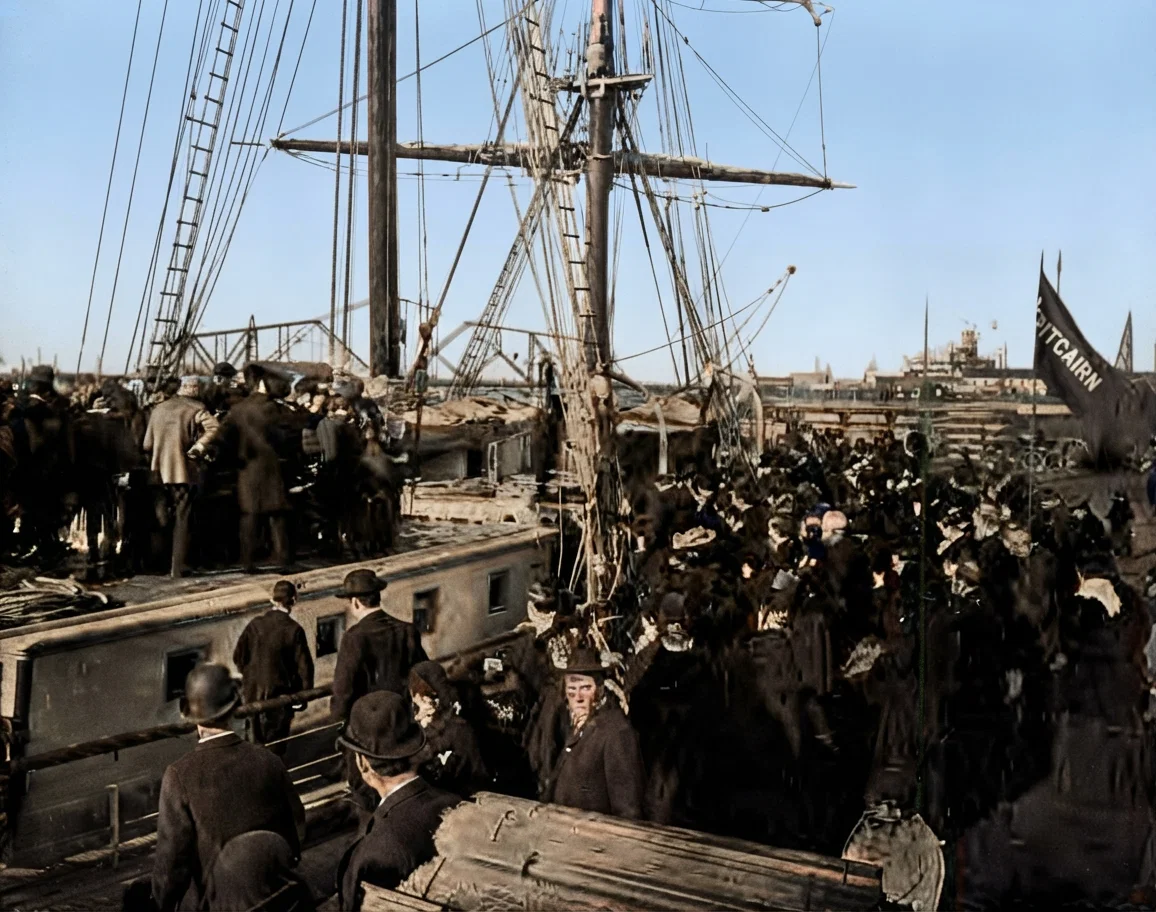
YES, our good missionary ship Pitcairn has entered upon its sixth cruise to the islands of Polynesia. It is probably now in the region where flying fish and tropic birds go dashing by and the north star hangs low in the horizon. It may be that our brethren have, ere this, sighted the southern cross and passed the doldrums.
As the ship is headed south no land will be sighted until 25° south latitude, where lies the island of Pitcairn, some thirty days' sail from San Francisco.
As our earth revolves upon its axis toward the east, the unstable elements of wind and water naturally rush across the equatorial region of the Pacific toward the shores of Asia. In order to take advantage of these currents, the course of our missionary ship is directed westward through the tropics.
The people of Pitcairn Island are always on the alert to note the approach of passing vessels, and as the season of the year has now arrived when they would naturally begin to look for the Pitcairn, they are no doubt doubly watchful. The eyes of the islanders and seafaring men become somewhat telescopic, so they are generally able to see much farther than landsmen.
While waiting upon Pitcairn Island for the return of our vessel, we one day heard a distant yell, which was soon caught up by others until it echoed and re-echoed over the length and breadth of the little island. Some one had sighted a sail. Immediately there was a general hurrying to and fro, men gathering oranges, bananas, pineapples, and melons, while others hastily made ready to launch the whale-boats to go and meet the coming vessel. One with a glass from the hilltop reports that it is the Pitcairn, and there is great rejoicing.
We can quite imagine ourselves once more seeing the islanders gathering in the old thatched chapel to hear the good news from America. The onward progress of the message that we love, the need of a deeper Christian experience, and the reception of the Holy Ghost, are all topics of live interest to these people.
FAREWELL SERVICE ON THE PITCAIRN JUST BEFORE SHE LEFT THE WHARF.
As the Pitcairn sails away from the place after which our good vessel was named toward the Society Islands, the course will be to the northwest, where lie a large number of small coral islands known as the Tuamotu Archipelago. A rugged reef of coral, enriched by drift and sand, with a fringe of coconut trees, is all that goes to make up many of these low islands. While there are some fourscore places in this group where the little trading schooners call for copra and pearl shells, it would not be wise for the Pitcairn to stop at any of them, so she bears on her course to Tahiti, the port of entry and headquarters of the French possessions of Polynesia.
We have one brother in the low archipelago just passed, Alex Drollet, who is conversant with French, English, and Tahitian, and is in a position to do much good.
Our vessel is regarded with a friendly feeling generally by the natives, and its movements are carefully noted. The semaphore upon the heights back of Papeete, Tahiti, will not long have signaled a brigantine outside the harbor before it will be noised abroad among the natives far and near that the "pahi Pitania" (ship Pitcairn) has come again.
Should the Pitcairn not return, the conclusion would gain ground among the natives that this religion was dying out. Its coming has a wonderful influence to strengthen the confidence of those who are weak in the faith, as well as to encourage those long in the way. The Pitcairn is the only missionary ship which visits the French possessions of Polynesia. The London Missionary Society has abandoned that portion of the South Pacific.
Our work among the Society Islands has been largely confined to Tahiti and Raiatea. None of our workers have yet located upon the fine islands of Moorea, Tahaa, Huahine, or Boroboro.
Tahiti and Raiatea both have commodious harbors, while Pitcairn, Rurutu, Rimitara, and Rarotonga are deficient in this respect. Whole navies might drop anchor within Raiatea's barren reef.
Six hundred miles west of the French possessions the rugged heights of Rarotonga present a pleasing picture to the visitor. Our brethren who are there laboring year after year will no doubt do their share of rejoicing upon sighting the welcome sail of the Pitcairn.
Rarotonga is the principal island of the Cook group, Aitutaki, Mangaia, and Atiu being smaller, but still important islands. Upon none of these have we workers except on Rarotonga.
After visiting Samoa, where war and unrest fill the hearts of the native people, our brethren will hasten on to Tongatabu, which is the principal island of the Tongan group. Here the king of Tonga has his palace and the proudest of Polynesian tribes conduct a very elaborate system of government.
The Tongans are a fine-looking people, who make singing their specialty, and farm a little at odd intervals.
Beyond Tonga lies Fiji, with its population of over 100,000. Suva, Fiji, is the greatest business center of the South Sea Islands. Steamers come and go frequently. The large population is scattered over a great many islands, so that Fiji comprises about as much in population, business, and territory as all the other groups mentioned combined. It is a great missionary field. Large numbers of natives from the Solomon group and other cannibal isles to the west have been brought to Fiji on the labor vessels. These men are now scattered among the Fijians. It seems to us that an excellent opportunity is thereby given the missionary of reaching the wild natives of the western groups by beginning with those now in Fiji, where the climate is more healthful and environments less trying than in the Solomon or New Hebrides groups. There are also large numbers of East Indians in Fiji.
We will not go farther with the ship at this writing. E. C. CHAPMAN.
Egypt.—The obstacles in the line of work in Egypt are many, but let me mention these three: The learning of the Arabic language is difficult because of its many guttural sounds. The prevailing religion is Moslem, and it is hard to fight against, because it is a mixture of truth and error. Another difficulty is the position given to woman. She is liable to be divorced at any time, and divorce hangs over her head like the sword of Damocles.—Rev. W. M. Nichol.10
Gospel Expansion in Siam
By Robert E. Speer
In Siam the Gospel has been carried northwest to Cheng-tung, in the British Shan States, and northeast into Luang Prabang, and the Sip Sung Pun Nah, in French territory. It was hoped that the French would not object to the Protestant missions, but when at last the old missionary, who for years had been working northward in the hope of reaching the unreached peoples, endeavored to begin his station he was obliged to leave almost with broken heart. Under British rule, and in Siamese territory proper, there has been peace through the year, and no man has hindered the Gospel.—Robert E. Speer.
Opportunities in China
By Henry Blodgett
Opportunities in China.—The West River has recently been opened in all its length to trade and trading vessels. The Yang-tse has been opened in like manner. These rivers flow through densely-populated countries, and large numbers of missionaries are needed to reach the multitudes of people. A steamer has passed through the rapids of the Yang-tse, and the fifty million of Szechuan are now accessible by steam communication. The number of missionaries there needs greatly to be increased. The province of Hunan has now two resident missionaries. This province has been intensely hostile to foreigners. Until very recently no foreign missionary could labor in that province at all.—H. Blodgett, D.D.
The Outlook in Japan
The Outlook in Japan.—New treaties with Japan are to go into effect this year, which will probably largely influence educational missionary work in the empire. The educational council of Japan is said to advise that foreigners be forbidden to conduct schools in Japan; whether this includes theological schools does not yet appear. The reason is said to be “the influence of foreigners in denationalizing the youth of Japan.” The national spirit, already manifested in other departments, seems likely to affect the educational system. Two opposite tendencies have for years been at work in this island empire, one in favor of a fellowship of nations, and the other intensely and narrowly Japanese, and miscalled patriotic. The latter seems for the time to prevail.—Missionary Review.
South Africa’s Rising Empire
By Bishop Hartzell
IN South Africa there is a country larger than all of the United States east of the Missouri River, in which a new Anglo-Saxon empire is developing. Already there are 700,000 white people, about equally divided between the English and their descendants and the Holland Dutch and their descendants. In this section there are now more than 6,000 miles of railroad. Cape Town, Port Elizabeth, Durban, in the far south and southeast, are splendid cities, while 650 miles north of Cape Town lies Kimberley, with its 20,000 people, the greatest diamond center in the world, from which $15,000,000 worth of diamonds are shipped every year. Farther north lies Johannesburg, the great gold center. South Africa leads all other nations in the world in its gold output.—Bishop Hartzell.
No Wonder That Spain Is Poor
No WONDER that Spain is poor. She supports from her treasury 117,000 monks, nuns, and other persons under religious vows—nearly five times as many as the former standing army of the United States.—Congregationalist.
White Influence
White Influence.—Writing to The Missionary Review, Mrs. J. T. Whitney says: “While in the Marshall Islands with my husband, I was trying to persuade a native young man to go as a teacher to another island. He said, ‘We Marshall islanders are not like white people,—we love our relatives and our homes.’ No wonder he said it, when he had seen so many white men who were mere driftwood. To counteract the influence of these low white men is one of the greatest obstacles in these islands.”
It is so everywhere; those who have had the best opportunity, and therefore ought to set the best example, will not go into the kingdom of God themselves nor set such an example as to encourage others to go in.
THE LAMENT OF A MISSIONARY BOX.
By Mrs. Mary St. Clair
The Heathen Children's Friend.
FORGOTTEN and forlorn I live
Upon a dusty shelf;
I'm so dispirited and sad
I scarcely know myself.
A missionary box am I,
And better days have seen,
For coppers, silver, yes, and gold,
But now I'm very lean.
When from that meeting long ago
You brought me here with glee,
"Our box shall soon be full," you cried;
"How happy we shall be!"
Bright hopes were they, but quickly dashed,
Once only full I've been.
Your ardor swiftly, sadly waned,
And I have lacked since then.
The missionaries say, indeed,
That pence to pounds soon grow;
But older people ought to give;
We need the money so.
And thus in emptiness I wait,
And dustier grow each day;
While, heedless of my silent plea,
You round me work and play.
Altho each day you have three meals,
You never seem to think
That I, poor, wistful mission box,
Should want to eat or drink;
Yet I am always hungry now;
My mouth stands open wide.
Dear children, drop the pennies in;
They'll be so safe inside.
MRS. MARY ST. CLAIR.
Indianapolis, Ind.
Korea’s Political Crisis and Missionary Work
By Sunday School Times
KOREA, midway between Japan and China, is like an imbecile child. Russia took off her hand early in the year, so placating Japan, with whom then she covenanted to leave Korea alone for a while. Left alone, the weak, silly, corrupt king, surrounded by weak, silly, and corrupt men, is conducting a government which is the laughing stock and the despair of all who would help it. As the ablest man of Korea said not long ago: “One resolute man with a pistol could capture the Korean Government. But what would he do with it? There are no capable men with whom he could conduct the State.” The progressive men compose what is known as the “Independence Club,” an organization which makes daring propositions near of kin to sedition, and whose desires are right, tho capacity and confidence are wanting. Meanwhile, throughout the whole land, the missionaries continue to lay deep and strong foundations on which they expect that in time a new Korea will rest.—Sunday School Times.
Obstacles in Africa
By Rev. T. W. Woodside
Obstacles in Africa.—There are two classes of obstacles: First, from the natives themselves—the apathy, they are so content with what they have and are. Second, obstacles from without, from immoral white men, rum, and slavery. The rum is the vilest kind of stuff, made of potatoes and doctored with sulphuric acid. Then there is slavery, not only among the natives, but also among the white men; Portuguese, Dutch, and Englishmen buy slaves. This is not only domestic, but there is also slavery on the high seas. Slaves are shipped upon the high seas. There were one hundred slaves on the steamer on which we came home. They, of course, are not called slaves, but “contract laborers.” They have contracts made out by a notary public, but they are fraudulently obtained.—Rev. T. W. Woodside.
Missions in Russia
"ACROSS the whole of Northern Asia great Siberia spreads. With his back against the Arctic Circle, impregnable from behind, the Russian bear reaches out southward. His railroad grows steadily, and his destiny as steadily expands. It can not be that God is permitting the mighty growth of Russia in Asia only for evil. Surely God's purpose is to bring out of the expansion of the Slav a new enlargement of His church. But missions have not found their place yet under the double eagles of the czar." So says a correspondent of the Sunday School Times.
But God can work effectually in the worst countries without great missionary establishments, when He has men who have a mind to work. This was demonstrated by the apostles, and is being illustrated to-day by some of our brethren even in Russia.
Mexico
By Editor
Mexico.—In a report concerning our sister republic, Rev. C. D. Campbell says: “Mexico has twelve and one-half million inhabitants. There are one hundred thousand Christians. The country is open from end to end. The two principal railroads are in the hands of Americans. The mines are going into their hands, but they are not Christians. The government is friendly to missions. Two states are without Christian workers. Medical missions will pay as well in Mexico as elsewhere, will speedily become self-supporting, and there is but one medical mission in Mexico.”
If this mention refers to the medical mission at Guadalajara, then the only mission of that character in Mexico is a Seventh-day Adventist institution. If it refers to some other medical mission, then the writer is mistaken in stating that there is but one.
Cash Cost of Converts
Cash Cost of Converts.—Often the mathematical Christians of our day attempt to depreciate missions by making out the cost of conversions to be unduly dear. In the November issue of the Baptist Missionary Magazine appeared a series of statistical tables, showing the results of the past eight years in the foreign work of the United States Baptists, Congregationalists, Methodists, and Presbyterians. The last of these columns contains an estimate of the cash cost of each convert.
The statistics may be interesting, but there are a hundred reasons why all such estimates are both dishonoring to God and misleading to men. We have not one word in Scripture to justify any such materialism in our estimate of God's work. Who shall ever tell us the worth of Saul's conversion to the church and the world? Think of a financial reckoning of the value of Luther to the ages.—Missionary Review.
LESSON IX.—SABBATH, MARCH 4, 1899.
THE FIRST MIRACLE.
Cana of Galilee, A.D. 27.
(John 2:1-11.)
1 “AND the third day there was a marriage in Cana of Galilee; and the mother of Jesus was there; and Jesus also was bidden, and His disciples, to the marriage. And when the wine failed, the mother of Jesus saith unto Him, They have no wine. 4 And Jesus saith unto her, Woman, what have I to do with thee? Mine hour is not yet come. 5 His mother saith unto the servants, Whatsoever He saith unto you, do it. 6 Now there were six water-pots of stone set there after the Jews' manner of purifying, containing two or three firkins apiece. 7 Jesus saith unto them, Fill the water-pots with water. And they filled them up to the brim. 8 And He saith unto them, Draw out now, and bear unto the ruler of the feast. And they bare it. 9 And when the ruler of the feast tasted the water now become wine, and knew not whence it was (but the servants which had drawn the water knew), the ruler of the feast calleth the bridegroom, 10 and saith unto him, Every man setteth on first the good wine; and when men have drunk freely, then that which is worse; thou hast kept the good wine until 11 now. This beginning of His signs did Jesus in Cana of Galilee, and manifested His glory; and His disciples believed on Him.”
NOTE.—The texts inclosed in marks of parentheses, while not essential to the lesson study, will be found to throw much light upon the lesson, and are suggested for those who wish to study further.
SUGGESTIVE QUESTIONS.
1. On the third day following the last events studied, what took place in Cana of Galilee? John 2:1.
2. Who is mentioned as being present at the wedding? Verse 2. Note 1.
3. What threatened to mar the pleasure of the occasion? Verse 3. Note 2. (Judges 9:13; Ps. 104:15.)
4. Who was appealed to for a remedy? and by whom?
5. In reply, how did Jesus address His mother? Verse 4. Note 3. (John 19:26; 20:15.)
6. What reason did Christ give for thus checking His mother's interference? Note 4.
7. Notwithstanding these words of Christ to His mother, what did she order the servants to do? Verse 5.
8. What sort of vessels, and how many, were standing near? Verse 6. Note 5. (Mark 7:3.)
9. What order did Christ give the servants? Verse 7.
10. Having filled the jars, what did He then tell them to do? Verse 8.
11. Did the conductor of ceremonies know where the new supply of wine came from? Verse 9. Note 6.
12. Upon tasting the wine, what did the master of ceremonies do?
13. How did he congratulate the bridegroom concerning the acquisition of wine? Verse 10.
14. What is the work of Christ called by the evangelist? Verse 11. (John 1:14; Isa. 40:5; John 11:40.)
15. What effect did it work upon His disciples? Note 7.
16. Where did Jesus next go? and who went with Him? Verse 12. (Matt. 12:46; 13:55; John 7:3, 5.)
Side Lights.—“Desire of Ages,” pp. 144-153; “Spirit of Prophecy,” vol. 2, pp. 98-115.
NOTES.
1. Cana.—“The reedy place,” so called from the thick jungles originally found in its immediate neighborhood; was situated on a hill which rises from the plain of El Battauf. It is supposed to have been nine miles north of Nazareth, the home of Jesus, which was the first objective point of the journey. Arriving there, and finding no one to receive them, Jesus and His disciples accepted an invitation to be present at the wedding, which from attending circumstances seems to have been that of some relative of Christ, judging from the prominent part his mother was acting in connection with it.
2. Wine failed.—Fresh juice of the grape was considered indispensable at a Jewish wedding, while the fermented variety was forbidden. Prov. 20:1. It is not known how long the festivities had been going on before the wine gave out, but such a failure was a disgrace to those making a feast, and so the extremity on that occasion was one to be deplored.
3. Woman.—He no longer calls her “mother,” but uses a familiar Hebrew expression, the common form of address to all women. He wishes her to understand that she no longer controls Him, but that He is under the sole guidance of His Father above. Her interference in His work, on the ground of her fleshly relationship, was repudiated. There was danger of her forgetting His changed relation to her. While the address now seems harsh, it was not then so considered, as will be seen by His last tender words to her, when He was expiring on the cross. John 19:26.
4. Mine hour.—The hour is not Mine in which to be glorified; the time has not yet come for Me to be exalted. God fixes My hour and work; I must now glorify Him alone.
5. Manner of purifying.—The sanitary precautions of the Old Testament had been so distorted by the Jews of that day that before every meal each person must wash his hands. No one came from the market and neglected the prescribed ablution. Every guest must have his feet washed upon arrival, and leave his sandals outside of the door. For these purposes, and countless other washings, great stone jars were by the doorway. At this place there were six of these, each holding about ten gallons. This is the lowest estimate of their capacity made by any author. To fill all these with wine showed overflowing generosity, which is characteristic of the Lord in answering our requests for spiritual blessings.
6. Knew not whence it was.—This was a great miracle. As said by Milton, “The conscious water saw its God and blushed.” The difference between this miracle and the regular operation of nature was only in the matter of time taken to obtain the result. In the operation, one is as much a miracle as the other, since it requires the power of God to accomplish the result in either case. The miracle did not break the order of nature's laws, but only hastened it.
7. Believed.—Without doubt, as the guests remarked on the quality of the wine set before them, inquiries were raised as to where it was procured. The servants, of course, related the whole proceeding. Jesus was then sought for. Anticipating this, in His great modesty He retired, and this act on His part gave opportunity for His disciples to proclaim Him as the Son of God, the Messiah. Quickly the news of the event spread until it reached even Judea, and so Christ sought retirement for a few days.
12 “AGAIN therefore Jesus spake unto them, saying, I am the light of the world; He that followeth Me shall not walk in the darkness, but shall have the light of life.”
31 “Jesus therefore said to those Jews which had believed Him, If ye abide in My word, then are ye truly My disciples; 32 and ye shall know the truth, and the truth shall make you free. 33 They answered unto Him, We be Abraham’s seed, and have never yet been in bondage to any man; how sayest Thou, Ye 34 shall be made free? Jesus answered them, Verily, verily, I say unto you, Every one that committeth sin is the bond- 35 servant of sin. And the bond-servant abideth not in the house 36 forever; the son abideth forever. If therefore the Son shall make you free, ye shall be free indeed.”
Golden Text.—“If the Son therefore shall make you free, ye shall be free indeed.” Verse 36.
SUGGESTIVE QUESTIONS.
(1) When Jesus was in the temple during the feast of tabernacles, what remarkable declaration did He make? V. 12. Note 1. (2) What did He say to those Jews that believed on Him? V. 31. Note 2. (3) What knowledge would they gain by abiding in His Word? And what would be the consequences to them? V. 32. Note 3. (4) What answer did the Jews give? V. 33. Note 4. (5) What reply did Jesus make? V. 34. Note 5. (6) What did Jesus say of a servant? and of the Son? V. 35. Note 6. (7) How can one be made free indeed? V. 36.
NOTES.
1. “The light of the world.”—Jesus used a prominent feature of the feast of tabernacles, then being celebrated, as a symbol of this great truth. He was at this time in the treasury (see verse 20); that is in the court of the women, where were the thirteen treasure chests, with trumpet-shaped openings to receive the gifts of the people. Close behind him, says Canon Farrar, were two great candelabra, seventy-five feet high, on which, every night during the feast, lamps were lighted which shed a soft light for a long distance around. Under these lamps the people, even to the stateliest Pharisees and priests, joined in festivities. At the same time, to the accompaniment of instrumental music, the Levites, drawn up in array on the fifteen steps which led up to the court, chanted the beautiful psalms which early received the title of Song of Degrees. These lights were in commemoration of the pillar of cloud in the wilderness which gave light to the camp of Israel.
2. “If ye abide in My word.”—Here is the key to Christian life and final salvation. The blessing of such abiding is indicated in chap. 15:7: “If ye abide in Me, and My words abide in you, ye shall ask what ye will, and it shall be done unto you.” It is through the Word that we must be sanctified. The prayer of Christ for His disciples was, “Sanctify them through Thy truth; Thy Word is truth.” Thus we see that the importance of implicit obedience is limited only by the value of salvation.
3. “The truth shall make you free.”—The Jewish idea of freedom was deliverance from the Roman tyranny. But Jesus knew that their greater need was deliverance from the bondage of sin. However, if Israel had not departed from the truth (“All Thy commandments are truth,” Ps. 119:151), they would have avoided every captivity that they ever suffered. And it is just as true to-day as it ever was that the truth, and only the truth, can make men free. Jesus Christ is the truth (John 14:6), and “if the Son therefore shall make you free, ye shall be free indeed.” Verse 36 of lesson.
4. “Were never in bondage.”—Showing a strange condition of blindness to the truth, or an unwillingness to acknowledge the fact that their nation had been in bondage for hundreds of years, and they themselves were in bondage to the Romans at that moment. Showing also to what lengths people will go to defend themselves against the charge of being sinners, instead of confessing and forsaking sin, and turning to Him who alone can make them free.
5. “Whosoever committeth sin is the servant of sin.”—No man can claim absolute independence; either he is a servant of righteousness or he is a servant of sin. The verb “committeth” is in the continuous present. It is not to commit a single sinful act, but to live a continually sinful life. The sinner is fettered and restrained from freely doing right. His evil nature and his bad habits have the mastery over him. “Let not sin therefore reign in your mortal body, that ye should obey it in the lusts thereof.” Rom. 6:12.
6. God had called Israel to the honorable position of His chosen people. “He came to His own, but His own received Him not.” They did not remain faithful. They became the servants of sin, and therefore could not abide. “Moses verily was faithful in all his house, as a servant.” Heb. 3:5. “And the people served the Lord all the days of Joshua, and all the days of the elders that outlived Joshua, who had seen all the great works of the Lord, that He did for Israel.” Judges 2:7. Then “they forsook the Lord, and served Baal and Ashtaroth.” Verse 13. From that time on their course, with occasional times of revival, was in the main downward in the scale of trustworthy service. But the Son, together with all who are born of the Spirit and are faithful to the end of the race, will abide forever.
Lessons by Mail on Medical Electricity or How to Use the Battery
By Prof. G. L. Abell
By Prof. G. L. Abell
Member of the Board of Directors of the Electro-Medical Society of San Francisco.
Learn how to use the battery and treat yourself. Many diseases are quickly cured by the proper application of electricity. The course embraces the treatment of every organ and part of the body. The lessons are written in plain language and are illustrated. Course, five dollars. Send for circular. Address,
PROF. G. L. ABELL, School of Chemistry and Electro Therapeutics. 22 1/2 Geary St., San Francisco, Cal.
Tract Prices
Arrangements have been made by which you can obtain the tracts published in Bible Students' and Apples of Gold Libraries at reduced rates. Ask your Tract Society or the publishers for an order sheet and circular giving the new prices.