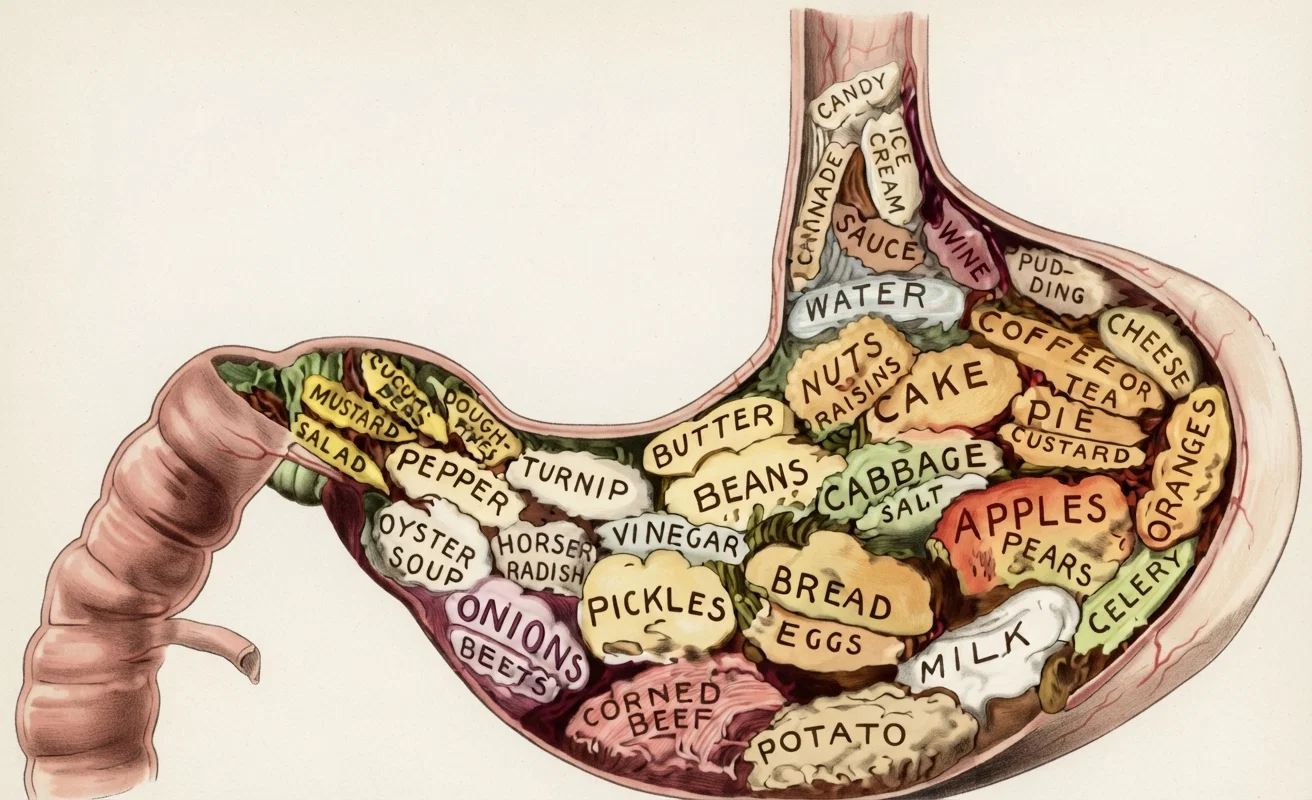
TOO great a variety of food at one meal is injurious to health. Late dinners or suppers, with their long drawn-out courses of many dishes, are no longer a novelty; flesh foods in half a dozen varieties or more are devoured at a single meal, and vegetables, boiled, baked, fried, stewed, scalloped, or steamed, are served with rich dressings, together with fruits, grains, jellies, ices, pickles, salads, etc., etc., etc.
Soups are taken to warm the stomach, ices to cool it, condiments to stimulate it, vegetables to fill it, wines to give it tone, flesh to satisfy its cravings, coffee or tea to wash the food down, and the innumerable variety of pies, cakes, and puddings, together with frozen cream, are eaten to satisfy the mind that a "square meal" has been devoured. But the end is not yet; the pleasure of eating is over with, it is true, but what will the stomach now do with such a conglomerate mass. The stomach has it, and must take care of it in some way. So in order that the reader might better understand what trouble and distress he brings upon his digestive organs when he compels them to work beyond their strength, the writer has concluded to stop here and refer you to the able article that is subjoined hereto, "The Conscientious Stomach," written by Mary Henry Rossiter, of the Battle Creek (Mich.) Sanitarium. B. F. RICHARDS.
The Conscientious Stomach.
The digestive organs awoke with a start. The mouth felt bad, and sighed for a drink of water. The tongue was so thickly covered with germs that the salivary glands made fun of it. Their merriment, however, was of short duration, for the tongue retorted that they looked rather empty themselves, and the mouth remarked sternly that they had better be about their business, if they intended to moisten the breakfast. The pharynx and œsophagus were not very amiable, having a vivid recollection of some blistering salad that had made them smart the night before. The stomach examined its various pits and depressions with great anxiety. Its wrinkles deepened when it discovered the cause of the disturbances which had broken its rest for hours. A mass of decaying and fermenting food was still moving over its lower surface, while millions of germs were dancing about and multiplying at a tremendous rate.
"This is terrible!" groaned the stomach, "but what can I do? My muscular tissues worked as hard as they could for five or six hours, and the gastric juices dissolved everything possible. It is the imperative business of the pylorus to keep its orifice shut against everything but chyme; certainly this stuff is not ready for the duodenum." And the stomach churned up a long string of connective tissue and several pieces of wilted celery.
"Good-morning," said a peptic gland to a pyloric gland near by.
"Good-morning," replied the other, as both began to bestir themselves for the day's work.
"I do hope that our dear stomach will not have so much to do to-day as it did yesterday."
"Yes, indeed," rejoined the second, putting the final touches on a drop of juice. "It was so exhausted last night when the last bit of chyme squeezed through the pylorus, that I am sure it couldn't have contracted another time, no matter what came into it."
"And the worst of it is," continued the peptic gland, "there is a wretched residue of indigestible things that could not get through the pylorus at all, and they have been here all night. Those hateful germs are swarming all over the stuff, and are getting disgustingly fat and happy. I did hope that we were going to starve them out, but the chance is evidently gone for the present."
"It's all on account of the chicken salad, olives, coffee, ice-cream, and cake that came rushing down here, pell-mell, late last night, just as we thought we had everything tidy and ready to leave," said the pyloric gland, which was a very domestic and neat little body. "For my part, I think the mouth didn't do just right. It knew very well that the stomach had not had a moment's rest all day, and I think it might have been a little more considerate."
"But, my dear child," remonstrated the peptic gland, which was more of a philosopher, "the mouth could not help it. The poor thing has to do just what the Man says, and you know yourself that he is a perfect tyrant."
"But he must be a very wonderful being, that Man," said the little pyloric gland, "to be able to defy and control the laws of nature the way he does."
"Wonderful, truly!" said the other dyspeptically. "For my part, I don't believe any more that the Man knows a thing. I think he's an imbecile."
"For mercy's sake!" exclaimed the pyloric gland, secreting several drops of gastric fluid in its excitement, "what makes you think that?"
But before this question could be answered, the two glands became aware of a hurried rhythmical movement along the œsophagus not far away, and suddenly a gulp of hot coffee came plunging into the stomach. Several pieces of half-chewed toast mixed with oatmeal, sugar, and cream, followed immediately. Then came a large mass of beefsteak, then another and another. These were thickly covered with pepper, butter, and mustard, and accompanied by small, hard pieces of fried potatoes. For several minutes the half-masticated steak and potatoes came tumbling down without an instant's pause; then, after a brief respite, the œsophagus swallowed in two buttered pancakes, a quantity of maple syrup, and a doughnut.
The stomach moaned and stirred feebly.
"What better evidence of imbecility do you want than that?" exclaimed the peptic gland, and it sent off a few drops of peptic juice to meet this food. "Look at that toast; for instance, made of half-baked bread in the first place, and full of germs that are just nicely warmed up by the toasting process and prepared to do us every sort of mischief. Then there is all that starch in the oatmeal, as well as the bread. I don't believe the ptyalin ever touched it. It doesn't look like it, and it didn't stay in the mouth long enough anyway, so we can not do a thing with that. There is so much energy wasted by the Man! How ridiculous, too, to put sugar on oatmeal; just as if the body couldn't make all the sugar it wanted out of starch! My! but the œsophagus must be inflamed, with all that pepper and mustard scratching its walls and burning its membrane. You can see for yourself that the Man doesn't know anything, or he wouldn't act so. But we must get to work faster, or that food will lie around here all day."
The stomach by this time had begun to recover from the shock of the arrival of the meal, and was calling for the gastric juices to come to its help. The latter needed no urging, but in numberless little globules ventured out from the tiny ducts, clung timidly for a moment to the edges of the alveoli, and then began to drop off bravely on the nearest mouthfuls; soon a steady stream of digestive fluid enveloped the entire mass of food, while the stomach's muscular layers began to contract, gently churning and mixing every portion of the breakfast. The mucous lining smoothed out its folds to make more room, and all the blood corpuscles in the neighborhood crowded close to the transparent membrane. So wonderful are the resources of nature, and so vigorously did the stomach attack its task, that possibly even the heterogeneous conglomeration of incompatibilities collected in this breakfast might have been reconciled and assimilated had not the Man, at this moment, felt thirsty. The mouth, the pharynx, and the œsophagus had been so irritated by the condiments forced against their surfaces that they set up a lusty cry for water; hence, no sooner had the stomach put its energies in motion than a sudden flood of ice-cold water swept down into it, stopping all the secretions, driving the corpuscles back from the walls, and paralyzing every activity. It was some time before the corpuscles ventured back to their work, and began to warm up the poor little glands that were stiff with cold. By and by a few drops of gastric juice oozed slowly forth and began a desultory work on the saturated food. By degrees the muscular tissues resumed opera13tions, and the process of digestion was again under way.
The stomach felt exceedingly heavy. After revolving its contents carefully, it sent a message of gas to the mouth. The gas signified to the mouth that fermentation had already begun. The stomach, it said, was well aware that the mouth, like itself, labored under limitations; but could it not, for once, refuse to open its lips to further atrocities that day? This course would, the mouth would assuredly agree, favor the best interests of the Man as well; for with its present burdens the stomach would be absolutely unable to send any more nourishment to the body unless it could have a little peace.
The mouth replied that itself, the teeth, and the tongue were all in thorough sympathy with the stomach, and would do everything possible to carry out its wishes. At the same time it could think of no way to keep itself closed against the Man's will unless it could manage to bring on lockjaw. It feared, however, that this would be impossible, since the Man had a terror of lockjaw, and took every precaution against it; besides, there was danger—
But here the mouth's remarks were cut short by a cigar placed between its teeth.
The stomach would have begun to ache had it not learned by experience that if it did the Man would send down a pill or a powder that would merely stop the pain and make matters still worse. Many a time the stomach, feeling the hopelessness of the situation, had resolved to protest no more, even to the mouth, but to bear its sufferings in silence, and to do its duty by the Man without murmuring so long as any one of its functions continued able to work. But the stomach realized better than any other part of the body the vital importance of digestion. It knew that every other organ, that every blood-vessel, muscle, and nerve, in short, that every cell of the whole physical system, was dependent upon it for food; that the entire Man, even to his inmost thoughts and emotions, was made of the elements prepared in its laboratory. Altho from earliest infancy it had been constantly abused, tormented, and overworked to gratify the capricious whims of the Man, his family, and his friends, yet it was sincerely and deeply attached to him, not only by the tissues surrounding it, but also by that subtle and indefinable natural affinity that underlies all blood relationships. The stomach loved the Man, and altho in the nature of things it could never have studied physiology, yet it knew by instinct that his course of life was all wrong, that there was no possible harmony between the food he ate and what he expected of it after assimilation. It saw plainly that the Man was slowly but certainly starving and poisoning himself to death. His bones, his muscles, his brain, his hair, his nerves, his blood, were all crying hungrily for food, and irritably refusing the poison that was sent them for bread.
And so on this occasion, as many times before, the stomach turned again to its vast army of little helpers. In them it never found disappointment. On the morning in question every particle of gastric juice that had been able to recover its vital power and to get a foothold on the coarse, chilled masses of food, was earnestly at work dissolving connective tissue and making peptones. The acids of the stomach were breaking down the albuminous walls of the fat cells so as to set free their oily contents, and dissolving also the mineral salts. Not being able to act upon fats or starch, the gastric juice could not do much with the fried potatoes, the oatmeal, or the toast. This was unfortunate, since none of the food had remained in the mouth long enough to be acted upon by the salivary glands; therefore a large share of it could now be removed from the stomach only by peristalsis.
"It is really pathetic," remarked the pyloric gland, which was watching the struggle from the door of its duct, "to see how hard those juices work. They are giving their lives for the sake of the Man, and yet he never lifts a finger to make their sacrifice easier."
"What I am worried about," said the peptic gland, "is that we are not going to have any time to rest before the luncheon comes down. Not that I mind so much on my own account working when I am tired, but I have already secreted all the gastric juice I had prepared for, and I can not possibly get any more ready so soon. I am sorry for the poor stomach, too. It is always so mortified when it has to force into the intestines food that is not properly reduced."
"Well," exclaimed the other, "I should like just once to lay my nerves on that Man. I am only a weak little ignorant gastric gland, but I know I try as hard as I can to do what nature tells me, and I am sure the Man does not, or else he has never paid enough attention to what she says, to know. Sometimes I think he has never heard that it makes any difference what he eats; then, again, I think that he doesn't care; that he just eats things that make that horrid little palate feel good, and doesn't care a thing about all the rest of us. I don't know, but I get all confused when I think about it."
But the patient little glands and all the other activities of the stomach had no more time for social amenities that day. It would be tedious to tell of the ice-cold ginger ale, that sent a shiver through every cell of the digestive organs; of the luncheon that followed the ginger ale; of the peppery soup that made the salivary glands feel lazy, and tore the lining of the œsophagus; of the cold roast pork and the Saratoga chips that sank like lead to the bottom of the soup; of the olives, the jelly, the salad, the pepper-sauce, the ice-cream, the chocolate cake that made the stomach's afternoon one long Spanish torture; to tell again of the evening dinner, the roast chicken and French potatoes, the cucumbers and vinegar, the tomatoes with mayonnaise dressing, the coffee, with green apple pie, and imported cheese. Perhaps it is cruel to mention the Welsh rarebit and the pint of beer that came down about midnight.
Suffice it to say that the Man was sick in the night. When a soft, kind stomach pump descended through the gullet to take away its revolting and intractable burden, the heart-broken stomach, that had worked so faithfully and conscientiously for forty years, heard the Man say between groans: "I have a beastly stomach. Were it not for that I should be a happy man."
THE HOME
BABY'S OTHER MOTHER.
By Minnie Embree
"Will 'oo be baby's uzzer muzzer?"
For he wasn't contented quite;
And so he wanted an "uzzer"
To make everything just right.
There are babies whose own dear mothers
By death have been taken away,
And they're sadly in need of another,
To stand in her place to-day.
O women all over the nation,
These children are calling to you!
Tho exalted or low be your station,
Think soberly, "What can I do?"
Don't try their sad pleading to smother,
And shut yourself up to your own;
Be some little child's other mother,
And have one more star in your crown.
MINNIE EMBREE.
San Pasqual, Cal.
"HELP SALLY TO COUNT FORTY."
By Bombay Guardian
UNCLE ICHABOD C. lived in one of the New England States, and was an active, earnest, praying man, who had quite a notable way of speaking his mind upon all needed occasions.
He was at a church meeting one day, where the members of the church were all expected to be present and to make some statement of their personal experiences and their religious state.
"Sister Sally," a maiden lady of uncertain age, was a member of the church, who used to earn her living by spinning stocking yarn for the neighbors, for which she was paid so much per knot, a knot being—as some of our old lady readers know, and as some of our young lady readers are not likely to know—a thread of yarn long enough to go forty times around the reel, and which was then knotted, or tied around with a thread to keep it separate from the rest.
Mysteriously, Sally's knots of yarn were said to be very liable to lack the requisite number of threads, when counted, and this kind of mistake, it was said, occurred too frequently, and was too commonly in the spinster's favor to escape the remarks of those who were deficient in charity.
The church meeting referred to progressed, till at length Sister Sally's turn came, and she proceeded to relate the story of her sorrows and trials, which, unhappily, were very numerous. She confessed she did not make the progress she desired, and had many temptations and trials, and went through an ordinary and commonplace acknowledgment of sins, and desire for the sympathies and prayers of Christian brethren, when the monotony was broken by the ringing voice of Uncle Ichabod, saying:—
"Lord, help Sister Sally to count forty!"
The effect of this prayer must be imagined; it may reasonably be concluded, however, that if it was answered, some of Sister Sally's troubles and trials would diminish just in proportion as her threads of yarn increased in number, till they reached the legal standard of an honest woman's work.
Uncle Ichabod is dead, but when listening to the dreary platitudes of persons who bewail their sins, and still hide and persist in little cheating tricks and petty meannesses, we are reminded of his pointed prayer, and feel as if they need some one to pray the Lord to help them "to count forty," or fifty, or a hundred, as the case may be, or to do an honest day's work, or measure an honest bushel of corn, or an honest yard of cloth, or pack an honest barrel of apples, or tub of butter; and we really think that a little help from the Lord about counting, reckoning, measuring, weighing, trading, and working would do more toward driving away "temptations and trials and dark hours" from many minds than a good deal of the whining and mourning which are not attended by fruits meet for repentance.—Bombay Guardian.
Relief for the Sick and Despairing
EVERY
SICK
AND
DESPAIRING
MAN OR
WOMAN
CAN
GET
RELIEF
BY
USING
The Kellogg Sanitas Bath
BE GOOD TO YOURSELF, quit taking poisonous drugs and use Nature's remedy. Booklet treating on Health and Hygiene mailed to you free. There are any number of men and women who are sick from some disease. They have struggled for years, perhaps, to find some remedy that will release them from the pain and torture of Rheumatism, Liver and Kidney Troubles, Sciatica, Neuralgia, Eczema, Obesity, Night Sweats, and Indigestion.
The use of the Sanitas Cabinet Bath makes a healthy skin and beautifies the complexion. Recommended by leading physicians; managers of agencies and bath parlors wanted. Enclose 2c stamp for booklet and full information. Address,
The Kellogg Sanitas Co.
Battle Creek, Mich. U. S. A.
NUTS
EASILY and cheaply made in any household by the use of our complete equipment for grinding and emulsifying nuts. The production of our mills is unsurpassed. Full directions and a booklet containing many valuable nut food recipes, free with each mill.
NUTS
Shelled and unshelled, of all kinds at reasonable prices
For further information, catalog, price-list, etc., write to
JOSEPH LAMBERT
Battle Creek Michigan When you write, please mention the SIGNS OF THE TIMES.
Healthful Delicious Nut Foods
The best, handiest, easiest running, cheapest, and most durable
# FLY SHUTTLE
# GARPET LOOM
In the world,—100 yards a day. Catalogue free.
EUREKA LOOM CO.
5018 Main St., Battle Creek, Mich.
When you write, please mention the SIGNS OF THE TIMES.
New Trusts
New Trusts.—Two soap manufacturing trusts are now in process of formation, one in Chicago, and the other in Boston, the Chicago concern with a capital stock of $100,000,000, and the Boston trust with a capital of $29,000,000. . . . . Railway car manufacturing companies are negotiating for the formation of a trust, in which many million dollars will be represented. The moving factor in this new deal is the Michigan-Peninsular Car Company, which has a capitalization of its own amounting to more than $8,000,000. . . . . The charter of the Merchants' Wire and Wire Goods Company, a trust, was filed at Trenton, N. J., on February 4. This trust will control the output of large mills in both the East and West. . . . . A combine covering all grades of oatmeal and breakfast foods is now in process of formation. The capital of this new corporation amounts to about $33,000,000. . . . Negotiations were completed on February 1 for the consolidation of all the leading pottery companies in the United States, with a capitalization of $40,000,000. . . . . The Union Tobacco Company of America, with headquarters at New York City, has filed with the Secretary of State an increase of its capitalization from $19,350,000 to $24,000,000. This increase in stock was secured by the consolidation of the Union Tobacco Company and the North American Commercial Company. . . . . Seven of the largest salmon-packing concerns on the Columbia River have formed a trust under the name of the Columbia River Packers' Association. The capital stock of this new organization is $2,000,000. . . . . There is a trust in process of formation to be known as the United States Cast-iron and Foundry Company. Its capitalization is $24,000,000, and the firms which are uniting to form this corporation are said to control ninety-five per cent. of the total output of cast-iron pipe in this country. . . . . A milk trust has been organized in Chicago, of which Joseph Leiter is the head. The capital stock is principally in the hands of Leiter, he having bought outright the routes of many of the milk dealers. The capital stock of the concern will be $10,000,000. The trust promises not to raise the price of milk for the present, but holds out no promises for the future. . . . . The National Steel Company is about to be incorporated in New Jersey, combining many wealthy firms, and capitalized at $50,000,000. It is expected that within a short time other firms will join the combine, raising the capitalization to about $700,000,000.
International.—China has conceded to England the opening of the city of Nan-ning as a treaty port, which the British consider necessary to the exploitation of West River. The Chinese foreign office also agrees to pay $30,000 to the relatives of the murdered British missionary, Mr. Fleming. . . . . France is endeavoring to raise a loan of $50,000,000 in England, with which to build war ships and make more effective the equipment of her army. . . . . The French ambassador at Constantinople has entered a vigorous protest with the sultan against the concession to Germany of a port and dock at Haidar Pasha, nearly opposite Constantinople, on the south side of the Sea of Marmora, which is to be used as a terminus of the Anatolian Railroad. . . . . An uprising of peasants occurred at Craiova, Roumania, on February 4, which was so serious as to call out two regiments of troops for its suppression. It is reported that the peasants repulsed the troops. The trouble was occasioned by a landed baron refusing any longer to lease his land. . . . . Another rebellion has broken out in Uruguay and the rebels have captured the town of Carmelo. . . . . Capital has been subscribed for building a cable direct from Germany to the United States. It is understood that this enterprise is fostered by the German Government for Germany's protection in case of war with England. . . . . The natives of the Kongo Free State are driving in the Belgian outposts, and destroying Belgian stations. The Belgian troops are being concentrated near the railway, and it is feared that Leopold's domination in Central Africa will shortly collapse. Belgian commercial houses have already lost millions, and the prestige of the whites in that portion of the Dark Continent is waning rapidly. . . . . The Australian colonial premiers, who have been in conference at Melbourne over questions referred to them by the colonies in regard to federation, have reached a unanimous agreement, and the federation of these colonies seems to be assured. The federal capital, like Washington, will be in federal territory. The Parliament is to consist of a Senate and House of Representatives, and an absolute majority of the members of both houses is to decide all questions.
Domestic.—The Sundry Civil Appropriation Bill has been completed by the House Committee, and carries appropriations amounting to $62,027,931, $20,000,000 of which is for the purpose of carrying out the "obligations of the treaty between the United States and Spain." This amount will be payable immediately upon the exchange of ratifications of the treaty by the two governments. . . . . The American Board of meat survey at Havana has condemned nearly 11,000 tins of canned meat which have been furnished as food for the soldiers. . . . . Bishop Henry C. Potter has secured the necessary funds for starting what he calls a "twentieth-century saloon" in New York City. This is to have all the furnishings of the ordinary first-class saloon, with the exception of liquor. . . . . On February 6 the House passed the census bill providing for the taking of a census of the United States in the year 1900; also a bill to extend to the territory of Hawaii the anti-contract labor laws of the United States. . . . . The House Committee on Commerce has recommended for favorable action the Hepburn Canal Bill. This is a substitute for the Morgan Bill, which passed the Senate. It is thought that final action upon the Canal Bill during this session of Congress is practically assured. . . . . According to records compiled by the Express Gazette, the number of train robberies in the United States during the year 1898 was 28. In these hold-ups five trainmen and five of the robbers were killed. . . . . On February 6 the Senate ratified the peace treaty between this country and Spain, by a margin of only one vote more than the necessary two-thirds.
The battle-ship Iowa, which made the trip around the Horn in company with the battle-ship Oregon, arrived in San Francisco Bay, February 7. The Oregon is on her way to Manila. . . . . Commissary General Charles Patrick Eagan has been found guilty of conduct unbecoming a gentleman and officer in the United States Army, and was sentenced by the court-martial appointed to try his case to dismissal from the army. The sentence was commuted by the President to suspension from the service for the period of six years. . . . . The Naval Committee of the House of Representatives has recommended the building of twelve new war vessels, three of which are to be battle-ships of 13,500 tons' displacement, costing $3,600,000 each; three armored cruisers of 11,000 tons, costing $4,000,000 each; six cruisers of 2,500 tons, costing $1,141,800 each. The committee contemplates recommending the building of three cruisers of 6,000 tons' displacement, at a cost of $2,500,000 each.
Casualties and Calamities.—Five persons were killed and one injured while crossing a railroad track at Riverton Station, Pennsylvania, on February 3. . . . . More than a score of persons lost their lives in a terrible fire in the village of Nagyprobrooz, Hungary, on February 6. Nearly the entire village was destroyed. . . . . The steamer Empress of Japan left Vancouver, B. C., on February 1, with over a million bottles of beer for the Americans in Manila. . . . . A fierce conflagration nearly destroyed one of the largest business blocks of Columbus, Ohio, on February 2. The loss is placed at $750,000. . . . . A fire destroying property valued at over $300,000 occurred at Philadelphia, February 6. . . . . Four Indians were killed and a number wounded by U. S. deputy marshals at Juneau recently. The Indians were drunk, and rushed into the town to avenge the killing of one of their number. . . . . It is estimated that 30,000 sheep in Southern Colorado are dying of cold and starvation. Many cattle also are dying of starvation both in Colorado and Wyoming. Nearly all railway lines in Colorado are blocked by snow, resulting in much inconvenience and suffering.
The Philippines.—The Filipinos attacked the outposts of the Americans around Manila on the night of February 4, and a general engagement followed immediately between the Filipino and the American land and naval forces. Fighting continued for forty-eight hours, with the result that the Filipinos were repulsed, losing, it is reported, about 2,000 killed, 3,500 wounded, and between 4,000 and 5,000 prisoners. The Americans lost 49 killed and 148 wounded, according to the report of General Otis. The Americans are advancing, and driving the Filipino forces farther from the city and their original positions. The water works which have been in the hands of the insurgents since the capitulation of Manila by the Spanish, were captured by the Nebraska troops. General Aguinaldo has declared war against the Americans, and urges all his followers to unite for their freedom. His private secretary has been captured within the American lines, and will be held as a spy. The city of Manila is reported to be full of armed desperadoes, and the troops are compelled to keep close watch against incendiarism.
NEWS AND NOTES
You Have Been Wanting
By Editor
A College Education
Do You Want One Still?
Then Read Our Offer
We will give you a free scholarship of one year, including board, room, and tuition, in any one of the following colleges or academies:—
Union College, Lincoln, Nebraska
Walla Walla College, College Place, Wash.
Healdsburg College, Healdsburg, Cal.
South Lancaster Academy, S. Lancaster, Mass.
Mt. Vernon Academy, Mt. Vernon, Ohio
Keene Industrial Academy, Keene, Texas
Southern Industrial School, Graysville, Tenn.
Upon the condition that you secure for us a certain number of yearly subscriptions for THE SIGNS OF THE TIMES, at one dollar ($1.00) each.
The number of subscriptions required to entitle you to a scholarship in Union College, Healdsburg College, Walla Walla College, South Lancaster Academy, Mt. Vernon Academy, and Keene Industrial Academy, is 140. One hundred subscriptions will entitle you to a scholarship in the Southern Industrial School, at Graysville, Tennessee. These subscriptions must be accompanied by the cash, $1.00 for each subscription, and must be sent to us direct.
If you are interested in securing an education without financial expense to yourself, write us for particulars and instructions. We are making you an offer of great intrinsic value,—an offer whose acceptance will mean much in your future usefulness, whatever your field of labor. Send for catalogues to the schools named above, and write us at once in order that you may begin work without delay.
Address,
SIGNS OF THE TIMES,
Subscription Dept. Oakland, Cal.